Data Center and Supercomputers Addressing Climate Change - ServerFarm
←
→
Page content transcription
If your browser does not render page correctly, please read the page content below
Data Center and Supercomputers
Addressing Climate Change
Celebrating the Data Centers and Supercomputers Crunching Climate Data

Tackling climate change is at the forefront of data center development and new supercomputer installations across
the world as Governments and NGOs strive to measure carbon emissions, monitor extreme weather and conduct
environmental modelling in the interest of public safety and the long-term future of civilization.
Just like the challenges they are addressing the scale of these machines is vast.
New partnerships and technology advances in supercomputing power and data center infrastructure operations are
the foundations of the data crunching capabilities required.
Here (in no particular order) we offer what we think are 11 super impressive efforts worth acknowledging and celebrating.

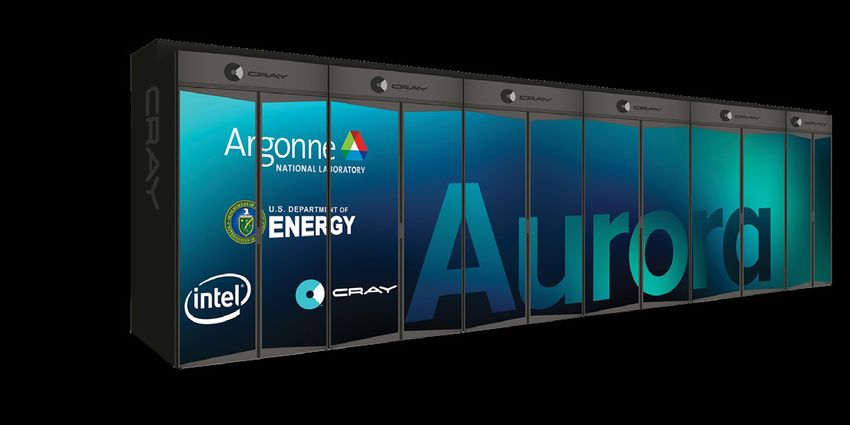
                                                        New ‘Aurora’ Supercomputer Poised to be
                                                        Fastest in U.S. History
                                                        Argonne National Laboratory in Lemont, Illinois, USA will receive
                                                        a new $500 million fully operational computer in 2021. This is a
                                                        joint venture between manufacturers Intel, Cray and the U.S
                                                        Department of Energy as the leading authority. Aurora will be
                                                        among the fastest computers in the world providing scientists key
                                                        insights into climate change and weather activity. The
                                                        supercomputer will cover an area the size of ten tennis courts
                                                        and be able to perform a quintillion calculations per second.
                                                        Source

MeteoSwiss to Improve Weather Forecasting
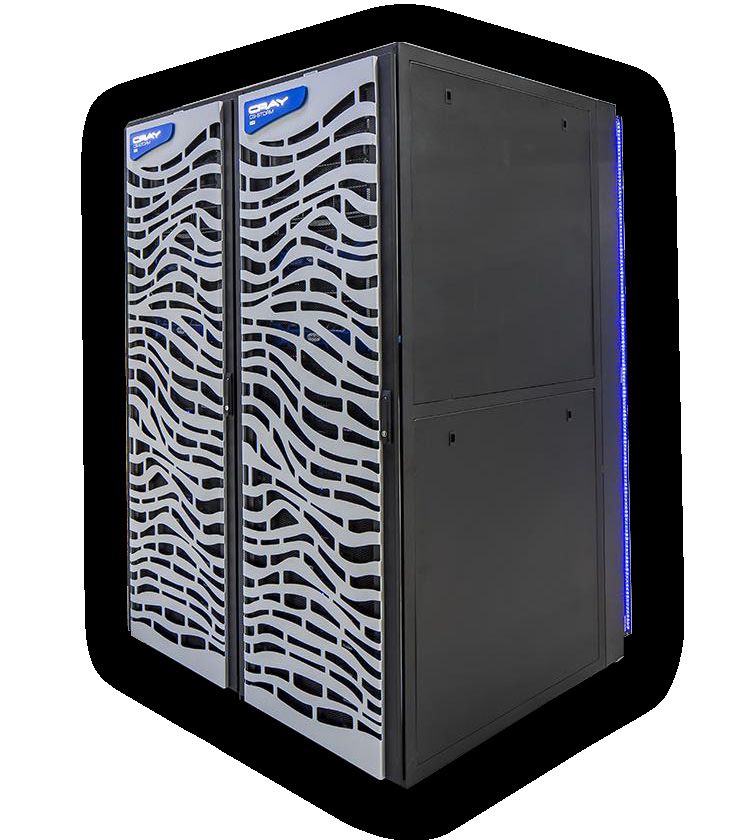
with Cray CS-Storm Supercomputer
The Swiss national supercomputing center (CSCS) will integrate
a new Cray CS-Storm Supercomputer at MeteoSwiss to improve
weather forecast model accuracy. The CS-Storm system uses the
latest graphic processing unit (GPU) accelerators which enable
the organization to produce numerical weather models with a
reduced energy footprint. Configuration includes 18 compute
nodes; each has 8 NVIDIA V100 GPU with 2 Intel Xeon Gold 6134
CPUs and the storage systems are Cray ClusterStor L300. This
next generation supercomputer will be operational in mid-2020.
Source

                                                        Met Office UK New Supercomputer
                                                        The UK government confirmed funding a £1.2 billion
                                                        supercomputer project designed to predict severe weather and
                                                        climate change. The Meteorological Office has management
                                                        over the computer integration phase and functionality to predict
                                                        weather distribution which assists the Environmental agency to
                                                        take the appropriate action. This project is scheduled to start
                                                        in 2022 and be completed by early 2032. The exact technical
                                                        features of the new supercomputers remain undetermined.
                                                        Source

                                               Data Center and Supercomputers Addressing Climate Change                     1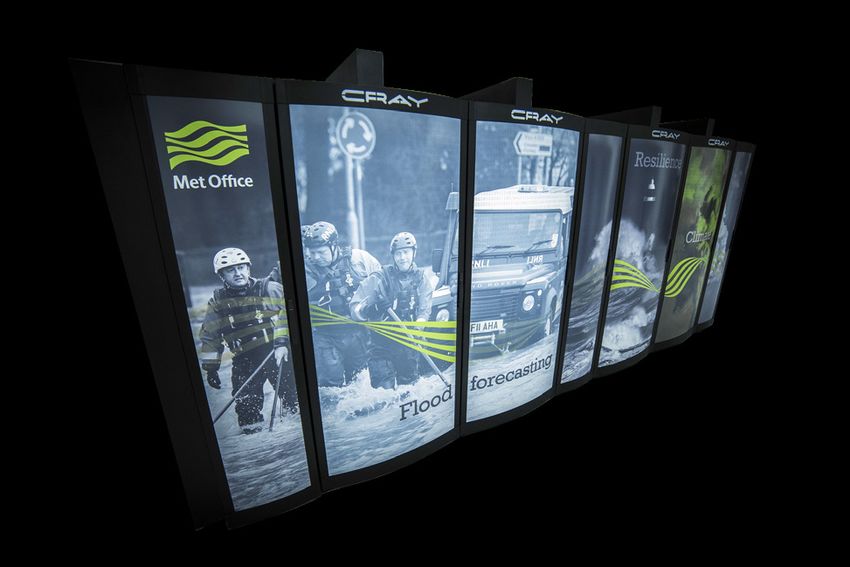
ECMWF Enhance European Weather Prediction
                                        Capabilities with New Supercomputer

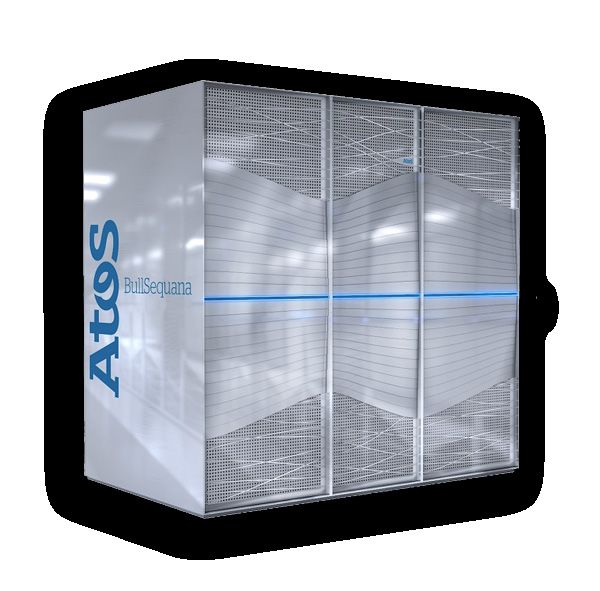
                                        In January 2020 Atos and European Center for medium-range weather forecasts
                                        (ECMWF) signed a contract over a four-year span to integrate a new
                                        high performance computing (HPC) system. The project is a $89 million fund
                                        to upgrade the current computing power to effectively support researchers
                                        in 30 different European countries to improve weather forecasts with greater
                                        accuracy. A data center constructed in Bologna, Italy will host the Bull Sequana
                                        XH2000 supercomputer, which will be fully operational by 2021, as the technical
                                        features are provided by Atos and partner companies. Advanced Micro
                                        Devices: Epyc 7742 (64-core 2.25 GHz) processor, Mellanox: HDR InfiniBand
                                        and Data Directs Networks storage solution.
                                        Source

                                         Australia Pumps Another $70 Million Into
                                         Tier-1 Supercomputing
                                         Pawsey Supercomputing Center located in Perth western Australia received
                                         a AUS$70 million investment from the Australian Government in order to
                                         replace the current flagship supercomputer known as Magnus. Magnus is
                                         among the most advanced super computers in the southern hemisphere. Its
                                         features include 1.1 petaflops (linpack), Cray XC40.

                                        In Canberra capitol territory, the National Computational Infrastructure
                                        National Facility (NCINF) current supercomputer is Raijin which combines
                                        Fujistu-Lenovo system powered by Xeon Broadwell CPUs, Nvidia P100 GPUs
and Xeon Phi KNL processors. Raijin supports climate change researchers in 35 universities.

The New Pawsey Supercomputer features 546 teraflops MWA cluster which comprises 78 nodes, two intel Xeon Gold
6230 processors (both of which operate at 2.1 GHz) and a total number of 40 compute cores. The high-bandwidth
memory is 32 GB in a single NVIDIA V100 which interconnects 384 GB main memory and local NVMe storage 960 GB.
Source

National Weather Service USA
The national weather service (NWS) located in the Washington metro-
politan area uses supercomputers to monitor weather activity with data
gathered from satellites, weather balloons and radar. The most recent
computer upgrade happened in 2018 at the main centers in Reston
Virginia and Orlando Florida. The combined operational power of each
supercomputer is 8.4 petaflops with 40ft long row at both locations.
Built for the interest of public safety the computers can predict weather
hazards in the USA such as hurricanes, tornados and extreme heat waves.
Source

                                        Ottawa Unveils $430 Million Supercomputer for
                                        Weather Forecasts

                                        Canadian Meteorological center upgraded its weather-prediction capabilities
                                        in 2017. Located in Dorval Quebec the systems are designed to forecast weather
                                        patterns which threaten public safety. The computers each contain 270 petabytes
                                        of storage, operating continuously all year, processing 2,444 trillion calculations
                                        per second and installed in two separate data halls with independent electric
                                        supply, cooling and fire suppression systems.
                                        Source

                                              Data Center and Supercomputers Addressing Climate Change                        2
NEC to Deliver Europe’s Fastest Weather
                                              Supercomputer
                                              In mid-2019 the German meteorological service DWD chose Japanese
                                              tech company NEC as the primary supplier of supercomputers. Located
                                              in Offenbach am main Germany to improve weather forecast at a 50
                                              million euros ($56 million) payment. The SX-Aurora Tsubasa model is
                                              scheduled for integration by October 2022 and offers advancement in
                                              weather predictability. Operating system Linux is supplied with the
                                              computer, so new software and develop management are not required.
                                              Source

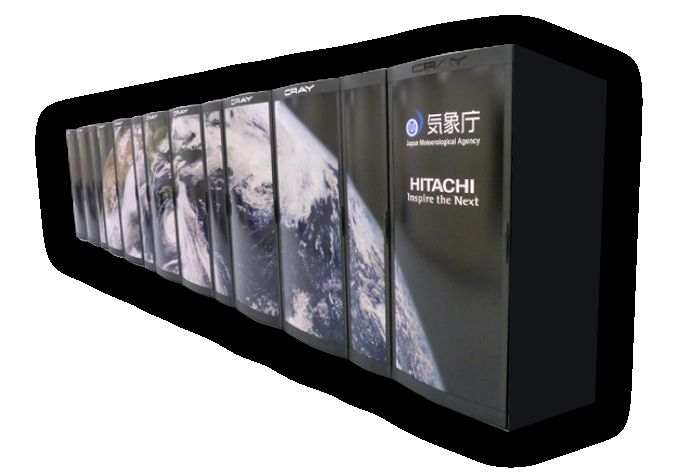
JMA Begins Operation of its 10th-generation
Supercomputer System
Headquartered in Tokyo Japan, the Japan Meteorological Agency
(JMA) activated a new supercomputer system on June 5, 2018.
Numerical calculations can forecast weather and climate change
in a several month prediction to anticipate typhoons or torrential
rainfall. The new model is a Cray XC50 provided by Hitachi with
a 18,166 TFlops performance capability (in theory). New memory
capacity is 528 TBytes which is connected to a magnetic disk of
10,608 TBytes.
Source

                                              NOAA’S National Climate Data Center
                                              The US National Oceanic and Atmosphere Administration announced
                                              in February 2020 that their supercomputer will receive an upgrade
                                              to enhance computer capacity, storage space and connection speed
                                              scheduled for completion in 2022. Specifically designed to improve
                                              the weather and climate operational system which allows level data
                                              exchange between forecast centers both domestic and international.
                                              These two new supercomputers are designed by Cray with primary and
                                              backup functionality, located in Manassas, Virginia and Phoenix Arizona.
                                              NOAA’s total supercomputing capacity for predication and research will
                                              increase to 40 petaflops.
                                              Source

DKRZ – Germany’s Climate Computing Center
The German Climate Computing Center (DKRZ) is the central
national service facility for climate and earth system research.
The organization maintains software to improve the climate
modelling infrastructure at the University of Hamburg and is
funded by the federal ministry of education and research. DKRZ
uses climate models, climate simulations and climate data to
assist scientists in making estimations on weather predictability.
The supercomputer is model HLRE-3 “Mistral” for Earth System
Research 3 which is a combination of computer components
manufactured by Atos/Bull. It features 3,300 computer nodes
bullx DLC 700 and over 100,000 processing cores, 3.6 PetaFLOPS
computing power. Main memory is approximately 266 terabytes
and two Maxwell GPUs.
Source

                                               Data Center and Supercomputers Addressing Climate Change                  3
You can also read


