Data mining 7 Wonders, the board game - SBGames
←
→
Page content transcription
If your browser does not render page correctly, please read the page content below
SBC – Proceedings of SBGames 2019 — ISSN: 2179-2259                                              Computing Track – Short Papers

                                    Data mining 7 Wonders, the board game

                          Joaquim Assunção, Gabriel Pereira, Júlia Acosta, Rafael Vales, Lana Rossato
                                               Department of Applied Computing
                                        Universidade Federal de Santa Maria (UFSM)
                                                      Santa Maria, Brazil
                                 {joaquim, ggpereira, jgacosta, rvales, lbrossato}@inf.ufsm.br

   Abstract—Board games can be used as objects of study for           7 Wonders. Third, it is based on the match data of the best
artificial intelligence (AI), as their rules are well defined and     players from a large community of players.
good players can challenge ordinary AI. However, unlike Chess
or Go, most board games are not deterministic, as they rely on           Although our contribution might become evident for the
dice or cards. The stochastic factor is a challenge as a supervised   unique aspects of the work, we highlight a few related works
learner should learn rules that lead to victory. These rules should   that have a similar approach in some aspect.
be, ultimately, knowledge extracted from data. In this article, we       Regarding card games, Poker, for instance, a few works use
describe a knowledge discovery and data mining process (KDD)
for the board game 7 Wonders. From data selection to analysis         Case-based reasoning (CBR) to improve the bot performance
and evaluation, we mined the data to get the implications of          against humans, which can be compared to ordinary human
playing specific types of cards in specific situations.               players [2], [3]. CBR, however, requires a large number of
  Keywords-Data mining, boardgames, 7Wonders                          cases and a considerable modeling effort and initial knowl-
                                                                      edge, which might impact on the performance if the model
                                                                      has to be changed [4]. When the initial knowledge is a crucial
                       I. I NTRODUCTION
                                                                      factor, and there are no game logs, a data mining process
   The state-of-the-art in artificial intelligence for games are      can be useful to acquire the initial knowledge for another
using reinforcement learning supported by an initial supervised       technique.
learning step [1]. Such combination of techniques means that             Siqueira et al., [5] and Odierna et al., [6] used data mining
even deep learning models need a first step of supervised learn-      to analyze and identify patterns in the players’ behavior, as
ing, so the model can learn the essential rules for a complex         well as to classify these behaviors and players. Siqueira et al.,
game. Furthermore, deep learning models often heavily relies          worked on mining the game World of Warcraft. They used
on GPUs and are time consuming, which makes the use of an             methods clustering and regression models to identify patterns
initial supervised learning useful for practical purposes.            of players in order to indicate if the player will stop playing
   In a game of checkers, chess, or go, we have a relatively          in the near future.
simple structure and tons of logs to be learned from an algo-            Oliveira et. al., [7] worked to form good team compositions
rithm. In more complex electronic games, such as StarCraftII,         to increase the victory rate in the game League of Legends.
we have vast amouts of data and we can use bots to play               The data were collected from professional matches, observing
thousands of matches in a few days [1]. However, for many             the choice of characters and the outcome of the game. They
other board and card games, we do not have enough data for            generated a tree with several combinations of possible good
fed complex models. Furthermore, we also lack a fast forward          compositions. By using linear regression, they identified the
machine vs machine for deep learning training. In fact, we do         team with a higher chance of winning, helping the player to put
not even have prior information for a winning strategy or, in         together a composition that increases a team overall chances
many cases, even a game log (hand by hand). For many games,           of winning.
we only have match statistics, which describes a match as a              Robilliard et. al., [8] wrote about the Monte-Carlo tree
whole (not action by action).                                         search algorithm for creating an AI for the 7 Wonders game.
   Considering such scenario, in this work we concern with a          They implemented using a Monte-Carlo tree search with
step prior to the supervised learning. We focus on data mining        susceptible levels, in which the nodes correspond to the possi-
game data to get the basic knowledge for a winning strategy,          bilities of plays. A second AI was implemented deterministic,
which can be further fed as a class for a supervised learner.         using fixed rules. In the end, they compared the two AIs,
                                                                      showing that the first had better results.
                      II. R ELATED W ORK
                                                                         We use data mining process to achieve winning patterns
   There is a myriad of works that uses AI to play games.             from players’ behavior (like in [5], [6]), using the best players,
However, our work distinguishes by a couple of reasons. First,        considering different amounts and combinations of players per
it is for data mining for a specific board game, 7 Wonders,           table (Similar to [7]) of 7 Wonders. However, unlike Robilliard
with a set of restrictions described in Section I. Second, as         et. al., [8] we collected prior knowledge, for the creation of a
far as we know, it is the first work to get association rules for     bot, through data mining association rules.

 XVIII SBGames – Rio de Janeiro – RJ – Brazil, October 28th – 31th, 2019                                                          583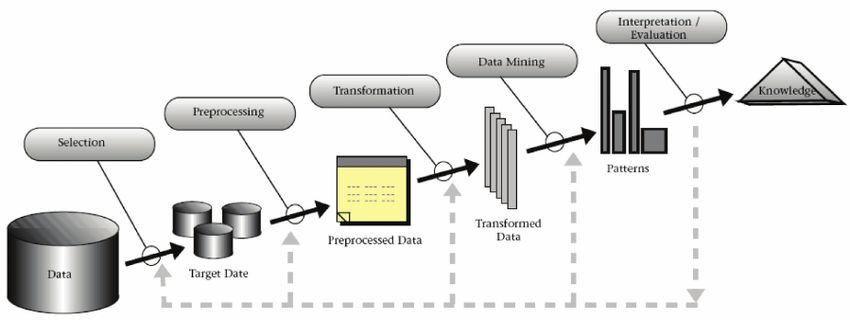
SBC – Proceedings of SBGames 2019 — ISSN: 2179-2259                                                          Computing Track – Short Papers

                   III. 7 W ONDERS OVERVIEW                                   i.e., use this data as a class for a learner algorithm to learn
   7 Wonders is a board game where 3 to 7 players receive a                   the best card to play.
board representing one of the seven Wonders of the ancient
world. The game is split into three ages. In each era, cards
are distributed. These cards are divided into seven types: civil,
scientific, commercial and military structures, raw materials,
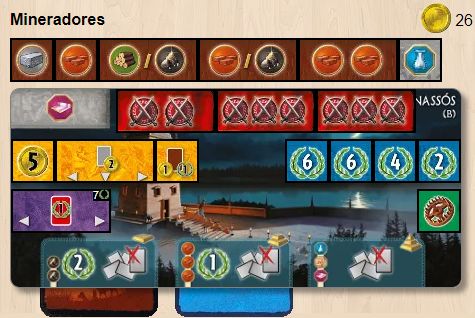
manufactured goods, and guilds. Figure 1 displays how is the
board of a player during a match from Board Game Arena
(BGA) 1 .

                                                                              Figure 2.    Workflow to generate decisions for the supervised learning
                                                                              algorithm.

                                                                                 To define a minimum number of rules and categories,
                                                                              we created a series of questions regarding the game. These
                                                                              questions were based on a few analysis made by experienced
                                                                              players and the board game community, for instance, the
                                                                              boardgamegeek forums 3 .
                                                                                 The next subsections illustrate our data mining process,
Figure 1. Mausoleum of Halicarnassus’ board along with the cards played.      from data selection to evaluation, which was based on the
A screenshot, from BGA, that shows only the part of the cards that matters;   KDD process. Figure 3 illustrates the process.
productions, shields, commerce, points, etc.

   Civil, scientific and guild cards generate victory points,
commercial cards provide coins or advantages in purchases
in the commerce, and military cards grant shields for con-
flicts. Cards related to raw materials and manufactured goods
generate the necessary resources for the construction of other
structures.
   Like most card games, 7 Wonders is a stochastic strategic
game in which players deals with other players action. After
each age, the players have to ponder or change their strate-                   Figure 3.   Knowledge discovery process, illustrated by Fayyad et al., [9]
gies based on the situation in the first age. In a stochastic
formalism, considering the computational cost, the different
types and values for every combination of cards could generate                A. Data selection
millions of states. At the end of the third age, the victory points              Our data were collected from Board Game Arena (BGA) 1 ,
of each player are counted. Detailed rules can be found in the                a well-known website that has many online implementations
game manual 2 .                                                               of board games, among them, 7 Wonders, which have a large
                                                                              number of games played daily. At the end of each match, the
            IV. M INING 7 W ONDERS MATCH LOGS                                 site provides statistics of the game regarding the actions of
   Since our game logs correspond to the final results, we                    each player. There are 25 different attributes in the statistics,
do not have the information hand by hand. Thus, we need                       such as victories points from each type of cards, the amount
to find useful information using only the data corresponding                  of each type of cards played, the number of stages built of
to the final statistics of each match. Figure 2 shows the                     wonder, etc.
steps to extract information regarding the cards that make the                   In order to extract and format the data, we implemented a
difference for a player victory. We can use these pieces of                   script that generates a CSV file. We pick the best player in
information as an input for a supervised learning approach;                   the BGA ranking as a source for collecting the data. Thus,
                                                                              we have the results belonging to the best players in the entire
    1 www.boardgamearena.com
   2 www.7wonders.net/wp-content/uploads/2017/06/7WONDERS                        3 https://boardgamegeek.com/thread/691370/
RULES US.pdf                                                                  some-complex-strategies-7-wonders

 XVIII SBGames – Rio de Janeiro – RJ – Brazil, October 28th – 31th, 2019                                                                            584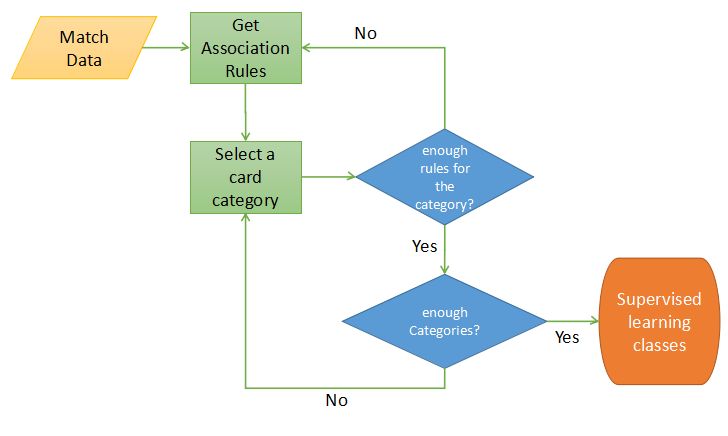
SBC – Proceedings of SBGames 2019 — ISSN: 2179-2259                                                    Computing Track – Short Papers

platform. Since the game configuration is different depending             cards played, above the average, the following rule was caught:
on the number of players, the data was separated into five                military → victory with a support of 0.26 and confidence of
datasets, one for each number of players, with 50 matches                 0.54. Furthermore, among the winners, 78% of them launched
each 4 .                                                                  a high number of military cards. victory → military with a
                                                                          support of 0.26 and confidence of 0.78. This demonstrates
B. Pre-processing and Transformation
                                                                          that investing in military structures, in a 3-players game, may
   Some players leave the game before it is finished, which               be one of the main factors leading to victory, as the player
prevents its sequence. When such interruption occurs in the               directly confronts his two opponents. This may seem obvious,
BGA, the game is canceled and a tie is declared between all the           yet it is not the case analyzing statistics from ordinary players
other players. However it is kept in the game history, leading to         (the ones not well ranked in BGA).
incomplete and incoherent statistics. Since these data are not               The confidence of this rule falls as the number of players
relevant, we verified all the datasets, removing the matches              increases. Hence, more players in the table, the less important
that finished before the time. Thus remaining only complete               is the use of the military cards, as the players are not directly
games with consistent data to be analyzed.                                confronting each other.
   For the use of the Apriori algorithm, the data was trans-
formed into presence matrices. To fill each matrix, and use               B. Coins should to be spent
different amount of cards, we defined parameters such as a                                              TABLE I
arithmetic mean, quantile, as well as fixed values. Thus, values                              M ORE COINS THAN THE AVERAGE
that are greater or equal to a parameter were converted to one,
                                                                            Players       LHS           RHS      Support       Confidence     Lift
otherwise it was assigned 0.
                                                                            3 players     treasure=1    defeat      0.29             0.64    0.97
C. Getting association rules                                                4 players     treasure=1    defeat      0.21             0.71    0.89
                                                                            5 players     treasure=1    defeat      0.25             0.78    0.94
   Using the presence matrices, we applied the APRIORI                      6 players     treasure=1    defeat      0.31             0.71    0.95
algorithm to generate the association rules. The algorithm                  7 players     treasure=1    defeat      0.39             0.85    0.99
works from two given parameters: the minimum support and
the minimum confidence. Support that an attribute, or a set of               Table I shows us that have too much money is bad in
attributes, A implies in an attribute, or a set of attributes, B,         the game. Considering the players’ average, for those who
is given by: Sup(A ⇒ B) = P (B|A) = total(T                               accumulate more than half of the total value (treasure), they
                                                  ) . Confidence
                                             A∩B

that A ⇒ B is given by: A [10]. A and B are also
                                A∩B                                       tend to lose. This is especially true for a seven-player game.
commonly represented as Left Hand Side (LHS) and Right                    The obvious reason is that every 3 coins score 1 point. The not
Hand Side (RHS).                                                          so obvious reason is that fewer players, and large amounts of
   We generated two larger sets of rules, from different ma-              coins, implies in debt for the other players (point transferring),
trices, one based on generated symbols, for instance, military            mitigating the effect. The balance is subtle, but it is more
cards may hold one to three shields; and the other based on the           advantageous to spend with resources that are base for building
number of cards. In each of those sets, and for each number of            cards that grant more victory points at the end of the game.
players, we used as a discrimination metric the constants one             C. Trading leads to money
and two, the first quantile, the average, and the third quantile
were chosen as parameters for analysis. The constants are                                              TABLE II
                                                                                        M ORE COMMERCIAL CARDS THAN THE AVERAGE
merely for mark the use of a card, one or two times, where
the average and the quantiles seek to obtain patterns on the                Players      LHS            RHS          Support    Confidence    Lift
amount of use for each card or type of cards. For instance,                 3 players    commercial=1   treasure=1      0.32          0.65   1.46
                                                                            7 players    commercial=1   treasure=1      0.26          0.65   1.42
if the average number of yellow cards was 3, the presence
matrix will generate a 1 for every player in a match in which                Table II shows strong rules regarding the relation between
he/she used more than 3 cards. Using these categories, we got             commercial structures and large amount of coins. Even the
a total of 5796 rules with a support of 50%. However, it was              confidence was a match of 65% for both 3 and 7 players,
not enough for some categories; for instance, the third quartile          which indicates that the commercial effects remains strong
for 3 players got only 10 rules. Hence, we kept lowering the              independent of the number of players. This rule is bonded
support until a set of interesting rules was reached, ending at           with the previous one, which is not a good strategy since
20%.                                                                      coins above the average, in most cases, leads to defeat, as seen
                            V. R ESULTS                                   in Section V-B. Therefore, commercial structures should be
A. If a war is inevitable, face it or perish                              played in moderation, trying to stay in the absolute minimum
                                                                          for guarantee enough resources.
  Considering victories in 3-player matches, a pattern emerges               These rules become obvious when we analyze the points
with the use of military cards. For the number of military                generated by the cards in the last age; therefore, depending to
   4 Our data and scripts are publicly available at https://github.com/   the height of the game, may not help as it takes a turn that
dmag-ufsm/7wondersDataMinning                                             should be used to play stronger cards.

 XVIII SBGames – Rio de Janeiro – RJ – Brazil, October 28th – 31th, 2019                                                                     585
SBC – Proceedings of SBGames 2019 — ISSN: 2179-2259 Computing Track – Short Papers
D. A science career demands sacrifices slightly stronger on an odd number of players. This can be
explained due to the distribution of the cards.
TABLE III
M ORE SCIENCE CARDS THAN THE AVERAGE TABLE VI
R AW MATERIAL AND COMMERCE CONSIDERING THE AVERAGE
Players LHS RHS Support Confidence Lift
3 players scientific=1 raw materials=0 0.25 0.63 1.41 Players LHS RHS Support Confidence Lift
3 players scientific=1 military=0 0.30 0.77 1.48 3 players raw materials=0 commercial=1 0.23 0.51 1.16
3 players scientific=1 commercial=0 0.26 0.67 1.20 5 players raw materials=0 commercial=1 0.25 0.62 1.12
3 players scientific=1 civilian=0 0.32 0.81 1.32 7 players raw materials=0 commercial=1 0.34 0.69 1.12
3 players scientific=1 guild=0 0.31 0.79 1.18 3 players raw materials=1 commercial=0 0.34 0.62 1.10
5 players raw materials=1 commercial=0 0.29 0.49 1.10
7 players raw materials=1 commercial=0 0.23 0.45 1.19
Science cards are known for their cumulative property, 3 players manufacture=1 commercial=0 0.43 0.67 1.20
5 players manufacture=1 commercial=0 0.20 0.59 1.32
where a combination of equal symbols scores 2n if n > 1,
1 otherwise. Also, each set of all three symbols gives +7
points. These properties imply that a player going for a science VI. F INAL R EMARKS
strategy should take at least 3 of a kind to take advantage
This work described a KDD process, focused on getting as-
of science cards. Our rules detected that usually, successful
sociation rules for the board game 7 Wonders. After extracting
players, in a three player game, tend to sacrifice everything else
matches from the best-ranked players, we were able to extract
to go to science. The necessary production and raw material
interesting and previously unknown rules. As shown in Section
for playing the cards is replaced with the cards chain and
V, such rules comprise different types of cards, with a different
commerce; even when that means sell cards for 3 coins.
number of players, allowing a strategic advantage for most 7
Table III shows these rules, which are the ones with the
Wonders scenarios. As a work in progress, our next step is to
highest confidence in our sets. An exception to this rule is
create an AI using a supervised learning algorithm, based on
the manufactured goods, shown in Table IV. This is expected
the set of the strongest rules we collected.
since the first scientific cards lead to the others and, each one
cost one different manufactured good. This holds true for the R EFERENCES
matches with 3 to 7 players, but the strongest rules were found [1] O. Vinyals, T. Ewalds, S. Bartunov, P. Georgiev, A. S. Vezhnevets,
in 3 and 6 players matches. M. Yeo, A. Makhzani, H. Küttler, J. Agapiou, J. Schrittwieser, J. Quan,
S. Gaffney, S. Petersen, K. Simonyan, T. Schaul, H. van Hasselt, D. Sil-
TABLE IV ver, T. P. Lillicrap, K. Calderone, P. Keet, A. Brunasso, D. Lawrence,
M ORE SCIENCE AND MANUFACTURED GOODS THAN THE AVERAGE A. Ekermo, J. Repp, and R. Tsing, “Starcraft II: A new challenge for
reinforcement learning,” CoRR, vol. abs/1708.04782, 2017.
Players LHS RHS Support Confidence Lift [2] J. Rubin and I. Watson, “Case-based strategies in computer poker,” AI
3 players scientific=1 manufacture=1 0.30 0.76 1.19 Commun., vol. 25, pp. 19–48, Jan. 2012.
6 players scientific=1 manufacture=1 0.25 0.71 1.07 [3] I. Watson and J. Rubin, “Casper: A case-based poker-bot,” in AI 2008:
Advances in Artificial Intelligence (W. Wobcke and M. Zhang, eds.),
(Berlin, Heidelberg), pp. 594–600, Springer Berlin Heidelberg, 2008.
E. Use woods for buildings [4] P. Reuss, M. Dick, W. Termath, and K.-D. Althoff, “Case-based rea-
soning: potential benefits and limitations for documenting of stories in
Table V describes the action of overproduction, i.e., players organizations,” Zeitschrift für Arbeitswissenschaft, vol. 71, pp. 252–258,
that create too many raw materials (above the third quantile) Dec 2017.
[5] E. S. Siqueira, C. D. Castanho, G. N. Rodrigues, and R. P. Jacobi, “A
tend to lose. Both the support and confidence are strong for data analysis of player in world of warcraft using game data mining,”
these rules. Players performing such actions to guarantee the in 2017 16th Brazilian Symposium on Computer Games and Digital
best cards or incoming money on the trade. However, this Entertainment (SBGames), pp. 1–9, IEEE, 2017.
[6] B. A. Odierna and I. F. Silveira, “Player game data mining for player
strategy does not pay off because it is better to pay a few classification,” in Proceedings of SBGames, 2018.
coins for the best cards than lose two or three cards to create [7] V. da Costa Oliveira, B. J. Placides, M. d. F. O. Baffa, and A. F.
raw material. da Veiga Machado, “A hybrid approach to build automatic team com-
position in league of legends,” in Proceedings of SBGames, 2017.
TABLE V [8] D. Robilliard, C. Fonlupt, and F. Teytaud, “Monte-carlo tree search for
R AW MATERIAL ABOVE THE THIRD QUANTILE the game of “7 wonders”,” in Workshop on Computer Games, pp. 64–77,
Springer, 2014.
Players LHS RHS Support Confidence Lift [9] U. Fayyad, G. Piatetsky-Shapiro, and P. Smyth, “The kdd process for
extracting useful knowledge from volumes of data,” Communications of
3 players raw materials=1 defeat 0.38 0.71 1.06
the ACM, vol. 39, no. 11, pp. 27–34, 1996.
5 players raw materials=1 defeat 0.49 0.83 1.00
[10] C. Kaur, “Association rule mining using apriori algorithm: a survey,”
7 players raw materials=1 defeat 0.43 0.86 1.00
International Journal of Advanced Research in Computer Engineering
& Technology (IJARCET), vol. 2, no. 6, 2013.
Another case is the underproduction, which the best players
know well and solve this problem with commerce (see Table
VI). Otherwise, when investing in materials (near the average),
players do not invest heavily on commerce, i.e., an average
production of raw material implies in low use of commerce.
These rules hold true for all combination of players but were
XVIII SBGames – Rio de Janeiro – RJ – Brazil, October 28th – 31th, 2019 586You can also read


