DIGITAL SLOVENIA 2020 - DEVELOPMENT STRATEGY FOR THE INFORMATION SOCIETY UNTIL 2020 - Gov.si
←
→
Page content transcription
If your browser does not render page correctly, please read the page content below
REPUBLIC OF SLOVENIA

DIGITAL SLOVENIA 2020 –
DEVELOPMENT
STRATEGY FOR THE
INFORMATION SOCIETY
UNTIL 2020
DIGITALISATION OF SLOVENIA BY INTENSE AND
INNOVATIVNE USE OF ICT AND INTERNET IN ALL
SEGMENTS OF SOCIETY

Development strategy for the information society until 2020   1
Document Information
Document Title DIGITAL SLOVENIA 2020 - Development strategy for the information
society until 2020
Document Date March 2016
Participants in Ministry of Labour, Family, Social Affairs and Equal Opportunities,
document Ministry of Finance,
preparation
Ministry of Infrastructure,
The Ministry of Education, Science, and Sport
Ministry of Public Administration,
Ministry of Culture,
Ministry of Agriculture, Forestry and Food,
Ministry of the Interior,
Ministry of Defence,
Ministry of the Environment and Spatial Planning,
Ministry of Justice,
Ministry of Health,
Ministry of Foreign Affairs,
Government Office of the Republic of Slovenia for Development and
European Cohesion Policy.Table of Contents
1 Introduction..................................................................................................................................... 4
2 Abstract ........................................................................................................................................... 6
3 Analysis of the National Context ..................................................................................................... 7
3.1 General Awareness of the Importance of the Information Society ........................................ 7
3.2 Indicators of Development of Information and Digital Society .............................................. 7
3.3 SWOT Analysis of the National Context .................................................................................. 9
4 Objectives ...................................................................................................................................... 12
5 Development Principles of Operation ........................................................................................... 14
5.1 The Internet as a Strategic Development Opportunity of the Digital Society ...................... 14
5.1.1 Focus on the internet in Drafting Development Measures........................................... 14
5.1.2 Protection of Openness and Neutrality of the internet ................................................ 16
5.2 Seeking Synergies .................................................................................................................. 17
5.3 Management of Copyright in Digital Environment ............................................................... 19
5.4 Trust in Cyberspace ............................................................................................................... 20
5.5 Interoperability and Standards ............................................................................................. 21
5.6 Use of Slovenian and the Preservation of Cultural Identity .................................................. 22
6 Priority Areas of Measures ............................................................................................................ 24
6.1 Broadband and Other Electronic Communications Infrastructure ....................................... 25
6.1.1 Importance of the Field ................................................................................................. 25
6.1.2 Strategic Objectives ....................................................................................................... 26
6.1.3 Measures Envisaged ...................................................................................................... 26
6.2 Innovative data-driven services ............................................................................................ 28
6.2.1 Importance of the Field ................................................................................................. 28
6.2.2 Strategic Objectives ....................................................................................................... 30
6.2.3 Measures Envisaged ...................................................................................................... 30
6.3 Digital Entrepreneurship ....................................................................................................... 33
6.3.1 Importance of the Field ................................................................................................. 33
6.3.2 Strategic Objectives ....................................................................................................... 34
6.3.3 Measures Envisaged ...................................................................................................... 35
6.4 Cyber Security........................................................................................................................ 38
6.4.1 Importance of the Field ................................................................................................. 38
6.4.2 Strategic Objective ........................................................................................................ 38
6.4.3 Measures Envisaged ...................................................................................................... 38
DIGITAL SLOVENIA 2020 - Development strategy for the information society until 2020 16.5 Inclusive Digital Society ......................................................................................................... 39
6.5.1 Importance of the Field ................................................................................................. 39
6.5.2 Strategic Objectives ....................................................................................................... 41
6.5.3 Measures Envisaged ...................................................................................................... 41
7 Strategy Implementation Management ........................................................................................ 44
7.1 Monitoring Strategy Implementation Indicators .................................................................. 45
7.2 Strategy Implementation Management ................................................................................ 48
7.3 Competencies of Implementing Structure ............................................................................ 50
8 Process of Preparation of Strategy and Inclusion of Stakeholders ............................................... 51
9 Annexes ......................................................................................................................................... 53
9.1 Annex 1: List of abbreviations ............................................................................................... 53
9.2 Annex 2: Statistics of Development of the Information Society in Slovenia......................... 56
9.2.1 Digital Economy and Society Index ............................................................................... 56
9.2.2 Infrastructure ................................................................................................................ 57
9.2.3 General Use of the Internet .......................................................................................... 58
9.2.4 Use of Mobile Internet .................................................................................................. 60
9.2.5 Digital Literacy and ICT Skills ......................................................................................... 60
9.2.6 E-trade ........................................................................................................................... 62
9.2.7 E-Government ............................................................................................................... 63
9.2.8 Purchase of Cloud Computing Services ......................................................................... 64
9.2.9 ICT Sector in Slovenia .................................................................................................... 65
9.3 Annex 3 Analysis of the National Context ............................................................................. 67
9.3.1 Broadband Infrastructure .............................................................................................. 67
9.3.2 Innovative Data-driven Services .................................................................................... 67
9.3.3 Digital Entrepreneurship ............................................................................................... 77
9.3.4 Cyber Security................................................................................................................ 79
9.3.5 Inclusive Digital Society ................................................................................................. 82
9.4 Annex 4: List of indicators for measuring the success of DAE .............................................. 84
2 DIGITAL SLOVENIA 2020 - Development strategy for the information society until 2020TABLE OF FIGURES Figure 2: Indicators for monitoring the achievement of general objectives of the strategy ................ 47 Figure 3: Digital Economy and Society Index 2015, EU28 (source: EC) ................................................. 56 Figure 4: Digital Economy and Society Index 2015, Slovenia (source: EC) ............................................ 57 Figure 5: Internet access by households, Slovenia (Source: Eurostat).................................................. 59 Figure 6: Persons aged 16–74 who accessed the internet through a portable device away from home or work, EU, 2014 (Source: Eurostat) .................................................................................................... 60 Figure 7: Distribution of ICT skills in persons aged 16 to 74, EU, 2012 (Source: EC – Digital Agenda Scoreboard) ........................................................................................................................................... 61 Figure 8: Persons aged 16–74 who made online purchases within the last 12 months, EU, 2014 (Source: Eurostat) .................................................................................................................................. 62 Figure 9: Persons aged 55–64 who used websites of public institutions within the last 12 months (Source: Eurostat) .................................................................................................................................. 64 Figure 10: Why enterprises with at least 10 employees do not purchase cloud computing services, by type of factors, Slovenia, 2014 (Source: SORS) ..................................................................................... 65 Figure 11: Design of national computer cloud - NCC (Source: MPA) .................................................... 71 Figure 12: Number of incidents addressed per year (source: SI-CERT) ................................................ 81 Figure 13: Number of incidents by categories (Source: SI-CERT) .......................................................... 81 DIGITAL SLOVENIA 2020 - Development strategy for the information society until 2020 3
1     Introduction
In 2010, the European Commission (EC) adopted the Europe 20201 strategy designed to help the
economy of the European Union (EU) escape the crisis and prepare for the challenges of the next
decade. The baseline is that the EU needs thorough changes to preserve its competitiveness and
standard of living. The strategy’s principal objective is to turn the EU’s economy into one that is smart,
sustainable and inclusive. It sets measurable overall objectives that the Member States (MS), in
tailoring the strategy to their particular situation, should translate into their national targets and
trajectories.

The Europe 2020 Strategy contains seven flagship initiatives to catalyse progress under priority topics.
These initiatives include the Digital Agenda for Europe2 (DAE3), which concerns the key role of
information and communication technologies (ICT) in the efforts to achieve strategic objectives. The
general objective of the DAE is to ensure that the uniform digital market based on fast and ultrafast
internet connections and interoperable applications results in lasting economic and social advantages.

The DAE foresees that the Member States will adopt their own strategic frameworks to achieve the
DAE objectives. This framework can be set up by a single comprehensive strategic document or by
several coordinated strategies. Due to the adverse economic conditions and rapidly changing
development factors since the implementation of the DAE, Slovenia has not yet fully taken up the
development opportunities offered by ICT. The efforts to place the development of an information
society among development priorities have been unsuccessful, so promotional activities are weak,
incoherent, and lacking development resources and the necessary support. The delays in this area
unavoidably cause negative consequences in several other development fields; above all, Slovenia
loses competitiveness in terms of several standards compared to other EU Member States.

The implementation of DAE showed weaknesses and the need for the renewal of strategic orientations
at the EU level. The current fragmentation of digital markets across the Member States and their small
size in comparison with domestic markets prevents European economies from creating the economy
of scale, increases the costs of appearance in these markets, prolongs the time for market entry,
hinders business cooperation, the flow of ideas and innovation. At the same time these limits make
the EU as a business environment less and less attractive for global multinational enterprises. In view
of the prominent horizontal effect of digitisation, negative consequences refer to most industrial
sectors and not only to the ICT sector, as well as to European society as a whole, of course. In order to
eliminate system deficiencies and accelerate development in this field, the EC published the Digital
Single Market Strategy4 for Europe in 2015 as a sequel to DAE; the document drafts the measures for
a more efficient use of digital technologies to help the population and enterprises use the
opportunities enabled by these technologies. In the context of digital space - regardless of whether we
mean the private or business aspect - the key strategic task is to abolish restrictions that prevent the
creation of a uniform European digital market. Since the development of the digital society has not
proved equally successful in all EU countries and since geographic and national borders remain an
obstacle to the creation of a fully functioning digital market, measures for a more balanced

1Europe   2020 - A strategy for smart, sustainable and inclusive growth - COM(2010)2020.
2Digital Agenda for Europe – COM(2010)245.
3 http://ec.europa.eu/digital-agenda/
4 http://europa.eu/rapid/press-release_IP-15-4653_sl.htm

     4             DIGITAL SLOVENIA 2020 - Development strategy for the information society until 2020
development of the digital society (infrastructure, digital services and content, digital knowledge and skills) will have to be implemented and legislation will have to be aligned. This will create a single European digital space (market), which will help enterprises simplify operations, lower their costs for participating in the single market, improve the opportunities for research, development and innovation, and provide equal opportunities for citizens' access to digital services, content and products on the part of users. Uniform rules of operation, security and protection are also expected to increase users’ trust in digital technologies and services. The creation of the future European digital single market and single European digital space, respectively, is expected to bring a number of advantages and opportunities to the economy and society, but will also raise issues of the readiness of Slovenian stakeholders for the new European digital environment without borders. At the beginning of a new development period that coincides with the next multiannual financial period of the allocation of funds from the European Structural Funds (2014-2020), it is also high time for Slovenia to adopt a strategic framework for the development of the information society that will outline the direction of development, stimulate development activities, and envisage the provision of development resources. The overall objectives are equal inclusion in the European digital space and the creation of digital growth. Resources should be earmarked for measures consistent with the overall strategic objectives that will boost cross-sectoral synergies, enjoy broad support, be feasible and yield long-term results as soon as possible. The adoption of a new strategic framework is also a condition for the allocation and use of structural resources of ERDF in the multiannual financial period 2014-2020. In order to co-finance measures for the information society, the EC requires the adoption of the National strategic framework for digital growth and investment in the construction of broadband networks, and the adoption of the Plan for developing next-generation networks. Within these frameworks, Slovenia adopts the DIGITAL SLOVENIA 2020 - Development strategy for the information society until 2020 as well as the associated strategic documents Cyber Security Strategy and Plan for Developing Next-Generation Networks by 2020. DIGITAL SLOVENIA 2020 - Development strategy for the information society until 2020 is an umbrella strategy determining the key strategic development orientations and uniting the mentioned strategies in a uniform strategic development framework. At the same time, the strategy is one of three key strategies in this area (in addition to the RISS - Research and Innovation Strategy of Slovenia, and SIP - Slovenian Industrial Policy), which provide guidelines for the creation of innovative knowledge-based society and which are united in the Strategy of Smart Specialisation (SSS) as a platform for focused investment in priority areas. Since the scope of the information society and ICT is horizontally included in the SSS across vertical content areas, the Development Strategy for the Information Society until 2020 specifies strategic directions of the digitisation of society and business, which will form the foundations of development projects by priority areas of the SSS. It foresees measures for harnessing the social and economic potential of ICT and the internet for digital growth, focusing on digital infrastructure, intense use of ICT and the internet, cyber security and an inclusive information society. Strategy implementation will be organised systematically, with strategic and operational links to other strategies and with the integration of stakeholders through the Slovenian Digital Coalition. In developing area-specific strategies, Slovenia will ensure compliance with the DIGITAL SLOVENIA 2020 strategy and other associated strategies. DIGITAL SLOVENIA 2020 - Development strategy for the information society until 2020 5
2    Abstract
Slovenia adopts the DIGITAL SLOVENIA 2020 - Development strategy for the information society until
2020 as well as associated strategic documents Cyber Security Strategy and Plan for Developing Next-
Generation Networks by 2020. DIGITAL SLOVENIA 2020 - Development strategy for the information
society until 2020 is an umbrella strategy determining the key strategic development orientations and
uniting the strategies in a uniform strategic development framework.

The DIGITAL SLOVENIA strategy is a commitment for a faster development of the digital society and
the use of opportunities enabled by information and communication technologies and the internet for
general economic and social benefits. Along with the strategies from its scope, it envisages measures
to tackle the major development gaps in the field of digital society: faster development of digital
entrepreneurship, increased competitiveness of the ICT industry, overall digitisation, development of
digital infrastructure, construction of broadband infrastructure, strengthened cybersecurity and the
development of an inclusive information society. It foresees priority investment in the digitisation of
entrepreneurship, innovative data-driven economy and development, and the use of the internet and,
in these frameworks, in the research and development of technologies of the internet of things, cloud
computing, big data and mobile technologies. A new system of electronic identities should be
established in good time; basically intended for the public sector, it enables easy cross-border
operation and equal participation of Slovenian enterprises in the European single digital market. There
is a need for the systemic regulation of providing a high level of cyber security and improving financial,
human and technical resources for key stakeholders. A series of measures must be implemented to
eliminate the largest development lags in the digital society and set up appropriate digital
infrastructure for the equal participation of Slovenian stakeholders in the single European digital space.
The strategy envisages the establishment of the Slovenian Digital Coalition to unite stakeholders
developing the digital economy and establishing digital jobs, as well as other stakeholders of the
digitisation of Slovenia. Working with the private sector, NGOs and other stakeholders, measures will
be put into place for the digitisation of entrepreneurship and society, for increased overall awareness
of the developmental importance of ICT and the internet, improved digital literacy, improved e-skills
of active population, and the increased number of trained ICT professionals. Formal and informal
education should be opened up to new ideas and adapted to new generations, the needs of educating
for new digital jobs, and the equal participation of all generations in the European digital society.
Measures for a better internet for children and the elderly are foreseen. In the digital society of the
omnipresent internet and ICT, we must provide a high level of personal data protection and privacy of
communication in order to create confidence in the digitisation and cyberspace.

In view of the current shortcomings in promoting the development of an information society, Slovenia
accepts the commitment to devoting all the necessary attention to these tasks and the provision of
development resources in the state administration. A good and timely implementation of measures
from DIGITAL SLOVENIA 2020 is necessary for the equal participation of Slovenian stakeholders in the
new digital Europe.

Through the accelerated development of a digital society, Slovenia will use the development
opportunities of ICT and the internet and become an advanced digital society. It strives to become a
reference environment for introducing innovative approaches in the use of digital technologies.

    6           DIGITAL SLOVENIA 2020 - Development strategy for the information society until 2020
3 Analysis of the National Context
3.1 General Awareness of the Importance of the Information Society
Compared with other EU member states, Slovenia has been recording about a fifteen-year long
downward trend in its information society development level, which has reflected negatively in other
development areas. This situation is a result of significantly too low investments in the development
of information society, and insufficient general awareness of the importance of ICT and the internet
for the development of the economy, state and the society in general. European competitors have
made higher and more systematic investments all this time, which reflects in faster development
progress than Slovenia was able to implement. By inappropriate placement of ICT and the internet in
its development efforts, Slovenia as a society forgoes the development potentials enabled by ICT and
the internet. If such practice does not stop, the development lag behind the countries that place the
highest priorities on these areas will continue.
The latest data on the indicators of development and comparisons in the EU framework are alarming.
The development lag grows from year to year, so Slovenia needs to change the social attitude towards
ICT and the internet at the threshold of the new development period until 2020 and create a more
stimulating environment for the faster and more harmonised development of an information society
and the ICT sector. To this end, Slovenia needs to provide considerably higher development funds in
order to reduce the development gap with the most developed countries in the following development
period until 2020 as much as possible. The progress in higher competitiveness of the ICT sector,
development of digital society, digital economy and, last but not least, digital growth will not be
possible without thorough changes in the awareness of the importance of ICT and the internet in
Slovenia.
In view of highly limited development funds from the core budget, the funding of the implementation
of measures under the DIGITAL SLOVENIA 2020 initiative will require funding from EU structural funds.
Measures must be implemented to eliminate the largest development lags in the information society
and set up an appropriate infrastructure for the equal participation of Slovenian stakeholders in the
single European and global digital space.
Above all, promoting the importance of ICT and the internet in public requires the implementation of
measures for the promotion and stimulation of demand for ICT and use of the internet, and a stronger
dialogue with the broader public. Positive effects of these measures are a precondition for changing
the general attitude towards digitisation and the use of development opportunities of ICT and the
internet, and for the development of a contemporary digital society.
3.2 Indicators of Development of Information and Digital Society
To monitor progress in achieving the objectives of the DAE and the development of the information
society, a conceptual framework was adopted for the collection of statistical data on the information
society as a benchmarking framework for the period 2011-20155, including a list of core indicators
monitored by national statistical offices in unified surveys on the extent of the use of ICT in households,
by individuals and enterprises. These are especially quantitative indicators divided in three main
5 Benchmarking Digital Europe 2011-2015.
DIGITAL SLOVENIA 2020 - Development strategy for the information society until 2020 7groups: infrastructural indicators, indicators on the use of ICT in enterprises, and indicators on the
access and use of ICT in households and by individuals. The list of indicators for measuring the success
of the DAE strategy is provided in Annex 4.
In Slovenia, the data methodologically comparable at the European level are collected by the Statistical
Office of the Republic of Slovenia (SORS), who then communicates the data to Eurostat. Statistically
processed, methodologically harmonised and internationally comparable data for the Member States
are published at the Eurostat website6. The data arranged by DAE chapters are also publicly available
at the EC website "Digital Agenda Scoreboard"7.
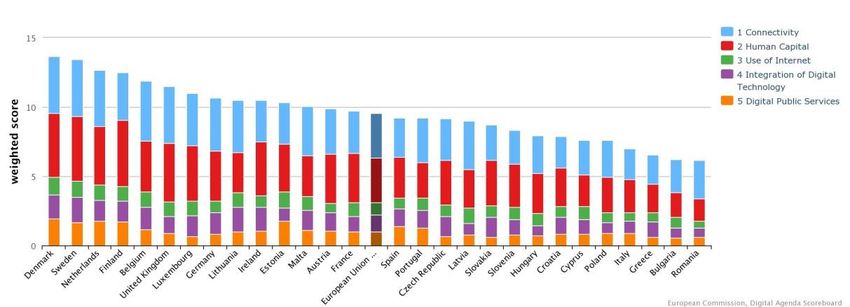
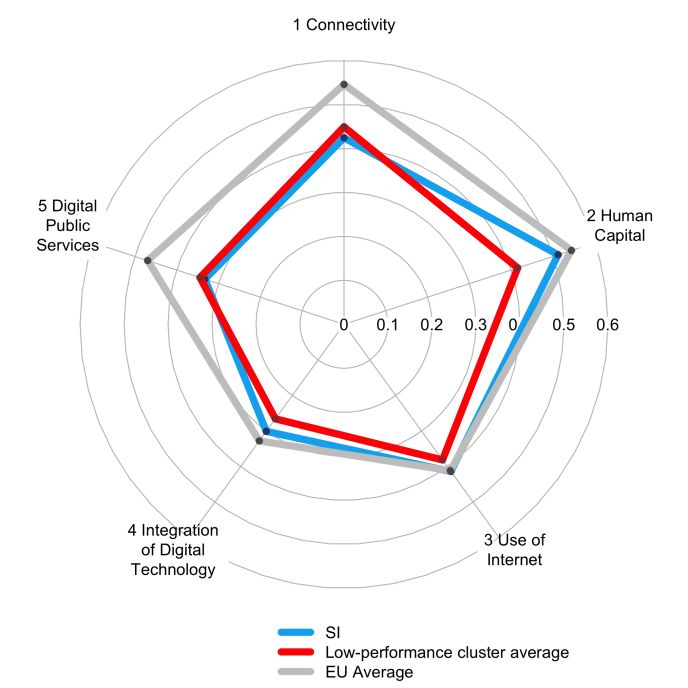
To assess the development of EU Member States in the digital economy and society, the EC developed
the composite Digital Economy and Society Index – DESI. The index summarises a series of indicators
based on five characteristics: connectivity, human capital, use of the internet, integration of digital
technology, and digital public services. According to the digital economy and society index that the EC
published for 2015, Slovenia ranks 19th among 28 EU Member States. Detailed information is available
at the DAE scoreboard website.
Another important indicator for the development of the information society is a broader political
awareness of the importance of ICT and the opportunities of the digital economy, which is reflected in
the importance of this area for the government, clearly defined strategic guidelines and measures for
accelerated development of the digital economy in the overarching national strategic documents and
budgetary resources earmarked for the measures in the field.
A more detailed report on the state of development of the information society in Slovenia in 2014,
which is presented in Annex 2, is based primarily on statistics, reports and analyses published on the
DAE Scoreboard and on the SORS data. A detailed description of the situation in the EU and in Slovenia
is provided in Annex 3.
6 http://epp.eurostat.ec.europa.eu/portal/page/portal/eurostat/home/
7 http://ec.europa.eu/information_society/digital-agenda/scoreboard/index_en.htm
8 DIGITAL SLOVENIA 2020 - Development strategy for the information society until 20203.3 SWOT Analysis of the National Context
ADVANTAGES DISADVANTAGES
Digital Economy and Digital Society Digital Economy and Digital Society
Good bases for the development and implementation Significant lag in the development of the information
of data-driven economy and innovation, development society over the past ten years.
of cloud computing, the internet of things and mobile Significantly insufficient investments in the
technologies. development of information society.
Proximity of yet undeveloped markets. Lack of development resources (financial, human,
Examples of globally successful ICT enterprises in niche material and technical).
areas (good practices, integration). Insufficient awareness of the importance and potential
Participation in international projects and integration of ICT for social development at all levels.
in the joint European education and research network. Insufficient political support for the efforts to develop
Established network of NGOs for an inclusive the digital society: general digitisation, digital
information society. economy, introduction of e-business and digitisation of
Examples of good practices in internet start-ups and the public sector (e.g. e-health).
application of new internet-based business models Declarative support is not reflected in operational
(peer-to-peer, sharing economy, cryptocurrencies…). support.
Established network for the inclusion of broader public Unstable political, organisational and development
in discussions about the internet - Slovenian internet environment and subsequent delay in drafting
Forum. development documents.
Electronic Communications Infrastructure Strategic documents do not sufficiently recognise ICT
Competitive market of electronic communications. as a promoter of general development and economic
Good basis and readiness for transition to IPv6. growth.
Digital Literacy and ICT Skills Insufficient participation of stakeholders in drawing up
Examples of good practices of intergenerational and implementation of measures for promoting the
cooperation and e-literacy development (Simbioza). development of digital society.
Broad possibilities for formal and informal education. Insufficient range of e-content and e-services in
School children have a basic degree of digital literacy. Slovenian in certain fields.
Good results of the preventive measures for the safe Existence of provisions that constitute a hindrance in
use of the internet (awareness raising programmes) capturing, keeping and accessing digital content.
implemented so far. Electronic Communications Infrastructure
Experience in the advanced application of ICT in High costs of construction of capable broadband
education. infrastructure in white areas.
E-government and Public Sector Digital Literacy and ICT Skills
High level of development of e-government solutions. Geographic, age-related and other digital divides in the
Existing national ICT infrastructure: national HKOM provision and use of communication and information
network, data centre, SIGOV-CA and other issuers of services.
qualified digital certificates, Arnes infrastructure. Low digital literacy, lack of e-skills and deficient use of
Experience in interoperability of cross-border e- available advanced e-services and ICT solutions in
services. certain population segments.
High-quality and connectible central databases in state E-government and Public Sector
administration, effective identifiers. Inappropriate organisation and placement of
Established national open data portal NIO. competencies for the digitisation of the public sector
Good legislative framework of access to information of and for the development of the information society.
public character - ZDIJZ. Problems with the implementation of a
Important role and practice of the Information complementary approach and the implementation of
Commissioner. synergistic effects at the inter-departmental and cross-
Guidelines for capturing, long-term conservation and sectoral levels.
access to cultural heritage in digital form. Decentralised computerisation of the state (and
ICT Sector in Slovenia partially broader public) administration and healthcare
ICT industry with the full spectrum of skills for the has brought about dispersed and unconnected IT
digitisation of Slovenia (digital entrepreneurship, systems and high costs of development and
development and introduction of e-services and e- maintenance.
business).
DIGITAL SLOVENIA 2020 - Development strategy for the information society until 2020 9 Number of experts from the ICT field. Poor awareness of the advantages and poor legal basis
Concentration of know-how in competence centres for the implementation of the interoperability principle
from the ICT field. and broader application of the national interoperability
Cyber Security framework (IOF).
Functioning operational level of cyber security Insufficient awareness of public authorities of the
provision with well-qualified although insufficient importance of transparent action and publication of
human resources. data in open formats.
Good experience with participation in common The ICT Sector in Slovenia
international exercises in cyber security. A small number of high-tech enterprises and
insufficient orientation toward global markets.
A low level of early entrepreneurial activity and failure
to adapt to incentive measures to the specifics of ICT
and the internet.
Cyber Security
Lack of specific cyber security provision regulations at
the strategic level, without appropriate sources
(central coordination facility, point of single contact for
international cooperation).
OPPORTUNITIES THREATS
Digital Economy and Digital Society Digital Economy and Digital Society
Significantly higher investments in the development of Organisational and political instability and insufficient
information society and the ICT sector. sources of funding the development of society’s
Clear political support for development efforts and digitisation.
high level of awareness of the importance and Lack of understanding of development opportunities
development opportunities of ICT and the internet. for the digital society and lack of political support in
Higher technological orientation of the society in earmarking funds for the implementation of proposed
steering development. measures.
Increased efficiency as a result of innovative and The influence of partial interests and unwillingness to
intense use of ICT and the internet as horizontal cooperate.
strategic orientation in all development documents Lack of stakeholders' interest in the implementation of
and activities. foreseen measures and use of advantages of
Inter-departmental and cross-sectoral cooperation for digitisation.
complementary development approaches and seeking Lagging behind DAE objectives, which means failure to
synergies. implement common European commitments adopted.
Classification of Slovenia as an advanced reference Further negative impact of development lag in the field
environment for introducing new technologies (data of information society on all other development areas
centres, open public and research big data, internet of of society.
things, cloud computing, IPv6, etc.). Risk of violating copyright and related rights because of
Research, development and establishment of open unsuitable or deficient regulations.
platforms based on interoperability and standards for Shifting the burden of the higher costs of trust service
easier and quicker development of high-quality, management to final user.
innovative, safe and trustworthy solutions, as well as Decrease in the competitiveness of the economy.
recognition in foreign markets. Electronic Communications Infrastructure
Development of new ways of electronic social The developmental lag of rural and suburban areas
communication. because of insufficient digital infrastructure.
Inclusion of stakeholders of the development of digital Digital Literacy and ICT Skills
society in the preparation of development and Disregarding the specificities of individual target
legislative documents via the Slovenian digital groups in increasing digital literacy.
coalition. Negative impacts of various types of digital divides.
Development of creative content and creation of new Drop in the use of Slovenian among native speakers of
or enriched offer of digitised cultural heritage. Slovenian in digital environments.
Electronic Communications Infrastructure Drop in the amount of digital content created in
Potential synergies in constructing smart and Slovenian.
broadband networks and other measures for lowering E-government and Public Sector
the costs of constructing broadband infrastructure. Short-term and sectorally partial operation of public
Digital Literacy and ICT Skills sector institutions.
10 DIGITAL SLOVENIA 2020 - Development strategy for the information society until 2020 Digitisation of education and research, culture, and Increased risk for deficient public e-services because of
media. Increased production of digital media content. poor quality and availability of data.
E-government and the Public Sector Loss of cultural heritage, less legal certainty, and
Consolidation and centralisation of the digitisation of difficulties in the re-use of data because of the
state administration with the use of cloud computing unsuitable system for archiving and storing digital
technology and big data in order to achieve synergistic objects.
effects. Unsuitable and badly thought-out replacements for
Development of new e-services of state administration traditional technologies with IP technologies.
(including healthcare, the public sector, partly local ICT Sector in Slovenia
self-government services) within the common service Degradation of research and development capacities in
IT-infrastructure. ICT because of the globalisation of research and
Pre-commercial procurement of computerisation and development and global competition.
development of advanced innovative e-services of Cyber Security
public sector. Lack of trust in cyberspace, safety and privacy and thus
Introduction of an electronic identity card (eID). in the use of e-services - weakening of the commercial
Development by the 'digital by default' principle, and potential of digitisation and lower level of trust of
priority or mandatory use of public e-services. citizens in the state.
Possibility to use IOF, infrastructure of electronic Insufficient awareness of the importance of ensuring a
identities and services of trust and other e- high level of cyber security.
infrastructure for cross-border public e-services also
for the private sector.
Introduction of new services for protection, salvage
and assistance to persons, especially relating to
services of emergency call on 112.
ICT Sector in Slovenia
Digitisation of entrepreneurship and production,
promotion of internet entrepreneurship and internet
start-ups.
Intensive opening of public and research data.
A test cloud for easier and faster development of
innovative e-services based on open public research
data and spatial data.
New and refashioned business models based on the
development opportunities of ICT and the internet
(industry 4.0, e-business, peer-to-peer, sharing
economy).
Cyber Security
Systemic regulation of cyber security provision and
protection of critical IT infrastructure, raising trust in
cyberspace.
Protection of human rights in the digital society.
DIGITAL SLOVENIA 2020 - Development strategy for the information society until 2020 114 Objectives
Facing adverse economic conditions and global, increasingly competitive rivals, Europe sees the speedy
development of a digital society and the ICT sector as one of the key opportunities for escaping the
crisis and preserving competitiveness and the standard of living. The indicators for Slovenia show, on
the contrary, that numerous structural changes related to exploiting development opportunities,
including the potential of ICT and the internet, are insufficiently radical and fast; thus Slovenia is losing
touch with the average of the European Union in terms of the digital society, which also means that it
is losing its competitive advantages. This situation is a result of significantly insufficient investments in
the development of a digital society, the unsuitable positioning of development and a lack of
coordination among stakeholders. The awareness of the importance of ICT for the development of a
contemporary digital society is much too low among the broader public in Slovenia.
According to DAE, long-term sustainable changes in Europe will be based on the digitisation of the
society and economy with the innovative and intense use of information and communication
technologies. The Digital Single Market Strategy for Europe additionally stresses the importance of
eliminating the barriers for a prompt establishment of a single digital market that will give a new
impetus to the European economy.In order to eliminate the lag in the development of a digital society,
Slovenia will radically alter development approaches, accelerate development activities, set up the
coordination of stakeholders in the development of the digital society, and earmark development
funds for the area in order to reduce the development gap behind the most developed countries. In
accordance with the mentioned guidelines and in order to enable Slovenian stakeholders to equally
participate in the single European digital environment, Slovenia will invest in the digitisation of society
and entrepreneurship, in digital growth, and education on digital societies, as well as implement the
strategic orientation of the innovative and intensive use of ICT and the internet in all fields of
development.
Slovenia’s vision is to use, through the accelerated development of a digital society, the
development opportunities of ICT and the internet and thus become an advanced digital society and
a reference environment for introducing innovative approaches in the use of digital technologies.
The objectives of the strategy to achieve the development vision are the following:
raising of general awareness as to the importance of ICT and the internet for society’s
development,
sustainable, systematic and focused investments in the development of the digital society,
general digitisation according to the 'digital by default' principle,
competitive digital entrepreneurship and digitised private sector for digital growth,
intense and innovative use of ICT and the internet in all social segments,
high-speed access to the open internet for all,
inclusive digital society,
safe cyberspace,
trust in cyber space and protection of human rights,
DIGITAL SLOVENIA 2020 - DEVELOPMENT STRATEGY FOR THE INFORMATION SOCIETY UNTIL
12
2020 Slovenia – a reference environment for introducing innovative approaches in the use of digital
technologies.
DIGITAL SLOVENIA 2020 - Development strategy for the information society until 2020 135 Development Principles of Operation
5.1 The Internet as a Strategic Development Opportunity of the Digital Society
5.1.1 Focus on the internet in Drafting Development Measures
The internet is an omnipresent communication network of information sources that fundamentally
changes the way in which our modern society functions by providing an easy access to a wide range of
topics and services. In a globalised world, it is an extremely effective means of communication for the
free flow of information, which has markedly changed the channels the modern world uses to
communicate, so internet access and the use of its services are generally understood as a human right
in the 21st century.
As the basic element of the digital or information society the internet is continuously developing and
offers immense development opportunities in broader social frameworks. It increasingly shapes
individuals’ opportunities in all fields of private and public life; from education, employment, access to
information, contemporary financial and public services, and freedom of expression, to participation
and relationships in public and private life. It has the same far-reaching impacts in the private sector,
public sector and civil society. In terms of directing development, the internet is a strategic tool for
increasing productivity, to create innovative business models, products and services, to improve
communication as well as the overall efficiency of the society. Cloud computing is turning the internet
into a comprehensive service system that blends new technologies of the future internet (the internet
of things), cloud computing services and internet e-services. The internet of things is an increasingly
efficient uniform environment, offering extraordinary development opportunities and an extensive
range of services that are useful, functional, reliable, safe and flexible. In steering development
activities we must take into account the fact that economic and general development in contemporary
digital society is closely connected with the development and use of the internet and digital literacy.
The internet offers exceptional opportunities for tackling economic, social and environmental
challenges, so it is a key factor for future economic and social development; thus its deployment
strongly in the public’s interest.
The internet is of vital importance for development, so Slovenia made its development and use a
strategic focus and a national priority in the development of digital economy and digital society.
Slovenia will use development measures to seize the potentials of the internet for promoting
innovation, openness and access to knowledge, creation of employment opportunities, improvement
of productivity and competitiveness of all sectors of the economy and improvement of quality and
efficiency of public services. By reducing the impact of economic and social activities on the
environment, it will support sustainably-oriented economic growth. Slovenia will promote discussions
about the internet in cooperation with the Slovenian internet Forum, whose operation it will actively
support.
Slovenia aims to rank among the leading digital societies, so it will harmonise the activities of all
development stakeholders to optimise the use of the internet for the economic (digital) growth,
education, social development and reduction of environmental impact.
14 DIGITAL SLOVENIA 2020 - Development strategy for the information society until 2020In cooperation with the Slovenian internet Forum and other stakeholders, Slovenia will propose the
adoption of a joint declaration about the internet that will be a driver of development, use, importance
and role of the internet in the society in the national environment.
In order to seize development opportunities enabled by the internet, Slovenia will invest and operate
in three fields in the future development period.
internet as technological platform:
- increased investments in RDI in the ICT field,
- development of internet technologies (internet of things - future internet, cloud
computing, industrial internet, industry 4.0, etc.),
- support for the development and higher competitiveness of the internet industry,
- establishment of enabling supportive environment for internet start-ups,
- introduction of contemporary models of cloud computing in public administration,
- promotion of the development of national and European interoperability for more
efficient operation of the public sector,
- introduction of uniform and user-friendly services of e-identification and other services of
trust for safe and private e-business,
- quick identification of upcoming ICT trends and technologies and responsive
establishment of regulatory frameworks that will enable and promote the introduction of
innovative approaches in the use of digital technologies,
- establishing enabling environment for reference projects of introducing innovative
approaches in the use of digital internet technologies,
- promotion of the use of open-source technological solutions with a view to strengthening
information independence and competitiveness.
internet as communication network:
- development of high-capacity communication optic-fibre infrastructure (lowest target
level being 100 Mb/s),
- provision of an appropriate level of network and service quality,
- fast and well thought-out transition to IPv6 (this transition is necessary for the stability of
the internet and its further growth, including the possibility of user access to services and
content of their own choice),
- development of mobile internet (mobile communications networks 4G and 5G, digital
dividend II – the 700 MHz frequency band),
- provision of free, open and neutral internet,
- ensuring a high level of cyber security,
- ensuring privacy.
internet for the development of society and economy:
- improving the population’s digital literacy (improving their ability to use the internet and
digital media at school, at the workplace and in everyday life, inclusion of digital content
in general education, teaching of programming, informal education for younger and older
generations),
DIGITAL SLOVENIA 2020 - Development strategy for the information society until 2020 15- promotion of the use of the internet,
- awareness raising and training the population for safe and responsible use of the internet,
- measures for a better internet for children and the elderly,
- encouraging discussions about the development and use of the internet, shaping public
interest in managing development policies, regulation and adoption of decisions in the
society and economy, promotion of multi-stakeholder approach to addressing internet
issues, cooperation at the international level,
- cooperation with Slovenian internet Forum and support for its activities,
- adoption of the national declaration about the internet,
- development of new models and manners of performing social and political activities,
- development of new cooperative models of online transactions (collaborative, peer-to-
peer, sharing economy, cryptocurrencies, etc.),
- stimulation of the ICT sector to develop innovative IT solutions of e-business,
- use of the internet in developing efficient digital public administration, e-health, e-justice
etc.,
- investments in higher use of the internet in the economy and e-business,
- use of services enabling telework or work from home,
- computerisation of polling stations and gradual introduction of e-elections,
- promotion of opening and re-use of data of the public and research sectors, development
of e-services targeting user needs,
- use and development of the internet for contemporary financial services with stress on
open standards and protocols.
5.1.2 Protection of Openness and Neutrality of the internet
The internet has developed organically, with minimum interventions of official institutions. But as the
importance of the internet for society and the economy grows, its operation, management and access
are becoming a matter of public interest that is mostly implemented by the self-regulation of markets.
But when market mechanisms fail to fulfil society’s expectations, state intervention is necessary to
protect public interest. The public interest concerns particularly the provision of the availability,
accessibility and openness of the internet, quality of services and privacy, safety and protection on the
internet.
Different stakeholders in development, management and use of the internet create the future internet
according to their respective roles, the general consensus being that the internet should remain a free
and open public place of communication and services, which means unlimited access, non-
discrimination and neutrality of content and technology from the aspect of exchanging
communication. Without doubt, the internet is a communication medium that has fundamentally
changed our contemporary society for the better. In order to retain the positive effect, the future
internet needs to remain free, open, uniform, pro-democratic and safe; it needs to ensure privacy and
be managed transparently and by the multi-stakeholder principle. These are the values that have
developed the internet into an omnipresent network that connects the globalised world in digital
society more than anything else. It has to be kept in mind, though, that the internet is open and free
16 DIGITAL SLOVENIA 2020 - Development strategy for the information society until 2020in its technical concept but not necessarily in legislative, regulatory, management, user and other aspects. Thus legislators currently face the issues of restricting its use, overregulating or influencing the internet, which is contrary to its basic characteristics and may easily produce undesirable side effects. The sensitivity of the internet values makes it even more important to treat them cautiously in national frameworks. In dealing with online content, the state plays a role in protecting children, fighting racism and hate speech, cybercrime and efforts for ensuring a high level of cyber security; the measures taken, however, must be proportionate to the objective. In contemporary society, an increasing share of real life unfolds through or by using the internet, so the question of whether countries should regulate the internet or not is moot. The only question is what and how extensive should such regulation be, so that it will not unduly restrict the development and use of the internet. In principle, restricting the use of the internet is legitimate only if it is in accordance with international norms and standards necessary for the functioning of a democratic society and ensuring human rights, and if it is regulated by legislation. In this spirit, the accepted view is that a general requirement for filtering, blocking, or any discriminatory treatment of the internet traffic is excessive and unacceptable, unless it complies with precise and narrowly defined legal reasons set out above and with the highest legal standards. The fundamental motive for protecting net neutrality is the fact that the driving force of its development is a low entry threshold for new providers of content and services. The global internet network and all its potential users are readily and simply available to them. As a rule, the success of a new business model and new internet content, including the related services, depends only on their innovation and quality. Electronic communication networks that do not treat internet traffic neutrally threaten democracy, non-discrimination, transparency, openness and the freedom of the internet. Considering the influence of the internet on the globalised society, the risk of eliminating the neutrality of the internet is simply too great, which has to be borne in mind when steering its development. Slovenia underlines the importance of preserving open net neutrality for innovation, development of entrepreneurship and digital society and functioning of single digital market. This is why Slovenia advocates strong and clear protection of net neutrality. Slovenia particularly stresses the role of online platforms in the provision of net neutrality. Some online platforms have practically become a part of the internet infrastructure because of their monopoly positions, while their business models include discriminatory treatment of internet content and services. Online platforms can thus eliminate content-related net neutrality ensured at the level of transmission. Therefore Slovenia expressly supports the EC activities in the analysis of online platforms and potential regulation of internet platforms at the level of services and content. Preserving the openness and neutrality of internet content is in the interest of the internet’s development and, with respect to its remarkable impact, also in the interest of society’s development at the national level, so Slovenia will continue to strive for its protection. 5.2 Seeking Synergies As development resources are limited, achieving strategic goals requires the establishment of stakeholder integration at the interdepartmental and cross-sectoral levels that should include enterprises, ministries, public sector, service and content providers, users, education and research DIGITAL SLOVENIA 2020 - Development strategy for the information society until 2020 17
You can also read


