Digital twin technology as a modern approach to quality management
←
→
Page content transcription
If your browser does not render page correctly, please read the page content below
E3S Web of Conferences 284, 04013 (2021)                                      https://doi.org/10.1051/e3sconf/202128404013
TPACEE-2021

         Digital twin technology as a modern approach to
         quality management
         Nikita Rodionov1* and Lyudmila Tatarnikova1
         1Irkutsk   National Research Technical University, 664074, Lermontova str., 83, Irkutsk, Russia

                        Abstract. The concept of a digital twin and its types are discussed in this
                        paper. The essence of the development of digital twins in the SysML
                        language, the use of AnyLogic (simulation software) and the use of MES
                        (Manufacturing Execution Systems) software for communication with
                        production systems are described. The functions of neural technologies that
                        can be integrated into a modern QMS (quality management system) are
                        considered. The use of digital twins in the quality management system
                        allows monitoring inconsistencies in the technological component of
                        production and quickly eliminating them, and also offers solutions to the
                        identified problem. Companies are now finding a competitive advantage in
                        digital technologies, especially digital twins, whose economic benefits are
                        undeniable. The quality management system of enterprises with high-tech
                        industries is more and more moving into the analysis of big data and in
                        interaction with the digital environment. Thus, it is so important to pay
                        attention to technologies directly related to the analysis of the quality of the
                        product and the processes of its creation. As a result of the study, a clear
                        connection between advanced information technologies and the
                        development of the quality management system of enterprises was revealed.

         1 Introduction
         Nowadays, the economy of a new technological generation is actively developing - the digital
         economy, which is largely determined by Smart Big Data. The central place in the economy
         is occupied by the sphere of material production, i.e. a high-tech industry that must meet the
         requirements of global competitiveness, efficiency and high labor productivity. For the best
         fulfillment of the quality plan, meeting customer expectations and maintaining production at
         a high level, leading companies are rapidly developing the digital transformation of their
         production into high-tech one. [6]
             Today, the industry is developing digital platforms, for example, digital twins of real
         objects, products and production. Systems of intelligent assistants are developing, global
         automation, robotization and intellectualization of industry are taking place, and the
         transition to cyber-physical systems is under way. These global technological changes are
         accompanied by the development of fundamentally new business processes and business
         models at all levels. [1.5]

         * Corresponding author: nikrodionov411@gmail.com

   © The Authors, published by EDP Sciences. This is an open access article distributed under the terms of the Creative
   Commons Attribution License 4.0 (http://creativecommons.org/licenses/by/4.0/).
E3S Web of Conferences 284, 04013 (2021) https://doi.org/10.1051/e3sconf/202128404013
TPACEE-2021
A digital twin is a virtual prototype of a physical object or group of objects that is designed
to simulate their behavior. Virtual models can determine the state of physical objects, as well
as predict, assess and analyze changes. [2]
A high level of digital twin means that this technology must provide a difference between
the results of virtual and physical tests within ± 5% (in this case, it has the right to be called
a digital twin, otherwise the technology remains an electronic model, digital mock-up, digital
prototype, etc.), which are created within the framework of traditional iterative software
development, i.e. within the framework of software development in small stages, during
which the obtained intermediate results are analyzed, new requirements are put forward, and
the previous stages of work are corrected. [8]
The digital twin answers the questions: “Where to measure?” and “What to measure?”,
i.e. it is necessary to indicate critical areas in which sensors and critical characteristics should
be placed, for example, deformations, temperature, pressure, vibration displacement,
vibration acceleration, and others. Then you should indicate the path of data storage,
processing, transmission and protection (Big Data).
The digital twin shifts the focus to the process of generating meaningful data, during
which intelligent big data is generated. Moreover, the digital twin makes it possible not only
to adequately describe the behavior of a real object or product in all modes of operation
(including normal operating conditions, violations of these conditions, emergency situations,
etc.), but also to simulate various possible situations with a high degree of accuracy
(including their various combinations and overlays). Thus, the digital twin has predictive
potential, in contrast to a simple set of sensors, which only help to generate data on processes
that have already taken place and does not allow predictions of complex phenomena and
situations. [2,7,4]
It is fundamentally important to distinguish digital twins from digital shadows, which are
systems of connections and dependencies that approximately describe the behavior of a real
object or product under certain conditions of its operation, but are not able to simulate
situations in which the object was not used. The digital twin provides real-time monitoring
of systems and processes, as well as timely data analysis to prevent problems before they
occur, plan preventive maintenance, reduce or prevent downtime, add new features, plan for
future updates and new developments.
Also, the automatic analysis of big data using the artificial intelligence of the digital twin
will provide options for more accurate calculation of various situations and tasks in
production, which will have a positive effect on the final product, and for optimizing the main
aspects of the product life cycle. At the same time, digital twin technology makes it possible
to reduce the cost of system verification and testing. [1]
The functionality of this technology allows the company's quality management system to
respond to the current requirements of high-tech production and timely improve the
production process or the product itself if it has its own digital twin.
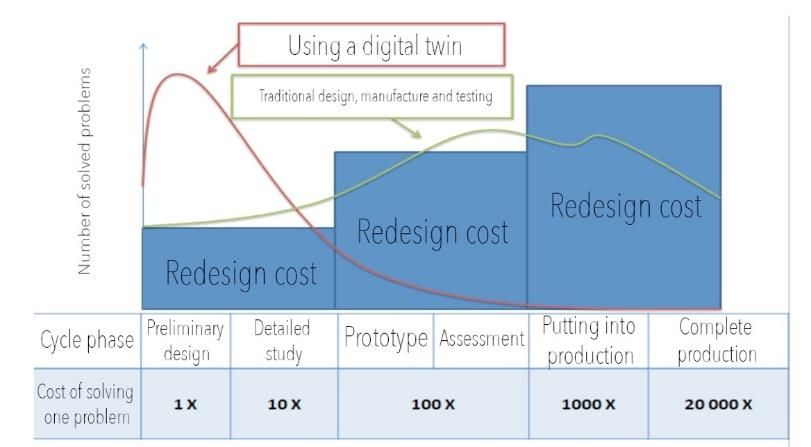
The use of technology reduces the company's overall product development costs. (Figure
1) [13].
2E3S Web of Conferences 284, 04013 (2021) https://doi.org/10.1051/e3sconf/202128404013
TPACEE-2021
Fig. 1. Redesign cost using a digital twin.
2 Types of digital twins
The digital twin of a product combines digital modeling and system-oriented product
development processes. It enables you to design, simulate and validate complex products,
automate the design of electrical and electronic components, and manage software code
without the need for physical prototypes. [9]
Modeling, simulation and optimization of production processes in a digital environment
with the possibility of automated code generation for programmable logic controllers (PLCs)
form the digital twin of production.
As a result of the joint modeling of mechatronics (mechatronics is a field of science and
technology based on the synergistic combination of precision mechanics units with
electronic, electrical and computer components that ensure the design and production of
qualitatively new mechanisms, machines and systems with intelligent control) and industrial
automation, an integral model is formed, which serves as the basis for the virtual
commissioning of production processes.
The optimal sequence of operations is planned based on the availability of the production
facility and possible constraints. Automatically generated work instructions, technical and
safety information, and other required documents are available for employees in production
facilities in a digital form. The system quickly responds to deviations in process targets,
enabling the transition to predictive planning. This is made possible by networked products
and solutions for automation, industrial communication and security.
Process digital twins are created based on the design of an optimal technological process.
These models are then compared with the actual process parameters in real time, obtained
from the automated process control system (APCS) or from data archives.
The same concept is used in the case of Advanced Process Control (APC) systems, where
the optimal production parameters of the APC system are compared with the real ones. The
3E3S Web of Conferences 284, 04013 (2021) https://doi.org/10.1051/e3sconf/202128404013
TPACEE-2021
difference between optimal parameters and actual ones is the potential of the opportunities
for the operation of the enterprise.
3 Planning of the production process
The entire production process can be planned and developed in the virtual world. Here,
product and component data are connected to available manufacturing operations,
equipment, tools, and other required resources, including supplier resources throughout the
value chain. Even assembly operations can be modeled to optimize robot trajectories and
provide ergonomic workspaces for personnel to reduce the risk of injury. [10]
Continuous improvement and optimization of the material flow in production is essential
for production planning. Simulation modeling of the latter allows one to quickly detect
bottlenecks, increase their throughput, optimize energy consumption of the entire production
cycle of the enterprise, prioritize and determine the directions in which the situation can be
improved in order to avoid disruptions and instability of production, excessive consumption
of raw materials and energy resources.
4 Development of digital twins
SysML is a general-purpose graphical modeling language that supports the analysis,
specification, design, and validation of complex systems. SysML includes 9 diagrams:
package diagram, requirement diagram, action diagram, sequence diagram, state diagram,
use case diagram, internal block diagram, and parametric diagram.
SysML can be used at any level of system detail and helps engineers focus on design
rather than the traditional hierarchical complexity of documents and drawings. [3]
One of the recognized tools for implementing a simulation model as part of creating a
digital twin is AnyLogic, a powerful and flexible simulation environment. MES-system is
designed for modeling and control of intrashop material flows in the dispatch control loop.
A modern MES system is designed to work with both modern IoT (Internet of Things)
interfaces and legacy hardware, which makes it possible to endow huge amounts of data with
usefulness and consistency. [7]
In this case, the MES system acts as an intermediate layer of the translator, which turns
the data flow into valuable information suitable for making strategic decisions.
5 Conclusions
According to the Digital Twin Market report, the global digital twin market, estimated at $
3.1 billion in 2020, is projected to reach $ 48.2 billion by 2026. [11]
It is possible to increase the level of management decisions made on the basis of the
provided digital analytics by integrating information from different expert systems into a
single and well-protected database. Integration of digital twins of equipment and process
seems to be the most urgent today. Such a combination also opens up new opportunities for
increasing the productivity and profitability of enterprises, and the quality of products.
Nowadays, many companies are engaged in methodological issues of building digital
twins: determining a set of controlled parameters (signals), their classification, etc.
Further research in the field of digital twins should be aimed at organizing communication
between a real industrial facility and its digital model, i.e. the exchange of signals between
real and virtual controllers.
Thus, the modern approach to quality management is increasingly becoming a digital
version of the quality management system, which is driven by artificial intelligence.
4E3S Web of Conferences 284, 04013 (2021) https://doi.org/10.1051/e3sconf/202128404013
TPACEE-2021
References
1. A.I. Borovkov, Yu.A. Ryabov, V.M. Maruseva, Digital production: methods,
ecosystems, technologies, p. 24-44 (2018) URL: http://assets.fea.ru/ (date of access:
07.09.2020)
2. D.S. Kokorev, N.P. Posmakov, Colloquium-journal, 26 (50) (2019) URL:
https://cyberleninka.ru/article/n/primenenie-tsifrovyh-dvoynikov-v-proizvodstvennyh-
protsessah (date of access: 09.09.2020)
3. V.V. Makarov, E.B. Frolov, I.S. Parshina, M.V. Ushakova, The concept of developing
a digital twin, V.A. Trapeznikov Institute of Control Problems of RAS, Russia
(Moscow, 2019) URL: https://mlsd2019.ipu.ru/proceedings_1/section_15/1252-
1254.pdf (date of access: 09.09.2020)
4. N.V. Kurganova, M.A. Filin, D.S. Chernyaev, A.G. Shaklein, D.Ye. Namiot,
International Journal of Open Information Technologies, 5 (2019) URL:
https://cyberleninka.ru/article/n/vnedrenie-tsifrovyh-dvoynikov-kak-odno-iz-
klyuchevyh-napravleniy-tsifrovizatsii-proizvodstva (date of access: 08.09.2020)
5. E.B. Frolov, I.S. Parshina, A.S. Zaitsev, A.S. Klimov, Science-intensive technologies
in mechanical engineering, 2 (92), 42-48 (2019)
6. A.V. Guryanov, D.A. Zakoldaev, A.V. Shukalov, I.O. Zharinov, M.O. Kostishin,
Scientific and technical bulletin of information technologies, mechanics and optics, 18,
2, 268-277 (2018)
7. S.A. Sinyagov, V.P. Kupriyanovskiy, P.V. Kurenkov, D.E. Namiot, A.V. Stepanenko,
et al, International Journal of Open Information Technologies, 5, 5, 46-79 (2017)
8. A.P. Dobrynin, K.Yu. Chernykh, V.P. Kupriyanovsky, P.V. Kupriyanovsky, S.A.
Sinyagov, International Journal of Open Information Technologies, 4, 1, 4-11 (2016)
9. Iterative software development. [Electronic resource] - URL: https://web-
creator.ru/articles/iterative_development (date of access: 02.09.2020)
10. N.A. Demkovich, I.A. Volkov, E.I. Yablochnikov, Bulletin of the Samara Scientific
Center of the Russian Academy of Sciences, 18, 3-4, 459–463 (2016)
11. A. Gulli, S. Pal, Keras Library - a deep learning tool (DMK Press, 2017)
12. Digital Twin Market worth $48.2 billion by 2026. [Electronic resource] - URL:
https://www.marketsandmarkets.com/PressReleases/digital-twin.asp (date of access:
05.09.2020)
13. D.S. Kokorev, A.A. Yurin, Colloquium-journal, 10 (34) (2019) URL:
https://cyberleninka.ru/article/n/tsifrovye-dvoyniki-ponyatie-tipy-i-preimuschestva-
dlya-biznesa (date of access: 06.09.2020)
5You can also read


