Double Degree Programme between Justus Liebig University Giessen, and its Faculty of Biology and Chemistry, Germany The Graduate School of Science ...
←
→
Page content transcription
If your browser does not render page correctly, please read the page content below
Spezielle Ordnung für den Masterstudiengang „Chemie“
Anlage 5: Double Degree Programm                                                            23.04.2021            7.36.08 Nr. 2            S. 1
In der Fassung des 13. Beschlusses vom 27.01.2021
                                                                                                                         Gül�g ab SoSe 2021

  Anlage 5

                                   Double Degree Programme
                                            between
      Justus Liebig University Giessen, and its Faculty of Biology and Chemistry, Germany
                                               and
           The Graduate School of Science and Engineering, Kansai University, Japan

        1. Aims
  Based on the agreement of Justus Liebig University (JLU) and Kansai University (KU) both
  universi�es establish a double degree programme on Master’s level in chemistry. The
  programme provides the opportunity for master students of chemistry at JLU and for master
  students of the Graduate School of Science and Engineering at KU to gain the Master’s degree
  of both universi�es: the „Master of Science“ of JLU and the „Master of Engineering“ (or the
  “Master of Science” – for KU students only) of KU.

        2. Master’s programmes
  The double degree programme is based on the following two Master’s programmes:
  The JLU Master’s programme in Chemistry is taught by Faculty 08 - Biology and Chemistry at
  the JLU. Star�ng every semester, the 2 years long programme (i.e. 4 semesters) includes core
  modules in chemistry, as well as op�onal modules in the first year (lecture-based modules).
  The second year is en�rely devoted to research work. Students choose 3 research-oriented
  modules. The Masters’ programme will be completed by submi�ng the Master’s thesis and
  defending its results in front of an examina�on commitee.
  On successful comple�on of the programme, both facul�es jointly confer the award of „Master
  of Science“(M.Sc.). Students receive a Master’s cer�ficate and a Cer�ficate of Examina�on
  including Master’s classifica�on 1 and Transcript of Records (�tles of all modules passed,
  workload and grading, �tle of Master’s thesis and grading).
  The Masters’ programme itself is structured in modules. Modules are units of lectures,
  prac�cal work, seminars, tutorials etc. dedicated to a specified topic (e.g. electrochemistry).
  Each module is described in detail by its content, aims, workload, types of exams, responsible
  lecturer etc. and is listed in the “Module descrip�ons” atached to the Special Regula�on for
  the Master’s programme in chemistry.
  In general, there are two different types of modules:
 •     Lecture-based modules: These modules typically include a lecture (running for 15 weeks =
       1 semester) and a seminar or a theore�cal/prac�cal exercise run by tutors. Thus, these
       modules can typically be finished completely within 4-5 months. Marks will be given on the
       basis of either a writen or oral exam at the end of the module. The subjects of the modules
       typically represent important fields in science and technology. During the first year, JLU

  1 The M.Sc. award is classified according to an overall grading. The overall grade is calculated by dividing the total weighted grade points
  (grade points for each module mul�plied by the credit points allocated to the module) by the total number of credit points.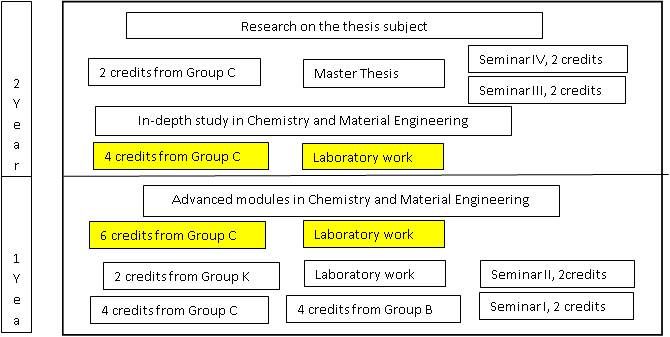
Spezielle Ordnung für den Masterstudiengang „Chemie“
Anlage 5: Double Degree Programm                                                                                            23.04.2021            7.36.08 Nr. 2             S. 2
In der Fassung des 13. Beschlusses vom 27.01.2021
                                                                                                                                                         Gül�g ab SoSe 2021
        students take 6 of these advanced modules in chemistry. Addi�onally, they follow their own
        interests by choosing 4 op�onal lecture- and/or research-based modules (6 CP each).
 •      Research modules: These modules are exclusively research-based, and the modules are
        defined on an individual basis – depending on the research profile of the respec�ve master
        student. The student can either take part in ongoing research or can be trained in a specific
        scien�fic method (e.g. a specific analy�cal method). At JLU students select three research
        modules during the second year: two in-depth research modules in chemistry oriented
        natural science (following their own interest) and one specialisa�on research module for
        preparing their Master thesis.
  In accordance with the European Credit Transfer System (ECTS), the volume of learning
  ac�vi�es (workload) required for achieving the Master’s degree in Chemistry equals 120 ECTS
  Credit Points (CP), i.e. 30 CP per semester / 60 CP per year. 1 CP is equivalent to an average
  working �me of 30 hours. This includes contact �me at which students have to be present at
  lectures, seminars, tutorials, prac�cal work etc. and �me for prepara�on and post-processing.
  Finally, this also includes �me for self-study and examina�ons.
  Each first year lecture-based module comprises 6 CP corresponding to 180 hours working �me.
  The second year research modules comprise 10 CP each (i.e. 300 h). Preparing and defending
  the Master’s thesis is equivalent to 30 CP (i.e. 900 h / 22 weeks).

  M.Sc. Chemistry Schedule:

                                                                                            Master Thesis (30 CP)
     Year 2

                                  In-depth research module 1                                   In-depth research module 2                 Specialisation research module
                                            (10 CP)                                                      (10 CP)                                      (10 CP)

                           Solid State Inorganic                Organic Chemistry
              Summer

                                                                                                   Analytics of Solids        Elective Module             Elective Module
                                Chemistry                        Reaction Design
                                                                                                        (6 CP)                     (6 CP)                      (6 CP)
                                  (6 CP)                             (6 CP)
     Year 1

                            Physical Chemistry                                          *
              Winter

                                                               Molecular Catalysis                 Molecular Analytics        Elective Module             Elective Module
                            Structure of Matter
                                                                        (6 CP)                          (6 CP)                     (6 CP)                      (6 CP)
                                  (6 CP)
                       *   From 2022 on substituted by "Theoretical and Computational Chemistry"

  The KU Masters’ programme at the Graduate School of Science and Engineering
  •           Lecture courses: These courses typically run for 15 weeks. Marks will be given at the end
              of the course on the basis of either a writen exam, a writen report, or an oral exam. KU
              students typically takes 1 course from Group A, 2 courses from Group B and 8 courses
              from Group C. (2 credits each)
  •           Project-based courses: Some courses are given in the form of project-based learning. A
              research project is given for each student. Some introductory lectures are given and
              guidance will be given each week in response to the progress report of the students.
              Marks will be given at the end of the course on the basis of the performance. (2 credits
              each)
Spezielle Ordnung für den Masterstudiengang „Chemie“
Anlage 5: Double Degree Programm 23.04.2021 7.36.08 Nr. 2 S. 3
In der Fassung des 13. Beschlusses vom 27.01.2021
Gül�g ab SoSe 2021
• Seminar courses: Seminar courses are exclusively research-based, and are defined on an
individual basis. They are mainly aimed for the prepara�on of Master thesis. They include
long-hour laboratory works but they are counted only 2 credits for each course.
Workload: 30 credits and the submission and defense of master thesis are required for
achieving the Master’s degree. Typically, 18 credits lecture courses, 4 credits project-based
courses, and 8 credits Seminar courses are taken. The programme is designed to be completed
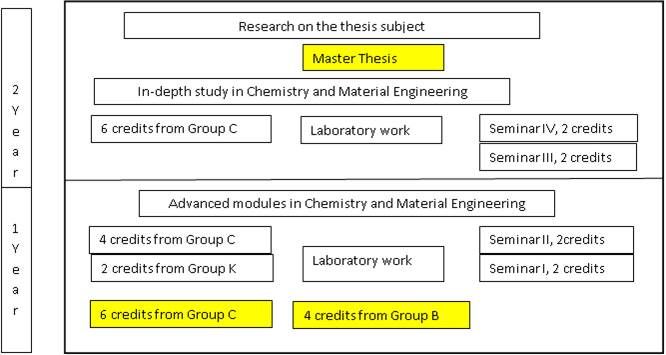
in 2 years. As the below chart would illustrate, the courses from group A-K should be obtained
mostly in the first year, whereas Master thesis and most of the in-depth study in their selected
field as well as work at the laboratory should take place in the second year.
1 credit in lecture course is equivalent to the working �me of 45 hours. This includes contact
�me at which students have to be present at lectures and �me for prepara�on and post
processing, and also it includes �me for self-study and examina�ons.
Official workload for a Seminar course is the same as that for a lecture course. To account for
the actual workload for Seminar courses, for DD students, KU will cer�ficate the laboratory
works. Marks will be given on the basis of writen reports and/or oral presenta�ons.
M. Eng Chemistry and Materials Engineering Schedule for JLU DD students:
M. Eng Chemistry and Materials Engineering Schedule for KU DD students:Spezielle Ordnung für den Masterstudiengang „Chemie“
Anlage 5: Double Degree Programm 23.04.2021 7.36.08 Nr. 2 S. 4
In der Fassung des 13. Beschlusses vom 27.01.2021
Gül�g ab SoSe 2021
Yellow boxes mean that they are to be replaced with the studies in JLU.
3. Double Degree Programme
Requirements for awarding a Master’s degree of JLU and of KU in the framework of the double
degree programme:
• Students have to complete a one year study stay at the partner university. During this
�me they have to pass all modules (i.e. the course work) defined in the working plan
mutually agreed upon by the academic coordinators at JLU and KU. The working plan
shall contain the typical workload per year at the partner university: i.e. at JLU 60 CP in
total (lecture based and research modules), at KU 8 credits lecture course and 6 credits
research. Therefore, each university offers a defined set of modules (i.e. lecture
courses) taught in English. These modules (i.e. lecture courses) should be fully accepted
by both universi�es. An updated list has to be provided by both universi�es regularly.
• Furthermore, the master thesis has to be writen under joint supervision by professors
from both universi�es and has to be defended in front of an examina�on commitee.
Schedule for Students’ Exchange:
JLU students of the Masters’ programme in chemistry normally start their studies in October
at JLU (semester 1: October - March). During the first semester, they have to pass 5 lecture-
based modules (i.e. 30 CP in total). A�erwards, from March on, they spend a one-year study
stay (2 semesters) at the KU Graduate School of Science and Engineering where they have to
obtain 14 credits (equals 60 CP at JLU), typically, 6 credits by lecture courses and 8 credits by
seminar courses. A�er coming back to the JLU, students complete their studies by preparing
and defending their master thesis (30 CP at JLU. KU cer�fies 6 credits research).
(30CP at JLU. KU cer�fies 6 credits.)
Schedule for JLU students:
Master’s students of the Graduate School of Science and Engineering start their studies in April
at KU. During their first semester (from April - September) they typically obtain 10 credits by
lecture courses and 4 credits by Seminar courses. From October on, they spend a one-yearSpezielle Ordnung für den Masterstudiengang „Chemie“
Anlage 5: Double Degree Programm 23.04.2021 7.36.08 Nr. 2 S. 5
In der Fassung des 13. Beschlusses vom 27.01.2021
Gül�g ab SoSe 2021
study stay (2 semesters) at the JLU where they have to obtain 60 CP in total: Students have to
pass 5lecture-based modules (three core ones and two elec�ve one) (6 CP each). Furthermore,
depending on their research profile students choose 3 research modules (10 CP each), in
consulta�on with their supervisor. Back at the KU, along with 2 credits lecture courses and 4
credits Seminar courses, students complete their studies by preparing and defending their
master thesis.
Schedule for KU students:
In addi�on to the described schedule, KU students can also start in their first semester (April)
at JLU and spend their first year at JLU before returning to KU. These students will follow the
same study programme at JLU as those coming in their second semester.
4. Master thesis
A�er returning to their home university, students con�nue their research work and finalise
their master thesis. Outcomes of the students’ research work at the partner university shall be
included in their Master thesis. These deliverables have to be specified as being gained at the
partner university. The master thesis has to be writen under the joint supervision of both
universi�es and has to be submited in English on schedule at the students’ home university.
One copy of the master thesis has to be provided for each supervisor at JLU and at KU. The
outcomes of the master thesis have to be defended in English in front of an examina�on
commitee. The supervisor of the partner university has to be enabled to par�cipate in the
commitee (in person or via internet).
5. Applica�on and Entry Requirements
Admission procedures to the double degree programme are carried out by the home
universi�es. At the same �me, the host university reserves the right for making the final
decision.Spezielle Ordnung für den Masterstudiengang „Chemie“
Anlage 5: Double Degree Programm 23.04.2021 7.36.08 Nr. 2 S. 6
In der Fassung des 13. Beschlusses vom 27.01.2021
Gül�g ab SoSe 2021
Both universi�es should nominate students of their Master’s programmes (in addi�on KU may
nominate students which are at the end of their Bachelors programme for star�ng at JLU in
April).
As the en�re study stay at the partner university will be conducted in English, knowledge of
writen and spoken English is required. Applicants must provide a cer�ficate giving evidence
of their proficiency in English. The following are accepted as evidence:
• 80 (iBT – internet based) in the TOEFL (Test of English as a Foreign Language),
• 6 points in the IELTS Academic Test (Interna�onal English Language Tes�ng System),
• a Bachelor’s degree course completed in English or
• another approved English competency test (e.g. at JLU DAAD vd2 or UNIcert II
European Level B2; at KU those who have (i) at least TOEFL score of 550 ~600 PBT and
(ii) obtained a very good standing grade (A or above) from the English mediated courses
offered at Kansai University in prior to their departure for their study abroad at JLU [For
AY 2016-2017, Academic Wri�ng Prac�ce, Presenta�on Skills, and Academic Discussion
& Debates].
Master students who are admited to the JLU Master’s programme in Chemistry or the KU
Masters’ programme at the Graduate School of Science and Engineering are eligible to apply
for the double degree programme. In addi�on students in their last Bachelor semester (see §3
of the agreement) may apply. At the beginning of the semester prior to the exchange,
applicants have to submit the following documents (in English) to the academic coordinator of
their home university:
• Bachelor’s Cer�ficate (not applicable for KU students star�ng at JLU in April),
• Leter of mo�va�on,
• Working plan accepted by a professor and the academic coordinator of their home
university,
• Leter confirming supervision by a professor of the partner university,
• an approved English competency test (see above).
Addi�onally, JLU students must prove that they have par�cipated at all first semester modules’
and passed exams of four of them (24 CP) prior to the exchange.
Students may also be admited to the programme on the basis of interviews guided by the
academic coordinator of their home university.
Based on the requirements and procedures men�oned above, both universi�es should
nominate students as candidates for the programme. By the partner universi�es’ academic
coordinators’ approval (including confirma�on of working plan and supervision) students are
admited to the double degree programme by their home university.
6. Language
Studying during the study stay at the partner university is carried out in English. The Master
thesis has to be writen and defended in English.Spezielle Ordnung für den Masterstudiengang „Chemie“
Anlage 5: Double Degree Programm 23.04.2021 7.36.08 Nr. 2 S. 7
In der Fassung des 13. Beschlusses vom 27.01.2021
Gül�g ab SoSe 2021
7. Workload Approval and Grading Scheme
It is agreed that mutual recogni�on of the period of studies at the partner university is
guaranteed. The workload will be calculated on the basis of the guidelines of the par�cipa�ng
universi�es. At the JLU, the basis for recogni�on is the Special Regula�on for the programme
in Chemistry leading to the Master of Science degree at Justus Liebig University Giessen:
htps://www.uni-giessen.de/mug/7/findex36.html/7_36_08_2_C
The KU Masters’ programme at the Graduate School of Science and Engineering consists of
nine “Disciplines” which exactly correspond to the nine departments in the undergraduate
course: 1. Mathema�cs, 2. Pure and Applied Physics, 3. Mechanical Engineering, 4. Electrical
and Electronic Engineering, 5. Architecture, 6. Civil, Environmental and Applied System
Engineering, 7. Chemical, Energy and Environmental Engineering, 8. Chemistry and Material
Engineering, 9. Life Science and Biotechnology. They are grouped into three “Majors” which
again correspond to the three facul�es: I. Engineering Science (1, 2, 3, 4), II. Environmental
and Urban Engineering (5, 6, 7), III. Chemistry, Materials and Bioengineering (8, 9).
There are two courses for the Master degree program. One is the standard course in which the
lectures are given in Japanese language, and the other is the newly opened interna�onal
course in which the lectures are given in English.
In the standard course, most of the students are those from the corresponding undergraduate
course, though there are also students from other universi�es in Japan and foreign students
who are qualified in Japanese language. Since the main part of the students is from Kansai
University, the curriculum of this course is designed to extend from that of the undergraduate
course. In the undergraduate course, the curriculum is organized to train the students to be
engineers, teachers, public officers, and so on. It starts with the basic lectures in the first year,
then higher level lectures in specialized fields follow in the second and in the third year. In the
final year, the students belong in the laboratories and do their research under the supervision
of the professors. The total number of 128 credits is necessary to finish the undergraduate
course. The students coming to the Graduate School are expected to have the knowledge
which is necessary to start their thesis research. The lectures in the Graduate School are given
rather independently by each professor without much correla�on among the lectures. Thus,
the organiza�on of the lectures in the master course is quite different from that in the
undergraduate course.
Lectures in the standard course are grouped into three categories: Group A, Group B and
Group C. Group A contains the lectures that are common to all the Disciplines, for example,
“Engineering Ethics”, “Intellectual Property”, “Philosophy of Science and Technology”, and so
on. They offer general knowledge to the students to be highly educated engineers and
scien�sts. Group B contains the basic lectures that are common to a group of some Disciplines.
For example, for Chemistry, Materials and Bioengineering Major (Faculty), it contains “Safety
Technology”, “X-ray Diffrac�on”, “Polymer Science”, “Advanced Life Science”, “Advanced
Biotechnology”, and so on. Group C contains the specialized lectures given by each professor.
In order to be granted a Master degree (in Engineering or in Science), it is necessary for the
students to acquire 30 credits and to submit the thesis. Among the 30 credits, 2 credits must
be acquired from the common subjects in Group A. It is also recommended to take someSpezielle Ordnung für den Masterstudiengang „Chemie“
Anlage 5: Double Degree Programm 23.04.2021 7.36.08 Nr. 2 S. 8
In der Fassung des 13. Beschlusses vom 27.01.2021
Gül�g ab SoSe 2021
classes from Group B. Besides these general subjects, the students need to take classes on
their specialized subjects. They include compulsory four “Seminar” classes in which the
students make prepara�ons for the thesis work under the supervision by the professor.
Students take one Seminar class in each semester. Each Seminar class is worth only 2 credits,
but it actually reflects all the laboratory works by the students. Normally, students acquire
about 24 credits in the first year. That is, even in the first year, students spend a significant
amount of �me in the laboratory, acquiring laboratory skills and learning how to organize
research projects. In the second year, they focus on the thesis work. Many of them have
chances to report on their research work in academic mee�ngs.
The newly opened Interna�onal course is organized for the foreign students who are not
familiar with Japanese language. In this course, the lectures are given in English and the
direc�on and guidance on the research are also given in English. The students are requested
to submit a master thesis that is writen in English. The number of lectures in this course is
rather limited at this moment and it will get larger in a few years. The lectures in the
Interna�onal course are grouped into two categories: Group K and Group C. Group K contains
the lectures that are common to all the students in this course. There are lectures for the
foreign students to get familiar to Japan (Japan study), such as its history and culture of Japan,
company management and business in Japan and so on. Group C contains some general
lectures of the field specially prepared for this course and the specialized lectures by each
professor.
As in the standard course, it is necessary to acquire 30 credits to obtain a Master degree of
Kansai University. Four “Seminar” classes (8 credits) are compulsory also in this course. One
has to acquire at least 2 credits (or 4 credits) from Group K.
This course is applied also to the students in the DD (double degree) program. In the case of
the DD program, one may u�lize the credit transfer system to cover the maximum of 10 credits.
The 8 credits of Seminar classes and the credits from Group K are s�ll compulsory. That leaves
about 10 credits to be acquired from Group C.
It is strongly recommended for the students in the DD program to discuss in advance with the
home supervisor and with the host supervisor on what subjects should be learned in Japan.
Workload Approval:
Gaining the Master’s degree of JLU and of KU in the framework of the double degree
programme requires that students pass modules (i.e. course work) to the extent of a typical
one-year workload at the partner university:
• at JLU 60 CP in total (lecture based and research modules),
• at KU 6 credits lecture courses, 8 credits Seminar courses.
Mutual recogni�on of study periods (modules/course work resp. CP/credits) is implemented
on the basis of the following tables which contain a comparison of workload at JLU and KU.Spezielle Ordnung für den Masterstudiengang „Chemie“
Anlage 5: Double Degree Programm 23.04.2021 7.36.08 Nr. 2 S. 9
In der Fassung des 13. Beschlusses vom 27.01.2021
Gül�g ab SoSe 2021
Workload approval for JLU students:
Approved as (in italics)
JLU KU
1.Semester (JLU) 30 CP (5 x 6 CP modules) 10 credits lectures
2.+3.Semester 24 CP (4 x 6 CP modules) 6 credits lectures
(KU) 36 CP research modules 8 credits Seminar
4.Semester (JLU) 30 CP (Master thesis) Master thesis (6 credits research)
16 credits lecture, 14 credits
Ʃ 120 CP research
Workload approval for KU students (the same workload holds true for KU students going to
JLU in their first semester):
Approved as (in italics)
KU JLU
10 credits lectures, 30 CP
1.Semester (KU)
4 credits Seminar + lab. work
2.+3.Semester 24 CP (4 x 6 CP modules), 36 CP (6 CP
6 credits lectures, 4 credits research
(JLU) project, 30 CP research modules)
2 credits lectures, 30 CP
4.Semester (KU)
4 credits Seminar + Master thesis
18 credits lectures, 12 credits
Ʃ research 120 CP
Comparative Grading Scheme:
All work performed within modules shall be graded in accordance with the grading scheme
applicable at the universi�es in ques�on.Spezielle Ordnung für den Masterstudiengang „Chemie“ S.
Anlage 5: Double Degree Programm 23.04.2021 7.36.08 Nr. 2 10
In der Fassung des 13. Beschlusses vom 27.01.2021
Gül�g ab SoSe 2021
Compara�ve table of JLU/KU grades:
JLU KU
Percen Grade Verbal grades Percentage Grades Verbal grades
tages s s for the
evalua�on
for the
evaluat
ion
≥ 97 15 very good with
dis�nc�on
≥ 92 14 very good ≥ 80 A very good
≥ 87 13 very good
≥ 82 12 Good
≥ 77 11 Good
≥ 73 10 Good
≥ 68 9 sa�sfactory 70 – 79 B Good
≥ 64 8 sa�sfactory
≥ 59 7 sa�sfactory
≥ 54 6 sufficient 60 – 69 C sufficient
≥ 50 5 sufficient
< 50 4-0 Fail < 60 F Fail
For approval of workload and grading, a summary table should be provided in English for each
student by the corresponding university. The summary table should also contain the �tle of
the modules, workload, percentage reached and the grades (Transcript of Records). In order
to arrive at the overall grade, the module grades at JLU should be converted into KU grades
and vice versa in accordance with the table presented above.
8. Master’s Cer�ficate
Students who meet academic requirements (provided that no module is finally failed) in the
framework of the double degree programme should be awarded two Master’s Cer�ficates: the
Master’s cer�ficate of JLU „Master of Science“ and the Master’s cer�ficate of KU „Master of
Engineering“ (or “Master of Science” for KU students only). Both cer�ficates must refer to the
bilateral double degree programme. Students also receive a Cer�ficate of Examina�on
including Master’s classifica�on and a Transcript of Records. Both universi�es provide Diploma
Supplements.Spezielle Ordnung für den Masterstudiengang „Chemie“ S.
Anlage 5: Double Degree Programm 23.04.2021 7.36.08 Nr. 2 11
In der Fassung des 13. Beschlusses vom 27.01.2021
Gül�g ab SoSe 2021
9. Academic coordina�on
To ensure and facilitate the implementa�on of the double degree programme, each ins�tu�on
shall appoint an academic coordinator as contact person. The coordinators can be addressed
by students, JLU and KU colleagues of the double degree programme. Besides admi�ng
applicants, they are authorized persons for accep�ng students’ working plans and workload
approval.You can also read


