Effect of Strip Insertion on Thermal Performance Evaluation in Evacuated Tube Solar Water Heater with Different Inner Tube Diameter
←
→
Page content transcription
If your browser does not render page correctly, please read the page content below
Effect of Strip Insertion on Thermal Performance Evaluation in Evacuated Tube
              Solar Water Heater with Different Inner Tube Diameter

              Hitendra Damarlal Chaudhary1; Dr. Sadanand A Namjoshi2; Anand Patel3
                 1
                 Research Scholar, Madhav University, Pindwara (Sirohi), Rajasthan, India.
                                      1
                                        chaudharyhiten43@gmail.com
                    2
                      Professor, Madhav University, Pindwara (Sirohi), Rajasthan, India.
                 3
                   Mechanical Engineer, HCL America Solutions Inc, Sunnyvale, CA, USA.

Abstract
Solar energy is a form of all energy, and it is abundantly available. Solar energy is not only
environmentally friendly, but it also reduces consumption of fossil fuels for energy production. Solar
energy can be used for a variety of purposes, including power generating, water heating, and drying.
The current research focuses on using solar energy for water heating with evacuated tube solar water
heaters by introducing turbulence strip in evacuated tubes with inner diameters of 18 mm and 20 mm
without twisted tape, respectively, and studying the effect of the same on the thermal performance of
evacuated tube solar water heaters.

Key-word: Solar Energy, Fossil Fuels, Evacuated Tube Solar Water Heater, Turbulence Strip.

 1. Introduction

         Because production and manufacturing can be fulfilled solely through energy use, energy
 availability is critical in economic activity. Nowadays, low-cost energy is required for any country's
 economic development; however, because the majority of energy is still extracted from fossil fuels,
 countries with insufficient amounts of such fossil fuels face numerous issues related to unemployment.
 Renewable forms of energy such as solar energy, wind energy, and biomass, on the other hand, can
 help solve the energy dilemma. However, renewable energy sources such as solar energy, wind Solar
 energy is abundant and it is responsible for all of the light and the majority of the heat that we experience
 on Earth. Energy from sun i.e., solar can also be used to heat water through absorption and conduction
 in solar thermal collectors. It may be intensified with mirrors to cook meals and used to heat rooms

 ISSN: 2237-0722                                                                                       1842
 Vol. 11 No. 3 (2021)
 Received: 02.05.2021 – Accepted: 18.05.2021
with strategically positioned windows. Photovoltaic cells can even convert photons (light) from the sun
into electricity.
The effects of the tilt angle of solar collectors were studied by Foued Chabane, Nourddine
Moummi, and Said Benramache [1]. The optimum angle is found by calculating the numbers at
which overall sunlight on the solar collector is highest for a specific day or timeframe. U. K. Nayak,
S. C. Roy, M. K. Paswan, and A. K. Gupta [2] concentrated their efforts. The friction factor and heat
transmission properties of a thermosyphone solar water heater with a flat plate solar collector and a
full-length baffle with a 10cm pitch have been investigated experimentally. For this investigation, the
flow regime is laminar, with Reynolds numbers ranging from 124 to 258. Work on twisted-tape began
with its application in circular ducts, but it was eventually expanded to include non-circular ducts.
S.Rajasekaran, M.Chandrasekar, and T.Senthil Kumar [3] investigated the influence of various
materials used for water tubes in solar water heaters, such as steel, copper, and aluminium. Despite the
limited thermal conductivity of stainless steel and aluminium, this study aims to introduce heating
system with a flat plate collector that gives effective performance at a reasonable cost.
R. Meenakshi Reddy, N. Nallusamy, and K. Hemachandra Reddy [4] summarize the major
experimental data of a combination sensible and latent heat thermal energy storage (TES) system
integrated with such a variable (solar) heat source. Variable HTF flow rates and various sizes of
spherical capsules are investigated in the TES system for distinct phase change materials (paraffin and
Stearic acid) (68, 58, and 38mm in diameter). Hussain Al-Madani [5] conducted an experiment on a
cylindrical solar water heater and calculated the efficiency of the device. During the trial, the greatest
value was discovered to be 41.8 percent. This demonstrates the system's ability to transform solar
energy into heat that can be used to heat water. When compared to the flat plate collector, the cylindrical
solar water heater is more cost effective, according to an economic analysis. Chii-Dong Ho, Tsung-
Ching Chen, and Cheng-Jung Tsai [6] investigated the absorber efficiencies of a recycled flat-plate
solar water heater with rectangular conduit cross - section both theoretically and practically. The
recycle-effect notion entails increasing the rate of convective heat transfer. On collector efficiency, the
impact of flow conduit aspect ratio, incoming solar radiation, inlet water temperature, number of
conduit pairs, recycling ratio, and water mass flow rate is studied.Anand Patel [7,8,9] reported
experimental results in a solar water heater using helical and serpentine shaped tubes, as well as a solar
water heater using phase change material (PCM).
The goal of such performance evaluations, according to Sharad B. Parekh and Ripen Shah
[10], is to find new materials as solar thermal absorbers and build workable technology. Another
motivation to go from polycarbonate to a copper tube-based flat plate collector is to save money. By
ISSN: 2237-0722 1843
Vol. 11 No. 3 (2021)
Received: 02.05.2021 – Accepted: 18.05.2021selecting the suitable shape and measurement of fins, Sethuraman Ramasamy and Pakkirisamy
Balashanmugam [11] discussed the experiment with the goal of maintaining velocity at the output and
improving exit water temperature. The major goal of this experiment is to maintain the pressure drop
while increasing the heat transfer rate by increasing the tube area. Vimal Dimri, et al. [12] focuses on
an attempt to analyze the inner and outer glass temperatures and their impacts on yield. Due to increased
operational temperature variations between water and the inner glass cover, an active solar distillation
system yielded more than a passive system. P.P.Patil et al. [13] analyses the design of solar water
heaters to provide hot water for home and industrial purposes.
Because the design of a solar water heating system is critical to ensuring optimum benefit to
consumers, they focus on and assess absorber plate materials, absorber and glazing coatings, as well as
design adjustments. When constructing a solar water system, the right selection for every component
of the needed capacity and installation site for a solar water heater to provide hot water is essential.
2. Experimental Methodology
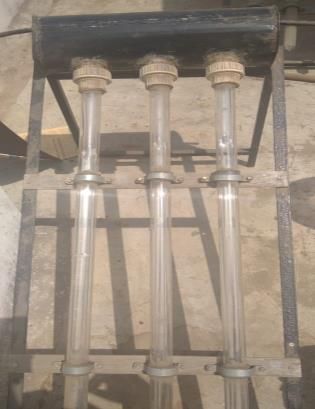
In the present work first of all three evacuated tubes made from 20 mm inner diameter and 40
mm outer diameter glass with 1 m length are fabricated. These three tubes are connected with water
tank made from mild steel with black coating having dimension s of 6” diameter and 15” length from
where cold and hot water is recalculated in the system as per the principle of convective current. The
twisted stripes with 1 m 950 mm length and 18 mm diameter with pitch of 1.5” are inserted in the
evacuated tubes of another set up with same all other dimension to make flow turbulent. The ‘K’ type
thermocouples are used to measure the temperature of water temperatures at inlet and outlet as well as
body temperature too. The measuring flask with capacity of 1000 ml is used to measure mass flow rate
water.
Fig. 1 - Experimental Set Up; Fig. 2 - Evacuated Tube with Twisted Tape
ISSN: 2237-0722 1844
Vol. 11 No. 3 (2021)
Received: 02.05.2021 – Accepted: 18.05.20213. Result and Discussion
Fig. 3 - Temperature Variation for Low Flow Rate
50
45
40
35 Temp Variation in 20 mm
30 dia Tube witout Tiwsted
25 Tape
20 Temp variation in 18 mm
15 dia tube with twisted
10 Tape
5
0
10:15 10:45 11:15 11:45 12:15 12:45 13:15 13:45 14:15
Fig.4 - Temperature Variation for Medium Flow Rate
50
45
40
35 Temp Variation in 20 mm
30 dia Tube witout Tiwsted
25 Tape
20 Temp variation in 18 mm
15 dia tube with twisted
10 Tape
5
0
10:15 10:45 11:15 11:45 12:15 12:45 13:15 13:45 14:15
Fig. 5 - Temperature Variation for High Flow Rate
Effect of Inner Tube Diameter on Temperature
50
40
Temp Variation in 20 mm
30 dia Tube witout Tiwsted
Tape
20 Temp variation in 18 mm
dia tube with twisted
10 Tape
0
10:15 10:45 11:15 11:45 12:15 12:45 13:15 13:45 14:15
ISSN: 2237-0722 1845
Vol. 11 No. 3 (2021)
Received: 02.05.2021 – Accepted: 18.05.2021Table 1 - Mass Flow Rate of Water for Solar Water Heater
Flow Time Required to fill 1000ml Flask (s) Flow Rate (lps)
Low 735 0.00136
Medium 695 0.00144
High 617 0.00162
1. It is obvious from observation that the temperature gain of H2O at low and mid flow rates is
greater in both the circumstances than at high flow rates, owing to the longer retention period,
which raises the temperature of the water.
2. Because this is a small experimental model of 10 lt capacity and has no protecting glass sheet
and no black coating, the temperature gain is almost 1 to 1.5 0C in all circumstances.
3. In comparison to without twisted tape, higher temperature rise will be obtained with twisted tape
due to turbulence in the flow and tiny inner diameters, which improve heat transfer area.
4. Conclusion
• Heat will be collected more efficiently via the evacuated tube.
• Because the evacuated tube generates a vacuum in the annular space, the solar water heater must
not waste heat from the water to the air due to convection.
• There will be higher heat transmission due to the inclusion of twisted tape because water going
via swirling action creates turbulence in the flow.
References
Foued Chabane, Nourddine Moummi, Said Benramache, Effect of the Tilt Angle of Natural Convection
in A Solar Collector with Internal Longitudinal Fins, International Journal of Science and Engineering
Investigations, vol. 1, issue 7, August 2012, pp. 13-17.
U. K. Nayak S. C. Roy, M K Paswan, A. K. Gupta, Heat Transfer and Flow Friction Characteristics of
Solar Water Heater with Inserted Baffle Inside Tube, International Journal of Mechanical Engineering
and Technology (IJMET), Volume 5, Issue 4, April (2014), pp. 16-22
S. Rajasekaran, M. Chandrasekar, T. Senthil Kumar, Performance Analysis of Coated Solar Flat Plate
Collector, International Conference on Energy Efficient Technologies For Automobiles, Special Issue
6: March 2015, pp 240-243.
R. Meenakshi Reddy, N. Nallusamy, and K. Hemachandra Reddy, Experimental Studies on Phase
Change Material-Based Thermal Energy Storage System for Solar Water Heating Applications,
Journal of Fundamentals of Renewable Energy and Applications Vol. 2 (2012). Pp 1-6.
Hussain Al-Madani, The performance of a cylindrical solar water heater, Renewable Energy 31 (2006)
1751–1763.
ISSN: 2237-0722 1846
Vol. 11 No. 3 (2021)
Received: 02.05.2021 – Accepted: 18.05.2021Chii-Dong Ho, Tsung-Ching Chen, Cheng-Jung Tsai, Experimental and theoretical studies of recyclic flat-plate solar water heaters equipped with rectangle conduits, Renewable Energy 35 (2010) 2279-2287. Anand Patel and Sadanand Namjoshi, “Phase change material based solar water heater,” International Journal of Engineering Science Invention., vol. 5, no. 8, August 2016. PP. 31-34. Patel A, Parmar H, Namjoshi S 2016 Comparative thermal performance studies of serpentine tube solar water heater with straight tube solar water heater. IOSR Journal of Mechanical and Civil Engineering (IOSR-JMCE) 13 79–83. Anand Patel, Divyesh Patel, Sadananad Namjoshi Thermal Performance Analysis of Helical Solar Water Heater, International Journal of Innovative Technology and Exploring Engineering (IJITEE) ISSN: 2278-3075, Volume-5 Issue-3, August 2015. PP 67-69. Sharad B. Parekh, Ripen Shah, Performance Evaluation of Polycarbonate Collector based Solar Water Heating System, International Journal for Technological Research in Engineering Volume 1, Issue 5, January – 2014, 2347 – 4718 Sethuraman Ramasamy and Pakkirisamy Balashanmugam, Thermal Performance Analysis of the Solar Water Heater with Circular and Rectangular Absorber Fins, IJISET - International Journal of Innovative Science, Engineering & Technology, Vol. 2, Issue 1, January 2015, pp 233-236 Vimal Dimri, Bikash Sarkar, Usha Singh, G.N. Tiwari, Effect of condensing cover material on yield of an active solar still: an experimental validation. Desalination 227 (2008) 178-189 P. P. Patil, Dr. D.S. Deshmukh. Design Considerations for Flat Plate Solar Water Heater System Vol.3, No. 2, June 2015 ISSN (Print) 2277—7261. ISSN: 2237-0722 1847 Vol. 11 No. 3 (2021) Received: 02.05.2021 – Accepted: 18.05.2021
You can also read


