Efficient Masked Face Recognition Method during the COVID-19 Pandemic
←
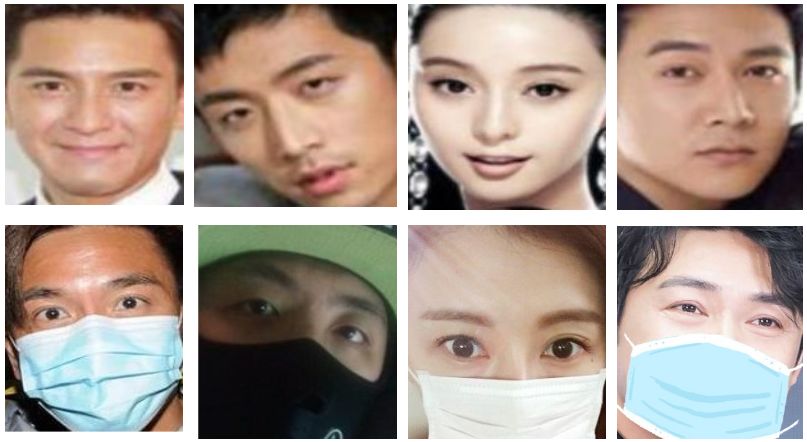
→
Page content transcription
If your browser does not render page correctly, please read the page content below
manuscript No.
                                        (will be inserted by the editor)

                                        Efficient Masked Face Recognition Method during the
                                        COVID-19 Pandemic
                                        Walid Hariri
arXiv:2105.03026v1 [cs.CV] 7 May 2021

                                        Received: date / Accepted: date

                                        Abstract The coronavirus disease (COVID-19) is an            1 Introduction
                                        unparalleled crisis leading to a huge number of casu-
                                        alties and security problems. In order to reduce the         The COVID-19 can be spread through contact and con-
                                        spread of coronavirus, people often wear masks to pro-       taminated surfaces, therefore, the classical biometric
                                        tect themselves. This makes face recognition a very dif-     systems based on passwords or fingerprints are not any-
                                        ficult task since certain parts of the face are hidden. A    more safe. Face recognition is safer without any need to
                                        primary focus of researchers during the ongoing coron-       touch any device. Recent studies on coronavirus have
                                        avirus pandemic is to come up with suggestions to han-       proven that wearing a face mask by a healthy and in-
                                        dle this problem through rapid and efficient solutions.      fected population reduces considerably the transmis-
                                        In this paper, we propose a reliable method based on         sion of this virus. However, wearing the mask face causes
                                        occlusion removal and deep learning-based features in        the following problems: 1) fraudsters and thieves take
                                        order to address the problem of the masked face recog-       advantage of the mask, stealing and committing crimes
                                        nition process. The first step is to remove the masked       without being identified. 2) community access control
                                        face region. Next, we apply three pre-trained deep Con-      and face authentication have become very difficult tasks
                                        volutional Neural Networks (CNN) namely, VGG-16,             when a grand part of the face is hidden by a mask.
                                        AlexNet, and ResNet-50, and use them to extract deep         3) existing face recognition methods are not efficient
                                        features from the obtained regions (mostly eyes and          when wearing a mask which cannot provide the whole
                                        forehead regions). The Bag-of-features paradigm is then      face image for description. 4) exposing the nose region
                                        applied to the feature maps of the last convolutional        is very important in the task of face recognition since
                                        layer in order to quantize them and to get a slight repre-   it is used for face normalization [24], pose correction
                                        sentation comparing to the fully connected layer of clas-    [18], and face matching [13]. Due to these problems,
                                        sical CNN. Finally, Multilayer Perceptron (MLP) is ap-       face masks have significantly challenged existing face
                                        plied for the classification process. Experimental results   recognition methods.
                                        on Real-World-Masked-Face-Dataset show high recog-               To tackle these problems, we distinguish two dif-
                                        nition performance compared to other state-of-the-art        ferent tasks namely: face mask recognition and masked
                                        methods.                                                     face recognition. The first one checks whether the per-
                                                                                                     son is wearing a mask or no. This can be applied in
                                                                                                     public places where the mask is compulsory. Masked
                                        Keywords Face recognition · COVID-19 · Masked                face recognition, on the other hand, aims to recognize
                                        face · Deep learning.                                        a face with a mask basing on the eyes and the forehead
                                                                                                     regions. In this paper, we handle the second task using a
                                                                                                     deep learning-based method. We use a pre-trained deep
                                        Walid Hariri
                                                                                                     learning-based model in order to extract features from
                                        Labged Laboratory, Computer Science department               the unmasked face regions (out of the mask region).
                                        Badji Mokhtar Annaba University                              It is worth stating that the occlusions in our case can
                                        E-mail: hariri@labged.net                                    occur in only one predictable facial region (nose and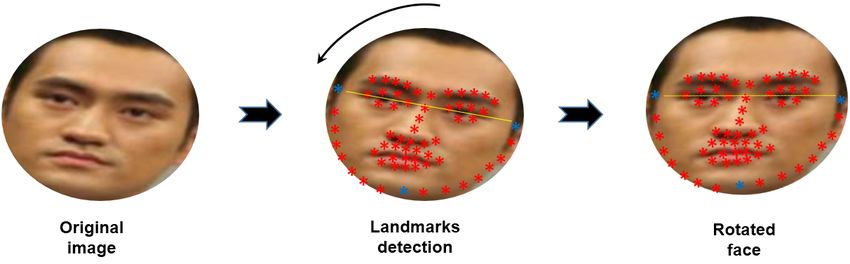
2                                                                                                           Walid Hariri

mouth regions), this can be a good guide to handle this       ones. For instance, Bagchi et al. [4] proposed to restore
problem efficiently.                                          facial occlusions. The detection of the occluded regions
    The rest of this paper is organized as follows: Section   is carried out by thresholding the depth map values
2 presents the related works. In Section 3 we present the     of the 3D image. Then the restoration is taken on by
motivation and contribution of the paper. The proposed        Principal Component Analysis (PCA) [31]. There are
method is detailed in Section 4. Experimental results         also several approaches that rely on the estimation of
are presented in Section 5. Conclusion ends the paper.        the occluded parts. Drira et al. [6] applied a statistical
                                                              shape model to predict and restore the partial facial
                                                              curves. Iterative closest point (ICP) algorithm has been
2 Related works
                                                              used to remove occluded regions in [8]. The restoration
                                                              is applied using a curve, which uses a statistical es-
Occlusion is a key limitation of real-world 2D face recog-
                                                              timation of the curves to manage the occluded parts.
nition methods. Generally, it comes out from wearing
                                                              Partially observed curves are completed by using the
hats, eyeglasses, masks as well as any other objects that
                                                              curves model produced through the PCA technique.
can occlude a part of the face while leaving others un-
affected. Thus, wearing a mask is considered the most
difficult facial occlusion challenge since it occludes a          Occlusion removal approach: In order to avoid
grand part of the face including the nose. Many ap-           a bad reconstruction process, these approaches aim to
proaches have been proposed to handle this problem.           detect regions found to be occluded in the face image
We can classify them into three categories namely: lo-        and discard them completely from the feature extrac-
cal matching approach, restoration approach, and oc-          tion and classification process. Segmentation based ap-
clusion removal approach.                                     proach is one of the best methods that detect firstly the
    Matching approach: Aims to compare the simi-              occluded region part and using only the non-occluded
larity between images using a matching process. Gener-        part in the following steps. For instance, Priya and
ally, the face image is sampled into a number of patches      Banu [26] divided the face image into small local patches.
of the same size. Feature extraction is then applied to       Next, to discard the occluded region, they applied the
each patch. Finally, a matching process is applied be-        support vector machine classifier to detect them. Fi-
tween probe and gallery faces. The advantage of this ap-      nally, a mean-based weight matrix is used on the non-
proach is that the sampled patches are not overlapped,        occluded regions for face recognition. Alyuz et al. [3] ap-
which avoids the influence of occluded regions on the         plied an occlusion removal and restoration. They used
other informative parts. For example, Martinez et aleix.      the global masked projection to remove the occluded
[20] sampled the face region into a fixed number of local     regions. Next, the partial Gappy PCA is applied for
patches. matching is then applied for similarity mea-         the restoration using eigenvectors.
sure.
    Other methods detect the keypoints from the face             Since the publication of AlexNet architecture in 2012
image, instead of local patches. For instance, Weng et        by Krizhevsky et al. [14], deep CNN have become a
al. [30] proposed to recognize persons of interest from       common approach in face recognition. It has also been
their partial faces. To accomplish this task, they firstly    successfully used in face recognition under occlusion
detected keypoints and extract their textural and ge-         variation [2]. It is seen that the deep learning-based
ometrical features. Next, point set matching is carried       method are founded on the fact that the human visual
out to match the obtained features. Finally, the sim-         system automatically ignores the occluded regions and
ilarity of the two faces is obtained through the dis-         only focuses on the non-occluded ones. For example,
tance between these two aligned feature sets. Keypoint        Song et al. [28] proposed a mask learning technique in
based matching method is introduced in Duan et al. [7].       order to discard the feature elements of the masked re-
SIFT keypoint descriptor is applied to select the ap-         gion for the recognition process.
propriate keypoints. Gabor ternary pattern and point
set matching are then applied to match the local key-             Inspired by the high performance of CNN based
points for partial face recognition. In contrast to the       methods that have strong robustness to illumination,
above-mentioned methods based on fixed-size patches           facial expression, and facial occlusion changes, we pro-
matching or keypoints detection, McLaughlin et al. [21]       pose in this paper an occlusion removal approach and
applied the largest matching area at each point of the        deep CNN based model to address the problem of masked
face image without any sampling.                              face recognition during the COVID-19 pandemic. Mo-
    Restoration approach: Here, the occluded regions          tivations and more details about the proposed method
in the probe faces are restored according to the gallery      are presented in the following sections.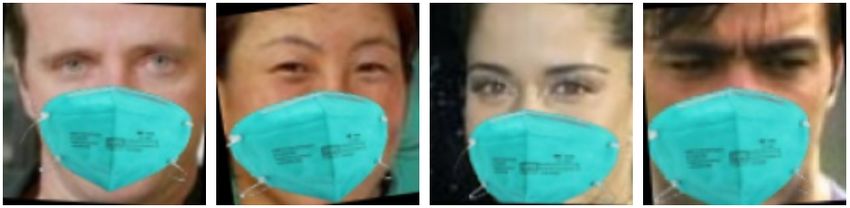
Efficient Masked Face Recognition Method during the COVID-19 Pandemic                                                 3

3 Motivation and contribution of the paper

Motivated by the efficiency and the facility of the oc-
clusion removal approaches, we apply this strategy to
discard the masked regions. Experimental results are
carried out on Real-world Masked Face Recognition
Dataset (RMFRD) and Simulated Masked Face Recog-
nition Dataset (SMFRD) presented in [29]. We start by               Fig. 1: Overview of the proposed method.
localizing the mask region. To do so, we apply a crop-
ping filter in order to obtain only the informative re-
gions of the masked face (i.e. forehead and eyes). Next,
we describe the selected regions using a pre-trained
deep learning model as a feature extractor. This strat-
egy is more suitable in real-world applications com-
paring to restoration approaches. Recently, some works
have applied supervised learning on the missing region
to restore them such as in [5]. This strategy, however,                      Fig. 2: 2D Face rotation.
is a difficult and highly time-consuming process.
    Despite the recent breakthroughs of deep learning
architectures in pattern recognition tasks, they need to
estimate millions of parameters in the fully connected
layers that require powerful hardware with high pro-
cessing capacity and memory. To address this problem,
we present in this paper an efficient quantization based
pooling method for face recognition using three pre-            Fig. 3: (1): Masked face. (2): Sampling the masked
trained models. To do so, we only consider the feature           face image into 100 regions of the same size. (3):
maps at the last convolutional layers (also called chan-                          Cropping filter.
nels) using Bag-of-Features (BoF) paradigm.
    The basic idea of the classical BoF paradigm is to
represent images as orderless sets of local features. To      a differentiable quantization scheme that enables simul-
get these sets, the first step is to extract local features   taneous training of both the quantizer and the rest of
from the training images, each feature represents a re-       the network, instead of using fixed quantization merely
gion from the image. Next, the whole features are quan-       to minimize the model size [23]. It is worth stating that
tized to compute a codebook. Test image features are          our proposed method doesn’t need to be trained on
then assigned to the nearest code in the codebook to          the mission region after removing the mask. It instead
be represented by a histogram. In the literature, the         improves the generalization of the face recognition pro-
BoF paradigm has been largely used for handcrafted            cess in the presence of the mask during the pandemic
feature quantization [16] to accomplish image classifi-       of coronavirus.
cation tasks. A comparative study between BoF and
deep learning for image classification has been made in
Loussaief and Abdelkrim [17]. To take full advantage          4 The proposed method
of the two techniques, in this paper we can consider
                                                              Fig. 1 presents an overview of the proposed method. It
BoF as a pooling layer in our trainable convolutional
                                                              has four steps:
layers. This aims to reduce the number of parameters
and makes it possible to classify masked face images.
    This deep quantization technique presents many ad-        4.1 Preprocessing and cropping filter
vantages. It ensures a lightweight representation that
makes the real-world masked face recognition process a        The images of the used dataset are already cropped
feasible task. Moreover, the masked regions vary from         around the face, so we don’t need a face detection stage
one face to another, which leads to informative images        to localize the face from each image. However, we need
of different sizes. The proposed deep quantization al-        to correct the rotation of the face so that we can re-
lows classifying images from different sizes in order to      move the masked region efficiently. To do so, we detect
handle this issue. Besides, the Deep BoF approach uses        68 facial landmarks using Dlib-ml open-source library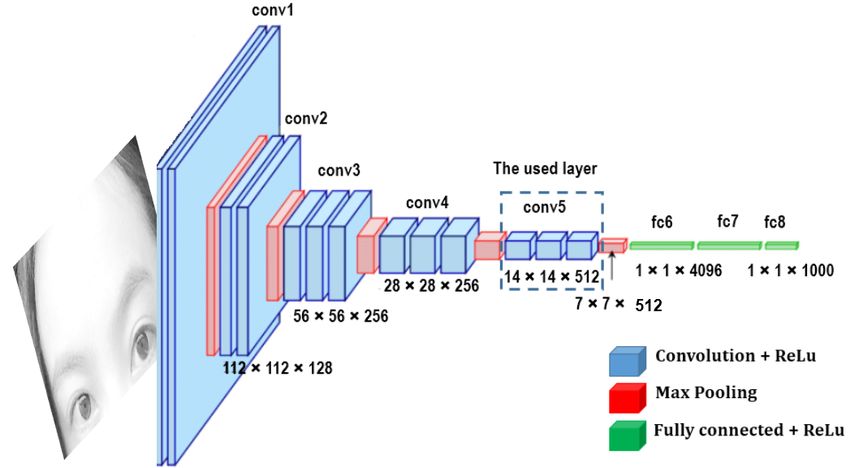
4                                                                                                          Walid Hariri

introduced in [12]. According to the eye locations, we
apply a 2D rotation to make them horizontal as pre-
sented in Fig. 2.
    The next step is to apply a cropping filter in order
to extract only the non-masked region. To do so, we
firstly normalize all face images into 240 × 240 pixels.
Next, we partition a face into blocks. The principle of
this technique is to divide the image into 100 fixed-size
square blocks (24 × 24 pixels in our case). Then we
extract only the blocks including the non-masked region
                                                              Fig. 4: VGG-16 network architecture introduced in
(blocks from number 1 to 50). Finally, we eliminate the
                                                                                   [27].
rest of the blocks as presented in Fig. 3.

4.2 Feature extraction layer

To extract deep features from the informative regions,
we have employed three pre-trained models as feature
extractors:

VGG-16: [27] is trained on the ImageNet dataset which
has over 14 million images and 1000 classes. Its name          Fig. 5: AlexNet network architecture introduced in
VGG-16 comes from the fact that it has 16 layers. It                                 [15].
contains different layers including convolutional layers,
Max Pooling layers, Activation layers, and Fully Con-
nected (fc) layers. There are 13 convolutional layers, 5
Max Pooling layers, and 3 Dense layers which sum up
to 21 layers but only 16 weight layers. In this work, we
choose the VGG-16 as the base network, and we only
consider the feature maps (FMs) at the last convolu-
tional layer, also called channels. This layer is employed   Fig. 6: ResNet-50 network architecture introduced in
as a feature extractor and will be used for the quanti-               [10]. The extracted DRF are shown.
zation in the following stage. Fig. 4 presents VGG-16
architecture.
                                                             4.3 Deep bag of features layer
AlexNet: has been successfully employed for image
classification tasks [15]. This deep model is pre-trained    From the ith image, we extract feature maps using the
on a few millions of images from the ImageNet database       feature extraction layer described above. In order to
through eight learned layers, five convolutional layers      measure the similarity between the extracted feature
and three fully-connected layers. The last fully-connected   vectors and the codewords also called term vector, we
layer allows to classify one thousand classes. The fifth     applied the RBF kernel as similarity metric as proposed
convolutional layer is used in this paper to extract deep    in [23]. Thus, the first sub-layer will be composed of
features (See Fig. 5).                                       RBF neurons, each neuron is referred to a codeword.
                                                                 As presented in Fig. 1, the size of the extracted fea-
ResNet-50: [10] has been successfully used in various        ture map defines the number of the feature vectors that
pattern recognition tasks such as face and pedestrian        will be used in the BoF layer. Here we refer by Vi to the
detection [22]. It containing 50 layers trained on the Im-   number of feature vectors extracted from the it h image.
ageNet dataset. This network is a combination of Resid-      For example, if we have 10 × 10 feature maps from
ual network integrations and Deep architecture parsing.      the last convolutional layer of the chosen pre-trained
Training with ResNet-50 is faster due to the bottleneck      model, we will have 100 feature vectors to feed the
blocks. It is composed of five convolutional blocks with     quantization step using the BoF paradigm. To build
shortcuts added between layers. The last convolution         the codebook, the initialization of the RBF neurons
layer is used to extract Deep Residual Features (DRF).       can be carried out manually or automatically using all
Fig. 6 shows the architecture of the ResNet-50 model.        the extracted feature vectors overall the dataset. The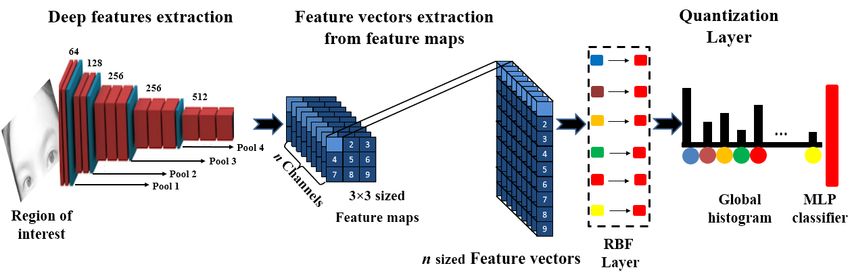
Efficient Masked Face Recognition Method during the COVID-19 Pandemic                                                     5

most used automatic algorithm is of course k-means.               following, we present the datasets’ content and varia-
Let F the set of all the feature vectors, defined by:             tions, the experimental results using the quantization of
F = {Vij , i = 1 . . . V, j = 1 . . . Vi } and Vk is the number   deep features obtained from three pre-trained models,
of the RBF neurons centers referred by ck . Note that             and a comparative study with other state-of-the-arts.
these RBF centers are learned afterward to get the final
codewords. The quantization is then applied to extract
the histogram with a predefined number of bins, each
bin is referred to a codeword. RBF layer is then used as          5.1 Dataset description
a similarity measure, it contains 2 sub-layers:
    (I) RBF layer: measures the similarity of the in-             Real-World-Masked-Face-Dataset [29] is a masked
put features of the probe faces to the RBF centers. For-          face dataset devoted mainly to improve the recognition
mally: the j th RBF neuron φ(Xj ) is defined by Eq.(1):           performance of the existing face recognition technology
                                                                  on the masked faces during the COVID-19 pandemic.
                                                                  It contains three types of images namely, Masked Face
φ(Xj ) = exp(kx − cj k2 /σj ),                             (1)    Detection Dataset (MFDD), Real-world Masked Face
                                                                  Recognition Dataset (RMFRD), and Simulated Masked
    Where x is a feature vector and cj is the center of           Face Recognition Dataset (SMFRD). In this paper, we
the j th RBF neuron.                                              focus on the last two datasets described in the following.
    (II) Quantization layer: the output of all the
RBF neurons is collected in this layer that contains the
histogram of the global quantized feature vector that              a) RMFRD is one of the richest real-world masked
will be used for the classification process. The final his-       face datasets. It contains 5,000 images of 525 subjects
togram is defined by Eq.(2), where φ(V ) is the output            with masks, and 90,000 images without masks which
vector of the RBF layer over the ck bins.                         represent 525 subjects. A semi-automatic annotation
                                                                  strategy has been used to crop the informative face
          N
          X
           k                                                      parts. Fig. 7 presents some pairs of face images from
hi = Vj        φ(Vjk )                                     (2)    RMFRD dataset.
          k

                                                                   b) SMFRD contains 500,000 simulated masked faces
4.4 Fully connected layer and classification
                                                                  of 10,000 subjects from two known datasets Labeled
                                                                  Faces in the Wild (LFW) [11] and Webface [32]. The
Once the global histogram is computed, we pass to the
                                                                  simulation is carried out using Dlib library [1]. This
classification stage to assign each test image to its iden-
                                                                  dataset is balanced but more challenging since the sim-
tity. To do so, we apply the Multilayer perceptron clas-
                                                                  ulated masks are not necessarily in the right position.
sifier (MLP) where each face is represented by a term
                                                                  Fig. 8 shows some examples of simulated masked faces
vector. Deep BoF network can be trained using back-
                                                                  from SMFRD dataset.
propagation and gradient descent. Note that the 10-fold
cross-validation strategy is applied in our experiments
on the RMFRD dataset. We note V = [v1, . . . , vk ] the
term vector of each face, where each vi refers to the
occurrence of the term i in the given face. t is the num-
ber of attributes, and m is the number of classes (face
identities). Test faces are defined by their codeword V .
MLP uses a set of term occurrences as input values (vi )
and associated weights (wi ) and a sigmoid function (g)
that sums the weights and maps the results to output
(y). Note that the number of hidden layers used in our
experiments is given by: m+t 2 .

5 Experimental results                                            Fig. 7: Pairs of face images from RMFRD dataset: face
                                                                  images without a mask (up) and with a mask (down).
To evaluate the proposed method, we carried out exper-
iments on very challenging masked face datasets. In the
6 Walid Hariri
Table 1: Recognition performance on RMFRD dataset
using four codebook sizes.
Method Size 1 Size 2 Size 3 Size 4
term vectors 50 60 70 100
VGG-16 model
Conv5 FM1
88.5% 89.2% 87.1% 87.5%
14×14×512
Fig. 8: Masked faces from SMFRD dataset.
Conv5 FM2
90.8% 87.4% 87.2% 88.0%
14×14×512
Conv5 FM3
91.0% 91.3% 90.1% 89.8%
14×14×512
5.2 Method performance AlexNet model
Conv5 FM
84.3% 85.7% 85.9% 86.6%
13 × 13 × 256
The face images were firstly preprocessed as described
ResNet-50 model
in Section 4.1. In contrast to SMFRD dataset, RM- Conv5 FM
87.4% 87.9% 89.5% 89.3%
FRD is imbalanced (5,000 masked faces vs 90,000 non- 7×7×2048
masked faces). Therefore, we have applied an over-sampling
by cropping some non-masked faces to get an equiva- Table 2: Recognition performance on SMFRD dataset
lent number of cropped and full faces. Next, using the using four codebook sizes.
normalized 2D faces, we employ the three pre-trained
Method Size 1 Size 2 Size 3 Size 4
models (VGG-16, AlexNet and ResNet-50) separately term vectors 50 60 70 100
to extract deep features from their last convolutional VGG-16 model
Conv5 FM1
layers as presented in Section 4.2. The output features 82.4% 83.7% 84.5% 84.7%
14×14×512
are (14 × 14 × 512, 13 × 13 × 256, 7 × 7 × 2048) dimen- Conv5 FM2
83.1% 83.5% 85.0% 85.4%
14×14×512
sional, respectively. Conv5 FM3
81.7% 81.3% 84.4% 85.6
14×14×512
The quantization is then applied to extract the his-
AlexNet model
togram of a number of bins as presented in Section 4.3. Conv5 FM
83.7% 83.9% 84.2% 86.0%
Finally, MLP is applied to classify faces as presented 13 × 13 × 256
in Section 4.4. In this experiment, the 10-fold cross- ResNet-50 model
Conv5 FM
validation strategy is used to evaluate the recognition 7×7×2048
83.5% 84.7% 88.9% 88.5%
performance. The experiments are repeated ten times
in RMFRD and SMFRD datasets separately, where 9
samples are used as the training set and the remaining 5.3 Performance comparison
sample as the testing set, and the average results are
calculated. To further evaluate the performance of our proposed
Table 1 reports the classification rates on the RM- method, we have compared the obtained experimental
FRD dataset using four different sizes of the codebook results with those of other face recognizers on the RM-
(i.e. number of codewords in RBF layer) by (i.e. 50, 60, FRD and SMFRD datasets as follows:
70, 100 term vectors per image). We can see that the
best recognition rate is obtained using the third FMs in Comparison with transfer learning-based tech-
the last convolutional layer from VGG-16 with 60 code- nique: We have tested the face recognizer presented
words by 91.3%. The second FMs achieved 90.8% with in [19] that achieved a good recognition accuracy on
50 codewords and outperformed the first FMs over the two subsets of the FERET database [25]. This tech-
four codeword sizes. AlexNet, on the other hand, real- nique is based on transfer learning (TL) which em-
ized 86.6% with 100 codewords where the best recog- ploys pre-trained models and fine-tuning them to recog-
nition rate achieved by ResNet-50 was 89.5% with 70 nize masked faces from RMFRD and SMFRD datasets.
codewords. In this experiment, it is clear that VGG-16 The reported results in Table 3 show that the pro-
outperformed the AlexNet and ResNet-50 models. posed method outperformed the TL-based method on
Table 2 reports the classification rates on the SM- the RMFRD and SMFRD datasets.
FRD dataset. The highest recognition rate is achieved
by the ResNet-50 through the quantization of DRF fea- Comparison with covariance-based technique:
tures by 88.9%. This performance is achieved using 70 Covariance-based features have been applied in [9] and
codewords that feed an MLP classifier. AlexNet model achieved high recognition performance on 3D datasets
realized good recognition rates comparing to the VGG- in the presence of occluded regions. We have employed
16 model (86.0% vs 85.6% as highest rates). this method using 2D-based features (texture, gray level,Efficient Masked Face Recognition Method during the COVID-19 Pandemic 7
LBP) to extract covariance descriptors. The evaluation 5.5 Discussion
on the RMFRD and SMFRD datasets confirms the su-
periority of the proposed method as shown in Table 3. The obtained high accuracy compared to other face rec-
ognizers is achieved due to the best features extracted
from the last convolutional layers of the pre-trained
Comparison with deep feature extractor: Another models, and the high efficiency of the proposed BoF
efficient face recognition method using the same pre- paradigm that gives a lightweight and more discrimi-
trained models (AlexNet and ResNet-50) is proposed native power comparing to classical CNN with softmax
in [2] and achieved a high recognition rate on various function. Moreover, dealing with only the unmasked re-
datasets. Nevertheless, the pre-trained models are em- gions, the high generalization of the proposed method
ployed in a different manner. It consists of applying a makes it applicable in real-time applications. Other meth-
TL technique to fine-tune the pre-trained models to the ods, however, aim to unmask the masked face using gen-
problem of masked face recognition using an SVM clas- erative networks such as in [5]. This strategy is a greedy
sifier. We have tested the this strategy on the masked task and not preferable for real-world applications.
faces. The results in Table 3 further demonstrate the The efficiency of each pre-trained model depends
efficiency of the BoF paradigm compared to the use of on its architecture and the abstraction level of the ex-
a machine learning-based classifier directly. tracted features. When dealing with real masked faces,
VGG-16 has achieved the best recognition rate, while
ResNet-50 outperformed both VGG-16 and AlexNet on
Table 3: Performance comparison with state-of-the-art
the simulated masked faces. This behavior can be ex-
methods.
plained by the fact that VGG-16 features fail to ensure
Method Dataset Technique Masks Accuracy a high discriminative power comparing to the DRF fea-
Luttrell et al. [19] RMFRD TL yes 85.7% tures that are still relatively steady compared to their
Hariri et al. [9] RMFRD Covariance yes 84.6%
Almabdy et al. [2] RMFRD CNN+SVM yes 87.0% results on the real masked faces. When dealing with
Our RMFRD CNN+BoF yes 91.3% other state-of-the-art recognizers, one of them applied
Luttrell et al. [19] SMFRD TL yes 83.3% the same pre-trained models with a different strategy.
Hariri et al. [9] SMFRD Covariance yes 83.8%
Almabdy et al. [2] SMFRD CNN+SVM yes 86.1%
The proposed method outperformed TL-based method
Our SMFRD CNN+BoF yes 88.9% using the same pre-trained models. This performance
is explained by the fact that the fc layers of the pre-
trained models are more dataset-specific features (gen-
erally pre-trained on ImageNet dataset) which is a very
different dataset, thus, this strategy is not always suit-
able for our task. Moreover, the proposed method out-
5.4 Computation and training times comparison
performed previous methods in terms of training time.
The achieved performance further confirms that the
The comparison of the computation times between the
BoF paradigm is a slight representation that further
proposed method and Almabdy et al.’s method [2] shows
reinforces the high discrimination power of the deep
that the use of the BoF paradigm decreases the time
features to feed a machine learning-based classifier.
required to extract deep features and to classify the
masked faces (See Table 4). Note that this comparison
is performed using the same pre-trained models (VGG- 6 Conclusion
16 and AlexNet) on the RMFRD dataset. AlexNet is
lowest training and testing time compared to VGG-16 The proposed method improves the generalization of
with less GPU memory usage. the face recognition process in the presence of the mask.
To accomplish this task, we proposed a deep learning-
based method and quantization-based technique to deal
Table 4: Training and testing time on the RMFRD with the recognition of the masked faces. We employed
dataset in milliseconds. three pre-trained models and used their last convolu-
Method AlexNet VGG-16 tional layers as deep features. The Bof paradigm is
Almabdy et al. [2]
train:550 train:930 applied to quantize the obtained features and to feed
test:34 test:120
train: 308 Train:605
an MLP classifier. The proposed method outperformed
Our
test:21 test:84 other state-of-the-art methods in terms of accuracy and
time complexity. The proposed method can also be ex-
tended to richer applications such as video retrieval and8 Walid Hariri
surveillance. In future work, we look at the application 15. A. Krizhevsky, I. Sutskever, and G. E. Hinton. Imagenet
of deep ensemble models with additional pre-trained classification with deep convolutional neural networks.
Communications of the ACM, 60(6):84–90, 2017.
models to enhance the accuracy. 16. H. Lobel, R. Vidal, D. Mery, and A. Soto. Joint dictio-
nary and classifier learning for categorization of images
using a max-margin framework. In Pacific-Rim Sym-
7 Acknowledgments posium on Image and Video Technology, pages 87–98.
Springer, 2013.
17. S. Loussaief and A. Abdelkrim. Deep learning vs. bag
The authors would like to thank DGRSDT, Algeria. of features in machine learning for image classification.
In 2018 International Conference on Advanced Systems
and Electric Technologies (IC ASET), pages 6–10. IEEE,
References 2018.
18. X. Lu, A. K. Jain, and D. Colbry. Matching 2.5 d face
scans to 3d models. IEEE transactions on pattern anal-
1. Dlib library. http://dlib.net/. [Accessed 02-January-
ysis and machine intelligence, 28(1):31–43, 2005.
2021].
19. J. Luttrell, Z. Zhou, Y. Zhang, C. Zhang, P. Gong,
2. S. Almabdy and L. Elrefaei. Deep convolutional neural
B. Yang, and R. Li. A deep transfer learning approach
network-based approaches for face recognition. Applied
to fine-tuning facial recognition models. In 2018 13th
Sciences, 9(20):4397, 2019.
IEEE Conference on Industrial Electronics and Applica-
3. N. Alyuz, B. Gokberk, and L. Akarun. 3-d face recog-
tions (ICIEA), pages 2671–2676. IEEE, 2018.
nition under occlusion using masked projection. IEEE 20. A. M. Martı́nez. Recognizing imprecisely localized, par-
Transactions on Information Forensics and Security, tially occluded, and expression variant faces from a single
8(5):789–802, 2013. sample per class. IEEE Transactions on Pattern analysis
4. P. Bagchi, D. Bhattacharjee, and M. Nasipuri. Robust 3d and machine intelligence, 24(6):748–763, 2002.
face recognition in presence of pose and partial occlusions 21. N. McLaughlin, J. Ming, and D. Crookes. Largest match-
or missing parts. arXiv preprint arXiv:1408.3709, 2014. ing areas for illumination and occlusion robust face recog-
5. N. U. Din, K. Javed, S. Bae, and J. Yi. A novel gan-based nition. IEEE transactions on cybernetics, 47(3):796–808,
network for unmasking of masked face. IEEE Access, 2016.
8:44276–44287, 2020. 22. H. Mliki, S. Dammak, and E. Fendri. An improved multi-
6. H. Drira, B. Ben Amor, A. Srivastava, M. Daoudi, and scale face detection using convolutional neural network.
R. Slama. 3d face recognition under expressions, occlu- Signal Image and Video Processing, 2020.
sions, and pose variations. Pattern Analysis and Ma- 23. N. Passalis and A. Tefas. Learning bag-of-features pool-
chine Intelligence, IEEE Transactions on, 35(9):2270– ing for deep convolutional neural networks. In Proceed-
2283, 2013. ings of the IEEE international conference on computer
7. Y. Duan, J. Lu, J. Feng, and J. Zhou. Topology preserv- vision, pages 5755–5763, 2017.
ing structural matching for automatic partial face recog- 24. X. Peng, M. Bennamoun, and A. S. Mian. A training-
nition. IEEE Transactions on Information Forensics and free nose tip detection method from face range images.
Security, 13(7):1823–1837, 2018. Pattern Recognition, 44(3):544–558, 2011.
8. A. S. Gawali and R. R. Deshmukh. 3d face recognition us- 25. P. J. Phillips, H. Wechsler, J. Huang, and P. J. Rauss.
ing geodesic facial curves to handle expression, occlusion The feret database and evaluation procedure for face-
and pose variations. International Journal of Computer recognition algorithms. Image and vision computing,
Science and Information Technologies, 5(3):4284–4287, 16(5):295–306, 1998.
2014. 26. G. N. Priya and R. W. Banu. Occlusion invariant face
9. W. Hariri, H. Tabia, N. Farah, A. Benouareth, and D. De- recognition using mean based weight matrix and support
clercq. 3d face recognition using covariance based descrip- vector machine. Sadhana, 39(2):303–315, 2014.
tors. Pattern Recognition Letters, 78:1–7, 2016. 27. K. Simonyan and A. Zisserman. Very deep convolutional
10. K. He, X. Zhang, S. Ren, and J. Sun. Deep residual learn- networks for large-scale image recognition. arXiv preprint
ing for image recognition. In Proceedings of the IEEE arXiv:1409.1556, 2014.
conference on computer vision and pattern recognition, 28. L. Song, D. Gong, Z. Li, C. Liu, and W. Liu. Occlu-
pages 770–778, 2016. sion robust face recognition based on mask learning with
11. G. B. Huang, M. Mattar, T. Berg, and E. Learned-Miller. pairwise differential siamese network. In Proceedings of
Labeled faces in the wild: A database forstudying face the IEEE International Conference on Computer Vision,
recognition in unconstrained environments. 2008. pages 773–782, 2019.
12. D. E. King. Dlib-ml: A machine learning toolkit. The 29. Z. Wang, G. Wang, B. Huang, Z. Xiong, Q. Hong,
Journal of Machine Learning Research, 10:1755–1758, H. Wu, P. Yi, K. Jiang, N. Wang, Y. Pei, et al. Masked
2009. face recognition dataset and application. arXiv preprint
13. M. L. Koudelka, M. W. Koch, and T. D. Russ. A arXiv:2003.09093, 2020.
prescreener for 3d face recognition using radial symme- 30. R. Weng, J. Lu, and Y.-P. Tan. Robust point set match-
try and the hausdorff fraction. In 2005 IEEE Com- ing for partial face recognition. IEEE transactions on
puter Society Conference on Computer Vision and Pat- image processing, 25(3):1163–1176, 2016.
tern Recognition (CVPR’05)-Workshops, pages 168–168. 31. S. Wold, K. Esbensen, and P. Geladi. Principal compo-
IEEE, 2005. nent analysis. Chemometrics and intelligent laboratory
14. A. Krizhevsky, I. Sutskever, and G. E. Hinton. Imagenet systems, 2(1-3):37–52, 1987.
classification with deep convolutional neural networks. 32. D. Yi, Z. Lei, S. Liao, and S. Z. Li. Learning face repre-
In Advances in neural information processing systems, sentation from scratch. arXiv preprint arXiv:1411.7923,
pages 1097–1105, 2012. 2014.You can also read


