Electroweak Symmetry Breaking without a Higgs Boson
←
→
Page content transcription
If your browser does not render page correctly, please read the page content below
Electroweak
 Symmetry Breaking
without a Higgs Boson
            Elizabeth H. Simmons
           Michigan State University

1.   Introduction
2.   The Origin of Mass (and the Higgs)
3.   Chiral Symmetry Breaking: Technicolor
4.   Extra Dimensions: Higgsless Models
5.   Conclusions

             VIPP      July 29, 2010
Introduction:
Fundamental Particles and
 Fundamental questions
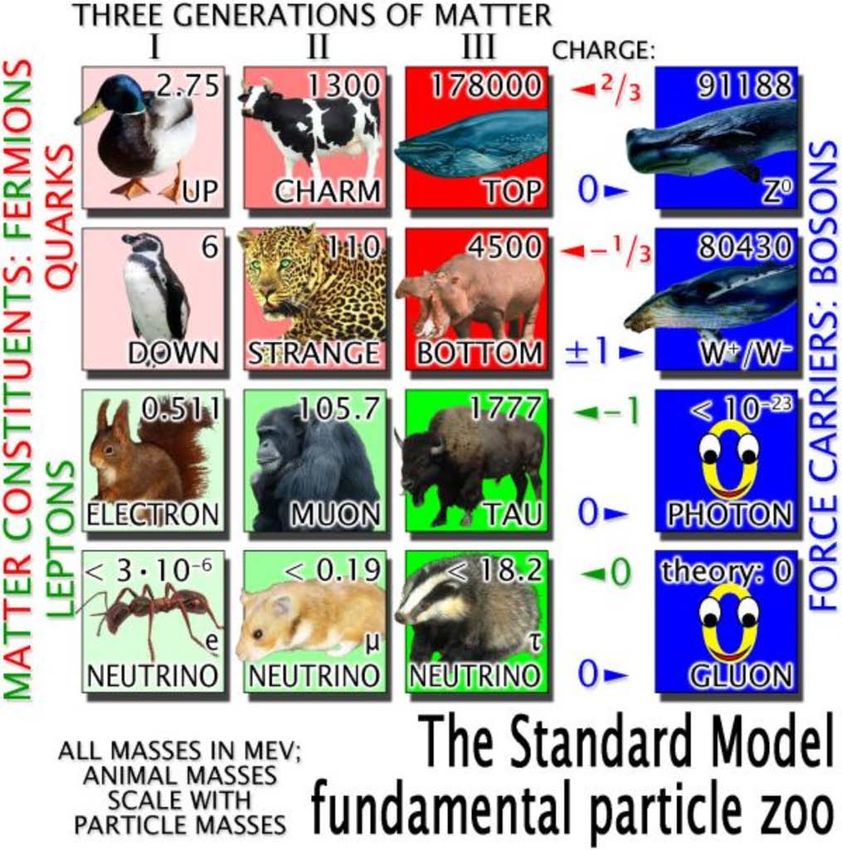
Subatomic Structure
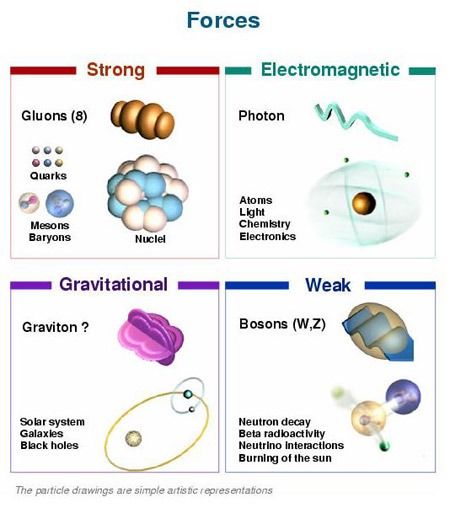
Force      SU(3)   QCD

Carriers                  U(1)
 (bosons)

                          SU(2)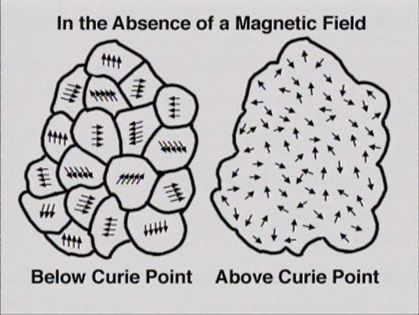
Matter
Particles
  (fermions)

  Each can exist
  in LH and RH
     chirality

LH (RH) version is
 charged (neutral)
   under weak
   interactions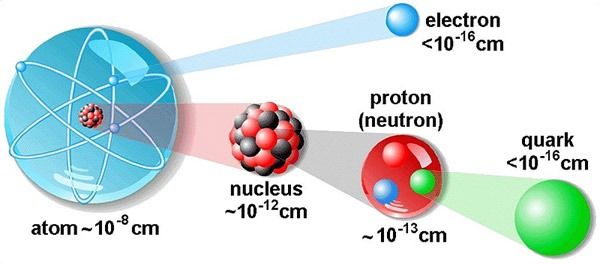
Questions
  About
  Broken
Symmetries

Flavor:
Why do fermions
with the same
charge have
different masses?

Electroweak:
Why are the W &
Z bosons heavy
while the photon
is massless?
                    e4.physik.uni-dortmund.de/bin/view/ATLAS/Bildergalerie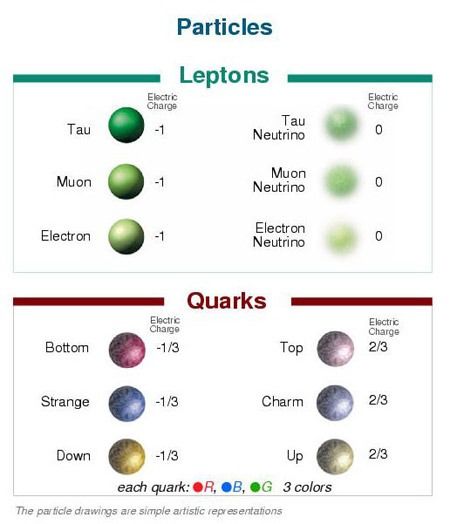
The Origin of Mass:
Electroweak Symmetry
Breaking and the Higgs

Gauge Boson Masses
Consider the masses of the electroweak gauge bosons:
    Mγ = 0     (2 transverse modes only)
    MW , MZ != 0 (2 transverse modes,
                 and 1 longitudinal)

An apparent contradiction exists:
  •   W  ±
           and  Z 0
                    are massive gauge bosons
  • mass implies a Lagrangian term W WµM  2
                                            W µ

   ... but such a term is not gauge-invariant
Resolving the contradiction:
The SU(2)W gauge symmetry is broken at the
energies our experiments have probed so far.

Relationship of SU(2) and U(1):
  • W bosons are electrically charged (±1) ,
  implying that the weak & electromagnetic
  forces are related
  •  U(1)EM is the low-energy remnant of a
  high-energy electroweak gauge symmetry
  SU(2)W x U(1)Y
  •   how to achieve this symmetry breaking?

Is the symmetry explicitly broken?
     i.e., do we just add a W mass term to the Lagrangian?

  No: consider high-energy WL WL        WL WL scattering

Unitarity would be violated (scattering probability > 100%)
         for scattering energies Ec.m. ~ 1000 GeV ...
                 so something is still missing.
Must have spontaneous symmetry breaking!
• Lagrangian is symmetric, but ground state is not
• a familiar example: ferromagnetism
jchemed.chem.wisc.edu/JCESoft/CCA/CCA2/INDEX.HTMThe SM Higgs
A fundamental (not composite) complex weak doublet
(4 degrees of freedom) of scalar (spin-0) fields
+
! "
φ
φ=
φ0
with potential energy function
! 2
"2
† v
V (φ) = λ φ φ −
2
is employed both to break the electroweak symmetry
and to generate masses for the fermions in the
Standard ModelNambu-Goldstone bosons provide MW and MZ
The potential is minimized away from
the origin, so the scalar acquires a
non-zero vacuum expectation value:
√
• !φ" = (0, v/ 2) breaks SU (2)W × U (1)Y → U (1)EM
• breaking this continuous symmetry yields 3 Nambu-
Goldstone bosons which become the L
W +
, W −
L , ZL
0
• the scalars’ kinetic energy term includes D µ †
φ Dµ φ
which now becomes
1 2 µ † 1 2 2 µ 1 2 µ
g W φ Wµ φ → g v W Wµ ≡ MW W Wµ
4 8 2
a mass term for the W and Z bosons!The remaining scalar (H = Higgs Boson)
resolves the unitarity problem:
including (d+e)Fermion Masses
The scalar doublet φ couples to fermions
as λf¯φ f , yielding two effects when the
electroweak symmetry breaks
• The fermion coupling to Nambu-Goldstone
modes produces masses for the fermions
√
mf = λ!φ" = λv/ 2
• The coupling of the remaining Higgs Boson (H)
to fermions allows the Higgs to be produced by
or decay to fermion pairs
f
- H
fPolar Decomposition
Put in matrix form by defining
φ φ̃ ≡ iσ2 φ∗
and Φ ≡ (φ̃,φ ) so that Φ† Φ =ΦΦ † = (φ† φ) I
A polar decomposition of Φ
1
Φ(x) = √ (H(x) + v) Σ(x)
2
Σ(x) = exp(iπ a (x)σ a /v)
neatly separates the radial “Higgs boson” from
the “pion” modes (Nambu-Goldstone Bosons).
In unitary gauge, !Σ" = IExcluded Excluded Excluded
Higgs massProblems with the Higgs Model
• No fundamental scalars observed in nature
• No explanation of dynamics responsible for
Electroweak Symmetry Breaking
• Hierarchy or Naturalness Problem
• Triviality Problem...Interim Conclusions • The electroweak symmetry is spontaneously broken. The three Nambu-Goldstone bosons of this broken continuous symmetry become the WL and ZL states. This process is known as the Higgs Mechanism. • Additional states must exist in order to unitarize the scattering of the WL and ZL bosons. One minimal candidate is the Higgs boson. • The Standard Model with a Higgs Boson is, at best, a low-energy effective theory valid below a scale Λ characteristic of the underlying physics. • What lies beyond the Standard Model?
A Fork in the Road...
• Make the Higgs Natural: Supersymmetry
• Make the Higgs Composite
   – Little Higgs
   – Twin Higgs
• Eliminate the Higgs
   – Technicolor
   – “Higgsless” Models
Chiral Symmetry Breaking:
        Technicolor
For a new approach to generating mass, we turn to
the strong interactions (QCD) for inspiration
Consider the hadrons composed of up and down quarks:
Why is the pion so light?Recall that the QCD coupling varies with energy scale,
becoming strong at energies ~ 1 GeV
.3
[coupling]2 .2
.1
0
1 10 100
Energy (GeV)The strong-interaction (QCD) Lagrangian for the
u and d quarks (neglecting their small masses)
/ uL + id¯L D
L = iūL D / uR + id¯R D
/ dL + iūR D / dR
displays an SU(2)L x SU(2)R global (“chiral”)
symmetry
When the QCD coupling becomes strong
• !q¯L qR " #= 0 breaks SU(2)L x SU(2)R SU(2)L+R
• pions (q̄L qR ) are the associated Nambu-
Goldstone bosons!Bonus: from chiral to electroweak symmetry breaking • uL,dL form weak doublet; uR,dR are weak singlets • so !q¯L qR " #= 0 also breaks electroweak symmetry • could QCD pions be our composite Higgs bosons? Not Quite: • MW = .5g< > = 80 GeV requires < > ~ 250 GeV • !q̄L qR " only supplies ~ 0.1 GeV • need extra source of EW symmetry breaking
This line of reasoning inspired Technicolor

  introduce new gauge force with symmetry SU(N)TC
  • force carriers are technigluons, inspired by
      QCD gluons
  • add techniquarks carrying SU(N)TC charge: i.e.,
      matter particles inspired by QCD quarks
      • e.g. TL = (UL, DL) forms a weak doublet
             UR, DR are weak singlets
      • Lagrangian has familiar global (chiral)
             symmetry SU(2)L x SU(2)R
                                         Susskind, Weinberg
If SU(N)TC force is stronger than QCD ... then spontaneous symmetry breaking and pion formation will happen at a higher energy scale... e.g. • gauge coupling becomes large at ΛT C ≈ 1000 GeV • !TL TR " ≈ 250 GeV breaks electroweak symmetry • technipions ΠT C become the WL, ZL • W and Z boson masses produced by technicolor match the values seen in experiment! So far, so good... but what about unitarization?
ρ   unitarizes π π scattering in QCD
                   |a11|
Data for             0.8
amplitude of                                  ρ
spin-1 isospin-1
π π scattering       0.4

                            0.2   0.4   0.6   0.8
                                                    E (GeV)

We expect similar behavior in WLWL scattering
due to the techni- ρ ... which
should be ~2500 times heavier
Prediction: q
W
Techni-ρ will unitarize
WLWL scattering at LHC W
q
(simulations only)Fermion Masses
In extended technicolor* or ETC models, new heavy
gauge bosons connect ordinary and techni- fermions. The
quarks and leptons acquire mass when technifermions
condense. The top quark mass, e.g.
gET C 2
acquires a value mt ~ ( M ) !T̄ T " * (flavor-dependent factor)
ET C
Challenge: ETC would cause rare processes that mix
quarks of different flavors to happen at enhanced rates
excluded by data (e.g. Kaon/anti-Kaon mixing)
*Dimpoulos & Susskind; Eichten & LanePrecision Electroweak Corrections
General amplitudes for “on-shell” 2-to-2 fermion
scattering include deviations from the Standard Model:
! 2 ! 2 !
2 QQ (I3 − s Q)(I3 − s Q)
−AN C =e 2
+ ! s2 c2 S
" 1
+ f lavor
Q e 2 − 16π Q 2+ √ (1 − αT )
4 2GF
S : size of electroweak symmetry breaking sector
T : tendency of corrections to alter ratio MW/MZ
data (e.g. from LEP II, SLC, FNAL) are sensitive to
quantum corrections, constraining S, T to be ~.001
QCD-like technicolor models predict larger S, T values
S, T: Peskin & TakeuchiWalking Technicolor
[coupling]2 walking (conformal)
‘running’ (QCD-like;
asymptotic freedom)
Energy
gET C 2
• Large TC coupling enhances mf ~ (
MET C
) !T̄ T "
• Pushes flavor symmetry breaking to higher
scale (M), so rare process rates agree with data
• Precision electroweak corrections no longer
calculable by analogy with QCD ... smaller?Extra Dimensions: Higgsless Models
Overview :
Suppose the universe is a 5-D spacetime including a
gauge theory subject to appropriate boundary
conditions. What we 4-D folk observe is:

 • a light set of bosons identified with the
   photon, W, and Z

 • towers of heavy replica gauge bosons
   (called Kaluza-Klein modes)

 • WW L   scattering being unitarized through
          L
   exchange of the KK modes (instead of via
   Higgs or techni-rho exchange)
Massive Gauge Bosons
from Extra-D Theories
KK mode
Extra-D
1
Expand 5-D gauge bosons in eigenmodes; e.g. for S /Z2:
4-D gauge kinetic term contains
∞
1 ! " 2 an 2 an 2
i.e., Aan an
#
2 n=1
Mn (Aµ ) − 2Mn Aµ ∂ A5 + (∂µ A5 )
an µ an
L ↔ A54-D KK Mode Scattering
Cancellation of bad high-
energy behavior through
exchange of massive
vector particles
RSC, H.J. He, D. DicusRecipe for a Higgsless Model:
• Choose“bulk” gauge group, fermion profiles, boundary conditions
• Choose g(x )
5
• Choose metric/manifold: g (x )
MN 5
• Calculate spectrum & eigenfunctions
• Calculate fermion couplings
• Compare to model to data
• Declare model viable or not ....Recipe for a Higgsless Model:
• Choose“bulk” gauge group, fermion profiles, boundary conditions
• Choose g(x )
5
• Choose metric/manifold: g (x )
MN 5
• Calculate spectrum & eigenfunctions
• Calculate fermion couplings
• Compare to model to data
• Declare model viable or not ....
Sisyphus
(Titian, 1548/9)To break the cycle...
Latticize the Fifth Dimension
xµ
x5Deconstruction
g g g g g
0 1 2 N N+1
f1 f2 f3 fN f N+1
• Discretize fifth dimension with a 4D gauge
group at each site
• Nonlinear sigma model link fields Σ(x) = exp(iπa (x)σa /v)
break adjacent groups to diagonal subgroup
• To include warping: vary f j
• For spatially dependent coupling: vary g k
• Continuum Limit: take N infinity
Arkani-Hamed, Georgi, Cohen & Hill, Pokorski, WangBrane-Localized Fermions
g g g g g
0 1 2 N N+1
f1 f2 f3 fN f N+1
• consider a generic SU(2)N+1 x U(1) Higgsless
model with generic fj and gk values
• simplest case: fermions do not propagate in
the 5th dimension, but stay on the 4-D
“branes” [sites 0 and N+1] at either end
• Many 4-D/5-D theories are limiting cases
[e.g. N=0 related to technicolor]; with this
technique we can study them all at once!
cf. “BESS” and “HLS” Foadi, et. al. & Chivukula et. al.Conflict of S & Unitarity for
Brane-Localized Fermions
Heavy resonances must unitarize WW scattering
(since there is no Higgs!)
√
This bounds lightest KK mode mass: mZ1 < 8πv
4s2Z c2Z MZ2 α
... and yields αS ≥ 2
=
8πv 2
Too large by a factor of a few!
Independent of warping or gauge couplings chosen...A New Hope?
g g g g g
0 1 2 N N+1
x0 x1 x2 xN
f1 f2 f3 fN f N+1
Since Higgsless models with localized
fermions are not viable, look at:
Delocalized Fermions, .i.e., mixing of “brane”
and “bulk” modes
How will this affect precision EW observables?Ideal Fermion Delocalization
• The light W’s wavefunction is orthogonal to
wavefunctions of KK modes (charged gauge
boson mass-squared matrix is real, symmetric)
• Choose fermion delocalization profile to match
W wavefunction profile along the 5th dimension:
gi xi ∝ viW
• No (tree-level) fermion couplings to KK modes!
Ŝ = T̂ = W = 0
2
Y = MW (ΣW − ΣZ )
Mass Eigenstate RSC, HJH, MK, MT, EHS hep-ph/0504114The 3-Site Higgsless Model:
SU (2) × SU (2) × U (1) g0 , g2 ! g1
RH Boundary
ψR1 tR2 , bR2 Fermion
R
f1 f2
g g g
0 1 2
L
LH Boundary
Fermion ψL0 ψL1
“Bulk Fermion”
Gauge boson spectrum: photon, Z, Z’, W, W’
Fermion spectrum: t, T, b, B ( ψ is an SU(2) doublet)
and also c, C, s, S, u, U, d, D plus the leptonsUnitarity in the 3-Site Model
AI=0 (s, cos θ) = 3A(s, t, u) + A(t, s, u) + A(u, t, s)
! +1
1
AI=J=0 (s) = d cos θ AI=0 (s, cos θ)P0 (cos θ)
64π −1
Coupled-Channels
0.5 0.5
0.4 0.4
0.3 0.3
0.2 0.2
Elastic
0.1 0.1
0.5 0.75 1 1.25 1.5 1.75 2 0.5 0.75 1 1.25 1.5 1.75 2
MW ! = 400 GeV MW ! = 600 GeV
Modest Enhancement of Scale of Unitarity Violation3-Site Parameter Space
Heavy
fermion mass M
T,B
25000
Allowed Region
20000
MT,B >> MW! Unitarity
violated
15000
10000
5000
0
400 600 800 1000 1200 MW’
WWZ vertex Heavy W’ mass
visibly altered Electroweak precision
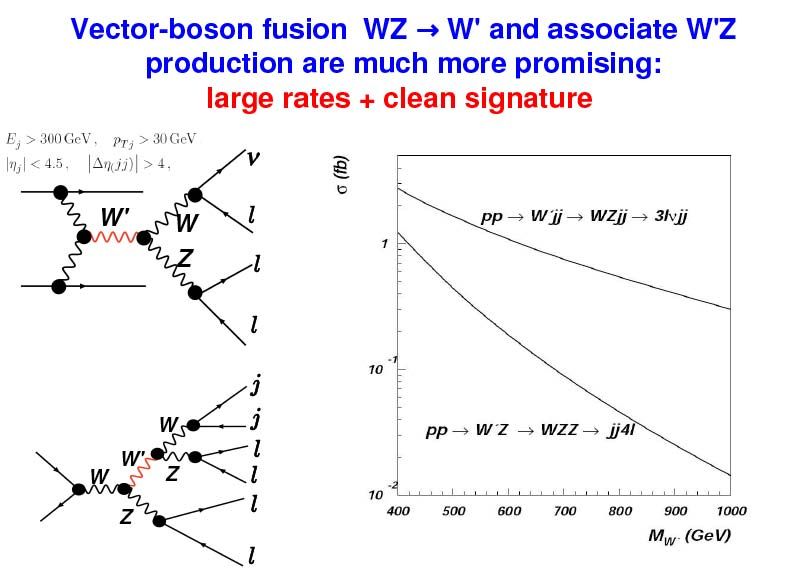
corrections too largeVector Boson Fusion (WZ W’) and
W’Z Associated Production
promise large rates and clear signaturesIntegrated LHC Luminosity required
to discover W’ in each channel
Associated
FusionConclusions
• The Standard Higgs Model is a low-energy effective theory
of electroweak symmetry breaking that is valid below a scale
characteristic of the underlying physics.

•   Intriguing candidates for the underlying physics include:
      Technicolor
          composite Nambu-Goldstone bosons
          techni-rho exchange unitarizes WLWL scattering
      Higgsless models
          Nambu-Goldstone bosons from extra dimensions
          KK-mode exchange unitarizes WLWL scattering

• Experiments now underway at the Large Hadron Collider
(CERN) should be able to tell the difference!
You can also read


