ENMAX CORPORATION GROUND DISTURBANCE GUIDELINES
←
→
Page content transcription
If your browser does not render page correctly, please read the page content below
ENMAX CORPORATION
                 GROUND DISTURBANCE GUIDELINES
                           Effective Date: June 15, 2021       Rev. 3.1       Page 1 of 16

                                                                           Verify revision is
                                                                          current prior to use.

                 Scan the above QR Code to obtain the most current version.

Approved By:               Title                                              Date Approved
John Price                 Director, Safety and Environment                 January 15, 2021

Kevin Eckstadt             Safety Specialist                                January 15, 2021
GROUND DISTURBANCE
                                                                        GUIDELINES
            If using a printed version,
                                                                                                                                               EFFECTIVE DATE:
            verify it is the most current                                      SAFETY COUNCIL
            version prior to use.                                                                                                                15-JUN-2021

                                                                   Table of Contents

1.0        INTRODUCTION ............................................................................................................................................. 4
           1.1         PURPOSE .......................................................................................................................................... 4
           1.2         KEY CONTACTS ................................................................................................................................. 4
           1.3         REFERENCES ..................................................................................................................................... 4
           1.4         GLOSSARY ........................................................................................................................................ 5
2.0        GROUND DISTURBANCE PROCESS ................................................................................................................ 6
           2.1         LOCATES ........................................................................................................................................... 6
           2.2        BUFFER ZONE ................................................................................................................................... 6
           2.3        ENMAX PERMISSION LETTER ........................................................................................................... 7
           2.4        NOTIFICATIONS FOR EXCAVATION ACTIVITIES ................................................................................ 7
           2.5        COMPLETE GROUND DISTURBANCE ................................................................................................ 7
           2.6        BACKFILL .......................................................................................................................................... 8
           2.7        PROCEDURE – IF DAMAGE OCCURS................................................................................................. 9
           2.8        GROUND DISTURBANCE PROCESS FLOWCHART ........................................................................... 10
ATTACHMENT A – SAFE WORK PRACTICES .............................................................................................................. 11
ATTACHMENT B – CONFLICT ZONE .......................................................................................................................... 12
ATTACHMENT C – EXCAVATION METHODS ............................................................................................................. 13
ATTACHMENT D – ENGINEERED SUPPORTS ............................................................................................................ 15

                                                                 Review Required: 15-JAN-2022                                                            Page 2 of 16
 The contents of this document may change and, as such, it is the responsibility of the reader to ensure they are accessing the most recent version. This
 document is considered uncontrolled when printed.
GROUND DISTURBANCE
                                                                  GUIDELINES
            If using a printed version,
                                                                                                                                 EFFECTIVE DATE:
            verify it is the most current                               SAFETY COUNCIL
            version prior to use.                                                                                                  15-JUN-2021

REVISION HISTORY
This document is reviewed a minimum of every year or as required.
 Rev No.                 Date                                                          Revision History
    1.0         October 11, 2017            New document
    2.0         March 30, 2020              Reviewed by stakeholders; updated format
    3.0         January 15, 2021            Added reference to Primary Switch Disconnect Reconnect Form
                                            Minor edits
    3.1         Jun 15, 2021                Updated Section 2.5
                                            Replaced Senior Line Inspector with Damage Prevention Dept.
                                            Added QR Code
                                            Updated “Pole tie-back vendors”

                                                           Review Required: 15-JAN-2022                                                   Page 3 of 16
 The contents of this document may change and, as such, it is the responsibility of the reader to ensure they are accessing the most recent version. This
 document is considered uncontrolled when printed.
GROUND DISTURBANCE
                                                                  GUIDELINES
            If using a printed version,
                                                                                                                                 EFFECTIVE DATE:
            verify it is the most current                               SAFETY COUNCIL
            version prior to use.                                                                                                  15-JUN-2021

1.0 INTRODUCTION
1.1       PURPOSE
Ground disturbance, or excavations, poses significant hazards to workers, the public, and the environment. This
document provides requirements companies and individuals MUST comply with when exposing buried ENMAX
facilities. Other sources to comply with include provincial legislation, codes, bylaws and other utility
requirements.
               WARNING: Use extreme caution when working near energized cables; consider ALL power cables
               energized. Contact with cables may cause injury or death; therefore, excavators MUST contact
               their project inspector or access the Primary Switch Disconnect Reconnect Form to schedule
               switching and isolation of energized cables if cable support is needed.

               NOTE: If energized cables cannot be isolated and grounded, companies must adhere to their own
               hand exposure and hydrovac safe work practices.

1.2       KEY CONTACTS
The following must be readily available when conducting ground disturbance near ENMAX facilities.
 Key Contacts           Contact                           Phone Number Email
                        Alberta One-Call                  1-800-242-3447 www.AlbertaOneCall.com
                        ENMAX Customer Projects                            getconnected@enmax.com
                                  ENMAX Field Services (MSO, and                                           EPCFieldServicesMSOs@enmax.com
                                  anchor and guy removal
                                  ENMAX Hot Digs                                                           HotDigs@enmax.com
                                  ENMAX Line Inspection                                                    lineinspection@enmax.com
                                  ENMAX Transmission                              403-514-3679
                                  ENMAX Trouble Dispatch                          403-514-6100
 NOTE                           The Primary Switch Disconnect Reconnect Form must also be readily available
1.3     REFERENCES
All work must be carried out in accordance with the following:
 Legislation                    Alberta Occupational Health and Safety Code
                                   • Part 17 Overhead Power Lines
                                   • Part 18 Personal Protective Equipment
                                   • Part 32 Excavating and Tunneling
                                Alberta Electrical Utility Code
                                   • Section 2- 014 Activities near Overhead Power Lines
                                   • Section 2- 018 Moving Equipment or Buildings
                                   • Section 2- 020 Excavation Activities in the Vicinity of Underground Power Lines
                                CAN/CSA Standard C22.3 No. 7-10 Underground Systems
                                CAN/ULC-S801-(7.15.6) Standard on Electric Utility Workplace Electrical Safety
 ENMAX form                     Primary Switch Disconnect Reconnect Form
 ENMAX training                 ENMAX Hazardous Electrical Awareness Tutorial
                                NOTE: Available upon request at hotdigs@enmax.com or safety@enmax.com.
 Other resources                    • Alberta Common Ground Alliance
                                    • Canadian Common Ground Alliance
                                    • Where’s the line? Power Line Safety
                                                           Review Required: 15-JAN-2022                                                   Page 4 of 16
 The contents of this document may change and, as such, it is the responsibility of the reader to ensure they are accessing the most recent version. This
 document is considered uncontrolled when printed.
GROUND DISTURBANCE
GUIDELINES
If using a printed version,
EFFECTIVE DATE:
verify it is the most current SAFETY COUNCIL
version prior to use. 15-JUN-2021
1.4 GLOSSARY
Acronyms
AEUC Alberta Electrical Utility Code MSO Minor Service Order
CSA Canadian Standards Association PPE Personal protective equipment
LOA Limits of Approach (Safety Code) QUE Qualified Utility Employee
HRC Hazard Risk Category SWP Safe Work Practices
Terms
Air excavation / A non-destructive process using pressurized water or air and a vacuum truck to remove
hydrovac earth cover (soil, gravel, stones, rubble, mud).
equipment
Competent worker A worker who is adequately qualified, suitably trained, and with sufficient experience to
safely perform work without supervision or with only a minimal degree of supervision.
Conflict zone At risk locations within the work area for any of the following:
• Listed on the locate slip by the Locator
• Within 1 m (3’-3”) of any locate marks
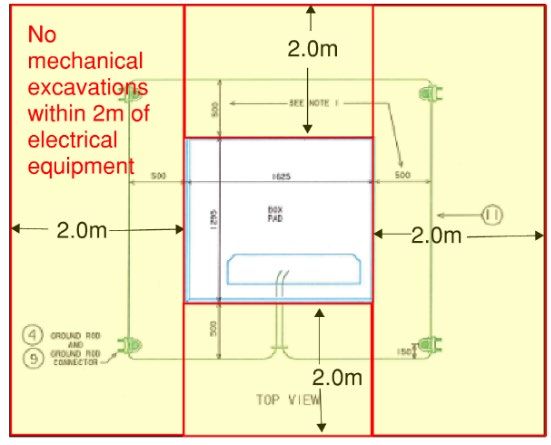
• Within 2 m (6’-6”) of any ENMAX at-grade facility
• As described in Attachment B - Conflict Zone.
Destructive An operation using equipment or explosives to move earth, rock or other material
excavation below existing grade.
ENMAX facilities ENMAX facilities include:
• Cables • Parallel lines • Switches
• Concrete • Poles • Transformers
• Guy wire w/pole anchors • Pull boxes • Transformer vault
• Manholes
Excavator Any contractor, developer, property owner, or other individual performing any work,
operation or activity that results in a disturbance of the ground, regardless of depth.
Ground Any work, operation, or activity that results in a disturbance of the ground, regardless
disturbance of depth.
Hot dig Process of exposing energized cables and facilities.
Locate marks Temporary markings to identify the approximate location of underground infrastructure
(buried facility).
Examples include pin flags, coloured paint, stake chasers, coloured chalk, chevron.
Non-destructive One (1) metre (3’-3”) from either side of the locate marks.
buffer zone
Non-destructive Hand exposure (provided there is a non-conductive handle on shovel), air vacuum or
excavation hydrovac equipment.
Qualified Utility A power line or station utility employee trained and experienced to work safely on
Employee (QUE) energized electrical equipment or lines.
Review Required: 15-JAN-2022 Page 5 of 16
The contents of this document may change and, as such, it is the responsibility of the reader to ensure they are accessing the most recent version. This
document is considered uncontrolled when printed.GROUND DISTURBANCE
GUIDELINES
If using a printed version,
EFFECTIVE DATE:
verify it is the most current SAFETY COUNCIL
version prior to use. 15-JUN-2021
2.0 GROUND DISTURBANCE PROCESS
2.1 LOCATES
ENMAX Submit an online locate request at Alberta One-Call PRIOR to any ground disturbance
underground near ENMAX facilities.
facilities Call Alberta One-Call directly at 1-800-242-3447 for the following:
• Request emergency locates
• Provide damage information
NOTE: Inside property-private owners (includes commercial lots, multi-
dwelling) must obtain locates for secondary conductors via private utility
locating service provider of choice.
At grade facilities System ground wires and ground rods are not locatable. They are typically buried below
the final grade and encompass a 1 m (3’-3”) area around or adjacent to ENMAX facilities.
CAUTION: Contacting the ground system may cause damage to the
adjacent structures or equipment and/or personal injury or death. Only
Non-destructive excavation in accordance with this Guideline may be
performed when disturbing the ground within 2 m (6’-6”) of equipment.
Asphalt removal Excavators must develop a procedure to ensure ENMAX facilities are not damaged.
CAUTION: Locates do NOT determine depth or dimensions of manholes,
vaults, or duct banks, increasing the risk of contact.
Heavy equipment breakers, hammers and saw cutting asphalt/concrete
can damage manhole roofs or shallow duct banks.
2.2 BUFFER ZONE
Within the buffer Locate marks (chevron), shown below, depict the location of underground facilities.
zone The buffer zone (non-destructive) extends 1 m (3’-3”) beyond the locate marks.
Contact information for OTHER facility owners can be found on the back of the locate
slip provided by the locate service provider.
NOTE: Locate marks are valid for 30 days from the date provided.
Outside the buffer If the ground disturbance occurs OUTSIDE the buffer zone, ENMAX has no restrictions
zone on the ground disturbance. Excavation may proceed (subject to requirements of
provincial legislation, codes, bylaws and other utilities).
Review Required: 15-JAN-2022 Page 6 of 16
The contents of this document may change and, as such, it is the responsibility of the reader to ensure they are accessing the most recent version. This
document is considered uncontrolled when printed.GROUND DISTURBANCE
GUIDELINES
If using a printed version,
EFFECTIVE DATE:
verify it is the most current SAFETY COUNCIL
version prior to use. 15-JUN-2021
2.3 ENMAX PERMISSION LETTER
Permission Letter Obtain an ENMAX Permission Letter PRIOR to performing ground disturbance near
ENMAX facilities. The Letter MUST remain on site while exposing ENMAX facilities.
Email HotDigs@enmax.com to obtain an ENMAX Permission Letter.
Excavator Excavators MUST comply with the following requirements:
requirements • Create and adhere to own SWPs for ground disturbance (reference Attachment A
– Safe Work Practices for minimum requirements)
• Ensure all personnel involved in any ground disturbance are competent workers
• Ensure SWP and procedures comply with this guideline, legislation, bylaws, codes
• Ensure a cell phone or other means of contacting ENMAX Trouble Dispatch is
always available while at the worksite
• Comply with all requirements contained in the ENMAX Permission Letter
2.4 NOTIFICATIONS FOR EXCAVATION ACTIVITIES
ENMAX Projects – Contact the ENMAX Project Inspector when performing work for ENMAX and a contract
contract in place exists between ENMAX and the contractor.
Non-ENMAX Notifications for non-ENMAX projects are outlined below.
projects If… Then…
Damage to ENMAX Call Trouble Dispatch at 403-514-6100 or Project Inspector
Infrastructure Reference Section 2.7 Procedure - If Damage Occurs.
Engineering supports are Submit stamped engineering drawings to
required for Pull boxes, hotdigs@enmax.com a minimum of 14 days prior to planned
transformers, duct banks, excavation facility support approval.
cables and cables in duct Reference Section 2.3 and Attachment D
Work is within 2 m (6’-6”) Complete the ENMAX Primary Switch Disconnect Reconnect
of ENMAX facilities Form for ground grid protection around transformers,
rigging and slinging of cables, or isolation and grounding
where practicable. Request a Minor Service order to
schedule ENMAX personnel to complete the request.
NOTE: The primary switching request must be completed a
minimum of 5 days prior to planned excavation where
possible.
Anchor and guy removal Request a Minor Service Order (MSO) to schedule ENMAX
personnel to complete the request. Email-
lineinspection@enmax.com
EPCFieldServicesMSOs@enmax.com
Backfill inspection Follow the process in Section 2.6 Backfill.
NOTE: Call 9-1-1 for emergencies!
2.5 COMPLETE GROUND DISTURBANCE
Perform ground Complete ground disturbance in accordance with this Guideline; requirements include:
disturbance • Attachment A – Safe Work Practices
• Attachment B – Conflict Zone
• Attachment C – Excavation Methods
• ENMAX Permission Letter - instructions and restrictions conveyed by ENMAX
Review Required: 15-JAN-2022 Page 7 of 16
The contents of this document may change and, as such, it is the responsibility of the reader to ensure they are accessing the most recent version. This
document is considered uncontrolled when printed.GROUND DISTURBANCE
GUIDELINES
If using a printed version,
EFFECTIVE DATE:
verify it is the most current SAFETY COUNCIL
version prior to use. 15-JUN-2021
2.6 BACKFILL
Notifications Notify the following PRIOR to backfilling the site.
If work is for Then contact the following PRIOR to backfilling…
ENMAX Project Inspector to arrange for inspection
Other During business hours – Damage Prevention Dept. at
LineInspection@enmax.com
After hours - Trouble Dispatch at 403-514-6100 to arrange inspection
Specifications After the work is completed, pad exposed facilities with the following.
Material Requirements
Bedding Covers the facilities to a minimum depth of 200 mm (8”), and free from:
sand • Snow and ice • Organic material
• Loam • Stones larger than 5 mm (1/5”)
NOTE: Excavators are required to provide compaction test results to
ENMAX, if requested.
Common Placed on top of the bedding sand. Material must be free from:
backfill • Snow and ice • Organic material
• Loam • Boulders larger than 200 mm (8”)
NOTE: Common backfill compaction must comply with The City of Calgary
specifications to a minimum of 95% proctor dry density.
NOTE: Restore final grade to ensure the burial depth of ENMAX cables has
not changed. Contact your ENMAX Inspector if a rise or fall in the final
grade exists PRIOR to excavation and backfill to record the new grade.
For all others, call 403-514-6100
Spacing Backfill requirements for cables and ducts are shown below.
NOTE: All dimensions are MINIMUM requirements.
CABLES AND DUCTS CONCRETE ENCASED DUCT BANK
Review Required: 15-JAN-2022 Page 8 of 16
The contents of this document may change and, as such, it is the responsibility of the reader to ensure they are accessing the most recent version. This
document is considered uncontrolled when printed.GROUND DISTURBANCE
GUIDELINES
If using a printed version,
EFFECTIVE DATE:
verify it is the most current SAFETY COUNCIL
version prior to use. 15-JUN-2021
2.7 PROCEDURE – IF DAMAGE OCCURS
Procedure Excavators must complete the following steps if there is any damage to an ENMAX facility.
Step Action
1. STOP WORK!
2. Exit the excavation immediately.
3. Call 911 if an injury has occurred.
4. Secure the site; use appropriate signs, barriers, or barricades.
5. Contact ENMAX Trouble Dispatch at 403-514-6100, and the Project Inspector if
required.
WARNING: Do NOT re-enter the excavation site until clearance has
been given and repairs have been completed by an ENMAX QUE.
Repairs can ONLY be completed by ENMAX personnel and
approved ENMAX contractors.
Review Required: 15-JAN-2022 Page 9 of 16
The contents of this document may change and, as such, it is the responsibility of the reader to ensure they are accessing the most recent version. This
document is considered uncontrolled when printed.GROUND DISTURBANCE
GUIDELINES
If using a printed version,
EFFECTIVE DATE:
verify it is the most current SAFETY COUNCIL
version prior to use. 15-JUN-2021
2.8 GROUND DISTURBANCE PROCESS FLOWCHART
Contact Alberta One-Call
Reference Section 2.1
Are you excavating in
the buffer zone?
Reference Section 2.2
YES NO
Request permission from
ENMAX OK to dig!
Reference Section 2.3
Do you have a
contract with
ENMAX?
YES NO
Notify the ENMAX
Referenc Section 2.4
Project Inspector
Complete excavation
Reference Section 2.5
(Attachments A, B, C)
Backfill the excavation site
Reference Section 2.6
Review Required: 15-JAN-2022 Page 10 of 16
The contents of this document may change and, as such, it is the responsibility of the reader to ensure they are accessing the most recent version. This
document is considered uncontrolled when printed.GROUND DISTURBANCE
GUIDELINES
If using a printed version,
EFFECTIVE DATE:
verify it is the most current SAFETY COUNCIL
version prior to use. 15-JUN-2021
ATTACHMENT A – SAFE WORK PRACTICES
Barriers and Excavators are responsible for the following:
barricades • Prevent exposed energized equipment and cables from public contact
• Restrict access to all open excavations during periods of inactivity (unsupervised);
may include a cover, barricade, 1.8 m (6‘) rigid fence
Personal protective A minimum of the following PPE is required for all ground disturbance activities within
equipment (PPE) the buffer zone; for hand exposing only.
Reference AB OH&S Part 18.
Protective clothing Fire resistant outer layer clothing, ankle to cuff
NOTE: HRC 2 (8 Cal/ cm2) minimum
Safety glasses CSA Z94.3 Eye and Face Protectors
Rubber gloves Tested - Class 3 high voltage rubber insulated gloves (rated at
30,000 volts) with outside leather protectors.
Head protection CSA Approved Class E Hard Hat
Hearing protection CSA approved hearing protection (if required)
Footwear CSA approved dielectric footwear with the following symbols:
Warning signs If the job site and equipment are left unsupervised, signs in accordance with the
excavator’s procedures MUST be visible. Minimum information to include:
• Caution or Warning of open excavation
• Name of ground disturber
• Emergency contact number
“DANGER HIGH VOLTAGE” sign must be located a minimum of 3 m (9’-10”) from the
truck to reduce the risk of injury from step and/or touch potential.
WARNING: Do NOT touch any vehicles while excavating is in progress to
avoid touch potential (electrocution may occur).
Review Required: 15-JAN-2022 Page 11 of 16
The contents of this document may change and, as such, it is the responsibility of the reader to ensure they are accessing the most recent version. This
document is considered uncontrolled when printed.GROUND DISTURBANCE
GUIDELINES
If using a printed version,
EFFECTIVE DATE:
verify it is the most current SAFETY COUNCIL
version prior to use. 15-JUN-2021
ATTACHMENT B – CONFLICT ZONE
Primary and Mechanical excavation is NOT permitted within the 1 m (3’-3”) buffer zone until the
secondary cables underground facilities have been fully exposed to sight and a minimum of 600 mm (24”)
separation above, below, and parallel to the facility or desired depth using non-
destructive excavation techniques.
NOTE: The non-destructive buffer zone is 1 m (3’-3”) on either side of the
locate mark.
Underground If an ENMAX “NO CLEARANCE TO DIG” sticker exists on the locate slip, then mechanical
transmission excavation work is NOT permitted within 5 m (16’-5”) on either side of the locate mark.
equipment and Contact ENMAX Transmission Inspector at 403-514-3679. Reference ENMAX note
cables located on the back of the Alberta One-Call ticket for direction.
Distribution Mechanical excavation is NOT permitted within 2 m (6’-6”) of any ENMAX facilities; use
facilities non-destructive methods ONLY. Reference ENMAX note located on the back of the
Alberta One-Call slip for direction and notification. Refer to 2.4
Overhead Ground disturbance may occur near overhead electrical lines. The excavator must
electrical lines ensure safe distances to electrical lines and equipment are adhered to; reference AEUC
Table 2.1 (Part 17 OH&S)
NOTE: Personnel and equipment must stay a minimum of 7 m (~23’)
from all overhead lines.
Contact one of the following if work is required closer than 7 m (~23’) for LOA:
If… Then contact the following to arrange an inspection
ENMAX Project Project Inspector
Mon thru Fri Damage Prevention Dept. at
6 AM to 4 PM LineInspection@enmax.com
After hours and weekends Trouble Dispatch at 403-514-6100
Review Required: 15-JAN-2022 Page 12 of 16
The contents of this document may change and, as such, it is the responsibility of the reader to ensure they are accessing the most recent version. This
document is considered uncontrolled when printed.GROUND DISTURBANCE
GUIDELINES
If using a printed version,
EFFECTIVE DATE:
verify it is the most current SAFETY COUNCIL
version prior to use. 15-JUN-2021
ATTACHMENT C – EXCAVATION METHODS
1. Air Excavation Method
Minimum Air excavation uses pressurized air that is used to slough away soil and is subsequently
equipment collected by a vacuum tool such as an Air Spade.
specifications At a minimum, when using air excavation ensure that:
• Air pressure does NOT exceed 100 psi
• Vacuum dig tube end has a neoprene lip or equivalent
• Non-conductive wand, tube and hose extensions
CAUTION: Any air pressure above the listed values is considered a
destructive means of excavating.
Potential risks to Cable damage may occur if falling rocks or sloughing material contact exposed cables or
facilities ducts. If damage is suspected, reference Section 2.7 Procedure - If Damage Occurs.
Minimum safety Ensure the following minimum safety precautions when exposing cables using air
precautions excavation:
• Do NOT allow the wand to become stationary
• Make a sweeping motion during use perpendicular to the cables (vs. lengthways);
this eliminates stationary contact with the cable at the end of each sweep
• After the buried facility is exposed, maintain a minimum distance of 175 mm (7“)
between the cable and the wand nozzle
• Avoid positioning the vacuum tube directly over exposed facilities
WARNING: The air wand and vacuum pipe may become energized if
faulted conditions exist.
2. Hand Exposure Method
Minimum Ensure the following minimum requirements when using shovels to hand expose
equipment underground cables:
specifications • Shovels have dry, non-conductive handle
• Pointed probes that may pierce the cables are not used
Potential risks to Cable damage may occur if the shovel hits the cable. If damage is suspected, reference
facilities Section 2.7 Procedure - If Damage Occurs.
Minimum safety Ensure the following minimum safety precautions when exposing cables with a shovel:
precautions • Use PPE as per ATTACHMENT A
• Expose cables to sight at regular intervals (minimum of 5 m)
• No mechanical means within 600 mm (24”) once line is exposed.
• Use extreme caution when working within 1.5 m (≈5’) of any cable splices.
• Notify ENMAX Trouble Dispatch at 403-514-6100 or Project Inspector, to arrange
for inspection prior to backfilling splices.
WARNING: Do not move, walk on, or disturb cable splices while hand
exposing cables.
Review Required: 15-JAN-2022 Page 13 of 16
The contents of this document may change and, as such, it is the responsibility of the reader to ensure they are accessing the most recent version. This
document is considered uncontrolled when printed.GROUND DISTURBANCE
GUIDELINES
If using a printed version,
EFFECTIVE DATE:
verify it is the most current SAFETY COUNCIL
version prior to use. 15-JUN-2021
3. Hydrovac Method
Minimum At a minimum, when using hydrovac, ensure:
equipment • Water pressure does not exceed 1500 psi
specifications • Water temperature does not exceed 37.8 o C (100 o F)
• Vacuum pipe end has a neoprene lip or equivalent to protect the cable/facilities
• There is a single oscillating tip nozzle
• The wand is always moving
CAUTION: Any pressure or temperature variances above the listed values
is considered a destructive means of excavating.
Potential risks to A combination of the water temperature and pressure may damage cables. Damage
facilities may appear as a slice in the cable sheath of an unknown depth, or as though the outer
sheath has been torn and pulled outward. If damage is suspected, reference Section 2.7
Procedure - If Damage Occurs.
Minimum safety Ensure the following minimum safety precautions when exposing cables with hydrovac:
precautions • Expose cables to sight at a minimum of 5 m (~16’) intervals
• Direct the high-pressure nozzles in a circular motion
• Do NOT allow the wand to become stationary
• Make a sweeping motion during use perpendicular to the cables (vs. lengthways); this
eliminates stationary contact with the cable at the end of each sweep
• After the buried facility has been exposed, maintain a distance of at least 175 mm (7”)
between the cable and the oscillating head of the water wand
• Avoid positioning the vacuum tube directly over exposed facilities
WARNING: The water, wand, and vacuum pipe may become energized if faulted
conditions exist.
4. Destructive Excavation and Directional Coring
Equipment Includes the following equipment after a facility has been exposed to sight:
• Auger • Hammer (electric, hydraulic) • Directional drills • Plows
• Ditch witch • Pneumatic jack hammers • Track or rubber tire hoe • Scrapers
• Dozer, grader • Saw (asphalt, concrete) • Post pounders • Skid steers
Potential risks to Destructive excavation methods have the potential to damage underground equipment
facilities and buried facilities. If damage is suspected, reference Section 2.7 Procedure.
WARNING: If any part of the equipment contacts an energized cable, the
equipment operator MUST remain on the machine (if safe to do so) until given a
clearance from an ENMAX QUE.
Minimum safety Ensure the following minimum safety precautions when directional coring or using other
precautions destructive excavation methods:
• Observe the payload when pulling back through the excavation
• Ensure there is ample clearance and separation above or below the facility
• Maintain 1 meter of separation above, below and parallel to the cable
• Expose cables to sight at regular intervals (minimum of 5 m)
• Spotters MUST always be present when using excavation equipment
CAUTION: Expose all cables and facilities to sight AND a minimum of 1 m (3’-3”)
exposed on the drill side PRIOR to mechanical excavation. This allows the operator
time to stop the task if the drill head approaches the cable/duct.
Review Required: 15-JAN-2022 Page 14 of 16
The contents of this document may change and, as such, it is the responsibility of the reader to ensure they are accessing the most recent version. This
document is considered uncontrolled when printed.GROUND DISTURBANCE
GUIDELINES
If using a printed version,
EFFECTIVE DATE:
verify it is the most current SAFETY COUNCIL
version prior to use. 15-JUN-2021
ATTACHMENT D – ENGINEERED SUPPORTS
Underground Excavators supply the following to support cables and duct banks in underground
facilities facilities subject to ENMAX’s approval.
Supports Requirements
Beams and • Steel “I” beam or wood pole (excavator to determine the size)
poles NOTE: Submit stamped engineering drawings to
Hotdigs@enmax.com.
• Place across the excavation parallel with the undermined
facility
• Design to prevent sag, bending, and deflection
• Sufficient length to reach a minimum of 3 m (9’-10”) beyond
the edge of the excavation (on both sides)
• Supporting structure will not slough into the excavation due to
unstable soil conditions
Chains Support concrete encased duct banks.
Slings Direct buried cable or ducts must be supported by nylon slings
Transformers, • Must NOT be undermined and must be supported
switches, and • Complete the ENMAX Primary Switch Disconnect Reconnect
pull boxes Form to determine next steps.
NOTE: The maximum distance between supports (beams/chains/slings) is
1200 mm (~ 4’).
NOTE: All dimensions are in millimetres.
Review Required: 15-JAN-2022 Page 15 of 16
The contents of this document may change and, as such, it is the responsibility of the reader to ensure they are accessing the most recent version. This
document is considered uncontrolled when printed.GROUND DISTURBANCE
GUIDELINES
If using a printed version,
EFFECTIVE DATE:
verify it is the most current SAFETY COUNCIL
version prior to use. 15-JUN-2021
Power poles ENMAX requires excavators to stabilize poles and associated equipment, where
required below, prior to any ground disturbance.
WARNING: The collapse of a power pole could expose individuals to a
crush hazard or electrocution.
Poles must be supported if:
• The soil is not firm
• Excavation occurs within the shaded protected zone shown in the illustration
below
• Guys and/or anchors need to be temporarily removed and replaced (contact
lineInspection@enmax.com)
NOTE: The shaded protected zone encompasses the following area:
• At grade: 4d (4 times the pole diameter) away from the pole
• Below grade (cut angle): 3 m (9’-10”) horizontal to every 4 m (~13’) depth
All excavations and slope cuts must be in accordance with the following AB OH&S Code:
• Part 17 Limits of Approach
• Part 32 Pole Support
Pole tie back Excavators must contact their ENMAX Project Inspector or ENMAX Trouble Dispatch at
vendors 403-514-6100 if questions arise regarding a pole tie back.
NOTE: A QUE must complete all pole tie backs.
Excavators must contact an approved pole tie back vendor for availability and cost.
ENMAX approved pole tie back vendors with approved QUEs are listed below.
Tie-back Vendor Phone Number Email
Allteck 250-219-8094 klachapelle@allteck.com
Iconic Power Systems 403-899-8318 info@iconicpowersystems.ca
Primary Engineering 403-333-7099 RCoulter@primaryeng.com
Somerville 780-228-7479 corey@prolinepower.ca
Valard Construction 403-700-0982 KRyan@Valard.com
Review Required: 15-JAN-2022 Page 16 of 16
The contents of this document may change and, as such, it is the responsibility of the reader to ensure they are accessing the most recent version. This
document is considered uncontrolled when printed.You can also read


