EPA'S PROPOSED 2022 U.S. EPA - CONSTRUCTION GENERAL PERMIT
←
→
Page content transcription
If your browser does not render page correctly, please read the page content below

EPA’S PROPOSED 2022
CONSTRUCTION GENERAL PERMIT

       GREG SCHANER
         U.S. EPA
Help with the webinar

• Housekeeping tips for the slides:
   •   This session is being recorded.
   •   You can send technical issues and questions to: Zachary.Armand@erg.com.
   •   Please submit all other questions in the Q&A box.
   •   In order to minimize background noise, currently all attendees in this meeting are
       on mute.
Before We Get Started

                  Language in this presentation is not the
                  official proposal of the EPA. We have
                  attempted to be accurate as to the
Disclaimer        contents of the proposed permit. To the
                  extent there are differences between the
                  language in this presentation and the
                  proposed permit, the permit is what
                  governs.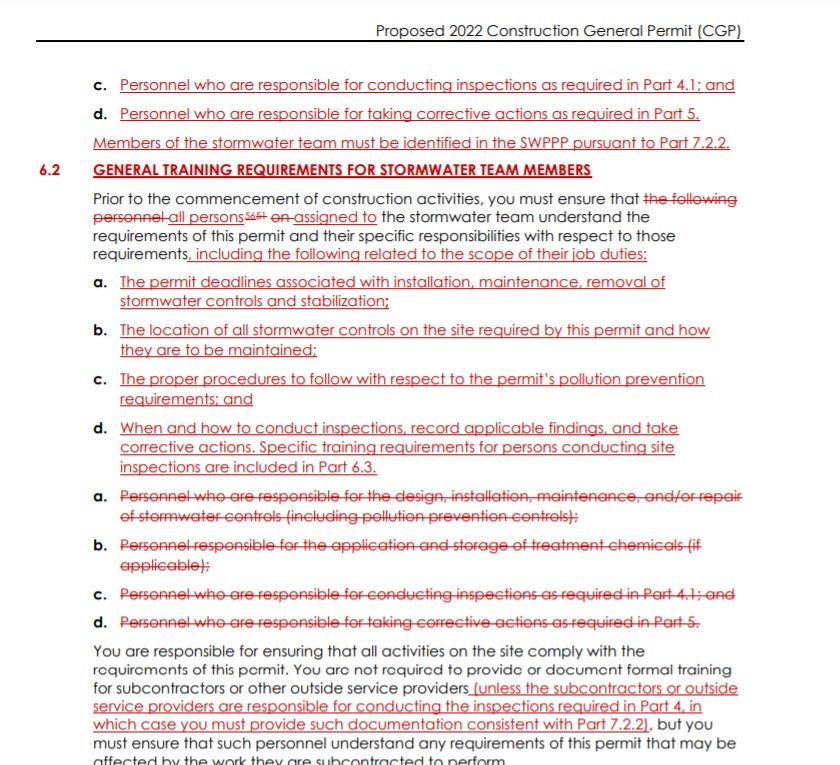
Abbreviations that will be used

• CGP – EPA’s Construction General Permit

• SWPPP – Stormwater Pollution Prevention Plan

• NOI – Notice of Intent

• NOT – Notice of Termination

THINGS TO KEEP IN MIND

      1                  2                  3                  4
                    Proposed CGP
                    requirements      The bulk of the
                   were informed        current CGP          Consider
       This
                    by discussions     requirements         providing
 presentation is
                     with states,     will remain the    feedback on the
 focused on the
                   developers, and      same, most        proposed CGP
new or clarified
                    environmental        proposed           during the
requirements in
                     groups, and      changes clarify       comment
  the proposed
                   EPA inspectors,    or add detail to        period
       CGP
                    scientists, and       existing
                    permit writers       provisions
WHAT’S AHEAD
• CGP Background

• Reviewing and commenting on proposed permit

• Summary of significant changes

• Requests for comment

• Q&A
CGP BACKGROUND
HOW DOES EPA
                                    1992,
  REGULATE                          1998,
CONSTRUCTION                        2003,

STORMWATER             PERMIT:      2008,
                                   2012, &
DISCHARGES?             CGP         2017

                     REGULATIONS:            1990 &
               40 CFR 122.26(b)(14)(x),       1999
                (b)(15), 40 CFR 450.21

                      STATUTE:                        1987
                     CWA 402(p)
WHAT IS     A Clean Water Act permit
REGULATED?   is required for
             stormwater discharges
             from any construction
             activity disturbing:

             • 1 acre or more of land,
               or
             • Less than 1 acre of land,
               but that is part of a
               common plan of
               development or sale that
               will ultimately disturb 1
               or more acres of land.

             Construction activity includes earth-disturbing activities such as
             clearing, grading, and excavating land and other construction-
             related activities that could generate pollutants.
FEDERAL      The Federal “C&D Rule” Requirements
STANDARDS FOR   All Clean Water Act permits for construction stormwater must address the minimum federal
                effluent limitation guidelines for the construction and development point source category
CONSTRUCTION    (referred to as “the C&D rule”).

& DEVELOPMENT   The C&D rule found in 40 CFR 450.21 establishes minimum effluent limitations :
    SITES       1. Design, install, and maintain effective erosion and sediment controls, and pollution
                   prevention measures, to minimize the discharge of pollutants;

                2. Initiate stabilization of disturbed areas immediately whenever earth disturbing activities
                   have ceased and will not resume for a period exceeding 14 calendar days;

                3. Prohibit the discharge of dewatering water unless managed by appropriate controls;

                4. Prohibit the discharge of:
                    • Wastewater from concrete washout (unless managed by appropriate control), or
                       washout/cleanout of stucco, paint, form release oils, other wastewater materials;
                    • Fuels, oils, or other pollutants used for vehicles; and
                    • Soaps or solvents to wash vehicles and equipment.

                5. For basins and impoundments, utilize outlet structures that withdraw water from the
                   surface, unless infeasible.
PERMIT:
CGP
PREPARE GET COVERED TAKE ACTION STABILIZE
Install Stabilize Site
Meet Eligibility Submit NOI Stormwater Within 14 Days
Conditions
Controls of Stopping
Construction
Receive Conduct
Develop SWPPP Coverage Inspections /
Take Corrective Submit NOT to
Actions Terminate CGP
Coverage
Complete
DocumentationWHERE DOES
VT EPA’S CGP
APPLY?
FED FACILITIES
NH
MA
DE FED FACILITIES
DC
OK
CERTAIN O&G
PUERTO RICO
AMERICAN SAMOA
GUAM
JOHNSTON ATOLL
MIDWAY ISLAND & WAKE ISLAND
NORTHERN MARIANA ISLANDSREVIEWING AND COMMENTING ON
PROPOSED PERMITPROPOSED PROPOSED
CGP, www.epa.gov/npdes/proposed-2022-
2022 CGP construction-general-permit-cgp-and-
PUBLISHED ON FACT related-documents
SHEET ...
MAY 12, 2021
60-DAY
COMMENT Comments due: July 12, 2021
PERIOD
SUBMIT
COMMENTS
www.regulations.gov/docket/EPA-HQ-
THROUGH OW-2021-0169
THE
DOCKETREVIEW OF PERMIT
All proposed text
modifications shown in
red font
Permit text that will be
retained shown in black
text
Same format used for
permit appendices
(Definitions, NOI, NOT)REVIEW OF PERMIT
Requests for comment
are identified within the
text of the proposed
permit in blue font
There are 8 specific
requests for comment in
the proposed permitSUBMITTING COMMENTS
Docket EPA-HQ-OW-2021-0169SUMMARY OF SIGNIFICANT CHANGES
STORMWATER CONTROLS
PART
  Updated requirements for perimeter controls                                          2.2.3

                 2017 CGP                                   PROPOSED 2022 CGP

Install sediment controls along any perimeter   Perimeter controls, with limited exceptions, are
areas of the site that will receive pollutant   required upgradient of natural buffers.
discharges.
                                                Install on the contour and with both ends bent
Remove sediment before it has accumulated to    upslope so that stormwater doesn’t circumvent
one-half the above-ground height of the         the edge of the control.
perimeter control.
                                                After storms, if there is evidence that
                                                stormwater has circumvented or undercut the
                                                control, extend the control to prevent
                                                circumventing and repair undercut areas to fix
                                                the problem.
PART
Photographic documentation of final stabilization 8.2.1.a
2017 CGP PROPOSED 2022 CGP
The permittee must certify on the Permittee must submit photographs
Notice of Termination (NOT) that it that clearly show the site’s compliance
has met the requirements for final site with the final stabilization
stabilization. requirements.PART
Clarify requirements for on-site chemical containers 2.3.3.C
2017 CGP PROPOSED 2022 CGP
Store petroleum products or other All chemicals must be stored in water-
chemicals in water-tight containers tight containers; additional controls
and provide either (1) cover to depend on the volume of chemical
minimize exposure, or (2) a similarly stored on site.
effective means to minimize pollutant • If 55 gallons or less, use spill containment
discharge. pallet if stored outside and have a spill kit
available to respond to leaks.
• If more than 55 gallons, store containers a
minimum 50 feet away from waters and
drainage systems and provide either cover
or secondary containment.DEWATERING REQUIREMENTS
WHAT IS DEWATERING
• Dewatering is the act of draining
  accumulated stormwater and/or
  ground water from excavations,
  foundations, vaults, trenches, and
  other similar points of accumulation.

• Often necessary for construction
  activities to commence or continue
  and to maintain the integrity of the
  structure being constructed.
                                          Source: Save Palo Alto’s Groundwater, Building basements
                                          without wasting water
DEWATERING DISCHARGES
• Untreated water from construction
dewatering operations may contain
pollutants that, if discharged to a
storm drainage system or natural
water course, may exceed water
quality standards of the receiving
water.
• The most common pollutant
discharged from dewatering
operations is sediment.STATE DEWATERING PERMITS State dewatering requirements may appear in either dewatering-specific general permits or as part of a state CGP. A growing number of state dewatering permits include stricter requirements than EPA’s permit: • Comply with numeric effluent limits (MA, NH, NJ, CO, MT, UT, WY, CA, HI, NV, AK) • Conduct effluent monitoring for multiple pollutant parameters (MA, NH, NJ, CO, UT, WY, HI, AK SD) • Conduct daily inspections (HI and AK permits, recommended in PA and MI) See Fact Sheet for additional discussion of state requirements.
PART
Use greater specificity to describe dewatering controls                                                  2.4

                    2017 CGP                                          PROPOSED 2022 CGP

Treat dewatering discharges with controls to           All dewatering water must be routed through a
minimize pollutant discharges.                         sediment control designed to prevent discharges
• Uncontaminated, non-turbid water can be discharged   with visual turbidity.
  without controls.
• Use oil-water separator designed to remove oil and   Excludes coverage of dewatering discharges from
  grease.
                                                       contaminated sites.
• Comply with velocity dissipation requirements.

                                                       Other requirements:
                                                       •   Discharge must not cause formation of visible sheen or
                                                           hydrocarbon deposits on the bottom or shoreline of the
                                                           water body.
                                                       •   To prevent erosion: (1) use stable, erosion-resistant
                                                           surfaces for the discharge, (2) do not place controls on
                                                           steep slopes, and (3) discharge must not cause re-
                                                           suspension of sediments in receiving water.
PART
Modify inspection protocols for dewatering 4.3.2/
4.6.3
2017 CGP PROPOSED 2022 CGP
No specific inspection provisions for Inspections required daily when discharging
dewatering. dewatering water.
For each inspection report, you must
document:
• Approximate times discharge began and ended;
• Estimated rate of discharge;
• Whether there is a sediment plume, or a visible
sheen or hydrocarbon deposit, is observed; and
• Photographs of (1) dewatering water prior to and
following treatment, (2) the treatment control in
operation, and (3) the point of discharge to a
water of the U.S.PART
When corrective action is required for dewatering 5.1.5
2017 CGP PROPOSED 2022 CGP
No specific corrective actions for Corrective action required where
dewatering problems. sediment plume or visible sheen or
hydrocarbon deposit observed by
permittee or documented by EPA,
state, or local authorities.
• Permittee then required to take immediate
action to correct the condition, including
immediately suspending dewatering
discharge and taking steps to correct
problem.Potential additional dewatering measures for
sensitive waters
2017 CGP PROPOSED 2022 CGP
No specific requirements for Request for comment on requiring
dewatering discharges to sensitive turbidity monitoring for dewatering
waters. discharges to sensitive waters.
Two potential options:
1. Benchmark monitoring approach or
2. Indicator monitoring approachTURBIDITY MONITORING • Visual turbidity refers to a sediment plume or other cloudiness in the water caused by sediment that can be observed • Turbidity can be an effective indicator of the effectiveness of construction site controls • Typically measured by portable turbidity meter Measured in nephelometric turbidity units (NTUs) Results are instantaneous Median one-time cost of around $1,000
TURBIDITY
MONITORING    • Monitor once per day on any day that a dewatering
                discharge occurs.

OPTION # 1:   • Compare the average of turbidity values for each week
BENCHMARK       with an established benchmark.
MONITORING       • EPA recommends using a benchmark of 50 NTU.
 APPROACH
              • If the weekly average exceeds the benchmark value,
                corrective action required to determine the source of the
                problem and to make any necessary repairs or upgrades to
                lower the turbidity levels.

              • Submit quarterly monitoring reports to EPA.
BENCHMARK OPTIONS
• Fixed benchmark level - 50 NTU
• Within the range of state-established turbidity
criteria
• Same as benchmark used for EPA’s 2021 MSGP
• Limited state data available suggest 50 NTU is Source: U.S. Geological Survey.
achievable
• Use whichever turbidity standard applies
• Most require data on natural background
conditions (“Class B waters shall not exceed
naturally occurring conditions by more than 10
NTUs”)
• Difficult to implement because the benchmark
would require background data and each site
would have a different benchmark levelTURBIDITY
MONITORING • Same monitoring and reporting requirements as
Benchmark Monitoring Approach, but no benchmark
would be established.
OPTION # 2:
INDICATOR • Primary purpose would be to provide operators and
MONITORING EPA with a baseline for understanding discharge water
APPROACH quality and the effectiveness of treatment.• Are you supportive of including turbidity monitoring for
TURBIDITY
dewatering discharges in the permit?
MONITORING
• Do you have a preference between the two monitoring
approaches?
ADDITIONAL
REQUESTS FOR • If you have had experiences with turbidity monitoring,
COMMENT provide feedback on:
What type of instrument did you use?
Did you find turbidity to be a reliable indicator of the
effectiveness of your controls?
Did making changes to the controls work to reduce turbidity
levels?
Did you report results or just keep them for your records?
Did you rely on a contractor?
How much did it cost to conduct turbidity monitoring?INSPECTION/CORRECTIVE ACTION
REQUIREMENTSWhen are inspections required for snowfall events PART
4.2.2
2017 CGP PROPOSED 2022 CGP
If you choose to conduct Snowfall inspections required
inspections once every 14 days, within 24 hours of a discharge
you must also conduct inspections: caused by snowmelt from a 3.25
• Within 24 hours of a 0.25-inch rain inch or greater accumulation of
event, or snow.
• If snowmelt runoff results in a • 3.25 inches is the equivalent of 0.25
discharge. inches of rain.Inspections during seasonally dry periods in arid or PART
semi-arid areas 4.4.2
2017 CGP PROPOSED 2022 CGP
Inspection frequencies and stabilization Seasonally dry period to be defined as a month
timeframes are different for sites located in in which the long-term average total
arid, semi-arid, or drought-stricken areas that precipitation is less than or equal to 0.5 inches.
will be active during the “seasonally dry period
or a period during which drought is EPA has developed an on-line climate look-up
occurring.” tool that allows permittees to determine if
their site is located in an arid or semi-arid
Permit does not define “seasonally dry area, and if any of the months out of the year
period.” are considered seasonally dry.
• Searchable by zip code.
• Climate look-up tool located in permit docket at
https://www.regulations.gov/document/EPA-HQ-
OW-2021-0169-0028Check for signs of sedimentation from discharge PART
4.6.1.d
2017 CGP PROPOSED 2022 CGP
Check for signs of visible erosion and Added: check for signs of
sedimentation that have occurred and sedimentation at points downstream
are attributable to the discharge at from the point of discharge that could
points of discharge and the banks of be attributable to the discharge.
any waters flowing within or • Ex: Sand bars with no vegetation growing
immediately adjacent to the site. on top.New training requirements for construction PART
inspections 6.3
2017 CGP PROPOSED 2022 CGP
Permittee must ensure that any individual Any personnel conducting inspections on a
conducting inspections is a “qualified person.” permitted site must either:
• Complete the EPA construction inspection course
A qualified person is someone who possesses and pass the associated exam; or
appropriate skills and training to assess the • Hold a valid construction inspection certification
effectiveness of any stormwater control or license from a program that addresses the
same principles as EPA’s course.
selected and installed to meet the
requirements of the permit.
EPA is in the process of developing an online
course that will be available to anyone needing
to meet the CGP requirements.
• To be available in English and Spanish.Differentiate between routine maintenance and PART
corrective action 2.1.4
2017 CGP PROPOSED 2022 CGP
If at any time the permittee finds that a Routine maintenance defined as work that can
stormwater control needs routine be completed within 24 hours to repair or
maintenance, such work must be initiated replace a stormwater control.
immediately and completed by the end of the
next business day. Corrective action required if:
• What is considered “routine maintenance” is not • The repair or replacement will take more than 24
defined. hours;
• The same routine maintenance fix to the same
Corrective action required if the control must control is needed repeatedly (i.e., 3 or more
be repaired or replaced. times); and
• The control was not designed or installed
correctly.PART
Clarify that inspection and corrective action records 4.7.3/
can be kept in electronic form 5.4.3
2017 CGP PROPOSED 2022 CGP
Permit is silent on whether inspection and Includes language from the FAQ in the permit
corrective action reports may be kept in to clarify that inspection reports and corrective
electronic form. action materials can be kept electronically.
However, EPA specified in a webpage FAQ that
keeping these reports electronically is allowed
where they are:
• In a format that can be read in a similar manner
as a paper record;
• As legally dependable as a paper record;
• Accessible during an inspection to the same
extent as a paper record.REQUESTS FOR PUBLIC COMMENT
DEFINITION OF                                                                                        PART
                Issue                                                                                1.1.1
 OPERATOR       Whether to modify the definition of “operator” to clarify that the
                entities who pay for work performed are required to obtain
                permit coverage.

                Existing Requirement
                An operator is any party that either:
                a. Has operational control over construction plans/specifications, and has the ability to
                   make modifications to those plans/specifications; or
                b. Has day-to-day operational control of those activities at a project that are necessary to
                   ensure compliance with the permit conditions.

                Request for Comment
                Should the definition be modified to include in (a) persons that determine
                acceptance of work and payment for work performed to ensure permit
                compliance?

                Is the definition already broad enough to include these types of entities?
WAITING PART
Issue 1.4.3
PERIOD FOR Whether to change the waiting period to account for additional
PERMIT time needed for review of the NOI.
COVERAGE
Existing Requirement
After submitting a complete NOI, permit coverage is held for 14 days to give
the Fish & Wildlife Service and National Marine Fisheries Service (“the
Services”) the opportunity to review the NOI for potential impacts to species.
Request for Comment
Should the 14-day waiting period be extended to 30 days?
If opposed, describe how such an extension would impact your projects?STABILIZATION PART
Issue
TIMEFRAMES Whether you have found the existing stabilization timeframes to be an
2.2.14.a
FOR LARGER effective incentive to phase construction activities.
CONSTRUCTION Existing Requirement
DISTURBANCES If a site disturbs more than 5 acres of land at any one time, stabilization must be
initiated and completed in 7 days; by comparison, the deadline is 14 days for sites
disturbing 5 acres of land or less at any one time.
Request for Comment
Has the existing requirement proven to be an effective incentive to phase
construction activities?
• If so, how have you changed your operational practices to disturb no more than 5 acres at a
time?
• If not, what alternative threshold or other requirements would be effective?
Request for feedback on capping disturbances at 10 acres at any one time?
Or, whether to adopt a 10-acre cap along with case-by-case exceptions and
additional requirements?PART
ADDITIONAL 2.3.3.
Issue
FLEXIBILITY Whether additional flexibilities should apply to certain construction a/e
FOR WASTE wastes.
CONTROLS Existing Requirement
For storage of building materials and products, pollution prevention practices are not
required where exposure to precipitation and to stormwater will not result in
discharge of pollutants, or exposure poses little risk of stormwater contamination.
No similar allowance is provided for the waste remnant of any of the same materials.
Request for Comment
Should this type of exception apply under any circumstances?
What types of materials should be treated in this way because they will not discharge
pollutants, and why?
How should the permit ensure that storage of these materials is kept separate from
other waste materials that could discharge pollutants?THANK YOU!
GREG SCHANER
schaner.greg@epa.gov
202-564-0721You can also read


