Exploring the Relationship between School Gardens, Food Literacy and Mental Well-Being in Youths Using Photovoice - MDPI
←
→
Page content transcription
If your browser does not render page correctly, please read the page content below
nutrients
Article
Exploring the Relationship between School Gardens,
Food Literacy and Mental Well-Being in Youths
Using Photovoice
Vanessa Lam 1, *, Kathy Romses 1 and Kerry Renwick 2
 1   Public Health Program—Child and Youth, Vancouver Coastal Health, Pacific Spirit Community Health
     Centre, 2110 W. 43rd Avenue, Vancouver, BC V6M 2E1, Canada; kathy.romses@vch.ca
 2   Department of Curriculum and Pedagogy, University of British Columbia, 2125 Main Mall,
     Vancouver, BC V6T1Z4, Canada; kerry.renwick@ubc.ca
 *   Correspondence: vanessa.lam@vch.ca

 Received: 18 April 2019; Accepted: 11 June 2019; Published: 16 June 2019

 Abstract: The goal of the project was to gain an understanding of the relationships between secondary
 school youth experiences in school gardens and their mental well-being. Over the course of five
 months, sixteen youths participated in a photovoice research project in which they expressed their
 personal experiences about food and gardening through photography and writing. The aspects of
 secondary school youths’ life experiences affected by exposure to school gardens and their impact
 upon their well-being were identified. The youth explicitly associated relaxation with the themes
 of love and connectedness, growing food, garden as a place, cooking, and food choices. They
 were able to demonstrate and develop food literacy competency because of their engagement with
 the gardening and cooking activities. Youth clubs or groups were identified as a key enabler for
 connection with other youth and adults. Youth shared their food literacy experiences, observing
 that their engagement improved some aspect of their mental well-being. Through the photovoice
 process, the youth identified how their involvement in green spaces enabled connections with others,
 and highlighted aspects of personal health and personal growth, all of which contribute to their
 mental well-being.

 Keywords: mental health; food literacy; photovoice

1. Introduction
      What many young people might have to say about their health and what they might want or prefer
is an important perspective in creating spaces where health and well-being are optimized. This paper
reports on a study that focused on youth exploring three interrelated aspects—consideration of mental
health and food literacy while situated within a school garden context. The study had two objectives:
(1) to identify what aspects of a young person’s life experiences are affected by exposure to food literacy
and school gardens; and (2) to identify the components and impact of food literacy and school garden
experiences that contribute to young people’s well-being. The opportunity offered by school gardens as
green spaces is due to them being widely placed and accessible for youth, particularly in the Vancouver
city area. These green spaces enabled experiential, problem-based education while also allowing for
interactions and social engagement amongst the “gardeners” [1]. Thus, engaging with green spaces
supports positive mental health in youth by building their resilience, sense of autonomy and positive
outlook [2,3] as well as a sense of inclusion and belonging. The complimentary focus on food literacy
was possible due to a number of the green spaces being school gardens. The youth were able to plant,
cultivate, harvest and prepare foods that they had grown. Food literacy is an emerging concept that

Nutrients 2019, 11, 1354; doi:10.3390/nu11061354                              www.mdpi.com/journal/nutrients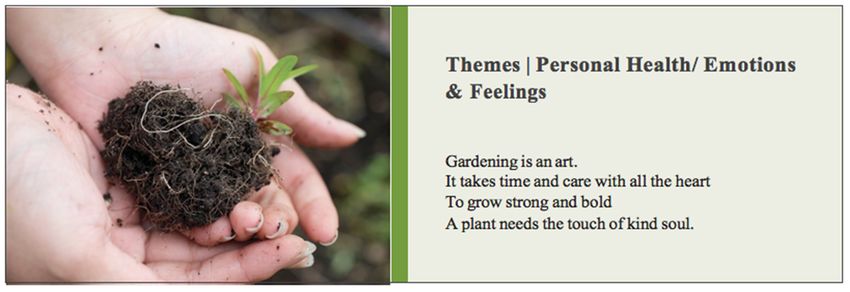
Nutrients 2019, 11, 1354                                                                           2 of 10

requires a holistic approach where understandings about food that are socially constructed and able to
be shared [4–6].
     Hands-on food education provides empowerment and skill building that can bolster resiliency to
support the mental well-being of students [7] and support academic development [8,9]. Local school
and community partners, who have worked with the authors, shared observations and comments
related to school connectedness, improved self-esteem, feeling safe in school gardens and mental
well-being about students who were involved in school garden and food literacy activities. While similar
observations have been noted in other locations including the USA [1], New Zealand [10], Australia [11]
and Greece [11] no local research data was available, particularly from a youth perspective.
     In this study, photography was chosen as way to enable participating youth to investigate their
world, [12–14] looking for connections between school gardens and how they perceived their own
mental health [15]. Wang [12] describes photovoice as a participatory action research methodology
where community members document their everyday realities in photographs, and use critical dialogue
to express personal or community strengths and concerns. The use of an arts-based methodology
for this study, specifically photovoice, was predicated on the understanding that knowledge exists
between and among youth in social settings and that learning is the result of their interactions [15,16].
Thus, the use of photovoice enabled the youth to become empowered through active involvement as
co-researchers and engaging with the process of developing knowledge [17].

2. Materials and Methods

2.1. Photovoice
     Photovoice methodology was developed by Wang and Burris [13] with the specific intent to share
expertise and knowledge in participatory ways and to enable people to document community strengths
and concerns [11,13]. Using photovoice voice as a method enabled the investigators to work with
youth to document their experiences in the garden. The youth took photographs to record aspects of
their engagement in the school gardens recording those aspects that took their attention. Follow up
conversations and discussions enabled time for reflection about the stimulus for the image [12–14].
As a community-based participatory research method, photovoice privileged the voices of youth as
they represented their experiences of the school garden green space [15]. The resultant conversations
and discussions were possible because of the shared experiences, respectful relationships and level of
trust [15,18].
     The research team funded a professional photographer, with experience in photovoice projects,
to collaborate with the primary investigator to guide planning and facilitation of youth sessions
around photography and writing. The photographer helped youth build skills in storytelling through
photography, showing examples of other photovoice projects, providing digital camera equipment,
training youth on how to operate the digital camera equipment, and collecting and organizing their
digital photographs. This process of working with youth to build their photography skills and develop
the technical capacity to present their views as both “competent citizens and active participants” [12]
(p. 152) who are engaging in transformational acts.

2.2. Ethics and Participants
     Ethics approval for this study was obtained from The University of British Columbia (UBC)
[H15-03101]. Permission to approach and engage with schools in Vancouver was obtained from the
Vancouver Board of Education. School and community partners in Vancouver recommended recruiting
participants from existing youth clubs and groups. Flyers were distributed in January to community
partners and posted at secondary schools to help with recruitment and a Youth Photovoice Project
Facebook page was created to share information and updates about the study. Purposive sampling
was used to recruit secondary school students from these sources, which provided a diverse group
of youth.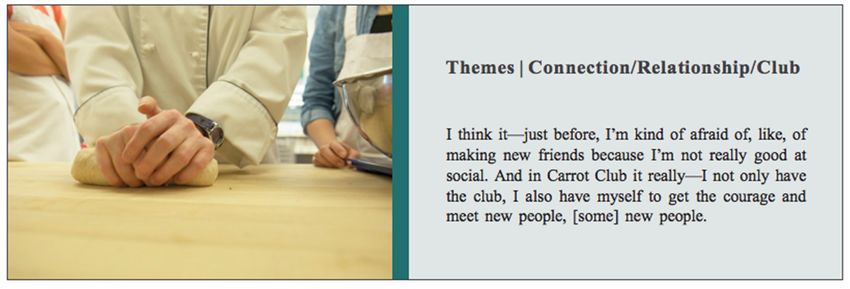
Nutrients 2019, 11, 1354                                                                           3 of 10

     Sixteen youth, nine females and seven males, in grades nine to twelve, attended seven, one to one
and a half hour photography and writing sessions over a five-month period. All participants were
actively engaged in garden to table activities such as growing, harvesting and cooking. Based on youth
preferences, the sessions were held primarily on a weekday after school at their own school site or
where their existing club or group was already convening. These sites included two secondary schools,
a university farm site, a community center and a neighborhood house. The school clubs and groups
were intergenerational social contexts in that there were adults who worked as facilitators. These adults
interacted with youth in the gardens and in doing so connections and relationships were developed.

2.3. Project Steps
      The youth joined in the three stages of the participatory approach of photovoice methodology
described by Wang and Burris [13]. The first stage is having youth take their photographs and selecting
their photographs of choice. The second stage focused on contextualizing or providing stories about
the meaning behind the chosen photos. The sessions with youth included having them document
their reflections in personal journals and sharing some of their writing with investigators and fellow
youth. The third stage involved codifying or identifying themes from the research process, which took
place both individually with each of the investigators and then together, followed by identifying and
checking themes with youth co-researchers. Two focus groups were facilitated one in June and the
second in September.
      Since different methods were used to collect information to triangulate findings and increase rigor
and credibility a meta-analysis was facilitated. Each investigator used a holistic thematic approach
by independently reading the transcribed interviews, focus group transcript and youth writing. One
investigator utilized the NVivo 10.0 [19] computer software and the other investigator used a manual
review process to develop a preliminary coding framework that emerged from the data. They met
several times to iteratively develop a shared list of categories, overarching themes and sub-themes to
enhance inter-rater reliability.
      Based on the derived draft list of themes and categories, overarching themes were shared for
participant verification at the September focus group to further improve inter-rater reliability and
verify findings with youth co-researchers. Five females and one male were in attendance. Two male
participants joined through a video Skype call on a mobile phone. A mind mapping activity was
utilized to allow youth to further refine and validate the key themes and connections between themes.

3. Results
     The data emerged out of this study in a number of different ways—visual representations in
the photographs, the associated text and ongoing conversations. As the youth were setting up and
reflecting on their photographs and text, they were asked brainstorming questions as a way to help
youth guide their photography and story writing. The examples of questions included: “What does
mental well-being mean to you? and What does food and gardening mean to you?” After the group
discussions, personal diarizing and selection of images the youth and investigators were able to identify
three broad emergent themes—connection, personal growth and personal health as being important
to mental well-being. The engagement in the photovoice process around the experiences of food,
gardening and well-being offers insights into what the youth were able to identify as strengths and
concerns at both a personal and community level.

3.1. Text and Images
     Participants indicated that connecting comes from having community, relationships and respect.
Youth clubs or groups were identified as a key enabler for connection. The use of a garden offered
opportunity to be with others that was different to their experience in school classrooms.
     The image and text provided in Figure 1 presents one young person’s take on their involvement
in the Carrot Club. This was an after school program that cooked foods including those harvested
Nutrients 2019, 11, 1354 4 of 10
Nutrients 2019, 11, x FOR PEER REVIEW 4 of 10
from the school garden. The club leaders structured the various activities in ways that facilitated
garden. The
interactions between the youth who attended.
Figure
Figure 1. Photovoice artifact
1. Photovoice artifact #1.
#1.
Table 1 offers examples of what youth perceived as being about connections that emerged in the
Table 1 offers examples of what youth perceived as being about connections that emerged in the
conversations and discussions. The idea of connections was about community and could be seen in
conversations and discussions. The idea of connections was about community and could be seen in
their relationships, how they work in respectful ways. The intergenerational aspect of gardens was
their relationships, how they work in respectful ways. The intergenerational aspect of gardens was
seen in a positive way, as was the capacity of the garden context to accommodate differing levels
seen in a positive way, as was the capacity of the garden context to accommodate differing levels of
of expertise. The perceptions about the inclusive and non-judgmental aspects of the garden offered
expertise. The perceptions about the inclusive and non-judgmental aspects of the garden offered
spaces where the youth could see themselves as having a legitimate place with others, an opportunity
spaces where the youth could see themselves as having a legitimate place with others, an opportunity
to contribute and achieve.
to contribute and achieve.
Table 1. Theme: connections.
Table 1. Theme: connections.
Sub-Theme Sample Participant Responses
Sub-Theme Sample Participant Responses
Well, the most
Well, the mostI canI can
say is
say I’ve never
is I’ve seen—well,
never seen—well, like,like,
if I have, it’s very
if I have, rare,rare,
it’s very but I’ve never
but I’ve
seen, like, both youth and seniors working together, and it’s gardening.
never seen, like, both youth and seniors working together, and it’s gardening. And like, And like, because
usually when it’s—when I think of teenagers, I think of people, like, using their phones every
Relationship because usually when it’s—when I think of teenagers, I think of people, like, using their
Relationship five minutes, and this is not something I saw during the times we were gardening. And so
phones
yeah, every
that’s justfive minutes,I noticed.
something and this Andis notitsomething I saw during
was very interesting, andtheyou
times
need wetowere
see
gardening.something
And so yeah, that’s just something I noticed. And it was
like that, to see it, that gardening can do this to people. very interesting, and
you need to see something like that, to see it, that gardening can do this to people.
I’ve seen it in gardening mostly, that people do come together of all ages. Like, you don’t
I’ve seen it in gardening mostly, that people do come together of all ages. Like, you don’t
need a lot of experience or not a lot of knowledge to actually be able to do gardening. Like,
youneed a lot
can just of experience
pick or not a lotinofthe
up and do something knowledge
smallest wayto actually be able
and it can help.toAnddo gardening.
you see, like,
Like,
the actual growth and the actual outcome of your own efforts, so it’s reallyhelp.
you can just pick up and do something in the smallest way and it can And you
rewarding.
Community
see, like, the actual growth and the actual outcome of your own efforts, so it’s really
Community Well, I see people laughing, making jokes about small things, and just enjoying the process of
rewarding.
gardening. It’s not—it’s not really actual gardening, but it’s working with other people, other
Well, I see people laughing, making peers.jokes about small things, and just enjoying the
And—yeah.
process of gardening. It’s not—it’s not really actual gardening, but it’s working with
I think that the biggest thing is that when you’re gardening, that there’s kind of like a sense
other people, other peers. And—yeah.
of, like, no judgment of what you’re doing in the moment. So you can share your opinions
andIreally
think get
thatto—get
the biggest
to knowthing is that
people when
from, you’re
like, gardening,
a different point that there’s
of view, andkind
get toofsee,
likelike,
a
Respect sense of,skills
like, no
what their thatjudgment of what
they’re good you’re
at. So doing
in terms of in the moment.
mental wellbeing,So you can say
I would share your
it really
opinions
makes youand find really
that get to—get of
connection to what
knowyou’re
peoplegood from,at,like,
andamakes
differentyoupoint of view,
feel good and
about
Respect
get to see, like, what their skills that they’re
yourself good
in the at. So in terms of mental wellbeing, I
end.
would say it really makes you find that connection of what you’re good at, and makes
you feel good about yourself in the end.
Being in gardens and the growing of food facilitated reflections about time, continuity and change.
Engaging with the photovoice process enabled this participant to imagine how an image of a lone
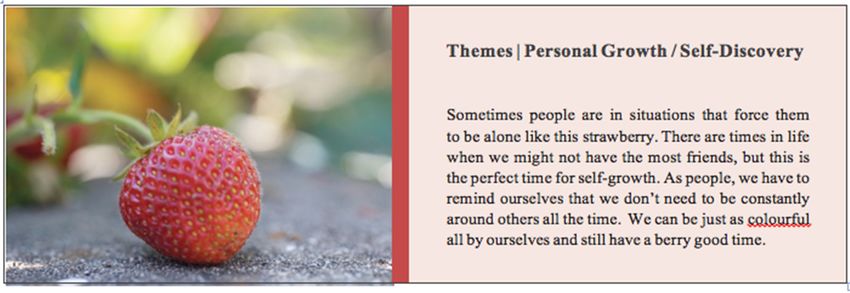
Being in gardens and the growing of food facilitated reflections about time, continuity and
strawberry seen in Figure 2, could equate to people being on their own, taking time for self-discovery.
change. Engaging with the photovoice process enabled this participant to imagine how an image of
The image and text tells a story about an understanding that a youth photographer has and wants to
a lone strawberry seen in figure 2, could equate to people being on their own, taking time for self-
share [12].
discovery. The image and text tells a story about an understanding that a youth photographer has
and wants to share [12].Nutrients 2019, 11, 1354 5 of 10
Nutrients 2019, 11, x FOR PEER REVIEW 5 of 10
Figure 2. Photovoice artifact #2.
Table 2 provides examples of what youth described as personal growth through self-discovery
Participants identified
and across time. Participants identified those
those things
things that
that “change
“change all
all the
thetime”,
time”,such
suchas
asself-discovery,
self-discovery,
life, personal growth, slower pace, future and nurture. TimeTime spent
spent in the garden enabled a different
engagement with the world. That instead of seeing it through
through computer or phone screens, these could
be set aside to experience what is necessary to grow something and that this could inform how they
lived their own lives.
Table 2. Theme:
Table 2. personal growth.
Theme: personal growth.
Sub-Theme
Sub-Theme Sample Participant
Sample Participant Responses
Responses
You
You don’t always have to be around others, and especially for youth, at my age or—we
kind
kind ofof feel
feel the
the needneed to fit in and always be around people, like social media and things
like that. But
like But II think
think what’s
what’s more
more important
important is, is, like,
like, finding that balance in order to solve
thatproblem,
that problem, and and finding
finding thatthat balance
balance might
might mean
mean something
something like like gardening
gardening or, or, like,
like,
doing something
doing something else else you
you love.
love.
Well, especially
Well, especially this
this age,
age, it’s
it’s just, it comes from peers, like, kind of that pressure pressure to to always
always
Self-discovery
Self-discovery fitting—to always
fitting—to always fit in and, like, always be talking to other people, but sometimes we
have to take that time off for ourselves, for, like, self-growth, and how
have to take that time off for ourselves, for, like, self-growth, and how we can still be we can still be bright
and colorful
bright just on our
and colorful justown.
on our Well,
own.it’sWell,
again,it’s
like, taking
again, time,
like, doing
taking things
time, doinglikethings
gardening
like
and like, finding that balance in our lives, just focusing on multiple things, not just one, in
gardening and like, finding that balance in our lives, just focusing on multiple things, not
order to—in order for that self-growth to happen.
just one, in order to—in order for that self-growth to happen.
how how gardening,
gardening,it—there’s, like—it
it—there’s, can relate
like—it to everyday
can relate life, not—it’s
to everyday not justnot
life, not—it’s gardening.
just
I would say give the opportunity to students gardening. to actually bring out what they think is
Future important,
I would sayandgive to not
theonly teach what
opportunity is part of to
to students theactually
curriculum,
bringbutoutsomething
what they that
thinkcould
is
Future important, and to not only help nurture
teach whatwhat they
is part of want to do in life.
the curriculum, but something that could
help nurture what they want to do in life.
Within the theme of personal health, identified factors included emotions and feelings, having
Within the themeand
a safe place, nutrition of personal
relaxation.health, identified
Relaxation factors included
was connected with theemotions
following and feelings,
grouped having
themes of:
agrowing
safe place, nutrition and relaxation. Relaxation was connected with the following grouped
food, garden as a place, cooking, love and food choices. This was linked to nature, beauty, themes
of: growing food,
environment garden as a place,
and sustainability. cooking,
In the love and
photovoice food choices.
contribution shownThis
in was
Figure linked toparticipant
3, the nature, beauty,
uses
environment
prose to help toand sustainability.
explain the image In the photovoice
offering some insightcontribution shown in figure
into the participant’s 3, [12].
interests the participant
The image
uses prose
presents to help
hands to explain
cradling the image
a young plant offering
with rootssome insight into
embedded the It
in soil. participant’s
evokes a sense interests [12]. care
of gentle The
image presents hands cradling a young plant
with the text highlighting the resultant potential. with roots embedded in soil. It evokes a sense of gentle
care with the text highlighting the resultant potential.Nutrients 2019, 11, 1354 6 of 10
Nutrients 2019, 11, x FOR PEER REVIEW 6 of 10
Figure 3. Photovoice
Figure 3. Photovoice artifact
artifact #3.
#3.
The
The statements
statements in
in Table
Table 33 make
make links
links between
between personal
personal health and nature,
health and nature, beauty,
beauty, environment
environment
and
and sustainability. The participants acknowledged how being in the garden with others impacted
sustainability. The participants acknowledged how being in the garden with others impacted onon
their personal health. Their considerations included how consumption of food nurtured
their personal health. Their considerations included how consumption of food nurtured their their bodybody
in a
physical sense sense
in a physical but also how
but it enabled
also social health
how it enabled through
social healthengagement and sharedand
through engagement activity withactivity
shared others.
That well-being was observed in the participants’ positive sense of self and environmental
with others. That well-being was observed in the participants’ positive sense of self and awareness.
environmental awareness.
Table 3. Theme: personal health.
Sub-Theme Table 3. Sample
Theme: personal health.
Participant Responses
Sub-Theme When I started working in the garden, Sample Participant
I started to feelResponses
this great connection with the things. I
When I started grew, and I started
working to care more
in the garden, about
I started to what I was
feel this eating.
great connection with the
When you’re the one who grew the food, like, it just adds that extra sort ofeating.
things. I grew, and I started to care more about what I was excitement and
Nutrition When you’re the one whomakes grew youthe food,
want like,
to eatit the
justfood.
adds that extra sort of excitement
Nutrition and makes you want to eat the food.
We heal ourselves using the foods we eat. So that’s part of the problem I see, is that people
We heal ourselves using
don’t care enough about the—about the foods we eat. So
themselves andthat’s
theirpart of the
health andproblem I see, is that
the environment, the
people don’t care enoughplanet,about
becausethe—about
that’s allthemselves
connected.and their health and the
environment, the planet, because that’s all connected.
It’s therapeutic in some way actually. Like, touching the soil is actually calm—not calm—like,
It’s therapeutic in
calming, but, like, it’s nicesometoway
just actually.
garden and Like,
gettouching
your hands the dirty
soil isand
actually
grow calm—not calm—
stuff and seeing it
like, calming, but, like, it’s nice to just garden and
grow, watching it grow. get your hands dirty and grow stuff
and seeing it grow, watching it grow.
Relaxation [Gardening] gave me more friends I guess and it’s kind of like what I said last time is [it’s] like
Relaxation a safe[Gardening] gave me more
place where I can escape from friends I guess
problems or and
stressit’s kind
that of like
I have whatschool
during I said and
last instead
time is I
[it’s] like a safe place where I can escape from problems
can embrace the things that make me happy. or stress that I have during
school and instead I can embrace the things that make me happy.
It calms me and allows me to think, not negatively, but logically.
It calms me and allows me to think, not negatively, but logically.
The use of photovoice as method allowed the youth as participants to document their experience
of being in the garden with others, thinking about the image, its composition, use of light and and texture,
texture,
shape and
shape andform
formallallcome
come together
together to convey
to convey the youth’s
the youth’s impressions
impressions about about food, gardening
food, gardening and
and mental
mental well-being.
well-being. The accompanying
The accompanying text highlights
text highlights a particular
a particular experienceexperience that the
that the young young
person person
wanted to
wanted about
convey to convey about themselves
themselves and their relationships
and their relationships with others.with others.
Evident inEvident in these
these artifacts is artifacts
a sense of is
a sense [20]
agency of agency [20] andgrowth
and personal personalduegrowth due to the interactions
to the interactions both
both with the withgarden
school the school garden
as a green as a
space
green
and space
with andgardeners
other with other gardeners [18].
[18].
3.2. Evidence of
3.2. Evidence of Food
Food Literacy
Literacy
Food
Food literacy
literacy is
is aa sociocultural
sociocultural knowing
knowing where
where food-related
food-related activities
activities are
are based
based on
on particular
particular
understandings that are context dependent and infused with power-relations [4,5]. The
understandings that are context dependent and infused with power-relations [4,5]. The participants’participants’ in
this study
in this were
study not not
were directly engaged
directly with with
engaged considerations and reflections
considerations on food
and reflections onliteracy per se. Rather
food literacy per se.
the researchers focused on statements made in the conversations and discussion with
Rather the researchers focused on statements made in the conversations and discussion with the the participants.
Thus the researchers
participants. Thus thewere exploring
researchers foodexploring
were literacy based
food on the exploration
literacy based on theof school gardens
exploration by the
of school
gardens by the youth. Categorization of these statements was informed by an understanding of food
literacy utilizing a multidimensional model developed by Green [21] and adapted for food literacyNutrients 2019, 11, 1354 7 of 10
youth. Categorization of these statements was informed by an understanding of food literacy utilizing
a multidimensional model developed by Green [21] and adapted for food literacy by Renwick [5]. This
model describes three different but related dimensions—operational, cultural and critical, and was
used as a way to elicit the researchers’ understanding about the ways the youth as participants were
developing food literacy.
Operational food literacy is about engaging with practical aspects of working with food. It is seen
in the ways food is selected and prepared, how it is stored and preserved and where it comes from. For
example, when youth spoke about their experiences of planting, growing, harvesting and preparing
food, these were aspects of the operational dimension of food literacy. Such comments included:
For me [I] like food workshops, we make foods; I like to make pizza, or pretzels. Pretzel is fun.
It’s really about the skills, something you gonna do when you grow up.
Between cooking and gardening we use cooking more in the future because we have to eat.
Cultural food literacy refers to how food is used in cultural contexts to convey social meaning.
Youth spoke about their food experiences and how they connected to family as a significant space for
induction into culture. They drew on ways of knowing, especially around traditional and healing
plants, reflecting a cultural dimension of food literacy. Their cultural food literacy included the
retelling of experiences with family members, intergenerational learning and connecting to others
with expertise.
A lot of the stuff [my grandfather] showed me are pretty simple things that gave me a little head start
with teaching the kids . . . how to plant things, like how far do they have to be, like the spacing. Making
sure that if they have to dig something up, if there’s a rock or something, try to find a way around it,
not just dig the rock out. And leave the rock somewhere else far away from the plant.
It’s easier in the garden to talk about and learn about other people.
I always go with my mom to the market, like supermarket or market place, buy vegetables and rice, so
I know how to pick them. Like choosing apples or oranges as fruits, or cabbage something like that.
Critical food literacy is implicated in our social practices and exercising of power relations because
of how we act as eaters and consumers. The critical dimension was evident when the youth discussed
how they connected the growing of food with eating healthy or sustainable food. When engaging
with this dimension youth were able to connect their experiences to what is occurring elsewhere. For
instance, their efforts to produce food was scaled up in their imaging of what those who work on the
land would need to do to feed communities.
Although it’s fun and rewarding, it’s a lot of work to grow something and when it dies you’re kind of a
little bit sad but it’s part of it I guess and you kind of realize how much work it is, like to grow one
plant, it took us a lot of work and then I think about the farmers that do like that for a living and then
I’m like, you kind of realize how hard they work and you appreciate it more.
Drawing on Cullen et al.’s [22] definition of food literacy, these quotes highlight what youth
are thinking about their food experiences demonstrated an understanding of what is involved in
growing and preparing food. They also highlighted the relationship between food and the youth,
as evidenced in ‘real’ social contexts, which supported their connectedness with others. Thus food
literacy is concerned with the interactions and concepts about food, typified as farm to table and how
it has meaning in daily life [22,23]. The very processes of selecting, producing and preparing food for
consumption are implicated with physical, emotional and mental health.Nutrients 2019, 11, 1354 8 of 10
4. Discussion
This paper contributes to the growing research that focuses on the relationship between school
gardens and student mental health. The research provided an in-depth understanding of the intersection
of mental health and food literacy from a youth’s perspective. All of the youth shared that their food
literacy experiences improved some aspect of their mental well-being that included building their
confidence, resiliency and sense of self-mastery. Seventy-five percent of Vancouver public schools
have food gardens, which can provide opportunities to be outside and be involved with hands-on,
interactive learning. Fostering opportunities for food literacy such as growing and preparing food
could help build resiliency. These strategies can build a supportive environment around mental health
promotion in schools [24]. The school garden can be used to promote physical activity, mental health
and well-being, neighborhood connections [1,14], as well as cross-curricular and inquiry-based learning
and educational outcomes [1,25]. The attention restoration theory explains the link between spending
time in nature such as the school garden with being able to concentrate better [26]. This is supported
by the qualitative research by Chawla et al. [25], which involved youth in gardening programs. The
use of the photovoice method enabled youth to share their understandings of way they considered as
their personal strengths and concerns for their mental well-being while engaged in school gardens
growing food.
The Comprehensive School Health (CSH) framework is recognized internationally and is used
by public health practitioners and school stakeholders in Vancouver. The framework helps to build
sustainable changes in school culture that support the health, learning and well-being of students.
Storey et al. [27] identified core conditions for CSH implementation that include students as change
agents, school-specific autonomy, demonstrated administrative leadership, dedicated champion to
engage school staff, community support, evidence and professional development. The contextual
conditions of time, funding and project supports, readiness and prior community connectivity influence
the capability of the core conditions to be achieved. The current study addressed the core conditions
of secondary school students as change agents and generated evidence from the local school district
setting. This supports Wang and her colleagues’ [12–14] recommendations for action based on findings
from photovoice projects. The action part of the process for the present study is ongoing and has
involved two public art gallery exhibitions; mobile displays at school board lobby, a secondary and
elementary school; sharing research summaries with the funding group and fellow researchers, school
board Research Committee, school board Sustainability Manager and Coordinator; an oral presentation
at a university dietetic intern research symposium; a poster presentation at a regional health authority
workshop for dietitians and part of a walking tour at a national Dietitians of Canada conference.
The use of a research method with a qualitative focus and the resultant small sample size meant
that the specific findings are not intended to be generalized beyond the study participants and localized
context. However, the general findings may be applicable to other secondary school youth involved
in food literacy, in particular school gardens and related school and community activities. Further
research on the long-term impact of this photovoice research project on food- and garden-related school
and community activities is warranted.
The intention of this project was to engage with youth as co-researchers to explore the relationship
between their well-being and green spaces such as school gardens. Thus, there was an exploration of
engaging with green spaces that both supported mental health but also supported the development
of food literacy. Based on this project, the researchers observe that food literacy in a cultural context
such as growing and preparing food can build resiliency in youth as a promising area for further work.
Additionally this experience supports how incorporating the perspective of youth can impact their
sense of connectedness and engagement with learning.
The use of the photovoice method enabled youth to share their understandings of way they
considered as their personal strengths and concerns for their mental well-being while engaged in
school gardens growing food. In responding to the two objectives of this study it was noted that there
were a number of aspects of a young person’s life experiences that are affected by exposure to foodNutrients 2019, 11, 1354 9 of 10
literacy and school gardens. The youth participants presented a number of understandings about
each of the three dimensions of food literacy drawing on specific personal experiences. While not an
explicit focus of the work with youth they were able to provide examples reflecting on experiences in
food handling, growing particular foods, to thinking about their personal and family food preferences,
to their role in the food system. And secondly youth did not identify the specific components of food
literacy referred to in this study. However, they were able to describe ways in which their growing
food literacy linked in with their school garden experiences and contributed to their mental well-being.
Author Contributions: Conceptualization, V.L.; K.R. (Kathy Romses) and K.R. (Kerry Renwick); methodology,
K.R. (Kathy Romses) and K.R. (Kerry Renwick); formal analysis, V.L.; K.R. (Kathy Romses) and K.R. (Kerry
Renwick); writing—review and editing, V.L.; K.R. (Kathy Romses) and K.R. (Kerry Renwick); funding acquisition,
V.L. and K.R. (Kathy Romses)
Funding: This research was supported by a VCH Research Institute Research Challenge grant, funded by the
Robert H.N. Ho Enhancing Patient Care Fund.
Acknowledgments: In this section you can acknowledge any support given which is not covered by the author
contribution or funding sections. This may include administrative and technical support, or donations in kind
(e.g., materials used for experiments).
Conflicts of Interest: The authors declare no conflict of interest
References
1. Ozer, E.J. The effects of school gardens on students and schools: Conceptualization and considerations for
maximizing healthy development. Health Educ. Behav. 2007, 34, 846–863. [CrossRef] [PubMed]
2. Roeser, R.W. To cultivate the positive . . . Introduction to the special issue on schooling and mental health
issues. J. School Psychol. 2001, 39, 99–110. [CrossRef]
3. Weare, K.; Nind, M. Mental health promotion and problem prevention in schools: What does the evidence
say? Health Promot. Int. 2011, 26 (Suppl. 1), i29–i69. [CrossRef] [PubMed]
4. Renwick, K.; Powell, L.J. Focusing on the Literacy in Food Literacy: Practice, Community, and Food
Sovereignty. J. Fam. Consum. Sci. 2019, 111, 24–30. [CrossRef]
5. Renwick, K. Critical Health Literacy in 3D. Front. Educ. 2017, 2, 1–5. [CrossRef]
6. Sumner, J. Food literacy and adult education: Learning to read the world by eating. Can. J. Study Adult Educ.
2013, 25, 79–91.
7. Sengmueller, E. Applying CAMH’s Best Practice Guidelines for Mental Health Promotion Programs for
Children and Youth to a Nutritional Context. 2015. Available online: https://www.porticonetwork.ca/
documents/81358/128451/BPGs_NRC.pdf/b4eaf84d-8792-4baf-982b-cd83c937661c (accessed on 27 June 2018).
8. Berezowitz, C.K.; Bontrager Yoder, A.B.; Schoeller, D.A. School gardens enhance academic performance and
dietary outcomes in children. J. Sch. Health 2015, 85, 508–518. [CrossRef] [PubMed]
9. Williams, D.R.; Dixon, P.S. Impact of garden-based learning on academic outcomes in schools: Synthesis of
research between 1990 and 2010. Rev. Educ. Res. 2013, 83, 211–235. [CrossRef]
10. Van Lier, L.E.; Utter, J.; Denny, S.; Lucassen, M.; Dyson, B.; Clark, T. Home gardening and the health and
well-being of adolescents. Health Promot. Pract. 2017, 18, 34–43. [CrossRef]
11. Dyment, J.; Green, M. Everyday, Local, Nearby, Healthy Childhoodnature Settings as Sites for Promoting
Children’s Health and Well-Being. In Research Handbook on Childhoodnature: Assemblages of Childhood and
Nature Research; Springer: Berlin, Germany, 2018; pp. 1–26.
12. Wang, C.C. Youth participation in photovoice as a strategy for community change. J. Community Pract. 2006,
14, 147–161. [CrossRef]
13. Wang, C.; Burris, M.A. Photovoice: Concept, methodology, and use for participatory needs assessment.
Health Educ. Behav. 1997, 24, 369–387. [CrossRef] [PubMed]
14. Wang, C.C.; Morrel-Samuels, S.; Hutchison, P.M.; Bell, L.; Pestronk, R.M. Flint photovoice: Community
building among youths, adults, and policymakers. Am. J. Public Health 2004, 94, 911–913. [CrossRef] [PubMed]
15. Watson, M.; Douglas, F. It’s making us look disgusting . . . and it makes me feel like a mink . . . it makes me
feel depressed! Using photovoice to help ‘see’ and understand the perspectives of disadvantaged young
people about the neighbourhood determinants of their mental well-being. Int. J. Health Promot. Educ. 2012,
50, 278–295. [CrossRef]Nutrients 2019, 11, 1354 10 of 10
16. Sorin, R. The postcards approach: Young children sharing drawings and stories about their environments.
Int. J. Arts Educ. 2014, 8, 37–54. [CrossRef]
17. Vygotsky, L. Interaction between learning and development. Read. Dev. Child. 1978, 23, 34–41.
18. Woodgate, R.L.; Skarloto, O. “It is about being outside”. Canadian youth’s perspectives of good health and
the environment. Health Place 2015, 31, 100–110. [CrossRef]
19. Castleberry, A. NVivo 10 [Software Program]. Version 10; QSR International Pty Ltd.: Doncaster, VIC, Australia,
2012.
20. Wood, L.; Hooper, P.; Foster, S.; Bull, F. Public green spaces and positive mental health–investigating the
relationship between access, quantity and types of parks and mental wellbeing. Health Place 2017, 48, 63–71.
[CrossRef]
21. Green, B. Subject specific literacy and school learning: A revised account. In Literacy in 3D: An Integrated
Practice; Chapter, 1, Green, B., Beavis, C., Eds.; ACER Press: Camberwell, Australia, 2012; pp. 2–21.
22. Cullen, T.; Hatch, J.; Martin, W.; Higgins, J.W.; Sheppard, R. Food literacy: Definition and framework for
action. Can. J. Diet. Pract. Res. 2015, 76, 140–145. [CrossRef]
23. Howard, A.; Brichta, J. What’s to eat? Improving food literacy in Canada. The Conference Board of Canada’s
Centre for Food in Canada. 2013. Available online: http://www.conferenceboard.ca/e-library/abstract.aspx?
did=5727&AspxAutoDetectCookieSupport=1 (accessed on 27 June 2018).
24. Centre for Addiction and Mental Health (CAMH), Dalla Lana School of Public Health,
Toronto Public Health. Best Practice Guidelines for Mental Health Promotion Programs: Children
(7–12) & Youth (13–19); CAMH Publications: Toronto, ON, Canada, 2014; Available
online: https://www.porticonetwork.ca/documents/81358/128451/Best+Practice+Guidelines+for+Mental+
Health+Promotion+Programs+-+Children+and+Youth/b5edba6a-4a11-4197-8668-42d89908b606 (accessed
on 27 June 2018).
25. Powell, L.J.; Wittman, H. Farm to school in British Columbia: Mobilizing food literacy for food sovereignty.
Agric. Hum. Values 2018, 35, 193–206. [CrossRef]
26. Chawla, L.; Keena, K.; Pevec, I.; Stanley, E. Green schoolyards as havens from stress and resources for
resilience in childhood and adolescence. Health Place 2014, 28, 1–13. [CrossRef]
27. Storey, K.E.; Montemurro, G.; Flynn, J.; Schwartz, M.; Wright, E.; Osler, J.; Roberts, E. Essential conditions for
the implementation of comprehensive school health to achieve changes in school culture and improvements
in health behaviours of students. BMC Public Health 2016, 16, 1133. [CrossRef] [PubMed]
© 2019 by the authors. Licensee MDPI, Basel, Switzerland. This article is an open access
article distributed under the terms and conditions of the Creative Commons Attribution
(CC BY) license (http://creativecommons.org/licenses/by/4.0/).You can also read


