Facial Emotion Recognition Using Conventional Machine Learning and Deep Learning Methods: Current Achievements, Analysis and Remaining Challenges
←
→
Page content transcription
If your browser does not render page correctly, please read the page content below
information

Review
Facial Emotion Recognition Using Conventional Machine
Learning and Deep Learning Methods: Current Achievements,
Analysis and Remaining Challenges
Amjad Rehman Khan

                                          Artificial Intelligence & Data Analytics (AIDA) Lab, CCIS Prince Sultan University, Riyadh 11586, Saudi Arabia;
                                          arkhan@psu.edu.sa

                                          Abstract: Facial emotion recognition (FER) is an emerging and significant research area in the pattern
                                          recognition domain. In daily life, the role of non-verbal communication is significant, and in overall
                                          communication, its involvement is around 55% to 93%. Facial emotion analysis is efficiently used
                                          in surveillance videos, expression analysis, gesture recognition, smart homes, computer games,
                                          depression treatment, patient monitoring, anxiety, detecting lies, psychoanalysis, paralinguistic
                                          communication, detecting operator fatigue and robotics. In this paper, we present a detailed review
                                          on FER. The literature is collected from different reputable research published during the current
                                          decade. This review is based on conventional machine learning (ML) and various deep learning
                                          (DL) approaches. Further, different FER datasets for evaluation metrics that are publicly available
                                          are discussed and compared with benchmark results. This paper provides a holistic review of FER
                                          using traditional ML and DL methods to highlight the future gap in this domain for new researchers.
                                          Finally, this review work is a guidebook and very helpful for young researchers in the FER area,
                                          providing a general understating and basic knowledge of the current state-of-the-art methods, and to
                                          experienced researchers looking for productive directions for future work.
Citation: Khan, A.R. Facial Emotion
Recognition Using Conventional            Keywords: facial expressions; facial emotion recognition (FER); technological development; healthcare;
Machine Learning and Deep                 security; deep learning and traditional classification methods
Learning Methods: Current
Achievements, Analysis and
Remaining Challenges. Information
2022, 13, 268. https://doi.org/           1. Introduction
10.3390/info13060268
                                                Facial emotions and their analysis play a vital role in non-verbal communication. It
Academic Editor: Danilo Avola             makes oral communication more efficient and conducive to understanding the concepts [1,2].
Received: 19 April 2022
                                                It is also conducive to detecting human attention, such as behavior, mental state,
Accepted: 20 May 2022
                                          personality, crime tendency, lies, etc. Regardless of gender, nationality, culture and race,
Published: 25 May 2022
                                          most people can recognize facial emotions easily. However, a challenging task is the
                                          automation of facial emotion detection and classification. The research community uses a
Publisher’s Note: MDPI stays neutral
                                          few basic feelings, such as fear, aggression, upset and pleasure. However, differentiating
with regard to jurisdictional claims in
                                          between many feelings is very challenging for machines [3,4]. In addition, machines have
published maps and institutional affil-
                                          to be trained well enough to understand the surrounding environment—specifically, an
iations.
                                          individual’s intentions. When machines are mentioned, this term includes robots and
                                          computers. A difference is that robots involve communication abilities to a more innovative
                                          extent since their design consists of some degree of autonomy [5,6]. The main problem
Copyright:    © 2022 by the author.
                                          is classifying people’s emotions is variations in gender, age, race, ethnicity and image
Licensee MDPI, Basel, Switzerland.        quality or videos. It is necessary to provide a system capable of recognizing facial emotions
This article is an open access article    with similar knowledge as possessed by humans. Recently, FER has become an emerging
distributed under the terms and           field of research, particularly for the last few decades. Computer vision techniques, AI,
conditions of the Creative Commons        image processing and ML are widely used to expand effective automated facial recognition
Attribution (CC BY) license (https://     systems for security and healthcare applications [7–10].
creativecommons.org/licenses/by/                Face detection is the first step of locating or detecting face(s) in a video or single
4.0/).                                    image in the FER process. The images do not consist of faces only, but instead present

Information 2022, 13, 268. https://doi.org/10.3390/info13060268                                           https://www.mdpi.com/journal/information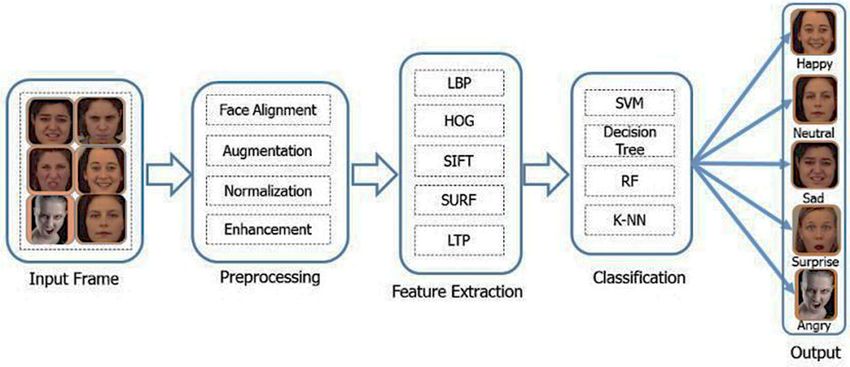
Information 2022, 13, 268                                                                                            2 of 17

                            with complex backgrounds. Indeed, human beings can easily predict facial emotions and
                            other facial features of an image, but these are difficult tasks for machines without excellent
                            training [11,12]. The primary purpose of face detection is to separate face images from
                            the background (non-faces). Some face detection domains are gesture recognition, video
                            surveillance systems, automated cameras, gender recognition, facial feature recognition,
                            face recognition, tagging and teleconferencing [13,14]. These systems need first to detect
                            faces as inputs. There is a color sensor for image acquisition that captures color images
                            everywhere. Hence, current face recognition techniques depend heavily on grayscale, and
                            there are only a few techniques that are able operate with color images. To achieve better
                            performance, these systems either implement window-based or pixel-based techniques,
                            which are the key categories of strategies for facial recognition. The pixel-based method
                            lags in separating the face from the hands of another skin region of the person [15,16].
                                 In contrast, the window-based method loses the capacity to view faces from various
                            perspectives. Model matching approaches are the most frequently used techniques for FER,
                            including face detection. In contrast, the window-based approach cannot view faces from
                            different angles. Currently, several state-of-the-art classifiers, such as ANN, CNN, SVM,
                            KNN, and random forest (RF), are employed for different features’ extraction and in the
                            recognition of tumors in healthcare, in biometrics, in handwriting studies and in detecting
                            faces for security measures [17–19].

                            Main Contributions
                                 Over the past three decades, there has been a lot of research reported in the literature
                            on facial emotion recognition (FER). Nevertheless, despite the long history of FER-related
                            works, there are no systematic comparisons between traditional ML and DL approaches.
                            Kołakowska [20] presented a review whose main focus was on conventional ML approaches.
                            Ghayoumi [21] proposed a short review of DL in FER, and Ko et al. [22] presented a state-
                            of-the-art review of facial emotion recognition techniques using visual data. However, they
                            only provided the differences between conventional ML techniques and DL techniques.
                            This paper presents a detailed investigation and comparisons of traditional ML and deep
                            learning (DL) techniques with the following major contributions:
                            •    The main focus is to provide a general understanding of the recent research and help
                                 newcomers to understand the essential modules and trends in the FER field.
                            •    We present the use of several standard datasets consisting of video sequences and
                                 images with different characteristics and purposes.
                            •    We compare DL and conventional ML approaches for FER in terms of resource uti-
                                 lization and accuracy. The DL-based approaches provide a high degree of accuracy
                                 but consume more time in training and require substantial processing capabilities,
                                 i.e., CPU and GPU. Thus, recently, several FER approaches have been used in an
                                 embedded system, e.g., Raspberry Pi, Jetson Nano, smartphones, etc.
                                 This paper provides a holistic review of facial emotion recognition using the traditional
                            ML and DL methods to highlight the future gap in this domain for new researchers. Further,
                            Section 1 presents the related background on facial emotion recognition; Sections 2 and 3
                            contain a brief review of traditional ML and DL. In Section 4, a detailed overview is
                            presented of the FER datasets. Section 5 considers the performance of the current research
                            work, and, finally, the research is concluded in Section 6.

                            2. Facial Emotion Recognition Using Traditional Machine Learning Approaches
                                 Facial emotions are beneficial for investigating human behavior [23,24] as exhibited in
                            Figure 1. Psychologically, it is proven that the facial emotion recognition process measures
                            the eyes, nose, mouth and their locations.
                                 The earliest approach used for facial emotion intensity estimation was based on
                            distance urged. This approach uses high-dimensional rate transformation and regional
                            volumetric distinction maps to categorize and quantify facial expressions. In videos,
                            most systems use Principal Component Analysis (PCA) to represent facial expression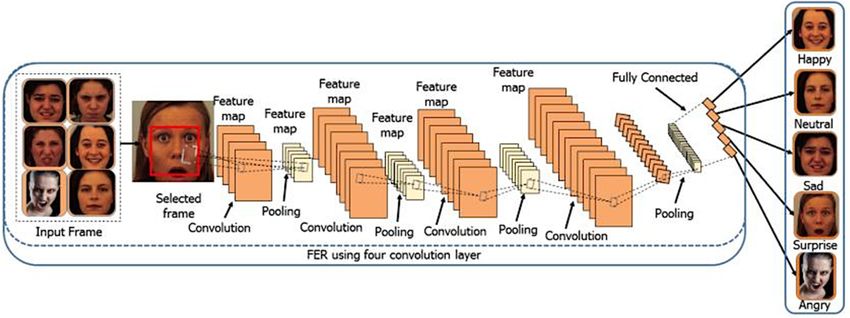
Information 2022, 13, x FOR PEER REVIEW 3 of 19
Information 2022, 13, 268 3 of 17
2. Facial Emotion Recognition Using Traditional Machine Learning Approaches
Facial
features emotions
[25]. PCA hasarebeen
beneficial
used for investigating
to recognize thehuman
actionbehavior [23,24] asand
unit to express exhibited
establish
in Figure 1. Psychologically, it is proven that the facial emotion recognition
different facial expressions. Other facial expressions are structured and recognized process by
measures thePCA
mistreatment eyes,for
nose, mouth and
providing their action
a facial locations.
unit [26].
Figure1.1.Facial
Figure Facialemotion
emotion recognition
recognition (FER)
(FER)process.
process.
The earliest
Siddiqi et al. approach usedand
[27] detected for extracted
facial emotion intensity
the face portionestimation was based
via the active on dis-
contour model.
tance urged. This approach uses high-dimensional rate transformation
The researchers used Chan–Vese and Bhattacharyya’s energy functions to optimize and regional vol-the
umetric between
distance distinction
facemaps
and to categorize
context, and quantify
and reduce facial expressions.
the differences within theInface.
videos, most
In addition,
systems use Principal Component Analysis (PCA) to represent facial expression
noise is reduced using wavelet decomposition, and the geometric appearance features of features
[25]. emotions
facial PCA has been used movement
and facial to recognizefeatures
the action unitoptical
using to express
flow and establish different
are extracted.
facial expressions. Other facial expressions are structured and recognized by mistreat-
There is no need for high computational power and memory for conventional ML
ment PCA for providing a facial action unit [26].
methods such as DL methods. Therefore, these methods need further consideration to im-
Siddiqi et al. [27] detected and extracted the face portion via the active contour model.
plement embedded devices that perform classification in real time with low computational
The researchers used Chan–Vese and Bhattacharyya’s energy functions to optimize the
power and provide satisfactory results. Accordingly, Table 1 presents a brief summary
distance between face and context, and reduce the differences within the face. In addition,
noise is reduced using wavelet decomposition, and the geometric appearance features of
Table 1. Summary of the representative conventional FER approaches.
facial emotions and facial movement features using optical flow are extracted.
References Datasets
There is no need for high computational powerFeatures
Decision Methods
and memory for conventional ML
Emotions Analyzed
methods such as DL methods. Therefore, these methods need further consideration to im-
support vector machine (SVM)
Varma et al. [28] plement embeddedclassifier
FECR devices that
and HMMperform classification
PCA and inLDA
real time with low computa-
Six emotions
tional power and provide satisfactory results. Accordingly, Table 1 presents a brief sum-
Haar Wavelet Transform
mary support vector machine (SVM) (HWT), Gabor wavelets and
Reddy et al. [29] CK+ Six emotions
classifier nonlinear principal
component
Table 1. Summary of the representative conventional analysis (NLPCA)
FER approaches.
MMI ORB
support vector machine (SVM) Emotions
Sajjad et al. [30] JAFFE SIFT Seven emotions
References Datasets classifier
CK+
Decision Methods Features
SURF Analyzed
CK+ KNN, SMO and MLP for
Nazir et al. [31]
MMI
support vector
classification
HOG, DCT Seven emotions
Varma et al.
FECR machine (SVM) LBP, SIFT,PCA and
Gabor LDA and
Function Six emotions
Zeng et al. [32] CK+ [28] DSAE Seven emotions
classifier and HMM HOG
Real-time dataset from
Uddin et al. [33] support
Deep Belief Network vector
(DBN) Haar Wavelet
MLDP-GDA Transform
features Six emotions
visual depth cameraet al.
Reddy
Al-Agha et al. [34] BOSPHORUS CK+Euclidean
machine
distance (SVM) (HWT), Gabor
Geometric wavelets
descriptor Six emotions
Four emotions
[29]
CK+ classifier and nonlinear principal
Ghimire et al. [35] MMI EBGM, KLT and AdaBoost-ELM Salient geometric features Seven emotions
MUG
BVTKFER
Wang and Yang [36] random forest classifier LBP Six emotions
BCurtinFacesInformation 2022, 13, 268 4 of 17
Table 1. Cont.
References Datasets Decision Methods Features Emotions Analyzed
BBC,
RSTD, four conventional Two emotions
SPOS
Wu et al. [37] support vector machine (SVM) features—raw pixels, Gabor, Smile (genuine and
MMI
HOG and LBP fake)
UvANEMO
Conditional Random Field (CRF)
Acevedo et al. [38] CK+ Geometric descriptor Seven emotions
and KNN
CK embedded hidden Markov
Kim [39] ASM and 2D DCT Seven emotions
JAFFE model (EHMM)
CK+
Gabor wavelets and geometric
Cornejo et al. [25] JAFFE PCA, LDA, K-NN and SVM Seven emotions
features
MUG
CK
Chan–Vese energy function,
JAFFE
Bhattacharyya distance
Siddiqi et al. [27] USTCNVIE hidden Markov model (HMM) Six emotions
function wavelet
Yale
decomposition and SWLDA
FEI
feature descriptors,
Chang et al. [40] CK+ Support Vector Regression (SVR) AAMs, Seven emotions
Gabor wavelets
3. Facial Emotion Recognition Using Deep-Learning-Based Approaches
Deep learning (DL) algorithms have revolutionized the computer vision field in the
current decade with RNN and CNN [41–43]. These DL-based methods are used for feature
extraction, recognition and classification tasks. The key advantage of a DL approach (CNN)
is to overcome the dependency on physics-based models and reduce the effort required
in preprocessing and feature extraction phases [44,45]. In addition, DL methods enable
end-to-end learning from input images directly. For these purposes, in several regions,
including FER, scene awareness, face recognition and entity recognition, DL-based methods
have obtained encouraging results from the state-of-the-art [46,47]. There are generally
three layers in a DL-CNN, (1) convolution layer, (2) subsampling layer and (3) FC layer, as
exhibited in Figure 2. The CNN takes the image or feature maps as the input, and slides
these inputs together with a series of filter banks to produce feature maps that reflect the
facial image’s spatial structure. Inside a feature map, the weights of convolutional filters are
connected, and the feature map layer inputs are locally connected [48–50]. By implementing
one of the most popular pooling approaches, i.e., max pooling, min pooling or average
pooling, the second type of layer, called subsampling, is responsible for reducing the given
feature maps [51,52]. A CNN architecture’s last FC layer calculates the class probability
of an entire input image. Most DL-based techniques can be freely adapted with a CNN to
detect emotions.
Li et al. [53] proposed a 3D CNN architecture to recognize several emotions from
videos. They extracted deep features and used three benchmark datasets for the experimen-
tal evaluation, namely CASME II, CASME and SMIC. Li et al. [54] performed additional
face cropping and rotation techniques for feature extraction using a convolutional neu-
ral network (CNN). Tests were carried out on the CK+ and JAFFE databases to test the
proposed procedure.
A convolution neural network (CNN) with a focus function (ACNN) was suggested
by Li et al. [55] that could interpret the occlusion regions of the face and concentrate on
more discriminatory, non-occluded regions. A CNN is an end-to-end learning system.
First, the different depictions of facial regions of interest (ROIs) are merged. Then, each
representation is weighted by a proposed gate unit that calculates an adaptive weight
according to the area’s significance. Two versions of ACNN have been developed in
separate ROIs: patch-based CNN (pACNN) and global-local-based ACNN (gACNN).
Lopes et al. [56] classified human faces into several emotion groups. They used threeCK+ AAMs, Seven emotions
[40] Regression (SVR)
Gabor wavelets
3. Facial Emotion Recognition Using Deep-Learning-Based Approaches
Information 2022, 13, 268 Deep learning (DL) algorithms have revolutionized the computer vision field in 5 ofthe
17
current decade with RNN and CNN [41–43]. These DL-based methods are used for feature
extraction, recognition and classification tasks. The key advantage of a DL approach
(CNN) isarchitectures
different to overcome for theclassification:
dependency on (1) physics-based
a CNN with 5models C layers, and
(2)reduce the effort
a baseline with
required
one C layerin preprocessing
and (3) a deeper andCNNfeature
withextraction
several Cphases
layers. [44,45]. In addition,
Breuer and KimmelDL [57]methods
trained
aenable
modelend-to-end
using various datasets
learning fromof FERimages
input to classify sevenFor
directly. basic
theseemotions.
purposes,Chu et al. [58]
in several re-
presented multi-level
gions, including FER,mechanisms for detecting
scene awareness, facial emotions
face recognition by combining
and entity recognition,temporal
DL-basedand
spatial
methods features. They used
have obtained a CNN architecture
encouraging results from for spatial feature extraction
the state-of-the-art [46,47]. and LSTMs
There are
to model the temporal dependencies. Finally, they fused the output
generally three layers in a DL-CNN, (1) convolution layer, (2) subsampling layer and (3) of both LSTMs and
CNNs to provide
FC layer, a per-frame
as exhibited prediction
in Figure 2. The CNNof twelve
takesfacial emotions.
the image Hasani
or feature mapsand asMahoor [59]
the input,
presented
and slides the these3Dinputs
Inception-ResNet
together withmodel and
a series of LSTM unit, to
filter banks which
producewerefeature
fused maps
to extract
that
temporal
reflect theand spatial
facial features
image’s from
spatial the inputInside
structure. frames of videomap,
a feature sequences. (Zhang
the weights ofetconvolu-
al., [60]
and Jain
tional et al.are
filters [61] suggestedand
connected, a multi-angle
the feature optimal
map layer pattern-dependent
inputs are locallyDL (MAOP-DL)
connected [48–
system to address the problem of abrupt shifts in lighting and achieved
50]. By implementing one of the most popular pooling approaches, i.e., max pooling, min proper alignment of
the feature set by utilizing optimal arrangements centered on multi-angles.
pooling or average pooling, the second type of layer, called subsampling, is responsible Their approach
first subtractsthe
for reducing thegiven
backdrop,
featureisolates the subject
maps [51,52]. A CNN from the face images
architecture’s andlayer
last FC latercalculates
removes
the
the facial points’ texture
class probability of anpatterns
entire and
input the related
image. main
Most features.techniques
DL-based The relatedcan features are
be freely
extracted and fed into an LSTM-CNN
adapted with a CNN to detect emotions. for facial expression prediction.
Figure 2.
Figure 2. Training
Training process
process of
of CNN
CNN model
model for
for facial
facialemotion
emotionrecognition.
recognition.
Li et al. [53]
Al-Shabi et al.proposed a 3Dand
[62] qualified CNN architecture
collected a minimalto recognize several
sample of data for emotions from
a model combi-
videos.ofThey
nation CNNextracted
and SIFTdeep features
features andexpression
for facial used threeresearch.
benchmark datasets
A hybrid for the experi-
methodology was
mental
used to evaluation,
construct annamely
efficientCASME II, CASME
classification model,and SMIC. LiCNN
integrating et al.and
[54]SIFT
performed addi-
functionality.
Jung
tionaletface
al. [63] proposed
cropping andarotation
system in which two
techniques forCNN models
feature with different
extraction using a characteristics
convolutional
were
neuralused. Firstly,
network presence
(CNN). Testsfeatures were extracted
were carried out on thefrom
CK+images,
and JAFFEanddatabases
secondly, to
temporal
test the
geometry
proposed features
procedure. were extracted from the temporal facial landmark points. These models
were Afused into a novel
convolution integration
neural network scheme
(CNN) withto increase
a focusFER efficiency.
function (ACNN)Yu and
wasZhang [64]
suggested
used
by Liaethybrid CNN
al. [55] thattocould
execute FER and,
interpret the in 2015, obtained
occlusion regionsstate-of-the-art
of the face and outcomes in FER.
concentrate on
They
more used an assemblynon-occluded
discriminatory, of CNNs with five convolution
regions. A CNN islayers for each facet
an end-to-end word.
learning Their
system.
method
First, theimposed
differenttransformation on the
depictions of facial input image
regions in the
of interest training
(ROIs) are process,
merged. while
Then, their
each
model produced predictions for each subject’s multiple emotions in the
representation is weighted by a proposed gate unit that calculates an adaptive weight testing phase. They
ac-
used stochastic
cording pooling
to the area’s to deliver Two
significance. optimal efficiency,
versions of ACNN rather thanbeen
have utilizing peak pooling
developed in sepa-
(Table 2). patch-based CNN (pACNN) and global-local-based ACNN (gACNN). Lopes
rate ROIs:
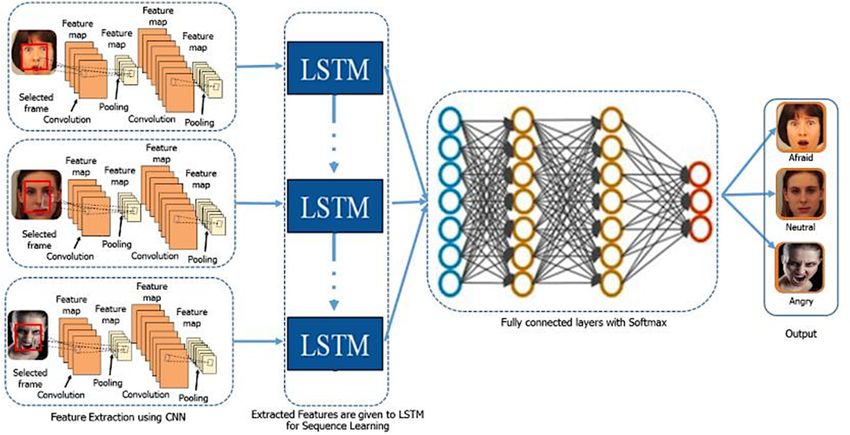
The hybrid CNN-RNN and CNN-LSTM techniques have comparable architectures, as
discussed in the previous section and exhibited in Figure 3. In short, CNN-RNN’s simple
architecture combines an LSTM with a DL software visual feature extractor, such as the
CNN model. The hybrid techniques are, thus, equipped to distinguish emotions from
image sequences. Figure 3 indicates that each graphic attribute has been translated to the
LSTM blocks and describes a variable or fixed-length vector. Finally, performance is given
for the prediction in a recurrent sequence learning module and the SoftMax classifier is
used in [58].Information 2022, 13, 268 6 of 17
Table 2. Deep learning-based approaches for FER.
References Datasets Methods Emotions Analyzed
CK+
Li et al. [65] convolutional neural network (CNN) Seven emotions
JAFFE
CK+ For the facial label prediction, they
Jain et al. [61] Six emotions
MMI used LSTM-CNN
SMIC 3D flow-based CNN model for
Li et al. [53] CASME video-based micro-expression Five emotions
CASME II recognition
CK+ Attention-based SERD and the
Xie et al. [66] Six emotions
JAFFE MPVS-Net
RAF-DB AffectNet SFEW
CK+
Li et al. [55] CNN with ACNN Seven emotions
MMI
Oulu-CASIA
CK+
CNN and specific image
Lopes et al. [56] JAFFE Seven emotions
preprocessing steps
BU-3DFE
CK+
Breuer and Kimmel [57] CNN with transfer learning Seven emotions
FER2013
CNN is used to extract spatial
representations and
Chu et al. [58] BP4D Twelve emotions
LSTMs used for temporal
dependencies
LSTM units extracted both temporal
and spatial relations from facial
CK+ Twenty-three primary and
Hasani and Mahoor [59] images;
DISFA compound emotions
as inputs of the network, they used
facial landmark points
CK+
Zhang et al. [60] Oulu-CASIA PHRNN and MSCNN Seven emotions
MMI
CK+ Dense SIFT and regular SIFT are
Al-Shabi et al. [62] Seven emotions
FER-2013 merged with CNN features
CK+
Jung et al. [63] DTAN and DTGN Seven emotions
Oulu-CASIA
FER-2013 Used an assembly of DCNNs with
Yu and Zhang [64] Seven emotions
SFEW seven convolution layers
Generally, DL-based methods determine classifiers and features by DNN experts,
unlike traditional ML methods. DL-based methods extract useful features directly from
training data using DCNNs [67,68]. However, the massive training data are a challenge
for facial expressions under different conditions to train DNNs. Furthermore, DL-based
methods need high computational power and a large amount of memory to train and
test the model compared to traditional ML methods. Thus, it is necessary to decrease the
computational time during the inferencing of DL methods.Information 2022, 13, 268 7 of 17
Information 2022, 13, x FOR PEER REVIEW 7 of 19
Figure 3. Demonstrated CNN features used by LSTM for sequence learning; SoftMax is used.
Figure 3. Demonstrated CNN features used by LSTM for sequence learning; SoftMax is used.
Table Emotion
4. Facial Datasets approaches for FER.
2. Deep learning-based
Experts
Referencesfrom different institutions have generated
Datasets Methods several datasets to evaluate
Emotions Analyzedreported
methods for facial expression
CK+ classification [69,70].
convolutional Accordingly,
neural network a detailed overview of
Li et al. [65] Seven emotions
some benchmark datasets JAFFE
is presented. (CNN)
CK+ For the facial label prediction,
• The CK+
Jain et Cohen Kanade Dataset:
al. [61] Six emotions
MMI they used LSTM-CNN
The Cohen KanadeSMIC database [71] is inclusive
3D flow-based CNN inmodel
that itforconsists of subject images
of all Li
sexes
et al.and
[53] races and
CASMEis open tovideo-based
the public.micro-expression
This dataset consists Five of seven essential
emotions
emotions that often include CASME neutral
II emotions. The images’ resolution is 640 × 490 or
recognition
640 ×Xie480 dimensions, with
et al. [66]
CK+ grayscaleAttention-based
(8-bit) existingSERD in and
the the
dataset.Six Approximately
emotions
81%
JAFFE MPVS-Net
of subjects are Euro-American, 13% are Afro American, and approximately 6% are from
other races. In theRAF-DB AffectNet
CK+ dataset, the ratio of females is nearly 65%. The dataset consists of
SFEW
593 images captured from 120 different people, and the age of these people varies from 18
Li et al. [55]
to 30 years. CK+ CNN with ACNN Seven emotions
MMI
• Bosphorus dataset Oulu-CASIA
This dataset CK+
Lopes et al. consists of 2D and 3D faces
CNN forandemotion recognition, facial action detection,
specific image
3D face reconstruction, JAFFE
etc. There are 105 Seven emotions
[56] preprocessing steps faces in different poses in the
humans with 4666
BU-3DFE
dataset. This dataset is different from other datasets in the following aspects.
Breuer and CK+
1. A rich collection of CNN
facial emotions is with transfer learning
included: Seven emotions
Kimmel [57] FER2013
i. Per person, at least 35 facial CNNemotions areextract
is used to recoded;
spatial
ii. FACS scoring; representations and
Chu et al. [58] BP4D Twelve emotions
iii. Each third person is a professional LSTMs used for temporal
actresses/actors.
dependencies
2. Systematic head poses are included.
LSTM units extracted both
3. A variety of facial occlusions are included (eyeglasses, hands, hair, moustaches and
temporal and spatial relations Twenty-three
beards).
Hasani and CK+
from facial images; primary and
Mahoor [59] DISFA
• SMIC dataset as inputs of the network, they compound emotions
used facial landmark points
SMIC [54] contains macro- and micro-emotions, but the focus is on macro-emotions;
this category includes 164 videos taken from 16 subjects. The videos were captured using a
powerful 100 frame per second camera.
• BBC dataset
The BBC database is from the ‘Spot the fake smile’ test on the BBC website (http:
//www.bbc.co.uk/science/humanbody/mind/surveys/smiles/ accessed on 17 DecemberInformation 2022, 13, 268 8 of 17
2021), which consists of 10 genuine and 10 posed smile videos collected with a resolution
of 314 × 286 pixels at 25 frames/s from seven females and thirteen males.
Information 2022, 13, x FOR PEER REVIEW
The image representation of these datasets is shown in Figure 4 such that 9each
of 19 row
represents an individual dataset.
CK+
MMI
JAFFE
SFEW
KDEF
FER-2013
MUG
Yale B face
Figure 4. Cont.Information 13, 268
2022, 2022,
Information 13, x FOR PEER REVIEW 10 of 199 of 17
BOSPHORUS
UvA-Nemo
NUST-NVIE
SPOS
FEI Face
DIFSA
AFEW
Curtain-face
Figure 4. Cont.Information 13, 268
2022,2022,
Information 13, x FOR PEER REVIEW 10 of 17
11 of 19
VT-KFER
Oulu-CASIA
BU-3DFE
BP4D
Figure
Figure 4. 4.Twenty
Twentydifferent
different datasets
datasets for
for facial
facialemotion
emotionrecognition, including
recognition, CK+,CK+,
including MMI,MMI,
JAFFE,
JAFFE,
SFEW, KDEF, FER-2013, MUG, Yale B face, BOSPHORUS, UvA-Nemo, NUST-NVIE, SPOS, FEI,
SFEW, KDEF, FER-2013, MUG, Yale B face, BOSPHORUS, UvA-Nemo, NUST-NVIE, SPOS, FEI,
DIFSA, AFEW, Curtain-face, VT-KFER, Oulu-CASIA, BU-3DFE and BP4D.
DIFSA, AFEW, Curtain-face, VT-KFER, Oulu-CASIA, BU-3DFE and BP4D.
5. Performance Evaluation of FER
5. Performance Evaluation of FER
Performance evaluation based on quantitative comparison is an important technique
Performance evaluation based on quantitative comparison is an important technique
to compare experimental results [72,73]. Benchmark comparisons on publicly available
to datasets
compare experimental results [72,73]. Benchmark comparisons on publicly available
are also presented. Two different mechanisms are used to evaluate the reported
datasets areaccuracy:
system’s also presented. Two different
(1) cross-dataset mechanisms
and (2) are used toFirstly,
subject-independent. evaluate the reported sys-
a subject-inde-
tem’s accuracy: (1) cross-dataset and (2) subject-independent. Firstly, a subject-independent
pendent task separates each dataset into two parts: validation and training datasets. This
task separates
process is alsoeach
knowndataset intocross-validation
as K-fold two parts: validation and training
[74,75]. K-fold datasets.isThis
cross-validation usedprocess
to
is also known
overcome as K-fold
overfitting cross-validation
and provide insight [74,75].
into howK-fold cross-validation
the model will generalizeis to
used to over-
an un-
come overfitting
known, and provide
independent dataset. insight into how the model will generalize to an unknown,
independent dataset.
6. Evaluation Metrics/Performance Parameters
6. Evaluation Metrics/Performance
The evaluation Parameters
metrics include overall accuracy, F-measure, recall and precision [76]
The
Each evaluation
evaluation metrics
metric includeseparately
is discussed overall accuracy,
below. F-measure, recall and precision [76]
Each
• evaluation metric
Precision: This is discussed
indicates separately
how accurate below.a model is, and it yields the actual
or precise
• positive values
Precision: from a sethow
This indicates of predictions
accurate orbyprecise
any algorithm.
a modelPrecision
is, and itisyields
an excellent
the actual
measure to indicate when the costs of false positives are relatively very high [77–79].
positive values from a set of predictions by any algorithm. Precision is an excellent
measure to indicate when
Precision the positive)/(True
= (True costs of false positives
positive +are relatively
False positive)very high [77–79].
(1)
• Recall: A Precision = (True
recall value positive)/(True
computes positive
how many actual + False
positive positive)
values a mode captures (1)
• Recall: A recall value computes how many actual positive values a mode captures
while labeling it positive. This metric is used to select the best model when there is a
high cost of false negatives [80,81].Information 2022, 13, 268 11 of 17
Precision = (True positive)/(True positive + False negative) (2)
• F1 Score: The F1 score is acquired when a balance is needed between precision and
recall. F1 is a function of precision and recall [82,83].
F1 = 2 * (Precision * Recall)/(Precision + Recall) (3)
• True Negatives (TN): Samples in the results are graded as not adequately belonging to
the required class [84–86].
• False Negatives (FN): Samples are mistakenly used in data identified as not belonging
to the required class [87–90].
• True Positives (TP): Samples in the data are appropriately categorized as belonging to
the desired class [91–93].
• False Positives (FP): Samples in the data are categorized incorrectly as belonging to
the target class [77,94].
Comparisons on Benchmark Datasets
It is challenging to compare different ML and deep-learning-based facial recognition
strategies due to the different setups, datasets and machines used [95,96]. However, the
latest comparison of different approaches is presented in Table 3.
Table 3. Conventional ML-based approaches for FER.
References Datasets Accuracy (%) Techniques
PCA and LDA for feature selection
Varma et al. [28] FECR 98.40 (SVM) 87.50 (HMM)
and SVM and HMM classifier
Haar Wavelet Transform (HWT),
Gabor wavelets and nonlinear
Reddy et al. [29] CK+ 98.00 principal component analysis
(NLPCA) feature extractor and SVM
classifier
MMI ORB
99.1 on MMI accuracy (92) on
Sajjad et al. [30] JAFFE SIFT
JAFFE accuracy (90) on CK+
CK+ SURF using SVM
CK+ 99.6 by using only 32 features HOG, DCT features and KNN, SMO
Nazir et al. [31]
MMI with KNN and MLP for classification
LBP, SIFT, Gabor Function and HOG
Zeng et al. [32] CK+ 95.79 features and Deep Sparse
Auto-Encoder (DSAE) classifier
Real-time dataset from MLDP-GDA features fed to Deep
Uddin et al. [33] 96.25
visual depth camera Belief Network (DBN) for prediction
CK+ 97.80
Salient geometric features and EBGM,
Ghimire et al. [35] MMI 77.22
KLT and AdaBoost-ELM class
MUG 95.50
BVT-KFER 93.33 LBP features and a random forest
Yang et al. [96]
BCurtinFaces 92.50 classifier
RSTD, four conventional
BBC 90.00
features—raw pixel, Gabor, HOG and
SPOS 81.25
Wu et al. [37] LBP features
MMI 92.21
Support vector machine (SVM)
UvA-NEMO 93.95
classifiersInformation 2022, 13, 268 12 of 17
Table 3. Cont.
References Datasets Accuracy (%) Techniques
Geometric descriptor and
89.3
Acevedo et al. [38] CK+ Conditional Random Field (CRF) and
86.9
KNN classifier
Geometric descriptor and Euclidean
Al-Agha et al. [34] BOSPHORUS 85.00
distance is used for the prediction
ASM and 2D DCT features and
CK 77.00
Kim [39] embedded hidden Markov model
JAFFE 64.7
(EHMM)
Features are extracted by using
CK 99.33
Chan–Vese energy function,
JAFFE 96.50
Bhattacharyya distance function
Siddiqi et al. [27] USTC-NVIE 99.17
wavelet decomposition and SWLDA
Yale 99.33
and hidden Markov model (HMM) is
FEI 99.50
used for prediction
CK+ 99.78 Geometric + PCA + LDA + KNN
Cornejo et al. [25] JAFFE 99.17 Geometric + PCA + LDA + K − NN
MUG 99.94 Geometric + PCA + LDA + K − NN
Mean Error (AAMs 0.316) feature descriptors, AAMs, Gabor
Mean Error (Gabor 0.349) wavelets and support vector
Chang et al. [40] CK+
MAEs (AAMs 0.324) regression (SVR) are used for
MAEs (Gabor0.651) classification
As shown in Tables 3 and 4, deep-learning-based approaches outperform conventional
approaches.
Table 4. Comparisons of deep-learning-based approaches for FER.
References Datasets Accuracy (%) Methods
97.38
CK+ 0.14 SD
Li et al. [65] Convolutional neural network (CNN)
JAFFE 97.18
0.30 SD
SMIC 55.49 3D flow-based CNN model for
Li et al. [55] CASME 54.44 video-based micro-expression
CASME II 59.11 recognition
With 10-fold cross-validation Expressional Region Descriptor
CK+ accuracy (SERD) and Multi-Path
Xie et al. [66]
JAFFE 95.88 Variation-Suppressing Network
99.32 (MPVS-Net)
RAF-DB AffectNet SFEW
Convolutional neutral network
CK+
Li et al. [55] 91.64 (CNN) with attention mechanism
MMI
(ACNN)
Oulu-CASIA
Average of C6class (96.76)
Average of Cbin (98.92)
CK+
Average of C6class (72.89) Convolutional neural network and
Lopes et al. [56] JAFFE
Average of Cbin (90.96) specific image preprocessing steps
BU-3DFE
Average of C6class (53.44)
Average of Cbin (84.48)
CK+ 98.62 ± 0.11 Convolutional neural network (CNN)
Breuer and Kimmel [57]
FER2013 72 ± 10.5 with transfer learningInformation 2022, 13, 268 13 of 17
Table 4. Cont.
References Datasets Accuracy (%) Methods
Extracted spatial representations
Accuracy on 3-fold (53.2) by CNN
Chu et al. [58] BP4D
Accuracy on 10-fold (82.5) and for temporal dependencies,
LSTMs were used
CK+ 89.5
Hasani and Mahoor [58] Facial landmark points fed to CNN
DISFA 56.0
CK+ 96.17 LSTM CNN using texture patterns for
Jain et al. [61]
MMI 98.72 facial expression prediction
Part-Based Hierarchical Bidirectional
CK+ 97.78
Recurrent Neural Network (PHRNN)
(Zhang et al. 2017) Oulu-CASIA 86.25
and Multi-Signal Convolutional
MMI 79.29
Neural Network (MSCNN)
CK+ 99.1 Dense SIFT and regular SIFT are
Al-Shabi et al. [62]
FER-2013 73.4 merged with CNN features
Fusion of deep temporal appearance
network (DTAN) and deep temporal
CK+ 97.25
Jung et al. [63] geometry network (DTGN) is
Oulu-CASIA 81.46
employed to predict facial
expressions
Validation accuracy 55.96 Assembly of DCNNs with seven
Yu and Zhang [64] SFEW
Test accuracy 61.29 convolution layers
In experimental tests, DL-based FER methods have achieved high precision; however,
a range of issues remain that require further investigation:
• As the framework becomes increasingly deeper for preparation, a large-scale dataset
and significant computational resources are needed.
• Significant quantities of datasets that are manually compiled and labeled are required.
• A significant amount of memory is required for experiments and testing, which is
time-consuming.
The approaches mentioned above, especially those based on deep learning, require
massive computation power. Moreover, these approaches are developed for specific emo-
tions, and thus are not suitable to classify other emotional states. Therefore, developing a
new framework to be applied to the whole spectrum of emotions would be of significant
relevance, and could be expanded to classify complex facial expressions.
7. Conclusions and Future Work
In this paper, a detailed analysis and comparison are presented on FER approaches.
We categorized these approaches into two major groups: (1) conventional ML-based ap-
proaches and (2) DL-based approaches. The convention ML approach consists of face
detection, feature extraction from detected faces and emotion classification based on ex-
tracted features. Several classification schemes are used in conventional ML for FER,
consisting of random forest, AdaBoost, KNN and SVM. In contrast with DL-based FER
methods, the dependency on face physics-based models is highly reduced. In addition,
they reduce the preprocessing time to enable “end-to-end” learning in the input images.
However, these methods consume more time in both the training and testing phases. Al-
though a hybrid architecture demonstrates better performance, micro-expressions remain
difficult tasks to solve due to other possible movements of the face that occur unwillingly.
Additionally, different datasets related to FER are elaborated for the new researchers
in this area. For example, human facial emotions have been examined in a traditional
database with 2D video sequences or 2D images. However, facial emotion recognition
based on 2D data is unable to handle large variations in pose and subtle facial behaviors.Information 2022, 13, 268 14 of 17
Therefore, recently, 3D facial emotion datasets have been considered to provide better
results. Moreover, different FER approaches and standard evaluation metrics have been
used for comparison purposes, e.g., accuracy, precision, recall, etc.
FER performance has increased due to the combination of DL approaches. In this
modern age, the production of sensible machines is very significant, recognizing the facial
emotions of different individuals and performing actions accordingly. It has been suggested
that emotion-oriented DL approaches can be designed and fused with IoT sensors. In this
case, it is predicted that this will increase FER’s performance to the same level as human
beings, which will be very helpful in healthcare, investigation, security and surveillance.
Funding: This research received no external funding.
Institutional Review Board Statement: Not applicable.
Informed Consent Statement: Not applicable.
Data Availability Statement: Not applicable.
Acknowledgments: This research was supported by the Artificial Intelligence & Data Analytics Lab
(AIDA), CCIS Prince Sultan University, Riyadh, Saudi Arabia.
Conflicts of Interest: The authors declare no conflict of interest.
References
1. Jabeen, S.; Mehmood, Z.; Mahmood, T.; Saba, T.; Rehman, A.; Mahmood, M.T. An effective content-based image retrieval
technique for image visuals representation based on the bag-of-visual-words model. PLoS ONE 2018, 13, e0194526. [CrossRef]
[PubMed]
2. Moret-Tatay, C.; Wester, A.G.; Gamermann, D. To Google or not: Differences on how online searches predict names and faces.
Mathematics 2020, 8, 1964. [CrossRef]
3. Ubaid, M.T.; Khalil, M.; Khan, M.U.G.; Saba, T.; Rehman, A. Beard and Hair Detection, Segmentation and Changing Color Using
Mask R-CNN. In Proceedings of the International Conference on Information Technology and Applications, Dubai, United Arab
Emirates, 13–14 November 2021; Springer: Singapore, 2022; pp. 63–73.
4. Meethongjan, K.; Dzulkifli MRehman, A.; Altameem, A.; Saba, T. An intelligent fused approach for face recognition. J. Intell. Syst.
2013, 22, 197–212. [CrossRef]
5. Elarbi-Boudihir, M.; Rehman, A.; Saba, T. Video motion perception using optimized Gabor filter. Int. J. Phys. Sci. 2011, 6,
2799–2806.
6. Joudaki, S.; Rehman, A. Dynamic hand gesture recognition of sign language using geometric features learning. Int. J. Comput. Vis.
Robot. 2022, 12, 1–16. [CrossRef]
7. Abunadi, I.; Albraikan, A.A.; Alzahrani, J.S.; Eltahir, M.M.; Hilal, A.M.; Eldesouki, M.I.; Motwakel, A.; Yaseen, I. An Automated
Glowworm Swarm Optimization with an Inception-Based Deep Convolutional Neural Network for COVID-19 Diagnosis and
Classification. Healthcare 2022, 10, 697. [CrossRef]
8. Yar, H.; Hussain, T.; Khan, Z.A.; Koundal, D.; Lee, M.Y.; Baik, S.W. Vision sensor-based real-time fire detection in resource-
constrained IoT environments. Comput. Intell. Neurosci. 2021, 2021, 5195508. [CrossRef]
9. Yasin, M.; Cheema, A.R.; Kausar, F. Analysis of Internet Download Manager for collection of digital forensic artefacts. Digit.
Investig. 2010, 7, 90–94. [CrossRef]
10. Rehman, A.; Alqahtani, S.; Altameem, A.; Saba, T. Virtual machine security challenges: Case studies. Int. J. Mach. Learn. Cybern.
2014, 5, 729–742. [CrossRef]
11. Afza, F.; Khan, M.A.; Sharif, M.; Kadry, S.; Manogaran, G.; Saba, T.; Ashraf, I.; Damaševičius, R. A framework of human action
recognition using length control features fusion and weighted entropy-variances based feature selection. Image Vis. Comput. 2021,
106, 104090. [CrossRef]
12. Rehman, A.; Khan, M.A.; Saba, T.; Mehmood, Z.; Tariq, U.; Ayesha, N. Microscopic brain tumor detection and classification using
3D CNN and feature selection architecture. Microsc. Res. Tech. 2021, 84, 133–149. [CrossRef]
13. Haji, M.S.; Alkawaz, M.H.; Rehman, A.; Saba, T. Content-based image retrieval: A deep look at features prospectus. Int. J. Comput.
Vis. Robot. 2019, 9, 14–38. [CrossRef]
14. Alkawaz, M.H.; Mohamad, D.; Rehman, A.; Basori, A.H. Facial animations: Future research directions & challenges. 3D Res. 2014,
5, 12.
15. Saleem, S.; Khan, M.; Ghani, U.; Saba, T.; Abunadi, I.; Rehman, A.; Bahaj, S.A. Efficient facial recognition authentication using
edge and density variant sketch generator. CMC-Comput. Mater. Contin. 2022, 70, 505–521. [CrossRef]
16. Rahim, M.S.M.; Rad, A.E.; Rehman, A.; Altameem, A. Extreme facial expressions classification based on reality parameters. 3D
Res. 2014, 5, 22. [CrossRef]Information 2022, 13, 268 15 of 17
17. Rashid, M.; Khan, M.A.; Alhaisoni, M.; Wang, S.H.; Naqvi, S.R.; Rehman, A.; Saba, T. A sustainable deep learning framework for
object recognition using multi-layers deep features fusion and selection. Sustainability 2020, 12, 5037. [CrossRef]
18. Lung, J.W.J.; Salam, M.S.H.; Rehman, A.; Rahim, M.S.M.; Saba, T. Fuzzy phoneme classification using multi-speaker vocal tract
length normalization. IETE Tech. Rev. 2014, 31, 128–136. [CrossRef]
19. Amin, J.; Sharif, M.; Raza, M.; Saba, T.; Sial, R.; Shad, S.A. Brain tumor detection: A long short-term memory (LSTM)-based
learning model. Neural Comput. Appl. 2020, 32, 15965–15973. [CrossRef]
20. Kołakowska, A. A review of emotion recognition methods based on keystroke dynamics and mouse movements. In Proceedings
of the 6th IEEE International Conference on Human System Interactions (HSI), Sopot, Poland, 6–8 June 2013; pp. 548–555.
21. Ghayoumi, M. A quick review of deep learning in facial expression. J. Commun. Comput. 2017, 14, 34–38.
22. Ko, B.C. A brief review of facial emotion recognition based on visual information. Sensors 2018, 18, 401. [CrossRef]
23. Sharif, M.; Naz, F.; Yasmin, M.; Shahid, M.A.; Rehman, A. Face recognition: A survey. J. Eng. Sci. Technol. Rev. 2017, 10, 166–177.
[CrossRef]
24. Khan, M.Z.; Jabeen, S.; Khan, M.U.G.; Saba, T.; Rehmat, A.; Rehman, A.; Tariq, U. A realistic image generation of face from text
description using the fully trained generative adversarial networks. IEEE Access 2020, 9, 1250–1260. [CrossRef]
25. Cornejo, J.Y.R.; Pedrini, H.; Flórez-Revuelta, F. Facial expression recognition with occlusions based on geometric representation.
In Iberoamerican Congress on Pattern Recognition; Springer: Cham, Switzerland, 2015; pp. 263–270.
26. Mahata, J.; Phadikar, A. Recent advances in human behaviour understanding: A survey. In Proceedings of the Devices for
Integrated Circuit (DevIC), Kalyani, India, 23–24 March 2017; IEEE: Piscataway, NJ, USA, 2017; pp. 751–755.
27. Siddiqi, M.H.; Ali, R.; Khan, A.M.; Kim, E.S.; Kim, G.J.; Lee, S. Facial expression recognition using active contour-based face
detection, facial movement-based feature extraction, and non-linear feature selection. Multimed. Syst. 2015, 21, 541–555. [CrossRef]
28. Varma, S.; Shinde, M.; Chavan, S.S. Analysis of PCA and LDA features for facial expression recognition using SVM and HMM
classifiers. In Techno-Societal 2018; Springer: Cham, Switzerland, 2020.
29. Reddy, C.V.R.; Reddy, U.S.; Kishore, K.V.K. Facial Emotion Recognition Using NLPCA and SVM. Traitement du Signal 2019, 36,
13–22. [CrossRef]
30. Sajjad, M.; Nasir, M.; Ullah, F.U.M.; Muhammad, K.; Sangaiah, A.K.; Baik, S.W. Raspberry Pi assisted facial expression recognition
framework for smart security in law-enforcement services. Inf. Sci. 2019, 479, 416–431. [CrossRef]
31. Nazir, M.; Jan, Z.; Sajjad, M. Facial expression recognition using histogram of oriented gradients based transformed features.
Clust. Comput. 2018, 21, 539–548. [CrossRef]
32. Zeng, N.; Zhang, H.; Song, B.; Liu, W.; Li, Y.; Dobaie, A.M. Facial expression recognition via learning deep sparse autoencoders.
Neurocomputing 2018, 273, 643–649. [CrossRef]
33. Uddin, M.Z.; Hassan, M.M.; Almogren, A.; Zuair, M.; Fortino, G.; Torresen, J. A facial expression recognition system using robust
face features from depth videos and deep learning. Comput. Electr. Eng. 2017, 63, 114–125. [CrossRef]
34. Al-Agha, S.A.; Saleh, H.H.; Ghani, R.F. Geometric-based feature extraction and classification for emotion expressions of 3D video
film. J. Adv. Inf. Technol. 2017, 8, 74–79. [CrossRef]
35. Ghimire, D.; Lee, J.; Li, Z.N.; Jeong, S. Recognition of facial expressions based on salient geometric features and support vector
machines. Multimed. Tools Appl. 2017, 76, 7921–7946. [CrossRef]
36. Wang, J.; Yang, H. Face detection based on template matching and 2DPCA algorithm. In Proceedings of the 2008 Congress on
Image and Signal Processing, Sanya, China, 27–30 May 2008; pp. 575–579.
37. Wu, P.P.; Liu, H.; Zhang, X.W.; Gao, Y. Spontaneous versus posed smile recognition via region-specific texture descriptor and
geometric facial dynamics. Front. Inf. Technol. Electron. Eng. 2017, 18, 955–967. [CrossRef]
38. Acevedo, D.; Negri, P.; Buemi, M.E.; Fernández, F.G.; Mejail, M. A simple geometric-based descriptor for facial expression
recognition. In Proceedings of the 2017 12th IEEE International Conference on Automatic Face & Gesture Recognition (FG 2017),
Washington, DC, USA, 30 May–3 June 2017; pp. 802–808.
39. Kim, D.J. Facial expression recognition using ASM-based post-processing technique. Pattern Recognit. Image Anal. 2016, 26,
576–581. [CrossRef]
40. Chang, K.Y.; Chen, C.S.; Hung, Y.P. Intensity rank estimation of facial expressions based on a single image. In Proceedings of the
IEEE International Conference on Systems, Man, and Cybernetics (SMC), Manchester, UK, 13–16 October 2013; pp. 3157–3162.
41. Abbas, N.; Saba, T.; Mohamad, D.; Rehman, A.; Almazyad, A.S.; Al-Ghamdi, J.S. Machine aided malaria parasitemia detection in
Giemsa-stained thin blood smears. Neural Comput. Appl. 2018, 29, 803–818. [CrossRef]
42. Iqbal, S.; Khan, M.U.G.; Saba, T.; Mehmood, Z.; Javaid, N.; Rehman, A.; Abbasi, R. Deep learning model integrating features and
novel classifiers fusion for brain tumor segmentation. Microsc. Res. Tech. 2019, 82, 1302–1315. [CrossRef]
43. Khan, M.A.; Kadry, S.; Zhang, Y.D.; Akram, T.; Sharif, M.; Rehman, A.; Saba, T. Prediction of COVID-19-pneumonia based on
selected deep features and one class kernel extreme learning machine. Comput. Electr. Eng. 2021, 90, 106960. [CrossRef]
44. Khan, M.A.; Sharif, M.I.; Raza, M.; Anjum, A.; Saba, T.; Shad, S.A. Skin lesion segmentation and classification: A unified
framework of deep neural network features fusion and selection. Expert Syst. 2019, e12497. [CrossRef]
45. Nawaz, M.; Mehmood, Z.; Nazir, T.; Naqvi, R.A.; Rehman, A.; Iqbal, M.; Saba, T. Skin cancer detection from dermoscopic images
using deep learning and fuzzy k-means clustering. Microsc. Res. Tech. 2022, 85, 339–351. [CrossRef]
46. Rehman, A.; Abbas, N.; Saba, T.; Mehmood, Z.; Mahmood, T.; Ahmed, K.T. Microscopic malaria parasitemia diagnosis and
grading on benchmark datasets. Microsc. Res. Tech. 2018, 81, 1042–1058. [CrossRef]Information 2022, 13, 268 16 of 17
47. Saba, T.; Haseeb, K.; Ahmed, I.; Rehman, A. Secure and energy-efficient framework using Internet of Medical Things for
e-healthcare. J. Infect. Public Health 2020, 13, 1567–1575. [CrossRef]
48. Saba, T.; Bokhari ST, F.; Sharif, M.; Yasmin, M.; Raza, M. Fundus image classification methods for the detection of glaucoma: A
review. Microsc. Res. Tech. 2018, 81, 1105–1121. [CrossRef]
49. Saba, T. Automated lung nodule detection and classification based on multiple classifiers voting. Microsc. Res. Tech. 2019, 8,
1601–1609. [CrossRef]
50. Sadad, T.; Munir, A.; Saba, T.; Hussain, A. Fuzzy C-means and region growing based classification of tumor from mammograms
using hybrid texture feature. J. Comput. Sci. 2018, 29, 34–45. [CrossRef]
51. Amin, J.; Sharif, M.; Yasmin, M.; Saba, T.; Anjum, M.A.; Fernandes, S.L. A new approach for brain tumor segmentation and
classification based on score level fusion using transfer learning. J. Med. Syst. 2019, 43, 326. [CrossRef]
52. Javed, R.; Rahim, M.S.M.; Saba, T.; Rehman, A. A comparative study of features selection for skin lesion detection from
dermoscopic images. Netw. Modeling Anal. Health Inform. Bioinform. 2020, 9, 4. [CrossRef]
53. Li, J.; Wang, Y.; See, J.; Liu, W. Micro-expression recognition based on 3D flow convolutional neural network. Pattern Anal. Appl.
2019, 22, 1331–1339. [CrossRef]
54. Li, B.Y.; Mian, A.S.; Liu, W.; Krishna, A. Using kinect for face recognition under varying poses, expressions, illumination and
disguise. In Proceedings of the IEEE workshop on applications of computer vision (WACV), Clearwater Beach, FL, USA, 15–17
January 2013; pp. 186–192.
55. Li, Y.; Zeng, J.; Shan, S.; Chen, X. Occlusion aware facial expression recognition using CNN with attention mechanism. IEEE
Trans. Image Processing 2018, 28, 2439–2450. [CrossRef]
56. Lopes, A.T.; De Aguiar, E.; De Souza, A.F.; Oliveira-Santos, T. Facial expression recognition with Convolutional Neural Networks:
Coping with few data and the training sample order. Pattern Recognit. 2017, 61, 610–628. [CrossRef]
57. Breuer, R.; Kimmel, R. A deep learning perspective on the origin of facial expressions. arXiv 2017, arXiv:1705.01842.
58. Chu, W.S.; De La Torre, F.; Cohn, J.F. Learning spatial and temporal cues for multi-label facial action unit detection. In Proceedings
of the 12th IEEE International Conference on Automatic Face & Gesture Recognition (FG 2017), Washington, DC, USA, 30 May–3
June 2017; pp. 25–32.
59. Hasani, B.; Mahoor, M.H. Facial expression recognition using enhanced deep 3D convolutional neural networks. In Proceedings
of the IEEE Conference on Computer Vision and Pattern Recognition Workshops, Honolulu, HI, USA, 21–26 July 2017; pp. 30–40.
60. Zhang, K.; Huang, Y.; Du, Y.; Wang, L. Facial expression recognition based on deep evolutional spatial-temporal networks. IEEE
Trans. Image Processing 2017, 26, 4193–4203. [CrossRef]
61. Jain, D.K.; Zhang ZHuang, K. Multi angle optimal pattern-based deep learning for automatic facial expression recognition.
Pattern Recognit. Lett. 2020, 139, 157–165. [CrossRef]
62. Al-Shabi, M.; Cheah, W.P.; Connie, T. Facial Expression Recognition Using a Hybrid CNN-SIFT Aggregator. arXiv 2016,
arXiv:1608.02833.
63. Jung, H.; Lee, S.; Yim, J.; Park, S.; Kim, J. Joint fine-tuning in deep neural networks for facial expression recognition. In Proceedings
of the IEEE International Conference on Computer Vision, Santiago, Chile, 7–13 December 2015; pp. 2983–2991.
64. Yu, Z.; Zhang, C. Image based static facial expression recognition with multiple deep network learning. In Proceedings of the
2015 ACM on International Conference on Multimodal Interaction, Seattle, WA, USA, 9–13 November 2015; pp. 435–442.
65. Li, K.; Jin, Y.; Akram, M.W.; Han, R.; Chen, J. Facial expression recognition with convolutional neural networks via a new face
cropping and rotation strategy. Vis. Comput. 2020, 36, 391–404. [CrossRef]
66. Xie, S.; Hu, H.; Wu, Y. Deep multi-path convolutional neural network joint with salient region attention for facial expression
recognition. Pattern Recognit. 2019, 92, 177–191. [CrossRef]
67. Nasir, I.M.; Raza, M.; Shah, J.H.; Khan, M.A.; Rehman, A. Human action recognition using machine learning in uncontrolled
environment. In Proceedings of the 2021 1st International Conference on Artificial Intelligence and Data Analytics (CAIDA),
Riyadh, Saudi Arabia, 6–7 April 2021; pp. 182–187.
68. Rehman, A.; Haseeb, K.; Saba, T.; Lloret, J.; Tariq, U. Secured Big Data Analytics for Decision-Oriented Medical System Using
Internet of Things. Electronics 2021, 10, 1273. [CrossRef]
69. Harouni, M.; Rahim, M.S.M.; Al-Rodhaan, M.; Saba, T.; Rehman, A.; Al-Dhelaan, A. Online Persian/Arabic script classification
without contextual information. Imaging Sci. J. 2014, 62, 437–448. [CrossRef]
70. Iftikhar, S.; Fatima, K.; Rehman, A.; Almazyad, A.S.; Saba, T. An evolution based hybrid approach for heart diseases classification
and associated risk factors identification. Biomed. Res. 2017, 28, 3451–3455.
71. Lucey, P.; Cohn, J.F.; Kanade, T.; Saragih, J.; Ambadar, Z.; Matthews, I. The extended cohn-kanade dataset (ck+): A complete
dataset for action unit and emotion-specified expression. In Proceedings of the IEEE computer society conference on computer
vision and pattern recognition-workshops, San Francisco, CA, USA, 13–18 June 2010; pp. 94–101.
72. Jamal, A.; Hazim Alkawaz, M.; Rehman, A.; Saba, T. Retinal imaging analysis based on vessel detection. Microsc. Res. Tech. 2017,
80, 799–811. [CrossRef]
73. Neamah, K.; Mohamad, D.; Saba, T.; Rehman, A. Discriminative features mining for offline handwritten signature verification.
3D Res. 2014, 5, 2. [CrossRef]
74. Ramzan, F.; Khan, M.U.G.; Iqbal, S.; Saba, T.; Rehman, A. Volumetric segmentation of brain regions from MRI scans using 3D
convolutional neural networks. IEEE Access 2020, 8, 103697–103709. [CrossRef]Information 2022, 13, 268 17 of 17
75. Keltner, D.; Sauter, D.; Tracy, J.; Cowen, A. Emotional expression: Advances in basic emotion theory. J. Nonverbal Behav. 2019, 43,
133–160. [CrossRef]
76. Phetchanchai, C.; Selamat, A.; Rehman, A.; Saba, T. Index financial time series based on zigzag-perceptually important points. J.
Comput. Sci. 2010, 6, 1389–1395.
77. Saba, T.; Rehman, A.; Altameem, A.; Uddin, M. Annotated comparisons of proposed preprocessing techniques for script
recognition. Neural Comput. Appl. 2014, 25, 1337–1347. [CrossRef]
78. Saba, T.; Altameem, A. Analysis of vision based systems to detect real time goal events in soccer videos. Appl. Artif. Intell. 2013,
27, 656–667. [CrossRef]
79. Ullah, H.; Saba, T.; Islam, N.; Abbas, N.; Rehman, A.; Mehmood, Z.; Anjum, A. An ensemble classification of exudates in color
fundus images using an evolutionary algorithm based optimal features selection. Microsc. Res. Tech. 2019, 82, 361–372. [CrossRef]
[PubMed]
80. Sharif, U.; Mehmood, Z.; Mahmood, T.; Javid, M.A.; Rehman, A.; Saba, T. Scene analysis and search using local features and
support vector machine for effective content-based image retrieval. Artif. Intell. Rev. 2019, 52, 901–925. [CrossRef]
81. Yousaf, K.; Mehmood, Z.; Saba, T.; Rehman, A.; Munshi, A.M.; Alharbey, R.; Rashid, M. Mobile-health applications for the
efficient delivery of health care facility to people with dementia (PwD) and support to their carers: A survey. BioMed Res. Int.
2019, 2019, 7151475. [CrossRef]
82. Saba, T.; Rehman, A.; Al-Dhelaan, A.; Al-Rodhaan, M. Evaluation of current documents image denoising techniques: A
comparative study. Appl. Artif. Intell. 2014, 28, 879–887. [CrossRef]
83. Saba, T.; Rehman, A.; Sulong, G. Improved statistical features for cursive character recognition. Int. J. Innov. Comput. Inf. Control.
2011, 7, 5211–5224.
84. Rehman, A.; Saba, T. Document skew estimation and correction: Analysis of techniques, common problems and possible solutions.
Appl. Artif. Intell. 2011, 25, 769–787. [CrossRef]
85. Rehman, A.; Kurniawan, F.; Saba, T. An automatic approach for line detection and removal without smash-up characters. Imaging
Sci. J. 2011, 59, 177–182. [CrossRef]
86. Saba, T.; Javed, R.; Shafry, M.; Rehman, A.; Bahaj, S.A. IoMT Enabled Melanoma Detection Using Improved Region Growing
Lesion Boundary Extraction. CMC-Comput. Mater. Contin. 2022, 71, 6219–6237. [CrossRef]
87. Yousaf, K.; Mehmood, Z.; Awan, I.A.; Saba, T.; Alharbey, R.; Qadah, T.; Alrige, M.A. A comprehensive study of mobile-health
based assistive technology for the healthcare of dementia and Alzheimer’s disease (AD). Health Care Manag. Sci. 2020, 23, 287–309.
[CrossRef]
88. Ahmad, A.M.; Sulong, G.; Rehman, A.; Alkawaz, M.H.; Saba, T. Data hiding based on improved exploiting modification direction
method and Huffman coding. J. Intell. Syst. 2014, 23, 451–459. [CrossRef]
89. Rahim MS, M.; Rehman, A.; Kurniawan, F.; Saba, T. Ear biometrics for human classification based on region features mining.
Biomed. Res. 2017, 28, 4660–4664.
90. Rahim, M.S.M.; Norouzi ARehman, A.; Saba, T. 3D bones segmentation based on CT images visualization. Biomed. Res. 2017, 28,
3641–3644.
91. Nodehi, A.; Sulong, G.; Al-Rodhaan, M.; Al-Dhelaan, A.; Rehman, A.; Saba, T. Intelligent fuzzy approach for fast fractal image
compression. EURASIP J. Adv. Signal Processing 2014, 2014, 112. [CrossRef]
92. Haron, H.; Rehman, A.; Adi DI, S.; Lim, S.P.; Saba, T. Parameterization method on B-spline curve. Math. Probl. Eng. 2012, 2012,
640472. [CrossRef]
93. Rehman, A.; Saba, T. Performance analysis of character segmentation approach for cursive script recognition on benchmark
database. Digit. Signal Processing 2011, 21, 486–490. [CrossRef]
94. Yousuf, M.; Mehmood, Z.; Habib, H.A.; Mahmood, T.; Saba, T.; Rehman, A.; Rashid, M. A novel technique based on visual words
fusion analysis of sparse features for effective content-based image retrieval. Math. Probl. Eng. 2018, 2018, 13. [CrossRef]
95. Saba, T.; Khan, S.U.; Islam, N.; Abbas, N.; Rehman, A.; Javaid, N.; Anjum, A. Cloud-based decision support system for the
detection and classification of malignant cells in breast cancer using breast cytology images. Microsc. Res. Tech. 2019, 82, 775–785.
[CrossRef]
96. Yang, B.; Cao, J.M.; Jiang, D.P.; Lv, J.D. Facial expression recognition based on dual-feature fusion and improved random forest
classifier. Multimed. Tools Appl. 2017, 9, 20477–20499. [CrossRef]You can also read


