FIRE, READY, AIM DON'T MISS THE POINT OF A POLICY ADMINISTRATION TRANSFORMATION - A PUBLICATION OF PWC'S FINANCIAL SERVICES INSTITUTE (FSI)
←
→
Page content transcription
If your browser does not render page correctly, please read the page content below
A publication of PwC’s Financial Services Institute (FSI)

Fire, Ready, Aim…
Don’t Miss the Point of a Policy
Administration Transformation
Contents

Section                               Page
 1
 1.        P i t off view
           Point      i                  2

 2.        Competitive intelligence     18

 3
 3.        A framework for response     23

 4.        How PwC can help             29

 5.
 5         Select q
                  qualifications        37
Section 1 Point of view
Point of view
The convergence of complex market demands, antiquated legacy platforms, and an
increasingly mature vendor landscape has created an environment where carriers view
policy administration system (PAS) transformation as a necessary and attainable initiative.
In today’s evolving industry Complex Carriers are facing demands from both customer and agent:
landscape, carriers require a market Customer preferences have changed and continue to change
modern foundational system that demands (e g Generation Y and Millenials).
(e.g. Millenials)
enables improved market Easy access to all products with the ability to quickly and
responsiveness and operating easily create quotes.
leverage. The ease of doing business for distributors.
The ability for business and product managers to make
An increasingly mature vendor changes
h without
ith t relying
l i on IT
IT.
landscape enables carriers to
Antiquated Many carriers are struggling with policy administration systems
embark on the PAS transformation legacy that are over 30 years old:
journey with less risk than they platforms These aging systems impede carriers from capitalizing on
had to endure ffive years
y ago,
g thus growth opportunities or reacting to competitive pressures.
enabling them to build a sound and These systems also require significant maintenance, thus
realistic business case for taking away from discretionary investment and creating a
transformation. “strategic squeeze” for carriers.
Mature A significant market for vended solutions has emerged over the
vendor
d past 5-10 years, and with this emergence carriers have an
landscape alternate option to the often expensive “homegrown” solution:
Vendor solutions provide a viable implementation option,
particularly for mid-tier carriers.
This increasingly mature vendor landscape is focused on
modern architecture with feature-rich solution options.
PwC Fire, Ready, Aim... Don’t Miss the Point of a Policy Administration Transformation
3Point of view
Our industry research, observations, and experience suggest that PAS transformations
will continue to be a priority for insurers—regardless of size and product mix—for the
near future.
Claims Billing
4% 4%
Other Large insurers tend to spend more on
8%
PAS PAS transformations than small or mid-
44% tier carriers due to the increased
D ’ get left
Don’t l f behind:
b hi d IT lik lih d off implementing
likelihood i l ti a customized,
t i d
Infrastructure home grown solution.
20%
An estimated 60% of P&C Nevertheless, PAS remains a top initiative
companies are deploying new for these insurers.
policyy administration
p g insurers have g
Large greater than
systems or enhancements to Underwriting US$2 billion in net written premiums
20%
modernize their current (NWP).
systems this year. Insurers
are expected to invest a
Underwritingg Other
significant
i ifi t amountt iin PAS 9% 2% Nea
Nearlyl 40% of mid-size
mid si e ins
insurers,
rers those
replacement or with US$500 million-US$2 billion in
modernization efforts over
Billing NWP, cite PAS as one of their top three
10% PAS initiatives over the next three years.
the next three to five years. 37%
Mid-size insurers are able to contain
IT
Infrastructure
spenddbby purchasing
h i iintegrated d software
f
11% solutions.
Claims
13%
Compliance
18%
Sources: DataMonitor, Ward Group, Celent, PwC analysis
PwC Fire, Ready, Aim... Don’t Miss the Point of a Policy Administration Transformation
4Point of view
We have observed that large PAS transformation programs are often delivered late or
over budget—if at all—as a result of the magnitude, complexity, and above all, poor
upfront planning and alignment with key business drivers.
A review of past efforts in this area illustrates there is room for improvement.
Transformation
Succeeded: The project was completed on time, within parallels with the
29% budget, and met all original benefit requirements. banking industry…
We have observed that the
system transformations being
undertaken by the insurance
industry parallel those
occurring in many banks.
53%
53
Challenged: The project made it to the deadline, but Like insurance firms, banks
experienced cost/schedule overruns and was unable to are struggling with
fulfill all of the original benefit requirements.
requirements implementation challenges
such as building the business
case, managing project
execution, and measuring
project impact and benefits.
For more information, see
PwC's FS Viewpoint
publication entitled When the
18% Failed: The project was abandoned or cancelled due to project Growing Gets Tough: How
being unable to meet cost, schedule, or customer expectations. Retail Banks Can Thrive in a
Disruptive, Mobile, Regulated
World.
Sources: The Standish Group, based on Fortune 1000 Corporate Interviews regarding strategic projects
costing > $10 M; Ward Group
PwC Fire, Ready, Aim... Don’t Miss the Point of a Policy Administration Transformation
5Point of view
Insurers in the “53% – Challenged” category can miss ROI opportunities and struggle to
achieve profitable growth and expense ratio reduction targets.
Common characteristics and business implications of challenged PAS initiatives:
Challenges Characteristics Business implications
Customer experience is not tailored to specific segments;
Differentiated customers continue to encounter inconsistencies across Despite a significant PAS investment and a new
customer and agent channels. policy platform, customers and agents see little
experience Agents don’t view the new PAS platform as a significantly improvement.
better tool to increase sales.
Introducing new products and enhancing existing products
Product agility and Competitors who implemented business-aligned
is not as easy as envisioned.
regulatory PAS systems can take additional market share;
Responding to regulatory changes still requires a long IT the insurer can face adverse selection.
improvements development cycle.
Smaller than expected expense ratio benefits are realized
Expense ratio in the years following the PAS transformation. Missed expense ratio expectations; lack of free
reduction and long The insurer continues to bear the cost of legacy systems capital for business improvements to maintain
term efficiency gains because pplanned systems
y conversions/sunsets are never parity
p y or achieve competitive
p advantage.
g
completed.
Data is not integrated, lacks definition, and continues to be
Information difficult to access and use. The insurer does not realize the promise of higher
management
g and p
Business departments struggle
gg to leverageg data for value information to understand customer needs
analytics operational analysis, improving underwriting profitability, and and make better business decisions.
gaining insight to customer behaviors and needs.
PwC Fire, Ready, Aim... Don’t Miss the Point of a Policy Administration Transformation
6Point of view
When initiating a PAS transformation, insurers often fire at a target before they fully
understand where to aim, causing them to miss out on significant ROI by not aligning key
business drivers with their transformation strategy.
Carriers can maximize value by approaching PAS transformation as an opportunity to enable carefully
targeted business benefits through modernized technology.
Most carriers are taking a technology-driven approach without the benefit of a PAS Transformation
guiding business strategy and associated capabilities focused on yielding the Target Business Benefits
greatest benefit. By replacing or modernizing the legacy systems and doing nothing
more, carriers are taking on higher risk and missing significant opportunities to
create a competitive advantage through a cost-efficient operating model, enhanced
customer focused capabilities, or improved market agility. In other words, these
carriers are firing at a PAS transformation target before they fully understand where
they should be aiming.
Before moving forward, carriers should fully understand their
business case, which can vastly differ based on company size, product
mix, geographical presence, distribution channels, and overall market
dynamics.
Carriers planning policy administration transformation should evaluate specific
business drivers as a diagnostic for assessing how a transformation will impact
profitability. This process will enable carriers to gain executive alignment and
confidence that available capital is aligned with the highest business priorities. The
carrier can target functional enhancements that have the most significant impact on
their business. Most importantly, they will be transitioning from a technology-led to
a business-led approach
pp in setting
gppolicyy administration direction,, reducing
g the risk
of firing at the wrong target.
PwC Fire, Ready, Aim... Don’t Miss the Point of a Policy Administration Transformation
7Improve market Improve operating
responsiveness leverage
Point of view
Leading carriers have recognized that a successful PAS transformation is dependent on
aligning to the prominent industry business drivers that are most relevant to their
strategy and operating environment and will result in the most benefits.
Improve market responsiveness Improve operating leverage
Product cross-
Simplify customer view sell Improve operational Expense ratio
1 Enable more timely and accurate response to efficiency
inquiries
q through
g aggregation
gg g of customer data Profitability 7 Create a more efficient
and productive
environment Policy throughput
Customer
e customer
Improve customer & agent experience retention
2 Focus on high-quality customer and agent Increase delivery
interactions and strengthened relations Revenue assurance Expense ratio
Focus on the
Provide greater
Revenue 8 confidence in
Enhance multi-channel distribution strategy
transforming the
3 Increase effectiveness and consistency of business in a timely and Cost to introduce/
product distribution through all channels Profitability minimally disruptive react
fashion
Enhance information management Revenue
Eliminate legacy Expense ratio
4 Increase use of business intelligence and Retention platforms
analytics for key insights and real-time decision
making Profitability 9 Migrate toward more Reusability
modern, standard, and
Introduce new products to market more Revenue efficient technology
Maintenance
rapidly platforms
5 Profitability cost
Implement product, rate, and service changes
Market agility
in a more timely fashion Market share
Reduce cost pressures Cost to compete
React to regulatory change more rapidly Cost of
compliance 10 Achieve sustainable cost
IImprove alignment
li t with
ith llegall statutes,
t t t red ction thro
reduction through
gh
M
6
compliance regulations, and changing reporting financial management Profitability
requirements Profitability
PwC Fire, Ready, Aim... Don’t Miss the Point of a Policy Administration Transformation
8Improve market Improve operating
responsiveness leverage
Point of view
Shifting to a customer-centric business model by integrating data across channels will be
the first point of differentiation for carriers who are trying to meet the demands of their
customers and agents.
Old paradigm: Policy-centric New paradigm: Customer-centric
(legacy PAS platforms) (modernized PAS platforms)
Policy-centric system design and data management Customer-centric business processes are supported by
optimized business processes within policy admin systems operational data from all systems, including policy admin
Segmentation differentiates treatment of customers,
customers
including data available in admin systems as well as
Standardized approach to customer service, with limited external (third-party) data
use of segmentation for differentiated treatment
Increased personalization of content, products, and
services for the individual
Customers expect insurers to provide a consistent,
Customer interactions history and associated information multi-channel experience and share the data from policy
isolated into channel-specific servicing applications admin and other systems for use in all customer-facing
business processes
p
Carriers must leverage real-time data services,
Reactive back-office processes analyze policy and
analytics, and business intelligence tools to deliver the
customer data in batches to identify sales opportunities
right products and service at each customer interaction
PwC Fire, Ready, Aim... Don’t Miss the Point of a Policy Administration Transformation
9Improve market Improve operating
responsiveness leverage
Point of view
An efficient, customer-centric model can help create the foundation for superior customer
experience, multi-channel service, and informed decision making enabled by a
business-aligned PAS transformation.
Improve agent experience Improve customer experience
The systems are viewed as an Create Create Ease of access to information
invaluable tool to increase close differentiated differentiated and services at the point of
rates and serve customers convenience
agent customer
Optimize agent recruitment using experience experience Integration of online,
online agency,
agency
analytics and call center, making complex
Attract and retain top performers transactions fast and easy
Share consumer insights &
prospect data
Increased sales
Respond to agent
g demands to Simplified g
Higher customer retention
improve servicing customer view Lower cost of service
Improve profitability and market
share
Enable multi-channel Effective cross- Data-driven
Enhance information
distribution channel service decision management
experience making
Cross-channel information sharing Increase cross-sell/up-sell by
(full views of customer information, pattern analysis
interaction history, across all Efficient campaign management
channels)
Increased focus on the customer is also a leading trend Identify prospective customers
Tailored messaging and updates and agents
Experience sales and service across the banking and capital markets space.
Mine cross-channel interactions
consistency across channels to find sales opportunities and
Companies across the financial services industry are recognizing the competitive
Respond to agent demands to advantages that may be gained through better customer targeting. As discussed in gaps
improve servicing p
PwC's FS Viewpoint p
publication entitled Getting
g to Know You: Building g a Customer-
Centric Business Model for Retail Banks, many banks are investing in new technology R
Respondd to competitive
i i fforces
Improve profitability and market to capture better data for profiling customers, enabling these institutions to gain deeper Improve underwriting profitability
share insight into ways to build more loyal and profitable customer relationships. and customer intelligence
PwC Fire, Ready, Aim... Don’t Miss the Point of a Policy Administration Transformation
10Improve market Improve operating
responsiveness leverage
Point of view
Leading insurers recognize that improved market agility is one of the most direct and
immediate impacts of a well-aligned PAS transformation.
Market agility drivers influenced by
Market Agility Framework effective PAS transformation:
Product offerings:
Platform Innovative products to market - Drive significant quantities of
Technology new, innovative products within existing products lines to the
Information flexibility & marketplace (e.g. product bundling).
management speed Scope of existing markets & products - Expand breadth of
Consumer
offerings outside core markets and products (e.g. introducing
Product Offering
breadth & coverage for a specialty market).
generation
Consumer depth React to regulatory & risk change - Improve ability to react to
focus regulatory change and risk exposure shifts.
Customer Expanding Consumer focus:
experience product lines
Respond to existing customer needs - Increase penetration
and share of wallet within consumer base and expand to new
consumer types.
Respond to prospective customer needs - Drive innovation
Organization Intermediated based on changing consumer bases and continually respond to
structure customer needs and desires.
Platform:
Operating Flexible platform - Policy administration system can provide the
Processes Directed Presence
model flexibility to handle rapid product change.
Business intuitive platform - Enables business users to rapidly
Strategy & Incentive &
move from business ideation through technology implementation
metrics controls
for significant changes to products or features.
Culture
PwC Fire, Ready, Aim... Don’t Miss the Point of a Policy Administration Transformation
11Improve market Improve operating
responsiveness leverage
Point of view
PAS transformation can be a direct enabler to improved operating leverage by addressing
redundant platforms and processes, simplifying existing systems, and reducing
underlying cost pressures.
Benefits of improving operating leverage
Enables improvements on the revenue side by improving delivery
capabilities and getting profit-generating products to market faster.
Expand profit
Enables expense-side improvements by reducing cost to run the
margins
business, the cost to implement change, and the cost to process
business.
Expand
profit Enables more underwriting efficiency and basic run-the-business
margins efficiency.
Improve Reduces cost associated with multiple systems, operational
expense ratio inefficiencies, and failed IT implementations. Overall expense ratio
improvements will be experienced in the years immediately following a
Improve Improve PAS transformation.
delivery expense
capabilities ratios Establish long-
Enables a long-term technology landscape that can produce revenue-
term value
generating change with less cost to the carrier.
engine
Benefits of
improving Results in ease of doing business improvements and associated cost
operating reductions
reductions.
Improve
Results in improved customer satisfaction associated with easier
leverage operational
processing.
efficiency
Results in potential headcount reduction associated with inefficient
Consolidate Establish processes.
legacy long-term
platforms value engine Reduces costs associated with old, inefficient systems.
Consolidate Reduces vendor and overall portfolio spend.
spend
legacy Enables simplification of technology skill sets.
platforms Creates simplified technology landscape and contributes to improved
Improve delivery assurance.
operational
efficiency
A modernized platform helps to enable delivery capabilities.
Improve Less complication of systems enables more distribution of system
d li
delivery k
knowledge.
l d
capabilities More readily available and skilled resources are associated with
modernized systems.
PwC Fire, Ready, Aim... Don’t Miss the Point of a Policy Administration Transformation
12Improve market Improve operating
responsiveness leverage
Point of view
Policy administration system transformations can also enable important operational
efficiency improvements. To help maximize the benefits of these improvements, insurers
should also account for productivity considerations in their business case development.
Operational Efficiency Gains Productivity opportunities and benefits
Automate UW processes Insurers can leverage these industry
advancements in terms of business
Implement STP via advanced Reinvest in value-
value
capabilities and technological flexibility in
business rule definition add growth-
order to create a more efficient and
Reduce UW cycle times and referral generating activities
productive internal and customer-facing
volume, and enable automated re-
environment.
underwriting
Increase self- Operational efficiency derived from policy
Decrease data Justification for
services administration claims
administration, claims, and billing
entry potential staff
transformation should make some manual
Implement Leverage third- reductions or
business processes obsolete, resulting in
agency and party data redeployment
potential staff reductions or more effective
customer self- integrations opportunities
service portals
Operational utilization of talent through redeployment.
Increase system
Reduce call Efficiency pre-fill rules, A modernized policy administration or claims
center efforts Gains lookups, and platform can enable insurers to automate
Reduce defaults business rules, implement straight-through
Further ease-of-
unnecessary Reduce data processing (STP), streamline underwriting
doing-business
customer entry/hand-offs procedures, and more effectively conduct
improvements
touch-points claims adjustment and fraud detection.
Carriers are able to focus underwriting talent
Simplify IT efforts on high
high-impact
impact activities.
activities
Decrease product design, development & The benefits of operational efficiency derived
testing efforts Future opportunity from a core systems transformation will result
Shorten PAS learning curve cost avoidance in time savings that can be reinvested toward
Reduce error-prone batch cycles & defect more value-added activities.
g
management
PwC Fire, Ready, Aim... Don’t Miss the Point of a Policy Administration Transformation
13Improve market Improve operating
responsiveness leverage
Point of view
A well-designed transformation can enable systems reuse and legacy platform
consolidation that improves operating leverage and drives both qualitative and
quantitative benefits to insurers.
Opportunity categories
Consolidation: Reduce the number of systems or feeds needed to support similar functions across departments; move systems off obsolete platforms to
align with future architectural direction.
Integration: Increase the use of existing system and data through effective interfaces and, as appropriate, provide uniform views of information across
departments.
Sourcing: Introduce alternate sourcing strategies for application development, maintenance, and/or operations.
Quantifiable benefits Qualitative benefits
Save an estimated 10%-30%
10% 30% on maintenance Improve scalability,
scalability performance
performance, and resilience
Reduced portfolio budget through license reduction, Improved service of applications to meet planned growth in
maintenance spend hardware/software rationalization, or service levels demand.
contract elimination.
Identify and address vendor tool redundancy. Reuse capabilities across distribution channels
Reduced vendor
p
Reduce the number of vendors and improve Improved without having
g to re-program
p g the same
spend
licensing agreements. distribution business logic.
Migrate to fewer supported technologies
Simplified requiring a more consolidated skill set.
Reduce time and costs of compliance since
technology skill set Develop expertise within a smaller set of information and processes are built into
technologies. Enhanced ease reusable services.
off compliance
li
Fewer FTEs required to support the portfolio Decrease the risk that critical functions are left
Reduced FTE count due to simplification of technology and unsupported or on outdated systems.
or improved talent reduction in environment complexity.
Simplified Break down application stovepipes, increasing
utilization Improve productivity by redeploying resources
system information sharing across the enterprise
to other activities that advance the business.
architecture and High accuracy of data due to consistent
Reduced Reuse common functional services to reduce enterprise-level business rules and processes encapsulated
development costs custom development needed on per-project data within the shared services.
and delivery time basis. aggregations
PwC Fire, Ready, Aim... Don’t Miss the Point of a Policy Administration Transformation
14Point of view
A PAS investment aligned to the carrier’s specific business drivers can result in material
and quantifiable market responsiveness and operating leverage benefits.
Hypothetical scenario:
US$1 billion regional carrier, 10-year business case
$30
Improved market responsiveness $ 68.0 M
Total benefits:
US$100 million
Expanded profit margins $ 20.0 M $25
Increased market share $ 15.0 M
$20 Net cash flow:
US$60 million
Improved loss ratios $ 10.0 M
Forecast (US $millions)
$15
Increased growth and retention $ 10.0 M
Increased cross-channel sales $ 8.0 M $10
Enhanced information management $ 5.0
50M $5
Improved operating leverage $ 32.0 M
$0
Increased operational efficiency $ 14.0 M
-$5
Modernized technology platform $ 10.0 M
Reduced FTE count $ 8.0 M -$10 Total investment:
(US$40 million)
-$15
Year 1
Year 2
Year 3
Year 4
Year 5
Year 6
Year 7
Year 8
Year 9
Year 10
PwC Fire, Ready, Aim... Don’t Miss the Point of a Policy Administration Transformation
15Point of view
Leading insurers are already reaping the benefits of modern and flexible policy admin
systems because they prioritized business drivers and aligned them with the PAS
transformation.
Leading insurers have successfully replaced policy administration systems
via business-led programs, allowing them to plan and execute a PAS
transformation that was fully aligned with their long-term business
priorities.
Some of these insurers have aligned their transformation programs with the primary
objective of improving operating leverage by modernizing platforms that enable
automated underwriting, reduce data entry, and eliminate systems redundancy. These
carriers
i recognized
i d the
h need d to d
decrease operating
i costs, iimprove the
h expense ratio,
i and
d
increase productivity through reinvestment in more high-value tasks.
Other insurers have determined that aligning the PAS transformation with the primary
objective of improving market responsiveness will result in the most benefits and
have the b
best impact
p on their bbusiness ppriorities. These leadingg carriers have moved
forward with a system designed to enable a simplified customer view and reliable data
gathering. A system that is flexible to rapid change will result in improved profitability and
operating ratios.
These leading insurers understood what was driving their business and planned for the
PAS transformation to be an enabler for those improvements.
improvements
PwC Fire, Ready, Aim... Don’t Miss the Point of a Policy Administration Transformation
16Point of view
In our experience with leading insurers, PAS transformation programs are far more likely
to succeed when carriers invest time to understand the core business drivers upfront and
plan a business case that fully aligns its operating strategy with the transformation.
Strategy and business case
Vendor selection Mobilization Execution
scenario planning
1 Strategic and business case scenario planning 2 Select a vendor & 3 Mobilization 4 Execute the Program:
Understand business design and operating environment solution: Decompose selected Program management
Prioritize key drivers for transformation Conduct vendor search scenario into an Development
Identify and prioritize key technical constraints Execute an RFI/RFP achievable roadmap QA & deployment
Determine transformation scenarios Conduct vendor Create execution plan
Assess high level costs,
costs benefits,
benefits and risks of each scenario workshops Mobilize
M bili resources
Evaluate scenarios against business and technical drivers Select a vendor
Recommend optimal scenario based on evaluation output
Understand business design Prioritize business drivers Align transformation scenarios
PwC Fire, Ready, Aim... Don’t Miss the Point of a Policy Administration Transformation
17Section 2 Competitive intelligence
Competitive intelligence
Leading insurers have a strong understanding of their business drivers, but not all excel at
aligning with their strategic transformations.
Characteristics of What we observe in the industry
business design and
transformation Insurer A Insurer B Insurer C
Grasp of business design Leadership conducts a frequent and Leadership reviews and refines business Senior leadership team rarely
and operating thorough review and refresh of its design objectives less than once a year, revisits business design and
environment strategic drivers,
drivers business design
design, but is aware of how they are tracking operating environment to determine
and operating environment. █ against objectives. █ if revisions are necessary. █
A senior management team Business design refinement is not owned Few employees can understand
member is dedicated to owning and within the senior management team. █ what is driving the organization and
understanding how market how they plan to move forward to
dynamics and competitive improve the business.
business █
landscape could alter the insurer’s
business design. █
Alignment of business Business drivers are reviewed and Insurer has no business case but only Insurer starts with a business case
priorities & objectives often re-prioritized based on aspirational objectives that are not linked that ends up underestimating cost
outcomes of the frequent reviews. █ to specific people, process, and and overestimating benefits due to
t h l
technology enablers.
bl █ th lack
the l k off detailed
d t il d analysis
l i and d th
the
“Word of mouth” is used to benefit of experience. █
disseminate changes in business Insurer builds technology and assumes
priorities, which takes time and benefits will follow, rather than first
results in inconsistent messages. █ developing a business case and aligning
the transformation program to it. █
Transformation that The transformation initiative begins IT constraints are clearly understood and Insurer has a portfolio of disjointed
reinforces business and business priorities are considered in scenario planning, which transformation programs that are not
priorities considered when implementation avoids costly missteps. █ focused on a common objective and
questions arise, resulting in linked to business priorities. █
disruption, rework, and unplanned Motivated by previous challenges, an
costs. █ overly cautious IT influence limits
financial and business benefits. █
█ Leading █ On par █ Lagging
PwC Fire, Ready, Aim... Don’t Miss the Point of a Policy Administration Transformation
19Competitive intelligence
Transformation scenario planning can be a difficult and ambiguous task. The following are
observations of how various insurers have dealt with this exercise.
Characteristics of What we observe in the industry
transformation scenario
planning Insurer A Insurer B Insurer C
Active and consistent Senior leaders take time to Leaders grow impatient with the rigor Leadership does not request a
involvement by business understand the initiative and are needed to develop a clear and viable business case, but the initiative runs
and IT leaders actively engaged from strategy business case and decide to proceed into roadblocks when it cannot be cost
through deployment. █ without a sufficient understanding of justified. █
costs and benefits. █
Key business owners work closely
with program leaders to identify, Key business owners are champions of
quantify, and validate realistic the initiative and insist on being closely
benefits █
benefits. involved in planning
planning, mobilization
mobilization, and
execution to ensure benefits are
realized. █
Balancing risk and reward Insurer builds a strong business Insurer manages risk by exploring Initiatives are prone to prolonged and
through incremental case for an initiative that is doomed options for breaking the transformation unplanned incremental delivery cycles
business benefits because of the “big bang” approach into achievable pieces. █ as a result of shifting priorities within
t accelerate
to l t benefits.
b fit █ th organization.
the i ti █
Senior leadership requires incremental
planning to prioritize delivery of
benefits. █
Recognize and plan IT is at the table for planning IT is rarely involved in business IT is included in transformation
around
a ou d IT co
constraints
st a ts discussions
d scuss o s but risks
s s raised
a sed a
are
e not
ot prioritization
p o t at o anda d bus
business
ess case planning
p a gaand
d tthe
e co
constraints
st a ts aare
e cclearly
ea y
taken seriously. █ development. █ recognized, but the organizational will
is not present to embrace the hard
IT is involved and has a voice in IT is included in scenario planning but realities and adjust the plan. █
the transformation scenario does not make a meaningful
planning. █ contribution due to lack of business
context. █
█ Leading █ On par █ Lagging
PwC Fire, Ready, Aim... Don’t Miss the Point of a Policy Administration Transformation
20Competitive intelligence
Even if insurers identify an ideal PAS transformation scenario they still have additional
challenges to address within vendor selection, mobilization, and execution.
Characteristics of PAS What we observe in the industry
transformations
conducted by various
insurance carriers Insurer A Insurer B Insurer C
Choosing the right vendor Senior leadership is only interested Insurer selects a vendor because they The vendor met at a conference is
in the cost aspect, abdicating liked the sales presentation and the selected after seeing the user interface
management of other success licensing fee is low. █ mock-ups and deciding it is a fit for the
factors. █ insurer’s transformation program. █
Insurer allows vendor to water down
Insurer engages relevant vendors the business case because it reduces Insurer conducts a use case based
in a rigorous process to understand their risk and accepts the implications proof-of-concept to validate the vendor
business fit and platform agility. █ unchallenged. █ can meet real-world requirements. █
Leadership and Senior leadership is actively Senior leadership checks out after Senior management has authorized a
governance to keep the engaged and requires regular contract negotiations, relying on strategic investment in the program but
initiative out of trouble updates with facts and analysis to periodic updates to stay then loses interest, no longer citing the
enable informed decisions. █ informed. █ program as key to meeting long-term
objectives. █
Governance venues are Program
g is critical to long-term
g
established with the right success, but senior management does Inexperienced junior management
participants and operating not understand how the business case resources are accountable for
principles to make them effective. █ will produce the needed results. █ delivering a strategic program without
sufficient oversight. █
Resources and capacity Key roles staffed with dedicated Insurer has strong and committed Insurer uses low-cost/capability
needed to be successful internal and external resources
resources. █ internal resources on the contractors with limited vendor
program. █ knowledge and motivation. █
Insurer is contracted with a
reputable vendor but locked into a Insurer utilizes vendor resources in SMEs are allocated with limited
time and material contract with no strategic roles where their specialized involvement as they try to balance their
incentives to control costs. █ skills can make a difference. █ day job with project responsibilities
without backfill. █
█ Leading █ On par █ Lagging
PwC Fire, Ready, Aim... Don’t Miss the Point of a Policy Administration Transformation
21Competitive intelligence
In our experience, insurers will be forced to consider a number of success factors and
stumbling blocks throughout the PAS transformation.
Critical success factors (+) Stumbling blocks preventing success (-)
()
Business capabilities should drive the technology roadmap and Scope creep Stakeholders continually change or add features
Business-IT
key decisions. When the business and IT are engaged in a true without regard to impact to cost and schedule.
alignment
partnership, the chances for success greatly improve.
Lack of leadership With a lack of a strong leader to maintain focus
Strong An active, aligned leadership team sets the tone for the rest of the
leadership and program By being willing to make tough decisions and being
program. and pace,
pace the initiative is orphaned by business
program actively engaged in the program, strong leaders provide the steady and IT management.
management hand and focus required for a long-term PAS journey.
Insufficient change Training and communication are often viewed as
Successful programs employ a structured approach to
Formalized management scope sufficient to drive adoption but are not enough.
organizational change management that identifies all affected
organizational
stakeholders early and develops a plan to obtain buy-in, develop
g
change Tactical solution By using old inefficient processes on new
and execute communication/training plans,
plans and effectively
management
implement organizational change with minimal disruption. technology, organizations miss out on lower cost
and higher customer service opportunities.
A well-defined roadmap addressing scope, architecture,
Clear roadmap integration, conversion, resources, and sun-setting laid out in a
logical progression enables a timely PAS transformation. Lack of talent/ Existing resources without complex program
experience experience and skills cannot be successful on a
Having
H i kkey stakeholders
t k h ld actively
ti l iinvolved
l d and dh holding
ldi ththem strategic initiative.
Active
accountable for decisions is absolutely critical to program success.
stakeholder
By creating a sense of ownership, stakeholders tend to make more
involvement Alternate governance The organization undermines its initiative by
responsible decisions because they have “skin in the game.”
allowing a vocal minority of dissenters to drive
Identifying top resources to help ensure that the right people (such
Right people on their own agenda.
as SMEs, BAs, PMs, and testers) are playing critical roles on the
the bus
project is paramount to the success of PAS
PAS.
Passive stakeholder Stakeholders abdicate their role as leaders and
At every level, people need the proper authority to make decisions
Empowered involvement disengage from the day-to-day decision making.
without having to go to a committee or upper management. This
team members
yields quick decisions and prevents delays and rework.
Tying benefits to delivery milestones provides stakeholders with Shifting focus Stakeholders lose focus on the initiative that is
g
immediate and tangible results and increases support
pp throughout
g p
most important to the future of the organization
g
Quick wins
delivery. Quick wins are necessary to build confidence and buy-in in favor of other priorities.
for the program.
PwC Fire, Ready, Aim... Don’t Miss the Point of a Policy Administration Transformation
22Section 3 A framework for response
A framework for response
Successful PAS transformations are aligned with the insurer’s business design and
operating environment. Leading insurers understand what will make them more
competitive and help ensure that the PAS transformation reinforces those business drivers.
Understand business design Prioritize business drivers Align transformation scenarios
Where lagging insurers often miss the target
Validate the business model Analyze the business design Using the prioritized business drivers,
components, opportunities, and consider the relevant technology
Define the operating model constraints factors, such as scalability and
integration
Understand the necessary Use the business design analysis to
organizational structure and skills develop a prioritized set of business Leverage the technology
drivers considerations to produce
Identify an appropriate technology transformation scenarios, such as using
platform a vendor solution or modernizing
legacy
Score each of the transformation
scenarios against how well they
support the prioritized business drivers
PwC Fire, Ready, Aim... Don’t Miss the Point of a Policy Administration Transformation
24Understand business Prioritize business Align transformation
design drivers scenarios
A framework for response
An understanding of the overall company business strategy sets the context for a successful
evaluation of a potential PAS transformation.
Sample business design components and diagnostic findings
Products Channels Markets
1. Business model Trade-offs where Products in each Best market
single margins are channel that opportunities across
sacrificed to represent the best products and
How we fundamentally
increase overall cross-sell/up-sell channels.
profit… share. opportunities.
Identify product
bundles that
represent growth.
2. Structure & incentives Subsidies for one Online & offline Incentive changes
product to drive channel incentives to orient more
How we encourage and growth in another. to support each toward customer
enforce our vision… Commission and other vs. competing than product.
bonus structure against each other.
impact.
How will product How will we What additional
3. Operating model management be leverage customer services need to be
organized to best support functions supported in the
How we most effectively cover the matrix of across channels future.
organize to support geographies, (i.e. call centers). What trends will
business model… products, & impact our design.
channels.
Which functions
should be
centralized.
Degree to which Level of channel The right sequence
4. Technology platform
reduced technology integration for reorganization to
spend with self-fund necessary. maximize the
How we support, changes. Definition of how a largest top & bottom
automate, improve, and Degree to which single, flexible line opportunities.
innovate our go-to- technology online channel can
market capabilities… platforms enable be leveraged.
products to be sold
p
in multiple channels.
PwC Fire, Ready, Aim... Don’t Miss the Point of a Policy Administration Transformation
25Understand business Prioritize business Align transformation
design drivers scenarios
A framework for response
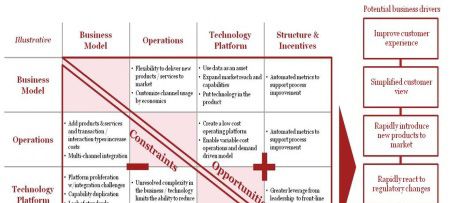
By evaluating the business design across various dimensions, insurers should clearly
identify opportunities and constraints that will enable them to prioritize specific business
drivers that can be aligned with their PAS transformation.
Prioritized business drivers
Business Technology Structure &
Illustrative Operations
Model Platform Incentives Improve customer
Flexibility to deliver Use data as an asset Automated metrics to p
experience
new products/services Expand market reach support process
Business to market and capabilities improvement
Model Customize channel Put technology in the
usage by economics product
Simplified customer
view
Additional products, Create a low cost Automated metrics to
services, and operating platform support process
transaction/interaction Enable variable cost improvement
Operations
– +
types increase costs operations and
Multi-channel demand driven model Rapidly introduce new
integration products to market
Platform proliferation Unresolved Greater leverage from
w// integration
i t ti l it iin th
complexity the l d hi tto ffrontt liline
leadership
Technology challenges business/technology
Rapidly react to
Platform Capability duplication limits the ability to
Lack of standards reduce unit costs regulatory changes
compliance
Power bases built by Efficiency and speed Structure aligns
level and function metrics reduce technology with
Structure & hinder optimal service quality and business functions Legacy platform
Incentives business model customer experience Technology focused elimination
function cost reduction efforts
Improve
p o e ope
operational
a o a
efficiency
PwC Fire, Ready, Aim... Don’t Miss the Point of a Policy Administration Transformation
26Understand business Prioritize business Align transformation
design drivers scenarios
A framework for response
A combination of the prioritized business drivers and most relevant technology
considerations will produce various transformation scenarios that can be evaluated.
Prioritized business drivers Prioritized technical considerations Transformation scenarios
Lower
Improve customer Scenario 1
Scalability
Scalability Integration
Integration
experience Leave system as is and
continue to modernize
internally
“Defense”
More
Multiple platforms will Use of modern
increase the complexity of technologies enable higher
Simplified customer the solution. There is an degrees of integration
view implicit architectural flexibility. System should
preference for fewer be able to integrate with
interfaces. other vended or Scenario 2
h
homegrown systems
t Leave PL as is, but re-
Rapidly introduce new necessary to function. platform CL with
products to market System X
Degree of
Change
Rapidly react to Scenario 3
regulatory changes Modernize PL products
Support the Delivery internally, but re-
business timelines platform CL with
vended product
“Offe
More
Legacy platform Efficiencies and A solution should be
ense”
e
elimination effectiveness that drive brought online within the
quality, turnaround time, existing schedule;
and customer satisfaction otherwise, there may be
can be derived from considerable impacts to Scenario 4
Improve operation eliminating or minimizing strategy and benefits. All LOB and all states
unnecessary with vended solution
efficiency
ffi i
inconsistencies. Higher
PwC Fire, Ready, Aim... Don’t Miss the Point of a Policy Administration Transformation
27Understand business Prioritize business Align transformation
design drivers scenarios
A framework for response
Various transformation scenarios should be evaluated and given an overall score in relation
to how well they align with the prioritized business drivers.
Simplified
Speed to Operational Delivery Platform
customer Scenario rationale Overall evaluation of scenario
market efficiency timeline elimination
view
Basic modernization of the system will not
fully maximize benefits around speed to
S
Scenario
i 1
market, cost reduction, and customer Does not Partially Supports
view, but will improve delivery timeline. support supports
Leave low-touch customer lines of
business as is and focus on the
Scenario 2
underwriting heavy CL products for policy Does not Partially Supports
administration transformation. support supports
Address personal lines and commercial
lines products with separate solutions.
Scenario 3
The PL solution will require customization
Does not Partially Supports
as the vended products is not adequate. support Supports
Address all lines of business with a
vended solution that will simplify the
system and address many of the business
Scenario 4 Does not Partially
Partiall S
Supports
t
drivers. However, this will be the most
support supports
expensive scenario with the greatest
impact on delivery timelines.
Does not meet Partially meets Meets business
business driver business driver driver criteria
criteria criteria
PwC Fire, Ready, Aim... Don’t Miss the Point of a Policy Administration Transformation
28Section 4 How PwC can help
How PwC can help
PwC provides a one-stop solution from strategy to results; our experience with PAS
transformation spans each approach, and we can help emphasize the factors that can result
in a successful transformation with real business benefits.
Strategy and business case
Vendor selection Mobilization Execution
scenario planning
Duration: 6
6-12
12 weeks Duration: 7
7-14
14 weeks Duration: 6
6-10
10 weeks Duration: Dependent on scope
Prioritize business drivers Develop capability matrix and Design program organizational Program management
Understand key aspects of the request for information structure Drive execution of the program
company’s business model Identify vendors for consideration Identify tracks and objectives Define cross-program interaction
Identify opportunities and based upon leaders in the field Define roles and responsibilities
and through market research Requirements gathering
constraints
Develop capabilities matrix based Create detailed program and Document architectural,
on business/technology project plans structural behavioral,
structural, behavioral functional
functional,
Business case development
Identify timeline, milestones, and non-functional requirements
Determine quantitative and requirements
Develop RFP, solicit responses, dependencies, and resources
qualitative benefits Architecture oversight
Perform cost/benefit analysis and evaluate solution fit with Develop program budget and Influence the quality and
business and technology metric-based reports consistency of business solutions
Capabilities model definition objectives Recommend sourcing approach and infrastructure
Identify and prioritize strategic and create cost model
Vendor workshops and finalists Development
business drivers Develop summary and drill-down
selection Manage all activities that make a
Define desired future-state reports to track budget, forecast,
Engage vendors in oral software system available for use
business capabilities and map to and actual costs by dimensions
a future-state conceptual presentations and conduct Quality assurance
scoring effort to evaluate fit Establish processes and tools to
architecture Confirm business capabilities
based on evaluation criteria operationalize the program
maintaining traceability between
Define and implement a PMO to
Transformation scenario b siness capabilities and testing
business
Proof of concept and final manage program execution
planning activities
recommendation Draft orientation materials
Outline scenarios against the
Conduct PoC and provide Deployment
business case Foundational analysis
recommendation to business and Manage all conversion and roll-
Determine scenario that aligns Define business processes and
technology stakeholders out activities across the
with the business objectives as technology architecture
organization
team transitions to solution
selection
PwC Fire, Ready, Aim... Don’t Miss the Point of a Policy Administration Transformation
30How PwC can help
As insurers progress through the policy administration transformation lifecycle, they face
questions that encompass strategic, business value, risk, and cost considerations.
Situation #1 Situation #2 Situation #3 Situation #4
Strategy and business
Vendor selection Mobilization Execution
case scenario planning
What should we do and how Many vendors claim that Now that we have selected a How do we salvage a
can we get the business and they have what we need and partner, how do we avoid the challenged project and
IT leaders behind the have done the project we are pitfalls that other insurers minimize cost overruns
initiative? envisioning before, but how have experienced, resulting while delivering a solution
Questiions
can we be sure who would in lower than expected value that is viewed as a
be the right partner for us? or a complete write-off?
write off? success?
Conduct full benefits case Mobilize a solution selection Conduct a rapid validation of Conduct a program health
program PAS business case assessment to identify the
Prioritize business drivers root cause of challenges
Conduct rapid business Define and deploy the and recommendations for
Identify transformation driver assessment program management and improvements
ns
scenarios and develop delivery capabilities needed
Solution
roadmap Conduct rapid transformation to implement a successful Develop an action plan to
scenario planning solution align the program for
success
Implement the program
remediation plan
PwC Fire, Ready, Aim... Don’t Miss the Point of a Policy Administration Transformation
31How PwC can help
Situation #1 – The need for a new PAS platform is understood, but the insurer is unclear on
how to gain alignment and develop a compelling business case.
Overview off current PAS lifecycle
f y p
phase Policy Admin Transformation Lifecycle
The insurer’s policy administration platform is not allowing the
desired market responsiveness and is costly to maintain.
A new platform is needed, but the organization first needs to Strategy and
business case Vendor selection Mobilization Execution
identify the PAS capabilities that will enable the business scenario planning
strategy.
t t
A compelling business case needs to be developed with options
in order to move forward. Develop a
business case
Considerations
Key
y activities may
y include:
With the
th breadth
b dth and dddepth
th off PAS business
b i functions,
f ti what
h t
capabilities should be prioritized to maximize ROI? Prioritize business drivers and define required capabilities
How can complete and accurate articulation of costs and Understand the key aspects of the company’s business design and
benefits be captured to create a compelling business case? strategy.
Identify opportunities that map back to the 10 key business drivers for
What options
p should the organization
g consider? policy administration.
What is the right way to approach the PAS transformation? Develop business case
Determine quantitative and qualitative benefits of conducting a policy
How PwC can help administration transformation.
PwC will work with the insurer to identify the capabilities and Understand which business drivers will bring the most benefit
(cost/benefit analysis).
develop a business case using the 10 key business drivers,
resulting in a prioritized set of capabilities. Identify transformation options and scenario planning
Outline scenarios against the business case based on key business drivers
PwC will conduct a transformation scenario diagnostic and and technology considerations.
planning exercise to provide perspective to cost/benefit Determine the relevant options based on the business objectives for
options. consideration by organizational leaders.
PwC Fire, Ready, Aim... Don’t Miss the Point of a Policy Administration Transformation
32How PwC can help
Situation #2 – Insurer has a clear justification for a new PAS vendor and solution but is
unsure how to select the right partner given their business and IT environment.
Overview off current PAS lifecycle
f y p
phase Policy Admin Transformation Lifecycle
Key business and IT stakeholders agree on the need for a new
policy administration platform as a means to enhance market
responsiveness and control costs. Strategy and
business case vendor selection Mobilization Execution
The insurer has investigated PAS solution options but needs to scenario planning
b tt understand
better d t d th the strengths
t th andd weaknesses
k off each
h tto
narrow the field of potential partners.
Mobilize solution selection and conduct
Considerations rapid business driver assessment
There are many vendor options but with unclear differentiation Key activities may include:
and understanding of which vendor would most appropriately
align with the specific needs of the insurer. Rapid business driver assessment and scenario planning
The criteria that would provide linkage between insurer needs Conduct rapid business driver assessment to identify prioritized high-
level business capabilities and scenarios designed to create clarity to the
and vendor capabilities is missing to inform the solution
insurer’s specific solution requirements.
selection process.
How PwC can help Capabilities matrix for solution selection
Map desired capabilities to RFI/RFP questions for the purpose of scoring
PwC will work with the insurer to develop solution selection perspective vendors.
criteria by conducting a rapid business driver assessment.
PwC will work with the insurer to create a vendor assessment Conduct solution selection and produce recommendation
f
framework k and
d scorecard d linked
li k d to
t bbusiness
i d
drivers
i and
d hi
high-
h Identify
d f prospective vendors
d and
dddevelop
l an RFI/RFP.
level functional capabilities. Score vendors based on the RFI responses and identify vendors to engage
in onsite visits and proof of concept phase.
PwC will work with the insurer to perform PAS vendor and The result is a recommendation based on scoring and proof of concept
solution due diligence to arrive at a recommendation for a results based on objective, insurer-specific criteria.
vendor partner.
PwC Fire, Ready, Aim... Don’t Miss the Point of a Policy Administration Transformation
33You can also read


