FLEET COMBAT IN THE By Mike Tuñez - Firelock Games
←
→
Page content transcription
If your browser does not render page correctly, please read the page content below
T A C T I C A L

FLEET COMBAT
        IN THE

A G E of S A I L
       By Mike Tuñez.

      FIRELOCK GAMES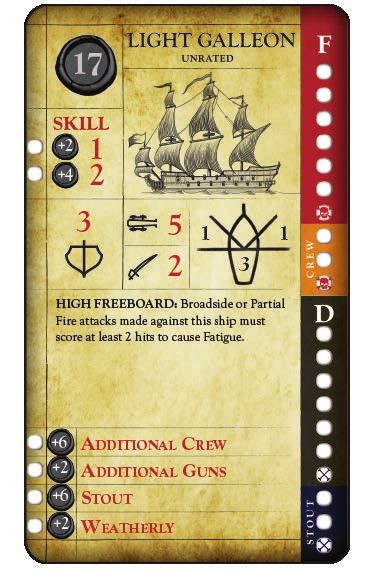
TABLE OF CONTENTS                                                      CREDITS
Introduction                                  2          Game Design                 Production
Game Components                               4          & Concept:                   Manager:
                                                            Mike Tuñez                 Alex Aguila
Playing the Game                              7
   Initiative Phase                           7           Design                   Layout &
   Movement Phase                             8        Contributors:             Graphic Design:
                                                        Christopher Tuñez            Lilian Figueroa
   Attack Phase                              15
                                                           Nate Zettle
   End Phase                                 18            Liam Taylor                Game Mat
                                                          Steven Soler                 Design:
Aditional Rules                             20            Fred Barnard                Chris Strekker
Creating a Squadron                         23           Gabriel Garcia
                                                                                      Terrain Set
Starting a Game                             24                                       Illustration:
                                                      Historical Con-
Fleet Battles (Multiplayer)                 26           sultation:                   Joshua Hayes
                                                          Benerson Little
                                                                                 Model Painting:
                                                           Sculpting:                 Adam Horton
                                                         Stacy Jenneman
                                                         Brian Rundlett                Editing:
                                                                                      Drew Saxton

                                           Playtesters:
    Stephen Foulk         Sean Martin           Andy Sims           Pete Barfield             Riley Blair
   Joseph DeLory           Tom Pace            Jeff Przybylo      Gerardo González      Jonathan Dispigno
  Jean Luc Bernard        Bryan Wade            Nigel King          Scott Crowe            Paul Dispigno
     Mark Stigter       Gavin Winspear         Jesse Abbott      Leif MacNaughton            Joel Sanchez
   Glenn Gonzalez     Timothy Korklewski    Crochet emmanuel          Ian Mann            Joseph Dieguez
      Matt Nott         Nicholas Bogart         Nic Evans          Omar Zaragoza            Steven Murga
     Eric Hansen         Robbie Rauch        Stephen Smith            Rodriguez         Steven Quintavalli
  Dr. Jeffrey Brown    Jacob Stauttener        Mike Moyer         Daniel R Weber       Juan Sebastian Mazo
     Leon Mason            Cris Smith        Benjy Feldmen             William               Mitch Reed
     John Hunter           Alex Hood           Scott Presley      Mac McClelland           Jordan Brutlag
     Dan Carlson       Adrian Gonzalez       Dillon Rinehart        Paul Carolan            Kevin McKay
    Tyler Carlson        Mike Jackson        Robert Kurzweil        Scott Parkin              Lee Hulley
    Bryan Fischer         Peter James        Nathan Rigaud          Vince Usher          Steve Holowienko
      Bruce Boyd       Douglas Johnson      Matthew K Green        Liam Galloway          Darren Kephart
    Rufus Devane         Maurice Kent           Lee Upton         Kevin John Waite         Mark Herman
      Kai Devane          Shane Knerl        Nathan Jopling        Leigh Brewster           Kevin Becker.
     Eric Mitchell        David Wolf       Rune Hoff Lauridsen   Graham Cummings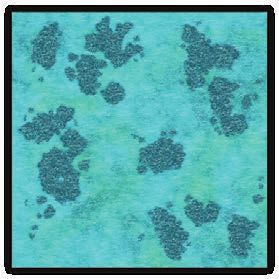
3

INTRODUCTION
                              CHAP. I.

Oak & Iron is a game set in the age of fighting sail. It allows players
to recreate battles between small fleets and squadrons of armed
sailing ships. The game is designed to be simple and intuitive while
also challenging players by providing significant tactical depth and
being true to the theme and tactics of the period.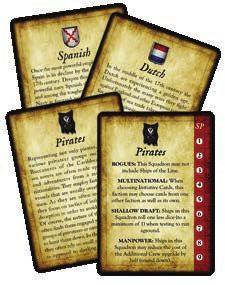
4                                                        OAK & IRON

       GAME
    COMPONENTS
                            CHAPTER. 2.

    S HIP CAR D B R EA KD OWN
                                          a   POINTS COST
        a                   b     l
                        c                 b   SHIP TYPE

                                          c   SHIP CLASS
    d
                                          d   SKILL UPGRADE

                                          e   FORTITUDE VALUE
            f
    e           h           h             f   BROADSIDE VALUE

            g       i            m        g   CREW VALUE

                                  n       h   WINDWARD VALUE

                            j             i   SAILING LARGE VALUE

                                          j   SPECIAL RULES

                                          k   UPGRADE OPTIONS
                                              (descriptions on the back)

                                          l   FATIGUE TRACK
                            k
                                  o       m   ADITIONAL CREW
                                              UPGRADE OPTION

                                          n   DAMAGE TRACK

                                          o   STOUT UPGRADE OPTION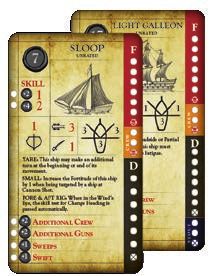
5                                                           OAK & IRON

                                      List of
                   COMPONENT S
   RULEBOOK                             SHIPS                            BASES

                                                                      EVENT CARDS

INITIATIVE CARDS    FACTION CARDS                SHIP CARDS              CLIPS

UPGRADE CARDS       ADMIRAL CARDS                              DICE

                                    SCENARIO CARDS

     Settings          Objectives                Deployments            Conditions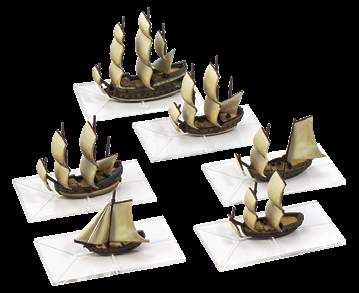
Game components                                                                     6

                                                 List of
                        COMPONENT S
                                             COUNTERS & TOKENS

                                 Fortune          Full Sails      Crippled       Reload

   Captured Ship

                                 Objective      Minimal Sails      Shaken

                                                                                  Wake
      Ship ID                    Anchored         Aground       Landing Party

                                               RANGE RULER
                   Cannon Shot                                   Musket Shot    Pistol Shot
                                                                                                Yard
                                                                                                Arm

           SEA MAT                                  MOVEMENT TOOLS              WIND ARROW

                                               TERRAIN TILES

 Islands & Fog Banks                                     Rocks & Shoals                 Land Masses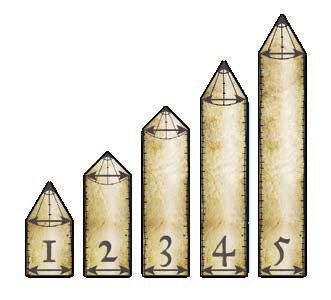
OAK & IRON                                                                                    7

                          PLAYING
                         THE GAME
                                                  C H A P. 3 .

                       Oak & Iron is played over a series of turns.
                       Each turn will be broken down into four phases:
                             I . T H E I N I T I AT I V E P H A S E
                            I I . T H E M OV E M E N T P H A S E
                               I I I . T H E AT TA C K P H A S E
                                   I V. T H E E N D P H A S E

         THE INITIATIVE PHASE
N . T.                              New terms for this section
         SQUADRON A Squadron is a group of two            rules and Fatigue), If any or       results are
         or more ships, including a Flagship, belong-     rolled, the test is successful.
         ing to a player.
                                                          CHALLENGE TEST A Challenge Test is
         FLAGSHIP Each Squadron must have a               a type of Skill Test where both players make
         Flagship. The Flagship is denoted by having      the test using their Flagship’s special rules
         an Admiral card assigned to it.                  and Fatigue, then compare results. The play-
                                                          er who rolls the most and/or           wins the
         SKILL TEST A Skill Test is used when a           Challenge Test. If there is a tie, the Flagship
         ship’s crew is attempting to do something        with the highest skill value is the winner.
         complex, like woking the ship’s rigging to at-   If both Flagships have the same skill value,
         tempt to adjust its current speed. To perform    continue rolling until there is a winner.
         a Skill Test roll 5 dice (augmented by special
8                                                                                  OAK & IRON

                              During this phase, players will reveal their           Test. The winner has the initiative. Once              I . P.
                              initiative cards to determine which player has         initiative has been determined, the cards re-
                              the initiative. Each player will also choose a         main face up to remind both players of the
                              new card for the following turn. Take the fol-         effect granted by their initiative card for that
                              lowing steps to complete the Initiative Phase:         turn. Initiative and event effects last until
                                                                                     they are discarded or returned to the hand
                              1. REVEAL INITIATIVE CARD Each                         (Unless otherwise noted on the card).
                              player reveals the initiative card they chose
                              during the previous turn’s Initiative Phase. If        2. SELECT NEW INITIATIVE CARD
                              playing the first turn of the game, each player        Each player now chooses a new initiative card
                              reveals the initiative card chosen during de-          from their initiative hand and places it face-
                              ployment. The player who reveals the card              down. The chosen facedown initiative card
                              with the highest initiative value has the initia-      will be revealed and applied at the beginning
                              tive and will go first in each following phase         of the following turn’s Initiative Phase.
                              for this turn. If both players reveal a card of        3. RESOLVE INITIATIVE CARD
                              equal value, an event card is drawn from the           EFFECTS Initiative card effects note when
                              event deck and its effects are resolved before         each effect is to be used. Apply the effects
                              moving on. If resolving the event is not pos-          that state “Immediately” now, and make note
                              sible for some reason, the event card effect is        of effects will be used later in the turn.
                              ignored. Once the event has been resolved,
                              the player whose Squadron has the highest
                              admiral value has the initiative. If there is a
                              still a tie, both players perform a Challenge

                              During the previous turn, Mike and Lily chose a card from their respective hands to be played facedown.       E X P.
                              These cards are turned over at the same time. Mike’s card has a 3 initiative and Lily’s card has a 4
                              initiative. Lily has the higher initiative value and will be the first to activate a ship in the proceeding
                              phases of the turn.

                              THE MOVEMENT PHASE
DESIGNER’S NOTES                                            New terms for this section                                                      N . T.
1
  In reality, there are 5
different points of sail      BOW A ship’s Bow is the front edge of its              is closer to the table’s Weather Edge than
and each has subtle dif-      base.                                                  its Bow.
ferences on the speed
and handling of the ship.     STERN A ship’s Stern is the rear edge of               »» Windward A ship is sailing Windward if
We have simplified these
                              its base.                                              its Bow is closer to the table’s Weather Edge
down to their most basic                                                             than its Stern.
forms and kept the most
significant aspects so that   WEATHER EDGE The Weather Edge                          »» In the Wind’s Eye This denotes a ship
players can face the very     is the side of the table the wind is blowing           with its Bow closer than 45º to the Wind-
real challenges of maneu-     from.                                                  ward Edge. If at the beginning of a ship’s
vering a ship throughout                                                             movement its Windward side mid-point is
the wind without all of       POINT OF SAIL1 A ship’s Point of Sail is               further away from the Weather Edge than
the intricacies often asso-   its heading in relation to the wind. In Oak
ciated with doing so.                                                                every point of your ship’s Bow, your ship is
                              & Iron there are 3 possible points a ship can          considered In the Wind’s Eye.
                              be sailing on:
                                                                                     To test this, find the ship’s Windward mid-
                              »» Large A ship is sailing Large if its Stern          point and the point of the Bow that is far-
OAK & IRON
         Playing the Game                                                                             9

                 CLOSER
                                         FARTHER                                 CLOSER

                                                             FARTHER

                     IN THE WIND’S EYE                             NOT IN THE WIND’S EYE

N . T.   thest from the Weather Edge. If the mid-         rying no sail at all and cannot move. A ship     DESIGNER’S NOTES
         point measures equal to or closer than the       on this Sail Setting takes an Anchored token.    2
                                                                                                             Sail setting is an abstract
         farthest point of the Bow, then the ship is
                                                          DOWNWIND A turn or move described as             idea in Oak & Iron. It
         not In the Wind’s Eye.                                                                            reflects the total amount
                                                          being Downwind indicates that it will cause
                                                                                                           of effective sail a ship is
         A ship at this Point of Sail cannot make any     the ship’s Bow to move farther away from the
                                                                                                           currently making use of.
         forward movement but may make a turn us-         Weather Edge.                                    Damage to the a ships
         ing the speed 1 tool.                                                                             rigging can have the same
                                                          FATIGUE represents the condition of the          effect on a ships speed as
         Any time a ship is directly between two          ship’s crew, equipment, and weaponry. Fac-       changing its sail setting
         Points of Sail, the controlling player may       tors such as casualties, morale, and physical    and therefore is treated
                                                          exhaustion of the crew cause Fatigue. For        the same way in the game.
         choose which one to use.
                                                          every point of Fatigue a ship has, it reduces
         SAIL SETTING2 A ship’s Sail Setting de-          the number of dice rolled for any Skill Test
         scribes how much sail a ship is using. There     or Attack by 1 (to a minimum of 1). If a ship
         are 4 possible Sail Settings:                    has any special rules that grant it additional
                                                          dice, these additional dice are added after
         »» Full Sail This is the highest possible Sail   the Fatigue penalty is applied. A ship may
         Setting. A ship on this Sail Setting takes a     never take more than 7 Fatigue points. Any
         Full Sail token. While on this Sail Setting,     amount of Fatigue taken over this is ignored.
         ships increase their speed rating by 1. While
         at Full Sail, a ship may not make Reload ac-     SHAKEN A ship becomes Shaken and takes
         tions during the Crew Action step.               a Shaken token when it receives 7 points of
         »» Battle Sail A level lower than Full Sail.     Fatigue. A Shaken ship may not take Sea-
         This is the default Sail Setting and requires    manship Actions and the only Crew Action
         no token. The speed values found on a ship’s     it may take is Rally. A ship will remain Shak-
         card assume a ship is on this Sail Setting.      en until its Fatigue points are reduced.

         »» Minimal Sail The ship is using the            CRIPPLED A ship becomes Crippled and
         least amount of sail possible. A ship            takes a Crippled token when it has taken 7
         on this Sail Setting takes a Minimal             points of Damage. A Crippled ship no lon-
         Sail token. While on this Sail Setting,          ger takes damage points. Instead, for every
         ships reduce their speed rating by 1.            point of damage the ship would have taken, a
                                                          point of Fatigue is taken instead. A Crippled
         »» Anchored At this setting, the ship is car-    ship’s speed rating is limited to 2.
10                                                                            OAK & IRON

ENTANGLED A ship that is Entangled                  to become immobile, such as losing a mast.
is stuck to another ship and will not move          A ship in this state takes an Aground token
during the Movement Phase as long as they           and may not move until the Aground token
remain Entangled. Entangled ships may not           is removed. To remove an Aground token,
take Crew Actions and may only take the             the ship must take a Repair Crew Action
Cut Free Seamanship Action. Opposing                and instead of removing a point of damage,
ships Entangled together may make Close             it rolls a Skill Test. If the test is passed, the
Combat Attacks against each other. Enemy            Aground token is removed. If it is failed, the
ships Entangled with friendly ships may             token and its effects remain.
not be the target of Broadside or Partial
Fire Attacks.                                       DIRECTLY AWAY If a ship must move
                                                    Directly Away from another ship (or object),
AGROUND A ship that is Aground has                  it moves the declared distance in whichever
usually struck the bottom and become stuck,         direction it can go farthest without pivoting
but this status can also be used to indicate        or touching an obstruction.
significant damage to a ship that causes it

During the Movement Phase, players will             2. SEAMANSHIP ACTION Before a ship                  M . P.
alternate activating 1 ship at a time . Each        moves, the controlling player may attempt to
time a ship is activated it will determine it’s     perform a Seamanship Action by rolling a
speed, take a Seamanship Action (optional),         Skill Test. If the test is passed, the ship may
move, and then take a Crew Action (option-          take one of the following actions:
al). Once a ship has completed these 4 steps,
                                                       • Change Heading If this ship is not In
place a Wake marker behind the activated
                                                      the Wind’s Eye, Entangled, Aground, or
ship to show that its move is complete. The
                                                      Anchored, the ship makes a turn before it
opposing player now chooses 1 of their ships
                                                      moves using the speed 1 tool.
to activate. Players continue alternating ships
until all ships have activated. If one player is       • Adjust Speed If this ship is not In the
left with multiple ships and their opponent           Wind’s Eye, Entangled, Aground, or An-
has moved all of their ships, the player with         chored, the ship may increase or decrease
the remaining ships will activate the rest 1          its current speed rating by 1. This is not a
at a time until all ships have gone. Once all         permanent adjustment and its effect only
ships have activated, proceed to the Attack           lasts for this move.
Phase.                                                 • Cut Free The ship moves Yard Arm
                                                      distance Directly Away from any ships it
1. DETERMINE SPEED RATING A
                                                      was Entangled with. If the ship cannot
ship’s speed rating is the distance a ship will
                                                      move Yard Arm disctance Directly Away,
move on the table. To determine speed rat-
                                                      it cannot Cut Free and remains Entan-
ing, start by checking the ship’s Point of Sail(-
                                                      gled. After a ship is Cut Free, it retains its
detailed on pg. 8 & FIG.2). The ship’s Point
                                                      current Sail Setting but its speed rating is
of Sail is always checked from where it began
                                                      limited to 1 this turn.
its activation. If it at any point of its move, a
ship ends up in a different Point of Sail this      3. MOVE To move a ship, select the move-
new postion has no effect on its speed rating.      ment tool that matches the ship’s current
The ship will move at its printed speed value       speed rating. A ship may never move faster
(plus or minus the effects of its Sail Setting,     than speed 5 for any reason. A ship with a
special rules, and initiative card effects the      speed greater than 5 will use the speed 5 tool
ship may receive)canno.                             instead. Place the ruler against either side of
                                                    the ship and line up the arrow on the bottom
OAK & IRON
Playing the Game 11
of the movement tool with the arrow on the the same ruler for turning as for movement. DESIGNER’S NOTES
mid-point of the ship’s base. Move the ship 1
Free Actions: Some
along the edge of the tool until the arrow on 4. CREW ACTIONS After a ship com-
1 cards and special rules
pletes its move, it may take a single Crew allow you to take “Free”
the ship’s base lines up with the arrow on
actions or attacks. These
the opposite end of the tool. A ship must Action from the list below. If a rule or game
are actions or attacks that
always move the full distance between the effect prevents a ship from moving, it may can be taken out of turn
two arrows on the movement tool and must still take a Crew Action. and in addition to normal
always move forward. The angle at the end of actions or attacks.
• Reload: Remove a reload marker from
the ruler is only used for turning and is not 1 of the ship’s sides. A Note on Special Rules:
counted for the move distance. Remember, When specific rules on
a ship In the Wind’s Eye cannot move at all, • Rally: Remove 1 point of Fatigue. cards contradict general
but may still make a turn using the speed 1 • Repair: Reduce the ship’s total damage rules expressed in this
tool. rulebook, follow the rule
points by 1 if the ship is not Crippled. Or
on the card.
As part of its movement, the ship may also attempt to remove an Aground token. To
perform a single turn either at the beginning remove an Aground token, roll a Skill Test.
or at the end of its move. To perform a turn, If the test is passed, the Aground token is
place the ruler against the side of the ship removed. If it is failed, the token and its
and line up the top arrow on the movement effects remain.
tool with the arrow on the ship’s base. The • Change Sail Setting: The ship may
ship may then pivot towards the direction of change its Sail Setting by 1 level (up or
the angled edge of the movement tool (up down). A ship will continue to use the
to where the ship’s edge lays flat against the current Sail Setting until this action is tak-
angled edge). Partial turns are allowed. Note en again or another game effect, such as
that some movement tools have a different rigging damage, causes it to change.
angles on the turning edge. Be sure to use
FIG. 1
E X P. (Figure 1)Lily has the
initiative, so she will be
the first to activate a
ship and check the ship’s
point of sail (Figure 1).
It is determined that
her ship is sailing large,
because her stern is clos-
er to the table’s weather
edge than her bow. The
ship’s large point of sail
is 3 and it is currently
at battle sails, so Lily
needs to use the 3 speed
template.
Before moving, Lily de-
cides she wants to try
to go a little faster .
She uses the seamanship
action “Adjust Speed” to
try and go faster. She
succeeds her skill test
and will now use the 4
speed template instead.
Lily now places the tem-
plate to either side of
her ship, making sure to
align the starting arrow
of the template with the
side arrow of the ship.12 OAK & IRON
• Boarding: A ship may attempt to M . P.
E X P. (Figure 2) Without moving the template, Lily
must slide her ship along the full length of the Board an opposing ship within Yard Arm
template until her side arrow is at the ending
arrow. She will turn the ship by having it pivot
distance. To attempt to board, roll a Skill
along ending arrow’s corner towards the tem- Test. If passed, move the ship taking the
plate’s turning edge. (Figure 2)
action Directly Toward the target ship until
Lily completes her movement activation by taking
a Reload Crew Action to remove a reload marker their bases touch. A ship may move direct-
from one side of her ship so that it is ready to fire ly sideways, forward, or backward when
a broadside in the Attack Phase.
making this move. Once touching, pivot
the Boarding ship in place until its lead-
FIG. 2
a ing edge lays against the nearest edge of
the ship being boarded(FIG.3). If neither
edge of the ship being boarded is closer,
the Boarding ship may choose which edge
to contact. The ships are now Entangled.
If the boarding ship is not able to place its
edge flush against the target ships nearest
edge for any reason, the action is not pos-
sible(FIG. 5).
• Row: A ship with the Sweeps special
rule or upgrade may make an additional
move using the speed 1 tool. This move
can be made even if the ship is at Anchor
or In the Wind’s Eye. This move may not
b include a turn.
• Transfer Flag: A Squadron’s Flag-
ship may move the Admiral card to a tar-
get friendly ship that is within Pistol Shot
of the Flagship and not Entangled. The
target ship is now the Flagship. If the target
ship had a captain card, that card is turned
facedown and ignored while the Admiral
is present on that ship.
• Landing Party: A ship that is not
Shaken, has its Sail Setting set to An-
chored, and is within Pistol Shot of an
island or landmass may send a Landing
c Party ashore. To do so, place a Landing
Party token anywhere on the island or
landmass within Musket Shot of the ship.
While ashore, the Landing Party may
make Close Combat attacks against any
other Landing Party token within Musket
Shot of the token using the crew value of
the ship that deployed it. If a ship with a
Landing Party token ashore ever becomes
Shaken or moves, the Landing Party token
is immediately removed.OAK & IRON
Playing the Game 13
E X P. Mike's ship is within a yard arm length away from Lily's ship. He is going to attempt to grapple and
Board Lily's vessel! He rolls a skill test for the ship attempting to board and succeeds. Now he has to
move his ship into place, laying the ship's leading edge against the nearest edge of Lily's ship. Below are
a couple examples of what that might look like:
FIG. 3 FIG. 4
a a
Lily
Lily
Mi
ke
Mike
b b
Lily
Mi Lily
Mike
ke
c c
Lily Lily
Mi
Mike
ke
FIG. 5
E X P. In the following example , Mike ’ s
ship has no space to lay flush against
Lily’s ship and cannot complete the
boarding action. In this case, Mike
may attempt a different crew action:14 OAK & IRON
E X P. Mike’s ship is entangled with another ship, he wants to cut grapples and move to escape.
Mike’s ship is in the wind’s eye and it is currently at battle sails. In order to move, he uses the Seaman-
ship Action “Cut Free”. His skill test is successful. Mike moves his ship yard arm distance away from
his opponent
Normally, the cut free action would cause Mike’s ship to move using the speed 1 template, but, because
the ship is in the wind’s eye, all Mike can do is make a turn using the speed 1 template turn.
He chooses to use the rally crew action to remove one point of fatigue and ends his ship’s move acti-
vation.
FIG. 6
a c
ike ike
M M
b d
ike
M MikeOAK & IRON
Playing the Game 15
THE ATTACK PHASE
N . T. New terms for this section
OUT OF ACTION A ship becomes Out of LINE OF SIGHT This determines wether
Action when it is both Crippled and Shaken. or not a ship can clearly see its target. There
A ship that is Out of Action is no longer is Line of Sight if a line can be drawn from
combat effective and its status is marked by the mid-point of any of the ships edges to the
having both a Shaken and Crippled token. mid-point of any edge and at least one corner
Once in this state, a ship can no longer of the target ship’s base(FIG. 7).
move, take Seamanship or Crew Actions,
make attacks, and is effectively out of the BROADSIDE PATH The area into which
game. Out of Action ships remain on the a ship may make Broadside attacks. To deter-
table as obstacles unless they sink during the mine the Broadside Path, draw two parallel
End Phase. lines perpendicular to the width the firing
ship’s base going toward the target ship. If
FULL TURN If a rule calls for a ship to any part of the target ship’s base falls within
make a Full Turn, the ship must pivot all the those two lines, the ship is within the Broad-
way until its edge lays flat against the move- side Path(FIG. 8)
ment tool’s angled edge.
FIG. 7 FIG. 8
2 2
1 1
3 316 OAK & IRON
A . P. During the Attack Phase, players will alternate making attacks, 1 ship at a time, until all
ships have activated. After a ship has activated, remove its Wake marker to indicate that it
has attacked this phase. During an activation, the ship may make 1 of the folowing attacks:
»» BROADSIDE A ship may fire 1 or 2 5. Check for Critical Damage If any of
Broadside attacks in a turn (one from each the dice results were a , the target ship may
side of the ship). The following qualifica- take Critical Damage. To check for Critical
tions must be met for each side: Damage, roll an additional die for each
result. If any , , or results are rolled,
• The target ship is within Cannon Shot
the target ship has taken critical damage. Any
or less of the firing ship.
other results have no further effect. Critical
• The target ship must be at least partial- damage effects are as follows:
ly within the Broadside Path of the firing
• If any results are rolled, a vulnerable
edge.
part of the ship has been hit causing the
• There must be Line of Sight to the tar- target ship to take a point of damage. If
get ship from the firing edge. 2 or more are rolled, the ship imme-
• The side firing has no reload marker. diately becomes Crippled. If the ship was
If all the qualifications are met, the attack already Crippled, it is now Out of Action.
may be made by taking the following steps: • If any results are rolled, the ship re-
duces its Sail Setting by 1 (to a minimum
1. Roll Broadside Dice Roll a number of Anchored). If 2 or more results are
of dice equal to the ship’s Broadside value rolled, the ship has lost 1 or more masts.
(reduced by 1 for each point of Fatigue the The ship takes an Aground token to rep-
firing ship has). Unlike other attacks, Fatigue resent the additional effort required by the
never reduces a ship’s Broadside Value to less crew to get it underway again.
than the ship’s Crew Value. The range of the
• If any results are rolled, the ship
attack will determine which results score hits:
takes an additional point of Fatigue. If two
• At Cannon Shot, and results or more results are rolled, the ship’s
score hits. helm has been struck! The target ship must
• At Musket Shot, , , and make a Full Turn using the speed 2 tool
results score hits. in the direction chosen by the opposing
• At Pistol Shot, , , , and player. If this move causes a Collision, it
results score hits. is resolved as if the ship moved at speed
2. Additionally, if this ship has an admiral
2. Re-roll Players will sometimes be able or captain card assigned to it, there is a
to re-roll dice by using skill value, Fortune chance they could be hit. Roll a dice. If a
Points, and special rules. All re-rolls on the or result is rolled, the captain or ad-
attack are taken during this step. miral card assigned to that ship is removed
3. Apply Fatigue If at least 1 hit was scored, from the game.
the target ship takes a point of Fatigue. 6. Assign reload markers: The ship now
4. Inflict damage Compare the number of takes a reload marker on any side that it
hits scored against the target ship’s Fortitude. fired from.
For every number of hits that equal the tar-
get ship’s Fortitude, it takes 1 point of dam-
age. Any remaining hits have no additional
effect(FIG.9).OAK & IRON
Playing the Game 17
FIG. 9
Mike’s galleon (broad- E X P.
side 5) has an eligible
shot on Liam’s 6th rate
frigate (fortitude 2) at
musket Shot.
Mike rolls 5 dice and
gets , , ,
M , .
ike
The result is re -
moved leaving 4 hits.
Liam’s frigate takes 2
damage as the number
of hits has equaled its
Liam fortitude twice , and
a 1 point of Fatigue as
there was a successful
hit against it.
As a was rolled in
the broadside attack,
this die is rerolled to
check for critical dam-
age.
A is rolled and
there is no critical
damage.
M Mike’s
ike galleon is given
a reload marker on the
firing side and it is then
Liam’s turn to attack
with one of his ships
Liam
b
M
ike
Liam
c
M
ike
Liam
d18 OAK & IRON
»» PARTIAL FIRE »» CLOSE COMBAT A ship may make a A . P.
This attack represents firing with only a por- Close Combat Attack against any ship it is
tion of the ship’s guns as well as swivels and Entangled with.
small arms. A Partial Fire Attack follows the To make a Close Combat Attack, roll a num-
same rules as a Broadside Attack with these ber of dice equal to 5 plus the ship’s Crew
exceptions: Rating . If the attacking ship has a Bow or
Stern edge in contact with the opposing ship,
• Line of Sight may drawn from any of the target ship takes 1 point of Fatigue for
this ship’s edges. each result rolled. If the attacking ship
• Target ship may be outside of the has a side edge in contact with the opposing
Broadside Path. ship, the target ship takes a Fatigue for each
• Attack’s range is limited to Musket , and result rolled.
Shot.
• May be made with one or more reload
markers.
• Does not generate a reload marker.
• Uses the ship’s Crew Rating to deter-
mine the number of dice rolled.
THE END PHASE
New terms for this section N . T.
CAPTURED A ship that is Captured has Points. During the end phase of every turn,
been overtaken by an opposing Squadron. players will count their current Strike Point
The Captured ship takes a Captured token total. If a Squadron ever earns more Strike
with the opposing factions insignia. Cap- Points than their current ship total, its admi-
tured ships follow all of the same restrictions ral will call a retreat and the player loses the
as Out of Action ships, but do not count game. Strike Points are not tracked between
as an Out of Action ship. A ship may be turns and are earned as follows:
re-captured by having a ship from its original
squadron become Entangled with it. Once • 1 for each ship that is Crippled (not
Entangled, remove the Captured token. Out of Action)
Re-captured ships remain Shaken, but will • 2 for each ship that has sunk, is cap-
otherwise operate normally. tured, or Out of Action (not Flagship)
• 3 for each Flagship that is Out of Ac-
STRIKE POINTS Throughout the game, tion
the mounting effects of battle begin to weigh
on your forces, causing them to want to flee • Objectives cards may cause players to
the engagement. This is represented by Strike earn extra Strike PointsOAK & IRON
Playing the Game 19
E . P. During this final phase, players count their 3. CHECK FOR SINKING SHIPS Roll
current Strike Points and check to see if the a dice for each Out of Action ship on the
game continues. Take the following steps to table. If a or is rolled, the ship sinks
complete the turn: and is removed from the table.
1. CAPTURE OR DESTROY SHAKEN 4. LOST ADMIRALS If a Flagship ever
ends a turn Out of Action, the controlling
SHIPS A ship Entangled with an opposing
player may spend a Fortune Point to take a
ship whose crew is Shaken may Capture or
Free Transfer Flag action during this step.
Destroy the Shaken ship. If the ship is Cap-
tured, it now counts toward the ship total of If the controlling player chooses not to do
the Squadron that Captured it. If the ship is this or it is not possible(e.g., the ship was
Destroyed, immediately take a Free Cut Free removed from the table), a new ship must im-
Action. If this is not possible, remove the De- mediately be assigned as the Flagship. Assign
stroyed ship from the table. The Destroyed an “Untested Admiral” card to this ship. If
ship is Out of Action. the player has more than 5 initiative cards
in their hand, that player must immediately
2. CHECK FOR WITHDRAWAL Each
remove cards from their hand until they have
player counts their total number of Strike
5 cards remaining.
Points. If the number of Strike Points earned
this round exceeds the total number of ships 5. RETURN INITIATIVE CARDS Both
in that Squadron (Aground or Out of Action players now return their face up initiative
ships do not count towards the ship total), cards to their hands.
that Squadron withdraws and the player has Once these 5 steps are complete, the turn
lost. If both players have earned more Strike ends. If neither player has achieved victory,
Points than their ship total, the player with a new turn begins.
the least amount of Strike Points is the win-
ner. If there is a tie, continue playing. During
the End Phase of turn 10. whichever player
has less Strike Points is the winner. If there
is a tie at the end of turn 10, the defender is
declared the winner (but just barely!).You can also read


