Franklin Sport and Active Recreation Facilities Plan July 2016
←
→
Page content transcription
If your browser does not render page correctly, please read the page content below
Franklin Sport and Active Recreation Facilities Plan
                                                                   July 2016

                                                                        1
                 Franklin Sport and Active Recreation Facilities Plan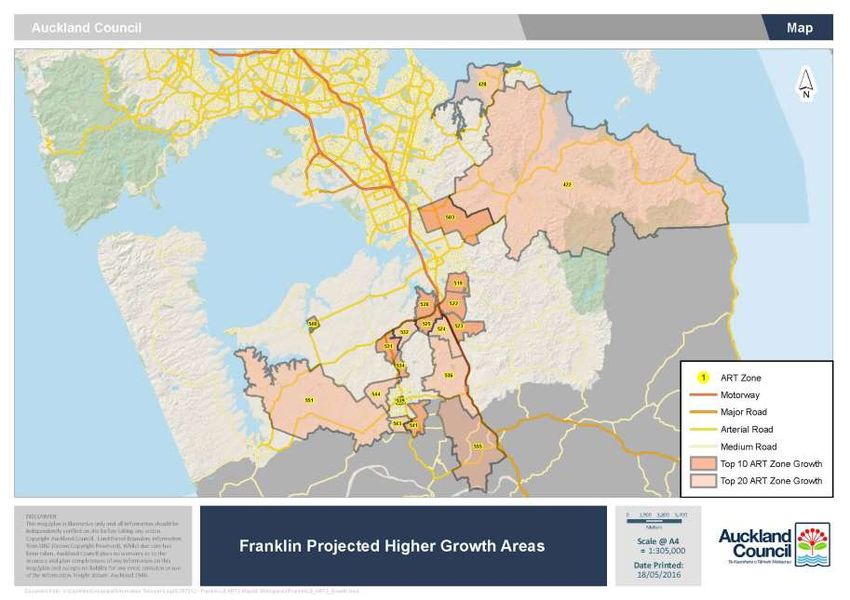
Contents

1.0   Introduction ..................................................................................................................................................... 3
      1.1 Purpose of Franklin Sport and Active Recreation Facilities Plan .................................................... 3
      1.2 Using this Plan .......................................................................................................................................... 3
      1.3 Methodology ........................................................................................................................................... 3
      1.4 Limitations ................................................................................................................................................. 4
2.0   Facility Hierarchy Definitions ......................................................................................................................... 5
3.0   Our challenges ............................................................................................................................................... 6
4.0   Our Choices for Maintaining the Network ................................................................................................. 7
5.0   Key Principles .................................................................................................................................................. 8
6.0   Population and Growth Areas ................................................................................................................... 10
7.0   Facility Needs and Proposed Projects ...................................................................................................... 17
8.0   Belmont and Wesley Future Sports fields Facility Requirements .......................................................... 27
9.0    Recommendations……………………………………………………………………………….…………….28

       Appendix 1 - Preliminary Overview by Sport………………………………………………………………29

                                                                                                                                                                        2
                                                              Franklin Sport and Active Recreation Facilities Plan
1.0     Introduction

1.1 Purpose of the Franklin Sport and Active Recreation Facilities
    Plan

The purpose of the final Franklin Sport and Active Recreation Facilities Plan is to provide
direction to the Franklin local board to assist with the prioritisation of future sport and
recreation facility investment. It is designed to provide direction on what should be done and
crucially, what should not be done.

The plan will ensure that any investment is in-line with the priorities, as identified in the facilities
plan and assist in ensuring that ad-hoc development is limited. It is designed to focus thinking
at a network wide sports facilities level.

The plan will also provide recommendations for new developments, redevelopments (capital
improvements) to existing facilities, including ancillary facilities. Where possible it will also
provide indicative costs for the recommended improvements.

This document is not intended to be a funding plan for the Franklin local board. Inclusion of
projects within this plan in no way guarantees financial support from the Franklin local board.

The plan focuses on sport and active recreation facilities which are under a wide range of
ownership structures (including council-owned facilities, private facilities, club-owned
facilities, and facilities owned by not-for-profit groups).

Facilities used for passive recreation were out of scope (such as the chess club, drama group
or art club facilities). Also out of scope were aquatic facilities and sports fields.

The geographical area of the plan includes both the Franklin local board area and the
northern part of the Waikato district, which was previously part of the Franklin District Council
(including Pokeno, Tuakau, Port Waikato and the Onewhero area).

1.2     Using this Plan
The plan should be seen as a living document and should be reviewed and updated on a
regular basis.

Like all high level plans additional more detailed planning will be required. The plan should
not be seen as a replacement for this detailed focused research and analysis. Inclusion of
projects in the plan should not be taken as an indication of feasibility. It is recommended that
all projects go through a robust feasibility and business case process.

As additional sports codes undertake or update their existing national and regional sports
facility plans it is envisaged that this plan will require updating. However, given the plan is
trying to examine issues based on available evidence at a network wide level, some specific
code aspirations may not align.

                                                                                                      3
                                        Franklin Sport and Active Recreation Facilities Plan
1.3    Methodology

The information summarised in this plan was collected using a mix of web survey, direct
consultation, and secondary data review methodologies. This triangulated approach
provided the best means to get the most comprehensive data coverage possible within the
project’s scope and budget. Key work components undertaken included:

Secondary Data Research and Analysis

This research and analysis component of the plan looked at the following key areas.

   •   National and regional sports plans,
   •   Franklin population analysis,
   •   Growth areas,
   •   Membership Analysis,
   •   Player Age Projections.

Primary Research and Consultation

This phase included:

  Sport and Active Recreation Club Survey
   Outcome:
   • Franklin district response rate: 73%,
   • Waikato district participant response rate: 57%,
   • Key sports and active recreation facility issues identified,
   • Potential sport facility developments identified.

   Club Site Visits
   • Site visits were undertaken to a cross section of the sport and active recreation sites.
   • These included indoor facilities, sports clubs, underdeveloped areas (e.g. Belmont
      Sports Park), council owned and non-council owned.
   • One-on-one meetings were also held with a number of sports and active recreation
      organisations.

   Steering Group Workshops
   • Three steering group meetings have been undertaken to provide both an update to
       the group, but also the opportunity to discuss and provide feedback on the key
       findings and emerging solutions.

   Local Board Updates
   • Two local board updates have been provided – giving an update on the project and
      the emerging trends and potential projects.
   • One local board workshop – brainstorming potential solutions.

1.4    Limitations

The plan was based on the available data at the time of writing. Given the reliance on
secondary data and primary data from third parties it is likely that some data emissions do
exist. However, the plan represents the most comprehensive local facility data source
currently available.

This plan does not replace the need for additional focused planning and analysis at a code
and the specific facility level.

                                                                                           4
                                    Franklin Sport and Active Recreation Facilities Plan
2.0 Facility Hierarchy Definitions
The following general facility hierarchy definitions have been used within the plan:
International: A facility with the ability to host international competitions / events (i.e.
between nations)
National: A facility with the ability to host regional representative competitions (including
professional and semi-professional franchise competitions involving teams from outside New
Zealand) and / or to serve as a national high performance training hub for one or more
sports codes.
Regional: A facility with the ability to host inter-regional and internal regional competitions
and /or serves as a regional high performance training hub for one or more sports codes.
Sub Regional: A facility with the ability to draw significant numbers of teams/competitors
from across adjacent territorial authority/local board boundaries for either competition or
training purposes.
Local: A facility with the ability to serve a local catchment’s basic sporting needs (which
often facilitates people’s introduction to sports and recreation). This catchment will
predominantly be drawn from within a single territorial authority.
Notes:
It is important to understand that a facility at a higher hierarchy level may also meet
the needs all the way down to a local level.
It is most likely that international and national level facilities in the Franklin local board
area will be for niche sports.
These definitions align with those used in adjoining territorial authorities.
The definitions used here may not necessarily align with those used by individual
national sports organisations (NSOs).
5
Franklin Sport and Active Recreation Facilities Plan3.0 Our Challenges
The Franklin sports facilities network faces a number of challenges. These challenges
include:
Population Distribution and Changing Demographics:
The Franklin local board area is a large area with an unevenly distributed population of
around 70,000 (2016 projection). Given major new planned and potential residential
developments, many localised areas of Franklin are projected to experience strong
population growth in coming years. Looking forward, the highest proportion of growth is
projected in the broad area between Papakura and Pukekohe in particular, but also with
other more localised ‘hotspots’ of growth elsewhere in Franklin.
These populations will also be aging overall, with the highest growth rates being among
those aged over 65 years, although all age groups are projected to increase across most
areas of Franklin. The location and types of sport and recreation facilities and services
offered will therefore need to adapt over time so they are not mismatched with community
needs.
Maintaining Assets, Facility Sustainability and Service Levels:
Community sport and recreational assets are provided by a range of entities including,
territorial authorities, charitable trusts, the Ministry of Education (via schools), and
community groups and clubs. Maintaining aging assets, current service levels and facility
sustainability is likely to become increasingly difficult in some geographic locations,
especially for any areas with rapidly increasing, generally decreasing and / or significantly
aging populations. Duplication and underutilisation of sports and recreational facilities will
become increasingly unaffordable over time.
Changing Sport Participation Preferences:
Sports participation preferences are constantly changing. As community needs change
future sports facilities will need to be more adaptable and resilient to allow for new and
changing demands, and have less of a reliance on single-activities. This is especially the
case for facilities at the more local and sub-regional levels.
Improving Collaborative Approaches:
Historical decision making in respect of new or replacement facilities has often been
undertaken on an ad-hoc basis. Population growth in certain areas and the desire to
replace or refurbish existing aging facilities (particularly in areas with an aging and/or
decreasing population) will place demands on capital funding budgets. It will become
increasingly important for all stakeholders to work collaboratively in order to improve
delivery of sport and recreational facilities.
The Franklin Sport and Active Recreation Facilities Plan provides an opportunity for all
stakeholders to work in a collaborative and cohesive manner to address these challenges.
Collaboration within the local board area and with our neighbours in the Waikato and in
adjoining Auckland local board areas will be essential.
6
Franklin Sport and Active Recreation Facilities Plan4.0 Our Choices for Maintaining the Network
Our future approaches / choices for maintaining the Franklin local board facility network can
be generally summarised as:
Retaining the status quo
Retaining the status quo will likely require either increasing rates, or diverting funding from
other budget areas (or a combination of the two) in order to maintain existing facilities and
service levels. This could be achieved by developing both new facilities and by maintaining
existing ones.
Halting new facility development
This would involve stopping any new development and investing only in the maintenance
and refurbishment of existing assets. As a result of this approach service levels would likely
decline in some population growth areas and increase in other more established areas. Over
time the facility network would be less likely to meet the needs of the changing population.
Undertaking strong asset rationalisation
Under this approach all assets, which did not meet certain viability or community need
criteria, would be rationalised over a period of time. Funding would then be prioritised to
facilities that fulfilled an identified community need and promoted a best practice approach
(in terms of design, materials, governance, management and sustainability).
Implementing a mixed rationalisation and development model
Under this approach a mix of coordinated facility rationalisation, optimisation
(refurbishment), and new development would be required. This would likely involve capital
development and operational partnerships between multiple stakeholders (such as Counties
Manukau Sport, Aktive (Auckland Sport & Recreation); Sport New Zealand; Regional Sports
Organisations; other Local Boards; charitable funders; schools and sports clubs).
On balance the mixed rationalisation and development approach is considered to be the
most viable and alignment with council’s regional approach. This approach underpins this
plan.
7
Franklin Sport and Active Recreation Facilities Plan5.0 Key Principles
The key principles underpinning this plan are summarised as:
Sustainability
The network of facilities and the individual facilities themselves need to be sustainable in
order to maximise community benefits.
Sustainability means well utilised sport and recreation facilities with strong governance and
management and that are able to meet their operational costs (while having robust asset
management planning including covering depreciation, renewals and maintenance).
Partnerships
Working together with partners, both within and outside the Franklin local board area, to
develop and operate sports facilities will become increasingly important in order to optimise
our network and maintain its sustainability.
Holistic lifecycle modelling
Existing and planned sports facilities need to be appropriately maintained throughout their
lifespan to ensure they deliver benefit to the community. All new facilities should have
lifecycle maintenance models established prior to any development to inform operational
plans and building material selection.
Adaptability / functionality
Sports trends and our demographics are changing. What we need from a facility today is not
necessarily what we will need in the future. Given that the lifespan of our typical sports
facilities is at least fifty years, it is important that they be as adaptable and functional as
possible.
Multi use
Currently many sports facilities are underutilised for large periods of time. Facilities should be
designed to enable multi uses where ever possible.
Optimisation of existing assets
Where a proven need exists and a cost benefits analysis (which includes consideration of
operational costs) dictates it is warranted, then existing assets should be optimised /
refurbished.
Clubs and codes should look to utilise the available capacity of facilities in neighbouring
areas to optimise the utilisation of the existing network.
8
Franklin Sport and Active Recreation Facilities PlanReturn on investment
The return on investment needs to be considered carefully as each investment comes with
an opportunity cost. As capital funding is limited an investment in one project will likely mean
others do not proceed. It is important that the sporting return on the funded project delivers
as much or more than any project it displaces.
Play to our strength and work with our neighbours
The Franklin local board area must play to its strengths and not seek to duplicate facilities
that can be satisfactorily delivered in neighbouring areas or by strategic partners.
Be flexible with niche national and international projects
From time to time unexpected national or international projects (or sub projects which
support national or international projects) may arise. These projects should be evaluated
thoroughly to determine if they are of benefit to the optimisation of the wider sports facility
network.
Note: In the case of the Franklin local board area this is most likely to be for niche sports.
9
Franklin Sport and Active Recreation Facilities Plan6.0 Population and Growth Areas
The population data utilised within this section were provided by Auckland Council’s
Research, Investigation and Monitoring Unit (RIMU). A review and update of this section
should be undertaken as new population data becomes available and new ‘Special Housing
Areas’ are designated.
An analysis of the Franklin population and club membership has been undertaken to identify
projected growth areas which could impact on the demand for sport and active recreation
facilities. Using the latest Auckland Council spatial population projections the following
section summarises projected population growth for the Franklin local board area overall,
and for specified Franklin subdivisions. More locally site-specific projections are also noted
(where particularly high projected growth has been indicated in the projection data)1.
Regional Population Projections
Franklin has much higher projected population growth over the next 30 years compared to
its nearest neighbours and the Auckland region overall (Table 6.1).
Table 6.1: Projected local board population change, 2016-2046
change % %/yr
2016 2021 2026 2031 2036 2041 2046
2016-2046 change change
Franklin 70,971 76,909 86,280 100,198 119,826 137,333 146,090 75,119 106 3.8
Papakura 53,786 62,751 78,501 81,430 83,677 88,620 93,502 39,716 74 2.6
Manurewa 87,068 87,376 87,508 87,885 86,976 85,976 85,511 -1,557 -2 -0.1
All Auckland 1,563,511 1,683,944 1,785,503 1,928,763 2,053,249 2,168,767 2,268,639 705,128 45 1.6
Source: Auckland Regional Transport (ART) model (output: Scenario I, Version 9, August 2015)
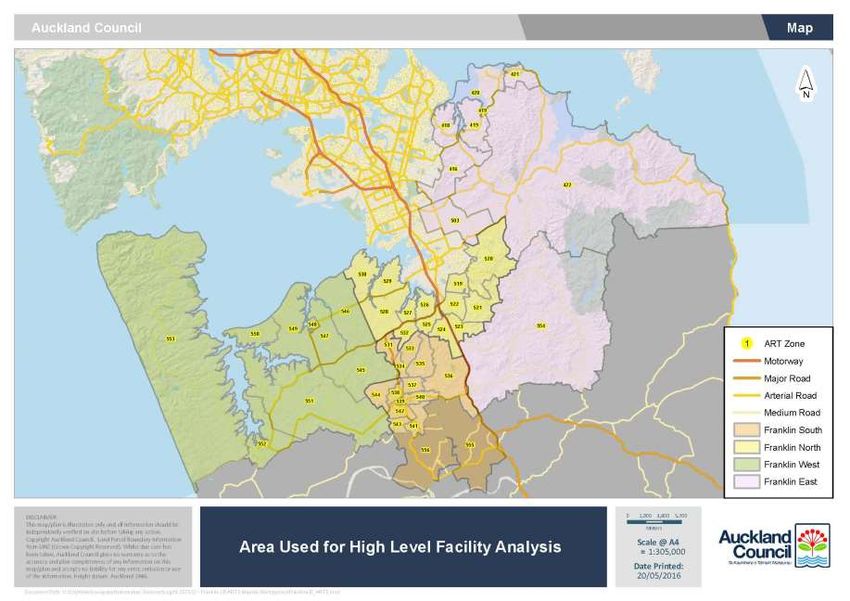
For the purposes of this project 2 the population of the Franklin local board area was sub-
divided into four indicative subdivisions. These were derived from a similar subdivision exercise
undertaken earlier by Auckland Council for the area (using ART Zone groupings – see
Footnote 1). However, this original arrangement of ART Zones was reconfigured to remove
areas included in the Papakura local board area, and to better reflect the nodes of
projected population growth in the central area of Franklin in particular. The resulting
indicative population subdivisions are labelled as follows:
Franklin West
Franklin East
Franklin North
Franklin South
The geographical extent of these, along with their component ART Zones can be viewed in
Figure 6.1 (p15).
1 From Auckland Council’s Research, Investigations and Monitoring Unit’s Auckland Regional Transport (ART) model (output: Scenario
I, Version 9) which refines standard Statistics NZ projections by incorporating local planning, strategy and development approval
factors to more accurately reflect likely localised population growth. These are used for the Council’s Long Term Plan and
Infrastructure Strategy, subject to change from any future changes in planning decisions and directions. Note that these are subject
to updates based on any new SHA designations or other residential development approvals.
2 As created more recently for Franklin local board and provided by them for this project – note different year categories.
10
Franklin Sport and Active Recreation Facilities PlanPopulation Projections – Within the Franklin Local Board Area
At the high level of the four indicative population subdivisions, projected population growth
varies considerably across the local board area (Table 6.2). Franklin North stands out as a
significant high-growth area overall, particularly given its very low 2016 base. More
geographically localised ‘hotspots’ of high growth also occur across the Board Area’ (refer
Table 6.5, p13).
Table 6.2: Projected population by indicative Franklin Sub-divisions
Change Change
2016 2021 2026 2031 2036 2041 2046 2016-2046 %
Franklin North 5,616 6,043 7,693 13,164 25,394 37,308 44,020 38,404 684
Franklin South 32,964 39,511 46,101 52,903 58,477 62,207 61,976 29,012 88
Franklin East 20,989 21,344 21,561 23,556 25,215 26,818 28,551 7,562 36
Franklin West 21,893 22,209 23,243 24,730 26,121 27,572 29,160 7,267 33
Source: Auckland Regional Transport (ART) model (output: Scenario I, Version 9)
Age Group Projections
Within any population, age group is a key component of sports and recreation participation
and demand. The majority of participation in most sports occurs in the younger age groups,
with a band of ages sometimes defined as the active ‘playing age’. However, some
activities are also characterised by the predominance of either particularly ‘older’ or
‘younger’ participants. To allow for these variations, but also capturing the key trends in
population age in the most concise manner, age groups are viewed here in two main ways:
Four broad age groups (based on Statistics NZ’s high-level categorisation),
A single ‘playing age’ group (based on ages of 5-35 years).
The source data here come from Statistics NZ Census and related age group projection3
figures. These sources are used to provide age group projections4 for the Franklin local board
overall, and then for the respective population projection Subdivisions within it.
Overall Age Group Projections
Overall age group projections for the whole local board area show increasing population
numbers in all age groups (Table 6.3). The highest rates of projected growth are in the 65+
age group, and the lowest in the 0-14 group. This reflects a general aging of the population,
where those aged 65+ are projected to increase from 14% of the population in 2013 to 23% in
2043. Over the same period the proportion of those aged 0-14 is projected to decline from
22% to 18%. However the rates of different age-group population growth do vary across the
Local Board Area, as shown for Playing-age projections below.
3 Statistics NZ data is used for age group projection figures as these are not available from the ART projection data. Grouping s of
Statistics NZ Area Units are available for defining Local Board Areas (as provided in Statistics NZ data), but customised groupings had
to be undertaken to correspond with the four population Subdivisions defined within the Board Area.
4 The total projection figures here do differ from those used in the ART projections, but the age group proportions within
corresponding areas are assumed to be largely consistent with those of Statistics NZ census and projection data, which are the most
accurate baseline available (note that the baseline for ART projections are the census data and projections).
11
Franklin Sport and Active Recreation Facilities PlanTable 6.3: Age Group projections 2013-2043 – Franklin Local Board
Change
2013 2018 2023 2028 2033 2038 2043 Change %
2013-2043
0-14 years 15,720 16,440 17,380 18,900 21,250 23,150 24,490 8,770 56
15-39 years 19,730 23,530 27,370 30,420 32,620 34,650 37,060 17,330 88
40-64 years 25,610 28,080 29,720 31,130 33,930 37,170 41,370 15,760 62
65+ years 9,560 12,550 15,800 19,920 24,160 28,340 31,400 21,840 228
Source: Statistics NZ Pop Projections (2013 Base), Medium series, high level categories
Playing Age’ Projections
The typical ‘playing-age’ range for most participation in most active sport and recreation
activities is around 5-35 years. Projections are provided here for this targeted age-group as a
more specific indicator of potential facility user numbers 5. Overall, the ‘Playing Age’
population (5-35 years) in the Franklin board area is projected to increase by around 72%
between 2016 and 2046. Using the ART projection figures, this represents an increase in
‘Playing Age’ numbers from around 26,000 in 2016 to around 50,000 in 20466.
While this represents a continued increase in ‘playing age’ numbers overall, as the wider
population ages the relative ‘Playing Age’ proportion in the overall population decreases in
the corresponding period (from 37% to 34%). This is not a strong decline but does indicate a
longer term population aging trend. Under current trends this proportional decline is likely to
continue, although general numerical growth will continue over the whole Board Area.
However this growth is not consistent across all areas, with considerable variations between
the different indicative Subdivisions (Table 6.4). This features very high growth in the playing-
age population of the Franklin North area, and to a much lesser extent the Franklin South
area. The Franklin East and West areas are projected to have relatively little growth.
Table 6.4: ‘Playing Age’ population projections – Franklin Subdivisions
Change Change
2016 2021 2026 2031 2036 2041 2046 2016-2046 %
Franklin North 2,078 2,175 2,693 4,476 8,380 12,312 14,527 12,449 599
Franklin South 13,515 15,804 17,979 20,103 21,636 23,017 22,931 9,416 70
Franklin West 7,881 7,773 7,903 8,161 8,359 8,823 9,331 1,450 18
Franklin East 7,766 7,684 7,331 7,773 8,069 8,314 8,851 1,085 14
Source: Statistics NZ Pop Projections; and Auckland Regional Transport (ART) model (output: Scenario I, Version 9)
Localised Population Growth - all Franklin ART Zones
Table 6.5 overleaf identifies the ART Zones in the Franklin area in descending order of
projected population growth in the 30 year period between 2016 and 2046. Figure 6.2 (p.16)
also maps these, featuring the ART Zones of highest projected growth. These growth patterns
are a key consideration for future investment in facilities as they relates directly to potential
demand at localised levels.
5
Source: Statistics NZ Population Projections (2013 Base), Medium series, combined from 5-year categories
6Calculated using age-group proportions from Statistics NZ age-group projection data, extrapolated from ART zone
population projection totals.
12
Franklin Sport and Active Recreation Facilities PlanTable 6.5: ART Zone Projections7 (descending numeric order, with highest % changes highlighted)
ART 2016 2046 Change % Change Franklin
ART Zone Area Description
Zone (estimated) (projected) 2016-2046 2016-2046 Subdivision
531 Rural North of Paerata, South of Karaka Rd 340 9540 9,199 2,703 Franklin South
525 Runciman and Rural SouthWest towards Paerata 205 8984 8,779 4,290 Franklin North
526 West of Drury across estuary, North of Karaka Rd 371 8141 7,770 2,096 Franklin North
541 Buckland 1698 8549 6,851 403 Franklin South
522 Runciman and Rural East 764 7558 6,794 890 Franklin North
503 Ardmore to Alfriston and Rural 1555 8172 6,618 426 Franklin East
534 Paerata 174 5203 5,029 2,886 Franklin South
548 Kingseat 283 5162 4,879 1,726 Franklin West
523 South East of Runciman 308 5154 4,845 1,573 Franklin North
519 Rural East of Drury 320 4457 4,137 1,294 Franklin North
524 Runciman and Rural South towards Ramarama 420 4372 3,952 942 Franklin North
555 Rural South of Bombay 2382 4935 2,553 107 Franklin South
551 Glenbrook Beach/Glenbrook and Rural to Patumahoe/Puni 4072 6500 2,428 60 Franklin West
543 Pukekohe South 2 1196 3270 2,074 173 Franklin South
544 Pukekohe Rural West 1279 3244 1,966 154 Franklin South
420 Beachlands 5133 7076 1,943 38 Franklin East
532 Rural South of Whangapouri Creek, South of Karaka Rd 220 1861 1,641 746 Franklin North
539 Pukekohe Central 727 1692 965 133 Franklin South
422 Brookby-Clevedon to Kawakwa Bay/Orere 4039 4991 952 24 Franklin East
536 Ramarama and Rural South to Bombay 1237 2021 783 63 Franklin South
545 Paerata, Helvetia and Rural West 1500 2124 625 42 Franklin West
542 Pukekohe South 1 5865 6486 622 11 Franklin South
540 Pukekohe West 2737 3334 597 22 Franklin South
535 Rural between Paerata and Ramarama - South 260 791 531 205 Franklin South
530 Rural area North of Karaka and Ellets Beach 140 461 320 229 Franklin North
546 Ellets Beach/ Te Hihi 796 1059 263 33 Franklin West
556 Rural South of Buckland to Tuakau 5554 5808 254 5 Franklin South
549 Rural West of Waiau Pa to Seagrove 892 1068 176 20 Franklin West
528 Karaka area, South of Linwood Rd 576 689 113 20 Franklin North
416 Rural SW of Whitford and Brookby 1491 1586 94 6 Franklin East
520 Rural/Natural North of Ponga 1106 1198 92 8 Franklin North
529 Karaka area, North of Linwood Rd 260 351 91 35 Franklin North
418 Whitford and Rural Northwest to Point View Rd 964 1029 65 7 Franklin East
552 Waiuku and Mission Bush to Pukeoware 9291 9323 32 0 Franklin West
533 Rural between Paerata and Ramarama - North 196 204 8 4 Franklin South
527 Rural South of Whangapouri Creek, North of Karaka Rd 215 153 -62 -29 Franklin North
521 Rural/Natural West of Ponga 711 642 -69 -10 Franklin North
547 Rural around Te Hihi Creek, East of Kingseat 556 413 -142 -26 Franklin West
419 Rural NE of Whitford along Potts and Clifton Rds. 751 557 -194 -26 Franklin East
537 Pukekohe NorthEast 2524 2196 -329 -13 Franklin South
553 Awhitu Peninsula Rural 2566 2080 -486 -19 Franklin West
550 Clarks Beach to Waiau Pa 1938 1430 -508 -26 Franklin West
421 Maraetai 2282 1684 -598 -26 Franklin East
554 Rural between Bombay, Hunua, Paparata, Paparimu 4773 3456 -1,317 -28 Franklin East
538 Pukekohe NorthWest 6795 4705 -2,090 -31 Franklin South
Source: Statistics NZ Pop Projections; and Auckland Regional Transport (ART) model (output: Scenario I, Version 9)
7
Some new Special Housing Area designations have not yet been incorporated into current ART Zone projections.
Some localised ART Zone projection figures will change, although the overall patterns above will remain.
13
Franklin Sport and Active Recreation Facilities PlanConclusion
The Franklin local board area is a significant population growth area. However, this will be
unevenly spread, with a particular focus on most significant growth, the ‘Franklin North’ area
between Pukekohe and Papakura, which currently has a very low base population. Other
areas of Franklin South north of and around Pukekohe are also highlighted.
Beyond these Franklin North and South areas only a few more localised hotspots of projected
growth above 1000 are apparent including Kingseat; the Glenbrook Beach area; and
Beachlands (subject to updated ART figures).
The analysis from this section has been used to inform the recommended facility approaches
outlined in the following sections.
14
Franklin Sport and Active Recreation Facilities PlanFigure 6.1: Areas Used for High level facility Analysis (Franklin ‘Subdivisions’)
15
Franklin Sport and Active Recreation Facilities PlanFigure 6.2: Franklin Projected Higher Growth Areas
16
Franklin Sport and Active Recreation Facilities Plan7.0 Facility Needs and Proposed Projects
The identified facility needs and the projects that will address them have been summarised
and prioritised in Table 7.1. These needs emerged following analysis of the primary and
secondary data. Certain needs and their associated projects were identified by proponent
sports entities, while others emerged from a gap analysis. All potential projects that were
identified were prioritised using a series of evaluation criteria8.
High priority projects are those that should be targeted for completion in a 1-3 year time
frame. Medium - high projects would ideally be completed in a 1-3 year time frame if
possible. Medium priority projects fall within a 4-10 year time frame while Low priority projects
fall within an 11-20 year time frame. It is recommended that every three years this plan be re-
evaluated based on new data. This re-evaluation process will likely see new projects emerge
and existing project priorities adjusted.
Important Note:
This plan does not replace the need for additional focused planning and analysis at a
code and the specific facility level. Full feasibility and business case analysis will be required
on all projects. Inclusion in the plan should not be seen as an indication of a project’s
feasibility / sustainability.
As additional sports codes undertake or update their existing national and regional sports
facility plans it is envisaged that this plan will require updating.
General Facility Approaches
The plan has identified as series of general approaches that should be applied throughout
the Local Board area. These are:
• Explore the viability of establishing cross boundary facility partnerships between
Waikato District Council and other local boards.
• Develop a school partnerships framework to help inform facility planning with schools
/ the MOE (this would cover key principles of potential partnerships and identify
specific areas/asset types that schools /the MOE are interested in partnering in such
facilities as playing fields, indoor courts, hockey turfs, and multiuse outdoor courts.
• Maintain existing facilities in line with their asset management plans.
• Prior to any major renewals undertake an independent building condition
assessment and needs and options analysis to determine the costs and benefits of
alternative facility delivery approaches (such as collocating with other sports and
recreation or community assets, school partnerships).
• Monitor and review existing facility utilisation and quality to ensure community
recreation use is nurtured.
• Rationalisation or repurposing of assets should be considered where sufficient
demand may not exist and/or viable alternatives are available.
As stated in the introduction to this plan the following project prioritisation should not be
interpreted as an indication of financial support on behalf of the Franklin Local Board.
8
The prioritisation of projects to meet the identified needs was guided by the use of a project assessment framework
(weighted matrix and series of criteria). These criteria included such things as the level of potential facilities sharing,
current participation / membership, projected participation / membership, level of strategic alignment the facility
has with regional and national plans / strategies, how appropriate the scale of the facility is (proportionate to the
identified need), the potential sustainability of the facility and the level of capital funding required.
17
Franklin Sport and Active Recreation Facilities PlanTable 7.1: Priority Projects – Franklin Sport and Active Recreation Facilities Plan
Project Name Project Project Capital Proposed Population and Need Analysis Club Proposed Priority
Description Cost Hierarchy Membership
Status High = 1 – 3 years
(Indicative only) Medium High =1-3
years (if possible)
Medium = 4 – 10 years
Low = 11 – 20 years
Indoor Court Options and Circa $40,000 - Sub Regional Population NA High
Expansion feasibility analysis $50,000. Franklin has a projected population increase
Planning for a central of 75,119 by 2046 bringing the total to
indoor court hub Note: The study 146,090 (2046).
Future (potentially would determine The northern area of Waikato District may
location(s) to incorporating when the add a further 10,000 to 20,000 people.
be analysed Franklin Leisure). additional court The Playing-age group (5 – 35) in Franklin has
space would a projected population increase of 24,399
ideally be by 2046 bringing the total to 55,640.
required (capex Needs
timing). Serves as the main indoor court hub for
Franklin and the northern area of Waikato
District Council.
One court will not be sufficient to meet the
needs of the growing population.
The hub can be supported by a network of
existing and potential school partnership
facilities in locations such as Pokeno and
Waiuku.
Pukekohe It is proposed that Cover 2 netball Sub Regional Population 2015 - High
Netball an additional two courts - Franklin South has a projected population 2,221
Covered Court courts be covered $450,000 increase of 29,012 by 2046 bringing the total 2014 -
Extension (with the existing to 61,976 (2046). 2,097
structure type). Playing age (5 – 35) is projected to increase 2013 -
to 22,931 by 2046. 2,114
Needs
Significant membership base,
Located in large growth area,
Identified as priority netball centre in the
Auckland Netball Regional Facilities Plan,
Contribution towards capital cost,
Increases the use of existing assets.
18
Franklin Sport and Active Recreation Facilities PlanCounties Turf replacement Upgrade of Sub Regional Population 2015 - High
Manukau and lighting floodlighting - Franklin South has a projected population 2,000
Hockey Lights upgrades of an $80,000 increase of 29,012 by 2046 bringing the total
and Turf existing asset New lights to 61,976 (2046).
Replacement (seen as a priority $250,000 Playing age (5 – 35) projected to increase to
for Counties Replacement 22,931 by 2046.
Manukau of 1 hockey turf Needs
Hockey). in the next 10 Identified as a priority hockey centre in the
years -$600,00 Auckland Hockey Regional Facilities Plan,
Replacement Significant membership base,
of 2 hockey Located in large growth area,
turfs in the next Nearest hockey centre located in
10 – 20 years Pakuranga/Howick,
$600,000 Maximise use of existing assets.
Franklin Franklin New GymSports Sub Regional Population 2015 - High
GymSports GymSports Club is facility Franklin South has a projected population 531
Club Facility proposing to $3,500 per m² increase of 29,012 by 2046 bringing the total
Development develop a new Non-Council to 61,976 (2046).
facility within the land Playing age (5 – 35) projected to increase to
Franklin A and P 22,931 by 2046.
Showgrounds to Needs
meet demand. One of the largest memberships nationally,
(Non-council Located in large growth area,
land) Small floor area for size of membership.
National GymSports Facility Strategy is likely
to support some form of development.
Pukekohe The existing This project has Sub Regional Population 2015 - High
Netball Centre cricket toilet block been Franklin South has a projected population 2,221
Toilet Block is being supported increase of 29,012 by 2046 bringing the total 2014 -
Provision demolished as financially by to 61,976 (2046). 2,097
part of the Franklin local Playing age (5 – 35) projected to increase to 2013 -
Bledisloe Park board 22,931 by 2046. 2,114
development. Needs
Currently Significant membership base.
Pukekohe Netball Located in large growth area.
utilise these toilets Identified as a priority netball centre in the
for weekend Auckland Netball Regional Facilities Plan.
competitions.
19
Franklin Sport and Active Recreation Facilities PlanKaraka Karaka rugby, Multisport Sub Regional Population Cricket Medium - High
Multisport cricket, netball clubroom Franklin North has a projected population 2015
and tennis clubs development, increase of 38,404 by 2046 bringing the total – 173
are working $3,500 per m², to 44,020 (2046). Rugby
towards Tennis court Playing age (5 – 35) projected to increase 2015
developing a development by 14,527 by 2046. - 500
large multisport Netball court Needs Netball
facility. development - Located in large growth area, 2015
$tbc Four sports club working together, - 120
Multisport focus on facilities. Tennis
2015
- 95
Waiuku Waiuku Rugby Changing Local Franklin North West has a projected Rugby Medium - High
Multisport club, College and rooms - $570,00 population increase of 7,562 by 2046 2015
Council are Rugby club bringing the total to 29,160 (2046). – 760
working towards redevelopment Playing age (5 – 35) projected to increase Athletics
shared $3,500 per m² by 9,331 by 2046. 2015
community Needs – 160
facilities. Budget has been Sports clubs and school partnership. Basketball
provided for in Focus on shared facilities. 2015
the 206/17 Increase use of existing assets. - 60
Franklin local
board budget
Bombay Bombay rugby, Land Sub Regional Population Cricket Medium - High
Multisport tennis, netball acquisition, Franklin East has a projected population 2015
clubs, school and Multisport increase of 7,562 by 2046 bringing the total – 22
the Lions are clubroom to 28,551(2046). Rugby
working towards a development Playing age (5 – 35) projected to increase to 2015
multisport facility. $3,000,000 - 8,851 by 2046. - 160
$4,000,000 Needs Netball
Site prep and Five organisations working together 2015
parking Provide a hub (as key sports clubs) for - 200
$550,000 - surrounding areas such as Pokeno, Tennis
$650,000 Multisport focus on facilities. 2015 - tbc
Tennis courts
development
$300,000
Purchase of
additional land
(not included)
20
Franklin Sport and Active Recreation Facilities PlanKarioitahi Surf Development of New surf club Sub Regional Population 2015 - Medium - High
Club Building new clubrooms building Franklin West has a projected population 149
(on existing site) to $2,700,000 increase of an additional 7,562 by 2046 2014 -
replace existing bringing the total to 29,160 (2046). 136
clubrooms. Playing age (5 – 35) projected to increase to 2013 -
Existing clubrooms 9,331 by 2046. 155
have limited asset Needs 2012 -
life. Provide key community service Auckland 145
Regional Bike Strategy.
Popular destination for Franklin and wider Community
Auckland residents (and Waikato residents) Service for
Project has potential for Auckland Council seed beach users.
funding.
Pukekohe The development Development Local Population Winter Medium- High
Showgrounds of a new of changing Franklin South has a projected population football
Changing changing/toilet rooms/toilets - increase of 29,012 by 2046 bringing the total Com-
Block facility for $570,000 to 61,976 (2046). munity
community use. (2 x changing Playing age (5 – 35) projected to increase to event
(Non-Council rooms / showers 22,931 by 2046. base
land) / toilets) Needs
$1,050,000 Community group and local board
(4 x changing partnership,
rooms / showers Focus on shared facilities,
/ toilets) Increase use of existing assets,
Build on existing relationship with Pukekohe
Showgrounds,
Located in large growth area.
Puni Rugby The Puni Rugby Dual use Local Population Rugby Medium- High
Club Netball Club is proposing carpark/netball Franklin West has a projected population 2015
Training Court to develop a dual training court - increase of 7,562 by 2046 bringing the total - 150
use $270,000 to 29,160 (2046). Netball
carpark/netball Playing age (5 – 35) projected to increase to 2015
training court for 9,331 by 2046. - 90
the local netball Needs
teams. Shared space development.
Provides local club a local space to train.
Maximise use of an asset.
Kawakawa Expansion of the TBC Sub Regional Population NA Medium
Bay Boat Ramp Kawakawa Bay Franklin has a projected population increase
21
Franklin Sport and Active Recreation Facilities PlanExpansion Boat Ramp of 75,119 by 2046 bringing the total to
146,090 (2046).
Needs
The Kawakawa Bay boat ramp is one of two
main access points to the Waitemata
Harbour,
Boat ownership is increasing in the region.
Demand for boat ramps will increase with
the population (and boat ownership).
Pukekohe The development New clubroom Local Population Rugby Medium
Rugby Football of a new development Franklin South has a projected population
2015 -
Clubroom clubroom above $3,500 per m² increase of 29,012 by 2046 bringing the total
Development the existing to 61,976 (2046). 1,200
changing rooms Playing age (5 – 35) projected to increase to
at Colin Lawrie 22,931 by 2046.
Softball
park is being Needs
proposed. Focus on shared facilities, 2015 -
Shared use Located in large growth area, tbc
opportunity with Large membership base.
junior and senior
rugby as well as
softball club.
Clevedon Local cricket, Prefabricated/tr Local Population Cricket Medium
Multisport football, rugby, ansportable Franklin East has a projected population
2015 – 100
tennis and bowls multiuse increase of an additional 7,562 by 2046
clubs working clubroom bringing the total to 28,551(2046). Football
towards shared (Stage 1) Playing age (5 – 35) projected to increase to 2015 - 150
facilities. Stage 1 8,851 by 2046
Netball
emphasis is Needs
utilising existing Five organisations working together, 2015 - tbc
building Focus on shared use facilities, Tennis
Circa $300,000 Low capital requirement for first stage of 2015 –tbc
Stage 2 tbc project,
Bowls
Makes use of existing underutilised assets for
the benefit of growth sports. 2015 - tbc
Pohutukawa The club is looking New track Sub Regional Population 2015 - Medium
Coast Bike at developing development Franklin East has a projected population
600
Club Track new tracks before increase of 7,562 by 2046 bringing the total
22
Franklin Sport and Active Recreation Facilities PlanExtension the new forest is to 28,551(2046). 2014 -
planted. Playing age (5 – 35) projected to increase to
500.
8,851 by 2046.
Needs 2013 -
Priority site identified within the Auckland 400
Regional Bike Strategy.
2012 -
Limited mountain bike sites in Auckland
region. 400
Growing recreational activity. 2011 -
300
2010 - 100
Pukekohe The development Development Local Population 2015 - 40 Medium
Rugby League of changing of changing Franklin South has a projected population (only if community
2014 - 60
Club Changing rooms and toilets rooms/toilets - increase of 29,012 by 2046 bringing the total use of fields is
Rooms/Toilets for community use $570,000 to 61,976 (2046). guaranteed)
Upgrade of sports fields (2 x changing Playing age (5 – 35) projected to increase to
(non-Council rooms /showers 22,931 by 2046.
land). /toilets) Needs
Long term Non-Council Poor condition of existing toilet
partnership land block/changing facility.
approach for Located in large growth area.
wider community Potential to increase use of existing asset.
use of sportsfields
(particularly for
users such as
football who have
a shortfall of
playing fields).
Franklin Pool Long term priority New wooden Sub Regional Population Basketball Low
and Leisure of Franklin Pool floor (basketball Franklin South has a projected population 2015
Centre and Leisure court size) - increase of 29,012 by 2046 bringing the total - 550 Note: But only
Wooden Floor Centre $260,000 to 61,976 (2046). because Council has
management Excludes facility Playing age (5 – 35) projected to increase to purchased a new
and Franklin upgrades to 22,931 by 2046. non-timber floor /
allow for Needs surface in 2016.
Basketball and
wooden floor to Located in large growth area. Note:
Pukekohe Netball.
be laid. Strong membership base. Community
Provides similar level of service to other Use – casual
areas within Auckland. use can be
Only wooden floor servicing large anticipated
23
Franklin Sport and Active Recreation Facilities Plancatchment area. at times.
Counties An upgrade of Upgraded or Sub Regional Population 2015 - Low
Manukau the existing new pavilion Franklin South has a projected population 2,000
Hockey pavilion is a goal $3,500 per m² increase of 29,012 by 2046 bringing the total
Pavilion of Counties to 61,976 (2046).
Upgrade Manukau Hockey. Playing age (5 – 35) projected to increase to
22,931 by 2046.
Needs
Identified as a priority hockey centre in
Auckland Hockey Regional Facilities Plan.
Significant membership base.
Located in large growth area.
Nearest hockey centre located in
Pakuranga/Howick.
Maximise use of existing assets.
Ecolight The upgrade of Development Local Population Unknown Low
Stadium the community of changing Franklin South has a projected population
Upgrade of toilets adjacent to rooms/toilets - increase of 29,012 by 2046 bringing the total
Community field number two $570,000 to 61,976 (2046).
Toilets at Ecolight 2 x changing Playing age (5 – 35) projected to increase to
Stadium. rooms 22,931 by 2046.
/showers/toilets Needs
Located in large growth area.
Condition of current facility is at a low level
of service.
Clarks Beach Development of a New bowls Local Population Golf Low
Community ‘Community Hub’ green at golf Franklin West has a projected population 2015
Hub facility between club $100,000 - increase of 7,562 by 2046 bringing the total – 579
Clarks Beach golf $250,000 to 29,160 (2046). Bowls
and bowls club. Relocation of Playing age (5 – 35) projected to increase to 2015
This would entail putting green 9,331 by 2046. - 70
the bowls club $20,000 - Needs
relocating to the $50,000 Multiuse facility development.
golf club under a Redeveloped Wider community focus.
shared facility Golf/Bowls/Co Maximise use of existing asset.
arrangement. mmunity Low capital cost for the initial phase of
clubrooms project.
$3,500 per m²
24
Franklin Sport and Active Recreation Facilities PlanWaiuku AFC Waiuku AFC is Clubroom/cha Local Population 2015 - Low
Clubroom/ proposing long nging rooms Franklin West has a projected population 300
changing term renovations renovations increase of 7,562 by 2046 bringing the total
room upgrade of clubrooms/ $3,500 per m² to 29,160 (2046).
changing rooms. Playing age (5 – 35) projected to increase to
9,331 by 2046.
Needs
Football is likely to remain a growth sport.
Patumahoe Patumahoe Clubroom Local Population Rugby Low
Rugby Club (senior) Rugby development Franklin West has a projected population 2015 - 166
Development Club is proposing $3,500 per m² increase of 7,562 by 2046 bringing the total Plus juniors
long term to to 29,160 (2046). Tennis
develop a new Playing age (5 – 35) projected to increase to
clubroom space 9,331 by 2046.
adjacent to their Needs
sports fields. Potential multisport development.
Partnership/share Potential for three clubs to be involved.
d facility
approach with
junior rugby club
and tennis club
on site.
Te Puru The draft Te Puru Increase Local Population Cricket Low
Community Community storage - $tbc Franklin East has a projected population 2015 –
Centre Centre Feasibility m² increase of an additional 7,562 by 2046 173
Optimisation report identified New floodlights bringing the total to 28,551(2046).
the need for - $250,000 Playing age (5 – 35) projected to increase to Football
increased storage 8,851 by 2046. 2015 -
areas and Needs 430
floodlighting as Numerous organisations working together.
Netball
the key priorities Focus on multisport facility. 2015 -
for user groups. Makes better use of existing asset. 170
Rugby
2015 –
127
Athletics
2015 –
50
25
Franklin Sport and Active Recreation Facilities PlanFranklin The club is looking Extend the Local Population General Low
Mountain Bike at further track length of tracks Franklin West has a projected population public use
Club Track extensions and/or within the Puni increase of 7,562 by 2046 bringing the total
Extension resurfacing of the Reserve to 29,160 (2046).
pump track Playing age (5 – 35) projected to increase to
(Council land) 9,331 by 2046.
Needs
Limited mountain bike sites in Auckland
region.
Growing recreational activity.
Sunset Coast Further track Cost estimates National / Population 2015 - 93 Low
BMX Club development and required once International Franklin West has a projected population 2014 - 76
Track resurfacing has exact facility increase of 7,562 by 2046 bringing the total 2013- 75
Development been identified as components to 29,160 (2046). 2012 - 80
their long term identified. Playing age (5 – 35) projected to increase to
priority as well as 9,331 by 2046. Events up to
event Needs 1,000 riders
infrastructure for Priority site identified within the Auckland
national and Regional Bike Strategy.
regional events.
26
Franklin Sport and Active Recreation Facilities Plan8.0 Belmont and Wesley Future Sports fields Facility Requirements
A separate component of the Franklin Sport and Active Recreation Facilities Plan is to identify
the potential facility requirements for the future Belmont and Wesley sports field’s
developments.
The key development principle in the case of these sports fields would be that a hub and
spoke model be implemented. That is that an existing sports club would continue to be
based at their home ground (which forms the “hub”) and would use Belmont or Wesley (the
“spoke”) as a satellite venue for training and competitions for some of their teams. Under a
hub and spoke model:
The hub for Belmont would be key clubs from Pukekohe, Patumahoe and surrounding
areas.
The hub for Wesley would be key clubs from Karaka and surrounding areas such as
Paerata.
It should be noted that Football has been identified as the key sport with a shortage of
training fields, both currently and in projections (Auckland Winter Sports Fields Supply and
Demand Study, 2013).
Key Future Facility Requirements
Any future facility requirements should be undertaken in a staged approach (matched to
the demand for facilities).
In the initial period of the sports fields being opened and utilised (1 – 3 years) it is
recommended that only community toilets be developed. This is based on the assumption
that under a hub and spoke model the initial use would be undertaken by junior teams
(where projected demand has been identified) who do not require changing facilities (or
satellite clubrooms).
Ongoing review of the usage and demand will identify the appropriate timeframe and need
to develop changing facilities as older junior and senior teams are located onsite. Only in the
longer term should clubhouse type facilities be considered. Temporary infrastructure can be
brought on site for one off events such as tournaments.
27
Franklin Sport and Active Recreation Facilities Plan9.0 Recommendations
The Franklin Sport and Active Recreation Facilities Plan recommends that:
1. The Franklin Sport and Active Recreation Facilities Plan is adopted as a high level
strategic document to assist the optimisation of the local board’s sport and
recreation facility network.
2. The Franklin Sport and Active Recreation Facilities Plan should be reviewed every
three years.
3. The Franklin local board, Auckland Council, and Waikato District Council work
together to determine the viability of establishing cross boundary facility partnerships
between local authorities / local boards.
28
Franklin Sport and Active Recreation Facilities PlanAppendix 1 – Preliminary Overview by Sport
A.1 Aerial/Model Flying Clubs
A.2 Introduction
The Franklin Sport Facilities Survey identified a total of three aerial clubs and associated facilities, across
a range of recreation/open space sites. Limited information was provided regarding facilities and sites
used. The three clubs surveyed have experienced differences in membership trends, from increasing
and staying about the same through to a decrease in participation.
A.3 Strategic Context
The Auckland Regional Model Flying Plan (2013) is the overarching strategic document for aerial/model
flying club facilities. In relation to the Franklin Local Board area, the Strategy determined that:
Model Flying will work with the Franklin Local Board to secure on-going use of the Clevedon
Showgrounds until an alternative site is identified in the south of the district. Note: this club no
longer uses the A&P Showgrounds Reserve in Clevedon.
Model Flying will work with Council and relevant Local Boards to identify potential sites to
relocate the Papakura-Manukau Model Aircraft Club (or Papakura Model Aero Club). Note:
This club has a Park User Agreement with council from 1 November 2015 to 30 October 2016.
A.4 Facility Inventory
The facility inventory identified a total of four specific recreation/open space sites (comprising 3x sports
reserves and 3x farms) within and outside the Franklin Local Board area. None of the three clubs have
their own clubrooms. Instead they use various indoor spaces for meeting-based activities. Some
members from one club use Balmoral Hall in the Albert-Eden Local Board area for indoor flying
activities.
Table A.1: Aerial/Model Flying club facilities overview
Area Aerial/Model Flying Club Facilities (summarised) Proposed Status
Various Auckland Hang Gliding and Use 1x reserve (Glover Park) & other Local.
Paragliding Club unspecified sites for open space activities.
(Glover Park & various other coastal Hire/use various indoor facilities on as-
sites) needs basis for administrative activities.
Franklin Auckland Model Aero Club 3x farm sites (2x Franklin, 1x Hoteo). Local.
(various sites) (various sites throughout Franklin Some members use the reserve at Karaka
area/wider Auckland region) Sports Park, Balmoral Hall (Albert-Eden
Local Board area) & unspecified school
gyms by arrangement.
Auckland Society of Model Engineers’
(ASME) clubrooms in Panmure hired for
monthly meetings.
Pukekohe Papakura Model Aero Club 1x PMAC airstrip at Puni Memorial Park Local.
(Puni Memorial Park, Pukekohe) (Park User Agreement).
A.5 Peak Use Levels and Demand Issues
Auckland Hang Gliding and Paragliding Club reported their membership is increasing. They do not use
any physical, built facilities for their outdoor activities. No demand or capacity-related issues were
reported.
Auckland Model Aero Club’s membership stated their membership is staying about the same. No
demand or capacity-related issues were reported.
Membership of the Papakura Model Aero Club has been decreasing since 2012. Their use of the PMAC
airstrip at Puni Memorial Park is reported to meet PMAC’s needs for small planes only.
29
Franklin Sport and Active Recreation Facilities PlanYou can also read


