From Waste to Biosorbent: Removal of Congo Red from Water by Waste Wood Biomass
←
→
Page content transcription
If your browser does not render page correctly, please read the page content below
water
Article
From Waste to Biosorbent: Removal of Congo Red from Water
by Waste Wood Biomass
Marija Stjepanović 1 , Natalija Velić 1, * , Antonela Galić 1 , Indira Kosović 1 , Tamara Jakovljević 2 and
Mirna Habuda-Stanić 1

                                              1   Faculty of Food Technology Osijek, University of Osijek, F. Kuhača 20, 31000 Osijek, Croatia;
                                                  marija.stjepanovic@ptfos.hr (M.S.); agalic@ptfos.hr (A.G.); indira.kosovic@ptfos.hr (I.K.);
                                                  mirna.habuda-stanic@ptfos.hr (M.H.-S.)
                                              2   Croatian Forest Research Institute, Cvjetno Naselje 41, 10450 Jastrebarsko, Croatia; tamaraj@sumins.hr
                                              *   Correspondence: natalija.velic@ptfos.hr

                                              Abstract: The aim of the study was to screen the waste wood biomass of 10 wood species as biosor-
                                              bents for synthetic dye Congo Red (CR) removal from water and to single out the most efficient
                                              species for further batch biosorption experiments. Euroamerican poplar (EP), the most efficient
                                              species achieving 71.8% CR removal and biosorption capacity of 3.3 mg g−1 , was characterized by
                                              field emission scanning electron microscopy (FE-SEM) and Fourier transform infrared spectroscopy
                                              (FTIR). Different factors affecting the biosorption process were investigated: initial biosorbent con-
                                              centration (1–10 g dm−3 ), contact time (5–360 min), initial CR concentration (10–100 mg dm−3 ),
                                              and the initial pH (pH = 4–9). The results showed that CR removal efficiency increased with the
                                              increase of biosorbent concentration and contact time. Increase of initial CR concentration led to an
                                              increase of the biosorption capacity, but also a decrease of CR removal efficiency. The highest CR
                                    removal efficiency was achieved at pH = 4, while at pH = 9 a significant decrease was noticed. The

                                              percentage of CR removal from synthetic wastewater was 18.6% higher than from model CR solution.
Citation: Stjepanović, M.; Velić, N.;       The Langmuir model fitted well the biosorption data, with the maximum biosorption capacity of
Galić, A.; Kosović, I.; Jakovljević, T.;   8 mg g−1 . The kinetics data were found to conform to the pseudo-second-order kinetics model.
Habuda-Stanić, M. From Waste to
Biosorbent: Removal of Congo Red              Keywords: biosorption; biosorbent; Congo Red; waste wood biomass; wastewater
from Water by Waste Wood Biomass.
Water 2021, 13, 279. https://doi.org/
10.3390/w13030279

                                              1. Introduction
Academic Editor: Hans Brix
Received: 22 December 2020                         The use of waste materials for different purposes has been widely promoted through
Accepted: 21 January 2021                     the implementation of circular economy principles in the developmental strategies of many
Published: 24 January 2021                    countries. Waste wood biomass, generated in substantial amounts by wood and wood
                                              processing industries, has mostly been further exploited for heat and power, thus replacing
Publisher’s Note: MDPI stays neutral          non-renewable energy sources (e.g., coal or natural gas) with a renewable, more sustainable
with regard to jurisdictional claims in       one [1]. However, a large portion of waste wood biomass remains unexploited, therefore
published maps and institutional affil-       posing a possible environmental danger.
iations.                                           Another serious environmental problem is the presence of synthetic dyes in aquatic
                                              ecosystems. Synthetic dyes have been irreplaceable in almost every industry and are often
                                              present in industrial effluents. The discharge of poorly treated or untreated dye-loaded
                                              industrial effluents into the natural recipients (i.e., the aquatic ecosystem) significantly
Copyright: © 2021 by the authors.             affects the physical and chemical properties of their water [2]. Furthermore, even a minimal
Licensee MDPI, Basel, Switzerland.            concentration of dyes can adversely affect the flora and fauna of the natural recipient. Many
This article is an open access article        synthetic dyes have been reported as toxic, mutagenic, or carcinogenic [3,4]. Given the
distributed under the terms and               complex chemical structures and the application requirements for dyes, they show stability
conditions of the Creative Commons            to heat, light, and oxidation and recalcitrance towards microbial degradation [2]. The effi-
Attribution (CC BY) license (https://         ciency of conventional biological wastewater treatment systems for dye removal is usually
creativecommons.org/licenses/by/              very low [5], which results in their accumulation and persistence in the environment.
4.0/).

Water 2021, 13, 279. https://doi.org/10.3390/w13030279                                                              https://www.mdpi.com/journal/water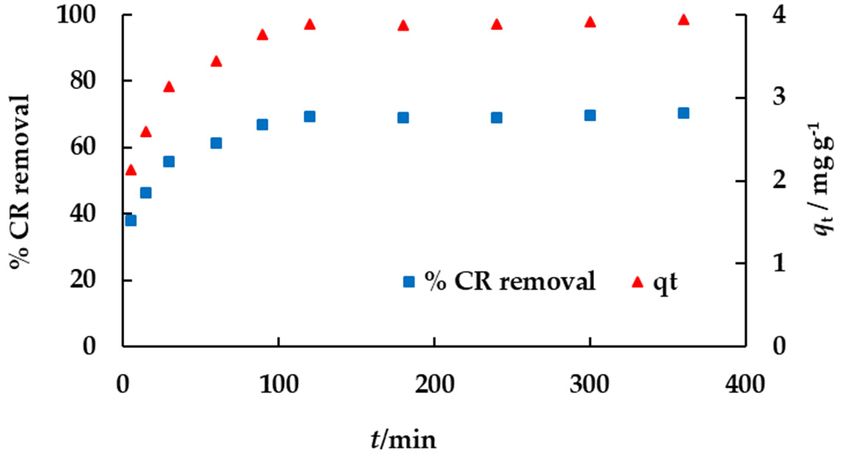
Water 2021, 13, 279                                                                                             2 of 17

                            Numerous methods (physical, chemical, and biological) for synthetic dye removal
                      from water have been studied and developed. However, adsorption is still the most
                      commonly used method, especially on a large-scale [6], because of its versatility, ease of
                      use, and efficiency. Activated carbon, the most frequently used adsorbent for dye removal,
                      efficiently removes cationic, mordant, and acid dyes, while its efficiency for dispersed,
                      direct, vat, and reactive dyes is slightly lower [2]. Often the main drawback of commercially
                      available activated carbons is their price and problems with regeneration, i.e., regeneration
                      is not straightforward and may result in reduced adsorption capacity [6]. Furthermore,
                      the problem with widely used coal-based commercial activated carbons (that efficiently
                      remove a whole range of water pollutants) is that coal itself is a fossil fuel and therefore a
                      non-renewable resource which soon might cease to exist. Therefore, many other materials
                      (especially lignocellulosic waste materials), are being investigated as possible low-cost
                      adsorbents for dye removal, either in their native (unmodified) or modified form (including
                      the biochar form). Being relatively cheap, widely available during the whole year, and
                      requiring little or no processing, waste wood biomass meets the conditions to be considered
                      a low-cost adsorbent. Furthermore, since it is a biological (organic) material, it can be
                      classified as a biosorbent. Biosorption is an adsorption subcategory, with the adsorbent
                      being of biological origin [7]. Wood biomass is composed primarily of three polymers:
                      cellulose (40–45% of the wood’s dry weight), hemicellulose (30% of the wood’s dry weight),
                      and lignin (20–30%) [8]. The adsorptive removal of dyes (and other contaminants) from
                      water is mainly accomplished by the interaction of dyes and specific functional groups of
                      lignocellulosic polymers (e.g., -OH and -COOH). Table 1 gives the examples of waste wood
                      biomass of different locally available wood species that have been evaluated as biosorbents
                      for synthetic dyes’ removal from water, including anionic azo dye Congo Red (CR), a
                      model dye used in this study.

                      Table 1. Removal of synthetic dyes using waste wood biomass as biosorbent.

                                                                              qmax /mg g−1
                              Dye                     Biosorbent                               % Removal      Ref.
                                                                              (Langmuir)
                                                      Pine bark                   1.6              100         [9]
                                             Lemon-scented gum sawdust           0.523             >80         [10]
                                               Fir (Abies nordmanniana)
                                                                                  28.1              86         [11]
                                                       sawdust
                           Congo Red
                                              Chir pine (Pinus roxburghii)
                                                                                  5.8               72         [12]
                                                       sawdust
                                                Eucalyptus (Eucalyptus
                                                                                   -               >80         [13]
                                                  globulus) sawdust
                                                 White cedar sawdust             55.15               -         [14]
                                                Poplar waste biomass              21.9             98.50       [15]
                         Methylene Blue
                                             Pine sawdust (Pinus strobus)         10.3             99.94       [16]
                                                  Cedar tree sawdust             142.36              -         [17]
                                              Chir pine (Pinus roxburghii)
                          Basic Violet 1                                          11.3              96         [12]
                                                       sawdust
                       Disperse Orange 30          Poplar sawdust                0.089             83.4        [18]
                       Eriochrome Black T        Sawdust unspecified             40.96              80         [19]
                         Allura Red AS           Sawdust unspecified             50.98               -         [20]
                           Safranine O           Sawdust unspecified               -                98         [21]

                           Compared to activated carbon and biochar, native lignocellulosic materials as biosor-
                      bents are mostly inferior, i.e., adsorption capacities of native materials are lower. Therefore,
                      attempts have been made to improve the adsorption capacities of such materials by phys-
Water 2021, 13, 279 3 of 17
ical and/or chemical methods, including the production of biochar. However, from an
economic perspective, the most affordable way to use lignocellulosic materials as biosor-
Water 2021, 13, x FOR PEER REVIEWbents is to use them in their native form, if sufficiently high adsorption capacity and dye
removal can be achieved.
CR is often used as a model dye in adsorption studies because of its complex chemical
structure comprising two azo groups and multiple aromatic rings (Figure 1). Azo dyes
are
thethe mostindustry,
textile widely usedbutclass
manyof synthetic
countriesorganic
havedyes.
bannedCR was formerlyofcommonly
it because its toxicity—CR
used in the textile industry, but many countries have banned it because of its toxicity—
olizes
CR into benzidine,
metabolizes a human
into benzidine, mutagen
a human mutagenandandcarcinogen
carcinogen[22].
[22]. However,
However, ititisis still u
stain
still in microbiology
used and diagnostic
as a stain in microbiology medicine
and diagnostic (e.g., in
medicine theindiagnosis
(e.g., of amyloido
the diagnosis of
as well as a[23],
amyloidosis) pHasindicator.
well as a pH indicator.
Figure Chemical
Figure1.1. structure
Chemical of Congo
structure Red (CR).
of Congo Red (CR).
This study aimed to screen the waste wood biomass of 10 different wood species
Thisin study
prevalent Croatia aimed to screen
as biosorbents for CR the wastefrom
removal woodwaterbiomass of 10
and to single outdifferent
the most wood
prevalent
efficient in Croatia
species. as biosorbents
Furthermore, the effects for CR removal
of different factors,from water
namely and
initial to single out t
biosorbent
concentration, contactFurthermore,
efficient species. time, initial CR the
concentration,
effects ofand initial pHfactors,
different on the biosorption of
namely initial bio
CR on the waste biomass of the most efficient tree species from the screening
concentration, contact time, initial CR concentration, and initial pH on the biosor experiment
were investigated.
CR on the waste biomass of the most efficient tree species from the screening exp
were
2. investigated.
Materials and Methods
2.1. Biosorbents and Adsorbate
2. Materials and Methods
Croatian Forests Ltd. (branch Osijek, Croatia) and Croatian Forest Research Institute
(Jastrebarsko, Croatia) kindly donated the waste wood biomass samples (shavings and saw-
2.1. Biosorbents
dust remained after and Adsorbate
cutting the trees with the chainsaw) of 10 tree species. The following
speciesCroatian
were included: Common beech (Fagus
Forests Ltd. (branch sylvatica
Osijek, L.), pedunculate
Croatia) Forestrobur
oak (Quercus
and Croatian Research
(Jastrebarsko, Croatia) kindly donated the waste wood biomassbetulus
L.), sessile oak (Quercus petraea (Matt.) Liebl.), common hornbeam (Carpinus samplesL.), (shavi
narrow-leafed ash (Fraxinus angustifolia Vahl), Euroamerican poplar (Populus euroamericana
sawdust remained after cutting the trees with the chainsaw) of 10 tree species. The
Dode-Guinier), European silver fir (Abies alba Mill.), Norway spruce (Picea abies Karst.),
ing species
European were
larch included:
(Larix Common
decidua Mill.), beechfir(Fagus
and Douglas sylvatica
(Pseudotsuga L.), pedunculate
menziesii Mirb.). The oak (
robur L.),
selected treesessile
speciesoak (Quercusinpetraea
are prevalent Croatian (Matt.)
growing Liebl.), common
stock. Out hornbeam
of 10 selected (Carpinu
species,
four species were coniferous (European Silver Fir, Norway Spruce,
L.), narrow-leafed ash (Fraxinus angustifolia Vahl), Euroamerican poplar (PopEuropean Larch, and
Douglas Fir), while the remaining six species were deciduous trees.
roamericana Dode-Guinier), European silver fir (Abies alba Mill.), Norway spruc
The samples were oven-dried at 333.15 K for 48 h and milled using a laboratory knife
abies(MF10
mill Karst.),
Basic,European larch (Larix
IKA Labortechnik, Staufendecidua Mill.),
im Breisgau, and Douglas
Germany) equippedfir (Pseudotsuga
with 1 mm m
Mirb.). The selected tree species are prevalent in Croatian growing
screen to obtain biosorbent particle size below 1 mm. Apart from drying and milling, no stock. Out o
other
lected treatments
species,(physical or chemical)
four species werewere applied. (European Silver Fir, Norway Spruc
coniferous
pean
2.2. Larch,
Model and
Congo RedDouglas Fir),and
(CR) Solutions while the Wastewater
Synthetic remainingPreparation
six species were deciduous tre
The samples were oven-dried at 333.15 K for 48 h and milled using a laborato
CR was purchased from Fisher Scientific. The stock solution of CR (1000 mg dm−3 ) was
mill (MF10
prepared withBasic, IKA Labortechnik,
demineralized Staufen
water daily. Model im Breisgau,
CR solutions Germany)
of different equipped wi
concentrations
screen to obtain biosorbent particle size below 1 mm. Apart from drying and mi
were prepared by diluting the stock solution to the desired concentration.
otherSynthetic wastewater
treatments was prepared
(physical by dissolving
or chemical) nutrients and minerals in deminer-
were applied.
alized water according to OECD guidelines 302B [24]. The composition of the synthetic
wastewater was as follows: Peptone (160 mg dm−3 ), meat extract (110 mg dm−3 ), urea
2.2.mg
(30 Model
dm−Congo Red (28
3 ), K HPO (CR)
mgSolutions and (7
dm−3 ), NaCl Synthetic
mg dm−Wastewater
3 ), CaCl ·2H Preparation −3
2 4 2 2 O (4 mg dm ),
CR was purchased from Fisher Scientific. The stock solution of CR (1000 m
was prepared with demineralized water daily. Model CR solutions of different co
tions were prepared by diluting the stock solution to the desired concentration.
Synthetic wastewater was prepared by dissolving nutrients and minerals inWater 2021, 13, 279 4 of 17
MgSO4 ·7H2 O (2 mg dm−3 ). For the preparation of synthetic wastewater with the addi-
tion of CR, the required amount of CR was added to the prepared synthetic wastewater
up to a final dye mass concentration of γCR = 50 mg dm−3 . The pH of the synthetic
wastewater with the addition of CR was pH = 7.56 (Seven Easy, Mettler Toledo, Greifensee,
Switzerland).
2.3. Biosorbent Characterization
Characterization of all investigated biosorbents, namely elemental composition (CHN
analysis), contents of ash, extractives, proteins and cellulose, point of zero charge (pHpzc ),
and determination of surface functional groups (by Fourier transform infrared spectroscopy,
FTIR) was given previously [15].
Further characterization of Euroamerican poplar (EP), as the most efficient biosorbent
for CR removal in this study, included the investigation of EP surface morphology using
field emission scanning electron microscope (FE-SEM, JSM-7000F, JOEL, Tokyo, Japan) and
the comparison of the surface functional groups of EP before and after the biosorption of
CR by recording the FTIR spectra from 4000 to 400 cm−1 (Cary 630, Agilent Technologies,
Santa Clara, CA, USA).
2.4. Batch Biosorption Studies
The screening of biosorption properties of waste wood samples was carried out by the
batch technique. A total of 25 cm3 of CR model solution (γCR = 50 mg dm−3 ) was added
to 100 cm3 Erlenmeyer flasks containing fixed amount (m = 0.25 g) of biosorbent. The
experiments were carried out in a thermostatic shaker (SW22, JULABO GmbH, Seelbach,
Germany) at the temperature of 298.15 K, the contact time of 360 min, and stirring speed of
150 rpm. pH was not adjusted, but it was measured at the beginning of the biosorption
process using pH-meter (Seven Easy, Mettler Toledo, Greifensee, Switzerland). After
360 min the flasks were collected from the thermostatic shaker, filtered using Whatman
filter paper No. 42, and centrifuged at 6000 rpm for 10 min (IKA mini G, IKA® -Werke
GmbH & Co. KG, Staufen, Germany). The dye concentrations in supernatants were
determined by ultraviolet-visible (UV/Vis) spectrophotometer at 498 nm (Specord 200,
Analytic Jena, Jena, Germany). The percentage of CR removal and biosorption capacity qe
(mg g−1 ) were calculated as follows:
(γ0 − γt )
% CR removal = ·100 (1)
γ0
γ0 − γe
qe = ·V (2)
m
where γ0 , γt , and γe (mg dm−3 ) are the initial CR concentration, CR concentration at a
predetermined contact time, and CR concentration at equilibrium, respectively. V (dm3 ) is
the volume of the CR model solution, and m (g) is the mass of the biosorbent.
Biosorption Studies Using EP as Biosorbent
The effect of biosorbent concentration on the amount of CR adsorbed was inves-
tigated by varying the amount of biosorbent (from 0.025 g to 0.25 g) added to a defi-
nite volume (25 cm3 ) of model CR solution, while keeping all other parameters constant
(γCR = 50 mg dm−3 , t = 360 min, pH = 7, T = 298.15 K, v = 150 rpm). The effect of contact
time was investigated at time intervals of 5, 15, 30, 60, 90, 120, 180, 240, 300, 360 min. To
study the effect of the initial dye concentration on the amount of CR adsorbed, the initial
CR concentrations were varied from 10 to 100 mg dm−3 , while all other parameters were
kept constant (γbiosorbent = 8 g dm−3 , t = 360 min, pH = 7, T = 298.15 K, and v =150 rpm).
The effect of pH was tested in the pH range from 4 to 9, while all other parameters were
kept constant. The pH was adjusted using 0.1 mol dm−3 HCl and 0.1 mol dm−3 NaOH
solutions.Water 2021, 13, x FOR PEER REVIEW 5
Water 2021, 13, 279 5 of 17
3. Results and Discussion
The obtained experimental equilibrium data were analyzed using Langmuir and
3.1. Screening
Freundlich of Waste
isotherm Biomass
models. of different
To investigate the Wood Species
adsorption as Biosorbents
kinetics of CR onto for
EP, CR Removal
pseudo-
first-order and pseudo-second-order kinetic models were used, as well as the intraparticle
The results of waste wood biomass screening for CR removal are presented in Fi
diffusion model. Duplicate experiments were conducted and were found reproducible.
2. EP proved to be the most efficient biosorbent for CR removal from water, achie
71.8%
3. ResultsCRand removal and biosorption capacity of 3.3 mg g−1. Second most efficient was c
Discussion
3.1.
monScreening of Waste CR
beach (51.1% Biomass of Different
removal Wood Species ascapacity
and biosorption Biosorbents of for
2.2CRmg Removal
g−1), followed by E
peanThe silver
resultsfirof(42.3% CR removal
waste wood and 1.8for
biomass screening mgCRg-1removal
biosorption capacity).
are presented Douglas
in Figure 2. fir
EP proved to be the most efficient biosorbent for CR removal from
the least efficient with 13.1% CR removal and biosorption capacity of 0.5 mg g . A water, achieving 71.8% −1
CR removal and biosorption capacity of 3.3 mg g−1 . Second most efficient was common
ported previously [15], all the tested samples are characterized by high cellulose con
beach (51.1% CR removal and biosorption capacity of 2.2 mg g−1 ), followed by European
and probably also by considerable hemicellulose and lignin contents [8]. The presen
silver fir (42.3% CR removal and 1.8 mg g−1 biosorption capacity). Douglas fir was the
many
least specific
efficient functional
with groups and
13.1% CR removal of these polymers
biosorption usually
capacity of 0.5favors
mg g−1the . Asbiosorptive
reported rem
of dyes. However,
previously [15], all thethe difference
tested samplesinare biosorption
characterized efficiency of the investigated
by high cellulose content and tree spe
probably also by considerable
was significant. This couldhemicellulose
probably beand lignin contents
attributed to the[8]. The
fact presence
that despite of many
the same pr
specific functional groups of these polymers usually favors
ration procedure, i.e., drying and milling, the degree of biomass fragmentation the biosorptive removal of (par
dyes. However, the difference in biosorption efficiency of the investigated tree species was
size distribution, PSD) may be different for the tested materials since PSD is influence
significant. This could probably be attributed to the fact that despite the same preparation
the material
procedure, i.e.,properties
drying and[25]. Even
milling, thethough
degree not alwaysfragmentation
of biomass investigated (particle
during the size biosorp
studies (including
distribution, PSD) may thebepresent
differentstudy),
for theparticle size cansince
tested materials be anPSD important factor
is influenced byaffecting
biosorption
the process. [25].
material properties Smaller
Evenbiosorbent particles
though not always have a larger
investigated during specific surface area, w
the biosorption
studies (including the present study), particle size can be an important
means a larger number of biosorption sites are available for adsorbate binding and m factor affecting
the biosorption
efficient process. However,
biosorption. Smaller biosorbent particles have
when particles a larger
are very specific
small, theirsurface area, from
separation
which means a larger number of biosorption sites are available for adsorbate binding
water after biosorption could be challenging. Furthermore, out of the tested samples,
and more efficient biosorption. However, when particles are very small, their separation
lars are
from the characterized by the smallest
water after biosorption specific density
could be challenging. and (thus)
Furthermore, outthe highest
of the testedinterna
samples, poplars are characterized by the smallest specific density and (thus) the highest The s
rosity [26,27], which could be the reason for the highest biosorption efficiency.
10 biosorbents
internal porosity were screened
[26,27], which couldfor cationic dye for
be the reason Methylene
the highest Blue (MB) removal
biosorption under sim
efficiency.
The same 10 biosorbents were screened for cationic dye Methylene
experimental conditions (different contact time, t = 120 min) and showed exceptional Blue (MB) removal
under
sorptive similar experimental
capability conditions
with over 90% MB (different
removal contact time,
in all runs t =[15].
120 min)
These and showed
results are consis
exceptional biosorptive capability with over 90% MB removal in all runs [15]. These results
with the research by Nacu [28] who reported that adsorption capacity of sawdust for
are consistent with the research by Nacu [28] who reported that adsorption capacity of
ionic dyes
sawdust for is muchdyes
cationic higher thanhigher
is much that for
thananionic
that for dyes
anionic(such
dyes as CR).
(such as CR).
Based on the presented results, EP was singled out as the most efficientmost
Based on the presented results, EP was singled out as the efficient
biosorbent for biosor
for removal
CR CR removal fromand
from water water
wasandusedwas used in
in further further experiments.
experiments.
Figure2.2. Screening
Figure Screeningofofwaste
waste biomass
biomass of different
of different wood wood species
species as biosorbents
as biosorbents for CR for CR removal
removal
from
fromaqueous
aqueoussolutions (γCR
solutions = 50
(γCR = 50 dm−
mgmg dm3, γ = 10
, γbiosorbent
−3biosorbent g dm
= 10 −3 , −3
g dm t= , t360 T = 298.15
min,min,
= 360 K,
T = 298.15 K, v
v150
= 150 rpm).
rpm).
3.2. Euroamerican Poplar (EP) Characterization
FE-SEM is a method often used to determine the morphological and structural cWater 2021, 13, 279 6 of 17
Water 2021, 13, x FOR PEER REVIEW3.2. Euroamerican Poplar (EP) Characterization
FE-SEM is a method often used to determine the morphological and structural char-
acteristics of the biosorbent surface. FE-SEM micrographs taken at different magnifica-
tions are shown in Figure 3. The surface of the EP is heterogeneous, rough, and uneven.
Nacu [28] reported that the texture properties of sawdust and bark of different tree species
are characterized by the presence of micro-, meso-, and macro- pores, with
are characterized by the presence of micro-, meso-, and macro- pores, with the predominant
nant mesoporous
mesoporous structure ofstructure
waste woodof wasteThe
biomass. wood biomass.
described Thefavorably
morphology described morpho
affects
affects
the theof binding
binding of adsorbate
adsorbate molecules [29]. molecules [29].
Figure
Figure 3. 3. Field
Field emission
emission scanning
scanning electron electron
microscopymicroscopy (FE-SEM)
(FE-SEM) micrographs micrographs
of Euroamerican of Eu
poplar
poplar (EP)
(EP) at different
at different magnifications:
magnifications: (a) 500,
(a) 500, (b) 1000, (b)(d)1000,
(c) 2000, 5000. (c) 2000, (d) 5000.
Qualitative analysis of specific functional groups on the biosorbent surface, which
Qualitative
affect the efficiency ofanalysis of specific
the biosorption process, functional groups on
is commonly performed thethebiosorbent
using FTIR s
affect the
method. efficiency
The FTIR ofEPthe
spectra of biosorption
before and after dyeprocess, isare
biosorption commonly performed
shown in Figure 4. u
The very wide band dominates both spectra at 3339.7 cm−1 (3324.8 for CR loaded EP),
method. The FTIR spectra of EP before and after dye biosorption are shown
which can be attributed to hydroxyl groups (-OH), i.e., vibrations of OH bond stretching,
probably connected to inter- and intramolecular formation of hydrogen bonds within
cellulose and lignin. The second most prominent band is the 1028.7 cm−1 intense band,
that could be assigned to the polysaccharides, i.e., C-O, C=C, and C-C-O stretching in
lignin, cellulose, and hemicellulose. The band with a maximum at 2914.8 cm−1 could be
associated with the stretching of aliphatic groups (-CH). The 1729.5 (1736.9 for CR loaded
EP) band can be assigned to C=O stretching [30]. The presence of branched-chain aromatic
radicals is indicated by bands from 1423.8 to 1505.8 cm−1 [31]. The slight shifting of the
peaks (frequency and intensity change) in the FTIR spectrum of CR loaded EP compared
to that of EP could be assigned to the biosorption of CR on the surface of biosorbent. As
reported previously [15], EP used in this study is comprised of a large portion of cellulose
(40.53%). The presence of cellulose, hemicellulose, and lignin, with a substantial number
of functional groups present at the biosorbent surface, favorably affects the removal of
dyes. In general, the adsorption takes place by hydrogen bonding, complexation, and
Figure 4. The Fourier transform infrared spectroscopy (FTIR) spectral characteristic
and after CR biosorption.Water 2021, 13, 279
Figure 3. Field emission scanning electron microscopy (FE-SEM) micrographs7of of 17
Euroame
poplar (EP) at different magnifications: (a) 500, (b) 1000, (c) 2000, (d) 5000.
ion exchange [32]. analysis
Qualitative High contents of cellulose,
of specific hemicellulose,
functional groups and
onlignin, with a large surface
the biosorbent
number of hydroxyl, carbonyl, and carboxyl functional groups, allow
affect the efficiency of the biosorption process, is commonly performedretention of dyes andusing t
even metals from aqueous solutions. In most cases this occurs through the ion exchange
method. The FTIR spectra of EP before and after dye biosorption are shown in Fig
mechanism in which such materials behave as shifters of natural ions [33,34].
Water 2021, 13, x FOR PEER REVIEW
previously [15], EP used in this study is comprised of a large portion of cellulose (
The presence of cellulose, hemicellulose, and lignin, with a substantial number
tional groups present at the biosorbent surface, favorably affects the removal of
general, the adsorption takes place by hydrogen bonding, complexation, and
change [32]. High contents of cellulose, hemicellulose, and lignin, with a large nu
hydroxyl, carbonyl, and carboxyl functional groups, allow retention of dyes and e
als from aqueous solutions. In most cases this occurs through the ion exchange me
in which such materials behave as shifters of natural ions [33,34].
Figure
Figure 4.4.The
The Fourier
Fourier
3.3. Biosorption transform
transform
Studies infrared
infrared
Using spectroscopy
EPspectroscopy (FTIR)
(FTIR) spectral
as Biosorbent spectral characteristics
characteristics of EP before of EP
and after CR biosorption.
and after CR biosorption.
3.3.1. The Effect of Biosorbent Concentration
3.3. Biosorption Studies Using EP as Biosorbent
TheEffect
3.3.1. The
The adsorbent
very wide
of concentration
band
Biosorbent dominatesisboth
Concentration an important parameter
spectra at 3339.7 cm−1 that affects
(3324.8 theload
for CR ad
process
whichThecanandbedefines
attributed
adsorbent the to
adsorption
concentrationhydroxyl capacity of the adsorbent
groupsparameter
is an important (-OH), i.e., affects at
thatvibrations thethe ofselected
OH bond
adsorption initial
str
ate concentration
probably
process defines the[35].
andconnected Since capacity
to inter-
adsorption the
andnumberof the of sorption
intramolecular
adsorbent sites
formation
at the at of
selectedtheinitial
adsorbent
hydrogen
adsorbate surface
bonds wii
concentration
by increasing[35]. Since
the the number
adsorbent of sorption
concentration, sites at the adsorbent
generally, the
lulose and lignin. The second most prominent band is the 1028.7 cm intense ba surface increases
percentage of
−1 by
dye remo
increasing the adsorbent concentration, generally, the percentage of dye removal will also
also increase
could [36]. In
be assigned to order to determine thei.e.,
the polysaccharides, optimal
C-O, concentration
C=C, and C-C-O of biosorbent
stretching to in
increase [36]. In order to determine the optimal concentration of biosorbent to be used in
in further
cellulose, experiments,
and hemicellulose.different
The biosorbent
band with aconcentrations
maximum at
− (1–10
2914.8
3
further experiments, different biosorbent concentrations (1–10 g dm ) were tested, and g
cm dm −3) were tes
−1 could be ass
theobtained
with
the obtained results
the stretching
results are ofare shown
aliphatic
shown in5.Figure
groups
in Figure 5. The 1729.5 (1736.9 for CR loaded E
(-CH).
can be assigned to C=O stretching [30]. The presence of branched-chain aromatic
is indicated by bands from 1423.8 to 1505.8 cm−1 [31]. The slight shifting of the pea
quency and intensity change) in the FTIR spectrum of CR loaded EP compared to
EP could be assigned to the biosorption of CR on the surface of biosorbent. As r
Figure 5. The effect of biosorbent concentration on the biosorption of CR to EP (γCR = 50 mg dm−3 ,
Figure 5. The effect of biosorbent concentration on the biosorption of CR to EP (γCR = 50 m
t = 360 min, pH = 7, T = 298.15 K, v = 150 rpm).
= 360 min, pH = 7, T = 298.15 K, v = 150 rpm).
Increase of the biosorbent concentration led to an increase of the CR removal percent-
age, but also a simultaneous
Increase decreaseconcentration
of the biosorbent of biosorption capacity.
led to anThe results show
increase of thethat
CRthe
removal
percentage of CR removal increased from 20.3% to 71.7% with an increase of biosorbent con-
age, but also a simultaneous decrease of biosorption capacity. The results show
centration from 1 to 10 mg dm−3 . However, when biosorbent concentration increased from
6percentage of incremental
to 8 g dm−3 the CR removal CR increased from 20.3%
percentage removal became tosmall.
71.7% with
This is inan increase of bi
accordance
concentration
with other authorsfrom 1 to 10the
who reported mg dm .inHowever,
−3
increase dye removalwhen biosorbent
percentage concentration in
with the increasing
from 6 to 8 g dm-3 the incremental CR percentage removal became small. This is in
ance with other authors who reported the increase in dye removal percentage
increasing biosorbent concentration up to a concentration when removal peWater 2021, 13, 279 8 of 17
biosorbent concentration up to a concentration when removal percentage reaches a con-
stant value [13,15,30]. The biosorption capacity decreased from 9.1 to 3.2 mg g−1 with the
increasing biosorbent concentration. The decrease in biosorption capacity can probably be
attributed to the increase of the area available for binding of the same amount of adsorbate,
whereby a smaller amount of adsorbate per unit mass of biosorbent is adsorbed.
Increase of the dye removal percentage with increasing the biosorbent concentration
Water 2021, 13, x FOR PEER REVIEWis consistent with the results of other studies dealing with biosorption of dyes, such as
CR biosorption on fir sawdust biomass [11], Eucalyptus wood sawdust [13], E. crassipes
root [37], and cattail root [38], as well as MB biosorption on EP waste biomass [15] and
meranti sawdust [30].
3.3.2. The Effect
Taking of Contactboth
into consideration Time CR removal percentage and biosorption capacity,
biosorbent concentration of 8 mg dm −3 was selected for further experiments.
Adsorption depends on the contact time between the adsorbent and the ad
Fast adsorption of the adsorbate
3.3.2. The Effect of Contact Time from the liquid phase and quick establishment
librium are some
Adsorption of the
depends ongood adsorbent
the contact characteristics.
time between the adsorbentDetermining the optimal
and the adsorbate.
tionadsorption
Fast contact time
of theis essential
adsorbate fortheboth
from liquidprocess
phase andoptimization and the
quick establishment application o
of equilib-
rium are some of the good adsorbent characteristics. Determining
sorbent in real wastewater treatment systems. From the results shown in Figurethe optimal adsorption
contact time is essential for both process optimization and the application of an adsorbent
be seen that the removal of CR by EP is characterized by rapid removal during th
in real wastewater treatment systems. From the results shown in Figure 6, it can be seen
stages
that (the first
the removal 60 by
of CR min)
EP isof biosorption.
characterized At the
by rapid initial
removal stages,
during the surface
the initial available
stages (the
first 60 min) of biosorption. At the initial stages, the surface available for dye biosorption [38]. A
biosorption is large, and the process mainly occurs at the biosorbent surface
is large, rapid
initial and theremoval
process mainly
of theoccurs
dye, inat the
thebiosorbent surface
later stages [38].experiment,
of the After the initial
the remo
rapid removal of the dye, in the later stages of the experiment, the removal
decreases until equilibrium is reached (within 180 min). At this stage, the dye rate decreases
until equilibrium is reached (within 180 min). At this stage, the dye is transported from
ported from the sites at biosorbent surface to the internal sites of the biosorben
the sites at biosorbent surface to the internal sites of the biosorbent, so the dye removal
dyeslower
gets removal getsToslower
[37,38]. [37,38].
ensure the To ensure
equilibrium the equilibrium
is reached, the contact timeis of
reached, the contac
360 min was
360 min
applied in was applied
further in further experiments.
experiments.
The effect −3 , −3
Figure
Figure6.6. The effectofofcontact
contacttime
timeononthethebiosorption of CR
biosorption to EP
of CR (γCR(γ=
to EP CR50 mgmg
= 50 dmdm , γbioso
γmg = 8 mg dm − 3 , pH = 7, T = 298.15 K, v = 150 rpm).
dm , pH = 7, T = 298.15 K, v = 150 rpm).
-3
biosorbent
3.3.3. The Effect of Initial CR Concentration
3.3.3.
TheThe Effect
effect of theofinitial
Initial
CRCR Concentration
concentration on the percentage CR removal and biosorp-
tion capacity is presented
The effect in Figure
of the initial CR 7. concentration
By increasing theon
initial
thedye concentration
percentage CR from 10 and
removal
to 100 mg dm−3 , the percentage of dye removal decreased from 85.6% to 49.6%, while
tion capacity is presented in Figure 7. By increasing the initial dye concentration
the biosorption capacity increased from 1.1 to 6.2 mg g−1 . At higher concentrations of
to 100 mg
adsorbate, thedm
−3, the percentage of dye removal decreased from 85.6 to 49.6%, w
number of occupied biosorption sites is higher, so the biosorption capacity
biosorption
increases. capacity
At the increased
same time, fromof1.1
the efficiency the to 6.2 mgremoval
adsorbate g−1. Atprocess
higher(expressed
concentrations
as of
percentage dye removal)
ate, the number in general will
of occupied decrease, probably
biosorption sites is ashigher,
a result so
of the
thesaturation of
biosorption cap
surface biosorption sites [36]. The results indicate that the removal of CR by biosorption on
creases. At the same time, the efficiency of the adsorbate removal process (expr
percentage dye removal) in general will decrease, probably as a result of the satur
surface biosorption sites [36]. The results indicate that the removal of CR by bio
on EP is a dye concentration-dependent process, which is consistent with the reWater 2021, 13, 279 9 of 17
EP is a dye concentration-dependent process, which is consistent with the results of other
authors who used other lignocellulosic biosorbents for CR removal such as the Eucalyptus
wood sawdust [13], chir pine sawdust [12], the roots of the plant E. crassipes [37], and the
Water 2021, 13, x FOR PEER REVIEW 9 of 17
cattail root [38]. The resistance to transfer dye molecules between the liquid and solid
phase is more easily overcome at higher initial dye concentrations, because of the higher
Water 2021, 13, x FOR PEER REVIEW driving force (higher concentration gradient) provided. Consequently, the amount of dye 9 of 17
adsorbed per unit mass of biosorbent, as well as the rate of biosorption at equilibrium
increase [13,36,39].
Figure 7. The effect of initial CR concentration on biosorption to EP (γbiosorbent = 8 mg dm−3, t = 360
min, pH = 7, T = 298.15 K, v = 150 rpm).
Figure 7. The effect of initial CR concentration on biosorption to EP (γbiosorbent = 8 mg dm−3 ,
Figure 7. The effect of initial CR concentration on biosorption to EP (γbiosorbent = 8 mg dm−3, t = 360
t = 360 min, pH = 7, T = 298.15 K, v = 150 rpm).
3.3.4.
min, pHThe Effect
= 7, of pHK, v = 150 rpm).
T = 298.15
3.3.4. The Effect of pH
Solution pH is the factor significantly affecting the efficiency of adsorbent during the
3.3.4. The Effect
Solution
wastewater pH of
treatment.pHfactor
is the significantly
A change in the pHaffecting
of thethesystem
efficiency of adsorbent
in which during theprocess
the adsorption
wastewater treatment. A change in the pH of the system in which the adsorption
takesSolution
place canpHleadis the factor
to the significantly
change in the activeaffecting
site ofthetheefficiency
biosorbent,of as wellprocess
adsorbent during
as to the
a change
takes place can lead to the change in the active site of the biosorbent, as well as to a change
wastewater
in the chargetreatment.
(degree of A ionization)
change in the pH of
of the dyethe system
itself in which
[36,40]. the adsorption
The effect of the pHprocess
on the
in the charge (degree of ionization) of the dye itself [36,40]. The effect of the pH on the
takes place
biosorption can lead to the
capacityofofEPEP
biosorption capacity
change
and
and thethe
in the active
percentage
percentage
site of
ofremoval
of CR
the
CR removal biosorbent, as
was tested
was tested
well
over
over the
as
pH the
to a change
pH range
range
in
fromthe4 charge
to 9 and(degree
is shown of ionization)
in Figure
from 4 to 9 and is shown in Figure 8. 8 of the dye itself [36,40]. The effect of the pH on the
biosorption capacity of EP and the percentage of CR removal was tested over the pH range
from 4 to 9 and is shown in Figure 8
Figure
Figure 8. The effect
effectofofpH
pHononbiosorption
biosorption of CR
of CR to (γ
to EP EPCR(γ 50=mg
=CR mg−dm
50 dm 3 , γ−3
, γbiosorbent
biosorbent = 8=mg
8 mg −3 , −3
dmdm ,t=
360 min, T = 298.15 K, v = 150 rpm).
t = 360 min, T = 298.15 K, v = 150 rpm).
Figure 8. The effect of pH on biosorption of CR to EP (γCR = 50 mg dm−3, γbiosorbent = 8 mg dm−3, t =
The highest percentage of CR removal (73.4%) and the highest biosorption capacity
TheThighest
360 min, = 298.15percentage of CR removal (73.4%) and the highest biosorption capacity
K, v = 150 rpm).
(4.4 mg g−−11 ) were achieved at pH = 4. In the pH range from 5 to 7 both the percentage CR
(4.4 mg g ) were achieved at pH = 4. In the pH range from 5 to 7 both the percentage CR
removal and biosorption capacity were almost constant (66.20–67.5% and 4.0–4.1 mg g−1 ,
The and
removal highest percentage
biosorption of CRwere
capacity removal (73.4%)
almost and (66.20–67.5%
constant the highest biosorption
and 4.0–4.1capacity
mg g−1,
(4.4 mg g ) were
−1
respectively) and achieved at pHlower
only slightly = 4. In the the
than pH values
range from 5 to 7atboth
achieved pH the
= 4.percentage CR
On the other
removal
hand, at and
basicbiosorption capacity
pH value (pH were
= 8–9) almost constant
a considerable drop(66.20–67.5%
of percentage andCR4.0–4.1 mgand
removal g−1,
respectively)capacity
biosorption and only slightly
was lower
noticed. When than the valuesthe
considering achieved
effect ofatpHpHon= adsorption
4. On the other
pro-Water 2021, 13, 279 10 of 17
respectively) and only slightly lower than the values achieved at pH = 4. On the other
hand, at basic pH value (pH = 8–9) a considerable drop of percentage CR removal and
biosorption capacity was noticed. When considering the effect of pH on adsorption process,
it is valuable to know the pH value that corresponds to a pH at which the adsorbent surface
charge density is equal to zero (i.e., point of zero charge, pHpzc ). pHpzc of EP was reported
to be pHpzc = 7.1 [15]. Knowing the pHpzc of the adsorbent is important to understand
better the electrostatic interactions between the adsorbent surface and the adsorbate at a
given pH. Theoretically, at pH < pHpzc the surface of the adsorbent is positively charged,
which is the condition conducive to the adsorption of anionic dyes, such as CR. On the
other hand, at pH > pHpzc the surface of the adsorbent is negatively charged, which favors
the adsorption of cationic dyes [41]. More efficient biosorption of CR at lower pH values
was confirmed by Ribeiro et al. [10] who used wood sawdust powder from Eucalyptus
Corymbia citriodora as biosorbent, by Khan et al. [12] who used chir pine sawdust, as well
as by Chanzu et al. [42] who used brewers’ spent grains as biosorbent. At lower pH
values cationic dyes compete for adsorption sites with H+ ions, while anionic dyes compete
with OH− ions at higher pH values, which in both cases negatively affects the adsorption
efficiency [42]. The results obtained in this study differ slightly from the results of [38]
who reported the highest CR removal percentage using cattail root at pH = 5, but constant
removal percentage over the pH range from 5.5 to 10. Li et al. [43] who used cassava waste
and Jain and Sikarwar [44] who used activated de-oiled mustard as biosorbents for CR
removal reported that pH did not significantly affect the biosorption capacity of the applied
lignocellulosic materials. Furthermore, Mane and Vijay Babu [13] reported that CR solution
is stable at pH =7, but gets unstable if solution pH is lower or higher. They also reported
the maximum percentage of CR removal at pH = 7. Over the pH range from 4 to 10, more
than 80% of CR was removed. The percentage CR removal increased (from 80% to 85%)
with the increase in pH from 4 to 7, while it slightly decreased over the pH range from 7 to
10. At pH > 10, they reported a significant decrease in percentage CR removal.
3.3.5. Biosorption of CR to EP from Synthetic Wastewater
Model dye solutions are commonly used when investigating the applicability of
adsorbents for dye removal, especially when dealing with unconventional (low-cost)
adsorbents, i.e., biosorbents. However, the composition of real wastewater is much more
complex, with many (dissolved and undissolved) pollutants and other substances that can
affect the bio-sorption process. To further explore the possible use of EP as biosorbent,
biosorption of CR to EP from synthetic wastewater with the addition of CR was investigated,
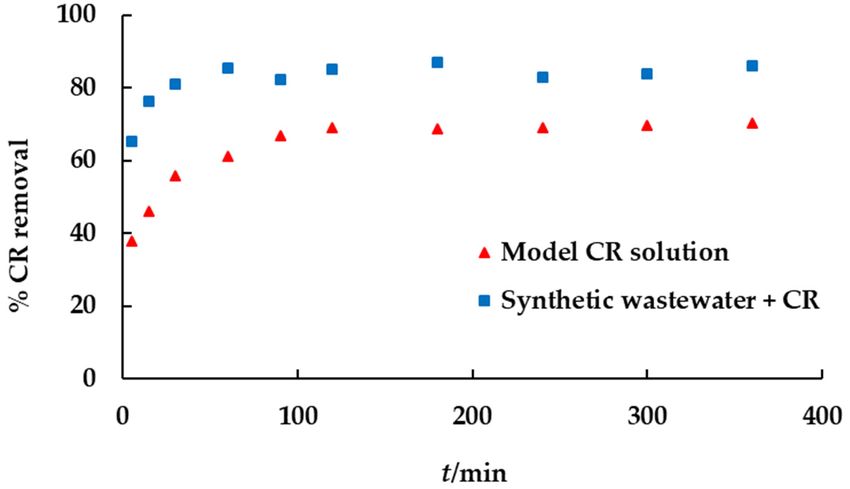
and the results are presented in Figure 9.
The percentage of CR removal from synthetic wastewater after 360 min was 18.6%
higher than from model CR solution. During the first 60 min, characterized by rapid
CR removal, the percentage of CR removal from synthetic wastewater was even higher
(28.2%). This can probably be explained by the fact that the ionic strength of wastewater is
higher than that of model dye solutions. Hu et al. [38] reported the increase of CR removal
by cattail root with the increase of ionic strength of NaCl from 0 to 0.1 mol dm−3 . They
stated that the ionic strength increase would result in the increase of the positive charge
of adsorbent surface and the electrostatic interaction between the dye and adsorbent will
increase.sorbents for dye removal, especially when dealing with unconventional (low-cos
bents, i.e., biosorbents. However, the composition of real wastewater is much mo
plex, with many (dissolved and undissolved) pollutants and other substances
affect the bio-sorption process. To further explore the possible use of EP as bio
Water 2021, 13, 279 11 of 17
biosorption of CR to EP from synthetic wastewater with the addition of CR was
gated, and the results are presented in Figure 9.
Water 2021, 13, x FOR PEER REVIEW
Figure9.9.Biosorption
Figure Biosorption of CR to EP
of CR tofrom modelmodel
EP from CR solution
CR solutionand synthetic wastewater
and synthetic with the
wastewater with
addition of CR
CR (γ − 3 − 3 , t−3=360 T = 298.15 K, v = 150
3.3.6.
ditionAdsorption
of CR==50
(γCR 50mg
mgdmdm, −3
Isotherms γ,biosorbent = 8=mg
γbiosorbent dm dm
8 mg min, min,
, t =360 T = 298.15 K,rpm).
v = 150 rpm
To describe
3.3.6. Adsorption how adsorbate
Isotherms molecules are distributed between the liquid an
phasesThe percentage
at equilibrium
To describe of CR removal
and tomolecules
how adsorbate providearefrom synthetic
insight into the
distributed wastewater
maximum
between after 360 min
adsorption
the liquid and solid wa
capac
higheratthan
phases
adsorbent forfrom
equilibrium model CR solution.
and to provide
adsorbate, During
insight into
adsorption the
arefirst
the maximum
isotherms 60 [45].
min, capacity
adsorption
used characterized
Langmuirof anandby r
Fre
adsorbent
removal, for adsorbate,
the adsorption
percentage of isotherms
CR removal are used
from [45]. Langmuir
synthetic and Freundlich
wastewater was even
adsorption isotherms are the most commonly used mathematical models for this p
adsorption isotherms are the most commonly used mathematical models for this purpose.
(28.2%). This
Langmuir and can probablyisotherm
Freundlich be explained by forthe
CRfact that the ionic strength of wain
Langmuir and Freundlich isotherm plots for plots
CR biosorption biosorption
on EP are shown oninEP are 10,
Figure shown
is higher
10, while
while thanobtained
the
the obtained that of model
isotherm dyeparameters
isotherm
parameters solutions.
are Hu given
are
given in Table et
2. al. [38] reported
in Table 2. the increase o
moval by cattail root with the increase of ionic strength of NaCl from 0 to 0.1 m
They stated that the ionic strength increase would result in the increase of the
charge of adsorbent surface and the electrostatic interaction between the dye an
bent will increase.
Figure 10. Langmuir and Freundlich isotherms of CR biosorption on EP (γbiosorbent = 8 mg dm−3 ,
Figure 10. Langmuir and Freundlich isotherms of CR biosorption on EP (γbiosorbent = 8 mg d
t = 360 min, pH = 7, T = 298.15 K, v = 150 rpm).
360 min, pH = 7, T = 298.15 K, v = 150 rpm).
Langmuir adsorption isotherm model assumes the adsorbent molecules are adsorbed
Table
in only2.one
Isotherm parametersall
layer (monolayer), foravailable
the removal of CR sites
adsorption by EPareathomogenous,
298.15 K. and their
number is fixed, and the adsorption process is reversible [46]. The Langmuir isotherm
Isotherm
equation [47] is expressed Model
as follows: CR
qm exp./mg g−1 qm ·KL ·γe
6.21
q =
Langmuir e 1 + KL ·γe (3)
qm cal./mg g−1 8.00
where γe (mg dm−3 ) is the CR concentration at equilibrium, qe (mg g−1 ) is the amount
of CR adsorbed perKunit
L/dm mg 0.067 of
3 −1
mass of adsorbent, qm (mg g−1 ) is the maximum amount
RL 0.130
se 0.441
Freundlich
KF/(mg/g (dm3/mg)1/n) 0.60Water 2021, 13, 279 12 of 17
CR adsorbed (to form a surface monolayer, i.e., monolayer adsorption capacity), and
KL (dm3 mg−1 ) is the Langmuir constant. The dimensionless constant RL (equilibrium
parameter) indicates the type of isotherm to be favorable (0 < RL < 1), unfavorable (RL > 1),
linear (RL = 1), or irreversible (RL = 0). It can be calculated as follows [46]:
1
RL = (4)
1 + K L · γo
where γ0 (mg dm−3 ) is the highest initial concentration of dye. The RL value presented in
Table 2 is 0.130, which indicates that biosorption of CR on EP under the applied experimen-
tal conditions was a favorable process.
Table 2. Isotherm parameters for the removal of CR by EP at 298.15 K.
Isotherm Model CR
qm exp. /mg g−1 6.21
Langmuir
qm cal. /mg g−1 8.00
KL /dm3 mg−1 0.067
RL 0.130
se 0.441
Freundlich
KF /(mg/g (dm3 /mg)1/n ) 0.60
n 1.61
se 0.794
The Freundlich adsorption isotherm is used to describe adsorption in a multilayer (on
heterogeneous surfaces) where there are interactions between adsorbate molecules. The
Freundlich isotherm can be expressed by the following equation [48]:
1
q e = K f γe n (5)
where qe (mg g−1 ) is the adsorbed amount of dye at equilibrium, γe (mg dm−3 ) is the
concentration of dye in solution at equilibrium, KF is the constant indicating adsorption
capacity of adsorbent, and n indicates the intensity of adsorption. When n = 1 adsorption
is linear, n < 1 adsorption is a chemical process, and n > 1 indicates a physical process
that is favorable [49]. The value of the constant n in this study was 1.61, which indicates a
physical process that is favorable.
By analyzing these values for both models presented in Table 2, as well as the Langmuir
and Freundlich isotherm plots for CR biosorption on EP given in Figure 10, it seems that
the Langmuir model better describes the experimentally obtained data.
3.3.7. Adsorption Kinetics
Research on the kinetics of the adsorption process is important because it provides
information on the possible adsorption mechanisms and a theoretical basis for the develop-
ment and application of adsorbents on an industrial scale [50]. Thus, knowing the batch
adsorption kinetics is vital for the industrial adsorption columns design [13]. The results of
the experimental data modelling using two selected kinetic models—the pseudo-first-order
model and the pseudo-second-order model—are given in Table 3.Water 2021, 13, 279 13 of 17
Table 3. Parameters of the pseudo-first-order and pseudo-second-order kinetic models for the removal of CR by EP
(γCR = 50 mg dm−3 , γbiosorbent = 8 mg dm−3 , t =360 min, pH = 7, T = 298.15 K, v = 150 rpm).
Pseudo-First Order Pseudo-Second Order
Parameter
γ0 /mg dm−3 qe exp /mg g−1 k1 /min−1 qe cal /mg g−1 R2 k2 /g mg−1 min−1 qe cal. /mg g−1 R2
50 3.95 0.061 1.063 0.837 0.035 4.023 0.9998
Lagergren pseudo-first-order model [51] that can be applied for the liquid/solid
system adsorption and assumes that the adsorption rate is proportional to the number of
unoccupied sites (by solutes) [52] is represented by the following equation:
ln(qe − qt ) = lnqe − k1 t (6)
where qe is the amount of dye adsorbed at equilibrium, qt (mg g−1 ) is the amount of dye
adsorbed at time t (min), and k1 (min−1 ) is the pseudo-first-order rate constant.
According to Ho and McKay [53], pseudo-second-order model is expressed as:
1 1 1
− = (7)
qt qe k2 ·q2e ·t
where k2 (g mg−1 min−1 ) is the pseudo-second-order rate constant. The pseudo-second-
order model assumes that both adsorption and ion exchange take place on the adsorbent
surface, with the limiting factor of the adsorption rate being the chemical binding to active
sites on the adsorbent surface [54].
Water 2021, 13, x FOR PEER REVIEW 13 of 17
The results presented in Table 3 suggest that the biosorption of CR on EP under
the applied experimental conditions is more appropriately approximated by the pseudo-
second-order model. The goodness of fit was based on the values of the linear regression
correlation
correlation coefficient
coefficientR2Rand 2 andthetheagreement
agreementofofcalculated
calculatedqeqcal values
valuesand andthethe
experimental
experimental
e cal
qe qexp values. Apart
values. Apartfrom fromR2 R 2 being
being closer to unity
closer forfor
to unity thethe
pseudo-second-order
pseudo-second-order model,
model, thethe
e exp
values
values of of
qe cal
qeand
cal q
ande expqfor the
e exp pseudo-second-order
for the pseudo-second-order model are
model in a better
are in a agreement
better than
agreement
forthanthe pseudo-first-order
for the pseudo-first-order model. This model.is inThis
line is
with otherwith
in line studies reporting
other studies the pseudo-
reporting the
second-order
pseudo-second-orderkinetic model as the
kinetic best-fit
model as model for the
the best-fit prediction
model for theofprediction
the batch adsorption
of the batch
adsorption
kinetics of CRkinetics of CRbiosorbents
on different on different[13,37,38,55].
biosorbents [13,37,38,55].
Adsorption
Adsorption is is a multistage
a multistage process,
process, inin which
which the
the adsorbate
adsorbate is is transferred
transferred from
from thethe
solution
solution to to
thethe solid
solid phase
phase into
into thethe interior
interior ofof
thethe adsorbent
adsorbent where
where it it
is is retained
retained [56].
[56]. ToTo
explain
explain the
the diffusionmechanism,
diffusion mechanism,the theexperimental
experimentaldata datawere
wereanalyzed
analyzed by by the intraparti-
intraparticle
diffusion model, and the graphical dependence q with t 0.50.5is shown in Figure 11, while the
cle diffusion model, and the graphical dependencet qt with t is shown in Figure 11, while
themodel
modelparameters
parameters are given
are given ininTable
Table 4. 4.
Figure 11. Weber and Morris intraparticle diffusion plot for CR removal using EP (γCR = 50 mg dm−3 ,
Figure 11. Weber and Morris intraparticle diffusion plot for CR removal using EP (γCR = 50 mg
γ = 8 mg dm−3 , t =360 min, pH = 7, T = 298.15 K, v = 150 rpm).
dm−3biosorbent
, γbiosorbent = 8 mg dm−3, t =360 min, pH = 7, T = 298.15 K, v = 150 rpm).
Table 4. Parameters of the Weber and Morris intraparticle diffusion model for the removal of CR
by EP (γCR = 50 mg dm−3, γbiosorbent = 8 mg dm−3, t =360 min, pH = 7, T = 298.15 K, v = 150 rpm, * mg
g−1 min−0.5).Water 2021, 13, 279 14 of 17
Table 4. Parameters of the Weber and Morris intraparticle diffusion model for the removal of CR
by EP (γCR = 50 mg dm−3 , γbiosorbent = 8 mg dm−3 , t =360 min, pH = 7, T = 298.15 K, v = 150 rpm,
* mg g− 1 min− 0.5 ).
Intraparticle Diffusion Model
Parameter
γ0 / mg dm−3 ki1 * C1 R1 2 ki2 * C2 R2 2 ki 3 * C3 R3 2
50 0.3089 14.329 0.9974 0.1419 23.678 0.9651 0.0143 36.758 0.9636
The intraparticle diffusion model was proposed by Weber and Morris [57]. The effect
of intraparticle diffusion resistance on adsorption process can be evaluated using the
equation:
qt = k i × t1/2 + C (8)
where ki (mg g−1 min−0.5 ) is the intraparticle diffusion rate constant, and C is constant that
describes the thickness of the boundary layer. Since C is proportional to the thickness, a
larger value indicates the more profound boundary layer effect, but also indicates higher
adsorption capacity [55]. When the plot of q versus t1/2 passes through the origin (Figure 11,
intraparticle diffusion is the only rate-limiting step. On the other hand, if C 6= 0, boundary
layer diffusion is controlling the adsorption to a certain level. Three linear regions are
visible in Figure 11. This multilinearity suggests that intraparticle diffusion is not the
only step limiting the rate of biosorption of CR to EP. The first linear region, which is the
steepest, can probably be attributed to biosorption on the outer surface of the biosorbent
(i.e., diffusion in the film). The other two linear regions are less steep and are attributed
to the phase in which adsorption is slower and the equilibrium phase when the effect of
intraparticle diffusion is much smaller or completely stopped, due to the low concentration
of adsorbate in the solution.
4. Conclusions
This study investigated the applicability of waste wood biomass of ten tree species
for the biosorptive removal of Congo Red (CR) from water. Euroamerican poplar (EP)
was singled out as the most efficient biosorbent for CR removal, achieving 71.8% CR
removal and biosorption capacity of 3.3 mg g−1 , and was used for further batch biosorption
experiments. The CR biosorption on EP was found to be strongly dependent on biosorbent
concentration, contact time, initial CR concentration, and pH. The equilibrium was achieved
within 180 min. The process could be interpreted in terms of the Langmuir adsorption
isotherm model. The pseudo-second-order kinetic model well described the kinetic data of
the biosorption process. Intraparticle diffusion was not the only process controlling the
biosorption of CR on EP. The results presented in this study suggest that the EP has the
potential to be used as a low-cost biosorbent for CR removal from dye-loaded wastewater.
With the aim of possible utilization of waste wood biomass of other tree species included in
the screening experiments, future research should include more detailed characterization
of these materials including the pore size and volume analysis, the surface area analysis,
and the study of the effect of biosorbent specific density, porosity, and particle size on the
biosorption efficiency. Furthermore, future research directions should focus on waste wood
modifications to improve the biosorption capacity, as well as on column studies that are
more industrially feasible for real wastewater treatment systems.
Author Contributions: Conceptualization, methodology, M.S. and N.V.; formal analysis, M.S. and
N.V.; investigation, M.S., A.G., and I.K.; resources, N.V., T.J., and M.H.-S.; writing—original draft
preparation, M.S. and I.K. writing—review and editing, N.V., M.H.-S., and T.J.; visualization, M.S.
and N.V.; funding acquisition, N.V., M.S., and M.H.-S. All authors have read and agreed to the
published version of the manuscript.
Funding: This research received no external funding.You can also read


