FY 2021-2024 Transportation Improvement Program
←
→
Page content transcription
If your browser does not render page correctly, please read the page content below

FY 2021-2024 Transportation Improvement Plan (TIP)

  FY 2021-2024
  Transportation
  Improvement
  Program
  (TIP)

   400 Kendrick Lane
   Front Royal, VA 22630
   Phone (540) 636-8800
   Winfredmpo.org

   April 2020

   Winchester-Frederick Country Metropolitan
   Planning Organization

Prepared for WinFred MPO by the Northern Shenandoah Valley Regional Commission

                                                                                 i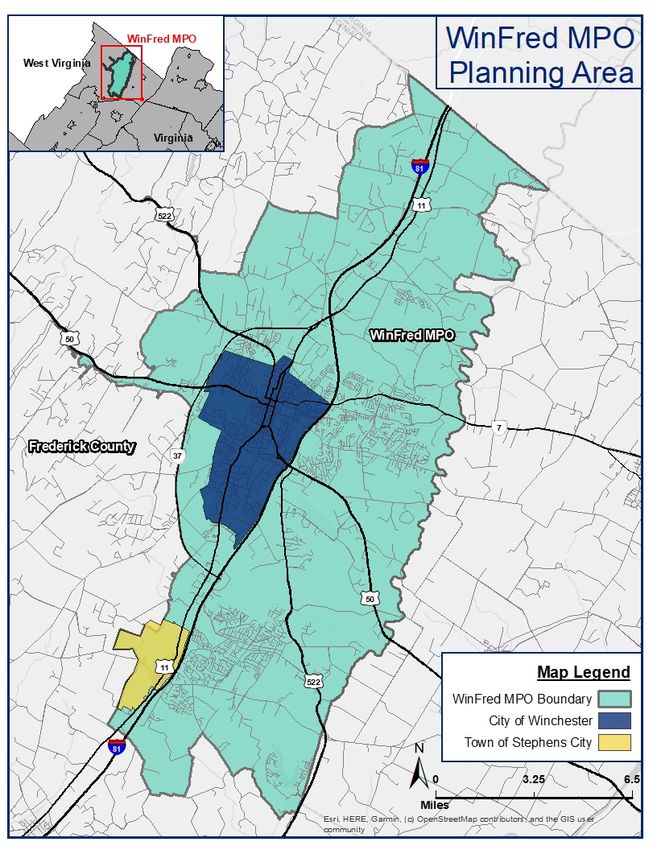
FY 2021-2024 Transportation Improvement Plan (TIP)

Winchester-Frederick County Metropolitan
Planning Organization
Policy Board

Officers
Chair, Charles S. DeHaven, Jr. – Frederick County
Vice Chair, Bill Wiley – Winchester
Secretary/Treasurer, Brandon Davis – NSVRC

Members
Judith McCann-Slaughter – Frederick County
Kris Tierney – Frederick County
Mike Majher – Stephens City
Randy Kiser – Virginia Department of Transportation
Mary Beth Price – City of Winchester
John Hill – City of Winchester
Richard Duran – Federal Highway Administration (non-voting)
Tony Cho – Federal Transit Administration (non-voting)
Ciara Williams – Virginia Department of Rail and Public Transportation (non-voting)
R.N. (Rusty) Harrington – Virginia Department of Aviation (non-voting)

                                                                                      ii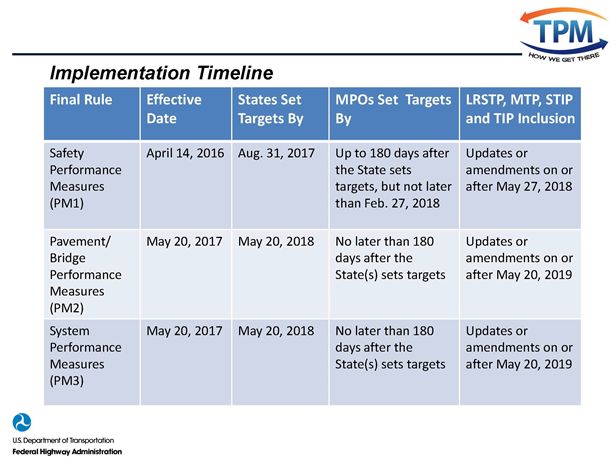
FY 2021-2024 Transportation Improvement Plan (TIP)

Technical Advisory Committee

Officers
Chair, Tim Youmans – City of Winchester
Vice Chair, John Bishop – Frederick County
Secretary/Treasurer, Brandon Davis – NSVRC

Members
Patrick Barker – Frederick County
Mike Ruddy – Frederick County
Jay Tibbs – Frederick County
Mike Majher – Stephens City
Terry Short – Virginia Department of Transportation
Ciara Williams – Virginia Department of Rail and Public Transportation
Nick Sabo – Winchester Airport
Renee Wells – Winchester Transit
Shawn Hershberger – City of Winchester
Justin Hall – City of Winchester
Perry Eisenach – City of Winchester

Plan Documentation
Contact Information
400 Kendrick Lane; Front Royal, Virginia 22630
Phone: (540) 636-8800
Virginia Relay for Hearing & Voice Impaired: Within Virginia 7-1-1;
Outside Virginia Voice 800-828-1140 • Hearing 800-828-1120
Website: https://winfredmpo.org

Title
FY 2021-2024 Transportation Improvement Program (TIP)

Staff
Brandon Davis, Executive Director, NSVRC
Karen Taylor, Senior Project and Operations Manager, NSVRC
John Madera, Principal Planner, NSVRC

                                                                         iii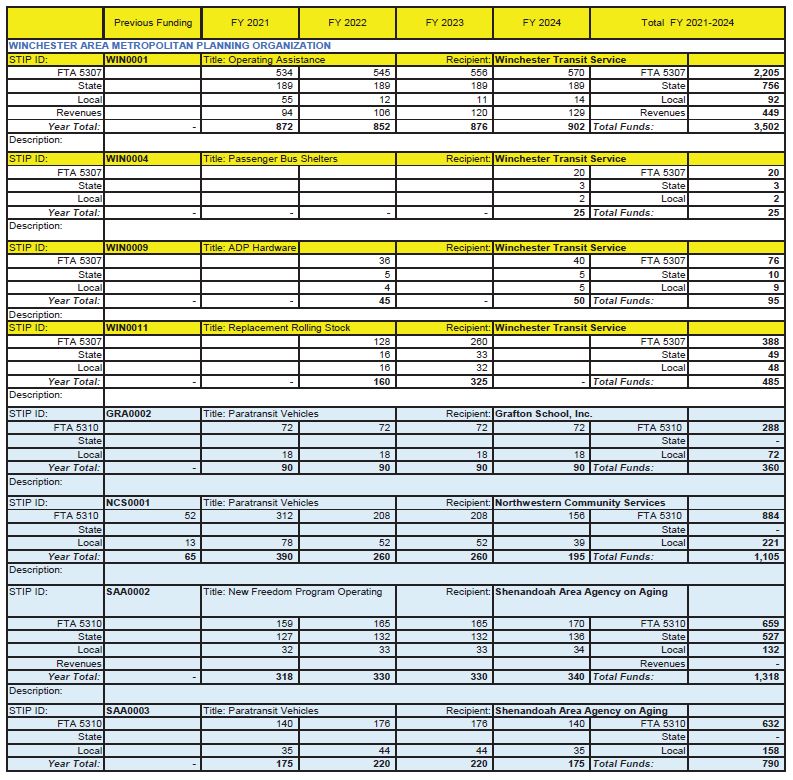
FY 2021-2024 Transportation Improvement Plan (TIP)

Disclaimer
The Winchester-Frederick County Metropolitan Planning Organization (WinFred MPO)
Transportation Improvement Program (TIP) has been prepared in accordance with federal
regulations 49 U.S.C. § 5303(j) and 23 CFR 450.326, and the Virginia Association of Metropolitan
Planning Organizations TIP Development Guidelines; and in partnership with the City of Winchester,
County of Frederick, and Town of Stephens City, the Virginia Department of Transportation (VDOT),
the Virginia Department of Rail and Public Transportation (DRPT), the Federal Highway
Administration (FHWA), and the Federal Transit Administration (FTA). The contents of this report
reflect the views of the WinFred MPO, which are responsible for the accuracy of the information
and data presented herein.

Self-Certification
Submission of the WinFred MPO TIP fulfils the federal self-certification requirements set forth by
23 CFR 450.336, confirming the WinFred MPO’s metropolitan transportation planning process is
conducted in accord with all applicable federal and state regulations.

Non-Discrimination Statement
The WinFred MPO ensures non-discrimination and equal employment in all programs and activities in
accordance with Title VI and Title VII of the Civil Rights Act of 1964. If you have questions or concerns
about your civil rights regarding this document, or if you need special assistance for persons with
disabilities or limited English proficiency, please contact the WinFred MPO. For more information, or
to obtain a Title VI Complaint Form, see https://winfredmpo.org/resources or call (540) 636-8800.

                                                                                                       iv
FY 2021-2024 Transportation Improvement Plan (TIP)
Signed Resolution Placeholder
vFY 2021-2024 Transportation Improvement Plan (TIP)
Contents
Winchester-Frederick County Metropolitan Planning Organization ................................ ii
Plan Documentation ....................................................................................................... iii
Introduction ..................................................................................................................... 2
The WinFred MPO ............................................................................................................ 3
The WinFred MPO TIP ...................................................................................................... 5
The TIP Financial Plan....................................................................................................... 9
Appendix A: Resource Guide .......................................................................................... 21
Appendix B: Highway Performance Based Planning and Programming – Safety
Performance Measures .................................................................................................. 26
Appendix C: Performance Based Planning and Programming – Transit Asset
Management .................................................................................................................. 31
Appendix D: Performance Based Planning and Programming – Pavements and Bridges
....................................................................................................................................... 33
Appendix E: Performance Based Planning and Programming – Highway System
Performance .................................................................................................................. 38
1FY 2021-2024 Transportation Improvement Plan (TIP)
Introduction
Purpose of this Document
Federal regulations [49 U.S.C. § 5303(j) and 23 CFR 450.326] require that all Metropolitan Planning
Areas develop and maintain a Transportation Improvement Program (TIP) to coordinate regional
transportation planning, maximize resources, provide transparency in the investment of federal
transportation funds, and make progress towards achieving state and regional performance targets.
Additionally, federal regulations require the TIP to be compatible with the WinFred MPO’s Long-
Range Transportation Plan (LRTP), the State’s SYIP (VDOT’s Six- Year Improvement Program), the
State’s Transportation Improvement Plan (STIP), and that it be updated a minimum of every 4-
years. This TIP identifies the investment plans for Highway and Transit which are provided in the
TIP Financial Plan on page 9.
Public Participation
Public participation is vital in the TIP development process to ensure that transportation projects
being advanced address needs identified by the community. Federal regulations require the WinFred
MPO to develop, implement, and maintain a Public Participation Plan (PPP) to provide a transparent
and open planning process. The PPP identifies the various methods and ways the WinFred MPO works
to ensure that the public is properly notified of its activities, and that opportunities to participate in
the WinFred MPO’s short and long-range planning activities are available to all residents. The TIP is
updated and amended according to the procedures provided in the PPP.
2FY 2021-2024 Transportation Improvement Plan (TIP)
The WinFred MPO
The MPO was established in 2003 through a Memorandum of Understanding (MOU) between the
Secretary of Transportation for the Commonwealth of Virginia and the localities in the urbanized area
including the City of Winchester, the Town of Stephens City, and Frederick County. A map of the
planning area boundary for the WinFred MPO, including the major roads within the boundary can be
seen in Figure 1.
The Winchester-Frederick County (WinFred) MPO is responsible for conducting a continuing,
comprehensive and coordinated (3-C) transportation planning process for the Winchester
metropolitan area in accordance with Section 134, Title 23, and Section 5303, Title 49, United
States Code, and the joint metropolitan planning regulations of the Federal Highway
Administration (FHWA) and the Federal Transit Administration (FTA). The 3-C Process enables the
WinFred MPO to collaborate with its members and partners to develop a comprehensive picture of
the region in its effort to identify potential issues, prioritize needs, provide solutions, identify
funding opportunities, and make decisions to support, maintain and improve the region’s
transportation network.
WinFred MPO Policy Board
The MPO is governed by a Policy Board comprised of elected officials from each locality and
representatives from the Virginia Departments of Transportation (VDOT) and Rail and Public
Transportation (DRPT), and FHWA. See page ii for the board roster. Typically meeting monthly, the
Policy Board is responsible for making all of the official decisions of the MPO.
Technical Advisory Committee (TAC)
The Policy Board is advised on technical matters by a Technical Advisory Committee (TAC) comprised
of planners, engineers and other transportation experts employed by the member localities and state
and federal partners. See page iii for the committee roster. The TAC typically meets monthly.
3FY 2021-2024 Transportation Improvement Plan (TIP)
Figure 1: WinFred MPO Planning Area and Major Roads
4FY 2021-2024 Transportation Improvement Plan (TIP)
The WinFred MPO TIP
The WinFred TIP is the region’s fiscally constrained four-year program of all transportation and
transit projects programmed in the WinFred MPO region that:
o Are scheduled to receive federal transportation funds
o Require a federal action; or
o Are deemed regionally significant
Projects using only local or state funds are typically not included in the TIP unless they require a
federal action or are considered regionally significant. The list of transportation and transit
projects programmed in the WinFred MPO FY 2021 – 2024 TIP can be found in the TIP Highway &
Transit Financial Plans on page 9 of this document.
Consistency with Other State and Regional Planning Documents
Federal regulations require the TIP to be consistent with other federal, state, and regional
transportation planning documents. These documents include the Statewide Transportation
Improvement Program (STIP), and Six Year Improvement Program (SYIP), and the WinFred MPO
Long-Range Transportation Plan (LRTP).
Upon approval by the WinFred MPO Policy Board, the WinFred MPO TIP is submitted to VDOT and
DRPT for approval and inclusion into the STIP, which is then forwarded to the FHWA and FTA for
federal approval.
TIP Development
The TIP is developed in accordance with 23 CFR 450.326, the Virginia Association of MPOs
(VAMPO) TIP Development Guidelines, and in partnership with member agencies, stakeholders,
VDOT, DRPT, FHWA and FTA, from projects in the WinFred MPO’s Constrained Long Range Plan
(CLRP), the VTrans 2040 Plan, and from member agency comprehensive plans. The TIP is updated
at least every four years.
5FY 2021-2024 Transportation Improvement Plan (TIP)
TIP Financial Plans
Highway Financial Plan
The TIP Highway Financial Plan lists all transportation projects programmed in the WinFred MPO
region during the TIP 4-year life-cycle. The Financial Plan provides a project’s details including the
type of project to be implemented, its phase, scope, obligated funding source(s), project cost(s),
and delivery schedule
Transit Financial Plan
The Transit Financial Plan provided by DRPT identifies all transit projects programmed for
implementation during the 4-year life cycle of the TIP. Project details shown in the Transit Financial
Plan include a project’s cost(s), funding allocation(s), funding source(s) and anticipated future
funding. Since transit resources are allocated on an annual basis, transit projects and funds shown
in the Financial Plan beyond FY 2018 are anticipated allocations.
Grouped Projects
Projects in the TIP that are determined not to be regionally significant, or are considered by VDOT
or DRPT not to be of an appropriate scale to be individually programmed are listed in grouped
categories. Listing these projects in grouped categories provides programming flexibility and
reduces the administrative process. Grouped category lists may be identified by function, work
type, or geographic area per 23 CFR 771.117(c) and (d) and 40 CFR part 93. A grouped project list
shows the total sum of funding obligated for the grouped category rather than individual project
descriptions and obligated funding. Grouped project listings are provided in both financial plans.
Amendments & Modifications
The TIP is periodically amended to add new projects or modify an existing project’s scope, cost,
and/or schedule when requested by VDOT, DRPT, or the project sponsor. TIP amendments and
modifications are included in the Highway and Transit Financial Plans beginning on page 9 of this
document. Amendments and administrative modifications are defined below per 23 CFR Section
450.104:
o Amendments are considered when a revision to a TIP involves a major change to an
existing project programmed during the document’s life-cycle. Major changes may include
the addition or deletion of a project, or a major change to a project’s cost, scope, or schedule
(e.g., adding new funds to a project, changing a project’s termini or revising the start and/or
delivery date). Amendments require a public notice that includes a review and comment
6FY 2021-2024 Transportation Improvement Plan (TIP)
period. Once the review and comment period are complete the amendment is presented
to the WinFred MPO Policy Board, VDOT/DRPT, FHWA/FTA for approval. Any change to a
TIP’s financial plan(s) must continue to demonstrate fiscal constraint.
o Administrative Modifications are considered to be minor revisions to a TIP. This includes
minor changes to an existing project’s programmed phase, costs, funding source(s), and
minor changes to a project’s schedule/delivery date. An administrative modification only
requires a staff-level review. Administrative modifications do not require a public notice of
the change, public comment period, or re-demonstration of fiscal constrain.
Amendments or modifications the WinFred MPO TIP are made according to the amendment policy
found in Section IX of the Win Fred MPO PPP.
Performance Management Requirements
The WinFred MPO is dedicated to improving the region’s transportation network by working with
its member agencies, VDOT, DRPT, FHWA, and FTA to implement regional performance measures
that support and advance regional, state, and national transportation performance goals.
The FHWA defines Transportation Performance Management as a “strategic approach that uses
system information to make investment and policy decisions to achieve national performance goals.”
With the passage of Moving Ahead for Progress in the 21st Century (MAP-21) in 2012 the and the
subsequent Fixing America’s Surface Transportation (FAST) Act in 2016, the FHWA and FTA
mandated that States and MPOs establish performance measures to integrate system-performance
management into the transportation and transit planning process. In order to guide the integration
of system performance measures into the planning process the FHWA and FTA identified the
following seven national performance measures:
o Safety
o Infrastructure Condition
o Congestion Reduction
o System Reliability
o Freight Movement & Economic Vitality
o Environmental Sustainability
o Reduced Project Delivery Delay
Advancing the seven national performance goals ensures that transportation networks continue
to develop and operate in a safe and efficient manner. Implementation of these measures in the
7FY 2021-2024 Transportation Improvement Plan (TIP)
WinFred MPO region ensures that transportation investments advance federal performance
objectives, and that the WinFred MPO TIP is consistent with statewide planning documents.
The performance measures and implementation schedule provided in Appendix B satisfy the
requirements of 23 CFR 450.218(q). WinFred MPO concurred with the state’s safety targets on
January 15, 2020. Performance measures and their revisions are to be incorporated into the TIP
via the administrative modification process as they are advanced by VDOT and DRPT and approved
by the WinFred MPO Policy Board.
8FY 2021-2024 Transportation Improvement Plan (TIP)
The TIP Financial Plan
MAP-21 requires a financial plan be provided in the TIP (23 CFR 450.324(h)). The Financial Plan
must demonstrate how the projects programmed can be implemented with existing obligations.
TIP projects identified must be consistent with the WinFred MPO’s Long-Range Transportation
Plan, and must be fully funded to the extent of available funding obligations or funding that is
reasonably expected to be available.
The WinFred MPO and its partners have collaborated to develop financial forecasts for the
Highway and Transit TIP based on the latest official planning assumptions, available or assumed
revenue(s), and estimated project cost(s). The financial information provided is either project
specific, or listed by a grouped funding category. All projects listed in the TIP are expected to be
implemented during the four-year life cycle of the document. The TIP Financial Plan may contain
projects that show $0.00 for planned obligations. Possible reasons for this include:
o The project is complete and is awaiting final closeout
o Project phases extend beyond four years
o A Project type ID that has no allocated funding during the four-year period of the TIP
9FY 2021-2024 Transportation Improvement Plan (TIP)
TIP Financial Plan – Highway
Interstate Projects
UPC NO 115852 SCOPE Traffic Management/Engineering
SYSTEM Interstate JURISDICTION Statewide OVERSIGHT NFO
PROJECT ITTF FY20 Micro Transit ADMIN BY DRPT
DESCRIPTION FROM: Various TO: Various
ROUTE/STREET 9999 TOTAL COST $500,000
FUND SOURCE MATCH FY21 FY22 FY23 FY24
PE AC Federal - AC OTHER $0 $500,000 $0 $0 $0
Primary Projects
UPC NO 110396 SCOPE
SYSTEM Primary JURISDICTION Frederick County OVERSIGHT NFO
PROJECT #HB2.FY17 RTE 277 - WIDEN TO 5 LANES GARVEE DEBT SERVICE ADMIN BY VDOT
DESCRIPTION
PROGRAM NOTE Includes $1,411,503 GARVEE Debt Service Prev, $1,001,639 GARVEE Debt Service Interest FFY21, $1,087,773
GARVEE Debt Service Interest FFY22, $1,027,677 GARVEE Debt Service Interest FFY23, $958,689 GARVEE Debt
Service Interest FFY24, $5,105,171 GARVEE Debt Service Interest FFY25-FFY36. Total GARVEE Debt Service Interest
$10,592,452. Corresponding CN UPC 18003 which is included in the Winchester MPO CN: Safety/ITS/Operational
Improvements grouping.
ROUTE/STREET 0277 TOTAL COST $10,592,452
FUND SOURCE MATCH FY21 FY22 FY23 FY24
PE Federal - AC CONVERSION $0 $0 $1,087,773 $1,027,677 $958,689
Federal - STP/STBG $0 $1,001,639 $0 $0 $0
PE TOTAL $0 $1,001,639 $1,087,773 $1,027,677 $958,689
PE AC Federal - AC $0 $8,179,310 $0 $0 $0
10FY 2021-2024 Transportation Improvement Plan (TIP)
Project Groupings
GROUPING Construction: Bridge Rehabilitation/Replacement/Reconstruction
ROUTE/STREET TOTAL COST $34,912,498
FUND SOURCE MATCH FY21 FY22 FY23 FY24
RW Federal - HIP/F $47,380 $189,520 $0 $0 $0
Federal - NHS/NHPP $125,181 $500,722 $0 $0 $0
Federal - STP/STBG $42,440 $169,758 $0 $0 $0
RW TOTAL $215,000 $860,000 $0 $0 $0
CN Federal - NHS/NHPP $1,456,442 $0 $0 $2,163,365 $3,662,402
Federal - STP/STBG $5,301,321 $0 $0 $2,163,365 $19,041,918
CN TOTAL $6,757,763 $0 $0 $4,326,730 $22,704,320
CN Federal - AC $573,920 $0 $0 $0 $2,295,680
AC
GROUPING Construction: Rail
ROUTE/STREET TOTAL COST $3,291,000
FUND SOURCE MATCH FY21 FY22 FY23 FY24
CN Federal - RAIL $131,778 $0 $0 $566,000 $620,000
GROUPING Construction: Safety/ITS/Operational Improvements
ROUTE/STREET TOTAL COST $105,628,238
FUND SOURCE MATCH FY21 FY22 FY23 FY24
PE Federal - NHFP $145,466 $0 $0 $0 $581,865
Federal - NHS/NHPP $10,000 $40,000 $0 $0 $0
PE TOTAL $155,466 $40,000 $0 $0 $581,865
RW Federal - AC CONVERSION $397,173 $1,588,693 $0 $0 $0
Federal - NHS/NHPP $48,263 $0 $0 $0 $193,051
RW TOTAL $445,436 $1,588,693 $0 $0 $193,051
CN Federal - HSIP $522,222 $0 $4,700,000 $0 $0
Federal - NHS/NHPP $81,631 $0 $326,524 $0 $0
CN TOTAL $603,853 $0 $5,026,524 $0 $0
CN Federal - AC $1,058,506 $0 $4,234,022 $0 $0
AC
GROUPING Construction: Transportation Enhancement/Byway/Non-Traditional
ROUTE/STREET TOTAL COST $10,171,196
FUND SOURCE MATCH FY21 FY22 FY23 FY24
PE Federal - NHS/NHPP $150,000 $0 $600,000 $0 $0
CN Federal - NHS/NHPP $623,000 $0 $0 $890,000 $1,602,000
CN Federal - AC $600,000 $0 $0 $0 $2,400,000
AC
11FY 2021-2024 Transportation Improvement Plan (TIP)
MPO Winchester
GROUPING Construction: Transportation Enhancement/Byway/Non-Traditional
ROUTE/STREET TOTAL COST $8,996,014
FUND SOURCE MATCH FY18 FY19 FY20 FY21
PE Federal - TAP/F $9,813 ($40,750) $80,000 $0 $0
Federal - TAP/SU $10,000 $40,000 $0 $0 $0
PE TOTAL $19,813 ($750) $80,000 $0 $0
CN Federal - TAP/F $258,550 $40,749 $993,451 $0 $0
Other $1,133,887 $0 $1,133,887 $0 $0
CN TOTAL $1,392,437 $40,749 $2,127,338 $0 $0
CN AC Federal - AC OTHER $0 $0 $3,943,493 $0 $0
MPO Note FFY19-27 STP Adj - updated based on actual oblig's: release $40,750 (TAP) & add $40,000 (TAP)
FFY18, add $80,000 (TAP) FFY19 PE phase; release $25,000 (TAP) FFY18 RW phase; add $40,749
(TAP) FFY18, add an addit'l $3,842,993 (AC-Other), add $591,410 (TAP) FFY19, release $60,000
(AC- Other) & $215,000 (TAP) FFY20 CN phase.
**Administrative Adjustment: Added to Highway TIP 12/03/2019 through TAC approval
GROUPING Maintenance: Preventive Maintenance and System Preservation
PROGRAM NOTE Funding identified to be obligated districtwide as projects are identified.
ROUTE/STREET TOTAL COST $66,219,025
FUND SOURCE MATCH FY21 FY22 FY23 FY24
CN Federal - NHS/NHPP $0 $8,194,023 $8,194,023 $8,194,023 $8,194,023
Federal - STP/STBG $0 $5,386,115 $7,523,629 $6,178,315 $14,354,874
CN TOTAL $0 $13,580,138 $15,717,652 $14,372,338 $22,548,897
GROUPING Maintenance: Preventive Maintenance for Bridges
PROGRAM NOTE Funding identified to be obligated districtwide as projects are identified.
ROUTE/STREET TOTAL COST $28,649,368
FUND SOURCE MATCH FY21 FY22 FY23 FY24
CN Federal - NHS/NHPP $0 $1,000,000 $1,000,000 $1,000,000 $1,000,000
Federal - STP/STBG $0 $3,242,450 $8,841,457 $7,047,626 $5,517,835
CN TOTAL $0 $4,242,450 $9,841,457 $8,047,626 $6,517,835
GROUPING Maintenance: Traffic and Safety Operations
PROGRAM NOTE Funding identified to be obligated districtwide as projects are identified.
ROUTE/STREET TOTAL COST $8,635,843
FUND SOURCE MATCH FY21 FY22 FY23 FY24
CN Federal - STP/STBG $0 $2,284,245 $1,780,824 $2,419,830 $2,150,944
12FY 2021-2024 Transportation Improvement Plan (TIP)
Administrative Adjustments
The following Administrative Adjustments to the Project Groupings Sections of the Highway TIP for
FFY20 were accepted by the Technical Advisory Committee at the request of VDOT on December 3,
2019.
GROUPING Maintenance: Preventive Maintenance and System Preservation
PROGRAM NOTE Funding identified to be obligated districtwide as projects are identified.
ROUTE/STREET TOTAL COST
FUND SOURCE MATCH FY18 FY19 FY20 FY21
CN Federal - NHS/NHPP $0 $0 $0 $8,194,023 $0
Federal - STP/STBG $0 $6,880,463 $6,519,835 $5,707,837 $8,290,921
CN TOTAL $0 $6,880,463 $6,519,835 $13,901,860 $8,290,921
MPO Note TIP AMD to update FFY20 planned obligations based on revised projected revenue. Add $8,194,023
(NHPP) & $5,707,837 (STP/STBG)
GROUPING Maintenance: Preventive Maintenance for Bridges
PROGRAM NOTE Funding identified to be obligated districtwide as projects are identified.
ROUTE/STREET TOTAL COST
FUND SOURCE MATCH FY18 FY19 FY20 FY21
CN Federal - BR $0 $5,774,010 $5,471,375 $0 $6,957,651
Federal - NHS/NHPP $0 $0 $0 $1,000,000 $0
Federal - STP/STBG $0 $0 $0 $4,120,207 $0
CN TOTAL $0 $5,774,010 $5,471,375 $5,120,207 $6,957,651
MPO Note TIP AMD to update FFY20 planned obligations based on revised projected revenue. Add $4,120,207
(STP/STBG) & $1,000,000 (NHPP)
GROUPING Maintenance: Traffic and Safety Operations
PROGRAM NOTE Funding identified to be obligated districtwide as projects are identified.
ROUTE/STREET TOTAL COST
FUND SOURCE MATCH FY18 FY19 FY20 FY21
CN Federal - STP/STBG $0 $1,659,914 $1,572,912 $9,621,807 $2,000,187
MPO Note TIP AMD to update FFY20 planned obligations based on revised projected revenue. Add $9,621,807
(STP/STBG)
13FY 2021-2024 Transportation Improvement Plan (TIP)
Projects by Grouping
14FY 2021-2024 Transportation Improvement Plan (TIP)
15FY 2021-2024 Transportation Improvement Plan (TIP)
16FY 2021-2024 Transportation Improvement Plan (TIP)
17FY 2021-2024 Transportation Improvement Plan (TIP)
18FY 2021-2024 Transportation Improvement Plan (TIP)
(1) ACC -- Advance Construction -- Funding Included in Federal Category based on year of AC Conversion.
(2) CMAQ/RSTP includes funds for TRANSIT projects.
(3) Statewide Category - Funding to be obligated Statewide for projects as identified.
(4) Maintenance Projects - Funding to be obligated for maintenance projects as identified.
End of Highway TIP Financial Plan
19FY 2021-2024 Transportation Improvement Plan (TIP)
TIP Financial Plan – Transit
End of Transit TIP Financial Plan
20FY 2021-2024 Transportation Improvement Plan (TIP)
Appendix A: Resource Guide
Highway TIP User’s Guide
This guide assists the reader in understanding project information for all projects in the Highway
TIP. Information for each project appears in the chart format shown below.
Terms used to identify specific programming requirements are presented in the grey boxes, while
project-specific details are presented in the white boxes to the right of, or below, each term.
Definitions for the numbered terms appear in the corresponding Glossary of Terms table.
Figure 2: TIP Programming Table
21FY 2021-2024 Transportation Improvement Plan (TIP)
Glossary of Terms
Table 1: Tip Programming Glossary of Terms
ID Term Definition
1 Universal Project Number assigned to each project at its conception, remaining with the project
Code (UPC) Number until completion.
2 Scope Details work to be covered by the project
3 System Indicates which system, program, or mode of transportation the project
falls within. E.g. - Interstate, Primary, Secondary, Urban, Rail,
Transportation Enhancements, or Miscellaneous
4 Jurisdiction Identifies the project jurisdiction
5 Federal Oversight FO: Indicates Federal Oversight in the project construction, contracting, and
Indicator (FO or NFO) management. NFO: Indicates No Federal Oversight in the construction,
contracting, and management issues, and does not affect the standard
environmental review process for transportation projects. All federally
funded transportation projects must include the required environmental
documents regardless of whether there is federal oversight required
6 Project/Project Phase Name of the Project and Phase (i.e. PE: Preliminary Engineering - Preliminary
field survey, utility location, environmental or historical studies, design drawings,
final field inspections and public hearings will be done. This process can take
several months to years to complete; RW: Right of Way - Negotiations with
property owners take place, payments are made, and arrangements with utility
companies are finalized to obtain the land necessary for the project; or CN:
Construction - Project is advertised to prospective contractors for bids. Once the
bids are opened and a contract awarded, construction can begin.)
7 Admin By Identifies the entity responsible for the project
8 Description Identifies the project's limits
9 Route/Street Identifies local Route number or name of road/street
10 Total Cost The total estimated cost (TO) reflecting the best overall estimate available at the
time. Estimated costs begin as rough estimates, usually based on historical data,
and are updated at critical stages (e.g. the final field inspection), as plans are
more defined.
11 Fund Source Identifies the FHWA or FTA funding source. Additional funding source
information is provided in Appendix C
12 Match Dollar amount matched to federally funded project. Most federal fund
sources require a match of some sort; most often 20% of the total cost. The
match is included in the obligations section for informational purposes. The
match can come from local, state or other sources
13 Current and Future The amount of funding which is obligated for the indicated phase of work. An
Obligations obligation represents a commitment from the Federal government to
reimburse the state for the Federal share (e.g. 80%) of a project’s eligible cost.
This commitment occurs when the project is approved and the Federal
government executes the project agreement. The funding obligation listed is
the dollar amount that a state may spend and expect reimbursement for during
each Federal fiscal year.
22FY 2021-2024 Transportation Improvement Plan (TIP)
Highway Funding Programs
Accelerated Incentive Deployment (AID):
The AID Demonstration program provides funding as an incentive for eligible entities to
accelerate the implementation and adoption of innovation in highway transportation. The AID
Demonstration program is one initiative under the multi-faceted Technology and Innovation
Deployment Program (TIDP) approach providing funding and other resources to offset the risk of
trying an innovation. The new Notice of Funding Opportunity (NOFO) was published on
September 1, 2016, continuing the AID Demonstration program under the Fixing America’s
Surface Transportation (FAST) Act (Pub. L. No. 114-94).
Bridge Rehabilitation and Replacement/Bridge Off-System Funds Program (BR/BROS):
A former SAFETEA-LU program that provided funding for bridge improvements. Eligibility for
funding was based on a rating of bridge condition by VDOT as a candidate for upgrading.
Interstate Maintenance (IM):
A former SAFETEA-LU program that provided funding for resurfacing, restoring, rehabilitating and
reconstructing (4R) most routes on the National System of Interstate and Defense Highways.
National Highway Performance Program (NHPP)
MAP-21 eliminated the programs with dedicated funding for repair by consolidating the
Interstate Maintenance and Highway Bridge Repair programs and shifting these funds to the new
NHPP. The new NHPP is now the largest highway program, receiving 58 percent of all highway
formula dollars. MAP-21 dramatically expanded the funding for the NHPP program (previously
called the National Highway System program) and consolidates the other programs intended for
bridge repair and Interstate maintenance.
Only projects located on the National Highway System (NHS) are eligible, which was expanded to
include an additional 60,000 new lane miles and bridges. If a state fails to meet minimum
Interstate pavement condition standards, they must set aside an additional amount of NHPP
funds until the standard is met. If the total structurally deficient deck area of NHS bridges exceeds
10 percent of all NHS bridge deck area, then a state must set aside NHPP funds to the Highway
Bridge Program until the standard is met. VDOT has consolidated funds into customized pots of
money for the State of Good Repair (SGR) program, which seeks to meet the State’s interstate
and bridge repair needs.
Non-Federal:
Any funding that does not come from federal sources is grouped into the nonfederal funding
category.
23FY 2021-2024 Transportation Improvement Plan (TIP)
Surface Transportation Program (STP):
Under the former SAFETEA-LU and MAP-21 eras, this program provided flexible funding that
could be used on any project located on a roadway that is classified higher than a minor collector.
Projects that were eligible for funding under this program included construction, reconstruction,
and rehabilitation, and bridge projects on any public road. Regional STP funds were designated
as RSTP, and Local STP funds were designated as LSTP.
Surface Transportation Block Grant Program (STBG):
The FAST Act converts the long-standing Surface Transportation Program into the Surface
Transportation Block Grant Program acknowledging that this program has the most flexible
eligibilities among all Federal-aid highway programs and aligning the program’s name with how
FHWA has historically administered it. [FAST Act § 1109(a)]. The STBG promotes flexibility in State
and local transportation decisions and provides flexible funding to best address State and local
transportation needs.
VDOT has consolidated its STBG funds (after set asides for TA and planning/research) and
National Highway Performance Program (NHPP) funds into customized pots of money for SMART
SCALE, State of Good Repair (SGR), and other programs.
Safe Routes to School Program (SRTS):
This is a competitive grant program to enable and encourage children to safely walk and bicycle
to school. Funds can be used for infrastructure improvements and educational programs.
Transportation Alternatives Program (TAP):
These funds are available for bicycle and pedestrian facilities through the Surface Transportation
Program of MAP 21 A 10% set aside from each state's allocation of STP funds must be used for
Transportation Enhancement Activities.
24FY 2021-2024 Transportation Improvement Plan (TIP)
Transit Funding Programs (FTA)
FTA 5307:
This is the FTA Urbanized Area Formula Program, Section 5307 provides funds for public
transportation capital investments, and operating expenses in urbanized areas (UZAs). Pursuant
to the FAST Act, job access and reverse commute projects that are located in urbanized areas are
now eligible for funding under this program.
FTA 5310:
This program is intended to enhance mobility for seniors and persons with disabilities by
providing funds for programs to serve the special needs of transit-dependent populations beyond
traditional public transportation services and Americans with Disabilities Act (ADA)
complementary paratransit services. Under the FAST Act, projects that were formerly eligible for
funding under SAFETEA-LU’s New Freedom, Section 5317 grant program are now eligible for
Section 5310 funds.
FTA 5311:
The FTA 5311 program is a non-urbanized area formula funding program for public transit capital
and operating costs in non-urbanized areas with a population fewer than 50,000 as designated
by the United States Census Bureau. Job access and reverse commute projects, which are located
in non-urbanized areas, are now eligible for these funds under the FAST Act.
FTA 5339:
This program provides capital funding to replace, rehabilitate and purchase buses and related
equipment and to construct bus-related facilities. Created under the FAST Act, this program
replaces components of SAFETEA-LU’s former Section 5309 Bus and Bus Facilities program.
25FY 2021-2024 Transportation Improvement Plan (TIP)
Appendix B: Highway Performance Based
Planning and Programming – Safety
Performance Measures
Performance Measure Implementation Schedule
Table 2: USDOT/FHA Implementation Schedule
Performance Targets
In accordance with the requirements of MAP-21 and the FAST Act, Virginia has established safety
performance objectives as published in Virginia’s 2017 – 2021 Strategic Highway Safety Plan
(SHSP) and, starting in 2017, annual targets in the Highway Safety Improvement Program (HSIP)
Annual Report. The SHSP performance measure objectives are indicated in Table 2 below.
26FY 2021-2024 Transportation Improvement Plan (TIP)
Table 3: Safety Performance Objectives
Per Year
Performance Target
Reduction
1 Number of Fatalities 2%
2 Rate of Fatalities per 100 Million Vehicle Miles Travelled 3%
3 Number of Serious Injuries 5%
4 Rate Serious Injury Million Vehicle Miles Travelled 7%
Number of Non-Motorized Fatalities and Non-
5 4%
Motorized Serious Injuries
For safety performance measures 1, 2, and 3, annual targets are developed collaboratively by the
Department of Motor Vehicles (DMV) Highway Safety Office (HSO) and VDOT HSIP staff 1. The DMV
HSO includes these measures in their Highway Safety Plan submitted to the National Highway
Traffic Safety Administration (NHTSA) every June.
The Commonwealth Transportation Board approves all five annual targets and VDOT includes
these in the HSIP Annual Report submitted to FHWA every August. Within 180 days of VDOT’s
annual report submission to FHWA, MPOs must indicate their support of the state targets or
submit their unique regional targets for one or more of the safety measures.
Connection to Other Performance Based Planning Documents
The federally required SHSP, a five-year multi-agency comprehensive plan focused on reducing
fatalities and serious injuries on all public roads, serves as the coordinating document for other
plans and programs that involve traffic safety. This coordination involves the long-range statewide
transportation plan (LRSTP), the metropolitan transportation plans (MTP), and three plans that
implement parts of the SHSP – the Highway Safety Plan (HSP), the HSIP, and the Commercial Vehicle
Safety Plan (CVSP). This integration is important for improving overall safety coordination amongst
various partners and leads to more comprehensive transportation safety planning.
1 It is a federal requirement that safety performance measures 1, 2, and 3 are identical targets for NHTSA's Highway Safety Grants Program
and FHWA's Highway Safety Improvement Program. This requirement allows States to align their safety performance targets and work
collaboratively to achieve them.
27FY 2021-2024 Transportation Improvement Plan (TIP)
The LRSTP, VTrans2040, guides the state’s investment decisions for transportation
improvements. Safety and performance management is included in the VTrans2040 Vision,
Goals & Objectives, and Guiding Principles:
o Guiding Principle 2: Ensure Safety, Security, and Resiliency – Provide a transportation
system that is safe for all users, responds immediately to short-term shocks such as
weather events or security emergencies, and adapts effectively to long-term stressors
such as sea level rise.
o Guiding Principle 5: Ensure Transparency and Accountability, and Promote
Performance Management – work openly with partners and engage stakeholders in
project development and implementation, and establish performance targets that
consider the needs of all communities, measure progress towards targets, and to
adjust programs and policies as necessary to achieve the established targets.
o Goal C: Safety for All Users – provide a safe transportation system for passengers and
goods on all travel modes.
o Objectives:
o Reduce the number and rate of motorized fatalities and serious
injuries.
o Reduce the number of non-motorized fatalities and injuries.
MTPs are similar to the LRSTP however an MTP covers a specific metropolitan planning area.
MTPs include goals and objectives for their respective areas/regions and identify strategies for
advancing long-term transportation investments in a specific region.
The HSP is an annual plan to address highway user behaviors that will improve safety through
education and enforcement campaigns. The HSP and associated NHTSA grants are administered
through the Highway Safety Office at the DMV. Furthermore, each year Virginia State Police (VSP)
submits a Commercial Vehicles Safety Plan (CVSP) to Federal Motor Carrier Safety Administration as
a requirement of obtaining related enforcement grants.
28FY 2021-2024 Transportation Improvement Plan (TIP)
The relationship between the various plans and programs is shown below:
Figure 3: Plan Relationship Matrix
Projects in the STIP are directly linked to the safety objectives outlined in the SHSP through the
strategies and actions that are priorities in Virginia.
Funding for Safety Projects
Safety targeted improvements are implemented through HSIP projects. Each year Virginia is
allocated $55 Million for HSIP and $5 Million for Railway Grade Crossing improvements. Virginia is
also subject to a Penalty Transfer provision, Section 154 “Open Container”, such that 2.5% of NHPP
funds are reserved for either NHTSA Alcohol-Impaired Driving or HSIP projects. The State determines
what proportion goes to each program. Of the HSIP funds, about 10 percent is set aside for non-
motorized safety projects and 20 percent of the remainder for improvements on locally-maintained
roadways.
29FY 2021-2024 Transportation Improvement Plan (TIP)
How do Safety Projects get selected for Inclusion in the STIP?
The HSIP project planning and delivery follows these steps:
o Each year highway segment and intersection locations that have the highest potential
for safety improvement are identified based on the previous five years of traffic crash
and volume data. These above average crash locations are provided to the VDOT
Districts to determine appropriate locations and countermeasures for HSIP funding. The
potential for vehicle-train crashes at each at-grade railroad crossing is also distributed.
o HSIP project proposals are submitted through the SMART Portal for the appropriate
safety program.
o VDOT and locality submitted HSIP proposals are reviewed and prioritized based on the
number of targeted crashes and the benefit to cost ratio or the potential risk reduction
for non-motorized and rail highway grade crossing improvements.
o Projects are selected and programmed for the last two or three years of the SYIP. At
present there are over $100 million of safety improvement proposals, with an expected
benefit, that remain unfunded.
In recent years, programmed priority HSIP projects have shifted from being higher cost spot
intersection and segment improvements to lower cost systemic improvements that target specific
crash types and/or roadway characteristics that are factors in crashes across the network. Examples
of systemic improvements include traffic signal devices and timing at intersections and curve signing,
higher friction surfaces and rumble strips on segments.
Safety improvements are also included within projects funded with non-HSIP funds. The SMART
SCALE scoring and prioritization process for inclusion of projects in the SYIP, considers safety
benefits from improvements addressing travel of all modes. Many of the large SMART SCALE
projects, upon completion, will have distinct impacts on safety performance in the
Commonwealth. In addition, projects funded through other state and federal sources in the SYIP,
such as the Transportation Alternatives Program, including Safe Routes to School grants, Revenue
Sharing, and even some CMAQ and maintenance projects, will also have crash reduction benefits
that contribute to improved safety performance.
Thus, the funding to meet Virginia’s safety objectives and targets is allocated to projects in the
CTB approved SYIP, and is consistent with VTrans2040. Since the SYIP is the foundation for the
STIP, the program of projects in the STIP demonstrates support to achieve Virginia’s safety
performance objectives and targets and is consistent with Virginia’s SHSP and the HSIP.
30FY 2021-2024 Transportation Improvement Plan (TIP)
Appendix C: Performance Based Planning
and Programming – Transit Asset
Management
The two most recent federal transportation laws, MAP-21 and FAST Act, establish performance
measure requirements to ensure states and metropolitan planning organizations (MPOs) are
investing transportation funds in projects that collectively will contribute towards the achievement
of national goals. The USDOT recently published new rules for states and MPOs to collect data and
establish performance targets that will support performance and outcome-based investment
decisions.
The new federal performance measurement requirement for transit agencies focuses on one area:
transit asset management (TAM). The measures look specifically at the percentage of revenue
vehicles that have exceeded their Useful Life Benchmark (ULB), the percentage of non-revenue
and service vehicles that have exceeded their ULB, and percentage of facilities with a condition
below 3.0 on the Federal Transit Administrator’s TERM Scale. All transit agencies receiving grants
from the FTA are required to complete a TAM plan. The FTA has established two tiers of agencies
based on size parameters.
o A Tier I agency operates rail, OR has 101 vehicles or more all fixed route modes,
OR has 101 vehicles or more in one non-fixed route mode.
o A Tier II agency is a subrecipient of FTA 5311 funds, OR is an American Indian
Tribe, OR has 100 or less vehicles across all fixed route modes, OR has 100 vehicles
or less in one non- fixed route mode.
31FY 2021-2024 Transportation Improvement Plan (TIP)
The first completed TAM plan must be sent to the National Transit Database (NTD) by October
1, 2018. Other required deadlines are found in the table below.
Table 4: Transit agency deadlines for TAM Rulemaking for June-July fiscal year
Reporting Activity Reporting Deadline
Complete compliant TAM Plan October 2018
Report FY18 asset data to NTD October 2018
Submit FY19 targets to NTD
Report FY19 asset data to NTD
Submit FY20 targets to NTD October 2019
Submit narrative report to NTD
Report FY20 asset data to NTD
Submit FY21 targets to NTD October 2020
Submit narrative report to NTD
Complete updated TAM Plan October 2022
The Department of Rail and Public Transportation (DRPT) has opted to sponsor a group TAM plan
for Tier II providers. Tier I providers are not eligible for group plans.
For Tier II providers under the DRPT Group Plan, any Transportation Improvement Program (TIP)
document or Metropolitan Transportation Plan (MTP) adopted after October 1, 2018 will be in
compliance with the TAM Plans developed by DRPT and adopted by the Tier II transit providers
within the MPO as well as the regional performance measures adopted by the MPO as a whole.
The performance measurements and the targets can be found in the DRPT Group Transit Asset
Management Plan.
The WinFred MPO planning process will integrate, either directly or by reference, the goals,
objectives, performance measures, and targets described in the Tier II group plan.
32FY 2021-2024 Transportation Improvement Plan (TIP)
Appendix D: Performance Based Planning
and Programming – Pavements and
Bridges
Performance Targets
In accordance with the requirements of MAP-21 and the FAST Act, Virginia has established
pavement and bridge condition performance targets as reported in Virginia’s Baseline
Performance Period Report for 2018-2021 2. This report, submitted to FHWA in October 2018,
satisfies the federal requirement that State DOTs submit a Baseline Performance Period Report to
FHWA by October 1st of the first year in a performance period. Performance measures for
pavement condition are required for the National Highway System (NHS), while bridge condition
requirements relate to structures identified as part of the National Bridge Inventory on the NHS.
The pavement condition measures and established performance targets for the 2018- 2021
performance period are indicated in Table 5 below.
Table 5: Pavement Condition Measures and Performance Targets
CY 2018-2019 CY 2018-2021
Interstate Pavement Condition Measures 3
Two Year Target Four Year Target
Percentage of Pavements in Good Condition N/A 4 45.0%
Percentage of Pavements in Poor Condition N/A4 3.0%
2018-2019 2018-2021
Non-Interstate NHS Pavement Condition Measures 5
Two Year Target Four Year Target
Percentage of Non-Interstate Pavements in Good Condition 25.0% 25.0%
Percentage of Non-Interstate Pavements in Poor Condition 5% 5.0%
2 Virginia’s Baseline Performance Period Report data is through December 2017.
3 Interstate condition measures are based on four distresses: International Roughness Index (IRI), cracking, rutting, and faulting.
4 During this first performance period, States are not required to establish 2-year targets for interstate pavements; however, Virginia
has chosen to establish performance targets and are 45.0% and 3.0% for percentage of pavements in good and poor condition,
respectively.
5 During this first performance period, Federal requirements for Non-Interstate NHS pavement condition and performance targets are
based on a single distress, IRI. However, Federal guidance outlined in a September 27, 2018 Memorandum on State DOT Targets for
Non-Interstate NHS Pavement Measures allows for the use of full distress data when reporting Non-Interstate NHS performance
targets. Given the availability of full distress data, Virginia has chosen this approach and reported performance targets for Non-
Interstate NHS pavements based on all four distresses. This allows for consistency in assessing the condition and setting performance
targets for both Interstate and Non-Interstate NHS pavements.
33FY 2021-2024 Transportation Improvement Plan (TIP)
Bridge condition measures and established performance targets for the 2018-2021 performance
period are indicated in Table 6 below.
Table 6: Bridge Condition Measures and Performance Targets
CY 2018-2019 CY 2018-2021
NHS Bridge Condition Measures Two Year Target Four Year Target
Percentage of Deck Area of NBI Bridges on the NHS in Good
33.5% 33.0%
Condition
Percentage of Deck Area of NBI Bridges on the NHS in Poor 3.5% 3.0%
Condition
Background/History
Virginia’s history of monitoring asset conditions and utilizing performance information to
determine investment strategies based on available funding levels spans over 10 years for
pavements and bridges.
VDOT maintains a comprehensive inventory of all pavement and bridges on the state-maintained
network. This inventory, which includes location, maintenance responsibility, ownership, and
current condition or inspection information, serves as the foundation for life cycle planning,
performance forecasting, maintenance and rehabilitation needs estimation, as well as prioritization
of work to maximize asset life given available funding. Condition information is also important for
communicating with external stakeholders, including the general public.
VDOT’s commitment to responsible Transportation Asset Management (TAM) practice is
demonstrated through VDOT’s annual condition data collection programs and its establishment
and publication of network level pavement and bridge performance goals. VDOT’s current
condition measures and performance goals have been in place for many years and are fully
integrated into VDOT’s budgeting process and investment strategies.
The federal pavement and bridge performance measures apply to a limited portion of the network
for which VDOT is responsible (less than 15% of all lane miles and 18% of the bridge inventory).
Connection to Other Performance Based Planning Documents
VTrans, the state’s long-range multimodal plan, provides the overarching vision and goals for
transportation in the Commonwealth. The long-range plan provides a vision for Virginia’s future
transportation system and defines goals, objectives, and guiding principles to achieve the vision. It
also provides direction to state and regional transportation agencies on strategies and policies to be
34FY 2021-2024 Transportation Improvement Plan (TIP)
incorporated into their plans and programs. The most recent approved long-range multimodal plan
is VTrans2040.
Performance management, specifically as it relates to pavements and bridges, is included in the
VTrans2040Vision, Goals & Objectives, and Guiding Principles as noted below:
o Guiding Principle 5: Ensure Transparency and Accountability, and Promote Performance
Management - Work openly with partners and engage stakeholders in project
development and implementation, and establish performance targets that consider the
needs of all communities, measure progress towards targets, and to adjust programs and
policies as necessary to achieve the established targets.
o Goal D: Proactive System Management - maintain the transportation system in good
condition and leverage technology to optimize existing and new infrastructure.
o Objectives:
o Improve the condition of all bridges based on deck area.
o Increase the lane miles of pavement in good or fair condition.
Virginia’s federally required Transportation Asset Management Plan (TAMP) presents pavement
and bridge inventory and conditions, along with the Commonwealth’s performance objectives,
measures, and associated risks as they relate to the federal requirements. Asset funding,
investment strategies, forecasts, goals, and gaps are also included. The TAMP is specific to the NHS
and provides the Commonwealth’s Transportation Asset Management (TAM) processes and
methodology to meet federal requirements. Pavement and bridge projects included in the STIP are
consistent with Virginia’s reported TAM processes and methodology.
The program of projects in the STIP are directly linked to the pavement and bridge objectives
outlined in VTrans2040 and the TAMP through the strategies and actions that are priorities in
Virginia.
Funding for Pavement and Bridge Projects
There are two key funding sources for pavement and bridge projects, the Highway Maintenance
and Operations Fund (HMOF) and State of Good Repair (SGR) program funds. The pavement and
bridge funding is used for differing projects from routine maintenance to reconstructive work.
Funds are allocated to pavement and bridge projects based on an annual needs assessment
process supported by a data-driven prioritization and selection process. The prioritization process
is the same for the various funding sources; however, the State of Good Repair program funds are
35FY 2021-2024 Transportation Improvement Plan (TIP)
designated for deteriorated pavements and structurally deficient bridges.
The SGR program requires funds be distributed proportionality between VDOT and localities,
based on assessed needs. More details, including the requirements for pavements and bridges,
and the SGR prioritization process methodology, can be found at: State of Good Repair for
Bridges and Local Assistance Funding Programs.
VDOT has developed a robust asset management program, placing maintenance of the
transportation network at the forefront of VDOT’s investment decisions. This commitment to
responsible asset management practice is demonstrated through VDOT’s annual collection of
condition data on pavements and bridges along with its establishment and publication of
network-level pavement and bridge performance targets. For more than a decade, VDOT has
monitored pavement and bridge conditions using performance information (measures and
targets) to determine investment strategies based on available funding levels.
In the annual needs assessment process, VDOT assesses 100% of the pavement network on
Virginia’s Interstate and Primary systems and approximately 20% of the Secondary system. In
2016, VDOT assessed 100% of the Secondary pavement network to create a condition baseline.
The pavement condition data is compiled, analyzed and reviewed to report the optimized needs
at a roadway system and district level. VDOT’s pavement program selects resurfacing projects, in
relation to needs, and optimizes the timing of projects through a data-driven pavement
management system.
For bridges, VDOT follows national standards in performing safety inspections and determining
general condition of the structures. Condition assessments are performed by certified safety
inspection personnel. The inspection program requires a qualified inspector to complete a “hands-
on” review of the structure or bridge during each inspection. By federal regulation, VDOT is
required to conduct detailed inspections of NBI structures at intervals not to exceed 24 months.
VDOT uses BrM software to store bridge condition and inventory data for each structure and to
program, schedule, and track bridge and structure inspections. The data collected during
inspections allows VDOT to use a proactive approach to maintenance.
Preventive maintenance and timely intervention repairs are performed to avoid and slow
deterioration that leads to greater rehabilitation or replacement cost. Virginia’s bridge
maintenance program is large and complex, so in order to direct its efforts more easily,
performance targets have been developed.
VDOT uses a prioritization process when determining funding for the pavement and bridge
programs and prioritizes work ranging from preventative maintenance to replacement. The
prioritization processes take into account similar factors such as condition, cost effectiveness,
36You can also read


