Generation Rent A lifetime of letting? Will rental rungs replace the property ladder?
←
→
Page content transcription
If your browser does not render page correctly, please read the page content below

Generation Rent
A lifetime of letting?
Will rental rungs replace
the property ladder?
Perceptions of the first-time buyer market 2014

Generation Rent 2014

Introduction                                                    Who makes up
                                                                Generation Rent?
The Generation Rent Report is the definitive annual
research by Halifax, the UK’s leading lender to first-time
buyers, which examines the current perceptions and views
of the first-time buyer market. This is the fourth annual
                                                                1.
report and now contains data from interviews with over
32,000 20-45 year olds built up over four years, and over
                                                                Plan to buy
3000 parents of 20-45 year olds over the past three years.      in the next
                                                                5 years...
The global recession which began in 2008 has had a huge
impact on the UK housing market, in particular for first-
time buyers who, facing a difficult mortgage market, high
deposits, poor job security and stagnating incomes, found
it difficult to muster the financial means to get onto the
property ladder.                                                2.
Our first report in 2011 found that despite a strong desire     Would like to buy...
for homeownership, over a third (35%) of 20-45 year olds
could be defined as ‘Generation Rent’ – a group with no
realistic prospect of owning their own home in the next five
years. Three years later, despite the economic recovery
and the implementation of government initiatives such as
‘Help to Buy’, this proportion has not changed, with 36% of
today’s 20-45 year olds falling into ‘Generation Rent’, those
that are either unable to get on the property ladder or those
that have no desire to do so.

This latest report looks back on the past four years to see
what has changed, and the impacts that it may have on the
                                                                3.
profile of the housing market overall:
                                                                Have no
                                                                desire to buy...
The makeup of the UK
housing market?

                                                                  Over a third (35%) of 20-
                                                                  45 year olds could be
                                                                  defined as ‘Generation
                                                                  Rent’ – a group with no
                                                                  realistic prospect of
                                                                  owning their own home in
                                                                  the next five years.

                                                                                              02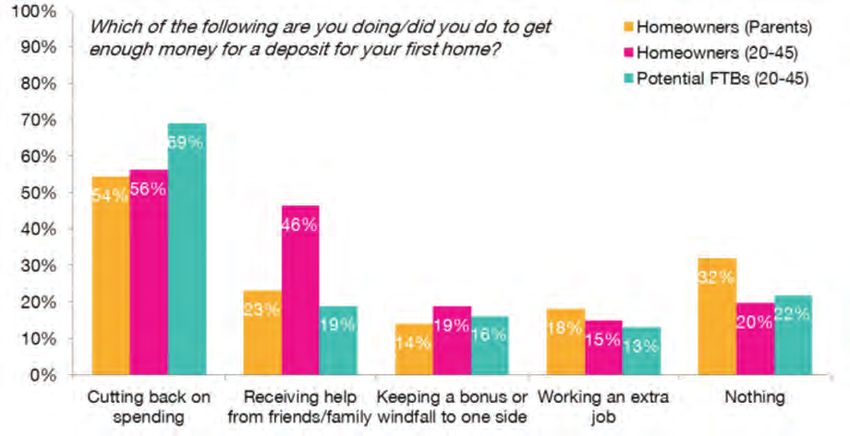
Generation Rent 2014

1. Plan to buy in the next 5                                      2. Would like to buy...
years...                                                          .

Profile:                                                          Profile:
■ Younger (52% aged 20-29, mean = 30)                             ■ Predominantly female (59%)
■ From a middle/high social grade (34% C1, 29% AB)                ■ Early 30’s (23% 30-34, mean = 33)
■ Have a higher household income (mean = £33k)                    ■ From a ‘lower’ social grade (56% C2DE)
■ Have a higher level of savings (mean = £11k)                    ■ Have a lower household income (mean = £23k)
■ Work full-time (62%)                                            ■ Have lower levels of savings (mean = £3k)
■ Be London-based (27%)                                           ■ Work part-time/be temporarily unemployed (35%)
■ Have grown up in an ‘owned’ home (73%)                          ■ Have grown up in rented accommodation (36%)

Views:                                                            Views:
■ Worried about getting ‘stuck’ renting                           ■ Worried about future finances
■ 58% agree they’re worried that if ‘I have to rent all my life   ■ 60% are worried that if ‘I have to rent all my life I won’t
  I won’t be able to retire’                                         be able to retire’
■ 67% agree renting means they never get to feel like             ■ 49% expect to be paying off their mortgage into their
  they’re fully settled                                              retirement
■ 67% agree renting means they’re not able to make it feel        ■ Feel a social division between those who can/cannot buy
  like home                                                          homes
■ Think owning is better than renting for all reasons as          ■ 78% agree the country is in danger of dividing into two,
  above, but more accepting that change is going to                  between those who can afford a house and those who
  happen                                                             will never be able to
■ 53% agree it is important for parents to bring up children      ■ 65% agree the division between people who can afford
  in a home that they own, not rent                                  a house and those who can’t will create long-term social
■ 64% agree buying a home is one of the ways that people             problems
  take a stake in society                                         ■ Tend to disagree that non-homeowners aren’t willing to
■ 85% agree owning your own home is a good financial                 make sacrifices. Feel government is not doing enough
  investment for the future                                       ■ ‘Only’ 37% agree people aren’t willing to make the
■ 50% agree Britain will become a nation of renters within           necessary sacrifices in order to buy their first property
  the next generation                                             ■ ‘Only’ 45% agree first-time buyers today are guilty of
                                                                     trying to find their perfect property rather than adjusting
                                                                     their expectations to their means

    The global recession which began in 2008 has had a
    huge impact on the UK housing market, in particular for
    first-time buyers.

                                                                                                                                   03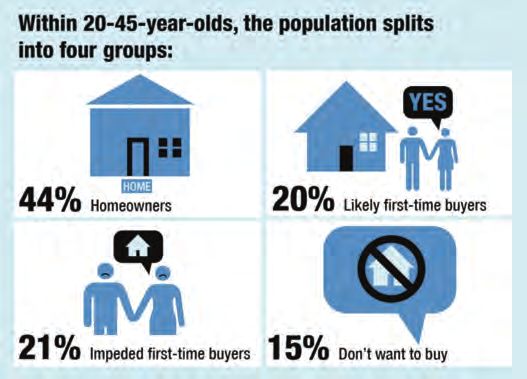
Generation Rent 2014

3. Have no desire to buy...                                    Opinions of homeowners.

Profile:                                                       Profile:
■ Young (26% 20-24, mean = 32)                                 ■ Predominantly male (53%)
■ From a ‘lower’ social grade (49% DE)                         ■ Older (57% aged 35+, mean = 35)
■ Have a lower household income (mean = £19k)                  ■ From a higher social grade (36% AB)
■ Have fewer savings (mean = £3k)                              ■ Have a higher household income (mean = £40k)
■ Are not likely to be working/students/house person           ■ Have higher levels of savings (mean = £16k)
  (55%)                                                        ■ Work full-time
■ Have been brought up in owned accommodation (49%)            ■ Have grown up in an ‘owned’ home (83%)

Views:                                                         Views:
■ Do not feel that owning a home is important; renting         ■ Think non-homeowners not willing to make sacrifices/
  is fine and Britain should lose obsession with home            compromises
  ownership
                                                               ■ 54% agree people aren’t willing to make the necessary
■ 23% agree it is important for parents to bring up children     sacrifices in order to buy their first property
  in a home that they own, not rent
                                                               ■ 57% agree first-time buyers today are guilty of trying
■ 39% agree buying a home is one of the ways that people         to find their perfect property rather than adjusting their
  take a stake in society                                        expectations to their means
■ 56% agree owning your own home is a good financial           ■ Feel owning your own home is still important, for
  investment for the future                                      settling down/taking a stake in society and as a financial
■ 36% agree Britons should lose their obsession with             investment
  home ownership - we’d be happier as a result                 ■ 41% agree owning your own home is less important in
■ Do not feel social division between those that can/            life now than it was a generation ago
  cannot buy homes.                                            ■ 46% agree it is important for parents to bring up children
■ 57% agree the country is in danger of dividing into two,       in a home that they own, not rent
  between those who can afford a house and those who           ■ 63% agree buying a home is one of the ways that people
  will never be able to                                          take a stake in society
■ 45% agree the division between people who can afford         ■ 85% agree owning your own home is a good financial
  a house and those who can’t will create long-term social       investment for the future
  problems
                                                               ■ 66% agree Britain should remain a nation of
■ Tend to disagree that non-homeowners aren’t willing to         homeowners and do not think this should, or will, change
  make sacrifices. Feel government is not doing enough
                                                               ■ 41% agree Britain will become a nation of renters within
■ 36% agree people aren’t willing to make the necessary          the next generation
  sacrifices in order to buy their first property
                                                               ■ 33% agree the Government is doing enough to support
■ 41% agree first-time buyers today are guilty of trying         people trying to buy their first home
  to find their perfect property rather than adjusting their
                                                               ■ 66% agree parents are now expected to help young
  expectations to their means
                                                                 people buy their first home
■ Do not expect support from parents
■ 46% agree parents are now expected to help young
  people buy their first home

                                                                                                                              04
Generation Rent 2014
Attitudes to homeownership Barriers to homeownership
and renting
Financial concerns are again cited as obstacles to
While homeownership remains an aspiration for the majority purchasing property. Almost half (48%) of non-owners claim
of 20-45 year olds (85%), there is evidence that attitudes that the biggest reason they are not buying property at
towards renting as a lifestyle option have softened, with the the moment is lack of sufficient earnings, followed by the
proportion of non-owners who don’t want to raise children high level of required deposits (43%). These concerns are
in a rented property falling to 40%, and also the number of particularly acute for women (50% and 46% respectively)
people worried about renting having a negative impact on compared to men (46% and 40% respectively).
their retirement also decreasing by 6% to 51%.
Despite this, saving for a deposit remains one of, if not the,
Almost half (48%) of this year’s respondents agree that most significant barriers to homeownership for first-time
Britain will become a nation of renters within the next buyers, and over half (57%) of those who would like to buy a
generation, with 46% also agreeing that Britain is becoming home admit that while they want to save for a deposit, they
more like Europe, where renting is ‘the norm’. don’t have the spare cash to do so.
The cycle of renting is also perpetuated by the fact that In 2013, increasing house prices meant that the average
people who grow up predominantly in rented accommodation deposit for first-time buyers in the UK increased from
are themselves more likely to rent than buy. 36% of people £28,001 to £30,943. Although deposit sizes as a proportion
that would like to buy but are unable to have grown up in of the total house price have remained stable at around 20%,
rented accommodation. this is still 10 percentage points higher than 2007 (10%)1.
Of those who don’t want to own, over a third (36%) think that On average, non-owners think they can afford to save £31.72
the nation should lose its obsession with homeownership towards a deposit each week. Indeed, 36% say they can’t
and that people would be happier as a result. save anything towards a deposit and would have to rely on a
If this pattern were to continue, then this would suggest that windfall, and another 14% say they could only save between
the people entering the housing market are less likely to want £1 and £10 (compared with 35% and 12% respectively in
to own a home, and are more likely to remain in ‘Generation 2013).
Rent’, irrespective of changing market conditions, leading to
a longer-term shift in the homeownership profile of the UK.
Barriers to homeownership Plan to buy in Would like to Total
next 5 years buy, but unable
The size of the deposit required 59% 65% 62%
High property prices 55% 52% 53%
Stamp duty 7% 3% 5%
Low income 39% 60% 50%
Lack of job security 27% 26% 27%
Other debts 14% 16% 15%
Extra fees (such as solicitors' fees or mortgage arrangement 17% 14% 16%
fees)
Finding the right property 14% 6% 10%
Not feeling able to apply for a mortgage because they believe 16% 16% 16%
most applications are rejected in today's economic climate
Not knowing how to go about applying for a mortgage 8% 5% 7%
Lenders having unrealistically high expectations of people's 20% 23% 21%
credit histories
Higher repayments from mortgages that have been secured 24% 16% 20%
with relatively small deposits
1
Halifax first time buyer review, 2012, 2013
http://www.lloydsbankinggroup.com/globalassets/documents/media/press-releases/halifax/2014/0401_first_time_buyers.pdf 05Generation Rent 2014
Sacrifices for homeownership Nine-in-ten (90%) young non-owners are prepared to
compromise in order to buy their property – a steady
Only 23% of those who want to buy a home claim to be increase since 2012 (84%). Willingness to compromise is
saving every penny for a deposit and making sacrifices particularly high amongst respondents from London (93%).
to do so. Those who are currently trying to put together a Respondents are most likely to compromise on parking
deposit are more likely to be doing so by making sacrifices (41%) and garden space (41%).
– cutting down on spending on hobbies (35% vs 26%);
going out (49% vs 39%), clothes,(41% vs 30%) or holidays The features that young respondents are least likely to
(36% vs 32%) compromise on are the number of bedrooms (28%) and
having a smaller living area (27%).
20-45 year-old homeowners are far more likely than
potential owners to have lived with their parents for longer
On average, non-owners would be prepared to save up for
(31% vs 15%) or borrowed money from friends/family (23%
a deposit to buy their first home for 5.29 years, down from
vs 4%).
5.41 years in 2013. 40-45 year olds are prepared to save for
This suggests that, for this generation, simply cutting longer than their younger counterparts (5.69 years vs. 4.91
down to save up may not be sufficient to put together years for 20-24 year olds). Following a similar pattern, part
enough money for a deposit on a home, and more dramatic time workers are prepared to save for longer than full time
measures such as moving back home to save on rent or workers (5.29 years vs. 4.95 years respectively).
borrowing money may be necessary.
Base: Parents who have ever owned a home; all homeowners aged 20-45; non-homeowners aged 20-45 who would like to buy a home and
want to save for a deposit.
Which of the following are you doing/did you do to get Homeowners Homeowners Potential
enough money for a deposit for you first home? (Parents) (16-45) Homeowners
(16-45)
Living in lower quality accommodation to save on rent 15% 11% 14%
Cutting down on / stopped going out 43% 39% 49%
Spending less on clothes, toiletries or personal grooming 35% 30% 41%
Going on fewer / cheaper holidays 37% 32% 36%
Spending less on Christmas, birthdays and other special events 24% 22% 31%
Spending less on my hobby / hobbies 26% 26% 35%
Borrowing money from friends or family 9% 23% 4%
Keeping a bonus or windfall to one side rather than spend it 14% 19% 16%
Working an extra job 18% 15% 13%
Living with parents 15% 31% 15%
I'm not doing any of these things 32% 20% 22%
06Generation Rent 2014
Parental assistance The future of the
UK Housing Market
Relying on parents or other family members and friends
for support when getting on the property ladder is now The report highlights a disconnect between the desire and
expected, with 6 in 10 of 20-45 year olds agreeing that perceived ability to buy a home. Although homeownership
support is from family members is now automatically is seen as advantageous by a majority, many of Generation
assumed/ a given to help first time buyers. Rent admit they are not taking the steps they need to
purchase their own home.
Of those that have purchased only 37% of 20-45 year old
homeowners received no help from their parents when Deposit sizes and mortgage accessibility are cited as the
purchasing their home. key barriers to homeownership between those that plan
to buy in the next five years than those who are unable
This is a marked generational shift; while both 20-45 year- to buy. Those that are unable to buy are far more likely
old homeowners and their parents cut back and made to identify low income as one of the top three barriers to
sacrifices in roughly equal measure, this generation of homeownership (60% vs. 39%) unsurprising given their
homeowners is far more likely than the preceding one to household income is, on average, £10,000 lower. This
have lived with their parents for longer (31% vs. 15%) or suggests that if issues of ‘affordability’ continue to worsen,
borrowed money from their friends/family (23% vs. 9%) in then those in ‘Generation Rent’ may be more vulnerable.
order to pull together a deposit. However, it also means that there is more scope for issues
of affordability to impact likely homeowners moving
Government assistance homeownership out of their reach.
Since the last research was conducted in 2013, the
government has introduced the ‘Help to Buy’ initiative to
Implications
try to help first-time buyers onto the property ladder either
This potential, and perceived movement in the UK towards
through equity loans or mortgage guarantees. 17,395
renting is not necessarily viewed as a good thing (only
homes have been bought under the scheme in its first nine
27% agree that Brits should lose their obsession with
months, 88% of which were to first-time buyers2.
homeownership), nor is it viewed as something that will
affect everyone (68% of 20-45 year-olds think the country
When asked, approximately 3 in 10 20-45 year olds thought
is in danger of dividing into those who can afford a house
that government initiatives were working, but the same
& those that will never be able to). 56% of the population
amount felt that it wasn’t, and more (4 in 10) didn’t know.
agree that the division between homeowners and non-
homeowners will create long-term social problems.
48% of 20-45
year olds believe
Britain will
become a nation
of renters in a
generation.
2
https://www.gov.uk/government/news/pm-hails-help-to-buy-success
07Generation Rent 2014
A widening of the existing With current estimates of a housing shortfall and an
estimated 232,000 new homes required each year to meet
wealth gap between demand, the house building industry needs to continue to
homeowners and supply new developments. But changes in the proportion
of people who rent, and the length of time they rent for,
non-homeowners are likely to affect the number and nature of new build
properties, and may lead to fewer homes being built than
79% of 20-45 year olds agree that owning your own home
is necessary. As first-time buyers are regarded as crucial
is a good financial investment for the future. As housing
to the housing market and house building industry to keep
represents a large proportion of Britain’s wealth, accounting
the market moving, any decrease in the number of first
for approximately 60% of the UK’s non-financial assets,
time buyers will have an impact on the funding of new
this could result in a widening of the existing wealth gap
builds. It will also be important that, when planning any new
between homeowners and non-homeowners.
developments, the likelihood of some of it being privately
rented is considered, to ensure the stock is of high quality
Lack of financial resources to support people
and well managed.
during retirement
Any decrease in first-time buyers will have an overall impact
Homeownership has long being viewed as a financial
on the future housing market. First-time buyers are viewed
investment; many homeowners view their home as
as the life blood of the housing market and are key to
a resource that they could potentially draw upon in
getting the market moving. In order for the market to remain
retirement. An increasing rental sector would therefore
sustainable, homeowners need to be able to move up the
mean an increasing proportion of the population would not
property ladder. Without a first-time buyer, many people
have that resource to draw upon in their retirement, with
living in their first home will be unable to move up the
51% of non-homeowners aged 20-45 are worried that if
property ladder and, without this movement, the market will
they rent all their lives they won’t be able to retire.
come to a standstill.
08You can also read


