Google Maps Security Concerns - Scientific Research Publishing
←
→
Page content transcription
If your browser does not render page correctly, please read the page content below
Journal of Computer and Communications, 2018, 6, 275-283
                                                                                                 http://www.scirp.org/journal/jcc
                                                                                                          ISSN Online: 2327-5227
                                                                                                            ISSN Print: 2327-5219

Google Maps Security Concerns

Aqil Burney1, Muhammad Asif2, Zain Abbas3, Shamaila Burney4
1
 Department of ASRM, College of Computer Science and Information Systems, IoBM, Korangi Creek, Karachi, Pakistan
2
 Department of Computer Science & Information Technology, NED University of Engineering & Technology, Karachi, Pakistan
3
 Department of Computer Science (UBIT), University of Karachi, Karachi, Pakistan
4
 Department of Management Sciences, Hamdard University, Karachi, Pakistan

How to cite this paper: Burney, A., Asif,     Abstract
M., Abbas, Z. and Burney, S. (2018) Google
Maps Security Concerns. Journal of Com-       Google Maps and other such maps in GIS have a lot of significance in every
puter and Communications, 6, 275-283.         one’s life for in modern world due to technological development as well as
https://doi.org/10.4236/jcc.2018.61027
                                              contemporary needs in travelling, business planning, agriculture, e-marketing
Received: December 3, 2017                    supply chain management, census and planning and excessive use of mobile
Accepted: January 5, 2018                     phones. Being a revolutionary technology, it attracts the users from its incep-
Published: January 8, 2018                    tion. It has been revolutionary in having an impact on one’s daily life by
                                              helping one explore geographical locations virtually anywhere on the whole
Copyright © 2018 by authors and
Scientific Research Publishing Inc.           planet. It has become a norm that people use Google Maps before or while
This work is licensed under the Creative      commuting to a certain place as most of the people rely on it to provide the
Commons Attribution International             shortest or fastest route to a destination. Google Maps has had a profound
License (CC BY 4.0).
                                              impact not only one’s personal life, but has opened new avenues of marketing,
http://creativecommons.org/licenses/by/4.0/
               Open Access
                                              business intelligence, urban planning, infrastructure strategy development, as
                                              well as traffic engineering. Hence, no one can deny the impact it has had on
                                              our society in a short period. However, Google Maps has security concerns
                                              associated with its use. This is because whenever a user is searching for a geo-
                                              graphical location on Google Maps, there is no way to ascertain his/her inten-
                                              tion. As result, whatever is requested by the user, it is provided without much
                                              security checks or personal specific logging history. Criminal minded people
                                              may use the technology to carry out unwarranted and uncalled-for activities
                                              such as terror attacks, exploitation of military assets, target killing, trailing a
                                              potential victim, kidnapping, demanding ransom money, and compromising
                                              national security etc. Numbers of such activities may be carried out using the
                                              guidance from “Google Maps” without getting noticed. This is largely due to
                                              that anonymous login is allowed into Google Maps. The paper highlights the
                                              main security issues that exist in the use of Google Maps and suggests the key
                                              areas to improve upon. In this research paper, we discuss the security con-
                                              cerns related to Google Maps utilization and try to identify the associated
                                              risks that may be worst in some situations due to that it is significant to assess

DOI: 10.4236/jcc.2018.61027 Jan. 8, 2018                         275                    Journal of Computer and Communications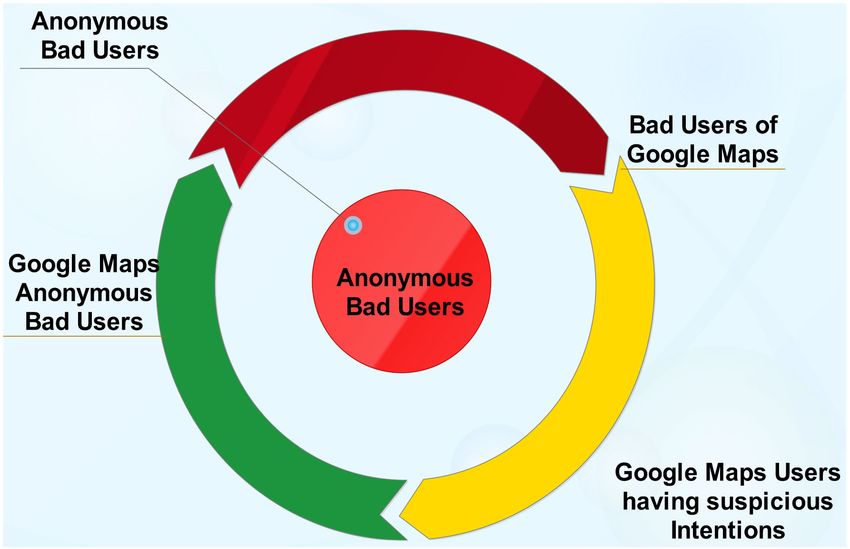
A. Burney et al.

                                the usage of this tremendous technology. We categorize the millions of Ano-
                                nymous Google Maps users into two major categories (Anonymous Good
                                Users and Anonymous Bad Users) based on Google Maps browsing and ana-
                                lyze the associated risks and potential threats and propose the way to minim-
                                ize them. In future, if Google Maps adopts the proposed techniques and im-
                                proves upon, then its utilization minimizes security concerns and makes the
                                world much safe place.

                                Keywords
                                Google Maps, Anonymous Users, Cybercrime, Security Issues,
                                Security Concerns, Spatial Information, Signup Mechanism, Potential Threats

                              1. Introduction
                              The Google Maps mashup is a very twenty-first-century beast born of code from
                              disparate Web applications [1]. Mashups are product of Web 2.0 and attract
                              both industry and academia. They represent an ad hoc composition technology
                              of Web applications that allows users to utilize the content retrieved from exter-
                              nal data sources and create entirely new services [2] [3]. Google Maps has been
                              making profound impact on human life for a while now [4]. It helps people visit
                              places, literally throughout the world, easily even though they aren’t aware of
                              those places or haven’t visited them previously. In past, it was quite difficult to
                              travel to any place if you are not aware of its location. Not anymore. Google
                              Maps is there to help while you are driving a car, aboard a public transit, or rid-
                              ing a bike; simply using Google Maps to direct you to your desired location [5].
                              Moreover, it provides other details such as time to your destination, distance
                              remaining, traffic situation, bus routes, etc. that can be used for making efficient
                              decisions [6]. It also helps businesses in terms of marketing by classifying them
                              into restaurants, shopping centers, picnic places, coffees shops, travel industries,
                              rent-a-car, fuel pumps, workshops, hotels, private hospitals etc. [7]. Similarly,
                              there are many other businesses that earn substantial marketing exposure due to
                              the Google Maps technology.
                                As a result, millions of users interact with Google Maps daily to draw advan-
                              tage. This usage generates huge history logs that can be used to improve user
                              experience. The users discussed thus far are law abiding citizens who do not
                              have any ulterior motives that use the services anonymously. But what about the
                              people who use these services to carry out some suspicious agenda? There are
                              terrorists, mafia, extortionists, and robbers etc. who have bad intentions and use
                              Google Maps for carrying out their ulterior motives such as collecting sensitive
                              information regarding Military, Law Enforcing Agencies, Government Depart-
                              ments, Sensitive public places, Sensitive installations, and others. They can use
                              this information to breach the security of such places [8], so careful thought
                              must be put in to address these issues to prevent negative usage of Google Maps

DOI: 10.4236/jcc.2018.61027                        276                    Journal of Computer and Communications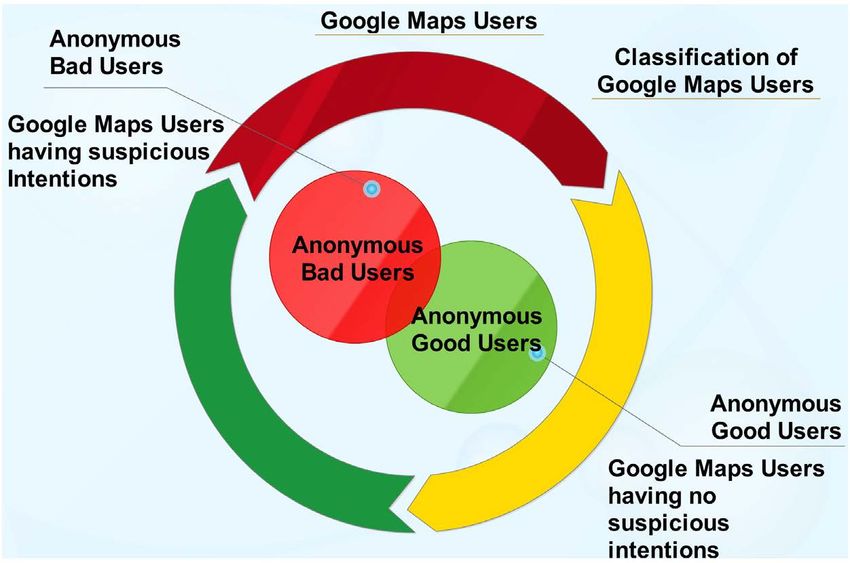
A. Burney et al.

                              by criminal minded users and avoid compromising the physical security of
                              highly sensitive areas.
                                The rest of the paper is organized as follows.

                              2. Google Maps Application
                              It is a great technological advancement all over the world that helps millions of
                              its users in getting quality geographical information for finding paths, locations,
                              places, distances, required time to travel at specific place, and making rational
                              decisions on the behalf of provided information. It has totally changed the way
                              of thinking and decision making on a large scale of a common user in an effec-
                              tive manner. It has caused exponential growth for businesses worldwide; mil-
                              lions of users interact with it on daily basis for exploring different places. It has
                              also helped tourism industry of all the countries by providing detailed insights,
                              reviews and much more that enable easy access to those locations that remained
                              hidden in the past.

                              3. Google Maps Users and Classification
                              After the commencement of Google Maps Technology millions of users are uti-
                              lizing this technology on daily basis for finding different geographical locations
                              and reduce time consuming tasks such as finding path, time required to reach at
                              destination, total distance, transit travel, etc. by this technology. As in result,
                              millions of users spend their time on Google Maps. Moreover, these users are
                              anonymous for Google Maps because there is no requirement of user authenti-
                              cation or authorization such as login, session logs, or security verification.
                              Hence, millions of users are still anonymous for google and their intentions are
                              not known [9].
                                Figure 1 shows that users of Google Maps can be classified into two major
                              categories basis on utilization of Google Maps technology:

                                 Figure 1. Google Maps users.

DOI: 10.4236/jcc.2018.61027                         277                    Journal of Computer and Communications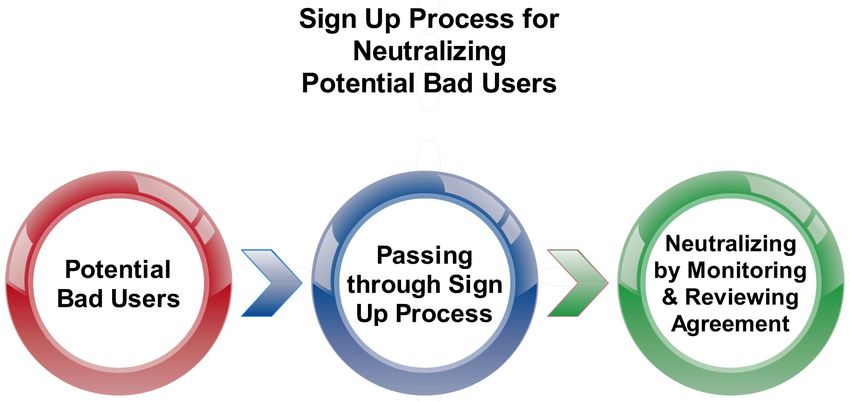
A. Burney et al.
Anonymous Good User;
Anonymous Criminal User.
Succeeding headings and diagrams will be helpful to understand the catego-
ries of anonymous users.
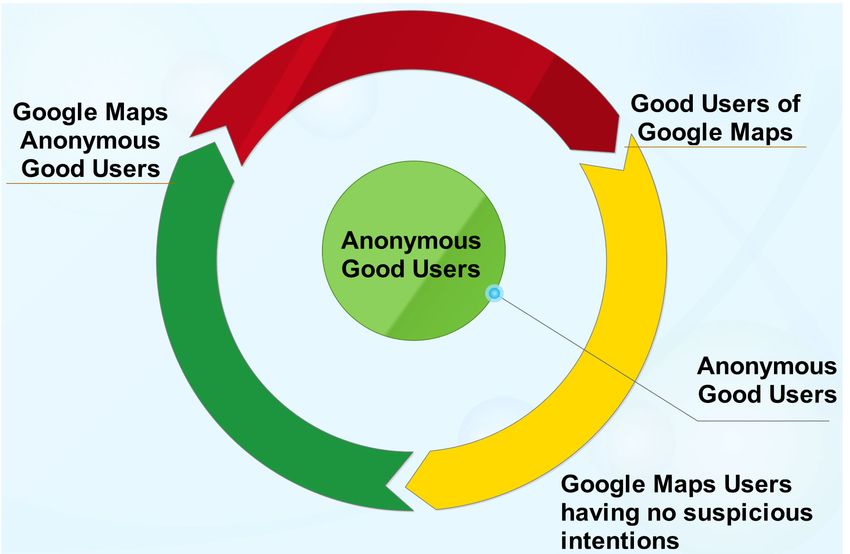
3.1. Anonymous Good Users
Google Maps users who are searching for places and have desire to get informa-
tion regarding their needs that can be helpful to travel as well as getting know
how and other related information regarding specific place having no suspicious
thoughts. Such users do not pose any real threat or risk as they are not intending
to achieve anything wrong. Similarly, they are not compromising the physical
security of the high-profile places like government departments, secured army
facilities, or other sensitive places that pertain to national interest. These kinds of
users do not deal any further study or investigation they are generally “good”
users. Figure 2 shows the classification of anonymous good users so potential
risks are not associated with this sort of Google Maps users.
3.2. Anonymous Bad Users
A Google Maps user who is searching for a place with criminal intentions and
desire to achieve suspicious activity is classified as an Anonymous Criminal User
[10]. These users search for information that can be helpful for getting sensitive
insights regarding places that may compromise security of governmental de-
partments, military installations, and facilities relating to national security of a
country. Moreover, such users may use maps to their advantage in carrying out
nonsocial activities such as demanding ransom money in acts of kidnapping,
murder or target killing. These horrendous acts can be executed after collecting
location/route information from maps [11], without being noticed as Google
Maps allows access from any place without being verified. Similarly, Google
Maps doesn’t take any details of its users and doesn’t make any history logs for
such anonymous users who are cyber criminals [12]. They pose real threat for
Figure 2. Anonymous good users.
DOI: 10.4236/jcc.2018.61027 278 Journal of Computer and Communications
A. Burney et al.

                              the national security of not only countries [13], but also societies, communities
                              and common peoples. Hence, they should be dealt in efficient manner. Ways to
                              ensure rational browsing regarding locations, neighborhoods and sensitive plac-
                              es etc. are discussed consequently. Figure 3 shows anonymous bad users.

                              4. Google Maps Should Adopt
                              A proposed way for Google Maps is to initiate authenticated sign up mechanism
                              [14], for all users after getting necessary credentials during signup process. This
                              will allow Google Maps to maintain the associated records & credentials of each
                              user along with session information, access location, browsing history, searching
                              of places etc. into Google Maps databases which can be used for monitoring &
                              analyzing later, if it is required conditionally. Figure 4 shows signup process that
                              can be helpful for neutralizing potential risks.

                              Initiate Sign up Process
                              Google Maps should introduce the sign-up process as shown in Figure 4 to users
                              before browsing and searching any location. It should be mandatory to be regis-
                              tered a user after providing necessary credentials to Google Maps so that a user
                              can be authenticated every time [14]. Whenever a user wants to search a location
                              he or she must login through the same credentials as a legitimate user.

                                        Figure 3. Anonymous bad users.

                                        Figure 4. Sign up process.

DOI: 10.4236/jcc.2018.61027                        279                     Journal of Computer and Communications
A. Burney et al.
5. Monitoring & Reviewing Agreement
Google Maps should take acceptance from users on Monitoring & Reviewing
agreement and warn to users regarding suspected browsing. If user browses a
location that is highly sensitive, then user’s activities can be monitored and re-
viewed. These may include acquiring user information such as session informa-
tion, session locations details, history logs, browsed places etc. for performing
investigations by the law enforcing agencies if any untoward incident or act of
terror happens at that location.
This will be helpful for identification of “Criminal Users” that has been re-
maining “anonymous” up till now. Such users will not remain “anonymous”
when Google Maps ensures that whoever wants to use Google Maps, must pro-
vide necessary credentials such as e-mail address and mobile numbers etc. con-
sequently it will be extremely useful in tracking those criminal users who have
bad intensions to violate physical security of highly sensitive area or having
some suspicious intensions to disrupt the society.
6. Potential Threats of Anonymous Users
Millions of users of Google Maps utilize the assistance provided by this out-
standing technology in everyday life and get better solutions of their problems
for identifying any location as per their requirements. But, as already mentioned,
many potential threats in form of criminal users having bad intensions, achieve
their goals without being noticed. Since its inception, such users are utilizing this
technology for malicious acts. We can see terrorist acts are happening all around
the World and the overall security has been compromised due to ill mindsets,
they use modern technologies including Google Maps for their worse intends.
Moreover, terrorists may collect vital spatial details prior to carrying out an of-
fensive at sensitive locations. As in result, such incidents also fall into the cate-
gory of cyber terrorism.
7. Distinctive Behaviors
If any incident or act of terror occurs at specific highly sensitive location, then
law & enforcement agencies may get prompt assistance from Google Maps for
assessing the history logs and identify those users who browsed for that specific
location and gain vital spatial information from Google Maps. This information
may lead to perform analysis and uncover their actual intensions as per brows-
ing habits, history logs, and performing statistical and predictive analysis based
on the available and accessible knowledge base. User’s browsing pattern can be
used to distinguish whether a user has positive intensions or negative intensions.
Moreover, the ones marked as having ill intentions or past criminals can be mo-
nitored and remain on watch list by law enforcement agencies. Figure 5 shows
that a potential bad user can be identified by browsing history and searching ac-
tivities that can be used for predicting the risks and potential threats.
DOI: 10.4236/jcc.2018.61027 280 Journal of Computer and CommunicationsA. Burney et al.
Figure 5. Monitoring user’s behavior.
8. Recommendations and Future Work
In this paper, we have focused on security concerns relating to the use of Google
Maps. We elaborated that millions of users using the technology are still ano-
nymous and we are generally unaware of their intensions and motive behind the
activities. As a result, they may accomplish their ulterior motives such as bomb
blasts, target killing, mass shooting, high profile kidnapping, kidnapping for
ransom etc. without being noticed. To cope with these challenges, main areas of
future development should focus on the following:
1) Account creation must be mandatory for Google Maps Users.
2) Necessary credentials of the users must be filled in during the sign-up
process.
3) Session logs, browsing history and activity logs must be maintained for
each user.
4) Users must sign acceptance to terms and conditions that should include
that in case of any suspected activity from the Google Map Account, legal ac-
tions can be taken against specific user.
5) In the result of signup process, millions of anonymous users will not fur-
ther remain anonymous in future.
6) Google Maps must show warning pop ups to its users if he or she is trying
to access any secure or sensitive place for browsing.
7) Statistical data analysis and predictive analytics can be used for predicting
and judging the behavior of suspected user by applying these techniques on
browsing history.
8) Learning mechanism in Artificial intelligence may be employed to mimic
the behavior of a criminal user and potential malicious users of Google Maps
may be forecasted.
DOI: 10.4236/jcc.2018.61027 281 Journal of Computer and CommunicationsA. Burney et al.
9) Cybercrimes acts can be used on Google Maps users if they are found
guilty.
10) If any incident or act of terror happens at specific location, then browsing
history of a user about that place can be reviewed and findings can be correlated
with other available information for tracing criminals.
9. Conclusion
This research dealt with Google Maps Security Concerns related to Google Maps
browsing, we focused on this great contemporary technology, it’s importance,
it’s usage in every one’s life, we classified millions of Google Maps users into two
major categories: Anonymous Good Users and Anonymous Bad Users. We
don’t have (Security Risk) concern with good users but real concerns are crimi-
nal users, they are accomplishing their malicious intentions by utilizing this
tremendous technology, we proposed different ways to deal with those criminal
users, if any incident occurs then in what initiatives or ways to correlate a crim-
inal user’s activities by Google Maps browsing history for tracing criminals, we
focused on security concerns of Google Maps, finally we recommended the fu-
ture works such as signup mechanism that would enables Google Maps for get-
ting necessary credentials such as user’s contact details, country and city names,
maintaining session logs will be helpful for identification of which device is used
to access Google Maps and from which region it is used, history logs will be
helpful for determining user’s intensions such as using probabilistic methods,
statistical methods, artificial intelligence & knowledge based learning systems
can be developed for predicting user’s behavior & tracing them for minimizing
the associated risks and handling the security issues in appropriate manners in
the real time for making rational decisions, consequently it would be a proactive
approach for dealing with potential threats of cyberterrorism and terrorism be-
cause terrorism is a real issue all around the globe and we have a chance to set
appropriate controls to mitigate the identified risk and threats for resolving the
issues of “Google Maps Security Concerns”.
References
[1] Miller, C.C. (2006) A Beast in the Field: The Google Maps Mashup as GIS/2. Carto-
graphica: The International Journal for Geographic Information and Geovisualiza-
tion, 41, 187-199. https://doi.org/10.3138/J0L0-5301-2262-N779
[2] Liu, X., Hui, Y., Sun, W. and Liang, H. (2007) Towards Service Composition Based
on Mashup. 2007 IEEE Congress on Services, Salt Lake City, UT, 9-13 July 2007,
332-339. https://doi.org/10.1109/SERVICES.2007.67
[3] Hoyer, V. and Fischer, M. (2008) Market Overview of Enterprise Mashup Tools.
International Conference on Service-Oriented Computing, Springer-Verlag, Berlin
Heidelberg, 708-721. https://doi.org/10.1007/978-3-540-89652-4_62
[4] Dodsworth, E. and Nicholson, A. (2012) Academic Uses of Google Earth and
Google Maps in a Library Setting. Information Technology and Libraries, 31,
102-117. https://doi.org/10.6017/ital.v31i2.1848
DOI: 10.4236/jcc.2018.61027 282 Journal of Computer and CommunicationsA. Burney et al.
[5] Belleau, F., Nolin, M.A., Tourigny, N., Rigault, P. and Morissette, J. (2008)
Bio2RDF: Towards a Mashup to Build Bioinformatics Knowledge Systems. Journal
of biomedical informatics, 41, 706-716. https://doi.org/10.1016/j.jbi.2008.03.004
[6] Pan, B., Crotts, J. C. and Muller, B. (2007) Developing Web-Based Tourist Informa-
tion Tools Using Google Map. Information and Communication Technologies in
Tourism, 2007, 503-512.
[7] Armstrong, G., Adam, S., Denize, S. and Kotler, P. (2014) Principles of Marketing.
Pearson Australia.
[8] Saini, H., Rao, Y.S. and Panda, T.C. (2012) Cyber-Crimes and Their Impacts. Inter-
national Journal of Engineering Research, 2, 202-209.
[9] Nguyen, L. (2014) User Model Clustering. Journal of Data Analysis and Informa-
tion Processing, 2, 41-48. https://doi.org/10.4236/jdaip.2014.22006
[10] Rababah, O.M., Al Hwaitat, A.K., Al Manaseer, S., Fakhouri, H.N. and Rababah,
O.M. (2016) Web Threats Detection and Prevention Framework. Communications
and Network, 8, 170-178. https://doi.org/10.4236/cn.2016.83017
[11] Phipps, A.G. (2014) Three Applications of V.3 Google Maps: Just for Display of
Data, or Analysis as Well? Journal of Geographic Information System, 6, 548-558.
https://doi.org/10.4236/jgis.2014.65045
[12] Ahmad, R., Yunos, Z., Sahib, S. and Yusoff, M. (2012) Perception on Cyber Terror-
ism: A Focus Group Discussion Approach. Journal of Information Security, 3,
231-237. https://doi.org/10.4236/jis.2012.33029
[13] Alqahtani, A. (2014) Awareness of the Potential Threat of Cyberterrorism to the
National Security. Journal of Information Security, 5, 137-146.
https://doi.org/10.4236/jis.2014.54013
[14] Ahmad, W., Zia, A. and Khalid, U. (2013) A Google Map Based Social Network
(GMBSN) for Exploring Information about a Specific Territory. Journal of Software
Engineering and Applications, 6, 343-348. https://doi.org/10.4236/jsea.2013.67043
DOI: 10.4236/jcc.2018.61027 283 Journal of Computer and CommunicationsYou can also read


