Hamburg's green roofs an economic evaluation - Hamburg.de
←
→
Page content transcription
If your browser does not render page correctly, please read the page content below
egy
                            o o f Strat
                          R
                G r e e n m b u rg
                         a
                For H

Hamburg‘s Green Roofs
  An Economic
           Evaluation
IMPrint

     Publisher: Free and Hanseatic City of Hamburg, Ministry of En-
     vironment and Energy (BUE), Neuenfelder Straße 19, 21109
     Hamburg, legally responsible for content: Jan Dube. October
     2017.
     For questions, contact: Dr. Hanna Bornholdt, BUE, telepho-
     ne: 040-428 40-3057, email: gruendach@bue.hamburg.de,
     further information: www.hamburg.de/gruendach
     Concept, editing and copywriting: HafenCity University Ham-
     burg, Fachgebiet Umweltgerechte Stadt- und Infrastrukturpla-
     nung; Prof. Dr.-Ing. Wolfgang Dickhaut (wolfgang.dickhaut@
     hcu-hamburg.de), Gionatan Vignola, Lisa Harseim
     Layout: Gionatan Vignola, following the guidelines of
     Hamburg‘s administration and mount. Design und Kommuni-
     kation für soziales Wachstum
     Project management and coordination: Dr. Hanna Bornholdt,
     Bart Jan Davidse, Marie-Thérèse Hliwa
     Translation: David Skogley
     Printing: Hamburg Ministry of Environment and Energy, in-
     house print-shop, paper: 100 % recycled paper
     Literature and internet directory: Behörde für Umwelt und
     Energie: Was ist ein Gründach?, Hamburg 2014 // Behörde für
     Umwelt und Energie: Was muss bei der Pflege eines Gründachs
     beachtet werden?, Hamburg, 2014 // Behörde für Umwelt und
     Energie: Wärmebildanalyse zeigt Kühlwirkung vom Gründach,
     Hamburg, 2016 // BBSR: Nutzungsdauern von Bauteilen für
     Lebenszyklusanalysen nach Bewertungssystem Nachhaltiges
     Bauen (BNB), 2017 // Bürgerschaft der Freien und Hansestadt
     Hamburg: Mitteilung des Senats an die Bürgerschaft. Printed
     material 20/11432, Hamburg, 2014 // Deutscher Dachgärt-
     ner Verband e. V.: Kommunale Gründach-Strategien. Inventari-
     sierung, Potenzialanalyse, Praxisbeispiele, Nürtingen, 2017 //
     Deutscher Dachgärtner Verband e. V.: Fragen und Antworten,
     Nürtingen, 2017 // FLL – Forschungsgesellschaft Landschafts-
     entwicklung Landschaftsbau e. V.: – Dachbegrünungsrichtlini-
     en – Richtlinien für die Planung, Ausführung und Pflege von
     Dachbegrünungen, 2016 // Fraunhofer-Institut für Bauphysik
     IBP: IBP-Bericht HTB 13-2013, Holzkirchen, 2013 // GERICS:
     Gebäudebegrünung und Klimawandel, 2017 // Immowelt AG,
     2017 // Mann, Dr. Gunter: Ansätze zu objektbezogenen Kos-
     ten-Nutzen-Analysen, Ditzingen, 2005 // Mann, Dr. Gunter:
     Nutzen begrünter Dächer – eine Frage des Blickwinkels, Dit-
     zingen, 2000 // Oebbeke, Alfons: DAKU-Dachbegrünungsele-
     mente mit Zulassung als zusätzliche Wärmedämmung, 2011
     // Sproul, Wan, Mandel, Rosenfeld: Economic Comparison of
     White, Green, and Black Flat Roofs in the United States, Energy
     and Buildings, 2013 // Pfoser, et.al.: Gebäude Begrünung Ener-
     gie, 2013 // VDI Zentrum Ressourceneffizienz GmbH: Grün-
     dach, 2017
     Picture credits: p. 1 – Title: photo: © BUE / Isadora Tast //
     pp. 2/3 – background: © visualisation: TH Treibhaus landscape
     architecture, aerial photo: Matthias Friedel // pp. 4/5, 6, 8/9,
     10/11, 12/13, 14, 18/19, 20/21 – photo: © BUE / Isadora Tast
     // pp. 7, 9, 12/13, 15, 17 – visualisation: © Gionatan Vignola,
     HCU // pp. 22/23 – background: © visualisation: TH Treibhaus
     landscape architecture, aerial photo: Matthias Friedel
02   Disclaimer: The creator of this brochure assumes no liability
     for the topicality, correctness, completeness or quality of the
     information provided. The pictorial, graphic and textual con-
     tent of the available information has been prepared with care
     and to the best of our knowledge, and compiled with the gre-
     atest possible topicality from our own research as well as ex-
     ternal sources. Liability claims against the creator relating to
     material or immaterial damage caused by the use or non-use of
     the information provided, or by the use of incorrect or incom-
     plete information are fundamentally excluded.
2   Imprint                                 10   Hamburg‘s Green Roofs / A Cost Comparison   03

5   An Overview                             16   Economic Life Cycle Analysis

6   Objective and Approach                  18   Economic Benefits

6   Structure and Types of Green Roofs      21   Planning Security with Regard to Costs

8   Cost Distribution during Construction   22   Conclusion
an overview

04
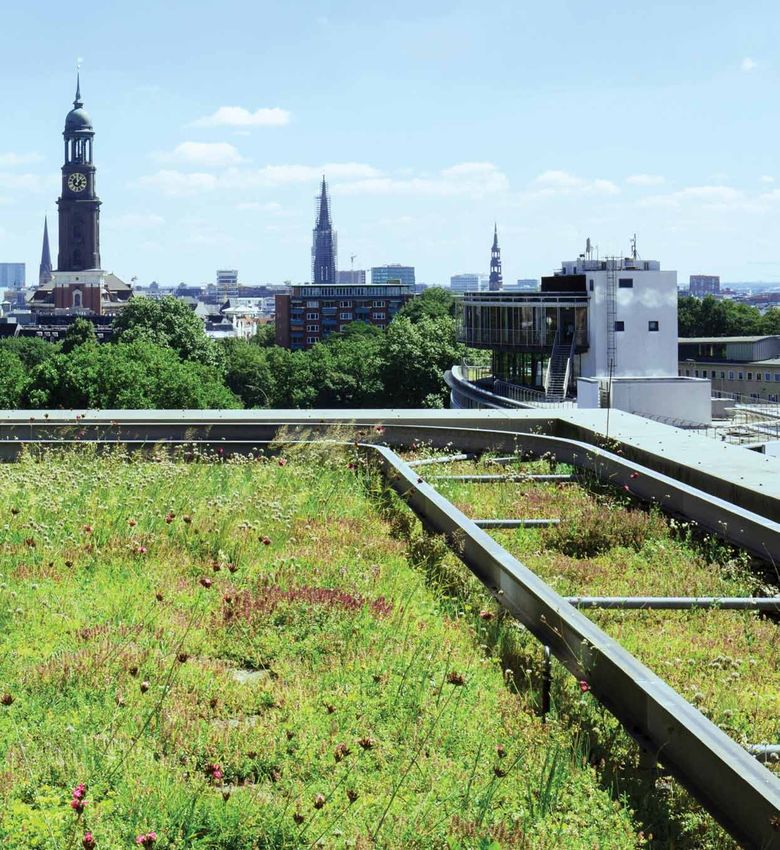
An Overview
With its current housing programme and the develop-
ment of commercial sites, the Senate of the Free and
Hanseatic City of Hamburg is setting new standards.
The goal is to build at least 10,000 apartments and
develop new commercial areas every year. As a result,
the city will become more dense and there will be
noticeable effects on the sealing of surfaces, the
climate and the amount of open space. Hamburg‘s
roofs have a great potential to mitigate these conse-
quences. Hamburg‘s green roof strategy is pursuing
the goal of developing new open space on rooftops
and of taking advantage of green rooftops as a re-
source for rainwater storage and climatic comfort.

This publication deals with the economic dimensions
of green roofs in Hamburg. By looking at the creation
of nearly a dozen green roofs in the Hanseatic city,
it considers the investment and maintenance costs
involved as well as the economic benefits and effects.
Everyone involved with the planning of buildings and
the cost issues of green roofs is addressed here, and
property owners and other decision-makers will find
convincing arguments for investing in green roofs.

The results of this study show that an investment
in green roofs is all the more worthwhile, the earlier
and more consistently the topic is made a part of the
planning process. The cost of building a green roof
amounts to about 1.3% of a building‘s overall const-
ruction costs. In multi-storey residential buildings this
share can sink to as little as 0.4 % of overall const-
ruction costs. When considering life-cycle costs, both
black roofs (i.e. without greening) and green roofs
have similar costs over a 40-year period.

                                                            05
Objective and Green Roof Structure

     Objective and                                            Structure and Types
     Approach                                                 of Green Roofs
     There are many reasons for creating green roofs in           structure
     compactly built cities. Whether and to what extent
     a green roof is economical compared to a non-green       According to the Green Roof Guidelines published
     roof depends on many different factors. This study       by the Forschungsgesellschaft Landschaftsentwick-
     has estimated the current production and main-           lung Landschaftsbau e. V. (Landscape Research,
     tenance costs of various Hamburg construction            Development and Construction Society, FLL), every
     projects and used them as the basis for an econo-        professionally built green roof has the following
     mic feasibility study. In the process, different cost    standard structure (see Fig. 1), starting with root-
     considerations were made: The investment in and          resistant roof waterproofing:
     maintenance costs of a green roof itself, the share      •   Protective layer: This protects the roof water-
     of green roof costs as a part of total roof costs and        proofing and/or against root penetration.
     total building costs, and green roof costs related to
                                                              •   Drainage layer: Due to its cavity volume, this
     the usable area and life cycle costs over a period of
                                                                  takes up excess water and guides it to the roof
     40 years.
                                                                  drains. At the same time it provides water sto-
                                                                  rage, enlarges the root zone and has a protecti-
     The data results from an evaluation of the real cons-
                                                                  ve function for the underlying structure.
     truction costs of the buildings as well as a quotation
     price comparison of a current call for proposals.        •   Filter layer: This prevents finer soil and sub-
     In addition, a survey of experts revealed what are           strate elements from being washed from the
     often controversial aspects of cost calculation and          vegetation layer into the drainage layer, thus
     accrual regarding green roofs, the results of which          impairing the water permeability of this layer.
06
     are presented here.                                      •   Vegetation stratum: This forms the basis of
                                                                  plant growth and must allow for strong root
     The study resulted in transferable findings for the          growth. It consists of substances mixed to-
     construction of green roofs on buildings in Ham-             gether or of soil prepared according to defined
     burg, and especially for residential buildings and           requirements, and is thus also referred to as
     commercial construction projects.                            substrate.
Types of Green Roof

Green roofs can be divided into three types, depen-                  on, e.g. groundcovering herbs and mosses, can
ding on the use, the technical parameters and the                    be tolerated.
type of construction. In turn, the type determines              •    Extensive greening is similar to near-natural
the corresponding plant selection and appearance:                    forms of vegetation that are largely self-main-
•    Intensive greening can consist of perennials,                   taining and self-propagating. Plants with a high
     grasses, bulbs, summer flowers and shrubs, and                  regenerative capacity and a special adaptability
     in individual cases, trees and lawns. They can                  to extreme site conditions are used. The effort
     be planar, height-differentiated or punctiform.                 involved in creating and maintaining extensive
     With the appropriate features, they are com-                    plantings is generally lower than it is for inten-
     parable to ground-based open space in terms                     sive plantings.
     of the options for use and design. This type of
     greening can only be permanently maintained
     through intensive care, and especially a regular
     supply of water and nutrients.
•    Simple-intensive greening usually consists of
     groundcover plants with grasses, perennials
     and shrubs. The use and design of such planting
     is limited in comparison to intensive plantings.
     The plants used are less demanding with regard
     to the layer structure, as well as on the supply
     of water and nutrients. They are less complica-
     ted to build than intensive greening and mainte-
     nance is also less demanding. Depending on the
     goal of the planting, self-propagating vegetati-

    Roof and roof waterproofing          Green roof

    4 Waterproofing                       9 Planting

    3 Thermal insulation                  8 Substrate

    2 Vapour barrier                      7 Filter layer

    1 Reinforced concrete                 6 Drainage layer

                                          5 Protective layer

                                                                               9
                                                                               8
                                                                               7
                                                                               6
                                     4                                         5

                                     3
                                                                                                                              07
                                     2
                                     1

    Black roof                             Green roof with a simple ex-                   Green roof with intensive
                                           tensive planting (drainage layer:              planting (drainage layer: artifi-
                                           bulk materials)                                cial materials)

    Fig. 1 – Standard construction of a roof (warm roof) without and with roof greening
Cost Distribution during Construction

     Cost Distribution during Construction
     When considering the costs of green roofs, it is         strips. Preparing for construction and the building
     interesting to find out how the costs are distributed    of maintenance roads are negligible costs.
     among the individual components of a green roof,
     and what the price difference between different          (3) Price optimisation for green roofs is possible for
     suppliers is.                                            the positions that are proportionately more expen-
                                                              sive, and achieved by searching for alternatives.
     This consideration is made possible by evaluating        Costs could possibly be reduced through modi-
     a price comparison of offers for an extensive green      fied structures (single-layer instead of multi-layer
     roof in a real call for proposals from 2016 for an ap-   greening), drainage layers (bulk material instead
     prox. 300 m² green roof. The comparison of prices is     of plastic), substrates, the edging of drains (gravel
     shown in the adjacent table.                             bedding instead of inspection shafts), dispensing
                                                              with gravel edging and the reduction of gravel strips
     The following conclusions can be drawn from this:        to the sizes required by fire prevention regulations.
                                                              (B. W. Krupka, expert, 2017).
     (1) The prices vary depending on the position, and
     overall vary strongly; average values for the respec-    (4) Little price optimisation is to be expected in the
     tive types of work are hard to derive. The totals of     area of completion care. Savings in this position
     the offers vary greatly, ranging from about 10,500       should be avoided in order to achieve high-quality
     € (approx. 35 €/m² roof area) to almost 17,000 €         and the rapid development of green roof vegetation.
     net (approx. 58 €/m² roof area), i.e. 1.5 times the
     first offer. This means that a qualified invitation
     to tender and the obtaining of various offers can
     strongly influence construction costs.
08

     ((2) The proportionate costs per position, on the
     other hand, are comparatively similar: The most
     expensive positions typically involve the drainage
     elements (on average 22.3 % of the bid total) and
     the substrate (on average 20.6 % of the bid total),
     followed by the extent of the gravel edging (on ave-
     rage 17.8 % of the bid total) and associated gravel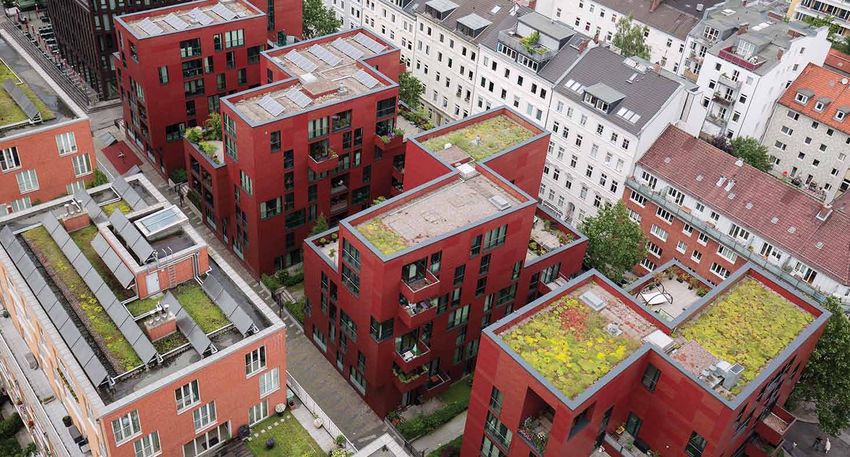
Price comparison - construction costs

Roof surface swept
clean (1)
                                 40           70           100              130          160              190           220         250   [€]       1,2 %

Delivery and installa-
tion of separating and
protective foil (1)             400        460           520          580         640          700          760            820      880   [€]       4,6 %

Delivery and installati-
on of storage protec-
tion mat (1)                    600        750           900      1050            1200        1350         1500         1650       1800 [€]          8,1 %

Delivery and installation
of drainage and water
storage element (1)            2000                    2500                       3000                     3500                    4000 [€]             22,3 %

Delivery and installa-
tion of system filter (1)

                                300                400                 500                600                     700               800   [€]                4,5 %

Gravel edging 100 mm (2)

                               1500                    2000                       2500                     3000                    3500 [€]                    17,8 %
Delivery and ins-
tallation of gravel
strips (3)                      500                    1000                       1500                     2000                    2500 [€]          10,1 %

Building maintenance
paths, concrete slabs (4)

                                 20             30               40               50                 60               70             80   [€]        < 1,0 %
Delivery and installa-
tion of substrate (5)

                               1500             2000           2500               3000           3500               4000           4500 [€]            20,6 %
Delivery and installati-
on of dry seeding (5)                                                                                           2

                                500                600                 700                800                    900               1000 [€]                   5,9 %
Establishment main-
tenance of seeding
(ext.) (1) (5) (6)
                                200          300           400              500          600              700           800         900   [€]                  3,4 %
Irrigation of
seeding (5)

                                 0         50        100       150          200         250      300            350        400      450   [€]                  1,3 %

    SUM (1)                                                                                                                                                 100 %             09

                              10.000       11.000        12.000  13.000    14.000                     15.000          16.000       17.000 [€]
                                34          37           40     43      46       49                       52             55          58    [€/m2]

(1) Quantity = 295 m2 / (2) Quantity = 130 m / (3) Quantity = 75 m2 / (4) Quantity = 20 m2 /
(5) Quantity = 220 m2 / (6) Establishment maintenance: Irrigation in dry months,
filling-in of gaps between plants and removal of fast-growing, invasive foreign plants
                                                                                                 Value           min.         to       mean value       to             max.

   Fig. 2 – Price comparison after evaluation of offers for an extensive green roof (roof area 300 m²) in 2016
HAMBURG‘S GREEN ROOFS

     A Cost Comparison

        Selected buildings

     This publication presents nine of Hamburg‘s buil-        Each roof examined is unique and has certain pe-
     dings. Seven buildings have an extensive green roof,     culiarities that also affect the price, and which are
     one an intensive green roof and one a conventional       shown in the table on the following page. All the
     black roof, which is used in this study as a reference   roofs were built after the turn of the millennium:
     value for green roofs. The buildings have various        The oldest roof dates from 2006; the newer ones
     functions: public emergency service, schools, sports     from 2012, 2014 and 2015, or they were completed
     halls, retail and residential.                           in 2016 at the beginning of, or during, the study. All
                                                              cost parameters were calculated using a construc-
     This mix of uses is also reflected in the building si-   tion price index (May 2017) in order to make them
     zes, which range from 232 m² to 5,360 m² of usable       clearly comparable.
     area (UFA). Multi-storey buildings are as common
     as single-storey buildings. The flat roof areas range    All of the buildings investigated are presented on
     from 196 m² for a small entry building to 1,944 m²       the following pages in a short profile in order to
     for a 3-field sports hall. This means that the size of   make the mix of factors more perceptible.
     the roof areas is typical for urban areas, but by no
     means on a par with industrial production halls. The
     costs can also be transferred to residential const-
     ruction due to the comparable size of the areas.

10   Just as the number of storeys and type of use in the
     group of examined roofs fluctuate, so too do the
     building costs. This changes the proportion of green
     roof costs regarding the overall building costs and
     the ratio of green roof costs to total roof costs (see
     Fig. 3, pp. 12/13).
Indices (some definitions) • Roof costs: This refers to the sum of the costs of all
In order to be able to economically evaluate Hamburg‘s the positions for the construction of the entire roof -
green roofs, the following indices were applied: including roof greening. This corresponds to cost group
360 (roofs) according to DIN 276-1 (2008) - Building
• Useable area (UFA): Partial area of the net internal
Costs (Building Construction). Expressed in €.
area (NIA), which serves the essential purpose of the
building, according to DIN 277 (2016) - Floor areas and • Green roof costs: This refers to the sum of the costs
spatial contents in the building industry (building construc- for green roofs (including establishment maintenance
tion). Expressed in m². - excluding root-resistant waterproofing). These costs 11
can be part of cost group 360 (roofs) or cost group
• Building costs: This is the sum of the costs of all the
500 (outdoor facilities) according to DIN 276-1 (2008)
positions for the construction of the entire building.
- Building Costs (Building Construction). Expressed in €
Costs that result as the sum of cost group 300 (buil-
ding – construction work) and 400 (building - techni- • All costs are gross, including VAT.
cal systems) according to DIN 276-1 – Building Costs
(Building Construction). Expressed in €. iHAMBURG‘S GREEN ROOFS
Building number 1 2 3 4
Main use Ochsenzoll Fire brigade School / Sport Othmarschen
Location Rescue Station Moorwerder Barmbek-Süd (A) Rescue Station
Client HGV (4) (B,C) HGV (4) (B,C) School building (D) HGV (4) (B,C)
Year built 2009 2016 2014 2016
Usable area (1) 232 m2 349 m2 774 m2
(5)
1.875 m2
Cost of construction (2)
569.902 € 1.015.979 € 5.849.707 € 5.763.807 €
Cost parameters per m2 2.456 €/m2 2.909 €/m2 1.987 €/m2 3.074 €/m2
useable area
Type of roof GR Extensiv GR Extensiv GR intensive GR extensive
Roof area 196 m2 414 m2 591 m2 1.000 m2
Green roof costs 14.242 € 18.077 € 34.562 € 43.361,22 €
Green roof costs per m2 73 €/m2 44 €/m2 58 €/m2 43 €/m2
Roof costs (3) 48.319 € 57.685 € - 210.876 €
Share of green roof costs in 2,5 % 1,8 % 0,6 % 0,75 %
building costs
Roof waterproofing costs - - - -
12
Costs of roof waterproofing - - - -
per roof area in m2
(A) Gebäudemanagement Hamburg GmbH [GMH] / (B) Hamburger Gesellschaft für Vermögens- und Beteiligungsmanagement mbH [HGV] /
(C) Sprinkenhof GmbH / (D) SBH Schulbau Hamburg / (E) SAGA Unternehmensgruppe Hamburg.
Fig. 3 – Compilation of the buildings in Hamburg, with and without green roofs5 6 7 8 9
School / Sport Poppenbüttel School / Sport Harburg retirement Sport
Wilhelmsburg retail business Barmbek-Süd (B) complex Eppendorf
GMH (A) SAGA (E) School building (D) SAGA (E) School building (D)
2015 2006 2014 2015 2012
1.264 m2 1.200 m2 1.946 m2 5.360 m2 2.424 m2
2.188.961 € 1.327.513 € 4.986.069 € 15.303.054 € 4.699.416 €
1.732 €/m2 1.106 €/m2 2.562 €/m2 2.855 €/m2 1.939 €/m2
Bitumen roof GR extensive GR extensive GR extensive GR extensive
1.050 m2 1.130 m2 1.214 m2 1.382 m2 1.944 m2
- 33.096 € 57.204 € 59.305 € 103.533 €
- 29 €/m2 47 €/m2 43 €/m2 53 €/m2
138.362 € - - - 390.515 €
(6)
1,4 % 2,5 % 1,2 % 0,39 % 2,2 %
30.690 € 21.098 € - - -
13
29 €/m2 19 €/m2 - - -
(1) Usable area (UFA) according to DIN 277 Floor Area and Volume in the Building Industry (Building Construction) / (2) Building costs
KG 300-400 according to DIN 276-1 (Costs in Building Construction) / (3) Roof costs: the sum of the costs of all items for the cons-
truction of the entire roof - corresponds to cost group 360 (roofs) according to DIN 276-1 / (4) Represented by Sprinkenhof GmbH /
(5) The usable area of the entire building is 2,944 m2 / (6) In this case, the building has a black roof, and only the cost of waterproofing
was determined. All prices are in euros and calculated according to a construction price index from May, 2017HAMBURG‘S GREEN ROOFS
The Ochsenzoll Rescue Station (1) and the Moor- The senior housing complex in Harburg (8) is also
werder Fire Brigade (2) are comparatively small somewhat more expensive in its price/m² for the
buildings. They only have one storey and thus have green roofs, because it concerns the four separate,
an economically less favourable ratio of roof area and thus in each case smaller, roofs of the individual
to building size; and building components, such as residential towers.
the roof or green roof, become significantly more
expensive. The sports hall in Eppendorf (9) has the largest
roof area, which can compensate for a certain
The school in Barmbek-Süd (3) has a complex amount of elements that increase the circumference
sports hall building spatially connected to the of the building. Although the total area consists of
school building. The building costs could not be four individual roofs that have large skylights, it is
calculated separately for the school building and not too far off the usual price/m².
the hall with green roof. The sports hall has a large
number of skylights and is the only building with an
intensive green roof. It is thus unique in this investi-
gation. Results
The Othmarschen Rescue Station (4) is a two- The adjacent diagram shows that the larger the
storey building with a medium-sized green roof area green roof is, the lower the green roof costs per m²
and has a favourable ratio of circumference to area. of roof area are.
The building shows slightly below-average green
roof costs per square metre of roof area. Construction costs and vegetation area
If green roof costs are set in relation to the respec-
The school in Wilhelmsburg (5) is the reference roof tive roof area, it becomes obvious that the costs
and has double-layer bitumen sheeting. for most extensive green roofs are in the range of
40-45 €/m² roof area (the reference value is the
The single-storey retail building in Poppenbüttel total roof area in row 11 of Fig. 3). Of these average
14 (6), connected to SAGA residential building, dates costs, about 30 % are attributable to the gravel strip
from 2006 and is characterised by an extraordinari- and gravel edging service positions for green roofs
ly cost-effective extensive roof with a simple form. (see p. 8, point (2) and (3), as well as Fig. 2), which,
under cost-optimisation aspects can be somewhat
The sports hall in Barmbek-Süd (7) has several reduced.
large skylights that lengthen the surrounding edges
of the green roof, thus making the price/m² of roof As expected, the intensive green roof is by far more
area slightly more expensive than expected. expensive per square metre of roof area (58 €/m²)
due to the more demanding nature of its planting.Due to the direct visual reference to the roof at Green roof costs and building costs
the school in Barmbek (3), however, there is also an On average, the costs of the (green) roof account
additional aesthetic benefit. for about 1.5 % of the building costs for one- to
two-storey buildings. In the six-storey residential
Green roof costs and useable area (UFA) complex in Harburg (8), the share of the green roof
Green roof costs in relation to the useable area costs is only about 0.4 %.
(UFA) range from 11 to 61 €/m² UFA, with an mean
value of 33 €/m² UFA (see Fig. 4). The intensive greening of the two-part school
sports building in Barmbek (3) is also well below
It is noteworthy that the extensive green roof of the the average, with green roof costs accounting for
senior housing complex in Harburg (8) (UFA: 5,360 approx. 0.6% of the building costs for the entire
m2) is 18 € below the square metre ratio of the building. However, only about half of the total roof
reference roof (7) in Barmbek-Süd (UFA: 1,946 m2). area was designed as a green roof, and had the
This is a comparison between a six-storey residenti- higher construction costs associated with intensive
al building and a one-storey sports hall. greening.
This shows the positive influence multi-storey buil-
dings have on average green roof costs per usable
area, which is a particularly relevant parameter for
residential construction.
Relation: Green roof costs per m2 roof area
Green roof costs (per m2 roof area) and roof area 5 6 8 4 2
1 [€/m2] 7 9 3 1
Green roof costs [€ ]
70
0 10 20 30 40 50 60 70 80
60
3 Green roof costs per m2 useful area (UFA)
4 5 6 7
[€/m2] 8 9 3 2 1
9
50
0 10 20 30 40 50 60 70
7
2 4 8
Buildings:
40 15
1 Ochsenzoll 4 Othmarschen 7 Barmbek-Süd (B)
2 Moorwerder 5 Wilhelmsburg 8 Harburg
Herstel-
3 Barmbek-Süd (A) 6 Poppenbüttel 9 Eppendorf
kosten
lungs-
5 6 30
Roof area [m2] Legend: Buildings
500 1000 1500 2000 Mean value
Fig. 4 – Green roof costs in relation to the roof area and the useful areaLIFE CYCLE COSTS
Economic Life Cycle Assessment
In addition to the analysis of construction costs, (Buildings 4, 6, 7, 8, Fig. 3). All have approximately
an economic life cycle analysis also includes the the same roof size of 1,000 to 1,300 m2. The
consideration of care, maintenance and repair different roof waterproofing costs in the real data
costs as well as considerations of demolition and were adjusted to avoid distorting the comparison
refurbishment at the end of service life. Further- (see footnotes in Fig. 5). The exemplary balance
more, reduced costs such as rainwater drainage sheet included:
fees are included.
• the construction costs of the buildings under
Service Life investigation: see chapter Hamburg‘s Green-
Roofs
Care begins with the completion care, which inclu- • expected maintenance costs: 0.25 € (m2/a) for
des all measures necessary for the growth of the the black roof, 0.60 € (m2/a) for the green roof
vegetation in the first year. It is therefore consi- • Rainwater drainage fees: 0.73 €/m² per year
dered to be part of construction costs. Successful for the black roof, 50 % of that for the extensive
growth means that about 60% of the substrate‘s green roof.
surface is covered by vegetation.
Thanks to the fact that sealing the roof protects
After the final inspection of the building, general against UV and infrared radiation, extreme weather
maintenance services according to DIN 18919 events (e.g. hail) and drastic temperature fluctua-
becomes relevant for the long-term preservation of tions, the life expectancy of a green roof increases
a green roof‘s advantages. Approximately two to to 30-50 years. In contrast, a black roof is subject
four maintenance visits per year are to be expected; to regular renovation cycles every 15-25 years
the amount of maintenance required depends on (BBSR, 2017). Additional demolition costs for the
the type of vegetation. An extensive green roof with old roof are not included in this comparison, as no
grasses may require the following work: weeding, in data is available. Periods of 40 and 20 years were
particular the fire protection strips, pruning, fertili- chosen for this comparison.
sing, irrigation of inclined and particularly exposed
areas, replanting of bare and eroded areas, and A constant interest rate of 3% per year is assumed
plant protection measures. Extensive sedum roofs in order to take long-term price trends into account.
are considered to be largely self-sustaining and easy
to maintain in the long term.
results
Factors and assumptions The adjacent graph and table overview show that
even if other positive cost factors are neglected,
Since no data on maintenance care are yet available green roofs can, in the long term, have similar or
for the green roofs examined, empirical values even slightly lower costs than bitumen roofs.
of 0.50 €/m² to 2.00 €/m² of vegetation area
and year must suffice (Sproul et al., 2013; SBH This result is in line with the results of cost-benefit
Schulbau Hamburg). The costs depend on roof size, analyses previously carried out by various authors
accessibility and green roof construction. (see, e.g. Mann, 2005), who established the long-
16 term financial advantages of green roofs over non-
Other cost factors that are difficult to predict were green roofs as early as the late 1990s.
not included in the compilation of Figures 5 and 6.
These include maintenance costs for minor repairs
and, in particular, savings in energy costs, which
can have a positive effect on the cost balance in the
long term. This analysis compares a bitumen roof
to the average costs of four extensive green roofsTYPE OF COST Green roof Black roof
(1.000 m²) (1.000 m²)
1. One-time costs
Construction costs 65.000 24.000
Green roof costs (€/m²) (1) 41
Sealing costs (€/m²) (2) 24 24
Renovation after 20 years (€) (3) 0 43.347
Sum of one-time costs 65.000 67.347
2. Running costs (over 40 years)
Maintenance care 24.102 10.043
(per year: green roof 0.60 €/m², bitumen roof 0.25 €/m²)(3)
Rain water charge (€) 14.235 28.470
Sum of running costs (€) 38.337 38.513
Total sum of a 40-year cycle (€) 103.337 105.859
Difference in cost compared to green roof (€) + 2.522
Total sum of a 40-year cycle (€/m2) 103 106
Difference in cost compared to green roof (€/m2) +3
(1) (1) Average value of buildings 4, 6, 7, 8 Fig. 3 / (2) Average value of real costs, in order to obtain the same basis /
(3) Interest rate: 3% per year
Fig. 5 – Economic life cycle assessment
A B C B Black roof
120.000
Costs [€ ]
of
Black ro
100.000
roof
Green
80.000
60.000
40.000
17
20.000
0 [Years]
0 10 20 30 40
A B Gren roof
A Construction B Service life C Renovation
Fig. 6 – Graphic illustration of life cycle assessment for 40 yearsLIFE CYCLE COSTS
Economic benefits
A representative greening of a building leads to
an increase in the value of the property and to an Under nature-conservation-related intervention and
image gain. If green roofs are planned as useable compensation regulations, green roofs are included
roofs and architecturally integrated, buildings, in the balance as a reduction measure. In this way,
residents and employees all benefit. According to an intervention in a site‘s ecological values can be
an estimate by TÜV Süddeutschland, the financi- partially compensated for directly on site, and the
al “green added value” of usable intensive green need for expensive compensatory measures can be
roofs was 6-8% more rental income. reduced elsewhere.
However, according to the current state of research
Used green roof = habitat and developments in construction practice, these
and subsequent aspects are not yet clearly quanti-
Green roofs can be designed as usable open space fiable in monetary terms, but according to empirical
with little additional effort. This space can then be values and calculations they do indeed provide a fi-
made available to owners, tenants and/or emplo- nancial advantage (all the following data see Pfoser
yees, and - especially in densely populated inner et al., 2013, and GERICS, 2017).
city areas - supplement the limited amount of public
space for recreation, health and leisure. Green roofs
create additional green space on the same site wit-
hout additional land acquisition costs. The synergy effects of insulation
If the green roof is made with elements certified for
Profitable use of roofs their insulating performance, direct savings can be
18 made regarding the construction costs: The green
With a green roof, companies actively demonstra- roof will be included in calculations as a functional,
te that they are acting sustainably and making a integrative component of the roof, instead of being
contribution to the diversity of nature in the city, considered as an added cost, as savings can be
thus creating competitive advantages for themsel- made on the insulation layer. In the winter heating
ves. Within the framework of DGNB certification costs will be less, and in the summer the evapora-
for sustainable construction, green roofs are rated tive cooling and thermal inertia of the living roof
as positive, so that green roofs can be quantified will provide cooler temperatures, especially in often
directly. overheated top floors. This cooling performancehas financial advantages: Running energy costs with a delay and reduced flow, drainage systems are
(and CO2 emissions) are reduced, and smaller-sized relieved. This effect can be further increased with
cooling systems can be purchased. In the case of special retention roofs. This in turn results in smal-
large halls, the construction of cooling systems can ler on-site infiltration or retention systems, which
possibly be omitted, permanently reducing energy can also save costs.
costs.
The combination of green roofs with rainwater har-
vesting systems is possible if the quantity of water
In combination with photovoltaics is sufficient. The filter function of green roofs only
changes the colour of the water, which can be used
Green roofs, which are often up to 40º (C) cooler for toilet systems or irrigation. The savings are two-
in summer than bitumen roofs, serve as a base for fold: Through the use of an additional storage tank
the mounting elements of photovoltaic modules, the building can be completely freed from having
increasing the efficiency of the systems by up to 3 % to pay rainwater drainage fees, and drinking water
per year and thus shortening the payback period of costs can be reduced at the same time.
such an investment.
Local climate and air improvement Inner-city climate effects
The microclimate on the roof, and, to a lesser ex- Since climate change is likely to not only lead to
tent, around a building becomes cooler in summer an increase in heavy rainfall but also to longer and
due to the evaporative cooling effects of a breathing more frequent hot spells, the positive influence of
roof. Air humidity is increased when on hot days being able to regulate the climate of surrounding
up to 0.5 l/m² of water is evaporated through the areas should not be neglected. This can influence
surface of leaves. In addition, up to 20% of various the attractiveness of entire districts. However, the
air pollutants are reduced, for example a green roof desired effect can only be achieved if green roofs 19
can bind dust particles. are built throughout a city.
Sustainable water management
Since extensive green roofs also retain up to 50-70
% of annual precipitation and up to 30-40 % of a
heavy rainfall, and either evaporate or discharge itLIFE CYCLE COSTS / PLANNING SECURITY
So-called “indirect additional costs of a green lead to any additional expenditures. If a green roof
roof” are often included in debates about the is planned (independently of a gravel roof) for a
cost of green roofs. This study therefore included reinforced concrete roof using solid construction,
numerous technical discussions with architects, with bitumen or plastic sheeting as a protective
structural engineers and construction supervisors layer, about 2 kg of additional reinforcement per m²
concerning the following aspects, and the explana- roof area must be provided for structural reasons.
tions briefly summarise the results of the discus- The foundations do not have to be reinforced as
sions. the loads are too low. The additional costs for the
extensive greening of a building in terms of total
Attic height statics are 3-4 € per m² roof area, according to ex-
perts. With a flat, wooden type of roof construction,
If an attic is not high enough from the outset, the reinforcement of the beams should be considered,
height of the green roof may make it necessary to which can lead to additional costs of 6-7 € per m²
raise the attic by about ten centimetres. If the attic is of roof surface if a green roof is planned (Prof. Dr.
raised by 10 cm, approx. 15-20 € per running metre Hans-Hermann Sass, structural engineer, 2017). .
will be required, depending on the design (facing
brick or plaster facade) (Prof. Dr. Hans-Hermann Sass,
structural engineer, 2017). With regard to one square Roof waterproofing
metre of green roof, costs of about 6.50 € to 8.50 €
per square metre of roof surface for a plaster facade According to the FLL, the construction costs of
or facing attic should be calculated (see example, p. root-resistant roof waterproofing vary depending
9 with approx. 130 m roof edge border and a 300 m² on the product, and are cost-neutral compared to a
roof surface). However, with many green roof projects non-root-resistant waterproofing system if selected
(both new construction and renovation) alternative correctly. For this reason, root-resistant roof water-
solutions are found in order to avoid these costs. In proofing systems are now generally used in practi-
accordance with DIN requirements, for example, a ce, even when a green roof is not used, as there is
set-back gravel edging strip is often used in green a desire to minimise the risk of root penetration
roof construction in order to prevent it from reaching caused by the growth of spontaneous vegetation.
the attic, thus avoiding the need for a higher struc-
ture. Depending on the wind load, the strip of roof
cladding between the gravel edging strip and the attic Construction process
is protected with gravel or concrete slabs. and scaffolding
The construction process is influenced by many fac-
20
statics tors. If the construction process is properly planned,
the construction of a green roof will take no longer
The consideration of an additional load regarding than it does with a conventional roof. As a rule, no
the statics depends on the chosen roof construction special scaffolding is required for the construction
and the desired green roof type. For a gravel roof, a of a green roof, as the material is brought to the
load of 100 kg/m² must be assumed, which corres- roof by cranes and/or pumps.
ponds to the usual average of a standard extensive
green roof (80-200 kg/m²) and therefore does notPlanning Security with Regard to Costs
What happens next?
Planning security is an important criterion in the pletion care up to December 2019. The additional
construction of green roofs. A comprehensive con- funding of open space areas, rain retention, the
sideration of life cycle costs as well as a weighing mounting of solar systems and inner-city locations
of costs and benefits only makes sense if their is possible (see Hamburger Gründachförderung at
marginal conditions do not change unexpectedly. the IFB Hamburg: www.ifbhh.de).
The goal of the “Dialogue” is to address the public,
Water management: Fee splitting planners and owners of buildings in various ways in
order to exchange facts and good examples, and to
In 2012 Hamburg‘s water management authori- convince them of the strategy‘s virtues.
ties introduced so-called “fee splitting”, which was
already common in many other cities and munici- On the third level of action, “Regulation”, the const-
palities in Germany. This makes it possible to take ruction of green roofs has been made a requirement
the retention function of green roofs into account: in development plans in order to commit both the
Annual rain water charges in Hamburg are 50% less city and private investors through a binding frame-
per m² of green roof. If necessary, the fee can even work regarding new construction.
be waived completely if rain water is managed on
the property itself. There is no indication that this All in all, this means Hamburg has created a basis
fee-splitting will be done away with in the next few for the construction of green roofs and that the
years. decision-making framework will essentially remain
constant.
Green roof strategy
The Hamburg Senate‘s Green Roof Strategy has
been implemented since 2014 in order to promote
“Financial Incentive, Dialogue and Regulation”
Regarding the aspect of “Financial Incentive”, the lo- 21
cal Ministry of Environment and Energy has created
funding guidelines, on the basis of which the Ham-
burg Investment and Development Bank (IFB) has a
budget of € 3 million to use for funding applications
for voluntary green roof projects on new buildings
or for renovations. This provides property owners
with support ranging from 14 €/m² to approx. 56 €/
m² of green roof, plus 50% of the costs for com-conclusion
Conclusion
After evaluating the data, it can be concluded that, • The production costs of a (green) roof amoun-
especially in multi-storey residential construction, ted to about 1.3% of the total construction
an increase in investment costs due to green roofs costs of a building. With a six-storey residential
can be well below 1% of total construction costs. building, the green roof accounted for about
The life cycle costs over 40 years are comparable 0.4 % of the building costs.
to those of black roofs. The range of prices for con- • The ability to include green roofs in the inter-
struction costs submitted by bidders is very wide. vention-compensation balance in accordance
In order to reduce costs, it is advisable to obtain with nature conservation regulations reduces
several offers from different companies who use compensation costs needed elsewhere.
systems made by a variety of manufacturers, and to
• The economic value of improving people‘s
optimise the use of building materials and technical
working and living environments, of upgrading
construction methods during planning.
the architecture, the microclimate and airborne
Individual conclusions: sound insulation, the filtering of air pollutants,
• The subsequent evaluation of documents con- the increasing of biodiversity and improving of
cerning the cost of green roofs is very complex. energy conservation is difficult to determine.
For many projects and building owners these • Savings through green roofs are possible due
are not available in a form that can be evalua- to a reduction of drainage costs, the protection
ted. Due to different designs, comparisons can of roof waterproofing and an increase in the
only be made with great care. efficiency of photovoltaic systems.
• The construction costs of extensive green roofs • In the context of DGNB (German Sustainable
- depending on the respective vegetation area - Building Council) certification for sustainable
were in the range of 40 to 45 €/m² of roof area. building, green roofs are rated as positive.
• For a square metre of planned usable area, the • Using green roofs for leisure and recreation
mostly single-storey examples in this study creates the potential to generate additional
required around 32 €/m² for an extensive green income from sales, rentals or leases.
roof. In the case of the six-storey building, how-
ever, the costs were, at 9 €/m², much lower.
• According to experts, with sufficiently good
planning no relevant additional costs were iden-
22 tified regarding statics, the height of parapets
or the construction process. Additional statics-
related costs for extensive vegetation are at
most 3-4 €/m², while an increase in the parapet
height is not necessarily required, and if it was,
the costs were approx. 6.50 - 8.50 €/m². During
the course of construction other costs were not
usually incurred.Acknowledgements Many thanks to all who have contributed to this survey with their expertise. In particular, our thanks go to Dohse Architekten, 23 Hamburg // Hamburg Investment and Development Bank // Expert Bernd W. Krupka, Bad Pyrmont // R plus Architekten GmbH, Hamburg // SAGA Siedlungs-Aktiengesellschaft Hamburg // structural engineer Prof. Dr. Hans-Herrmann Sass, Hemdingen // SBH Schulbau Hamburg // Sprinkenhof GmbH, Hamburg // Tchoban Voss Architekten, Hamburg // tun-architektur, Hamburg
You can also read


