Consumers' Intentions towards Green Hotels in China: An Empirical Study Based on Extended Norm Activation Model
←
→
Page content transcription
If your browser does not render page correctly, please read the page content below
sustainability

Article
Consumers’ Intentions towards Green Hotels in China: An
Empirical Study Based on Extended Norm Activation Model
Hongru Yan *            and Huaqi Chai

                                          School of Management, Northwestern Polytechnical University, Xi’an 710072, China; chaifam@nwpu.edu.cn
                                          * Correspondence: yanhongru@mail.nwpu.edu.cn

                                          Abstract: Although the occupancy rate of green hotels is a hot topic in the sustainable tourism
                                          economy, few empirical studies have used the expanded norm activation model to explore what
                                          drives consumers’ intentions to stay at green hotels. This study took environmental concern and
                                          perceived consumer effectiveness as antecedents, and perceived price, policy, and publicity as
                                          moderator variables to broaden the norm activation mode to explore consumers’ willingness to stay
                                          at green hotels. The hypothesis was tested in a survey that comprised a sample size of 435 participants
                                          in China. The outcomes exhibited environmental concern, and perceived consumer effectiveness as
                                          having a significant positive influence on personal norm and behavioral intention. Perceived price,
                                          as the external cost, negatively moderated the relationship between personal norm and consumers’
                                          behavioral intentions. Policy and publicity had a positive moderating impact on the link between
                                          personal norms and consumers’ behavioral intentions.

                                          Keywords: green hotel; consumers’ intention to stay in green hotels; extended norm activation
                                          model; environmental concern; perceived consumer effectiveness


Citation: Yan, H.; Chai, H.
                                          1. Introduction
Consumers’ Intentions towards Green
Hotels in China: An Empirical Study            Hotels are an energy- and water-intensive industrial sector that rigorously consume
Based on Extended Norm Activation         non-renewable resources and generate greenhouse gases [1]. The literature [2] shows that
Model. Sustainability 2021, 13, 2165.     75% of the negative environmental effects in hotels are caused by the unreasonable use
https://doi.org/10.3390/su13042165        of natural resources. Therefore, an increasing number of hotels are adopting proactive
                                          approaches for environment management so as to increase their competitive advantage [3].
Academic Editor: Andrea Pérez             One of the most effective ways is to guide consumers to participate in the hotels’ green
Received: 20 January 2021                 practices and improve their environmental awareness [4,5]. When consumers’ awareness of
Accepted: 12 February 2021                environmental protection increases, the occupancy rate of green hotels increases, promoting
Published: 18 February 2021               the sustainable development of green hotels [6].
                                               Previous research [7,8] suggests the planned behavior theory (TPB) is widely used for
Publisher’s Note: MDPI stays neutral      exploring consumers’ intention to stay at a green hotel. TPB is a social cognitive model
with regard to jurisdictional claims in   of human behavior. It takes a personal interest as the starting point and assumes one’s
published maps and institutional affil-   environmental protection intention and behavior [9]. However, such pro-environmental
iations.
                                          intention or actions are activated by self-interest and pro-social motives [10]. Scholars who
                                          believe that personal environmental intentions and behaviors are motivated by pro-social
                                          motives always adopt normative activation models (NAM) [11].
                                               NAM is one of the characteristic theories of altruistic behavior, and is widely applied
Copyright: © 2021 by the authors.         to predict consumers’ eco-friendly intention and behavior, including sustainable trans-
Licensee MDPI, Basel, Switzerland.        portation behavior [12] and recycling behavior [13]. It is a pity that the NAM model is
This article is an open access article    only centered on interior moral factors, while ignoring the external factors. To improve the
distributed under the terms and           interpretation of NAM, researchers have broadened NAM by merging external factors in
conditions of the Creative Commons
                                          pro-environmental field [14,15]: Perceived price and external publicity, which are crucial
Attribution (CC BY) license (https://
                                          external variables in the consumers’ decision-making process [16]. In addition, many
creativecommons.org/licenses/by/
                                          studies have only extended the antecedent variables of personal norms by environmental
4.0/).

Sustainability 2021, 13, 2165. https://doi.org/10.3390/su13042165                                   https://www.mdpi.com/journal/sustainability
Sustainability 2021, 13, 2165 2 of 15
concern or perceived consumer effectiveness. Actually, both factors have an important
impact on consumer behavior [15,17]. Based on the research above, this paper took en-
vironmental concern and perceived consumer effectiveness as the antecedent variables
of personal norm, and perceived price, policy, and publicity as the moderating variables
to probe into determinants of consumers’ intention to stay at a green hotel. In 2019, the
China Hotel Association and Universon (Hong Kong) Hotel Management Company jointly
released the white paper on the Green Development of China’s Accommodation Industry
in 2019. The report shows that the number of green hotels has been surging since 2017,
and green hotels are performing well. Therefore, this paper took the emerging green hotel
economy market in developing countries (i.e., China) as its research background to verify
the proposed hypothesis.
This study had the following research contributions: First, we proposed an extended
NAM for testing how altruism affects green hotel occupancy intention, enriching the
literature on green hotels. Secondly, the model put forward a new insight to extend NAM,
introducing perceived price, policy, and publicity as moderating variables to examine
how external factors affect the link between personal norms and green hotel occupancy
intention. Finally, to achieve a full NAM, environmental concern and perceived consumer
effectiveness were designed to test their impact on personal norms and intention to stay at
a green hotel.
The rest of the article proceeds below: The second part introduces the relevant lit-
erature on green hotels and NAM. The third part describes the research model and as-
sumptions. Sections 4 and 5 show the research methodology, data analysis, and outcomes.
Finally, this paper exhibits the discussion, the practical implications, the restrictions, and
future investigation prospects.
2. Literature Review
2.1. Environmental Hotel Practices
Growing public concern has prompted the hotel sector for implementing environmen-
tal responsibility management. “Green hotel” means an eco-friendly hotel that implements
environmental protection measures, such as water/energy conservation, eco-friendly pro-
curement policies, and emission/solid waste reduction for protecting nature [18]. Some
clear green initiatives include low flow toilets, hotel room and lobby lighting control key
cards, and creating eco-friendly awareness [19,20].
Sustainable hotel management practices, such as water conservation and solid waste
reduction, have a positive impact on visitors’ willingness to stay in a green hotel [21].
Descriptive norms play a critical role in encouraging consumers to reuse towels in hotel.
Enhancing moral norms was of great importance to promote guests’ intention of water
conservation [22]. In addition, the green implementation of hotels may not only increase
stakeholder pressure and improve competitive advantage and reputation, but also enhance
company performance and thus reduce costs by limiting the resources [23].
2.2. Normative Activation Model (NAM)
NAM is an important theory for studying altruistic behavior in social psychology. It is
widely adopted in the investigation of environmental protection intention and behavior.
Personal norms, awareness of consequences, and ascription of responsibility are the three
main variables in NAM [11]. Extensive research has shown that NAM can be expanded
by increasing the antecedents’ variables and integrating external factors. For instance, in
the empirical research of how to activate consumers’ moral norms, perceived consumer
effectiveness resulted in consumers’ personal norms and behavior intention [14,24], while
environmental concern is also considered to be one of the important antecedent variables
affecting consumers’ personal norms [5,17]. In addition, external costs negatively moderate
impact on the link between consumers’ personal norm and behavioral intention [14] and
policies and publicity positively moderate impact on the link between personal norms and
consumers’ behavioral intention [15]. However, few studies have incorporated perceivedSustainability 2021, 13, 2165 3 of 15
consumer effectiveness and environmental concern as antecedent variables of personal
norms, or perceived price, policy, and publicity as external factors into one model to study
consumers’ willingness to stay in green hotels. Therefore, this paper designed a new
theoretical model (extended NAM) to study consumers’ intention to stay at a green hotel.
3. Investigation Model and Assumptions
3.1. The NAM Original Model
In the NAM model, personal norms mean “having a moral obligation to do and not do
something” [25] and awareness of consequence is depicted as whether “one can assess the
consequences of not doing these” [26]. The ascription of responsibility is depicted as “If you
have non-environmental behavior, then you have to take the responsibility” [26]. Personal
norms are the core predictor of pro-environmental intention. Once personal norms are
activated, they feel obliged to do environmentally friendly behavior [11]. Awareness of
consequences and ascription of responsibility result in personal norms [27]. On the contrary,
if awareness of consequences and ascription of responsibility are reduced, the conduct is
unlikely to conform to current personal norms. Previous studies have established that the
NAM model is a valuable theoretical framework for predicting green travel intention [28]
and intention to adopting energy-saving appliances [15]. In addition, the NAM is supported
in the hospitality and tourism industry. For instance, the emotional process is incorporated
in NAM to explain travelers’ behavioral intentions [26]. The extended NAM was applied in
hotel guests’ eco-friendly decision-formulation course [29]. Hence, the hypotheses below
were formulated:
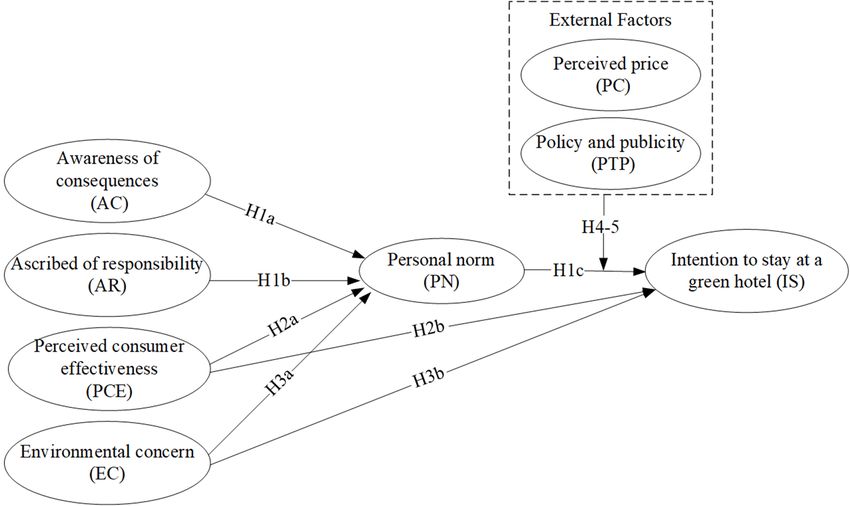
Assumption H1a: Awareness of consequences positively affects consumers’ personal norms;
Assumption H1b: Ascription of responsibility positively affects consumers’ personal norms;
Assumption H1c: Personal norms positively affect consumers’ intention to stay at a green hotel.
3.2. Perceived Consumer Effectiveness
Perceived consumer effectiveness was first proposed as a belief in a specific field;
that is, individuals can work hard to solve problems. Perceived consumer effectiveness
describes behavior through the combination of consumer perception and social cognitive
attitudes [30]. In the environment field, perceived consumer effectiveness is depicted
as an individual who can do something to reduce environmental pollution [31], which
is related to consumers’ perceptions regarding ethical and environmental issues. It has
previously been observed that perceived consumer effectiveness is considered as a positive
factor towards consumers’ personal norms. As was indicated by [14], perceived consumer
effectiveness positively affects the intention of adopting electric vehicles. Perceived con-
sumer effectiveness significantly affects the residents’ personal norms about purchasing
energy-saving appliances [15]. If consumers believe that their consumption behavior has
brought benefits to the environment, they will make greater efforts for the environmental
protection [32]. Hence, it is deemed that if consumers believe staying in green hotel will
be good for environment, they will change traditional consumers’ behaviors and stay at
a green hotel. They are more inclined to have moral obligation to reduce environmental
pollution. The following hypothesis is put forward:
Assumption H2a: Perceived consumer effectiveness positively affects consumers’ personal norms.
A perceived consumer effectiveness is a person’ s assessment of his contribution to
the environment, which can guide consumers’ behaviors [33]. The higher the perceived
effectiveness of consumers, the easier it is for them to have a favorable attitude towards the
environment [34]. Perceived consumer effectiveness serves as a determinant of consumer’s
socially responsible consumption. In order to support this stance, as was indicated by [35],
perceived consumer effectiveness greatly affects pro-environmental behavior. When con-
sumers judge their abilities to improve environmental issue, they will make effort to exhibit
socially responsible behaviors [36,37]. In addition, high levels of perceived consumerSustainability 2021, 13, 2165 4 of 15
effectiveness encourage customers to choose more sustainable foods among young people
in Belgium [38]. Therefore, the hypothesis is posed as:
Assumption H2b: Perceived consumer effectiveness positively affects consumers’ intention to
stay at a green hotel.
3.3. Environmental Concern
With the alarming global warming situation, more and more people are becoming
serious about environmental issues [39]. They have realized that their purchasing behaviors
may affect the environmental performance of the enterprise [40]. Environmental concern
is a pro-environmental attitude [41]. Environmental concern is also defined as a person’s
emotional reactions, such as reservations, dislikes, and compassion [42] towards environ-
mental problems [43]. Therefore, environmental concern is a key factor in promoting a
family’s higher personal norms and indirectly encouraging households to change their
energy consumption [44]. According to the research of [45], environmental concern can
activate consumers’ personal norms towards organic food choice. The research of [46]
proved environmental concern positively affects personal norm. Hence, the assumption is
posed as:
Assumption H3a: Environmental concern positively affects consumers’ personal norms.
The existing investigation on the link between environmental concern and green
product purchase intention shows environmental concern positively affects consumers’
intention and behavior of environmental protection. The study of [47] exhibits that environ-
mental concern is a stronger predictor in greenhouse gas emissions. Environmental concern
was considered to be a main driving force of consumers’ intention to use autonomous elec-
tric vehicles [48]. Compared with the group with low environmental concerns, customers
with high environmental concerns are more willing to buy energy-saving appliances [15].
Customers with high environmental awareness are more willing to buy green products [49].
In the hotel industry, environmental concern has long been regarded as a positive attitude
towards green practice [50]. Therefore, concern for environmental issue is considered as an
important predictor on the intention of green consumption behavior. On basis of above
discussion, it features an assumption that:
Assumption H3b: Environmental concern positively affects consumers’ intention to stay at a
green hotel.
3.4. The Moderating Effect of Perceived Price
Price is a key parameter in marketing literature [51]. Perceived price can be described
as a subjective feeling of consumers on the monetary value of products [52]. When con-
sumers face new product attributes, they assume perceived price and perceived quality,
which affects perceived value and intention to purchase [53]. The lower the price of a
product, the more likely it is that consumer ethics will affect consumer behavior [54]. Green
goods are often not cheaper than traditional goods [55], and the price of organic food is re-
garded as a key consideration when consumers are making the decisions to purchase them.
Since organic food is not cheaper than general food items, on the other hand, researchers
argue that the high price is a key obstacle to consume organic food [56,57]. In addition, it
has been suggested that perceived price negatively moderates the link between consumers’
personal norms, and the intention to adopt electric bikes [15,58]. Although consumers have
a moral obligation to stay at a green hotel, they may not want to stay because they think
the cost is too high. Hence, this research suggests the assumption below:
Assumption H4: Perceived price negatively moderates the link between personal norm and
intention to stay at a green hotel.tween consumers’ personal norms, and the intention to adopt electric bikes [15,58]. Alt-
hough consumers have a moral obligation to stay at a green hotel, they may not want to
stay because they think the cost is too high. Hence, this research suggests the assumption
below:
Sustainability 2021, 13, 2165 5 of 15
Assumption H4: Perceived price negatively moderates the link between personal norm and in-
tention to stay at a green hotel.
3.5.
3.5. The
The Moderating
Moderating Effect
Effect of
of Policy
Policy and
and Publicity
Publicity
China’s
China’s carbon
carbon emission
emission trading
trading policy
policy holds
holds the
the key to promoting carbon emission
reduction
reduction and carbon
carbon dioxide
dioxide emission intensity [59]. As As presented
presented by by [60],
[60], environmental
environmental
policies will improve
policies improve carbon
carbonemission
emissionefficiency
efficiencybybyreducing
reducingenergy
energy intensity
intensity and adjusting
and adjust-
industrial
ing structure.
industrial These
structure. studies
These show
studies thatthat
show the the
implementation
implementation of national environmen-
of national environ-
tally friendly
mentally behavior
friendly policies
behavior significantly
policies affects
significantly the intention
affects and behavior
the intention and behaviorof environ-
of en-
mental protection. Furthermore, extensive research [61,62] has shown
vironmental protection. Furthermore, extensive research [61,62] has shown that the that the incentive
incen-
policy
tive of financial
policy subsidies
of financial affects
subsidies people’s
affects desire
people’s to purchase
desire energy-saving
to purchase appliances.
energy-saving appli-
For example,
ances. a survey
For example, of Florida’s
a survey use of energy-saving
of Florida’s and renewable
use of energy-saving energy products
and renewable energy
found that
products consumers
found tended totended
that consumers purchase green products
to purchase with financial
green products subsidies
with financial [63].
subsi-
Furthermore, effective information publicity can be to promote residents’
dies [63]. Furthermore, effective information publicity can be to promote residents’ behav- behavior in-
tentions around e-waste recycling, but cannot directly influence intention
ior intentions around e-waste recycling, but cannot directly influence intention [13]. Poli- [13]. Policies
and and
cies publicity havehave
publicity positively regulated
positively consumers’
regulated intentions
consumers’ to usetoenergy-conservation
intentions use energy-conser-
vation appliances [15]. Hence, on basis of the above discussion,be
appliances [15]. Hence, on basis of the above discussion, it can assumed
it can that: that:
be assumed
Assumption H5:
Assumption Policyand
H5: Policy andpublicity
publicityhave
have a positive
a positive moderation
moderation effect
effect on link
on the the link between
between per-
personal norms and intention to stay at a green hotel.
sonal norms and intention to stay at a green hotel.
On basis
On basis of
of the
the above
above analysis,
analysis, Figure
Figure 11 exhibits
exhibits aa conceptual
conceptualmodemodel:
l:
Figure
Figure 1.
1. Conceptual
Conceptual model.
model.
4. Research
4. Research Design
Design
4.1. Questionnaire
4.1. Questionnaire Design
Design
All measuring terms of constructs were adapted from the previous research. In NAM,
awareness of consequences (AC) was measured using four items from previous research
by [64]. The four options represented guests’ different perceptions of environmental
pollution caused by hotels. Ascribed of responsibility (AR) refers to responsibilities of
each hotel guest’s perception of the environment. We used three items to explore ascribed
responsibility from [65]. The items of personal norm (PN) were based on the existing
research results of [9]. They focused on personal feelings of living in a green hotel. The
three items of intention to stay at a green hotel (IS) stemmed from the previous research
of [50].Sustainability 2021, 13, 2165 6 of 15
To measure guests’ perceived consumer effectiveness (PCE), four items were devel-
oped [37]. Items included “Staying at a green hotel, everyone’s behavior will positively
affect society”, “I think staying in a green hotel can help save energy”, “I think staying in
a green hotel helps protect the environment”, and “I can’t do anything about protecting
environment”.
Environmental concern (EC) was assessed using three items from [66], which included
“I greatly focus on environmental issues”, “I have a sense of mission to conserve energy
and protect the environment”, and “I think choosing to stay at green hotel can reduce
environment pollution”.
The measurement of perceived price (PP) was based on previous research of [67],
which included “The price of a green hotel is expensive”, “The price of a green hotel is
higher than a non-green hotel”, and “The price of a green hotel is higher than expected”.
The items of policy and publicity (PTP) were developed on basis of [66]. Items
included “I’ve heard about the subsidy policy about staying at the green hotel”, “Energy
conservation and environmental protection work in our district has been greatly promoted”,
and “Policy advocacy of energy conservation and environmental protection behavior will
motivate me to choose green hotel”.
The questionnaires were originally designed in English. Firstly, the English version of
the questionnaires was translated into Chinese. Secondly, two professors and eight scholars
were invited to go through the questionnaire and improve it. Thirdly, a pilot test was
conducted on 50 subjects and the convergent validity and reliability of the questionnaire
were evaluated. Appendix A exhibits the final items of the questionnaire and references.
4.2. Samples and Procedures
In order to get data more efficiently and effectively, the questionnaires were carried
out in Beijing, Shanghai, Shenzhen, Wuhan, and Chengdu, between January 2019 and
September 2019. The five cities represent five major urban agglomerations where green
hotels are concentrated. The research objects were tourists participating in green tourism
and service providers engaged in green hotels.
The online questionnaire was utilized to collect data by Wenjuanxing, which is an
authoritative online questionnaire platform. Local travel agencies were invited to forward
online questionnaires to target groups. A total of 600 questionnaires were randomly
distributed and as a result 430 valid and complete questionnaires were sorted out. Table 1
exhibits the demographic features of the sample. Just over half the samples (51.5%) were
male and the rest 48.5% were female. Importantly, 77.8% of participants were aged between
21 and 45 years. The majority of participants (73.4%) were well educated, and they had
a bachelor’s degree or above. In terms of monthly income, 67.9% of them were above
5000 RMB, which is considered a good salary in these areas.
4.3. The Variance of Common Methods
In this study, the Harman single consideration test [68] was adopted for testing the
common method variance. The variance interpretation rate of the first common factor
extracted was 39.106%, which was less than 40% of the standard value, indicating that
there was no serious common factor variance in the data of this study.
Table 1. Demographic sample.
Demographic Variables Categories Frequency Percentage (%)
Male 224 51.5
Gender
Female 211 48.5
≤20 20 4.6
21–25 87 20.0Sustainability 2021, 13, 2165 7 of 15
Table 1. Cont.
Demographic Variables Categories Frequency Percentage (%)
26–35 164 37.7
36–45 92 21.1
Age
46–55 48 11.0
≥56 24 5.5
Junior high school and below 28 6.4
Senior high school 88 20.2
Education
bachelor’s degree 263 60.5
master’s degree and above 56 12.9
≤3000 68 15.6
3000–5000 72 16.6
Total monthly income (RMB) 5000–8000 156 35.9
8000–10,000 119 27.4
≥10,000 20 4.6
5. Data Analysis and Results
In this paper, statistical analysis was performed using SPSS24.0 and AMOS24.0. The
bootstrap approach was employed for testing the mediation role. The moderation effect
was examined by hierarchical regression.
5.1. Measurement Model Testing
SPSS24.0 was employed for testing constructs’ reliability. Table 2 shows that all eight
Cronbach α were above 0.7, which indicates that there was sufficient reliability. Confirma-
tory factor analysis (CFA) was adopted for testing the convergence of the measurement
model, and AMOS24.0 was used for testing the convergence. Table 2 exhibits that the
average variance extracted (AVE) from each structure exceeded 0.5; the composite relia-
bility (CR) of variables exceeded 0.7; and a load of all items exceeded 0.7, indicating that
each structure had high convergence effectiveness. In addition, the discriminant validity
was tested by comparing the square root of the mean variance and the corresponding
correlation coefficients. Table 3 exhibits the number of diagonals and the square root of
the mean variance. The square root of the average variance of each structure exceeded the
correlation coefficient of the paired variables, meeting the criteria for judging the validity.
Table 2. Convergent validity and reliability.
Constructs Items Factor Loading CR AVE Cronbach α
AC1 0.727
AC2 0.846
AC 0.885 0.658 0.883
AC3 0.839
AC4 0.827
AR1 0.938
AR AR2 0.865 0.934 0.824 0.932
AR3 0.919
PCE1 0.862
PCE2 0.843
PCE 0.902 0.697 0.901
PCE3 0.832
PCE4 0.802
EC1 0.905
EC EC2 0.865 0.894 0.739 0.893
EC3 0.805
PN1 0.862
PN PN2 0.825 0.893 0.736 0.892
PN3 0.885
PP1 0.864
PP PP2 0.899 0.891 0.732 0.889
PP3 0.802Sustainability 2021, 13, 2165 8 of 15
Table 2. Cont.
Constructs Items Factor Loading CR AVE Cronbach α
PTP1 0.861
PTP PTP2 0.926 0.923 0.799 0.921
PTP3 0.894
IS1 0.852
IS IS2 0.846 0.895 0.739 0.895
IS3 0.879
Table 3. Factor correlation coefficient and the square root of the average variance extracted (AVE).
Constructs M SD 1 2 3 4 5 6 7 8
1. Awareness of Consequences 3.553 1.045 0.811
2. Ascribed of Responsibility 3.330 1.194 0.434 0.908
3. Perceived Consumer Effectiveness 3.272 1.183 0.468 0.575 0.835
4. Environmental Concern 3.633 1.061 0.437 0.161 0.355 0.860
5. Personal Norm 3.276 1.128 0.544 0.455 0.561 0.442 0.857
6. Perceived Price 3.579 1.140 0.344 0.240 0.364 0.378 0.475 0.856
7. Policy and Publicity 3.476 1.251 0.347 0.315 0.335 0.371 0.537 0.323 0.894
8. Stay at a Green Hotel 3.320 1.222 0.355 0.453 0.590 0.500 0.711 0.655 0.597 0.860
Note: Diagonal elements represent the square root of AVE, and the others are the correlation coefficient between constructs.
5.2. Result of Structural Model
In this study, the theoretical framework was verified by the structural equation
model. The free degree x2 /d f = 2.251, below 3; root mean square error of approxima-
tion (RMSEA) = 0.053, below 0.1; goodness of fit index (GFI) = 0.928; the normative fitting
index (NFI) = 0.947; incremental fit index (IFI) = 0.970; Tucker–Lewis index (TLI) = 0.963;
and the comparative fit index (CFI) = 0.969. The four indicators were greater than 0.9. The
indices of the model all met the evaluation standard, indicating that the theoretical model
presented in the study aligned with the actual survey data.
The path coefficient of the model is present in Table 4, in which awareness of con-
sequences positively affected personal norms (β = 0.156, p < 0.01); and responsibility
attribution positively affected personal norms (β = 0.218, p < 0.001). Compared with aware-
ness of consequences, responsibility attribution had a more significant positive relationship
with personal norms. A positive link existed between personal norm and intention to
stay at a green hotel (β = 0.489, p < 0.001). Hence, H1a, H1b, and H1c were all supported.
The standardized path coefficients presented an obvious positive link between perceived
consumer effectiveness and personal norm (β = 0.284, p < 0.001) and the intention to stay
at a green hotel (β = 0.264, p < 0.001). Hence, H2a and H2b were both verified. H3a
and H3b showed environmental concern positively affected personal norms (β = 0.232,
p < 0.001) and the intention to stay at a green hotel (β = 0.187, p < 0.001). From the above
empirical outcomes, it can be found that extended norm activation theory in this paper
was well-matched and all the assumptions of the major effect were fully supported.
Table 4. Outcomes of main impact analysis.
Assumption Path Standardized Unstandardized S.E. C.R. p
H1a:AC → PN 0.156 0.169 0.058 2.92 **
H1b:AR → PN 0.218 0.197 0.048 4.078 ***
H1c:PN → IS 0.489 0.507 0.056 9.043 ***
H2a:PCE → PN 0.284 0.264 0.057 4.652 ***
H2b:PCE → IS 0.264 0.255 0.047 5.402 ***
H3a:EC → PN 0.232 0.268 0.059 4.51 ***
H3b:EC → IS 0.187 0.224 0.053 4.261 ***
Note: *** p < 0.001, ** p < 0.01.Sustainability 2021, 13, 2165 9 of 15
5.3. Mediation Impact Testing
In this research, the bootstrap method was used to test the intermediary effect. A
total of 5000 samples were taken. Table 5 exhibits the test results. Personal norms hold
the key to the link between perceived consumer effectiveness and intention to stay at
a green hotel (β = 0.139, 95% BC CI = [0.075, 0.219]). Personal norms mediate the link
between environmental concern and intention to stay at a green hotel (β = 0.113, 95% BC
CI = [0.060, 0.181]). The confidence interval does not contain 0, suggesting the intermediary
impact of personal norms was obvious.
Table 5. Bootstrapping analysis of intermediate effect.
Path Estimate Lower Upper p
PCE→IS Total effect 0.403 0.274 0.533 0.000
EC→IS Total effect 0.301 0.197 0.41 0.000
PCE→IS Direct effect 0.264 0.143 0.393 0.000
EC→IS Direct effect 0.187 0.089 0.292 0.001
PCE→PN→IS Indirect effect 0.139 0.075 0.219 0.000
EC→PN→IS Indirect effect 0.113 0.060 0.181 0.001
5.4. Adjustment Effect Testing
Hierarchical regression analysis was employed for testing moderate effects of per-
ceived price, policy, and publicity. The results of the correlative analysis are presented in
Table 6. The regression coefficient of the interaction term of perceived price and personal
norm on model 3 was −0.226 (p < 0.01), indicating that perceived price played a negative
moderate effect between personal norm and intention to stay at a green hotel, and the H4
of this research was verified, while in Model 5, the regression coefficient of the interaction
term of policy and publicity, and personal norm was 0.121 (p < 0.01), indicating that policy
and publicity played a positive moderate role between personal norm and the intention to
stay at a green hotel, and H5 was supported.
Furthermore, we also explored how personal norms affected the intention to stay at
a green hotel under different perceived price, policy, and publicity levels. As shown in
Figure 2; Figure 3, when the perceived price was lower, the intention to stay at a green hotel
was more effected by personal norms. When the perceived price was higher, how personal
norm affected the intention to stay at a green hotel gradually weakened. When the policy
and publicity was lower, the intention to stay at a green hotel was less effected by personal
norm. When the level of policy and publicity increased, the influence of personal norms on
willingness gradually increased.
Table 6. Hierarchical regression results.
IS
Variables
Model 1 Model 2 Model 3 Model 4 Model 5
Gender 0.081 0.011 0.031 0.029 0.028
Age 0.039 0.019 0.015 0.031 0.033
Education −0.095 −0.010 −0.009 0.002 0.001
Income −0.011 0.038 0.029 0.021 0.021
PN 0.481 ** 0.438 ** 0.491 ** 0.517 **
PP 0.368 ** 0.310 **
PTP 0.297 ** 0.311 **
PP*PN −0.226 **
PTP*PN 0.121 **
R2 0.007 0.519 0.563 0.476 0.489
Adj-R2 −0.002 0.513 0.556 0.468 0.481
∆F 0.781 227.938 *** 42.587 *** 191.188 *** 11.195 ***
Note: *** p < 0.001. ** p < 0.01.Figure 2; norm
personal Figure 3, when
affected thethe perceived
intention price
to stay at was lower,
a green thegradually
hotel intention weakened.
to stay at aWhen
green
hotel was more effected by personal norms. When the perceived price was higher,
the policy and publicity was lower, the intention to stay at a green hotel was less effected how
personal
by norm
personal affected
norm. Whenthetheintention to stayand
level of policy at apublicity
green hotel gradually
increased, theweakened.
influence ofWhen
per-
the policy and publicity was lower, the intention
sonal norms on willingness gradually increased. to stay at a green hotel was less effected
Sustainability 2021, 13, 2165 by personal norm. When the level of policy and publicity increased, the influence10of per-
of 15
sonal norms on willingness gradually increased.
3.5
3.5
3
IS
3
2.5
IS
2.5 Low PP
2 High PP
Low PP
2 High PP
1.5
1.5
1
Low PN High PN
1
Low PN High PN
Figure 2. The moderating effect of the perceived price on the link between personal norms and the
Figure 2. The moderating effect of the perceived price on the link between personal norms and the
intention to stay at a green hotel.
intention
Figure to stay
2. The at a green
moderating hotel.of the perceived price on the link between personal norms and the
effect
intention to stay at a green hotel.
3.5
3.5
3
IS
3
2.5
IS
Low PTP
2.5
2 High PTP
Low PTP
2 High PTP
1.5
1.5
1
Low PN High PN
1
Figure 3. Moderation
L o w Peffects
N of policy and
H ipublicity
g h P N on the relationships between personal norm and
the intention to stay at a green hotel.
6. Discussion and Implication
6.1. Discussion
On basis of NAM theory, this study explored the considerations that affect China’s
consumers’ intention to stay at a green hotel, aiming to solve the following problems:
(1) Do environmental concerns and perceived consumer effectiveness help to promote
personal norms and green hotel occupancy intention?; and (2) do perceived price, policy,
and publicity have a moderate link between personal norms and intention to stay at a
green hotel?
Environmental concerns, personal norms, and perceived consumer effectiveness posi-
tively affect green hotel occupancy intention. The impact of personal norms on behavioral
intention is higher than environmental concern and perceived consumer effectiveness.
These results were in line with Schwartz who also found that personal norm plays an
important role in pro-environmental intention [11]. In addition, awareness of consequences
and responsibility positively affect personal norms, which supports previous work [28].
The more consumers are conscious of the waste of resources and environmental pollution
caused by traditional hotels, the more ethical norms guide them to stay at a green hotel,
and the more they feel the sense of responsibility and belonging, the more obliged they are
to stay at a green hotel. Furthermore, environmental concerns and perceived consumer
effectiveness positively affect consumers’ personal norms. These results further support theSustainability 2021, 13, 2165 11 of 15
views of [15]; when consumers have a higher level of environmental concern and perceived
consumer effectiveness, they are more likely to use energy saving appliances.
The negatively moderating effect of perceived price on the link between personal
norm and the intention to stay at a green hotel, and the positively moderating effect of
policy and publicity on the link between personal norm and the intention to stay at a green
hotel are supported. Perceived price, as the external cost, has a negative moderate effect
on the impact between personal norms and consumers’ intentions to stay at a green hotel.
When consumers perceive that the price of a green hotel is higher, the impact of personal
norm on the intention to stay at a green hotel is weaker. This finding aligns with prior
studies, indicating that extra cost affects personal norm on pro-environmental behavior
(Butler, 2008). Furthermore, how personal norm affects the intention to stay at a green hotel
is also moderated by policy and publicity. If the government has a more intensive incentive
policy of financial subsidies, it is easier for consumers to choose a green hotel.
6.2. Research Implications
For starters, personal norms hold the key to consumers’ intentions to choose the stay
at a green hotel. To promote the development of a green hotel, the government should
vigorously promote the environmental benefits of staying at a green hotel and emphasize
the moral obligation of consumers to stay at a green hotel, helping consumers establish
personal norms. Once consumers’ personal norms are established, they will choose a green
hotel depending on their ethical responsibilities.
Furthermore, the results of the study showed that environmental concern and per-
ceived consumer effectiveness positively affect consumers’ personal norms and behavioral
intention. Hence, on one hand, the government and enterprise should attach importance
to the promotion of green concepts and improve consumers’ awareness of environmental
protection. On the other hand, the government should use media networks to give publicity
to information about environmental hazards and waste of resources caused by traditional
hotels, such as the waste of water resources and the consumption of toiletries. If consumers
were aware of a large amount of negative information about the adverse conditions of
environment, they would be more motivated to stay at a green hotel.
Finally, this investigation revealed that the perceived price, policy, and publicity have a
significant moderate effect. Perceived price negatively moderates the relationship between
consumers’ personal norms and the intention to stay at a green hotel. Therefore, the
government should provide policy support such as loan discounts or a one-time financial
subsidy to reduce the cost of a green hotel, expanding the market share of a green hotel.
Furthermore, the green hotel should help consumers have a better understanding of green
consumerism through TV, newspapers, and the internet, and improve the green image of
the enterprise through public welfare activities.
6.3. Restriction and Future Study
First, this study successfully extended the NAM model that accounts for environmen-
tal concern and perceived consumer effectiveness as antecedents to verify their impact on
personal norms. In fact, anticipated guilt was regarded as one of the important factors
influencing consumers’ personal norms. In the future, psychological variables can be se-
lected to enrich the literature on the visiting intention of green hotels. Second, the proposed
model was more effective for predicting the intention to visit green hotels than the original
model, so it might be applicable to other research about pro-environmental intentions.
Third, different countries have different cultures; individuals’ pro-environmental behaviors
may vary depending on national culture [69]. The sample of this paper was based on
Chinese consumers, and China is a highly collectivist country, while western countries
are more inclined to individualism. Thus, the research model may not be generalized
to all consumers’ intention to stay at a green hotel. Finally, in future investigations, it
might be possible to combine NAM and TBP to explore consumers’ intentions to stay at a
green hotel.Sustainability 2021, 13, 2165 12 of 15
Author Contributions: Data curation, H.C.; formal analysis, H.Y.; funding acquisition, H.C.; investi-
gation, H.Y.; methodology, H.Y.; software, H.Y.; writing—original draft, H.Y.; writing—review and
editing, H.C. All authors have read and agreed to the published version of the manuscript.
Funding: This paper was supported by the National Natural Science Foundation of China (No. 71704142).
Institutional Review Board Statement: Not applicable.
Informed Consent Statement: Not applicable.
Data Availability Statement: Data is contained within the article.
Conflicts of Interest: The authors declare no conflict of interest.
Appendix A. Construct and Its Measurement Indicators
Construct Source
Awareness of consequences
Hotels cause pollution, climate change, and
AC1 Bamberg and Schmidt (2003)
depletion of natural resources
The hotel will have an environmental impact on the
AC2
surrounding area and the broader environment
Hotels can lead to environmental degradation such
AC3 as waste, energy/water overuse in guest rooms,
restaurants, and other facilities
Environmentally responsible hotels implement
energy/water conservation, waste reduction, and
AC4
environmental activities to minimize environmental
degradation
Ascribed sense of responsibility
I believe that every hotel guest is partly responsible
AR1 for the environmental issues resulting from the hotel Onwezen et al. (2013)
sector
I feel that the hotel industry is responsible for the
AR2
deterioration of the hotel environment
Every hotel guest must be responsible for the
AR3
environmental issues resulting from the hotel
Personal norm
Living in a green hotel and employing green
PN1 Beck and Ajzen (1991)
products/services will make me a better person
Unlike traditional hotels, living in a green hotel
PN2
makes me feel like a moral person
PN3 If I don’t stay at the green hotel, I feel guilty
Perceived consumereffectiveness
Staying at a green hotel, everyone’s behavior will
PCE1 Kim and Choi
positively affect society
PCE2 I think staying in a green hotel can help save energy (2005)
I think staying in a green hotel helps protect the
PCE3
environment
PCE4 I can’t do anything about protecting environment
Environmentalconcern
EC1 I greatly focus on environmental issues Smith and
I have a sense of mission to conserve energy and
EC2 McSweeney (2007)
protect environment
I think choosing to stay at green hotel can reduce
EC3
environment pollution
Perceived price
PC1 The price of a green hotel is expensive Petrick (2002)
The price of a green hotel is higher than a non-green
PC2
hotel
PC3 The price of a green hotel is higher than I expectedSustainability 2021, 13, 2165 13 of 15
Construct Source
Policy and publicity
I’ve heard about the subsidy policy about staying at
PTP1 Smith and
the green hotel
Energy conservation and environmental protection
PTP2 McSweeney (2007)
work in our district has been greatly promoted
Policy advocacy of energy conservation and
PTP3 environmental protection behavior will motivate me
to choose a green hotel
Intention to stay at a green hotel
IS1 I’d like to stay at a green hotel when I travel Chen and Tung (2014)
IS2 I plan to stay at a green hotel when I travel
IS3 I try to stay at a green hotel when I travel
References
1. Alzboun, N.; Khawaldah, H.; Backman, K.; Moore, D. The effect of sustainability practices on financial leakage in the hotel
industry in Jordan. J. Hosp. Tour. Manag. 2016, 27, 18–26. [CrossRef]
2. Aboelmaged, M. Direct and indirect effects of eco-innovation, environmentalorientation and supplier collaboration on hotel
performance: An empirical study. J. Clean. Prod. 2018, 184, 537–549. [CrossRef]
3. Walsh, P.R.; Dodds, R. Measuring the choice of environmental sustainability strategies in creating a competitive advantage. Bus.
Strategy Environ. 2017, 26, 672–687. [CrossRef]
4. Nimri, R.; Patiar, A.; Jin, X. The determinants of consumers’ intention of purchasing green hotel accommodation: Extending the
theory of planned behaviour. J. Hosp. Tour. Manag. 2020, 45, 535–543. [CrossRef]
5. Eid, R.; Agag, G.; Shehawy, Y. Understanding guests’ intention to visit green hotels. J. Hosp. Tour. Res. 2020, in press. [CrossRef]
6. Gupta, A.; Dash, S.; Mishra, A. All that glitters is not green: Creating trustworthy eco- friendly services at green hotels. Tour.
Manag. 2019, 70, 155–169. [CrossRef]
7. Agag, G.; Colmekcioglu, N. Understanding guests’ behavior to visit green hotels: The role of ethical ideology and religiosity. Int.
J. Hosp. Manag. 2020, 91, 102679. [CrossRef]
8. Han, H. Travelers’ pro-environmental behavior in a green lodging Context: Converging value-belief-norm theory and the theory
of planned behavior. Tour. Manag. 2015, 47, 164–177. [CrossRef]
9. Beck, L.; Ajzen, I. Predicting dishonest actions using the theory of planned behavior. J. Res. Pers. 1991, 25, 285–301. [CrossRef]
10. Bamberg, S.; Hunecke, M.; Blobaum, A. Social context, personal norms and the use of public transportation: Two field studies. J.
Environ. Psychol. 2007, 27, 190–203. [CrossRef]
11. Schwartz, S.H. Normative influences on altruism. Adv. Exp. Soc. Psychol. 1977, 10, 221–279.
12. Møller, M.; Haustein, S.; Bohlbro, M.S. Adolescents’ associations between travel behavior and environmental impact: A qualitative
study based on the norm-activation model. Travel Behav. Soc. 2018, 11, 69–77. [CrossRef]
13. Wang, Z.; Guo, D.; Wang, X.; Zhang, B.; Wang, B. How does information publicity influence residents’ behaviour intentions
around e-waste recycling? Resour. Conserv. Recycl. 2018, 133, 1–9. [CrossRef]
14. He, X.; Zhan, W. How to activate moral norm to adopt electric vehicles in China? An empirical study based on extended norm
activation theory. J. Clean. Prod. 2018, 172, 3546–3556. [CrossRef]
15. Song, Y.; Zhao, C.; Zhang, M. Does haze pollution promote the consumption of energy-saving appliances in China? An empirical
study based on norm activation model. Resour. Conserv. Recycl. 2019, 145, 220–229. [CrossRef]
16. Han, H. The norm activation model and theory-broadening: Individuals’ decision making on environmentally-responsible
convention attendance. J. Environ. Psychol. 2014, 40, 462–471. [CrossRef]
17. Han, H.; Chen, C.; Lho, L.H.; Kim, H.; Yu, J. Green Hotels: Exploringthe Drivers of Customer Approach Behaviors for Green
Consumption. Sustainability 2020, 12, 9144. [CrossRef]
18. Rahman, I.; Reynolds, D. Predicting green hotel behavioral intentions using a theory of environmental commitment and sacrifice
for the environment. Int. J. Hosp. Manag. 2016, 52, 107–116. [CrossRef]
19. Green Hotel Association (GHA). What are a Green Hotel? 2008. Available online: http://www.greenhotels.com/index.php
(accessed on 30 June 2020).
20. Han, H.; Hsu, L.T.J.; Lee, J.S.; Sheu, C. Are lodging customers ready to go green? An examination of attitudes, demographics, and
eco-friendly intentions. Int. J. Hosp. Manag. 2011, 30, 345–355. [CrossRef]
21. Han, H.; Lee, J.; Trang, H.l.T.; Kim, W. Water conservation and waste reduction management for increasing guest loyalty and
green hotel practices. Int. J. Hosp. Manag. 2018, 75, 58–66. [CrossRef]
22. Han, H.; Hyun, S.S. What influences water conservation and towel reuse practices of hotel guests? Tour. Manag. 2018, 64, 87–97.
[CrossRef]
23. Han, H.; Yoon, H. Hotel customers’ environmentally responsible behavioral Intention: Impact of key constructs on decision in
green consumerism. Int. J. Hosp. Manag. 2015, 45, 22–33. [CrossRef]Sustainability 2021, 13, 2165 14 of 15
24. D’Souza, C.; Apaolaza, V.; Hartmann, P.; Brouwer, A.R. Marketing for sustainability: Travellers’ intentions to stay in green hotels.
J. Vacat. Mark. 2020, 2. [CrossRef]
25. Schwartz, S.H.; Howard, J.A. Explanations of the moderating effect of responsibility denial on the personal norm-behavior
relationship. Soc. Psychol. Q. 1980, 43, 441–446. [CrossRef]
26. De Groot, J.I.; Steg, L. Morality and prosocial behavior: The role of awareness, responsibility, and norms in the norm activation
model. J. Soc. Psychol. 2009, 149, 425–449. [CrossRef]
27. Hopper, J.R.; Nielsen, J.M. Recycling as altruistic behavior normative and behavioral strategies to expand participation in a
community recycling program. Environ. Behav. 1991, 23, 195–220. [CrossRef]
28. Ellen, V.D.W.; Steg, L. One model to predict them all: Predicting energy behaviours with the norm activation model. Energy Res.
Soc. Sci. 2015, 6, 8–14.
29. Han, H.; Hwang, J.; Kim, J.; Jung, H. Guests’ pro-environmental decision making process: Broadening the norm activation
framework in a lodging context. Int. J. Hosp. Manag. 2015, 47, 96–107. [CrossRef]
30. Ellen, P.S.; Wiener, J.L.; Cobb-Walgren, C. The role of perceived consumereffectiveness in motivating environmentally conscious
behaviors. J. Public Policy Mark. 1991, 10, 102–117. [CrossRef]
31. Kinnear, T.C.; James, T.R.; Sadrudin, A.A. Ecologically concerned consumers: Who are they? J. Market. 1974, 38, 20–24. [CrossRef]
32. Kang, J.; Liu, C.; Kim, S.H. Environmentally sustainable textile and apparel consumption: The role of consumer knowledge,
perceived consumer effectiveness and perceived personal relevance. Int. J. Consum. Stud. 2013, 37, 442–452. [CrossRef]
33. Dang, T.V.; Nguyen, N.; Pervan, S. Retailer corporate social responsibility and consumer citizenship behavior: The mediating
roles of perceived consumer effectiveness and consumer trust. J. Retail. Consum. Serv. 2020, 55, 102082. [CrossRef]
34. Tucker, L.R., Jr. The environmentally concerned citizen: Some correlates. Environ. Behav. 1978, 10, 389–417. [CrossRef]
35. Cojuharenco, I.; Cornelissen, G.; Karelaia, N. Yes, I can: Feeling connected to others increases perceived effectiveness and socially
responsible behavior. J. Environ. Psychol. 2016, 48, 75–86. [CrossRef]
36. Webb, D.J.; Mohr, L.A.; Harris, K.E. A re-examination of socially responsible consumption and its measurement. J. Bus. Res. 2008,
61, 91–98. [CrossRef]
37. Kim, Y.; Choi, S.M. Antecedents of green purchase behavior: An examination of collectivism, environmental concern, and PCE.
Adv. Consum. Res. 2005, 32, 592–599.
38. Vermeir, I.; Verbeke, W. Sustainable food consumption among young adults in Belgium: Theory of planned behaviour and the
role of confidence and values. Ecol. Econ. 2008, 64, 542–553. [CrossRef]
39. Wang, Z.; Zhao, C.; Yin, J.; Zhang, B. Purchasing intentions of Chinese citizens on new energy vehicles: How should one respond
to current preferential policy? J. Clean. Prod. 2017, 161, 1000–1010. [CrossRef]
40. Laroche, M.; Bergeron, J.; Babaro-Forleo, G. Targeting consumers who are willing topay more for environmentally friendly
products. J. Consum. Mark. 2001, 18, 503–520. [CrossRef]
41. Mat Said, A.; Ahmadun, F.; Paim, L.H.; Masud, J. Environmental concerns, knowledge and practices gap among Malaysian
teachers. Int. J. Sustain. High. Educ. 2003, 4, 305–313. [CrossRef]
42. Milfont, T.L.; Gouveia, V.V. Time perspective and values: An exploratory study of their relations to environmental attitudes. J.
Environ. Psychol. 2006, 26, 72–82. [CrossRef]
43. Chan, R.Y.K.; Lau, L.B.Y. Antecedents of green purchases: A survey in China. J. Consum. Mark. 2000, 17, 338–357. [CrossRef]
44. Fujii, S. Environmental concern, attitude toward frugality, and ease of behavior as determinants of pro-environmental behavior
intentions. J. Environ. Psychol. 2006, 26, 262–268. [CrossRef]
45. Honkanen, P.; Verplanken, B.; Olsen, S.O. Ethical values and motives driving organic food choice. J. Consumer Behav. 2006,
5, 420–430. [CrossRef]
46. Steg, L.; De Groot, J.I.; Dreijerink, L.; Abrahamse, W.; Siero, F. General antecedents of personal norms, policy acceptability, and
intentions: The role of values, worldviews, and environmental concern. Soc. Nat. Resour. 2011, 24, 349–367. [CrossRef]
47. Enzler, H.B.; Diekmann, A. All talk and no action? An analysis of environmental concern, income and greenhouse gas emissions
in Switzerland. Energy Res. Soc. Sci. 2019, 51, 12–19. [CrossRef]
48. Wu, J.W.; Liao, H.; Wang, J.-W.; Chen, T.Q. The role of environmental concern in the public acceptance of autonomous electric
vehicles: A survey from China. Transp. Res. Part F 2019, 60, 37–46. [CrossRef]
49. Wei, S.; Ang, T.; Jancenelle, V.E. intention to pay more for green products: The interplay of consumer characteristics and customer
participation. J. Retail. Consum. Serv. 2018, 45, 230–238. [CrossRef]
50. Chen, M.F.; Tung, P.J. Developing an extended Theory of Planned Behavior model to predict consumers’ intention to visit green
hotels. Int. J. Hosp. Manag. 2014, 36, 221–230. [CrossRef]
51. Erdil, T.S. Effects of customer brand perceptions on store image and purchase intention: An application in apparel clothing.
Procedia Soc. Behav. Sci. 2015, 207, 196–205. [CrossRef]
52. Calvo-Porral, C.; Lévy-Mangin, J.P. Store brands’ purchase intention: Examining the role of perceived quality. Eur. Res. Manag.
Bus. Econ. 2017, 23, 90–95. [CrossRef]
53. Zeithaml, V. Consumer perceptions of price, quality and value: A means-end model and synthesis of evidence. J. Mark. 1988,
52, 2–22. [CrossRef]
54. Butler, J. The compelling ‘hard case’ for ‘green hotel’ development. Cornell Hosp. Quar. 2008, 49, 234–244. [CrossRef]Sustainability 2021, 13, 2165 15 of 15
55. Bezawada, R.; Pauwels, K. What is special about marketing organic products? How organic assortment, price and performance
driver retailer performance. J. Mark. 2013, 77, 31–51. [CrossRef]
56. Al-Swidi, A.; Huque, S.R.M.; Haroon, M.H.; Shariff, M.N.M. The role of subjective norms in theory of planned behavior in the
context of organic food consumption. Br. Food J. 2014, 116, 1561–1580. [CrossRef]
57. Padel, S.; Foster, C. Exploring the gap between attitudes and behavior: Understanding why consumers buy or do not buy organic
food. Br. Food J. 2005, 107, 606–625. [CrossRef]
58. Doorn, J.V.; Verhoef, P.C. Drivers of and barriers to organic purchase behavior. J. Retail. 2015, 91, 436–450. [CrossRef]
59. Xuan, D.; Ma, X.; Shang, Y. Can China’s policy of carbon emission trading promote carbon emission reduction? J. Clean. Prod.
2020, 270, 122383. [CrossRef]
60. Pan, X.; Pan, X.; Li, C.; Song, J.; Zhang, J. Effects of China’s environmental policy on carbon emission Efficiency. Int. J. Clim.
Chang. Strateg. Manag. 2019, 11, 326–340. [CrossRef]
61. Faiers, A.; Neame, C. Consumer attitudes towards domestic solar power systems. Energy Policy 2006, 34, 1797–1806. [CrossRef]
62. Ward, D.O.; Clark, C.D.; Jensen, K.L.; Yen, S.T.; Russell, C.S. Factors influencing intention-to-pay for the energy star (R) label.
Energy Policy 2011, 39, 1450–1458. [CrossRef]
63. Zhao, T.T.; Bell, L.; Horner, M.W.; Sulik, J.; Zhang, J.F. Consumer responses towards home energy financial incentives: A
survey-based study. Energy Policy 2012, 47, 291–297. [CrossRef]
64. Bamberg, S.; Schmidt, P. Incentives, morality or habit? Predicting students’car use for university routes with the models of Ajzen,
Schwartz, and Triandis. Environ. Behav. 2003, 35, 264–285. [CrossRef]
65. Onwezen, M.C.; Antonides, G.; Bartels, J. The norm activation model: An exploration of the functions of anticipated pride and
guilt in pro-environmental behavior. J. Econ. Psychol. 2013, 39, 141–153. [CrossRef]
66. Smith, J.R.; McSweeney, A. Charitable giving: The effectiveness of a revised theory of planned behaviour model in predicting
donating intentions and behaviour. J. Community Appl. Soc. Psychol. 2007, 17, 363–386. [CrossRef]
67. Petrick, J.F. Development of a multi-dimensional scale for measuring the perceived value of a service. J. Leis. Res. 2002, 34, 119–134.
[CrossRef]
68. Podsakoff, P.M.; MacKenzie, S.B.; Jeong-Yeon, L.; Podsakoff, N.P. Common method biases in behavioral research: A critical
review of the literature and recommended remedies. J. Appl. Psychol. 2003, 88, 879–903. [CrossRef]
69. Oreg, S.; Katz-gerro, T. Predicting pro-environmental behavior cross nationally values, the theory of planned behavior, and
value-belief norm theory. Environ. Behav. 2006, 38, 462–483. [CrossRef]You can also read


