Hampshire Pharmaceutical Needs Assessment 2018 2021 - Public Health
←
→
Page content transcription
If your browser does not render page correctly, please read the page content below
Hampshire Pharmaceutical Needs
         Assessment
          2018 - 2021

                          Public Health
Version Control

Version             Edited by:   Changes                       Date
Draft Version 0.1   DL           Formatting                    19/10/17
Draft Version 0.2   DL/SD        Approved for Publication 19/10/17
                                 for Consultation Purposes
Draft Version       JB           Amended              following 02/01/18
                                 consultation
Final Version                    Approved       by   Health   & 15/03/2018
                                 Wellbeing Board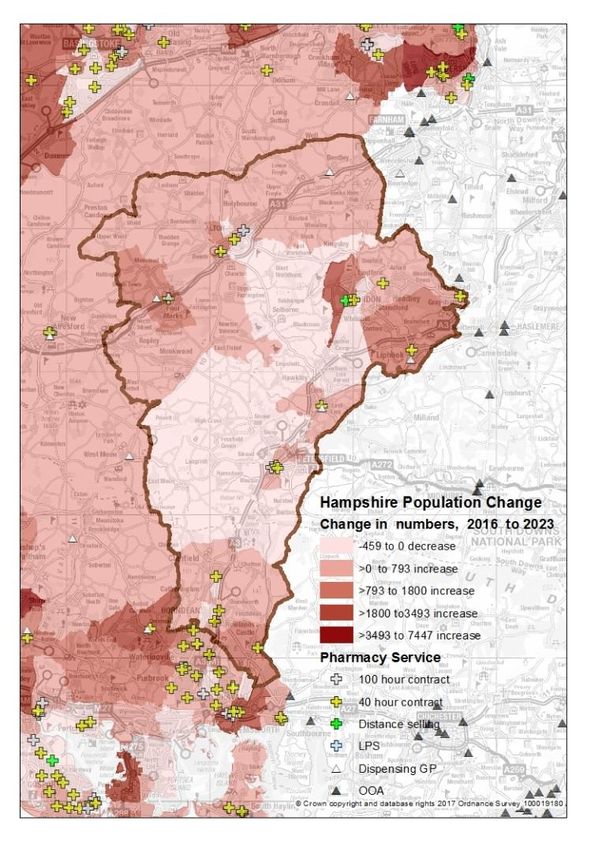
Hampshire County Council

Table of Contents
Version Control ....................................................................................................................................... 2
Introduction ............................................................................................................................................ 4
Components of the Pharmaceutical Needs Assessment ........................................................................ 4
Accountability ......................................................................................................................................... 4
Definition of localities ............................................................................................................................. 5
Engagement and Consultation ................................................................................................................ 5
Maps ....................................................................................................................................................... 5
Criteria for the assessment of need ........................................................................................................ 6
Defining need in relation to pharmaceutical services? .......................................................................... 6
Demography............................................................................................................................................ 7
New Housing developments and impact on local population dynamics .............................................. 11
General health of the population ......................................................................................................... 15
Medicine Use Reviews (MUR) ............................................................................................................... 16
New Medicine Service (NMS) ............................................................................................................... 17
Pharmaceutical services outside of Hampshire .................................................................................... 24
NHS services provided in or outside its area which affect need .......................................................... 25
Pharmacy Contractors .......................................................................................................................... 25
Travel distance ...................................................................................................................................... 28
Locality Needs ....................................................................................................................................... 29
Basingstoke and Deane ......................................................................................................................... 29
East Hampshire ..................................................................................................................................... 32
Eastleigh ................................................................................................................................................ 34
Fareham ................................................................................................................................................ 36
Gosport ................................................................................................................................................. 38
Hart ....................................................................................................................................................... 40
Havant ................................................................................................................................................... 42
New Forest ............................................................................................................................................ 44
Rushmoor .............................................................................................................................................. 47
Test Valley ............................................................................................................................................. 49
Winchester ............................................................................................................................................ 51

                                                                              3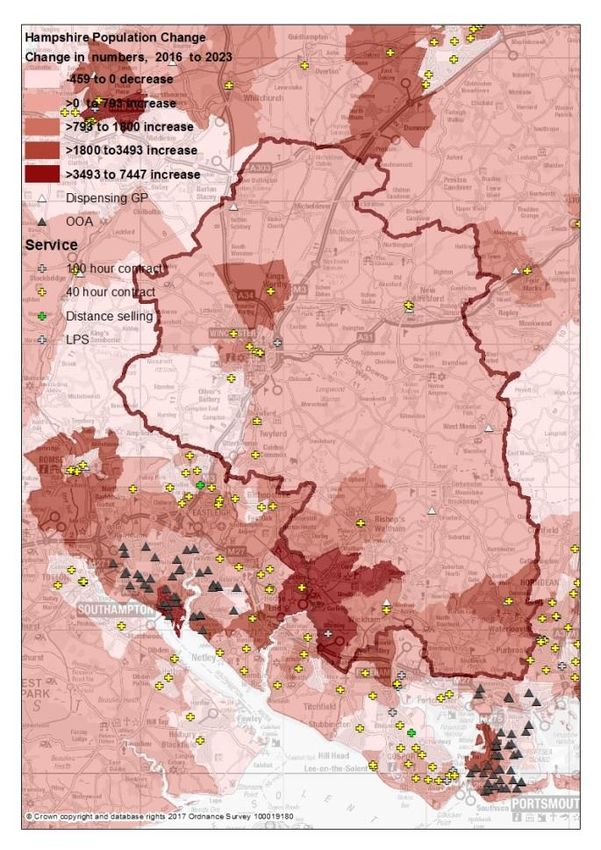
Hampshire County Council
Introduction
A pharmaceutical needs assessment (PNA) is a statement of the pharmaceutical
needs of the population within the local area. The National Health Service
(Pharmaceutical and Local Pharmaceutical Services) Regulations 2013 sets out the
requirement for each Health and Wellbeing Board to publish a pharmaceutical needs
assessment1.
Hampshire’s Joint Health and Wellbeing Strategy has been developed by
Hampshire’s Health and Wellbeing Board to improve health across the county. This
includes ensuring that the right services are delivered where and when they are
needed the most, this includes pharmaceutical provision. The PNA assesses the
need of pharmacy services and how the provision meets current and future needs.
This PNA replaces the assessment undertaken by Hampshire County Council Public
Health in 2014.
Components of the Pharmaceutical Needs Assessment
The PNA contains information on needs and on provision in relation to
pharmaceutical services.
The information on needs is taken from the Joint Strategic Needs assessment. The
Hampshire Joint Strategic Needs Assessment (JSNA) identifies the current and
future health and well being needs of the residents in the area covered by Hampshire
County Council.
In the context of the PNA the definition of pharmaceutical services are those
contained within the NHS Community Pharmacy Contractual Framework (contract)
consists of three levels of services as stated above. These are:
Essential services
Advanced services
Enhanced and locally commissioned services
Accountability
This needs assessment will be signed off by the Health and Wellbeing Board and
published by April 2018.
1
Section 128A of the 2006 Act
4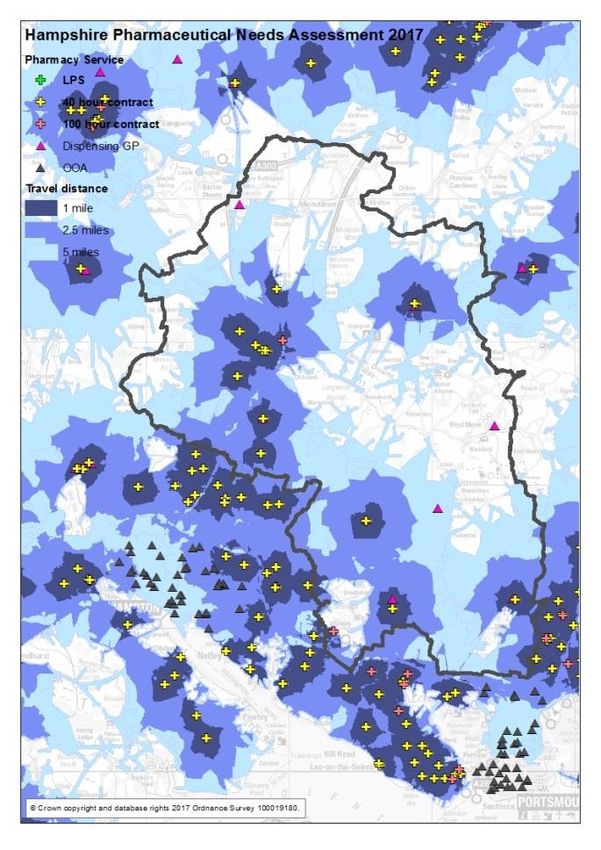
Hampshire County Council

Definition of localities

PNA guidance states that sub localities of the Health and Wellbeing Board may be
considered to give a more detailed assessment. Given the geography and population
of Hampshire, the PNA has used localities that match the district local authority
areas. These are at a suitable size to give a meaningful assessment whilst also
being small enough to relate to population communities within Hampshire.

Engagement and Consultation

The regulations stipulate that the Health and Wellbeing Board must consult on a draft
of their PNA at least once during its development and lists the persons that must be
consulted (see Appendix A for details). This consultation is aimed at professionals
and agencies. Whilst not aimed specifically at the public their views are welcomed
and will be taken into consideration if received.

The consultation is for a minimum period of 60 days.

Maps

All maps are produced under the full OS Crown copyright below.

© Crown copyright and database rights 2017 Ordnance Survey 100019180. Use of
this data is subject to terms and conditions. You are granted a non-exclusive, royalty
free, revocable licence solely to view the Licensed Data for non-commercial
purposes for the period during which HCC makes it available. You are not permitted
to copy, sub-license, distribute, sell or otherwise make available the Licensed Data to
third parties in any form. Third party rights to enforce the terms of this licence shall
be reserved to Ordnance Survey

                                           5
Hampshire County Council

The Needs

Criteria for the assessment of need

The Department of Health pharmaceutical needs assessment information 2 sets out
criteria for the needs assessment. These are as follows; each assessment must have
regard, in so far as it is practicable to do so, to the following matters:

      a) the demography of its area.
      b) whether in its area there is sufficient choice with regard to obtaining
         pharmaceutical services.
      c) any different needs of different localities within its area.
      d) the pharmaceutical services provided in the area of any neighbouring Health
         and Wellbeing Board which affects the area.
      e) any other NHS services provided in or outside its area which affect:
            a. the need for pharmaceutical services in its area, or
            b. whether further provision of pharmaceutical services in its area would
                secure improvements, or better access, to pharmaceutical services, or
                pharmaceutical services of a specified type, in its area.

When making an assessment for the purposes of publishing a pharmaceutical needs
assessment, each HWB must take account of likely future needs having regard to
likely changes to the:

      a) number of people in its area who require pharmaceutical services.
      b) demography of its area.
      c) risks to the health or well-being of people.

The information related to needs is taken from the Joint Strategic Needs
Assessment. Hampshire is in the top ten of the largest counties by land area,
covering approximately 1,400 square miles which includes 11 district local
authorities. These are Basingstoke and Deane, East Hampshire, Eastleigh,
Fareham, Gosport, Hart, Havant, New Forest, Rushmoor, Test Valley, and
Winchester City.

Defining need in relation to pharmaceutical services?

Some people will make more use of pharmacy services than others; these will
include those on long term medicines, older people and the very young. However the
main consideration of need is service location and availability.

2
    https://www.gov.uk/government/publications/pharmaceutical-needs-assessments-information-pack

                                                 6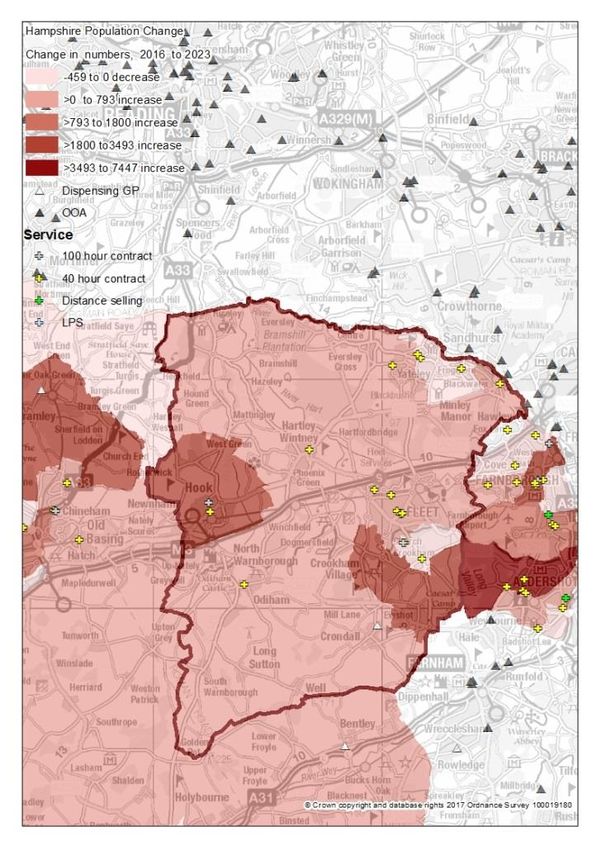
Hampshire County Council

Demography

Current population

The population of Hampshire is estimated to be 1.36 million people, making it the
third most populous county in England after Kent and Essex. Over the ten year
period between the Census of 2001 and 2011 Hampshire’s population increased by
6.3%, in absolute numbers this equates to an increase of almost 77,700 people.

The population pyramid presents the latest mid year population estimates available
for Hampshire compared to England. The chart shows Hampshire has an older
population with a higher proportion of the population aged 45 years and over
compared to England. Census 2011 data reported that the average age across
Hampshire County is 42 years (highest in the New Forest at 47 years and lowest in
Rushmoor at 36 years), compared to the average age nationally of 39 years.

Hampshire has fewer young working aged people (aged 20-39) compared to
England as a whole; 22% in Hampshire compared to 27% in England. Young people
(aged 0-19 years) make up 23% of the population compared to 24% nationally with
Hampshire’s older residents (aged 75 years and over) accounting for 10% of the
population, compared to 8% nationally. There are just over 15,100 people living in
Hampshire who are aged 90 years and over.

Figure 1

                                         7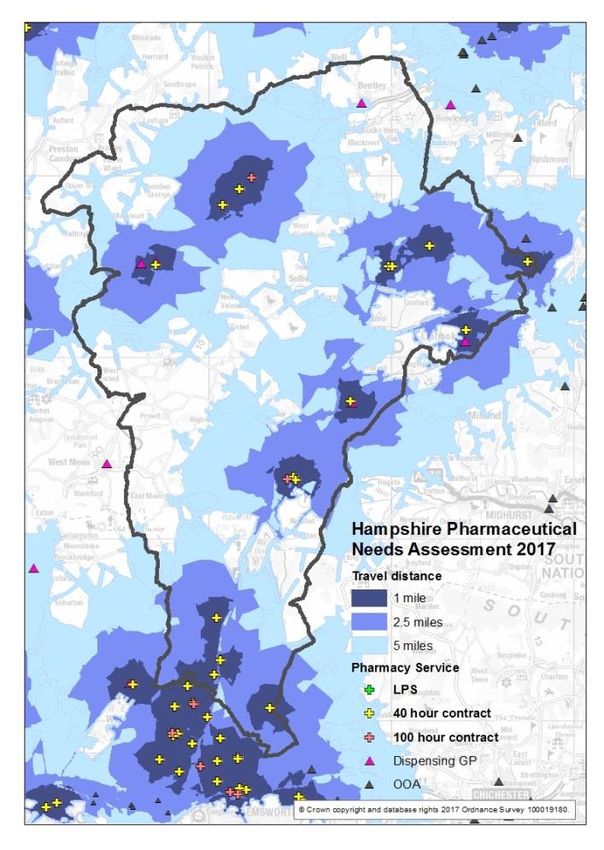
Hampshire County Council

The 2011 census reported that 91.8% of Hampshire’s population are ethnic group
‘White British’; this is much higher than the national figure of 79.8% and a marked
decrease from 2001 where 95.4% of the population were ‘White British’. However
Hampshire has a growing diverse population with growing numbers of people from
different backgrounds. 8.2% of the county’s population are from a non-ethnic White
British background, up from 4.6% in 2001.

Population forecasts

The population pyramid (figure 2) presents the forecast change in the County’s
population age and sex structure. The population of Hampshire is expected to
increase by 7.5% from 1,353,359 in 2016 to 1,455,381 by 2023.

Figure 2

Population forecasts suggest a 7% increase in the 0 to 19 years population, the
population pyramid illustrates that this increase can be mainly attributable to the 10-
14 years cohort.

Looking forward, the ageing of Hampshire’s population is set to continue across the
county with forecasts suggesting that by 2023 almost 23% of Hampshire’s population
will be aged 65 or older, 12.0% aged 75 or older and 3.8% aged 85 or older. The
proportion of the 85 years and over population is expected to increase by almost
30%, to 54,600 people by 2023.

                                           8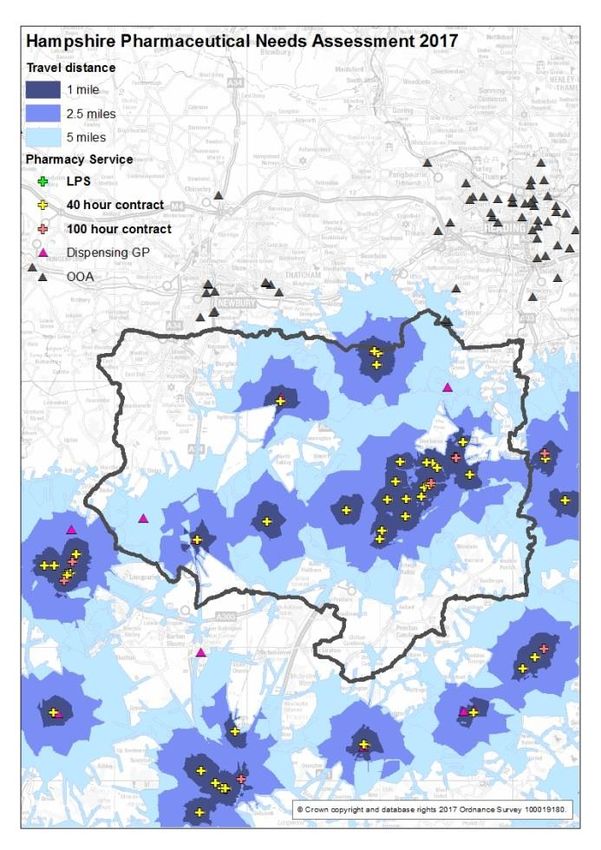
Hampshire County Council

Differences in the population

There is variation in population age structure between districts, for example one in
four of Basingstoke and Deane’s population are aged 0 to 19 years compared to one
in five in the New Forest. Rushmoor has the youngest population structure in the
County, almost one thirds of the districts population (29%) are of a young working
age (20-39yrs).

Across the districts the level of ageing varies significantly, though all districts have
seen their populations getting older. The New Forest has the oldest population
structure in the county with the highest number of residents aged 65 and over (n=
50,354), equating to almost one third (28%) of the population compared to just 14%
(n= 13,428) of Rushmoor’s total population.

The district of Hart has experienced the largest growth across the period 1981 to
2011, its 65 year and older population more than doubling over the period (reaching
15,000 by 2011). Between 2001 and 2011 the population in Hart aged 85 years and
over increased by 43%. The latest population estimates suggest there are now
18,213 residents in Hart aged 65 years and over, of which 2,323 are aged 85 years
or over.

Figure 3

Looking forward, population data suggest that the most growth over the next few
years is forecast to occur in Winchester district where the population is expected to
increase by over 16,100 people (equating to a rise of 13.4%) by 2023. In absolute
numbers Basingstoke and Deane’s population is set to rise by 17,200 which is a
population increase of 9.9%. Conversely Gosport’s population is only set to increase
by 350 people (0.4% increase).

                                            9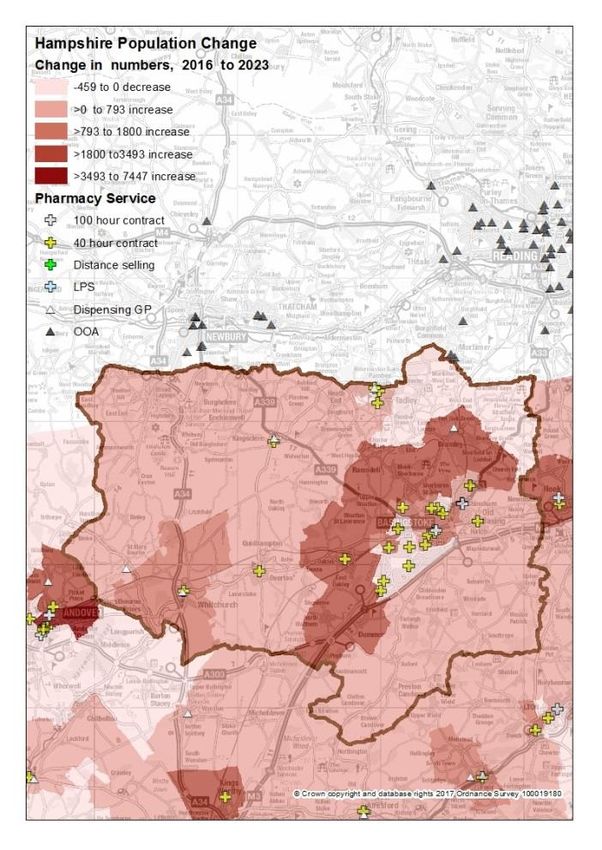
Hampshire County Council

Across all districts the biggest increases are predicted in the 65years and over age
group. Population data for two districts, New Forest and Gosport, predict a decrease
in the 0 to 64 years population by 2023 of 6% and 4% respectively. In contrast,
Winchester’s 0 to 64 years population is predicted to increase the most across the
County by 21%, followed by Rushmoor 19.3%.

The proportion of Hampshire’s population by ethnic groups vary markedly across the
county and whilst nine of Hampshire’s districts have over 90% of their population
defining themselves as being White British; Basingstoke and Deane and Rushmoor,
both in the north of the county, fall below the county average. Over 10% of
Rushmoor’s population are from a non-white British ethnic group, with over 6,120
people identifying themselves as Nepalese.

The age structure of different ethnic group populations varies, and in some cases
reflects the length of time communities have lived in the county. When compared to
Hampshire’s population age structure the White Other, Black, Asian and Other
ethnic groups have a much higher proportion of young working age adults, 25 to 40
years. Conversely the Mixed ethnic group has a higher proportion of the young
population aged 0 to 19 years. The largest non-white ethnic group within the older
population is the Asian ethnic group at 0.8% of the total population aged 65 and over
across Hampshire, equating to 1,880 people. The majority of this population live in
Rushmoor and Basingstoke and Deane.

                                         10
Hampshire County Council
New Housing developments and impact on local population dynamics
There is a strong link between dwellings and demographics. From the basic
requirement of people for shelter, the County’s population forecasts are constrained
to the number of dwellings currently available for habitation and those planned over
the forecast period to ensure the most robust estimate of the population can be
formulated. But the link between dwellings and population goes further with different
types of people more likely to live in different types of property and this can also vary
by location.
Work carried out investigating the demographics of new housing developments
across Hampshire between 2001 and 2011 suggested that recent new housing
developments were more likely to house; younger people; more single never married
people; those more likely to catch the train to work; they tend to be more ethnically
diverse and more densely populated and more likely to be in more urban areas. This
is reflected in the population pyramid which presents the demographics of people in
the new housing developments, compared to the county as a whole, and suggests
that a young working age cohort aged between 25 and 39 years with young children
aged 0 to 9 years are more likely to be living in the new housing developments.
Figure 4
Table one presents the predicted population and dwelling changes over the period
2016 to 2023 for each district and the County overall.
11Hampshire County Council
The forecasts are based on future dwellings supply. The dwelling supply information
for the period 2016 to 2023 includes all large and small sites with planning
permission, or allocated in local plans as at April 1st 2016. Additional dwelling
information is obtained from district’s Strategic Housing and Land Availability
Assessment (SHLAA). The figures are the best projections available as at
1/4/2016 on a site by site basis taking account of the current market conditions.
Table one shows that over the next 8 years the number of dwellings is predicted to
increase by 9% and the population to grow 8% across the County. Winchester is
expected to see the largest relative population growth (13%) attributed to almost
7,500 more dwellings. Basingstoke and Deane has the largest number of new
dwellings and population.
Table 1: Predicted population and dwelling changes for each district and the County overall, 2016 to
2023.
Dwelling Growth (2016 to 2023) Population Growth (2016 to 2023)
Area Number Percentage change Number Percentage change
Basingstoke and Deane 8,612 12% 17,207 10%
East Hampshire 5,841 11% 11,010 9%
Eastleigh 7,025 13% 15,118 12%
Fareham 3,103 6% 5,318 5%
Gosport 1,223 3% 351 0%
Hart 3,272 9% 6,386 7%
Havant 3,451 6% 5,541 4%
New Forest 2,315 3% 2,195 1%
Rushmoor 5,831 15% 11,512 12%
Test Valley 5,695 11% 11,212 9%
Winchester 7,439 15% 16,172 13%
Hampshire County Council 53,807 9% 102,022 8%
Map one shows the predicted population change between 2016 and 2023 and the
main housing development sites (10 homes or more) as at April 20016.
12Hampshire County Council
Map 1
13Hampshire County Council
Military
Hampshire has a substantial military presence, including Army, Royal Navy and RAF
bases. The number of military personnel entitled to Defence Medial Service (MDS)
care provides a good indication of the size of the serving population across
Hampshire. There are currently a total of 13,250 military personnel entitled to MDS
care in Hampshire, with the largest proportion in North East area of Hampshire and
Fareham and Gosport. Approximately 550 are Serving Gurkhas.3
The pharmaceutical needs of military personnel are in the main met by the military
service. However the health needs of families and dependents moving into the area
will be the responsibility of the Clinical Commissioning Groups (CCGs) and therefore
relevant to this PNA.
Offenders
There is one prison in Hampshire located in the district of Winchester. It is a
category B prison with an operational capacity of 690 and is able to take men from
the age of 18 upwards. Population prison data from Ministry of Justice for May 2017
report a population of 631.
The pharmaceutical needs of prisoners in Hampshire are met by the services within
the walls of those establishments and so are not within the scope of this PNA.
Population Density
Hampshire has a lower population density than the England average with 3.6 people
per hectare compared to 4.5 people per hectare for the South East of England and
4.1 across England. Gosport, Rushmoor and Havant remain the most densely
populated districts within Hampshire and have population densities much higher than
the regional and national averages. There are 24.0 people per hectare living in
Rushmoor, 32.6 people per hectare in Gosport, and 21.8 people per hectare in
Havant4.
Rurality
Hampshire is a predominantly rural county, 78% is defined as rural and over one
third of the county’s area is within National Parks or Areas of Outstanding National
Beauty. 22% of the dwellings and population live in the county’s rural areas.
Hampshire is a large county and so although the minority of the population, just over
3
Hampshire County Council: Veterans, Reservists and Armed Forces Families Health Needs
Assessment
4
Census 2011 data
14Hampshire County Council
one in five, live in a rural area this still equates to nearly 300,000 residents. This is a
key variation that needs consideration when assessing pharmaceutical need.
Migration
Migration is complex and there is no legal requirement to inform a single body when
someone moves. As such data on migration is much less robust and comes with
limitations on its use. Economic migrant data from the Department of Work and
Pensions report that between June 2015 and June 2016 there just over 7,000
national insurance number registrations to adult overseas nationals in Hampshire.
The majority of these people were from the European Union. Across the county
Basingstoke and Deane had the highest proportion of economic migrants (21%)
followed by Rushmoor (17%).
General health of the population
The census asks people to rate their general health, whether they have a long term
illness or disability. This information gives an insight into both how good the health is
of the people of Hampshire. The majority of Hampshire’s population (84.1%)
reported to have good or very good health, compared to 81.4% nationally. 84.3% of
Hampshire’s population reported no disabilities, compared to 82.4% nationally.
Across Hampshire 4% of people reported to have bad or very bad health, the highest
levels were reported in Havant (5.6%) and lowest levels in Hart (2.7%).
Amongst those who reported having a long term illness or disability that limited their
day to day activities a lot (6.7% across Hampshire as a whole, compared to 8.3%
nationally), the highest levels were again seen in Havant (8.8%) and lowest levels in
Hart at 4.5%.
However, looking at those of working age (16-64 years of age) with a disability which
limits their day to day activities a lot, it is still Havant with the highest levels at 3.6%
and Hart with the lowest at 1.6%. The county wide figure is 2.5% and again
compares favourably with the national level of 3.6%.
Pharmaceutical services
For the purposes of the PNA pharmaceutical services are included are;
Essential services
Advanced services
Enhanced services
Local pharmaceutical services (LPS)
Locally commissioned services
Dispensing service provided by medical practices
15Hampshire County Council
A description of these different types of services and how many are in Hampshire
follows.
Essential services
These are services which every community pharmacy and dispensing appliance
contractor (DAC) providing NHS pharmaceutical services must provide and is set out
in their terms of service. For pharmacies these include the dispensing of medicines,
disposal of unwanted drugs, promotion of healthy lifestyles, public health campaigns,
signposting and support for self-care. All DACs must provide dispensing of
prescriptions, delivery of certain appliances, supply of bags and wipes and
signposting.
Advanced services
These include pharmacies and DACS. These are services contractors may chose to
provide and have to meet certain criteria. For pharmacies these are medicines uses
review, new medicine service flu vaccination and NHS urgent medicines supply
service. For pharmacies and DACS these are appliance use review and stoma
appliance customisation.
Advanced services commissioned nationally but available in Hampshire are;
Medicine Use Reviews (MUR)
Medicine Use Review and prescription intervention service allows accredited
pharmacists to undertake structured adherence review with patients on multiple
medicines, particular for those receiving medicines for long term conditions. The
service helps patients understand their therapy, the best time to take the medicine,
discussion about side-effects and adherence with the prescribed regimen, which may
identify any problems the patient is experiencing along with possible solutions. The
MUR can be conducted on a regular basis, e.g. every 12 months, or on an ad hoc
basis, when a significant problem with a patient’s medication is highlighted during the
dispensing process.
At least half of the MURs provided each year must be for patients who fall within one
of the national target groups:
patients with respiratory disease (e.g. asthma and COPD),
patients recently discharged from hospital,
patient taking a ‘high risk’ medicine (NSAIDs, anticoagulants, antiplatelets and
diuretics).
The number of medicine use reviews is capped at 400 per pharmacy.
There are 237 pharmacies in Hampshire which are MUR accredited, providing good
coverage across the whole population.
16Hampshire County Council
New Medicine Service (NMS)
The service provides support for people, with long-term conditions and who have
newly been prescribed a medicine. The aim of the services is to help improve
medicines adherence; it is initially focused on particular patient groups and
conditions. If a patient is prescribed an anticoagulant (a blood thinning medicine) or
a medicine to treat asthma or chronic obstructive pulmonary disease (COPD), type 2
diabetes or high blood pressure for the first time, the NMS is available to provide
advice about the medicine.
Research has shown that after 10 days, two thirds of patients prescribed a new
medicine reported problems including side effects, difficulties taking the medicine
and a need for further information. The NMS has been designed to fill this identified
gap in patient need.
The pharmacist will provide the patient with information on their new medicine and
how to use it when it is first dispensed. The pharmacist and patient will then agree to
meet or speak by telephone in around a fortnight.
At this second stage of the service the pharmacist will discuss with the patient how
they are getting on with their new medicine. Further information and advice on the
use of the medicine will be provided and where the patient is experiencing a problem
the pharmacist shall seek to agree a solution with the patient.
A final consultation (typically 21-28 days after starting the medicine) will be held to
discuss the medicine and whether any issues or concerns identified during the
previous consultation have been resolved. If the patient is having a significant
problem with their new medicine the pharmacist may need to refer the patient to their
GP.
There are 212 pharmacies in Hampshire which are NMS accredited, providing good
coverage across the whole population. The data presented in table two covers the
financial year 2016/17 and suggests there is good uptake of the MUR and NMS
service across the county.
17Hampshire County Council
Table 2
Number of NMS Number of MUR Number of Number of
Local Authority Area accredited accredited MUR NMS
pharmacies pharmacies (2016/17) (2016/17)
Hampshire 212 237 70,888 17,404
Basingstoke and Deane 25 26 7,012 2,001
East Hampshire 16 19 5,649 1,188
Eastleigh 21 24 6,082 1,662
Fareham 12 16 4,808 690
Gosport 14 15 5,402 1,093
Hart 15 16 5,169 967
Havant 27 31 9,622 1,587
New Forest 35 36 11,827 4,258
Rushmoor 16 21 5,644 1,938
Test Valley 16 17 4,904 1,083
Winchester 15 16 4,769 937
Enhanced services
Only NHS England can commission enhanced services. The following enhanced
services which may be commissioned by NHS England from 1 April 2013 in line with
identified needs are:
Anticoagulation monitoring
Care home service
Disease specific medicines management service
Gluten free food supply service
Independent prescribing service
Home delivery service
Language access service
Medication review service
Medicines assessment and compliance support
Minor ailment service
Needle and syringe exchange
On demand availability of specialist drugs
Out of hours service
Patient group direction service (not related to public health services)
Prescriber support
Schools service
Screening
Stop smoking
Supervised administration
Supplementary prescribing service
18Hampshire County Council
There is also a new advanced service NHS Urgent Medicine Supply Advanced
Service (NUMSAS) which, at the point of writing this report, is not running in Wessex.
NUMSAS is a pilot service running from 1 December 2016 to 31 March 2018.
NUMSAS is a service that manages a referral from NHS 111 to a community
pharmacy where a patient has contacted NHS 111 because they need urgent access
to a medicine or appliance that they have been previously prescribed on an NHS
prescription. The service therefore enables appropriate access to medicines or
appliances Out-of-Hours (OOH) via community pharmacy, relieving pressure on
urgent and emergency care services by shifting demand from GP OOH providers to
community pharmacy.
There is one enhanced service commissioned by NHS England in Hampshire,
Wessex Pharmacy Urgent Repeat Medicines (PURM) Service. This service allows
participating pharmacies to make emergency supplies (which are usually private
transactions) at NHS expense. Normal prescription charges apply unless the patient
is exempt in accordance with the NHS Charges for Drugs and Appliances
Regulations. The pharmacist will only make a supply where they deem that the
patient has immediate need for the medicine and that it is impractical to obtain a
prescription without undue delay.
There are 180 pharmacies across the county offering the Wessex PURM service in
Hampshire.
Table 3
Number of pharmacies
Local Authority Area offering emergency
supply (PURM)
Hampshire 180
Basingstoke and Deane 15
East Hampshire 15
Eastleigh 19
Fareham 15
Gosport 14
Hart 11
Havant 26
New Forest 28
Rushmoor 11
Test Valley 11
Winchester 15
Local pharmaceutical services (LPS)
These are services provided under a local pharmaceutical services (LPS) contract
and must include dispensing as a minimum.
There is one LPS in Hampshire; this is located in the New Forest.
19Hampshire County Council
Locally commissioned services
Locally commissioned community pharmacy services can be contracted via a
number of different routes and by different commissioners, including local authorities,
Clinical Commissioning Groups (CCGs) and local NHS England teams.
Services commissioned by Public Health Hampshire are detailed below .
Health Check Assessments
The NHS Health Check is a health check-up for adults in England aged 40-74. It's
designed to spot early signs of stroke, kidney disease, heart disease, type 2 diabetes
or dementia and assesses each patient’s cardiovascular risk. Public health
commission both core Health Checks (where a patient responds to an invitation
letter) or opportunistic Health Checks ….. Across the county every GP practice and
an additional 82 pharmacies offer health checks.
Sexual Health Services including emergency hormonal contraception,
chlamydia screening, kits and condoms – provides access.
As at January 2018, 162 pharmacies provided emergency hormonal contraception,
181 offered chlamydia screening and 44 provided chlamydia screening kits and
condoms. 38 pharmacies offered all three sexual health services.
Supervised Administration Programme (SAP).
The SAP programme is currently delivered through community pharmacies. This
requires the pharmacist to supervise the consumption of oral methadone,
buprenorphine and other drugs that may be used in the management of drug
dependency/ misuse; ensuring that the dose has been administered to the patient
where the prescriber has indicated that supervised consumption is appropriate.
Pharmacists will also provide support to service users collecting their dispensed
prescriptions for methadone and other drugs used in the management of drug
misuse/ dependency where supervised consumption is not indicated. As of January
2018 67 pharmacies delivered the SAP programme.
Needle Exchange.
Community pharmacies offer a needle exchange service for injecting drug users. A
targeted approach to harm minimisation within a pharmacy setting is currently being
piloted, with a small number of pharmacies (10 across Hampshire in areas of high
need) offering in addition take-home Naloxone, referrals to community substance
misuse services, Blood Bourne Virus testing and mini-health-checks. There are
three levels to this service.
Level 1: emergency packs only, with written information on harm reduction (for
example, on safer injecting or overdose prevention).
20Hampshire County Council
Level 2: distribution of ‘pick and mix’ (bespoke) injecting equipment plus
health promotion advice (including advice and information on how to reduce
the harms caused by injecting drugs).
Level 3: level 2 plus provision of, or referral to, specialist services (for
example, specialist clinics, vaccinations, drug treatment and secondary care),
mini health checks, BBV screening.
As of January 2018 42 pharmacies offered a needle exchange service.
Flu vaccinations
Public Health commission flu vaccinations for eligible staff. As at January 2018, 145
pharmacies across the county offer flu vaccinations. At the beginning of each flu
season pharmacies have to sign up again to offer the flu vaccinations therefore the
number of pharmacies offering this service may change year on year.
Smoking Cessation.
Smoking cessation services helping people who want to stop smoking are offered in
31 pharmacies across the county.
Map 2: Locally commissioned services
21Hampshire County Council
Dispensing service provided by medical practices
22Hampshire County Council
Dispensing doctors are general practitioners (GPs) who provide primary healthcare
to patients who live in very rural areas. The provision of these services is included in
their medical contract with NHS England. For the purposes of the PNA only the
dispensing services they provide are included. The dispensing doctors are allowed
to dispense the medicines they prescribe for these patients. The provision for doctors
to provide pharmaceutical services in certain circumstances has been made in
various NHS Acts and Regulations. These circumstances are in summary:
a patient satisfies the organisation that they would have serious difficulty in
obtaining any necessary drugs or appliances from an NHS pharmacist by
reason of distance or inadequacy of means of communication (often known as
the “serious difficulty” test which can apply anywhere in the country); or
a patient is resident in an area which is rural in character, known as a
controlled locality, at a distance of more than one mile (1.6km) from pharmacy
premises (excluding any distance selling premises). The pharmacy premises
do not have to be in a controlled locality.
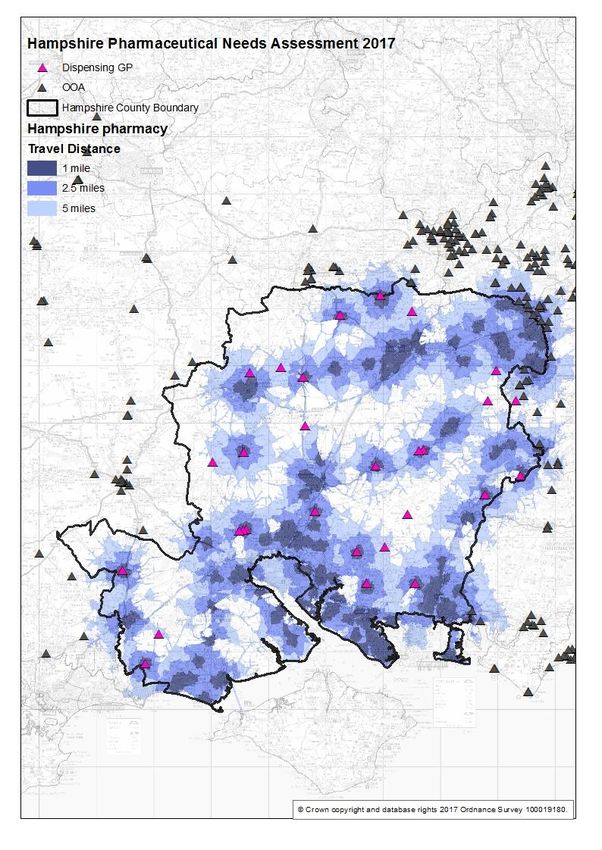
There are currently 28 dispensing doctor practices in Hampshire many serve the
rural communities where there is limited access to pharmacy. These will enhance the
pharmaceutical dispensing provision by community pharmacies. These are shown
on map three.
23Hampshire County Council
Map 3: Location of Dispensing GPs in Hampshire Table 4: Dispensing
GPs by LA
Number of
Local Authority Area dispensing
GPs
Hampshire 28
Basingstoke and Deane 5
East Hampshire 5
Eastleigh 0
Fareham 0
Gosport 0
Hart 1
Havant 0
New Forest 3
Rushmoor 0
Test Valley 6
Pharmaceutical services outside of Hampshire
Hampshire has a number of counties and cities on its borders. These may increase
access and choice of pharmaceutical services to those populations living on the edge
of Hampshire. The cities to the South and North West of the County provide
increased coverage to those people living near Southampton, Portsmouth,
Bournemouth and Camberley. These centres also provide out of hours primary care
facilities for Hampshire residents. Residents in the East of the County can also
access services in West Sussex and Surrey to the North East. This means that
prescriptions written out of hours can be dispended in these areas. Map four (page
28) shows all pharmacies including those on the edge of Hampshire.5
5
Based on information from NHS England accessed in June 2017
24Hampshire County Council
NHS services provided in or outside its area which affect need
NHS services that affect need are those that require a prescription to be dispensed.
For Hampshire these are the GP practices and the Out of Hours primary care
services. These are based in the urban centres of Hampshire and its borders.
Table 5: Out of Hours Centres
Andover War Memorial Hospital, Andover Basingstoke and North Hants
Hospital, Basingstoke
Royal South Hants Hospital, Southampton Frimley Park Hospital, Frimley,
Surrey
New Forest Hospital, Lymington Chase Community Hospital,
Bordon
Totton, Primary Care Centre (Health Gosport War Memorial Hospital,
Centre), Totton Gosport
Royal Hampshire County Hospital, Queen Alexandra Hospital,
Winchester Cosham, Portsmouth
Ringwood Medical Centre, Ringwood
Pharmacy Contractors
Nationally in 2015 1.08 billion prescription items6 were dispensed in the community,
an increase of 1.8% from 1.06 billion in 2014. Drugs used for diabetes were the most
commonly prescribed items. The greatest increase in the volumes of prescribing was
for antidepressant drugs7.
As of June 2017 NHS England (Wessex) has 243 pharmacy contractors on its list in
Hampshire. Of these, 6 are Distance Selling Pharmacies not specifically serving the
local population but available to anyone within England.
The remaining 237 are pharmacy contractors operating on 100 hour contracts,
standard 40 hour contractors or essential small pharmacy Local Pharmacy Services
(LPS) contracts.
6
These are medicines prescribed by a doctor on a script and dispended by a pharmacist
7
Prescriptions Dispensed in the Community, Statistics for England - 2005-2015 [NS]
http://content.digital.nhs.uk/searchcatalogue?productid=20895&q=title%3a%22Prescriptions+Dispens
ed+in+the+Community%22&sort=Relevance&size=10&page=1#top
25Hampshire County Council
Since 2010 the number of pharmacy contracts has grown by 25%. The breakdown of
contractor types and the changes since 2005 are shown in table six.
Table 6
Pharmacy
Contract Description 2005 2010 2014 2017
Type
Open for a minimum 40 hours per
Standard 40
week. Starting a new 40 hour
hours 184 201 205 208
pharmacy is restricted based control
contract
of entry test
Open for 100 hours. Formerly
100 hour Starting a 100 hour pharmacy under
1 16 27 27
opening the former exemption from the
control of entry test
Essential
A pharmacy contracted in a location
Small
where a 40 hour pharmacy would 9 6 4 0
Pharmacy
not be commercially viable
LPS
Services provided under a local
pharmaceutical services (LPS)
LPS contract and must include 1
dispensing as a minimum.
A registered pharmacy which offers
to sell or supply medicines over the
internet, or makes arrangements for
Distance
the supply of such products or 0 4 5 7
Selling
provision of such services over the
internet
Total 194 227 241 243
Dispensing GPs the provision of
Dispensing
practices these services is included in their 28
medical contract with NHS England.
Patient access to pharmacies within Hampshire is good, across England there are 22
pharmacies per 100,000 population (2014)8. Hampshire’s provision is slightly lower
8
https://lginform.local.gov.uk/reports/lgastandard?mod-metric=3707&mod-area=E92000001&mod-
group=AllRegions_England&mod-type=namedComparisonGroup
26Hampshire County Council
at 18 pharmacies per 100,000 population. Table seven presents the number of
pharmacies per population by county and district.
90% of pharmacies in Hampshire open on a Saturday and there is good ‘out of
hours’ availability across all areas. There are 27 Pharmacies across Hampshire
providing a 100 hour pharmacy service and 57 services (24%) are open on a
Sunday.
Table 7
2016
Number of Total Population Population aged 65+
Local Authority Area pharmacies Estimated Population Pharmacies Estimated Population Pharmacies
per area Resident per per 100k Resident per per 100k
Population pharmacy population Population pharmacy population
Hampshire 243 1,360,426 5,598 17.9 285,472 1,175 85.1
Basingstoke and Deane 27 174,588 6,466 15.5 29,245 1,083 92.3
East Hampshire 19 117,955 6,208 16.1 26,728 1,407 71.1
Eastleigh 24 129,635 5,401 18.5 24,650 1,027 97.4
Fareham 17 115,423 6,790 14.7 26,381 1,552 64.4
Gosport 16 85,363 5,335 18.7 16,579 1,036 96.5
Hart 17 94,250 5,544 18.0 18,213 1,071 93.3
Havant 31 123,640 3,988 25.1 28,674 925 108.1
New Forest 37 179,236 4,844 20.6 50,354 1,361 73.5
Rushmoor 21 96,327 4,587 21.8 13,428 639 156.4
Test Valley 17 122,044 7,179 13.9 25,871 1,522 65.7
Winchester 17 121,965 7,174 13.9 25,349 1,491 67.1
Table 8
100 hour 40 hour Distance
Local Authority Area LPS Total
contract contract selling
Hampshire 27 208 7 1 243
Basingstoke and Deane 2 25 27
East Hampshire 2 16 1 19
Eastleigh 23 1 24
Fareham 4 12 1 17
Gosport 2 13 1 16
Hart 2 15 17
Havant 5 26 31
New Forest 4 31 1 1 37
Rushmoor 2 17 2 21
Test Valley 2 15 17
Winchester 2 15 17
27Hampshire County Council
Travel distance
The travel map (map three) highlights those areas which are 1, 2.5 and 5 miles road
travel from a pharmacy. 67% of Hampshire is within 5 road miles of a pharmacy.
Those outside are very rural areas without roads which are often used for recreation.
The areas with higher population density have closer provision of pharmacy.
Map 4
28Hampshire County Council
Locality Needs
Detailed locality information is considered under necessary services. A summary for
each locality is given below.
Basingstoke and Deane
There are 173,277 people living in Basingstoke and Deane. The district population is
slightly younger than the Hampshire population. Basingstoke and Deane has more
very young and working age residents and less older people compared to
Hampshire. 88.2% of Basingstoke and Deane's resident population are of ethnic
group 'White British', those in other ethnic groups increased from 6.5% to 11.8% over
the period between 2001 and 2011 census. This is a higher proportion that
Hampshire overall (8.2%).
Deprivation is lower than England and Hampshire, however about 4,071 (11.8%)
children living in income deprived households, 14,126 people (8.3%) living in means
tested benefit households and 3,367 people (9.5%) aged 60+ live in a pension credit
household. Pockets of deprivation exist in South Ham, Popley East and Chineham
wards in Basingstoke affecting a substantial number of people who are consequently
likely to have poorer health.
Life expectancy for men and women is higher than the England average, but lower
than Hampshire. Healthy life expectancy at birth data suggests that men will live
13.2 years and women 15.3 years in poor health. This is better than England where
15.6 years for men and 18.2 years for women are spent in poor health.
Future Growth
Over the next six years (2016 to 2021) there is a forecast growth of 12,556 people
with the largest increase forecast in the over 75s. Across the county the greatest
population growth is forecast to occur in the Basingstoke and Deane district. This
may be attributed to the housing development plans. There is a growth of 8,612
dwellings (12% change) predicted in Basingstoke & Deane between 2016 and 2023
with an associated population growth of 17,207 residents (10% change). The
proposed housing development sites have good pharmacy cover. With good
communication routes these areas of growth are well serviced within 5 miles of a
pharmacy.
29Hampshire County Council
Figure 5 Figure 6
Pharmacy provision
There are 27 community pharmacies throughout this area. This includes two 100
hour pharmacies. Throughout Monday to Friday there is good out of hours provision
available. 11 pharmacies are open after 18:30 and a further three opening later into
the evening with the latest being 23.00. Additionally two sites open before 8am.
Weekend coverage is comprised of 22 pharmacies with open times covered from
06:30 to 23:00 on a Saturday and nine pharmacies open through the day with four
opening into the evening. On Sunday there are seven pharmacies with opening times
into the evening up to 21:00.
The out of hours GP provision is based on North Hampshire Hospital Site which is on
the edge of Basingstoke Town. There are also five dispensing practices across
Basingstoke and Deane.
30Hampshire County Council
Map 5 Map 6
Travel distance to pharmacy is good with 65% of the area within 5 miles road travel
of a pharmacy.9 The areas not covered are areas of very high rurality and low
population density and low road coverage.
Conclusion
There is good provision of pharmacy cover in Basingstoke and Deane matching
current and future planned population growth.
9
The excludes pharmacy outside the district
31Hampshire County Council
East Hampshire
The population of East Hampshire is 119,177. East Hampshire has relatively high
proportion of residents aged in their 50s and 60s and a relatively low proportion of
young children aged 0 to 9 and young adults aged 20-39 years. 93% of East
Hampshire’s resident population are of ethnic group 'White British'.
The health of people in East Hampshire is generally better than the England
average. Deprivation is lower than England and Hampshire. There are 1,854 (8.6%)
children living in income deprived households, 7,917 (6.8%) people living in means
tested benefit households and 2,576 (8.2%) people aged 60+ live in a pension credit
household.
Life expectancy for men and women is higher than the England average and
comparable to Hampshire. Healthy life expectancy at birth data suggests that men
will live 12.3 years and women 14 years in poor health. This is better than England
where 15.6 years for men and 18.2 years for women are spent in poor health.
Future growth
Over the next six years there is a forecast growth of 8,936 people with the largest
increase forecast in the over 75s. There is a growth of 5,841 dwellings (11%
change) predicted in East Hampshire between 2016 and 2023 with an associated
population growth of 11,010 residents (9% change).
Figure 7 Figure 8
Pharmacy provision
There are 19 Community Pharmacies in East Hampshire, this includes two 100 hour
pharmacies and a distance selling provider. Four chemists are open after 18:30.
One pharmacy is open every day until midnight from Monday to Saturday. There is
early morning provision (open from 07:00) provided by two pharmacies.
32Hampshire County Council
Weekend coverage in the area is good, with 17 pharmacies open on Saturday and
out of hours provision within the locality and close by in neighbouring localities. There
are four pharmacies open on a Sunday with provision into the early evening. Within
the area there is one dispensing practice in near Liss, two in Four Marks and one in
Liphook.
72% of the area is within 5 road miles of a pharmacy. Areas further than 5 miles are
areas of low population density and low population change. The west of the area is
serviced by pharmacies in Winchester and the South is served by Horndean (within
East Hampshire) and Havant (outside East Hampshire). The majority of the housing
developments are in the towns in the district. With good communication routes these
areas of growth are well serviced within 5 miles of a pharmacy.
Map 7 Map 8
Conclusion
There is good provision of pharmacy cover in East Hampshire matching current and
future planned population growth. Further provision on a Sunday could be
considered to secure better access for patients using the out of hours service in
Bordon.
33Hampshire County Council
Eastleigh
The population of Eastleigh is 128,873. East Hampshire population age and sex
structure is similar to Hampshire, Eastleigh has slightly more young working age (25
to 44 years) and slightly fewer older people compared to Hampshire. 91.8% of
Eastleigh resident population are of ethnic group 'White British'.
The health of people in Eastleigh is generally better than the England average.
Deprivation is lower than England and Hampshire. There are 2,538 (10.5%) children
living in income deprived households, 9,908 (7.8%) people living in means tested
benefit households and 2,881 (9.7%) people aged 60+ live in a pension credit
household.
Life expectancy for men and women is higher than the England and Hampshire
average. Healthy life expectancy at birth data suggests that men will live 13.7 years
and women 16.2 years in poor health. This is better than England where 15.6 years
for men and 18.2 years for women are spent in poor health.
Future growth
Over the next six years there is a forecast growth of 11,259 people with the largest
increase forecast in the over 75s. The forecast increase in the 0 to 74 year olds is
greater when compared to Hampshire. There is a growth of 7,025 dwellings (13%
change) predicted in Eastleigh between 2016 and 2023 with an associated
population growth of 15,118 residents (12% change).
Figure 9 Figure 10
Pharmacy provision
There are 24 pharmacies serving Eastleigh with provision from 08:00 to 22:00
through the week from a variety of sites across the district. 23 pharmacies are a
standard 40 hour contract; there is one distance selling pharmacy. Eight pharmacies
34Hampshire County Council
are open after 18:30. 23 pharmacies open on a Saturday with two opening into the
evening. Six sites are open on a Sunday during the day, the latest closing time is
16:00, with weekend out of hours provision from Southampton, this is the location of
the nearest out of hours GP service. 98% of the area is within 5 road miles of a
pharmacy.
Map 9 Map 10
Conclusion
There is good provision of pharmacy cover in Eastleigh matching current and future
planned population growth.
35Hampshire County Council
Fareham
Fareham is an area in the South of Hampshire with a population of 114,058 people.
The population structure is slightly older than the Hampshire population as a whole,
with fewer younger people aged 0 to 14 years and a greater proportion of older
people aged 45 to 74 years. 94.7% of Fareham resident population are of ethnic
group 'White British'.
The health of people in Fareham is generally better than the England average.
Deprivation is lower than England and Hampshire. There are 1,692 (8.7%) children
living in income deprived households, 7,482 (6.6%) people living in means tested
benefit households and 2,463 (7.9%) people aged 60+ live in a pension credit
household.
Life expectancy for men and women is higher than the England and Hampshire
average. Healthy life expectancy at birth data suggests that men will live 12.7 years
and women 14.9 years in poor health. This is better than England where 15.6 years
for men and 18.2 years for women are spent in poor health.
Figure 11 Figure 12
Future growth
Over the next six years there is a forecast growth of 3,747 people with the largest
increase forecast in the over 75s. The forecast increase in the 20 to 39 year olds is
greater when compared to Hampshire. There is a growth of 3,103 dwellings (6%
change) predicted in Fareham between 2016 and 2023 with an associated
population growth of 5,318 residents (5% change). The growth is in areas well
served by pharmacies.
36Hampshire County Council
Pharmacy provision
Fareham is served by 17 pharmacies with good weekday provision, six are open
after 18:30 with one open until 23:30. Early morning provision is served by four
pharmacies. This provision includes four 100 hour pharmacists. There is one
distance selling pharmacy located in this locality.
For the weekend all except one pharmacy is open on a Saturday with four open late
into the evening. Six pharmacies open on a Sunday with early evening provision.
95% of the area is within 5 miles road travel of a pharmacist.
Map 11 Map 12
Conclusion
There is good provision of pharmacy cover in Fareham matching current and future
planned population growth.
37Hampshire County Council Gosport Gosport is an area of Hampshire in the south of the county with a long history of navel maritime association. Gosport’s population of 82,785 and has a younger population age and sex structure than Hampshire. When compared to Hampshire, Gosport has a higher proportion of the very young aged 0 to 9 years and young working age of 20 to 39 years. The district also has a lower proportion of older people aged 60 years and over. 94.4% of Gosport resident population are of ethnic group 'White British'. The general health of people in Gosport is generally better than the England average. Gosport is one of the most deprived areas in Hampshire with eight areas in the district ranked in the 20% most deprived quintile nationally; however deprivation is lower than England. There are 3,034 (18.7%) children living in income deprived households, 10,434 (12.5%) people living in means tested benefit households and 2,308 (11.7%) people aged 60+ live in a pension credit household. Life expectancy for men and women is significantly worse than the England and Hampshire average. Healthy life expectancy at birth data suggests that men will live 14.8 years and women 17.1 years in poor health. This is better than England where 15.6 years for men and 18.2 years for women are spent in poor health. Figure 13 Figure 14 Future growth Over the next six years there is a very small forecast growth of 720 people with decreases in the 0 to 19 and 40 to 64 years cohorts. The forecast increase all other age bands is significantly less when compared to Hampshire. There is a growth of 1,223 dwellings (3% change) predicted in Gosport between 2016 and 2023 with an associated population growth of 351 residents (
Hampshire County Council

Pharmacy provision

15 pharmacies serve the Gosport area, including two 100 hour pharmacies. Three
are open after 18:30. There is early morning provision in the area. 14 of the 15 open
on a Saturday with evening provision up to 23:00. Three pharmacies provide
provision within the locality on a Sunday including early evening provision. 94% of
the borough is within 5 road miles of a service.

Out of hours GP services are provided at Gosport War Memorial hospital for this
area with closely aligned pharmacy provision.

Map 13                                         Map 14

Conclusion

There is good provision of pharmacy cover in Gosport matching current and future
planned population growth.

                                         39
Hampshire County Council
Hart
The population of Hart in the North of the County is 94,951. The district has a
younger population with a greater proportion of 0 to 14 years and 35 to 54 years
population compared to Hampshire. The current Hart population structure also
shows a lower proportion of the older cohorts aged 55 years and over. 90.7% of Hart
resident population are of ethnic group 'White British'.
The general health of people in Hart is better than the England average. Hart is the
least deprived district in the country, however there are 1,126 (6.1%) children living in
income deprived households, 4,283 (4.6%) people living in means tested benefit
households and 1,334 (6.2%) people aged 60+ live in a pension credit household.
Life expectancy for men and women is significantly better than the England and
Hampshire average. Healthy life expectancy at birth data suggests that men will live
11.2 years and women 13.8 years in poor health. This is better than England where
15.6 years for men and 18.2 years for women are spent in poor health.
Figure 15 Figure 16
Future growth
Over the next six years there is a forecast growth of 5,511 people with a larger
increase forecast in the 75+ years cohort when compared to Hampshire. There is a
growth of 3,272 dwellings (9% change) predicted in Hart between 2016 and 2023
with an associated population growth of 6,386 residents (7% change).
Predicted population growth is mainly within the area of 2.5 miles from a pharmacist
and all within 5 miles. There is a small area to the West of Hook which is over 5
miles from a pharmacy in Hart or its neighbouring district Basingstoke and Deane;
however this area is very rural and is mainly covered by a golf course.
40You can also read


