HAZARDOUS MATERIALS BUILDING SURVEY - Amherst, MA
←
→
Page content transcription
If your browser does not render page correctly, please read the page content below
HAZARDOUS MATERIALS BUILDING SURVEY

                   East Street School
                  89 South East Street
               Amherst, Massachusetts 01002

                          Prepared For:

                    Town of Amherst
                   4 Boltwood Avenue
               Amherst, Massachusetts 01002

            Hillmann Project Number M3-9657

                        January 14, 2021

            Your Property. Our Priority.
       Making a better future for all the communities we touch.
               www.HillmannConsulting.com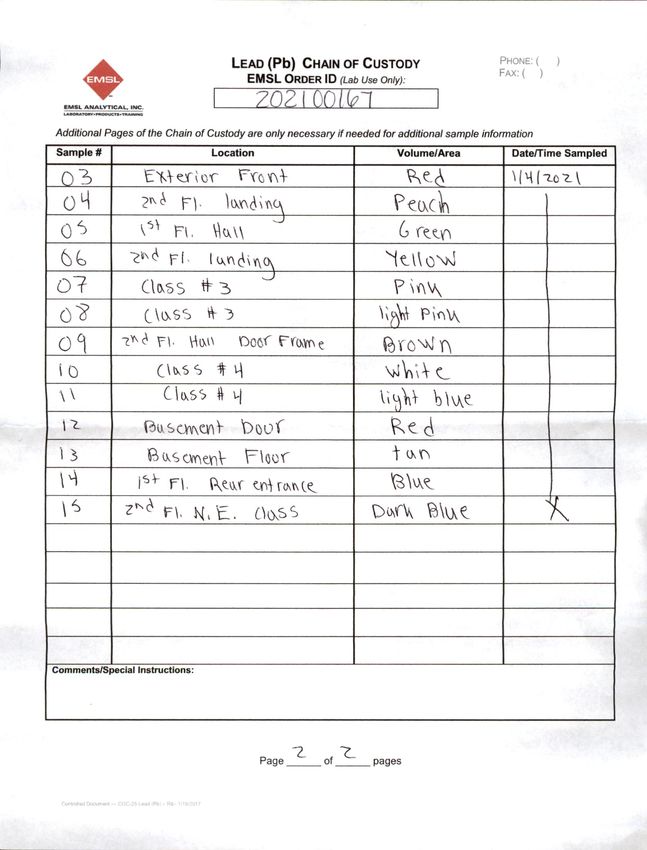
January 14, 2021

Mr. Nathaniel Malloy
Town of Amherst
4 Boltwood Avenue
Amherst, Massachusetts 01002

Re:    Hazardous Materials Building Survey
       89 South East Street
       Amherst, Massachusetts 01002
       Hillmann Project #: M3-9657

Dear Mr. Malloy:

Hillmann Consulting, LLC, is pleased to provide the results of the Hazardous Materials Building
Survey of the above referenced project location. The survey was performed in general accordance
with the contracted scope of work as well as applicable federal, state and local rules and
regulations.

We appreciate the opportunity to provide environmental due diligence services. If you have any
questions concerning this report, or if we can assist you in any other matter, please contact our
office at 978-362-0448.

Sincerely,

Hillmann Consulting, LLC

Jonathan Nicoll                                               Christopher Baker
Regional Manager                                              Vice President of Operations
jnicoll@hillmannconsulting.com                                cbaker@hillmannconsulting.com

                              Your Property. Our Priority.
                      Making a better future for all the communities we touch.
                                   www.HillmannConsulting.com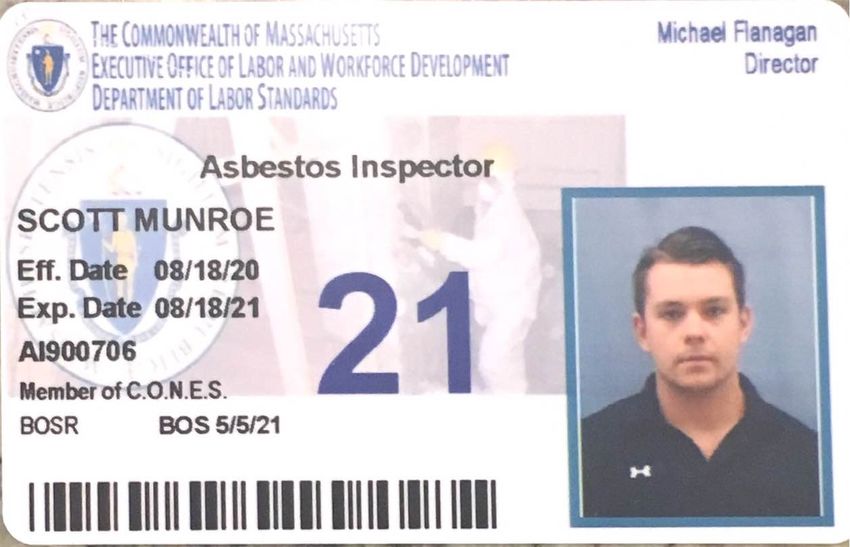
Hillmann Consulting LLC

                                                          TABLE OF CONTENTS

1.0         EXECUTIVE SUMMARY .........................................................................................................1
      1.1     General .................................................................................................................................................. 1
      1.2     Summary of Findings ............................................................................................................................. 1
      1.3     Recommendations.................................................................................................................................. 4
2.0         INTRODUCTION .......................................................................................................................6
      2.1     Purpose .................................................................................................................................................. 6
      2.2     Scope of Work ....................................................................................................................................... 6
      2.3     Survey Methods ..................................................................................................................................... 6
      2.4     User Reliance......................................................................................................................................... 9
      2.5     Significant Assumptions......................................................................................................................... 9
      2.6     General Limitations and Exceptions ..................................................................................................... 10
3.0         SURVEY FINDINGS ............................................................................................................... 12
      3.1     Survey Personnel ................................................................................................................................. 12
      3.2     Site Limitations/Inaccessible Areas ...................................................................................................... 12
      3.3     Asbestos Containing Materials (ACM) ................................................................................................. 12
      3.4     Lead Containing Paint .......................................................................................................................... 15
      3.5     Polychlorinated Biphenyls (PCBs)........................................................................................................ 15
      3.6     Universal Waste and Other Hazardous Materials .................................................................................. 16
6.0         APPENDICES .......................................................................................................................... 18

Appendix A – Guide to ACM Categories
Appendix B – Inspector Credentials
Appendix C – Asbestos Laboratory Analytical Results
Appendix D – Lead Paint Chip Sampling Report
Appendix E – Photographic Documentation

Hazardous Materials Survey                                                       -i-                                      Hillmann Project No. M3-9657
89 South East Street, Amherst, Massachusetts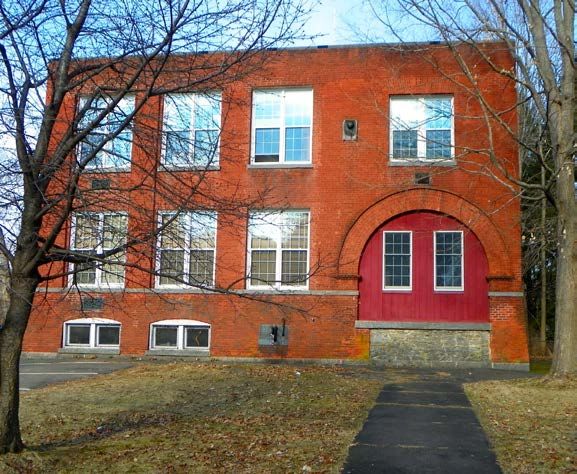
Hillmann Consulting LLC

       List of Abbreviations/Acronyms

Hillmann may use the following abbreviations and acronyms for common terminology described in
our report. Not all abbreviations or acronyms may be applicable to this report:
ACM            Asbestos Containing Material
ACBM           Asbestos Containing Building Material
AHERA          Asbestos Hazard Emergency Response Act
AST            Aboveground Storage Tank
ELAP           Environmental Laboratory Approval Program
EPDM           Ethylene Polymer Diene Monomer
EPA            United States Environmental Protection Agency
HEPA           High Efficient Particulate Air (filters)
HVAC           Heating Ventilation & Air Conditioning
HUD            United States Department of Housing and Urban Development
LBP            Lead-Based Paint
LF             Linear Feet
NESHAP         National Emissions Standards for Hazardous Air Pollutants
NOB            Non-friable Organically Bound
NVLAP          National Voluntary Laboratory Accreditation Program
OSHA           Occupational Safety and Health Administration
PCB            Polychlorinated Biphenyl
PLM            Polarized Light Microscopy
RCRA           Resource Conservation and Recovery Act
SF             Square Feet
TCLP           Toxic Characteristics Leachate Procedure
TEM            Transmission Electron Microscopy
TSI            Thermal Systems Insulation
USEPA          United States Environmental Protection Agency
UST            Underground Storage Tank
VAT            Vinyl Asbestos Tile
XRF            X-Ray Fluorescence

Hazardous Materials Survey                     -ii-                   Hillmann Project No. M3-9657
89 South East Street, Amherst, Massachusetts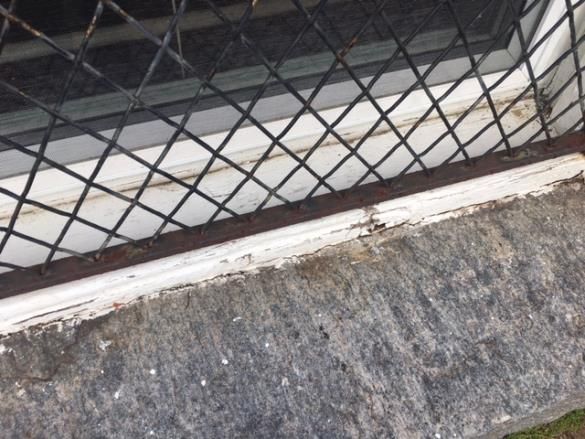
Hillmann Consulting LLC

1.0     EXECUTIVE SUMMARY

1.1     General

A hazardous materials survey has been completed at 89 South East Street, Amherst, Massachusetts.
The survey was completed in accordance with the contracted scope of work, which included
inspections and/or testing for the presence of asbestos-containing materials (ACM), lead containing
paint, universal waste, and other hazardous/regulated materials requiring handling or disposal
practices outside of conventional solid waste.

The project location covered by this survey is described in greater detail in Section 2.2.1. The roof
of the building was excluded from the survey. In addition, the scope of work excluded intrusive
surveying methods to locate potential hazardous materials and included building contents in
addition to fixed building components.

A summary of the findings and recommendations are provided in Section 1.2 and Section 1.3.
However, this section, alone, does not constitute the complete assessment. The report must be read
in its entirety.

1.2     Summary of Findings

The following ACM, lead containing paint, universal waste and other hazardous/regulated materials
have been identified at the project location:

        1.2.1 Table of Findings

 Asbestos Containing Building Materials
                                                                         Asbestos        Estimated
                Material                             Location
                                                                         Content             SF
             Joint Compound                 1st Floor Rear Exit        2% Chrysotile       600 SF
          9”x9” Black Floor Tile            2nd Floor Classroom #4     5% Chrysotile       720 SF
          9”x9” Black Floor Tile            2nd Floor Classroom #3     5% Chrysotile       720 SF
          9”x9” Black Floor Tile            1st Floor Hallway          5% Chrysotile       300 SF
  Black Mastic on 9”x9” Black Floor Tiles   1st Floor Hallway          5% Chrysotile       300 SF
           9”x9” Tan Floor Tile             Basement Art Room         10% Chrysotile       800 SF
   Black Mastic on 9”x9” Tan Floor Tiles    Basement Art Room         Trace Chrysotile     800 SF

Hazardous Materials Survey                          -1-                  Hillmann Project # M3-9657
89 South East Street, Amherst, Massachusetts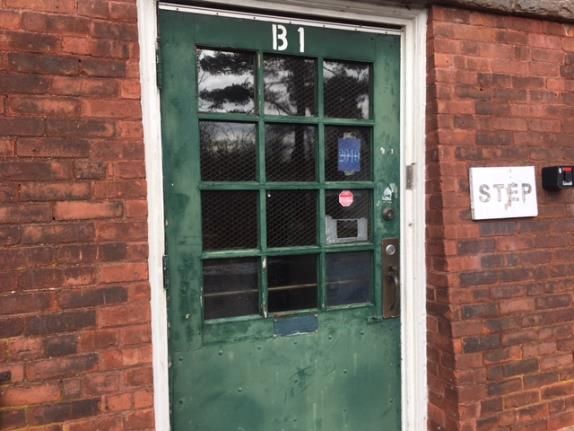
Hillmann Consulting LLC

 Lead Containing Paint
    Surface/Substrate, Color                             Location                  Lead (% by weight)
 Exterior Door, Metal, Green                                Exterior                        4.6
 Exterior Window Sill, Wood, White                          Exterior                        4.3
 Exterior Front, Wood, Red                               Exterior Front                    0.011
 Door, Wood, Green                                     1st Floor Hallway                    6.7
 Wall, Plaster, Pink                                     Classroom #3                       0.33
 Wall, Plaster, Light Pink                               Classroom #3                      0.041
 Door Frame, Metal, Brown                             2nd Floor Hallway                     1.0
 Wall, Plaster, White                                    Classroom #4                       0.12
 Wall, Plaster, Light Blue                               Classroom #4                       0.27
 Door, Metal, Red                                       Basement Door                       5.3
 Wall, Wallboard, Blue                             1st Floor Rear Entrance                 0.015
                                                nd
 Wall, Plaster, Dark Blue                      2 Floor North East Classroom                 0.18

 Universal Waste
             Type                                           Location                        Count/Qty
   Lamps:
 Fluorescent light tubes                Throughout                                                   154
     Batteries:
 None observed
     Suspected Mercury Containing:
 Thermostat; suspect mercury switches   Throughout                                                    13
     Pesticides:
 None observed

Hazardous Materials Survey                         -2-                        Hillmann Project # M3-9657
89 South East Street, Amherst, Massachusetts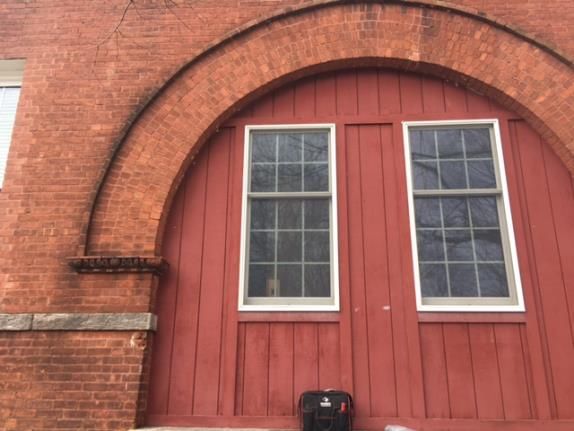
Hillmann Consulting LLC

 Other Potentially Hazardous Materials
              Type                                            Location                  Qty/Count
   PCB Wastes:
 Ballasts                              Throughout                                                 77
       Refrigerants:
 None observed
       Fuel Systems:
 Oil/ Non-Hazardous
       Hydraulic Systems:
 Elevator (presumed hydraulic)         Rear of Building                                             1
       Compressed Gases:
 Nitrogen Tanks                        Basement                                                     4
       Radioactive
 Ionization Smoke Detectors            Throughout                                                  9
 Exit Signs                            Throughout                                                  5
 Emergency Lights                      Throughout                                                 20
       Medical/Bio-Hazardous
 None observed
       Paints and Related Products:
 Floor Polish                          2nd floor                                                    1
       Oil and Lubricating Products:
 None observed
       Miscellaneous:
 Fire Extinguishers                    Throughout                                                 12
 Combustible Flashing Cement           2nd floor hallway                                           2
 Cleaning Products                     1st and 2nd floor hall closets                             10
 Above Ground Storage Tanks            Basement                                                    2

         1.2.2 Site Limitations/Inaccessible Areas

Hillmann notes that the following significant limitations and/or inaccessible areas were encountered
at the project site during the survey:

   -     The elevator shaft and machine room were inaccessible at the time of the inspection.

Hazardous Materials Survey                         -3-                   Hillmann Project # M3-9657
89 South East Street, Amherst, Massachusetts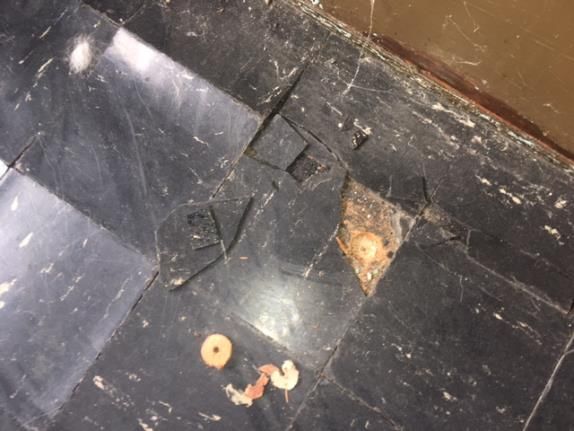
Hillmann Consulting LLC

1.3      Recommendations

In accordance with OSHA regulations, only individuals who have undergone the required training
for each material identified should be utilized for its removal.

1.3.1 Asbestos Containing Materials

•     Removal of the ACM is recommended if the material is to be disturbed by future renovation
      and should be removed by a licensed asbestos abatement contractor in accordance with all
      federal, state and local laws governing asbestos.

•     If during the renovation, materials are discovered that are not included in this or previous
      inspections, those materials are assumed to contain asbestos until tested and proven otherwise.
      This includes but is not limited to materials that may be uncovered behind walls, fixed ceilings
      or flooring, roofing, and exterior.

•     The OSHA Asbestos Construction Industry Standard protects workers who may be exposed to
      asbestos in construction. The OSHA standard specifies permissible exposure limits, and
      procedures for handling various forms and quantities of asbestos containing building materials.
      The standard describes regulated areas, exposure monitoring, respiratory protection and
      protective clothing, hygiene facilities, hazard communication, housekeeping, medical
      surveillance, record keeping, and worker training requirements.

1.3.2 Lead Containing Paint

The EPA RRP Ruling does not currently regulate the presence of lead-containing paint in
commercial or public buildings. During renovations/demolition of structures, the OSHA Lead In
Construction Standard, 29 CFR 1926.62 applies.

      1. If the lead-containing painted components are being disturbed or removed during a
         demolition/renovation project, the following recommendations should be taken into
         consideration:

         Demolition workers disturbing lead-painted surfaces must be notified of potential lead
         exposure. The Demolition Contractor should comply with the requirements of the following
         regulations:

         •       OSHA Title 29 Code of Federal Regulations (CFR) Section 1926.62 - Lead
                 Construction Standard
         •       OSHA 29 CFR 1910.134 - Respiratory Protection Standard
         •       EPA 40 CFR 261 - Resource Conservation Recovery Act (RCRA), Federal Hazardous
                 Waste Regulations

The Demolition Contractor should segregate components painted with lead-containing paint from
other demolition waste. The EPA considers materials, analyzed by Toxicity Characteristic
Leaching Procedure (TCLP), with concentrations of lead greater that 5 milligrams per liter (mg/L)

Hazardous Materials Survey                        -4-                     Hillmann Project # M3-9657
89 South East Street, Amherst, Massachusetts
Hillmann Consulting LLC

have the characteristics of toxicity; therefore, these materials must be handled and disposed of as
hazardous waste. The contractor should perform TCLP tests on representative samples of the waste.
Contingent on laboratory results, the waste will be handled as hazardous or non-hazardous waste.

1.3.2 Polychlorinated Biphenyls

All ballasts should be bulked together in a proper container and disposed of in accordance with
state and federal waste regulations.

1.3.4 Universal Wastes/Hazardous Materials

The thermostats, smoke detectors, and fluorescent bulbs should be inspected to determine if they
contain hazardous material. If hazardous materials are found, such as Mercury or PCB’s, they
should be disposed of in accordance with state and federal waste regulations.

Hazardous Materials Survey                     -5-                      Hillmann Project # M3-9657
89 South East Street, Amherst, Massachusetts
Hillmann Consulting LLC

2.0    INTRODUCTION

2.1    Purpose

This survey was performed for the purpose of identifying the presence of asbestos containing
building materials, lead containing paint, and building components that, in the event of removal
and disposal, may require special handling and disposal as universal, hazardous or other
unconventional solid waste classification.

2.2    Scope of Work

       2.2.1 Project Site Description:

The project site subject to the survey consists of a three-story (including basement) school building
structure located at 89 South East Street, Amherst, Massachusetts that was constructed circa 1920.
The survey included the interior and exterior of the building, with the exception of the roof, subject
to the limitations specified in Section 2.6 and 3.2.

The building consists of three stories and includes former classroom spaces, restrooms, storage
areas, and a basement which includes a boiler room.

The elevator shaft and machine room were inaccessible at the time of the survey.

       2.2.2 Hazardous Materials Survey-Scope of Work

The scope of work includes the following components:

An asbestos survey of the project site was conducted in accordance with the USEPA's AHERA
Regulation 40 CFR Part 763.85 through Part 763.88 to identify and quantify the presence of
asbestos containing materials.

A survey of the project site for the presence of lead-containing paint was conducted in general
accordance with modified HUD/EPA Methodology. The modifications included not testing every
wall but to perform a representative survey of the painted components to identify building
components coated with detectable concentrations of lead (Pb).

A visual inspection of the project site was conducted to identify and quantify the presence of
building components (excluding building contents) anticipated to require special handling, disposal
and/or recycling practices due to universal, RCRA hazardous or other unconventional solid waste
classification. No testing was included in the Scope of this investigation for these items.

2.3    Survey Methods
       2.3.1 Asbestos

Hazardous Materials Survey                       -6-                      Hillmann Project # M3-9657
89 South East Street, Amherst, Massachusetts
Hillmann Consulting LLC
Non-intrusive methods were utilized during the inspection of the premises for suspect ACM.
Therefore, suspect materials may exist within the inspected areas of the building that were not
accessible during the inspection. Such areas typically include, but may not necessarily be limited
to, enclosed wall cavities, ceiling plenums, sealed pipe chases and risers, the interior of HVAC
equipment and ductwork.
If any previously unidentified building materials are encountered during the demolition activities
that may disturb ACM, all work must stop. The unidentified materials must be assumed to contain
asbestos until laboratory analysis either refutes or confirms that assumption.
When planned or unplanned, renovation, restoration, maintenance or any other projects that may
impact or otherwise disturb ACM, removal of asbestos-containing materials should include
consulting services (air and project monitoring) and the removal should be performed by a
Massachusetts licensed asbestos abatement contractor and according to all federal, state and local
laws governing asbestos.
Asbestos-containing materials in good condition that will not be disturbed by any portion of the
work may remain in place. However, they must be documented in an Operations & Maintenance
Program, so they can be maintained until such time that they must be removed, such as when the
material incurs damage or future activities can disturb the material.
2.3.2 Lead Containing Paint
The painted surface is defined as lead-containing paint when any detectable concentration of lead
is present; compliance with the OSHA Lead in Construction Standard 29 CFR 1926.62 is required
when the surface will be disturbed during any applicable construction work as defined in the
standard. The painted surface is defined as lead-based paint in accordance with EPA and HUD
when any paint, varnish, shellac, or other coating that contains lead equal to or greater than 1.0
mg/cm2 as measured by XRF or laboratory analysis, or 0.5 percent by weight as measured by
laboratory analysis.
State and federal regulations are followed as applicable and, in all cases, the most stringent
regulation is followed. The results of this sampling are limited to those items that were tested on
the date of the assessment.
Lead based paint (LBP) paint chip samples were collected from affected areas and submitted for
laboratory analysis. The number of the paint chip samples collected was determined by the variety
of the paint types, color, generation and substrate. A total of twelve (12) paint chip samples were
collected for laboratory analysis.
Samples were transmitted under chain of custody to ProScience Analytical Services, Inc. of
Woburn, Massachusetts (AIHA-LAP, LLC ELLAP 102754) laboratory for analysis. The paint chip
samples were analyzed by Atomic Absorption Spectrophotometry (AAS) for total lead content in
accordance with the EPA Test Method SW846-7420.
Hazardous Materials Survey -7- Hillmann Project # M3-9657
89 South East Street, Amherst, MassachusettsHillmann Consulting LLC
2.3.3 Polychlorinated Biphenyls (PCBs)
Ballasts of Fluorescent Light Fixtures: Polychlorinated biphenyls (PCBs) were commonly used
in the manufacture of small capacitors within fluorescent light ballasts manufactured prior to 1980.
This survey included a visual inspection for the presence of older style fluorescent light fixtures
within the project area. If identified, due to the hazards of live electrical circuits, the ballasts within
the older style fixtures are assumed for the purposes of this survey to contain PCBs. Visual
inspection of the actual ballasts located within each fixture once disconnected from live electrical
circuitry would be needed prior to disposal; and ballasts that are not labelled as “No PCBs” should
be handled and disposal as PCB containing hazardous waste.
Oil-filled Electrical Equipment: Some electrical service equipment carrying high voltages such
as power transformers and electrical switchgear utilize dielectric liquids. Prior to 1980, dielectric
liquids used in these applications commonly contained PCBs. In addition, by 1980 the use of oil
filled circuit breakers and switchgear was largely phased out. This survey included a visual
inspection in accessible areas for the presence of high-voltage electrical service equipment installed
prior to 1980. If identified, any visible labeling of PCB content was noted. If no PCB labeling was
observed, an assumption has been made that any dielectric liquids within the equipment contains
PCBs unless testing indicates otherwise. If the age of the equipment is not determined, it will be
assumed to have been installed prior to 1980.
It is noted that due to the safety hazards associated with high voltage electrical equipment, the
observation of such equipment are limited to what was easily observed from a safe distance from
the equipment. Electrical equipment housings were not opened, and fenced-off areas with high
voltage warning signs were not entered. In addition, areas of electrical service equipment located
in restricted areas controlled by the power utility have been excluded from the scope of work of
this survey.
Hydraulic Systems: Prior to 1980, hydraulic fluids from certain manufacturers contained PCBs
and were primarily used in industrial equipment in a high-temperature setting. While PCB
containing hydraulic fluids were not commonly utilized in building systems such as elevators and
equipment/vehicle lifts, it is noted that hydraulic systems installed prior to 1980 may contain PCBs.
Systems that do not contain PCBs still contain hydraulic machine oils. This survey included a visual
inspection in accessible areas for the presence of hydraulic systems. The elevator in the central core
of the building is presumed to be powered hydraulically, but the elevator interior and machine room
were not accessible at the time of the inspection.
2.3.4 Universal Waste/Hazardous Materials
A visual inspection and inventory of universal wastes and other potential hazardous materials was
conducted.
EPA Universal Wastes: Universal wastes, as defined by federal regulations (40 CFR Part 273),
include certain common hazardous wastes within the following four categories:
Hazardous Materials Survey -8- Hillmann Project # M3-9657
89 South East Street, Amherst, MassachusettsHillmann Consulting LLC
• Batteries: a device consisting of one or more electrically connected electrochemical cells which
is designed to receive, store, and deliver electric energy. The federal definition is generally
intended to include lead-acid, lithium, mercury, silver ion, and nickel/cadmium batteries.
• Pesticides: any substance or mixture of substances intended for preventing, destroying,
repelling, or mitigating any pest, or intended for use as a plant regulator, defoliant, or desiccant.
• Mercury-containing equipment: a device or part of a device (including thermostats, but
excluding batteries and lamps) that contains elemental mercury integral to its function.
• Lamps: the bulb or tube portion of an electric lighting device. Examples of common universal
waste electric lamps include, but are not limited to, fluorescent, high intensity discharge, neon,
mercury vapor, high pressure sodium, and metal halide lamps.
State Designated Universal Wastes:
The State of Massachusetts currently does not have any state-designated categories of universal
waste.
Other Hazardous Materials: The survey also included an inspection and inventory of additional
building components or contents that may contain hazardous material or qualify as hazardous waste
or require special handling upon disposal. If indicated above, some of these categories may be
covered by state universal waste regulations.
• Paint and related products
• Oil and lubricating products
• Cleaning solvents
• Custodial/cleaning products
• Heating and motor fuels
• Ionization Chamber Smoke Detectors
• Refrigerants in building systems or storage containers
• Compressed gases
• Hydraulic Systems
• HVAC treatment chemicals
• Medical/bio-hazardous wastes
2.4 User Reliance
This report is for the exclusive use of the User(s) named on the front cover. No other party(ies)
shall have any right to rely on the content of this report without first obtaining the consent of the
original report User; and without obtaining written consent from Hillmann in the form of a letter of
reliance or report recertification.
2.5 Significant Assumptions
The following significant assumptions are made:
Hazardous Materials Survey -9- Hillmann Project # M3-9657
89 South East Street, Amherst, MassachusettsHillmann Consulting LLC
If during proposed renovations, materials are discovered that are not included in this or previous
inspections, those materials are assumed to contain asbestos until tested and proven otherwise. This
includes but is not limited to materials that may be uncovered behind walls, fixed ceilings or
flooring.
2.6 General Limitations and Exceptions
Hillmann has conducted this inspection using reasonable efforts according to industry standards,
and in accordance the agreed scope of services. Unless otherwise specified, this report is not
intended to be used as a construction document and should not be used for demolition, renovation
or other construction purposes without field verification by the construction/demolition contractor.
Report findings, conclusions and recommendations of this report are based, in part, on information
and/or documents provided by the Client or project site representative. Hillmann relies on such
information and/or documents and assumes that information to be true and correct. Regardless of
the findings stated in this report, Hillmann is not responsible for consequences or conditions arising
from facts that were concealed, withheld or not fully disclosed.
Identification of asbestos materials is also advised for ACM that is to remain in place. Building
occupants who have been informed of asbestos hazard locations are less likely to disturb the
material and cause fibers to be released into the air. Additionally, contractors and maintenance
personnel should be informed of the asbestos hazard locations.
Significant limitations related to the condition or accessibility of the project site at the time of the
site reconnaissance, if encountered, are reported in Section 3.2.
2.6.3 Special Terms and Conditions
This report is not definitive and should not be assumed to be a complete or specific definition of
the conditions above or below grade. Information in this report is not intended to be used as a
construction document and should not be used for demolition, renovation, site development,
redevelopment, or other construction purposes. Hillmann makes no representation or warranty that
the past or current operations at the Property are, or have been, in compliance with all applicable
federal, state and local laws, regulations and codes.
Findings, conclusions and recommendations presented in this report are based on our visual
observations of the Property, interviews conducted, the records reviewed, information provided by
the Client, and/or a review of readily available and supplied drawings and documents. Hillmann
relies upon the information, whether written, graphic or verbal, provided by the Property contact(s)
or as shown on any documents reviewed or received from the Property contact, owner or agent, or
municipal source; and assumes that information to be true and correct. Although there may have
been some degree of overlap in the information provided by these various sources, Hillmann did
not attempt to independently verify the accuracy or completeness of all information reviewed or
received during the course of this assessment. Hillmann can neither warrant nor guarantee the
accuracy or completeness of information that was obtained from ostensibly knowledgeable
individuals, regulatory agency representatives or other secondary sources.
Hazardous Materials Survey -10- Hillmann Project # M3-9657
89 South East Street, Amherst, MassachusettsHillmann Consulting LLC Regardless of the findings stated in this report, Hillmann is not responsible for consequences or conditions arising from facts that were concealed, withheld or not fully disclosed at the time the assessment was conducted. This report does not warrant against future operations or conditions, nor does it warrant against operations or conditions present of a type or at a location not investigated. In the event of any conflict between the terms and conditions of this report and the terms and conditions of the consulting services agreement for this project, the consulting services agreement shall control. Hazardous Materials Survey -11- Hillmann Project # M3-9657 89 South East Street, Amherst, Massachusetts
Hillmann Consulting LLC

3.0    SURVEY FINDINGS

3.1    Survey Personnel

The survey was conducted by Mr. Scott Munroe, an EPA-trained and Massachusetts Licensed
Asbestos Inspector. A summary of qualifications and applicable credentials for survey personnel
has been included in Appendix B.

3.2    Site Limitations/Inaccessible Areas

Limited intrusive methods were utilized during the inspection of the premises for suspect ACM due
to building occupancy. Therefore, suspect materials may exist within the inspected areas of the
building that were not accessible during the inspection. These areas typically include, but are not
limited to, enclosed wall cavities, above fixed ceilings, beneath ceramic tiles/marble tiles/granite,
sub floors, and adhesives behind wall-mounted mirrors, sealed pipe chases and risers, the interior
of HVAC equipment and ductwork. If these areas are exposed during renovation, then additional
sampling may be warranted. The inspection did include exterior building materials or the facade,
but the roof was excluded as part of the path of construction inspection.

The elevator shaft and machine room were inaccessible at the time of the inspection.

3.3    Asbestos Containing Materials (ACM)

       3.3.1 Sampling Summary

Seventy-eight (78) samples of suspect materials were collected. The number of samples analyzed
for each homogeneous material tested was sufficient to meet AHERA protocol. The conditions of
the tested materials and categories as per AHERA inspection protocols were noted.

Asbestos was detected in the following materials analyzed:

                                                                                               Asbestos
                                                                    Friable
               Material                         Location                       Condition       Content
                                                                     (Y/N)
            Joint Compound                   1st Floor rear Exit      Y           Good        2% Chrysotile

         9”x9” Black Floor Tile            2nd Floor Classroom #4     N            Fair       5% Chrysotile
         9”x9” Black Floor Tile            2nd Floor Classroom #3     N            Fair       5% Chrysotile
         9”x9” Black Floor Tile              1st Floor Hallway        N            Fair       5% Chrysotile

 Black Mastic on 9”x9” Black Floor Tiles     1st Floor Hallway        N           Good        5% Chrysotile

          9”x9” Tan Floor Tile              Basement Art Room         N            Fair      10% Chrysotile

  Black Mastic on 9”x9” Tan Floor Tiles     Basement Art Room         N           Good       Trace Chrysotile

Hazardous Materials Survey                         -12-                       Hillmann Project # M3-9657
89 South East Street, Amherst, Massachusetts
Hillmann Consulting LLC
3.3.2 Non-Asbestos Containing Materials Summary Table
The following table summarizes suspect materials that tested negative for ACM:
Friable
Material Location Condition
(Y/N)
Gray Drywall 2nd Floor Northeast Classroom Y Good
Gray Drywall 2nd Floor Hall Office Y Good
Gray Drywall 1st Floor Rear Exit Y Good
White Joint Compound 1st Floor Office Y Good
White Skim Coat Plaster 2nd Floor Hall Office Y Good
White Skim Coat Plaster 2nd Floor Classroom #3 Y Good
White Skim Coat Plaster 2nd Floor Northeast Classroom Y Good
White Skim Coat Plaster 1st Floor Hallway Y Good
White Skim Coat Plaster Basement Y Good
Gray Coarse Coat Plaster 2nd Floor Hallway Office Y Good
Gray Coarse Coat Plaster 2nd Floor Classroom #3 Y Good
Gray Coarse Coat Plaster 2nd Floor Northeast Classroom Y Good
Gray Coarse Coat Plaster 1st Floor Hallway Y Good
Gray Coarse Coat Plaster Basement Y Good
White Flat Ceiling Tile 2nd Floor Hallway Y Fair
White Flat Ceiling Tile 2nd Floor Hallway Closet Y Fair
White Flat Ceiling Tile 1st Floor Hallway Y Fair
White 2’ x 4’ Ceiling Tile 2nd Floor Hall Office Y Fair
1’ x 1’ Ceiling Tile 2nd Floor Classroom #3 Y Good
Tan Panel Adhesive 1st Floor Men’s Bathroom N Fair
Brown Cove Base 1st Floor Men’s Bathroom N Fair
Tan Adhesive with Brown Cove Base 1st Floor Men’s Bathroom N Fair
Black Cove Base 1st Floor Office N Good
Tan Adhesive with Black Cove Base 1st Floor Office N Good
Black Mastic with Black 9”x9” Floor Tile 2nd Floor Classroom #4 N Good
Black Mastic with Black 9”x9” Floor Tile 2nd Floor Classroom #3 N Good
Hazardous Materials Survey -13- Hillmann Project # M3-9657
89 South East Street, Amherst, MassachusettsHillmann Consulting LLC
Black 12” x 12” Floor Tile 2nd Floor Hallway N Fair
Tan/Black Adhesive with Black 12” x12”
2nd Floor Hallway N Good
Floor Tile
Tan 9” x 9” Floor Tile 2nd Floor Northeast Classroom N Fair
Tan Flooring Adhesive 2nd Floor Northeast Classroom N Fair
Tan 12” x 12” Floor Tile 2nd Floor Classroom #2 N Good
Tan Adhesive with Tan 12” x12” Floor Tile 2nd Floor Classroom #2 N Good
Gray/Blue 12” x 12” Floor Tile 1st Floor Hallway N Good
Tan Adhesive with Gray/Blue 12” x12”
1st Floor Hallway N Good
Floor Tile
Hazardous Materials Survey -14- Hillmann Project # M3-9657
89 South East Street, Amherst, MassachusettsHillmann Consulting LLC
3.4 Lead Containing Paint
3.4.1 Testing Summary
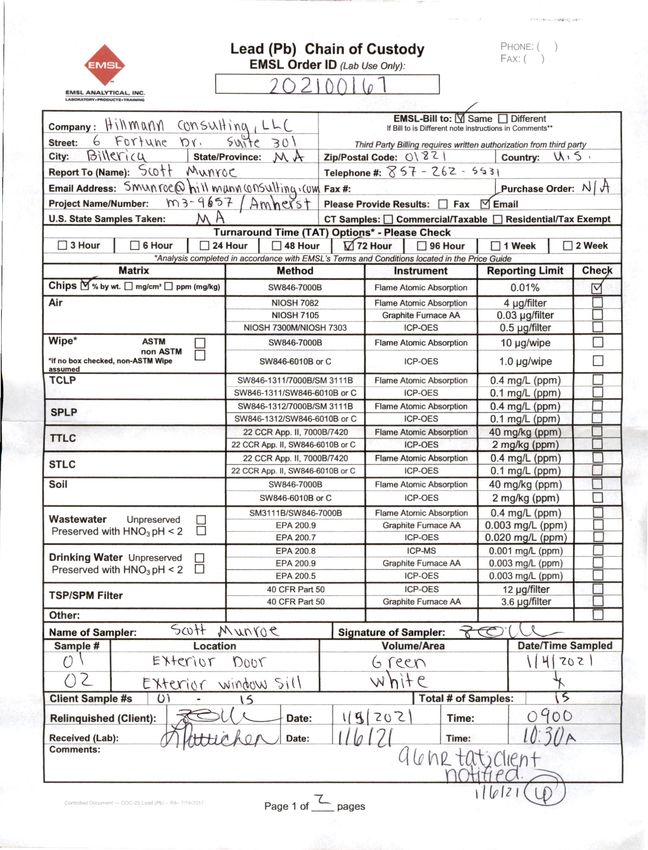
A total of fifteen (15) building components were tested via the collection of paint chip samples. Of
those samples, twelve (12) were found to contain detectable lead concentrations above the reporting
limit.
3.4.2 Table of Lead Containing Paint
The following table summarizes lead paint chip analytical results indicating detections of lead
containing paint:
Component / Lead (%
ID# Floor Color Substrate Condition Results*
Structure by weight)
01 Exterior Door Green Metal Fair 4.6 LBP
02 Exterior Window Sill White Wood Fair 4.3 LBP
03 Exterior Wall Red Wood Fair 0.011 LCP
05 1st Floor Door Green Wood Fair 6.7 LBP
07 2nd Floor Wall Pink Plaster Fair 0.33 LCP
08 2nd Floor Wall Light Pink Plaster Fair 0.041 LCP
09 2nd Floor Door Frame Brown Metal Fair 1.0 LBP
10 2nd Floor Wall White Plaster Fair 0.12 LCP
11 2nd Floor Wall Light Blue Plaster Fair 0.27 LCP
12 Basement Door Red Metal Fair 5.3 LBP
14 1st Floor Wall Blue Wallboard Fair 0.015 LCP
15 2nd Floor Wall Dark Blue Plaster Fair 0.18 LBP
* Lead-based paint (LBP) is defined by federal regulations as paint or other surface coatings that contain lead equal to or in excess of 1.0 milligrams
per square centimeter or more than 0.5 percent by weight.
* Lead-containing paint (LCP) is defined by federal regulations as paint or other similar surface coating materials for consumer use that contain
lead or lead compounds and in which the lead content (calculated as lead metal) is in excess of 0.009 percent by weight of the total nonvolatile
content of the paint or the weight of the dried paint film.
The lab report for all paint chip sample results has been attached in Appendix [D].
3.5 Polychlorinated Biphenyls (PCBs)
3.5.1 Ballasts of Fluorescent Light Fixture:
Hazardous Materials Survey -15- Hillmann Project # M3-9657
89 South East Street, Amherst, MassachusettsHillmann Consulting LLC
The building was construction in 1920; ballasts are suspected to contain PCBs. Approximately 77
ballasts were observed in the building.
3.5.2 Electrical Equipment:
No units were observed on site that are anticipated to contain oil that could be contaminated with
PCBs.
3.5.3 Hydraulic Systems:
The following table summarizes hydraulic building systems or equipment observed at the site that
may contain PCBs:
Type Location Notes
Elevator, Not accessible Rear of Building Presumed Hydraulic, Machine Room inaccessible
3.6 Universal Waste and Other Hazardous Materials
3.6.1 Universal Wastes
The following table summarize an inventory of observed items or materials that would be classified
under federal regulations as a universal hazardous waste:
Type Location Count/Qty
Lamps:
Fluorescent light tubes Throughout 154
Batteries:
None observed
Suspected Mercury Containing:
Thermostat; suspect mercury switches Throughout 13
3.6.2 Other Potentially Hazardous Materials
Other Potentially Hazardous Materials
Type Location Qty/Count
PCB Wastes:
Ballasts Throughout 77
Refrigerants:
None observed
Fuel Systems:
Oil/ Non-Hazardous
Hydraulic Systems:
Elevator (presumed hydraulic) Rear of Building 1
Compressed Gases:
Nitrogen Tanks Basement 4
Hazardous Materials Survey -16- Hillmann Project # M3-9657
89 South East Street, Amherst, MassachusettsHillmann Consulting LLC
Radioactive
Ionization Smoke Detectors Throughout 9
Exit Signs Throughout 5
Emergency Lights Throughout 20
Medical/Bio-Hazardous
None observed
Paints and Related Products:
Floor Polish 2nd floor 1
Oil and Lubricating Products:
None observed
Miscellaneous:
Fire Extinguishers Throughout 12
Combustible Flashing Cement 2nd floor hallway 2
Cleaning Products 1st and 2nd floor hall closets 10
Above Ground Storage Tanks Basement 2
Hazardous Materials Survey -17- Hillmann Project # M3-9657
89 South East Street, Amherst, MassachusettsHillmann Consulting LLC 6.0 APPENDICES Hazardous Materials Survey -18- Hillmann Project # M3-9657 89 South East Street, Amherst, Massachusetts
Hillmann Consulting LLC

                                          APPENDIX A

                   GUIDE TO ACM CATEGORIES, FRIABILITY,

                             DISTURBANCE & CONDITION

Hazardous Materials Survey                     -19-    Hillmann Project # M3-9657
89 South East Street, Amherst, Massachusetts
Hillmann Consulting LLC
GUIDE TO ACM CATEGORIES, FRIABILITY,
DISTURBANCE & CONDITION
Categories
The USEPA categorizes ACM as either 1) surfacing material, 2) thermal system insulation, or 3)
miscellaneous materials.
Surfacing Material
Surfacing ACM is defined by the USEPA as "materials which are sprayed-on, troweled-on, or
otherwise applied to surfaces. Examples included wallboard primer, sealer, paint and stucco,
acoustical plaster on ceilings, fireproofing on structural components, or other materials applied to
surfaces for acoustical, fireproofing, or other purposes."
Thermal Systems Insulation
Thermal system insulation ACM is defined as defined by the USEPA as "materials in a building or
distribution system applied to pipes, fittings, boilers, breaching, tanks, ducts, or other system
components to prevent heat loss or gain, water condensation, or for other purposes."
Miscellaneous Materials
Miscellaneous ACM is defined by the USEPA as "interior or exterior material components such as
wallboard, linoleum, floor and ceiling tiles, fire doors, roofing, siding; and materials not an integral
component of the building such as stage curtains, protective clothing, laboratory apparatus and
equipment, and other materials considered to be part of the real estate."
Friability
Friable ACM
Friability is a mechanical classification defined by the most recent EPA AHERA regulations as
"...those materials, which when dry, which may be crumbled, pulverized, or reduced to powder by
hand pressure." This includes previously non-friable material after such materials become damaged
to the extent that when dry they may be crumbled, pulverized, or reduced to powder by hand
pressure.
Non-Friable ACM
Category I non-friable ACM is defined by NESHAP as, "asbestos containing packings, gaskets,
resilient floor coverings, and asphalt roofing products containing more than one percent asbestos"
as determined by Polarized Light Microscopy (PLM).
Category II non-friable ACM includes any other non-friable material, excluding Category I ACM.
Disturbance
Hazardous Materials Survey -20- Hillmann Project # M3-9657
89 South East Street, Amherst, MassachusettsHillmann Consulting LLC
Several factors are used to determine the potential for disturbance. Planned renovation,
construction and maintenance activities may affect building materials, and rate a high potential.
Maintenance work that occurs regularly and/or accessible material in an occupied room may
constitute moderate physical disturbance. The influence of vibration i.e., loud motors, vicinity to
major airports or highways, music rooms, etc., is rated. Potential air erosion from a variety of
sources is also considered.
Damage
Damage can be classified as: 1-Deterioration or Delamination; 2-Physical Damage; 3-Water
Damage.
Deterioration
Deterioration may occur as a result of either the quality of the installation or environmental factors
that affect the cohesive strength of the material. Delamination, a form of deterioration, is a result
of loss of adhesive or adhesive strength. This causes the material to separate into layers or separate
from its substrate.
Physical Damage
Physical damage is the result of accidental or deliberate contact with the material. This is evidenced
by punctures, missing pieces, scrape marks, etc. Physical damage can cause materials that were
once in good condition to have exposed friable surfaces. Exposed surfaces may release fibers if
subjected to an air stream or vibrations, or if damaged further. Additionally, the act of damaging
or inadvertently disturbing the material will cause fibers to be released, posing a potential hazard
to occupants.
Water Damage
Water can dislodge, delaminate, or disturb friable ACM that are otherwise in good condition and
can increase the potential for fiber release by dissolving and leaching out the material's binder.
Materials considered non-friable may thus become friable. Water can also carry fibers to other
areas where evaporation will leave a collection of fibers that may become suspended in the air.
Overall Condition
Ratings of "Good", "Fair”, and "Poor" are meant to indicate the overall condition of the material as
a combination of these types of damage.
Good Condition
Hazardous Materials Survey -21- Hillmann Project # M3-9657
89 South East Street, Amherst, MassachusettsHillmann Consulting LLC
A material in good condition has an intact jacket or a covering of paint, has very few gaps between
insulation sections, and little or no evidence of physical damage. However, it is cautioned that
materials in good condition have the potential for damage in the future.
Fair Condition
A material in fair condition may show evidence of physical damage, have gaps between many
insulation sections, or have a ripped jacket or loose insulation sections. The material in fair
condition should remain in place only after it is properly repaired and returned to good condition.
Work should be scheduled as soon as possible to prevent further disturbance and accidental fiber
release. Removal is always preferable - existing damage is a good indicator of future damage.
Poor Condition
A material in poor condition usually shows extensive physical damage, may have a loose or missing
jacket, and often appears as dislocated insulation sections or sections on the ground. The material
in poor condition should be abated as soon as possible. Repair is not an option. Precautions should
be taken to inform persons of the potentially hazardous nature of the area if the material is highly
accessible or in a frequently used area. Limiting access to the area or room is advised until such
time as the material has been properly removed.
Hazardous Materials Survey -22- Hillmann Project # M3-9657
89 South East Street, Amherst, MassachusettsHillmann Consulting LLC
APPENDIX B
INSPECTOR CREDENTIALS
Hazardous Materials Survey -23- Hillmann Project # M3-9657
89 South East Street, Amherst, MassachusettsThis is to certify that
Scott Munroe
has completed requisite training, and has passed an examination for reaccreditation
as:
Asbestos Inspector Refresher
pursuant to Title II of the Toxic Substance Control Act, 15 U.S.C. 2646
Course Location
Institute for Environmental Education
16 Upton Drive Wilmington, MA 01887
May 5, 2020 May 05, 2020
Course Dates Examination Date
20-2966-106-266161 May 05, 2021
Certificate Number Expiration Date Training DirectorHillmann Consulting LLC
APPENDIX C
ASBESTOS LABORATORY ANALYTICAL RESULTS
Hazardous Materials Survey -24- Hillmann Project # M3-9657
89 South East Street, Amherst, MassachusettsDate of Sampling: 01/04/2021 Job #: M3-9657
Date of Sample Receipt: 01/06/2021 Order#: 0121059
#Received: 78
Client: TOWN OF AMHERST
4 BOLTWOOD AVENUE
HILLMANN CONSULTING, L.L.C.
ENVIRONMENTAL CONSULTING, LAB SERVICES
1600 ROUTE 22 EAST
Attn: NATHANIEL MALLOY
P.O. BOX 1597
Location: 89 SOUTH EAST STREET/ AMHERST/ MA UNION, NEW JERSEY 07083-1597
PHONE: (908) 688-7800 FAX: (908) 686-2636
www.hillmannconsulting.com
Field Technician: Scott Munroe
Date of Analysis: 01/06/2021
Date of Issue: 01/06/2021
BULK SAMPLE CERTIFICATE OF ANALYSIS
Method: EPA/600/M4-82-020 per 40CFR: PLM with Dispersion Staining
Asbestos Asbestos Non-Asbestos
Detected? Constituents Constituents
LAB ID # Location Sample Description (Yes/No) (%) (%)
W331872 01/ 2nd Floor/ Northeast Drywall, Gray, Non- No Cellulose Fiber 10%
Class homogeneous Non-Fibrous Material 90%
W331873 02/ 2nd Floor/ Hall Office Drywall, Gray, Non- No Cellulose Fiber 10%
homogeneous Non-Fibrous Material 90%
W331874 03/ 1st Floor/ Rear Exit Drywall, Gray, Non- No Cellulose Fiber 10%
homogeneous Non-Fibrous Material 90%
W331875 04/ 1st Floor/ Office Joint Compound, White, No Non-Fibrous Material 100%
Homogeneous
W331876 05/ 1st Floor/ Rear Exit Joint Compound, White, Yes Chrysotile 2% Non-Fibrous Material 98%
Homogeneous
W331877 06/ 1st Floor/ Rear Exit Joint Compound, White, Yes Chrysotile 2% Non-Fibrous Material 98%
Homogeneous
W331878 07/ 1st Floor/ Rear Exit Joint Compound, White, Yes Chrysotile 2% Non-Fibrous Material 98%
Homogeneous
W331879 08/ 1st Floor/ Rear Exit Joint Compound, White, Yes Chrysotile 2% Non-Fibrous Material 98%
Homogeneous
W331880 09/ 2nd Floor/ Hall Office Skim Coat, White, No Non-Fibrous Material 100%
Homogeneous
W331881 10/ 2nd Floor/ Class #3 Skim Coat, White, No Non-Fibrous Material 100%
Homogeneous
W331882 11/ 2nd Floor/ Northeast Skim Coat, White, No Non-Fibrous Material 100%
Class Homogeneous
Signature:
Dylan Jaycox Laboratory Director #Analyzed: 78 Lab Code 101421-0
PAGE: 1 of 9Date of Sampling: 01/04/2021 Job #: M3-9657
Date of Sample Receipt: 01/06/2021 Order#: 0121059
#Received: 78
Client: TOWN OF AMHERST
4 BOLTWOOD AVENUE
HILLMANN CONSULTING, L.L.C.
ENVIRONMENTAL CONSULTING, LAB SERVICES
1600 ROUTE 22 EAST
Attn: NATHANIEL MALLOY
P.O. BOX 1597
Location: 89 SOUTH EAST STREET/ AMHERST/ MA UNION, NEW JERSEY 07083-1597
PHONE: (908) 688-7800 FAX: (908) 686-2636
www.hillmannconsulting.com
Field Technician: Scott Munroe
Date of Analysis: 01/06/2021
Date of Issue: 01/06/2021
BULK SAMPLE CERTIFICATE OF ANALYSIS
Method: EPA/600/M4-82-020 per 40CFR: PLM with Dispersion Staining
Asbestos Asbestos Non-Asbestos
Detected? Constituents Constituents
LAB ID # Location Sample Description (Yes/No) (%) (%)
W331883 12/ 1st Floor/ Hall Skim Coat, White, No Non-Fibrous Material 100%
Homogeneous
W331884 13/ Ground/ Basement Skim Coat, White, No Non-Fibrous Material 100%
Homogeneous
W331885 14/ 2nd Floor/ Hall Office Coarse, Gray, Homogeneous No Non-Fibrous Material 100%
W331886 15/ 2nd Floor/ Class #3 Coarse, Gray, Homogeneous No Non-Fibrous Material 100%
W331887 16/ 2nd Floor/ Northeast Coarse, Gray, Homogeneous No Non-Fibrous Material 100%
Class
W331888 17/ 1st Floor/ Hall Coarse, Gray, Homogeneous No Non-Fibrous Material 100%
W331889 18/ Ground/ Basement Coarse, Gray, Homogeneous No Non-Fibrous Material 100%
W331890 19/ 2nd Floor/ Hall Flat Ceiling Tile, White, No Cellulose Fiber 90%
Homogeneous Non-Fibrous Material 10%
W331891 20/ 2nd Floor/ Hall Closet Flat Ceiling Tile, White, No Cellulose Fiber 90%
Homogeneous Non-Fibrous Material 10%
W331892 21/ 1st Floor/ Hall Flat Ceiling Tile, White, No Cellulose Fiber 90%
Homogeneous Non-Fibrous Material 10%
Signature:
Dylan Jaycox Laboratory Director #Analyzed: 78 Lab Code 101421-0
PAGE: 2 of 9Date of Sampling: 01/04/2021 Job #: M3-9657
Date of Sample Receipt: 01/06/2021 Order#: 0121059
#Received: 78
Client: TOWN OF AMHERST
4 BOLTWOOD AVENUE
HILLMANN CONSULTING, L.L.C.
ENVIRONMENTAL CONSULTING, LAB SERVICES
1600 ROUTE 22 EAST
Attn: NATHANIEL MALLOY
P.O. BOX 1597
Location: 89 SOUTH EAST STREET/ AMHERST/ MA UNION, NEW JERSEY 07083-1597
PHONE: (908) 688-7800 FAX: (908) 686-2636
www.hillmannconsulting.com
Field Technician: Scott Munroe
Date of Analysis: 01/06/2021
Date of Issue: 01/06/2021
BULK SAMPLE CERTIFICATE OF ANALYSIS
Method: EPA/600/M4-82-020 per 40CFR: PLM with Dispersion Staining
Asbestos Asbestos Non-Asbestos
Detected? Constituents Constituents
LAB ID # Location Sample Description (Yes/No) (%) (%)
W331893 22/ 2nd Floor/ Hall Office 2'x4' Ceiling Tile, White, No Cellulose Fiber 35%
Homogeneous Fibrous Glass 50%
Non-Fibrous Material 15%
W331894 23/ 2nd Floor/ Hall Office 2'x4' Ceiling Tile, White, No Cellulose Fiber 35%
Homogeneous Fibrous Glass 50%
Non-Fibrous Material 15%
W331895 24/ 2nd Floor/ Hall Office 2'x4' Ceiling Tile, White, No Cellulose Fiber 35%
Homogeneous Fibrous Glass 50%
Non-Fibrous Material 15%
W331896 25/ 2nd Floor/ Class #3 1'x1' Ceiling Tile, Homogeneous No Cellulose Fiber 40%
Fibrous Glass 50%
Non-Fibrous Material 10%
W331897 26/ 2nd Floor/ Class #3 1'x1' Ceiling Tile, Homogeneous No Cellulose Fiber 40%
Fibrous Glass 50%
Non-Fibrous Material 10%
W331898 27/ 2nd Floor/ Class #3 1'x1' Ceiling Tile, Homogeneous No Cellulose Fiber 40%
Fibrous Glass 50%
Non-Fibrous Material 10%
W331899 28/ 1st Floor/ Men's Fireproofing Adhesive, Tan, No Non-Fibrous Material 100%
Bathroom Homogeneous
W331900 29/ 1st Floor/ Men's Fireproofing Adhesive, Tan, No Non-Fibrous Material 100%
Bathroom Homogeneous
Signature:
Dylan Jaycox Laboratory Director #Analyzed: 78 Lab Code 101421-0
PAGE: 3 of 9Date of Sampling: 01/04/2021 Job #: M3-9657
Date of Sample Receipt: 01/06/2021 Order#: 0121059
#Received: 78
Client: TOWN OF AMHERST
4 BOLTWOOD AVENUE
HILLMANN CONSULTING, L.L.C.
ENVIRONMENTAL CONSULTING, LAB SERVICES
1600 ROUTE 22 EAST
Attn: NATHANIEL MALLOY
P.O. BOX 1597
Location: 89 SOUTH EAST STREET/ AMHERST/ MA UNION, NEW JERSEY 07083-1597
PHONE: (908) 688-7800 FAX: (908) 686-2636
www.hillmannconsulting.com
Field Technician: Scott Munroe
Date of Analysis: 01/06/2021
Date of Issue: 01/06/2021
BULK SAMPLE CERTIFICATE OF ANALYSIS
Method: EPA/600/M4-82-020 per 40CFR: PLM with Dispersion Staining
Asbestos Asbestos Non-Asbestos
Detected? Constituents Constituents
LAB ID # Location Sample Description (Yes/No) (%) (%)
W331901 30/ 1st Floor/ Men's Fireproofing Adhesive, Tan, No Non-Fibrous Material 100%
Bathroom Homogeneous
W331902 31/ 1st Floor/ Men's Cove Base, Brown, No Non-Fibrous Material 100%
Bathroom Homogeneous
W331903 32/ 1st Floor/ Men's Cove Base, Brown, No Non-Fibrous Material 100%
Bathroom Homogeneous
W331904 33/ 1st Floor/ Men's Cove Base, Brown, No Non-Fibrous Material 100%
Bathroom Homogeneous
W331905 34/ 1st Floor/ Men's Adhesive w/ Brown Cove, Tan, No Non-Fibrous Material 100%
Bathroom Homogeneous
W331906 35/ 1st Floor/ Men's Adhesive w/ Brown Cove, Tan, No Non-Fibrous Material 100%
Bathroom Homogeneous
W331907 36/ 1st Floor/ Men's Adhesive w/ Brown Cove, Tan, No Non-Fibrous Material 100%
Bathroom3 Homogeneous
W331908 37/ 1st Floor/ Office Cove Base, Black, No Non-Fibrous Material 100%
Homogeneous
W331909 38/ 1st Floor/ Office Cove Base, Black, No Non-Fibrous Material 100%
Homogeneous
W331910 39/ 1st Floor/ Office Cove Base, Black, No Non-Fibrous Material 100%
Homogeneous
W331911 40/ 1st Floor/ Office Adhesive w/ Black Cove, Tan, No Non-Fibrous Material 100%
Homogeneous
Signature:
Dylan Jaycox Laboratory Director #Analyzed: 78 Lab Code 101421-0
PAGE: 4 of 9Date of Sampling: 01/04/2021 Job #: M3-9657
Date of Sample Receipt: 01/06/2021 Order#: 0121059
#Received: 78
Client: TOWN OF AMHERST
4 BOLTWOOD AVENUE
HILLMANN CONSULTING, L.L.C.
ENVIRONMENTAL CONSULTING, LAB SERVICES
1600 ROUTE 22 EAST
Attn: NATHANIEL MALLOY
P.O. BOX 1597
Location: 89 SOUTH EAST STREET/ AMHERST/ MA UNION, NEW JERSEY 07083-1597
PHONE: (908) 688-7800 FAX: (908) 686-2636
www.hillmannconsulting.com
Field Technician: Scott Munroe
Date of Analysis: 01/06/2021
Date of Issue: 01/06/2021
BULK SAMPLE CERTIFICATE OF ANALYSIS
Method: EPA/600/M4-82-020 per 40CFR: PLM with Dispersion Staining
Asbestos Asbestos Non-Asbestos
Detected? Constituents Constituents
LAB ID # Location Sample Description (Yes/No) (%) (%)
W331912 41/ 1st Floor/ Office Adhesive w/ Black Cove, Tan, No Non-Fibrous Material 100%
Homogeneous
W331913 42/ 1st Floor/ Office Adhesive w/ Black Cove, Tan, No Non-Fibrous Material 100%
Homogeneous
W331914 43/ 2nd Floor/ Class #4 9x9 Floor Tile, Black, Yes Chrysotile 5% Non-Fibrous Material 95%
Homogeneous
W331915 44/ 2nd Floor/ Class #3 9x9 Floor Tile, Black, Yes Chrysotile 5% Non-Fibrous Material 95%
Homogeneous
W331916 45/ 1st Floor/ Hall 9x9 Floor Tile, Black, Yes Chrysotile 5% Non-Fibrous Material 95%
Homogeneous
W331917 46/ 2nd Floor/ Class #4 Mastic w/ Black 9x9, Black, No Cellulose Fiber 10%
Homogeneous Non-Fibrous Material 90%
W331918 47/ 2nd Floor/ Class #3 Mastic w/ Black 9x9, Black, No Cellulose Fiber 10%
Homogeneous Non-Fibrous Material 90%
W331919 48/ 1st Floor/ Hall Mastic w/ Black 9x9, Black, Yes Chrysotile 5% Non-Fibrous Material 95%
Homogeneous
W331920 49/ 2nd Floor/ Hall 12"x12" Floor Tile, Black, No Non-Fibrous Material 100%
Homogeneous
W331921 50/ 2nd Floor/ Hall 12"x12" Floor Tile, Black, No Non-Fibrous Material 100%
Homogeneous
W331922 51/ 2nd Floor/ Hall 12"x12" Floor Tile, Black, No Non-Fibrous Material 100%
Homogeneous
Signature:
Dylan Jaycox Laboratory Director #Analyzed: 78 Lab Code 101421-0
PAGE: 5 of 9Date of Sampling: 01/04/2021 Job #: M3-9657
Date of Sample Receipt: 01/06/2021 Order#: 0121059
#Received: 78
Client: TOWN OF AMHERST
4 BOLTWOOD AVENUE
HILLMANN CONSULTING, L.L.C.
ENVIRONMENTAL CONSULTING, LAB SERVICES
1600 ROUTE 22 EAST
Attn: NATHANIEL MALLOY
P.O. BOX 1597
Location: 89 SOUTH EAST STREET/ AMHERST/ MA UNION, NEW JERSEY 07083-1597
PHONE: (908) 688-7800 FAX: (908) 686-2636
www.hillmannconsulting.com
Field Technician: Scott Munroe
Date of Analysis: 01/06/2021
Date of Issue: 01/06/2021
BULK SAMPLE CERTIFICATE OF ANALYSIS
Method: EPA/600/M4-82-020 per 40CFR: PLM with Dispersion Staining
Asbestos Asbestos Non-Asbestos
Detected? Constituents Constituents
LAB ID # Location Sample Description (Yes/No) (%) (%)
W331923 52/ 2nd Floor/ Hall Adhesive w/ Black 12x12, No Non-Fibrous Material 100%
Tan/Black, Homogeneous
W331924 53/ 2nd Floor/ Hall Adhesive w/ Black 12x12, No Non-Fibrous Material 100%
Tan/Black, Homogeneous
W331925 54/ 2nd Floor/ Hall Adhesive w/ Black 12x12, No Non-Fibrous Material 100%
Tan/Black, Homogeneous
W331926 55/ 2nd Floor/ Northeast 9x9 Floor Tile, Tan, No Non-Fibrous Material 100%
Class Homogeneous
W331927 56/ 2nd Floor/ Northeast 9x9 Floor Tile, Tan, No Non-Fibrous Material 100%
Class Homogeneous
W331928 57/ 2nd Floor/ Northeast 9x9 Floor Tile, Tan, No Non-Fibrous Material 100%
Class Homogeneous
W331929 58/ 2nd Floor/ Northeast Adhesive, Tan, Homogeneous No Cellulose Fiber 3%
Class Non-Fibrous Material 97%
W331930 59/ 2nd Floor/ Northeast Adhesive, Tan, Homogeneous No Cellulose Fiber 3%
Class Non-Fibrous Material 97%
W331931 60/ 2nd Floor/ Northeast Adhesive, Tan, Homogeneous No Cellulose Fiber 3%
Class Non-Fibrous Material 97%
W331932 61/ 2nd Floor/ Class #2 12" Floor Tile, Tan, No Non-Fibrous Material 100%
Homogeneous
W331933 62/ 2nd Floor/ Class #2 12" Floor Tile, Tan, No Non-Fibrous Material 100%
Homogeneous
Signature:
Dylan Jaycox Laboratory Director #Analyzed: 78 Lab Code 101421-0
PAGE: 6 of 9Date of Sampling: 01/04/2021 Job #: M3-9657
Date of Sample Receipt: 01/06/2021 Order#: 0121059
#Received: 78
Client: TOWN OF AMHERST
4 BOLTWOOD AVENUE
HILLMANN CONSULTING, L.L.C.
ENVIRONMENTAL CONSULTING, LAB SERVICES
1600 ROUTE 22 EAST
Attn: NATHANIEL MALLOY
P.O. BOX 1597
Location: 89 SOUTH EAST STREET/ AMHERST/ MA UNION, NEW JERSEY 07083-1597
PHONE: (908) 688-7800 FAX: (908) 686-2636
www.hillmannconsulting.com
Field Technician: Scott Munroe
Date of Analysis: 01/06/2021
Date of Issue: 01/06/2021
BULK SAMPLE CERTIFICATE OF ANALYSIS
Method: EPA/600/M4-82-020 per 40CFR: PLM with Dispersion Staining
Asbestos Asbestos Non-Asbestos
Detected? Constituents Constituents
LAB ID # Location Sample Description (Yes/No) (%) (%)
W331934 63/ 2nd Floor/ Class #2 12" Floor Tile, Tan, No Non-Fibrous Material 100%
Homogeneous
W331935 64/ 2nd Floor/ Class #2 Adhesive w/ Tan Floor Tile, No Non-Fibrous Material 100%
Tan, Homogeneous
W331936 65/ 2nd Floor/ Class #2 Adhesive w/ Tan Floor Tile, No Non-Fibrous Material 100%
Tan, Homogeneous
W331937 66/ 2nd Floor/ Class #2 Adhesive w/ Tan Floor Tile, No Non-Fibrous Material 100%
Tan, Homogeneous
W331938 67/ 1st Floor/ Hall 12" Floor Tile, Gray/Blue, No Non-Fibrous Material 100%
Homogeneous
W331939 68/ 1st Floor/ Hall 12" Floor Tile, Gray/Blue, No Non-Fibrous Material 100%
Homogeneous
W331940 69/ 1st Floor/ Hall 12" Floor Tile, Gray/Blue, No Non-Fibrous Material 100%
Homogeneous
W331941 70/ 1st Floor/ Hall Adhesive w/ 12" Gray/Blue FT, No Non-Fibrous Material 100%
Tan, Homogeneous
W331942 71/ 1st Floor/ Hall Adhesive w/ 12" Gray/Blue FT, No Non-Fibrous Material 100%
Tan, Homogeneous
W331943 72/ 1st Floor/ Hall Adhesive w/ 12" Gray/Blue FT, No Non-Fibrous Material 100%
Tan, Homogeneous
W331944 73/ Ground/ Basement/ 9" Floor Tile, Tan, Yes Chrysotile 10% Non-Fibrous Material 90%
Art Room Homogeneous
Signature:
Dylan Jaycox Laboratory Director #Analyzed: 78 Lab Code 101421-0
PAGE: 7 of 9You can also read


