Human Resource Management@ Unisa - A complete guide to preparing yourself for career opportunities
←
→
Page content transcription
If your browser does not render page correctly, please read the page content below

Human Resource
   Management@
   Unisa
    A complete guide to preparing
    yourself for career opportunities

Define tomorrow.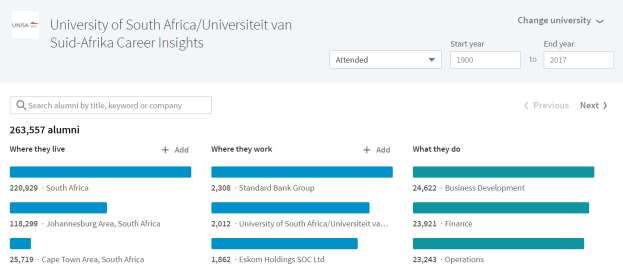
Contents
How will this brochure help me?                                                       2

What is Human Resource (HR) Management?                                               3

What do you do in HR?                                                                 3

Skills needed                                                                         5

Related job titles                                                                    6

Identify opportunities with career research                                           7

  How do you identify opportunities?                                                  7

  Further ways to do career research                                                  8

Professional bodies                                                              16

  South African Board for People Practices (SABPP)                                16

Qualifications offered by Unisa                                                  16

  Undergraduate                                                                   16

  Postgraduate:                                                                   17

Short learning Programmes (SLPs)                                                 17

  Centre for Business Management                                                  18

  Centre for Industrial and Organisational Psychology                             18

  Graduate School of Business Leadership                                          19

Counselling and career development services at Unisa                             20

The information in this document was correct as on 27 February 2018. Visit the
Directorate: Counselling and Career Development website (http://bit.ly/2ux94B5) for
the latest version of this document.
How will this brochure
help me?
It will provide you with some insight into what studying Human Resource
Management involves.
It will help you gain more information about the skills needed in Human
Resource Management.
It will help you identify possible career fields in Human Resource
Management.
It will assist you in finding Human Resource Management qualifications
offered by Unisa.
2 Human Resource Management @ UnisaWhat is Human Resource
(HR) Management?
Human: refers to the skilled workforce in the organisation
Resource: refers to limited availability or scarce
Management: refers to maximise or proper utilisation and make best use of
limited and a scarce resource
Human Resource Management (HRM) is the process of recruitment, selection of
employee, providing proper orientation and induction, providing proper training and
the developing skills, assessment of employee (performance of appraisal), providing
proper compensation and benefits, motivating, maintaining proper relations with
labour and with trade unions, maintaining employee’s safety, welfare and health by
complying with labour laws of the country. Altogether, HRM is the process of proper
and maximise utilisation of available limited skilled workforce. The core purpose of
the human resource management is to make efficient use of existing human
resource in the organisation. In other words, HRM is the governance of an
organisation’s employees. HRM is sometimes referred to simply as human resources
(HR) (http://www.whatishumanresource.com/human-resource-management).
What do you do in HR?
There are several HR disciplines, or areas, but HR practitioners in each discipline
may perform more than one of the essential functions, depending on where they are
employed. For example, in a smaller organisation, an HR professional may be
3 Human Resource Management @ Unisaexpected to fulfil multiple roles, whereas in a large organisation, the HR professional
may specialise in one area of expertise. Some of the main tasks performed by HR
professionals include:
Human resource planning. This entails researching the current and future
needs of an organisation and then planning one’s human resource needs.
Job analysis. Analysing and describing the nature of a job and the
requirements for it, and then compiling job descriptions.
Staffing. This includes recruitment and selection of human resources.
Recruitment. This includes advertising job openings, sourcing and screening
candidates, conducting interviews and advising on the final selection of a
candidate.
Safety. Assisting with the provision of a safe work environment for employees
in accordance to the Occupational Health and Safety Act.
Employee relations. This field is concerned with strengthening the employee-
employer relationship. It can be combined with labour relations where the
focus is on managing relationships with unions, negotiating collective
bargaining agreements, and advising in terms of contracting with employees.
Compensation and benefits. This area of specialisation focuses on setting
compensation structures and may include negotiating health coverage rates
with insurers as well as managing payroll activities.
Compliance. The HR professional in this field focuses on ensuring that the
employer complies with labour and employment laws.
Orientation/ onboarding. The HR professional assists new employees to
adjust to the new employer.
Training and development. This may involve the administration of training and
development activities for employees, in addition to providing training to
employees.
Performance management. HR professionals are usually involved with the
administration of a performance management system for an organisation and
advising supervisors and managers as to the implementation of the system.
4 Human Resource Management @ Unisa Career planning. HR professionals may be involved in career planning
activities with employees in order to plan their growth and advancement.
Record-keeping. This involves recording, maintaining, and retrieving
employee information.
Adapted from: http://smallbusiness.chron.com/six-main-functions-human-resource-
department-60693.html
Skills needed
Organisational skills
Negotiation skills
Problem Solving and Conflict Management skills
Communication skills
Multitasking skills
Leadership skill
Learn more about the skills required in these articles:
http://hrdailyadvisor.blr.com/2006/07/18/the-9-essential-skills-of-human-
resources-management-how-many-do-you-have-2/
https://targetjobs.co.uk/career-sectors/hr-and-recruitment/advice/324027-
what-skills-and-competencies-do-you-need-for-a-career-in-hr
5 Human Resource Management @ UnisaRelated job titles Possible job titles related to HR include: HR consultant Executive coach Recruitment consultant/ practitioner/ manager Training and development practitioner/ manager Compensation and benefits specialist HR advisor HR practitioner Human Resource Development (HRD) practitioner/ coordinator HRD manager HR planner HR systems specialist HR assistant HR systems administrator HR business partner HR generalist HR officer HR manager Learning and development coordinator Organisational development specialist Performance management specialist Skills development practitioner Talent Acquisition Manager Transformation manager Wellness coordinator 6 Human Resource Management @ Unisa
Identify opportunities with
career research
How do you identify opportunities?

Your career research will connect you to others who will help you to: answer
questions you have with relation to your career choice; expand your understanding
of the opportunities related to your career vision; identify “hidden” career paths that
you did not think of previously; and think about how you could plan to pursue specific
opportunities.

Prepare
Think about what you still need to find out: what questions do you have? You will use
these questions as a starting point to structure your research. Examples of questions
include: “What can I do with a major in...”, “How much do psychologists earn?” or
“What must I study to be ..?”

Keep track of information
Keep track of your research by making notes about what you learn and what you still
need to find out.

Evaluate
Evaluate the information that you are finding: Who wrote the information (person/
organisation)? Which country does the information relate to? When was the
information last updated? After you have visited a number of websites, you could
compare your notes about the information you found – what are the similarities and
differences? What else do you need to find out?

 7           Human Resource Management @ Unisa
Further ways to do career research

1 Online search
Use a search engine such as Google to search for information related to your
questions. For example, you need to find out about career opportunities related to
human resource management. You could start with using keywords such as “careers
in human resources”, or “careers in human resource development” and then to
further contextualise your findings, you could search keywords such as “careers in
human resource Africa” and “careers in human resource South Africa”. Scan the
brief descriptions of the first ten results and decide which website you would want to
explore first. Skim read through the information on the website (start with the
headings) to get an understanding of the content of the page and to find information
related to your question. Also check whether there are links to other websites that
you could further explore. As you are reading, make a summary of the information.
You could use the information you find to make lists of job titles related to your field
of study, organisations that employ individuals in these fields and professional
organisations.

Remember to bookmark pages that you would want to return to and make notes
about what you find and what you would still like to find out about. Use online
services or apps such as Evernote (http://www.evernote.com), Diigo
(http://www.diigo.com) or Google Bookmarks (http://www.google.com/bookmarks/) to
keep track of your research online.

Activity

Use Google to find specific job titles related to human resources as a major. The
following are some search terms you could consider: “job titles human resources”;
and “job titles human resource graduates south africa”.

 Job title                            Website

 Example:

 8           Human Resource Management @ Unisa
Job title                           Website

 Human resource manager              Quintcareers.com

2 Occupational information websites
The following websites will help you to learn more about specific job titles:

 Website                                       Description

 Unisa Counselling & Career                    This website provides more information
 Development                                   about opportunities related to
 http://bit.ly/2fE0Xd0                         qualifications at Unisa.

 Kheta (from SAQA)                             Search for information about specific
 http://ncap.careerhelp.org.za/occupations job titles.

 Career Planet                                 Learn more about career areas such
 http://www.careerplanet.co.za/                as IT, tourism, engineering and more.
                                               The website also contains information
                                               about learnerships and student finance

 9           Human Resource Management @ Unisa
Website Description
O*Net Explore job titles related to different
http://www.onetonline.org/ categories such as your interests,
skills, values, typical work activities,
and more. You could also browse
through groups of occupations related
to specific industries or economic
sectors.
Prospects Explore different job titles related to job
http://www.prospects.ac.uk/ sectors, as well as what you could do
with your major subject.
3 Job-search portals
Another type of website that is useful in terms of researching specific job titles linked
to different industries is job search portals. Finding jobs advertisements that interest
you is a worthwhile activity, even if you are not currently applying for jobs. You may
not yet be eligible to apply for your dream job, but you can still gain a lot of
information that can be applied to your career planning. For example, you are
interested in human resource management, but you are not sure which specific job
titles are linked to this field; or you want to know what kind of qualifications and skills
are needed to be a training specialist.
You can use this information to make career goals, and think strategically about how
you can develop experiences which will help you meet more of the selection criteria
in the future.
Job search sites include
PNet (http://www.pnet.co.za)
Careerjunction (http://www.careerjunction. co.za)
Careers24 (http://www.careers24.com/)
10 Human Resource Management @ Unisa Indeed (http://www.indeed.co.za)
Government positions (http://www.gov.za/aboutgovt/vacancies.htm)
4 LinkedIn
If you have not done so already, start building your network on LinkedIn
(http://www.linkedin.com) today!
Register for a free account and start connecting with your network online. Join
groups relevant to your career field so that you could participate in discussions, ask
questions and provide answers about specific topics, and search for people,
organisations and jobs in your field of interest. Do research about companies and
employees to help you identify opportunities. To learn more about using LinkedIn
effectively, go to http://bit.ly/2gyOAzS.
Activity
1. Go to www.linkedin.com and sign in to your LinkedIn account. If you do not
have an account yet, then create one.
2. Make sure that you have captured your current or previous studies at Unisa
on your LinkedIn profile.
3. Once you are signed in, go to the University of South Africa page at
https://www.linkedin.com/school/12049/.
4. Click on the “See alumni” button.
11 Human Resource Management @ Unisa5. You will now be presented with a page with Headings and graphs beneath the
headings (e.g. Where they live, Where they work, What they do).
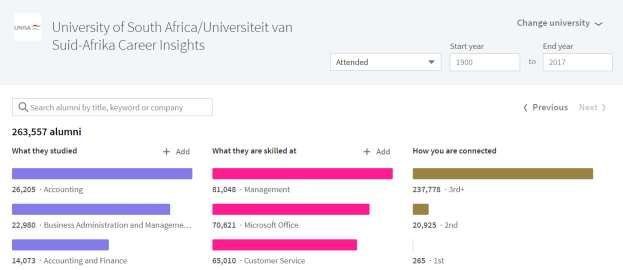
6. Click on the “Next >” link to go to the next set of headings (What they studied,
What they are skilled at, and How you are connected).
7. Click on “+Add” next to the heading “What they studied”
8. Start to type “human resource” in the search box. You will notice that you are
provided with suggestions for study fields (e.g. human resource management,
etc.).
9. Choose one of those options that you would want to explore.
12 Human Resource Management @ Unisa10. You will notice that the graphs for the different headings adjust. You have now
filtered the information to contain information about Unisa graduates who work
in the field you searched for.
11. You can now see how many graduates in these fields are on LinkedIn, where
they work, what they do, what they’re skilled at, etc.
12. You are also able to view the profiles of alumni who meet the criteria you
searched for. For example, you can filter your search results to those alumni
who indicated that they studied human resource management, and work at
Woolworths.
5 Talk to others (informational interviewing)
Once you have done some research about specific options, your next step is to talk
to individuals in the type of job/ industry that you are interested in. The goal of these
conversations is to explore your career options, to expand your network, to build
confidence, to access information and to identify your own strengths and areas of
development. For example, you read an article by an HR practitioner about the
impact of social media on recruiting practices and you feel curious about some of the
aspects discussed. You could contact the author of the article to ask if they would be
willing to share some more insights about those aspects you are curious about.
Before you interview someone, do research about what you would want to discuss
with them – you could ask this person to “fill in the gaps” for you. Start with people
you already know: friends, family, neighbours, colleagues, lecturers, tutors and fellow
students. Use online social networks such as LinkedIn to identify potential people.
For more information on how to go about this and suggestions for questions that you
might want to ask, go to http://bit.ly/2riGpQq. Also, watch this video to learn more:
The Dos and Don’ts of Informational Interviews: http://youtu.be/ixbhtm8l0sI.
Remember to keep track of the information you have gathered and how you make
sense of this. Also, track the questions you still have and how you think you would
be able to get answers to these questions.
13 Human Resource Management @ UnisaActivity Write a list of any people you know who might work in the fields you are interested in. For instance, do any of your parents' friends work in any of the fields you are considering? And write a list of those people who could give you information about any careers you are considering. You may have identified a lot more people than you thought! Imagine how much information you can gather about the career you are interested in just by talking to these people. Each person will give you fresh insights opinions and valuable information about the careers you are considering, whether they are currently working in that field or are only remotely related to or associated with it. 6 Attend a careers fair event Attending a careers fair event gives you the opportunity to speak to people from different industries. You may be studying a qualification that does not seem to have a direct link to the exhibitors or the presenters, but they have one thing in common: they employ people, who work in organisations, who do business with all kinds of suppliers and services. Somewhere in this value chain your qualification will find a place to fit – either as a customer or as an employer or employee. The annual Unisa Careers Fair usually takes place in July and August at various venues. Go to http://www.unisa.ac.za/counselling for more information. 7 Experience studying topics related to your field of interest Explore what human resource is by watching and listening to on-line lectures and reading free open textbooks on a variety of topics related to human resources. These resources will enhance your understanding of data science and the various opportunities related to this field. Search human resources courses and open textbooks on these sites: 14 Human Resource Management @ Unisa
Coursera.org (http://www.coursera.org/)
Udemy (http://www.udemy.com/)
Saylor Academy (http://www.saylor.org/books/)
Open Textbook Library (http://open.umn.edu/opentextbooks/)
College Open Textbooks (http://www.collegeopentextbooks.org/textbook-
listings/textbooks-by-subject/)
Open Culture (http://www.openculture.com/freeonlinecourses)
iTunes university (http://www.apple.com/education/itunes-u/)
YouTube education (http://www.youtube.com/education?b=400)
FreeVideoLectures (http://freevideolectures.com/)
15 Human Resource Management @ UnisaProfessional bodies
Depending on your qualification you may need to register with a certain professional
body. In other words, some professional bodies have a mandatory requirement that
all individuals working in a certain profession must have a valid registration with that
professional body.
South African Board for People Practices (SABPP)
SABPP is the HR Professional and statutory quality and standards body for the
people profession. As an internationally recognized profession Human Resources is
at the heart of the implementation of the HRD Strategy for South Africa to improve
the skills in the country so that people and the economy as a whole produce more
and better. Visit their official website for more information at http://sabpp.co.za/
Qualifications offered by
Unisa
Undergraduate
Bachelor of Commerce in Human Resource Management (98307)
Diploma in Human Resource Management (98211)
*Note: It is important to note that in order to apply for an undergraduate qualification
in the College of Economic and Management Sciences you are required to have
16 Human Resource Management @ UnisaMathematics as one of your Grade 12 subjects. If you did not take Mathematics as a
subject or do not meet the required Mathematics percentage then you will need to
apply for a higher certificate offered by the College of Economic and Management
Sciences. Completing the Higher Certificate will enable you to meet the requirements
for a diploma or degree in this College. You can then apply for the diploma or degree
in your last semester of study for the Higher Certificate.
Postgraduate:
Bachelor of Commerce Honours in Business Management (98452)
Postgraduate Diploma in Human Resource Development (98227)
Postgraduate Diploma in Human Resource Management (98228)
Postgraduate Diploma in Labour Relations Management (98209)
Postgraduate Diploma in Organisational Development (98212)
Master of Commerce in Business Management (Full Dissertation) Human
Resource Management (98582 - HRM)
Doctor of Philosophy in Management Studies Human Resource Management
(90021 - HRM)
Short learning
Programmes (SLPs)
Unisa offers a number of SLPs that people could look at completing. It is important to
remember that a SLP is not a formal qualification and will not allow you to qualify for
a formal qualification. The some SLPs in this field can be found under the College of
Economic and Management Sciences. SLPs related to the Human Resource
17 Human Resource Management @ UnisaManagement field can be found under the Centre for Business Management and Graduate School for Business Learning (SBL). Centre for Business Management Course in Human Resource Hiring Practices Course in Labour Relations Management Course in Managing Training and Development (76803) Programme in Human Resource Management (71080) Advanced Programme in Human Resource Management (76748) Go to the Centre’s website for more information: http://bit.ly/17Xx4zl. Centre for Industrial and Organisational Psychology Programme in Applied Organisational Development Programme in Skills Development Facilitation Short Course in Business Psychology and Human Behaviour Short Course in Compensation for Occupational Injuries and Diseases Short Course in Employee Wellness Short Course in Organisational Development: Appreciative Inquiry Approach) Short Course in the Occupational Health and Safety Act, 1993 Course in Workforce Diversity Go to the Centre’s website for more information: http://bit.ly/292B7gc. 18 Human Resource Management @ Unisa
Graduate School of Business Leadership

The Unisa SBL offers a Strategic Human Resource Management Programme.

19        Human Resource Management @ Unisa
Counselling and career
development services at
Unisa
The Unisa Directorate for Counselling and Career Development offers career-,
academic- and personal counselling services to Unisa students and the broader
community. You can talk to a counsellor about:
Career decisions. I am not sure which career path to follow; I don't know
which qualification would be best; I want to change my career direction…
Career information. How can I find out more about a career in …
Employability. How do I market myself to employers? How can I look for
work? How can I compile an effective CV? How do I go about networking with
others? How do I put together my career portfolio? How can I meet potential
employers? How can I improve my interview skills?)
My studies at Unisa. How can I get started with my studies? How do I plan
my studies? How can I study more effectively? I don 't feel motivated to
continue with my studies… I feel worried about preparing for/ writing the
exams. I failed my exams – what now? I need to improve my reading/ writing/
numeracy skills
Personal issues. How can I have better relationships with others? How can I
cope more effectively with issues that impact on my studies?
Visit our website at http://www.unisa.ac.za/counselling to access many self-help
resources, or talk to a counsellor by e-mail to counselling@unisa.ac.za.
20 Human Resource Management @ UnisaYou can also read


