GEORGIA'S CLEAN AIR FORCE AN OVERVIEW OF EMISSIONS TESTING FOR THE MOTORING PUBLIC
←
→
Page content transcription
If your browser does not render page correctly, please read the page content below
GEORGIA’S CLEAN AIR FORCE
AN OVERVIEW OF EMISSIONS TESTING
FOR THE MOTORING PUBLIC

OVERVIEW

           §   What is Georgia’s Clean Air
               Force?
           §   Testing Information
           §   My Vehicle Did Not Pass,
               Why?
           §   Repairing My Vehicle
           §   Used Vehicle Sales
           §   Registration Scenarios
           §   Resources At Your Fingertips
WHAT IS GEORGIA’S CLEAN AIR FORCE?

               §   Georgia's Clean Air Force (GCAF) is the
                   state's emissions testing program, also
                   known as the Georgia Vehicle Inspection
                   and Maintenance (I/M) Program.
               §   The I/M program has been in existence
                   since 1981. The Federal Clean Air Act
                   (CAA) amendments of 1990 led to
                   Georgia being required to implement an
                   “enhanced inspection and maintenance
                   program.” This enhanced program was
                   implemented in 1996. On-board
                   diagnostic (OBD) testing began in 2002.
WHAT IS GEORGIA’S CLEAN AIR FORCE?

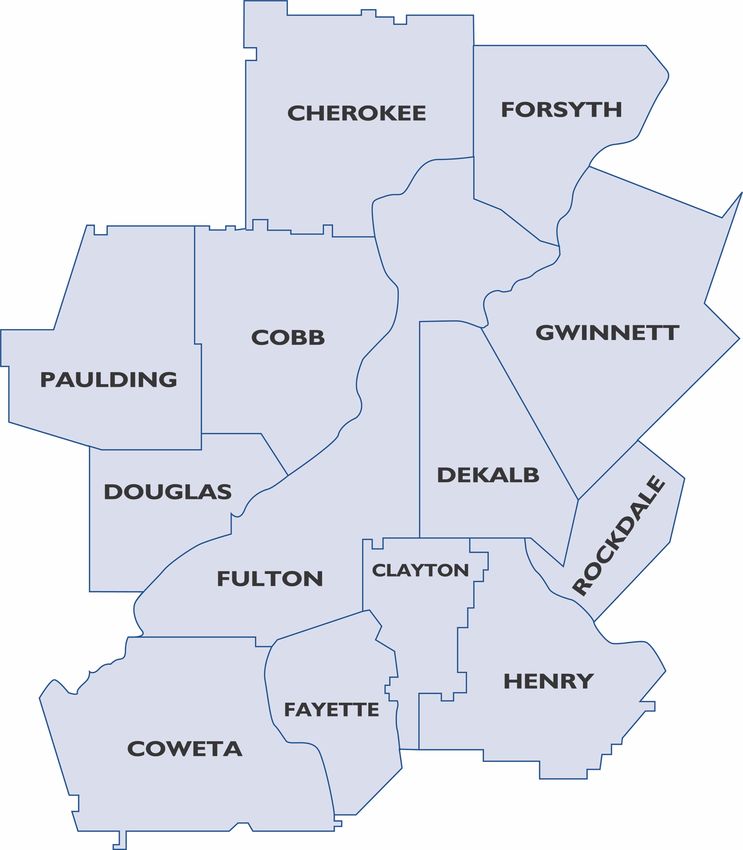
§   The program requires annual emissions
    testing for vehicle registrations for
    thirteen (13) metro Atlanta counties:
    Cherokee, Clayton, Cobb, Coweta,
    DeKalb, Douglas, Fayette, Forsyth,
    Fulton, Gwinnett, Henry, Paulding and
    Rockdale.

                                   GCAF has cleaned up more
                                   than 3.8 million vehicles
                                   since the program started.
TESTING INFORMATION

                      In This Section
                         − Why We Test
                         − What Are The Benefits
                           Of Emissions Testing?
                         − How Do I Get My Vehicle
                           Tested?
TESTING INFORMATION: WHY WE TEST

Air pollution is a public health and
environmental issue in metro Atlanta.
Particulate matter found in air pollution
can increase the risk of heart attack,
stroke and other cardiovascular problems.
Children and senior citizens are especially
vulnerable, but anyone who inhales
deeply can suffer asthma attacks,
coughing and wheezing, and shortness of
breath. Learn more.
TESTING INFORMATION: WHAT ARE THE BENEFITS OF
EMISSIONS TESTING?
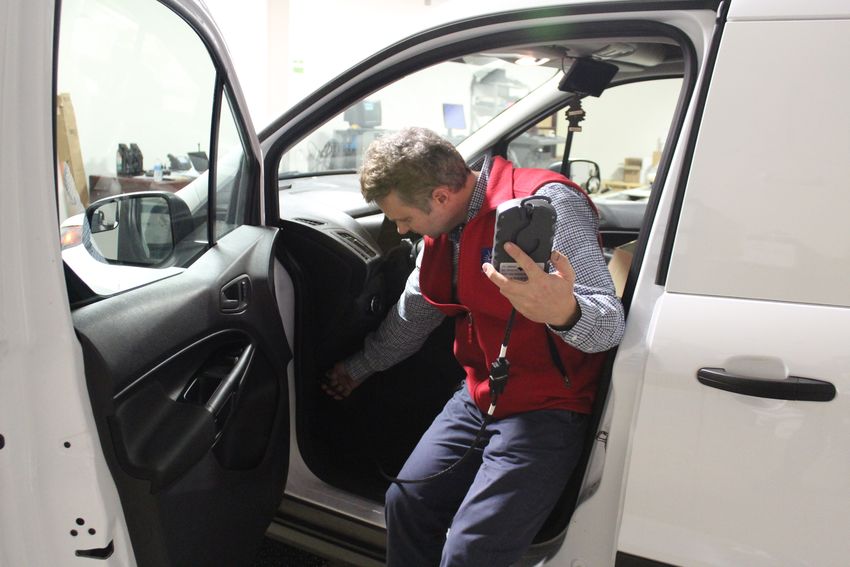
Georgia’s Clean Air Force (GCAF) is designed to identify and
ultimately repair the emissions issues that cause gasoline-powered
cars and light-duty trucks to pollute the air.
TESTING INFORMATION: WHAT ARE THE BENEFITS OF
EMISSIONS TESTING?
Since 1996, the program has identified and repaired more than
3.8 million heavy-polluting vehicles.

Additionally, the program has prevented nearly two million tons of
harmful ozone-forming pollutants from entering the air we
breathe.
TESTING INFORMATION: HOW DO I GET MY VEHICLE
TESTED?
Which vehicles require testing?

         Click to view the current testing requirements.
TESTING INFORMATION: HOW DO I GET MY VEHICLE
TESTED?
Which vehicles do not require testing?
§ Three most recent model years
§ Vehicles 25 model years old or older
§ Diesel powered vehicles
§ Motorcycles
§ RVs and motor homes
§ Alternative fueled vehicles that run exclusively on alternative
  fuels
TESTING INFORMATION: HOW DO I GET MY VEHICLE
TESTED?
Where do I test?
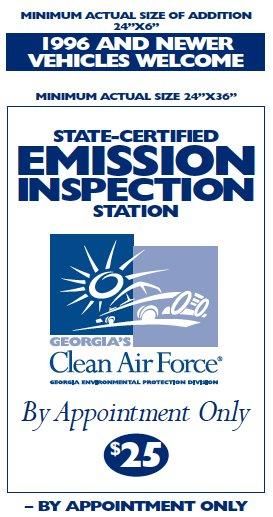
§ You may get your vehicle tested at any
  testing station that displays a state-certified
  sign (see example >). A list of testing
  locations can be found by clicking here.
How much does an emissions test cost?
§ Per Georgia law, the testing fee may not
  exceed $25. Stations are independently
  owned and operated and determine the
  price they will charge.

   View emissions testing tips.
TESTING INFORMATION: HOW DO I GET MY VEHICLE
TESTED?
What type of test will I receive?
§ All vehicles receive an on-
  board diagnostic (OBD) test,
  which consists of a three-part
  inspection:
   1.   A visual inspection of the
        catalytic converter
   2.   An OBD test, and
   3.   A fuel cap inspection.

For more details, click here.
TESTING INFORMATION: HOW DO I GET MY VEHICLE
TESTED?
What if I own an alternative fueled vehicle?
§ Vehicles powered only by diesel fuel or that run exclusively on
alternative fuel (natural gas, propane, etc.) are exempt from
emissions testing. Dual-fuel vehicles must be inspected if one of
the fuels burned is gasoline.
o DOR exclusively handles the determination of which vehicles are
eligible for the alternative fuel tag. For more information on this
subject, contact the Motor Vehicle Division at 1-855-406-5221 or
with respect to the income tax credits, contact the Taxpayer
Services Division at 1-877-423-6711, from 8:00 a.m. to 4:30
p.m. EST, Monday through Friday, excluding holidays. For forms
and other information, visit their website at www.dor.georgia.gov.TESTING INFORMATION: HOW DO I GET MY VEHICLE
TESTED?
How do I use my free retest after a failed inspection?
§ You will receive one free retest if you return to the original
inspection station within 30 calendar days of your initial
inspection.
o The 30 days includes the day of your first test and expires at the time
of day of the original test.
§ You must provide the failing vehicle inspection report (VIR) and
completed Emissions Repair Form.
§ If the retest has expired, you will be required to pay for the
next inspection.
§ Another emissions inspection station may perform the free
retest at no charge, however it is up to the station’s discretion
as to whether or not to perform the retest.TESTING INFORMATION: HOW DO I GET MY VEHICLE TESTED? What steps do I take if my vehicle has been impounded? 1. Pay the vehicle’s ad valorem tax and any additional fees. 2. Take the tax receipt to the impound company, at which point the vehicle will be released. 3. Have the vehicle towed from the impound lot to a testing station. 4. Get the vehicle emissions tested. 5. Return to the tag office for the new tag decal.
TESTING INFORMATION: HOW DO I GET MY VEHICLE
TESTED?
How do I get a refund?
§ GCAF does not have the authority to issue
  refunds because stations are independently
  owned and operated.
§ Retests are required to be free at the
  original inspection station for 30 calendar
  days. The 30 days includes the day of the
  first inspection and expires at the time of day of the original
  test.
§ If your original inspection station’s equipment is down or if the
  station is closed, call 1.800.449.2471 or send an e-mail to
  info@cleanairforce.com for assistance.
TESTING INFORMATION: HOW DO I GET MY VEHICLE
TESTED?
What if I will be out-of-the-area when my vehicle‘s
registration is due?
§ Vehicles can be tested well in advance if the driver will be out
  of the area at the time the registration is due.
§ A vehicle inspection report (VIR) is valid for one year.
§ Contact your county tag office to determine if it will allow a
  registration renewal prior to the normal renewal period (if
  more than 60 days prior to the renewal date).
§ Click here for more information.
TESTING INFORMATION: HOW DO I GET MY VEHICLE
TESTED?
Where are the service centers located and what are the
hours of operation?
§ GCAF has five full-time service centers located in Clayton,
  Cobb, DeKalb, Fulton and Gwinnett counties. Part-time service
  centers are open in Cherokee, Coweta, Douglas, Fayette,
  Forsyth, Henry, Paulding, and Rockdale counties.
   o   The hours of operation and driving directions to all service
       centers are listed on the GCAF website.
   o   Additionally, GCAF partners with metro Atlanta tag offices to
       offer extension, exemption and waiver services. We recommend
       contacting your local tag office to find out the services it offers.
TESTING INFORMATION: HOW DO I GET MY VEHICLE
TESTED?
How do I request a referee test?
§ If you question the test procedures, accuracy of the inspection
equipment, or validity of the results, you may request a referee
test within 15 business days of the disputed inspection if no
repairs have been made to the vehicle (15 days includes the
day of the first inspection).
o The referee test will be observed by a GCAF representative at a
mutually agreeable time at the inspection station where your
vehicle was tested. For more information or to schedule an
appointment, call the GCAF Call Center at 1.800.449.2471.
See more ↓TESTING INFORMATION: HOW DO I GET MY VEHICLE
TESTED?
How do I request a referee test? (continued)
o Also, please report any offers to illegally pass a vehicle by
calling the GCAF Call Center at 800.449.2471 or by sending an
e-mail to info@cleanairforce.com.
For additional information
Please review the Question and Answer (Q&A) brochure,
available at www.cleanairforce.com and at all emissions
inspection stations.MY VEHICLE DID NOT PASS. WHY?
In This Section
What Causes:
− A Readiness Failure
− A Non-Communication
Failure
− The "Check Engine" Light
− A HC Failure
− A CO FailureMY VEHICLE DID NOT PASS. WHY? WHAT CAUSES A READINESS FAILURE? Possible causes of a readiness failure include: § The failure could be the result of something preventing the vehicle from becoming “Ready.” You should check all wires, fuses, and the thermostat. All wires should be checked on any installed aftermarket system (ex.: CD player, radio, security, navigation system, satellite radio, etc.). Check the thermostat for proper operating temperature. § The failure could mean there is a recall, outstanding technical service bulletin (TSB), or manufacturer extended warranty issue related to the vehicle’s emissions control system. See more ↓
MY VEHICLE DID NOT PASS. WHY?
WHAT CAUSES A READINESS FAILURE?
Possible causes of a readiness failure include (continued):
§ A diagnostic analysis should be performed using an OBD
  generic scan tool; be sure the scan tool is connected to the data
  link connector (DLC) under the dash, not under the hood.

                    For additional information on readiness,
                    click here.
MY VEHICLE DID NOT PASS. WHY?
WHAT CAUSES A NON-COMMUNICATION FAILURE?
Possible causes of a non-communication failure include:
§ A failure could result from the data link connector (DLC) being
blocked, missing or broken.
§ The failure could result from interference caused by or damage
to a wire or fuse. You should check all wires and fuses.
o All wires should be checked on any aftermarket system (ex.: CD
player, radio, security, navigation system, satellite radio, etc.). If
a wire is interfering with the battery or OBD computer, it could
damage or interfere with the connection to the OBD computer.
§ The failure could mean there is a recall, outstanding technical
service bulletin (TSB), or manufacturer extended warranty issue
related to your vehicle’s emissions control system. See more ↓MY VEHICLE DID NOT PASS. WHY?
WHAT CAUSES A NON-COMMUNICATION FAILURE?
Possible causes of non-communication failure include
(continued):
o A diagnostic analysis should be performed using an OBD generic
scan tool; be sure the scan tool is connected to the DLC under the
dash, not under the hood.
o If a mechanic is able to communicate using generic OBD scan
tool, contact GCAF at info@cleanairforce.com or call the GCAF
Call Center at 1.800.449.2471 for further assistance. You are
required to provide documentation from your mechanic stating all
of the above have been checked.
For additional information on non-
communication, click here.MY VEHICLE DID NOT PASS. WHY?
MY ”CHECK ENGINE” LIGHT IS ON.
§ The “Check Engine” light may
illuminate indicating something as
minor as a loose fuel cap or as major
as an emissions control component
failure.
§ Your vehicle inspection report (VIR) will TIP: Tighten the fuel cap until it
list the first five diagnostic trouble clicks and drive for a few days.
codes (DTCs), indicating the general
area of the emissions control system
failure. See more ↓MY VEHICLE DID NOT PASS. WHY? MY ”CHECK ENGINE” LIGHT IS ON. (continued) § If a DTC listed on the VIR indicates a fault within the vehicle’s “evaporative system,” you should tighten the fuel cap until it clicks and drive the vehicle for a few days to see if the OBD system turns off the “Check Engine” light. § A transmission code that turns on the “Check Engine” light is directly related to the vehicle’s emissions control system. § A vehicle’s on-board computer will illuminate the “Check Engine” light if a problem with the transmission is detected. A diagnostic analysis will help identify the transmission component(s) needing repair. See more ↓
MY VEHICLE DID NOT PASS. WHY?
MY ”CHECK ENGINE” LIGHT IS ON.
(continued)
§ If the “Check Engine” light is flashing, the vehicle should be
   serviced immediately to avoid costly damage to the vehicle’s
   main emissions control component – the catalytic converter.

                       For additional information on the “Check
                       Engine” light, click here.
MY VEHICLE DID NOT PASS. WHY? WHAT CAUSES A HC FAILURE? Possible causes of a hydrocarbon (HC) failure include: § Faulty spark plugs and plug wires § Faulty oxygen sensor(s) § A faulty mass air flow sensor § A faulty EGR system § Clogged or leaking fuel injectors or carburetor § Incorrect ignition timing
MY VEHICLE DID NOT PASS. WHY?
WHAT CAUSES A CO FAILURE?
Possible causes of a carbon monoxide (CO) failure include:
§ Faulty oxygen sensor(s)
§ A faulty mass air flow sensor
§ A faulty PCV valve
§ A clogged air filter
§ Incorrect ignition timing
§ Faulty fuel pressure
§ A dirty fuel injection/carburetor
§ A vacuum and/or exhaust leak
MY VEHICLE DID NOT PASS. WHY?

    You should seek a repair facility for
assistance. You are encouraged to view
the RepairWatch Public Report to find a
qualified emissions repair shop in your
area. The report can be found at any
inspection station or on the GCAF website
at www.cleanairforce.com.
REPAIRING MY VEHICLE
In This Section
− Where Should I Go For
Repairs?
− Repair Shop Complaints
− Repair Research
Resources
− How Do I Get My
Vehicle Retested?REPAIRING MY VEHICLE
WHERE SHOULD I GO FOR REPAIRS?
§ Check to see if your vehicle is covered by a manufacturer’s
emissions control warranty.
o If the vehicle is under warranty, you should take it to an
authorized dealer. If the vehicle is not under warranty, you should
find a qualified emissions repair shop to make the necessary
repairs.
§ You are encouraged to view the RepairWatch Public Report to
find a qualified emissions repair shop in your area.
o You can find the report at any emissions inspection station or on
the GCAF website at www.cleanairforce.com.
See more ↓REPAIRING MY VEHICLE WHERE SHOULD I GO FOR REPAIRS? (continued) § GCAF recommends that you obtain a written estimate for any work before authorizing your repair technician to proceed. § Be sure you or your mechanic completes the Emissions Repair Form you received when your vehicle failed. The completed Emissions Repair Form and original vehicle inspection report (VIR) are required when the vehicle is retested.
REPAIRING MY VEHICLE
WHERE SHOULD I GO FOR REPAIRS?
What if I cannot locate a part?
§ You should check local salvage yards, as well parts and repair
  websites for the unavailable part.
§ You can find additional places in the Yellow Pages, under “Auto
  Parts New.”

                                                      See more ↓
REPAIRING MY VEHICLE WHERE SHOULD I GO FOR REPAIRS? (continued) § If all attempted efforts to locate the part have failed, then contact Georgia’s Clean Air Force at 800-449-2471. Attempts to locate parts must be documented. § Please note: it is illegal to install a used catalytic converter. § You are encouraged to pay the vehicle’s ad valorem tax while searching for the part.
REPAIRING MY VEHICLE
REPAIR SHOP COMPLAINTS
What if I am dissatisfied with the work of my repair facility?
§ GCAF does not regulate the repair industry; however, GCAF
  suggests that you file a complaint with your repair
  facility/dealership or contact the Better Business Bureau, the
  Georgia Department of Law – Consumer Protection Unit, or the
  Secretary of State’s office.
REPAIRING MY VEHICLE
REPAIR RESEARCH RESOURCES
Georgia's Clean Air Force offers two resources to research
repair issues:
1. Repair Assistance Knowledge Base - A list of recalls, technical
   service bulletins (TSBs), warranties and diagnostic trouble
   codes (DTCs).
2. TSB/Recall Notification List - A list of recent technical service
   bulletins (TSBs) and recalls.
REPAIRING MY VEHICLE
HOW DO I GET MY VEHICLE RETESTED?
§   For every paid test, you are allowed one free retest. View
    details on retests.
§   Bring the completed Emissions Repair Form to the retest
    location. You will need to make a copy of the Repair Form if
    you want one for your records. The emissions station will keep
    this form.
§   You can print a summary of your most recent VIRs via the GCAF
    website. Simply type in your vehicle identification number (VIN).
USED VEHICLE SALES
In This Section
− Passing VIR Not Available
− Non-Emissions County
Purchase
− Buyer Lives Outside of 13
Covered Counties
− “As-Is” Purchases
− Complaint ProcessUSED VEHICLE SALES
PASSING VIR NOT AVAILABLE
What if I purchased a vehicle that does not have a passing
vehicle inspection report (VIR).
§ Prior to purchasing a used vehicle, you should look up the VIN
via the Georgia’s Clean Air Force (GCAF) website, to see if the
vehicle has a passing VIR.
§ If you purchase a used vehicle from a seller located within the
13-county testing area and plan to register the vehicle in a
covered county,* the vehicle must have a passing VIR from the
last 12 months.
― Within 12 months, a vehicle may be sold numerous times using
the same valid VIR. See more ↓
*Covered counties: Cherokee, Clayton, Cobb, Coweta, DeKalb, Douglas, Fayette, Forsyth, Fulton,
Gwinnett, Henry, Paulding, and Rockdale.USED VEHICLE SALES PASSING VIR NOT AVAILABLE What if I purchased a vehicle that does not have a passing VIR? (continued) § Sellers are not required to provide the buyer with a hard copy of the VIR. The VIR will be on record electronically at the tag office. § If you would like a hard copy of the VIR, a free copy can be obtained by emailing your VIN to info@cleanairforce.com or by visiting any GCAF Customer Service Center.
USED VEHICLE SALES
NON-EMISSIONS COUNTY PURCHASE
I purchased a vehicle in a non-emissions county.
§ The seller is not responsible for selling a vehicle with a current,
  valid passing vehicle inspection report (VIR) if the seller is not
  located in the 13-county testing area.
USED VEHICLE SALES
BUYER LIVES OUTSIDE OF 13 COVERED COUNTIES
What if I live in a county that does not require emissions
testing?
§ If the buyer is located in a county that does not require
  emissions testing, the seller is not responsible for selling a
  vehicle with a current, valid passing vehicle inspection report
  (VIR).

What if I purchased a vehicle from an out-of-state seller?
§ He or she is not responsible for selling a vehicle with a current,
  valid passing VIR.
USED VEHICLE SALES
AS-IS PURCHASES
I purchased a vehicle “As Is”;
what does that mean?”

§ Vehicles sold “As Is” are just that -
  “as is,” however:
     o Georgia law requires a vehicle to have a valid, passing
       emissions inspection at the time of sale if the vehicle will be
       registered in a covered county and if the seller is located in the
       13-county testing area.
     o A valid, passing emissions inspection is required to register a
       vehicle in any of the 13 metro Atlanta counties, therefore
       emissions inspections are not subject to the “As Is” clause.
                                                               See more ↓
USED VEHICLE SALES
AS-IS PURCHASES
I purchased a vehicle “As Is”; what does that mean?”
(continued)
o The Georgia Secretary of State’s Office requires the seller
provide the buyer with the necessary paperwork to register and
tag a vehicle within 30 days of sale (seven days if purchased
from a private seller).USED VEHICLE SALES COMPLAINT PROCESS What is the process for filing a complaint against a seller? 1. Visit the GCAF website and download the Used Vehicle Sale Complaint Form. 2. Submit the completed form with the requested documentation. A bill of sale or title (which must include the seller’s name and address, the buyer’s name and address, and the sale date) and an affidavit are required documentation. 3. GCAF will investigate the case and contact you after the investigation is completed. The Georgia Environmental Protection Division (EPD) encourages you to seek resolution with the seller prior to filing a Used Vehicle Sale Complaint.
REGISTRATION SCENARIOS

           In This Section
              − Late Registrations
              − Early Registrations
              − Test Not On File At Tag
                Office
              − Moved To A Covered
                County From A Non-
                Covered County
              − Data Errors
REGISTRATION SCENARIOS LATE REGISTRATIONS What if I am late registering my vehicle? § If the vehicle has not been registered for several years and is registering late for the previous year, the vehicle will need to be tested now for the late renewal and tested again before the renewal for the current year. § If the vehicle has not been registered for several years and is registering for the current year, the vehicle will only need to be tested once to return it to the regular testing schedule. It is the tag office’s discretion as to what is required for late registration. Please contact your tag office for information regarding registration.
REGISTRATION SCENARIOS
EARLY REGISTRATIONS
Can I test and register my vehicle early?
§ Yes, a vehicle inspection report (VIR) is valid for 12 months or
  one registration renewal, by the same owner.
§ Georgia’s Clean Air Force (GCAF) recommends you test your
  vehicle four to six weeks prior to the registration renewal date;
  however, you may have the vehicle tested earlier if needed.
    o   To test early, the emissions inspector will need to select the option
        to test “At Motorist’s Request.”
§   You should contact your tag office to determine if it will allow a
    registration renewal prior to your normal renewal period (more
    than 60 days before your registration renewal date).
REGISTRATION SCENARIOS TEST NOT ON FILE AT TAG OFFICE What if my test is not on file at my county tag office? § If your vehicle’s test record is not on file, your vehicle's information, the vehicle identification number (VIN), may not have been entered correctly during testing. § The inspector must retest the vehicle and correct the issue at no cost to you.
REGISTRATION SCENARIOS
MOVED TO A COVERED COUNTY FROM A NON-COVERED COUNTY

I recently moved into a county that requires emissions tests;
what do I need to do?
§ You must have your vehicle tested and registered within 30
   days.
§ If you just moved to one of the 13 covered counties from a
   Georgia county where emissions testing is not required and
   your vehicle has a current Georgia registration, a valid
   emissions certificate will not be required until your registration
   renewal due date.
REGISTRATION SCENARIOS
DATA ERRORS
What if the inspector entered the
 data for my vehicle incorrectly.
§ If the VIN, mileage or any of the
  vehicle information is entered
  incorrectly, the inspector is to
  retest the vehicle and to correct
  the issue at no cost to you.

               For additional information on your rights, please
               review the Motorists Rights’ poster posted at
               www.cleanairforce.com and at testing facilities.
RESOURCES AT YOUR FINGERTIPS
In This Section
− Customer Service Options
− Program Website and
Customer Service Centers
− Program Materials
− Foreign Language
Resources
− Social Media ToolsRESOURCES AT YOUR FINGERTIPS
CUSTOMER SERVICE OPTIONS
Program Resource
Online Call Center E-Mail Live Chat
cleanairforce.com 1.800.449.2471* info@cleanairforce.com cleanairforce.com*
*Asistencia disponible en Español.RESOURCES AT YOUR FINGERTIPS
PROGRAM WEBSITE AND CUSTOMER SERVICE CENTERS
Georgia's Clean Air Force (GCAF) offers numerous
resources to assist you with the emissions testing process.
§ GCAF Website: CleanAirForce.com
Find program information, applications,
online VIR reprints, testing locations,
GCAF Service Center locations,
tag office locations, and more.
§ GCAF Customer Service Centers
GCAF offers waivers, extensions, and exemptions assistance at multiple
locations throughout metro Atlanta. Click here for a full listing of
locations and additional useful information.RESOURCES AT YOUR FINGERTIPS
PROGRAM MATERIALS
§ Registration Renewal Inserts
Inserts are mailed by your county tag office with your registration
renewal notice and provide a guideline for how to complete your
emissions test.
§ Question & Answer (Q&A) Brochure
Q&A brochures are available at all emissions inspection stations.
If you fail your emissions test, your inspector will provide a brochure for
repair and retest assistance.RESOURCES AT YOUR FINGERTIPS
PROGRAM MATERIALS
§ Motorists’ Rights Poster
Outlines your rights during the
emissions testing process. The
posters are posted at all emissions
inspection stations.
§ Many more program resources
are posted on the program
website, including waiver,
extension and exemption forms,
repair resources, and used vehicle
sale flyers.RESOURCES AT YOUR FINGERTIPS
FOREIGN LANGUAGE RESOURCES
§ Foreign language documents
Program information is available online at www.cleanairforce.com in
Spanish, Korean and Vietnamese.
Para el ensayo de la información en español, visite
CleanAirForce.com.
스페인어로 정보를 테스트하기 위해, CleanAirForce.com
를 방문하십시오.
Đối với kiểm tra thông tin trong tiếng Tây Ban Nha, hãy truy
cập CleanAirForce.com.RESOURCES AT YOUR FINGERTIPS
SOCIAL MEDIA TOOLS
@GACleanAirForce /GeorgiasCleanAirForce cleanairforce.com/youtube
Click on the links above to “like” us or “follow” us!www.cleanairforce.com
info@cleanairforce.com
800.449.2471You can also read


