IAEA Webinar
22 June 2021
←
→
Page content transcription
If your browser does not render page correctly, please read the page content below
IAEA Webinar 22 June 2021
Welcome

 Questions in the
 chat panel

 Participants are
 muted

 No certifications
Webinar Objectives
      Discuss pathways to decarbonization, including:
      - Increased shares of renewables, nuclear and hydrogen in energy
      systems
      - Replacement of coal by nuclear generation; and
      - Designing energy policy and finance mechanisms to accelerate the
      introduction of low-carbon energy sources for a Net Zero World.

      Engage young professionals in the discussion on the global energy
      transition with the use of low-carbon energy options, including nuclear.

      Launch a new IAEA initiative focusing on young professionals.
Today’s Topics

                   2. Driving energy
 1. Moving away                         3. Energy policy,
                     systems to net
  from coal: the                         financing, and
                   zero with nuclear,
 nuclear energy                            sustainable
                    renewables and
     option.                              development
                       hydrogen.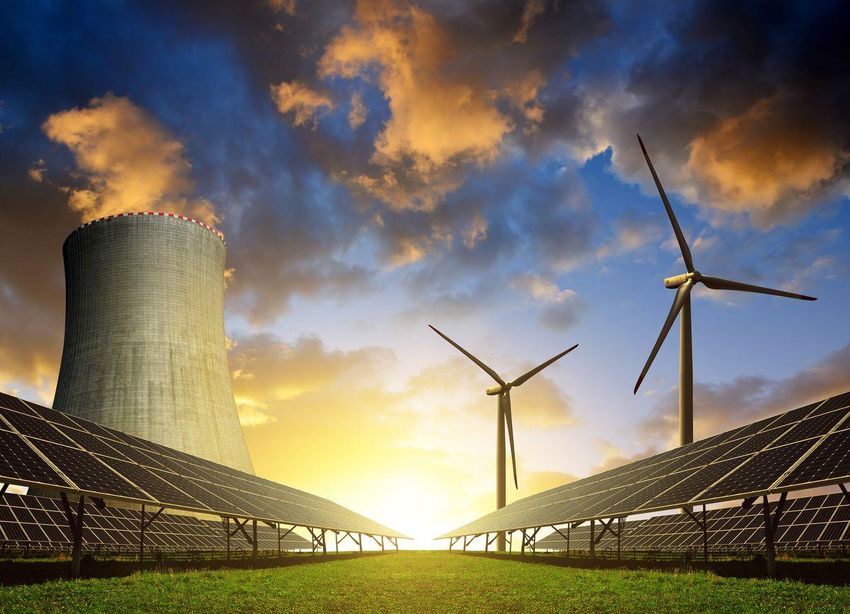
Opening Remarks
Henri Paillere

•   Head, IAEA Planning and Economic
    Studies Section since February 2020.
•   Over 25 years of experience in the
    nuclear energy sector.
•   Senior Analyst and Deputy Head of
    the Division of Nuclear Technology
    Development and Economics at the
    OECD Nuclear Energy Agency, 2011-
    2019.
•   Head of the Technical Secretariat for
    two international initiatives, the
    Generation IV International Forum,
    and the International Framework for
    Nuclear Energy Cooperation.
•   R&D Program Manager at the Alstom
    Power Company and at the French
    Alternative Energies and Atomic
    Energy Commission (CEA) in various
    positions.
What the Agency is doing ….

•   Support to Member States, those operating nuclear
    power and newcomer countries
•   Analysis of NZ scenarios and trajectories
    compatible with the Paris Agreement and
    Sustainable Development Goals, what these mean
    for the development of nuclear power, in terms of
    current fleet and required build up
•   Contributions of nuclear power to climate change
    mitigation, but also to the climate resilience of
    energy systems
•   Economics, Financing, Technology, Safety, Waste
    Management, Public Acceptance, Infrastructures,
    Milestones…
•   Partnerships with nuclear org. (e.g. OECD/NEA)
    and other org. (e.g. IEA) and collaborations within
    the UN family (e.g. UN Energy)
•   High level events (DG), webinars – reach
    beyond nuclear circles

                                                          6
Objective COP26… and beyond
(3 decades of action!)

                        Are we doing enough?

                        Want to hear to voice of
                       the young(er) generations

                                                   7
Part 1                      Moving away from coal:
                             The nuclear energy option

                      Craig Jantzen                                          River Bennett
                                                            • Graduate Research Assistant, University of Michigan,
• Climate Change Policy Analyst at IAEA as a Cost-Free
                                                              pursuing MS in Nuclear Engineering.
  Expert from the UK, coordinating the Agency’s COP26
                                                                  • Supported by National Reactor Innovation Center and
  preparations across departments.                                  Fastest Path to Zero
• Prior work in several energy, climate and science roles         • Researches siting and environmental justice
  across the UK Government, most recently as Head of                considerations for advanced reactors.
  International Science at the HMG Government Office for
  Science.                                                  • Fellow at the Nuclear Innovation Alliance, Lead organizer and
                                                              past participant of Nuclear Innovation Bootcamp.
• PhD in Nuclear Engineering, University of Manchester,
  on advanced reactor materials in partnership with Rolls   • Roles in edtech and international development with focus on
  Royce                                                       water and sanitation access.
• Masters of Engineering and Masters of Science in
                                                            • BA in Political and Social Thought, focus on Energy Policy,
  Nuclear Engineering, Lancaster University.
                                                              University of Virginia
The Coal Problem
                                                                                “…if we are serious about 1.5 degrees,
                                                              Glasgow must be the COP that consigns coal to history”
                                                                                                                                                       COP26 President
                                                                                                                                                          Alok Sharma

[1] Global mortality from outdoor fine particle pollution generated by fossil fuel combustion: Results from GEOS-Chem, Environmental Research (2021)
                                                                                                                                                                         10
The Coal Problem
World gross electricity production,
by source, 2018[1]
• Phase out of Coal is the Wind
Solar Other RE
worlds top climate priority Coal
38%
Hydro
• 38% of total in 2018, and
current stated policy
scenario
Nuclear
• Recent G7 summit showed 10.5%
the difficulty of agreeing Oil
phase out of this even for Gas
advanced nations
[1] IEA (2020), Electricity Information: Overview, IEA, Paris https://www.iea.org/reports/electricity-information-overview
11Nuclear vs Coal
Coal Plant
• Similar system properties:
Predictable,
dispatchable/flexible,
thermal power plants, dense
power sources, system
resilience and stability
• Coal: Carbon intensive, lots
of other pollutants, health
impacts
Nuclear Plant
• Nuclear: Low-carbon, used
for power or heat source
• Nuclear power can be an
ideal clean energy
replacement for coal on the
path to net zero
12Opportunities
“Renewables and nuclear power displace most fossil fuel use
in the Net‐Zero Emissions by 2050 Scenario”
IEA Net Zero by 2050 Report
• In a net zero scenario, nuclear IEA STEPS Scenario [2]
Energy, EJ
250
works with renewables to displace
200
coal.
150 Nuclear
• As of 2021, of the 16 countries* 100 Coal
pledging to phase out coal before 50
2030, 50% use nuclear energy[1] 0
2000 2010 2020 2030 2040 2050
• Currently, 32 countries are operating IEA Net Zero 2050 Scenario[2]
nuclear power plants + (7 more with Energy, EJ 250
plants under construction/advanced 200
NZ sees a doubling
preparation). Cover around 85% of 150 of Nuclear Power to 2050
the world’s coal generation
100
50 Nuclear
• A net zero world needs nuclear
0 Coal
2000 2010 2020 2030 2040 2050
13
[1] Overview: National coal phase-out announcements in Europe, (Europe Beyond Coal, 2021)
[2] International Energy Agency (2021), Net Zero by 2050, IEA
* with coal in their power system – some nations started with no coal in their electricity mixJust Transition
• Rapid phase out of coal
makes a ‘Just Transition’
challenging
• No one-size fits all system
– for many nuclear
energy is suitable
[1]
• Significant contribution
to economic
development
• Investment in nuclear
energy is estimated to Deprived Affluent
produce much larger Regions Regions
economic benefits
(compared to other
energy technologies)[3]
Relative GDP/capita in regions with coal-fired generating plants and coal mines, compared to the
[1] IEA (2021), "World energy balances", IEA World Energy Statistics and Balances (database, June 2021)
[2] IEA (2021), "World energy balances", IEA World Energy Statistics and Balances (database, June 2021) average national GDP/capita for selected countries in 2018[2]
[3] Building Back Better: How Big Are Green Spending Multipliers? IMF Working Paper WP/21/87, International Monetary Fund (2021) 14“We believe that there is no one-size-fits-all solution to the complexities of the
energy markets and the challenges we are facing.
What we say is that nuclear (power) has indisputably, a place at the table”
IAEA Director General
Rafael Grossi
15IAEA Young Voices on Nuclear Energy's
Contribution to a Net Zero World
PART 1: Moving away from coal:
the nuclear energy option
River Bennett, Graduate Researcher (Nuclear Engineering)
National Reactor Innovation Center (U.S.) +
Fastest Path to Zero (University of Michigan)A Brief history of nuclear technology:
Do we need nuclear energy?
Power plant closures present a compelling
opportunity

                                            nuscalepower.com
Power plant closures present a compelling opportunity
Communities and Workers as protagonists

         Naughton Power Plant, Wyoming (wyofile.com)
Case Study 1: UAMPS + NuScale Carbon Free Power Project
Case Study 2: Rocky Mountain Power +
TerraPower
Thank you!

River Bennett, Graduate Researcher (Nuclear Engineering)
       National Reactor Innovation Center (U.S.) +
       Fastest Path to Zero (University of Michigan)
                   riverb@umich.edu
Part 1 Moving away from coal:
The nuclear energy option
Craig Jantzen River BennettPart 2 Driving energy systems to net
zero with nuclear, renewables
and hydrogen
Ed Bradley Alice Cunha da Silva
• Key Account Engineer for Latin America, Westinghouse,
• Team Leader NPP Operation & Engineering Support in
and manages Westinghouse Brazil Office.
the IAEA Division of Nuclear Power. • Member of COP 26 Nuclear Delivery Team
• Experience in management, oversight and technical • International Organizations Chair of IYNC, member of
support of nuclear power and research reactor facilities. WIN Brazil executive committee, Theme co-lead at
• Previously design engineer and project manager for Women in Engineering Committee of the World
ANSTO, in Australia, and in US commercial nuclear Federation in Engineering Organizations, and
Communication and Education Chair of the Latin
power industry as reactor engineer at Oyster Creek NPP, America Section of American Nuclear Society.
and as shift- and system-engineer at Three Mile Island • Bachelors in Nuclear Engineering and M.B.A. in Project
Unit-1. Worked as Senior Reactor Operator at the 3000 Management, Federal University of Rio de Janeiro, and
MW DOE Savannah River Site L-reactor. M.B.A, University of Bordeaux.
• BS in Mechanical Engineering, Carnegie Mellon • Youngest member of the Brazilian Association of
Nuclear Energy Board, won the 2015 WNU Nuclear
University, technical certifications and qualifications. Olympiad with final stage at IAEA, TEDx Speaker.…a Net Zero World
Driving systems to net zero with nuclear, renewables & hydrogen
• Inclusive
• Inclusive

• Innovative
• Inclusive

• Innovative

• Disruptive
IAEA Young Voices on Nuclear Energy's
Contribution to a Net Zero World

Driving energy systems to net zero with
nuclear, renewables and hydrogen

 Alice Cunha da Silva                         @NI_YGN
                                   Tweet
 Brazil                            LinkedIn   Nuclear Institute Young
                                              Generation Network
                                   Instagram NI_YGN
                                   Facebook   NIYGN
                                   Web        nuclearinst.com/YGN
Driving energy systems to net zero with Nuclear,
Renewables and Hydrogen
➢ Nuclear Cogeneration
• Desalination
• H2production
• District heating
• Industrial processes heating
➢ Hybrid Energy Systems
Nuclear Power Considerations:
• Lifetime extensions;
• Pace of new construction;
• Advances in nuclear power
@NI_YGN
technology Tweet
Nuclear Institute Young
Generation Network
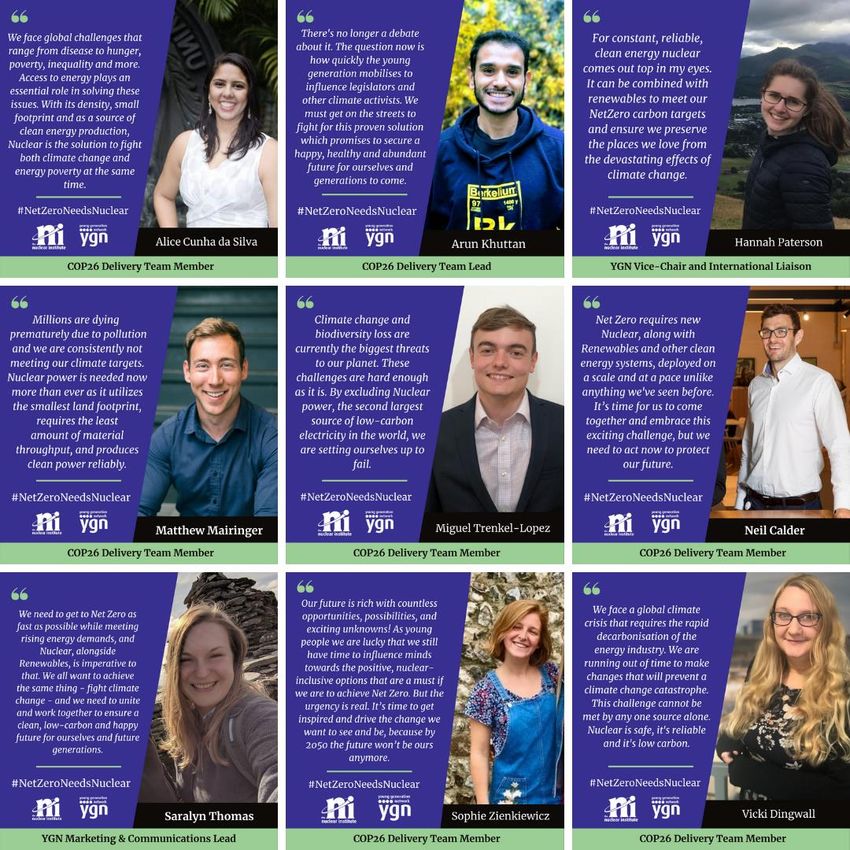
Besides Climate Change we also face many other global challenges like diseases, hunger,
NI_YGN
poverty, inequality more. Access to energy plays an essential role in solving these issues. Net
zero needs because, in combination with renewables, Nuclear allows those NIYGN
in energy poverty
to have a route to abundance while still pursuing a sustainable
Web and Net Zero Future.
nuclearinst.com/YGNYoung Generation
Network @COP26
Vision
To have a clean,
sustainable and
abundant low carbon
future for all.
Mission
To accelerate the ability
of the world to achieve
Net Zero by 2050, by
driving collaboration
between nuclear and
renewable technology#NetZeroNeedsNuclear Campaign
NetZeroNeedsNuclear.com
Contact:
alicecs@poli.ufrj.br
cunha1a@westinghouse.comPart 2 Driving energy systems to net
zero with nuclear, renewables
and hydrogen
Ed Bradley Alice Cunha da SilvaPart 3 Energy policy, financing
and sustainable development
Denis Subbotnitskiy Nancy Mberia
• Energy Data Analyst, IAEA Planning and Economic Studies • Technical officer, Nuclear Power and Energy
Section. Agency in Kenya.
• Economics and financing of energy programmes and projects,
and topics related to climate change and sustainable • Academic background in economics.
development. • Technical studies and drafting policies on and
• Regular contributor to IAEA Climate Change and Nuclear
strategies for the different infrastructure issues
Power report
within the country’s nuclear power programme.
• Co-Organizer of the IAEA Coordinated Research Project on
Economic Appraisal of Small Modular Reactors (SMR) • Contributes to Kenya’s energy planning process
and development of national energy plans within an
• Working in international development since 2011, with established multiagency framework.
UNIDO, FAO and IAEA, focus on energy economics,
energy efficiency, climate-friendly energy technologies and • Interests in sustainable policy formulation, energy
quality monitoring of international development projects. resource exploitation, energy mix creation and
• VP United Nations Nuclear Young Generation 2018-2020. carbon emission reduction.Energy Policy
We need a green planet – but the world is on red alert
UN Secretary-General A. Guterres, 2021 Leaders Summit on Climate
• International efforts to combat
climate change are accelerating:
– Countries announcing pledges to
achieve net zero emissions over the
next decades
– COP26 in Glasgow, UK: nationally
determined contributions (NDCs)
• Recognition of climate crisis as
a great challenge of our times
becomes a mainstream
– Policies – key instrument to bring the
world on track to limit global warming
to 1.5 °C
45Financing
• Transition to net zero world by
2050:
– Up to US$2 trillion per year: 1% to
1.5% of global GDP (ETC Report,
2020)
• More resources to become
available to decarbonize global
energy system
– Falling short: G7 summit in 2021
acknowledged that 2009 target to
provide US$100 billion to developing
countries per year to cut emissions
was not met
• Allocation of resources for
energy transition through new
financing mechanisms
– Nuclear: issues of access to green
and climate financing
46Sustainable Development
• Nuclear as part of the
solution for climate crisis:
– Hydropower and nuclear, the two
largest sources of low‐carbon
electricity today, provide an
essential foundation for
transitions (IEA, 2021)
• Recognition of nuclear as a
sustainable energy source
– EU taxonomy for sustainable
activities (2020) – originally
nuclear was not included
– 2021: discussion on inclusion
through a Delegated Act
• Nuclear technology – not only
power:
– 9 out of 17 SDGs – direct
contribution of nuclear science
and technology
– Nuclear is and will remain a part
of discussion on sustainable
future
47Young Voices on Nuclear Energy’s
Contribution to a Net Zero World
PART 3: Energy policy, financing and sustainable
development
IAEA Webinar | 22nd June 2021
Presenter:
Nancy Mberia
Nuclear Power and Energy Agency, KenyaEnergy policy, financing and
sustainable development
Energy policy Financing Sustainable development
•Sustainable, adequate, affordable, •High capital intensity •Protection and conservation of the
competitive, secure, reliable •Long construction periods (sensitive environment – focus on clean
energy supply to interest rates, construction energy sources
delays, cost overruns, inflation) •Ensure access for all (UN SDG 7)
•Need for innovative financing
structures
Successful implementation of nuclear power projectsThank you for your attention.
Part 3     Energy policy, financing
           and sustainable development

         Denis Subbotnitskiy   Nancy Mberia
Q&A
River Bennett
Alice Cunha da Silva
Craig Jantzen
Nancy MberiaThank you!
You can also read


