Intriguing and Beautiful: Adamacrocera adami gen. et sp. nov. from the Upper Cretaceous Amber of Myanmar Represents a New Subfamily of ...
←
→
Page content transcription
If your browser does not render page correctly, please read the page content below
insects
Article
Intriguing and Beautiful: Adamacrocera adami gen. et
sp. nov. from the Upper Cretaceous Amber of
Myanmar Represents a New Subfamily of
Keroplatidae (Diptera: Bibionomorpha)
Jan Ševčík 1 , Wiesław Krzemiński 2 and Kornelia Skibińska 3, *
 1    Department of Biology and Ecology, Faculty of Science, University of Ostrava, Chittussiho 10,
      71000 Ostrava, Czech Republic; sevcikjan@hotmail.com
 2    Institute of Biology, Pedagogical University of Kraków, Podbrzezie 3, 31-054 Kraków, Poland;
      wieslawk4@gmail.com
 3    Institute of Systematics and Evolution of Animals, Polish Academy of Sciences, 31-016 Kraków, Poland
 *    Correspondence: yukisiak@gmail.com

 Received: 30 July 2020; Accepted: 17 August 2020; Published: 19 August 2020

 Simple Summary: The Upper Cretaceous amber of Myanmar (also known as Burmese amber) is
 almost 100 Mya old and represents invaluable source of information about the evolution of life in
 the late Mesozoic. Various groups of fossil flies (Diptera) belong to the most abundant insects found
 in these fossil resins indicating that it was the Mesozoic when the early evolution and radiation of
 Diptera took place. Here we describe a remarkable fossil fly which combines characters of various
 other related flies from different families (both extant and fossil) in a very unusual way. This new
 genus is tentatively placed in the family Keroplatidae (the so called predaceous fungus gnats) pending
 and stimulating further research into the evolution of lower Diptera.

 Abstract: A new fossil genus and species of Keroplatidae (Diptera, Bibionomorpha, Sciaroidea),
 Adamacrocera adami gen. et sp. nov., from the Upper Cretaceous Burmese amber is described and
 illustrated. Based on morphological evidence, it is placed in a new subfamily Adamacrocerinae subfam.
 nov. The new genus, as well as the subfamily, possesses the wing venation characteristic of the genera of
 some Sciaroidea incertae sedis, as well as that of the fossil families Archizelmiridae, Antefungivoridae
 and Mesosciophilidae, in combination with macrocerine-like habitus and male terminalia.

 Keywords: fossil insects; Sciaroidea; inclusions; Mesozoic; taxonomy; new genus

1. Introduction
     The family Keroplatidae is one of the most diverse families of Sciaroidea in the dipteran infraorder
Bibionomorpha [1], with nearly 1000 described extant species and about 50 fossil species, mostly from
Baltic amber and other Tertiary deposits [2]. A real diversity of both the extant and fossil fauna of this
family is still inadequately known, since new species and genera are being described almost every
year [3–7]. The family is currently divided into six subfamilies: Arachnocampinae, Keroplatinae,
Lygistorrhininae, Macrocerinae, Platyurinae and Sciarokeroplatinae [8].
     The oldest described fossil species of Keroplatidae are Hegalari minor [9] and H. antzinako [9]
(Macrocerinae, both from the Cretaceous Alava amber of Spain), followed by Lebanognoriste [10]
(Lygistorrhininae, Lebanese Amber, ca. 130.0–125.5 mya), Schlueterimyia cenomanica [11] (Macrocerinae,
Cretaceous amber of France) and Burmacrocera petiolata [12] (Macrocerinae, Cretaceous Burmese amber).
The latter species was described by Cockerell [12] based on a single female and considered by him

Insects 2020, 11, 552; doi:10.3390/insects11090552                                www.mdpi.com/journal/insects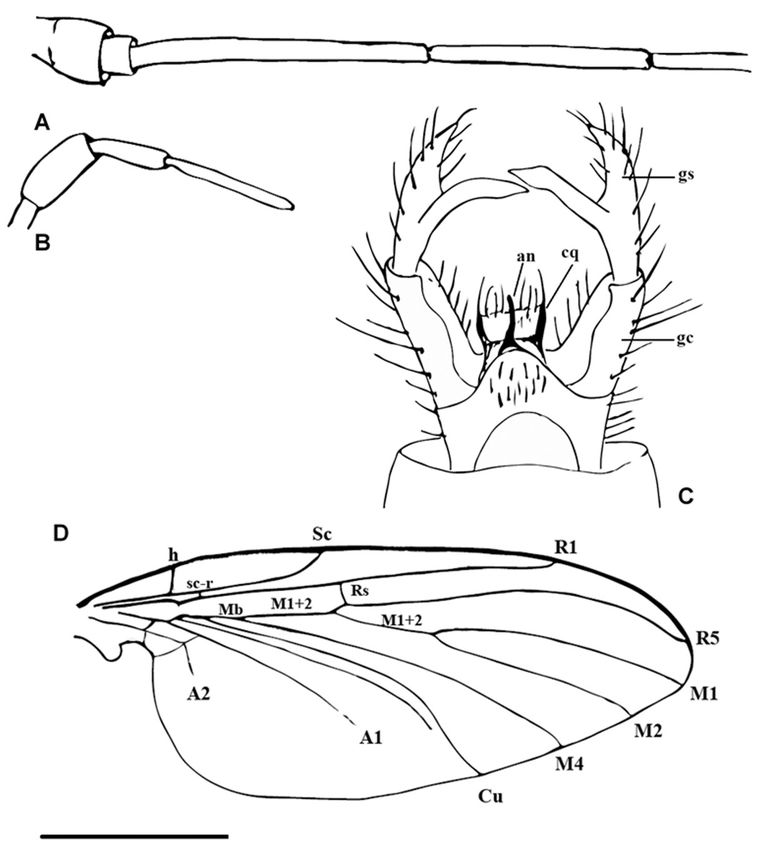
Insects 2020, 11, 552                                                                                  2 of 9

as closely allied to Macrocera [13]. Matile [14], however, placed the monotypic genus Burmacrocera
(containing only B. petiolata) in the tribe Orfeliini of Keroplatinae. Actually, various specimens
(both male and female) of Burmacrocera are relatively common in Burmese amber (personal collection
of J. Ševčík), and there is no doubt that this genus belongs either to Macrocerinae or to a related archaic
group, not to the much younger tribe Orfeliini, reliably known only since the Tertiary. However,
the delimitation and systematic position of this Cretaceous genus is beyond the scope of this paper and
will be the subject of a separate paper in preparation, covering also an undescribed extant Oriental
genus near Burmacrocera.
      The mid Cretaceous amber of northern Myanmar (Burmese amber) is considered as essential for
understanding the origins and diversification of recent families of Sciaroidea [10]. Although this amber
contains various taxa of Keroplatidae and related families [8], the vast majority of them still remain
undescribed or unrecorded. Most of these Cretaceous taxa belong to the subfamily Macrocerinae or
they are unplaceable to a subfamily.
      The concept, synapomorphies and monophyly of the subfamily Macrocerinae are far from being
clarified. The recent study by Mantič et al. [8] shows that this subfamily is most probably a rather
heterogeneous group, monophyletic with high support only in a broader concept, including several
genera regarded by these authors as Keroplatidae incertae sedis. The absence of a distinct morphological
synapomorphy applies also to the entire family Keroplatidae in its current broad concept [8].
      In this paper, we describe a new fossil genus of Keroplatidae, possessing a very unusual wing
venation, leading us to the decision to establish a new subfamily for this genus.

2. Materials and Methods
     The specimen was examined using a Nikon SMZ25 stereomicroscope equipped with a Nikon
DS-Ri2 digital camera. Photomicrographs are focus stacks captured using this system and processed
using NIS-Elements Imaging Software. Line drawings were produced by tracing photographs.
The terminology principally follows that in Blagoderov and Ševčík [15] and Matile [14], while some
terms of wing venation are after Krzemińska et al. [16]. The holotype comes from the Hukawng
Valley in Kachin State, northern Myanmar, and it is deposited in the Silesian Museum, Opava, Czech
Republic (SMOC). Burmese amber was dated by Cruickshank and Ko [17] to the middle–late Albian,
but Grimaldi et al. [18] estimated the age of this resin to the Turonian–Cenomanian based on arthropod
inclusions. Shi et al. [19], based on U-Pb dating of zircons from the volcaniclastic matrix of the amber,
estimated the age of Burmese amber at 98.79 ± 0.62 Ma (earliest Cenomanian).
     This published work and the nomenclatural acts it contains have been registered in ZooBank,
the online registration system for the ICZN. The LSID for this publication is: LSIDurn: lsid: zoobank.org:
pub: 610233EC-C775-43BC-8644-357EA9D45B95.

3. Results

3.1. Systematic Paleontology
      Order Diptera Linnaeus, 1758 [20].
      Infraorder Bibionomorpha Hennig, 1948 [21].
      Superfamily Sciaroidea Billberg, 1820 [22].
      Family Keroplatidae Rondani, 1856 [23].

3.2. Description of a New Fossil Material
      Subfamily Adamacrocerinae subfam. nov.
      LSID urn:lsid:zoobank.org:act:66D233EE-1BC3-4F00-9F3C-EAA05C1BA4D1
      Type of genus Adamacrocera gen. nov.
      Type of species Adamacrocera adami sp. nov.
      Genera included Adamacrocera gen. nov.
Insects 2020, 11, 552 3 of 9
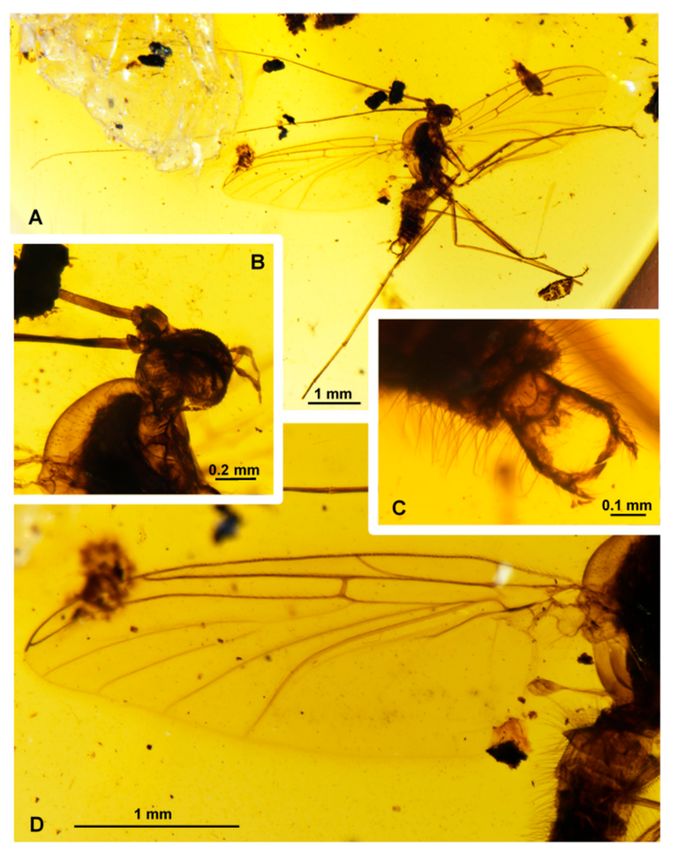
Differential diagnosis. Medium-sized fungus gnats, superficially resembling Macrocerinae. Male
antennae were about twice as long as the wing (Figure 1A). Wing vein Sc ends in C almost at the level
of Rs; R4 was absent; bases of M 1 + 2 were very long and nearly parallel with veins m-cu and Cub; r-m
fusion was absent, A1 was short, not reaching the wing margin. The posterior part of the mediotergite
(postphragma) was reduced (Figure 1). Male terminalia with gonostylus were as long as gonocoxite,
deeply bifid in the posterior half, with both the branches of similar length (Figures 1C and 2C).
Figure 1. Adamacrocera adami gen. et sp. nov. Photos of the holotype [No. 426/2019]. (A) Whole
specimen; (B) head; (C) male terminalia; (D) wing.Insects 2020, 11, 552 4 of 9
Insects 2020, 11, x 5 of 9
Figure 2. Line
2. Line drawings
drawings of Adamacrocera
of Adamacrocera adami
adami gen.
gen. et spec.
et spec. nov.
nov. (A) (A) Antennae;
Antennae; (B) palpi;(B)
(C)palpi;
male
(C) male terminalia;
terminalia; (D) wing,
(D) wing, scale scale:
: 1 mm. 1 mm. Abbreviations:gs—gonostylus;
Abbreviations: gs—gonostylus;an—anus;
an—anus; cq—cerque;
cq—cerque;
gc—gonocoxite; Sc—subcostal
gc—gonocoxite; Sc—subcostal vein; sc-r—subcostal
vein; radial radial
sc-r—subcostal crossvein; h—humeral
crossvein; cross-vein; cross-vein;
h—humeral Rs—radial
sector; R1—anterior branch of radius; R5—third branch of radius; M
Rs—radial sector; R1—anterior branch of radius; R5—third branch of1 +radius; 2 —stem
M1 + 2—stem M
of media; —first
of 1media;
branch of media; M
M1—first branch of media;
2 —second branch of media; M4—fourth branch of media; Cu—cubital
M2—second branch of media; M4—fourth branch of media; Cu—cubital vein;
A 1 —first
vein; branch
A1—first of anal
branch ofvein; A2 —second
anal vein; branch
A2—second of anal
branch of vein.
anal vein.
Adamacrocera gen. nov.
4. Discussions
LSID urn:lsid:zoobank.org:act:7D7E6F72-F5A6-4E25-953D-BE762B7E6FEA
Some
Type of ofspecies:
the body characters present
Adamacrocera adami gen.in Adamacrocera gen. nov. and
et sp. nov., by monotypy are typical
presentfor Macrocerinae
designation.
(Keroplatidae),
Diagnosis: especially
the same as theforvery
the long antennae and general outline of the male terminalia (Figure
subfamily.
1). On the other hand, a distinct
Etymology: the new genus (as well as the cerebral sclerite, presentwas
type species) in named
most Macrocerinae, is apparently
after Adam Ševčík, a son of
missing in Adamacrocera
the senior author. gen. nov., and the wing venation is utterly different from any described
genusAdamacrocera
of Keroplatidaeadami(Figures
sp. nov. 1D and 2D). This unique combination of characters would even
allow(Figures
the establishment
1 and 2) a new family for this genus. However, we consider this as premature,
pending a discovery of further similar fossil genera, to see the variation of the wing and other
LSID urn:lsid:zoobank.org:act:C10903B4-96E6-4293-89FB-C7840E21F0FA
characters, and the
Diagnosis: alsosame
pending
as forclarification
the genus and of the family assignment of 20 genera (both extant and
subfamily.
fossil)Description:
of fungus gnats body 2.20 mm long, wing length 3.42 mm.Sciaroidea incertae sedis (sensu Jaschhof
unplaced to a family—the so-called
[24])—see below. We2.0
Male antennae: consider
times as it long
as theasbest
the solution
wing andnow to 2.5
about tentatively
times asplace this
long as thepeculiar genus was
body; scapus to a
new subfamily of Keroplatidae, rather than to leave it unplaced or to describe
short and very broad; pedicel was very short, tubular, much narrower than the scapus and only slightly a new family for it.
widerThethanmale terminalia
the first of Adamacrocera
flagellomere; flagellomeres gen.
werenov. arelong
bare, distinct in having
and tubular a relatively
(Figures 1A andlong
2A). and
deeply branched
Palpi with fourgonostylus (Figures 1Cthe
visible palpomeres, and 2C), resembling
second palpomere was some of the more
broader than theprimitive
others; genera of
the apical
Macrocerinae (Keroplatidae), namely Chiasmoneura
segment was twice as long as the penultimate one (Figures 1B and 2B). (De Meijere, 1913) [25] (subgenus
Prochiasmoneura
Wings: 2.5 times Matile, 1988 as
as long [26]) and Srilankana
wide. Membrane (Matile,
hyaline 1990) [14] andmacrotrichia
was without also Heteropterna (Skuse,
and without
1888)
visible[27] from theCsubfamily
markings. ends slightly Keroplatinae.
beyond theThe apexstructure
of R5 ; Scofterminates
the male terminalia
in C, almostthus
at represents
the level ofoneRs;
of
sc-r ends before half of the Sc length and about three times its length after h; R4 was absent;most
the most important indications that the new genus belongs to Keroplatidae. In other
r-m fusion
Sciaroidea, including those unplaced to a family, male terminalia are much more complex, usually
with shorter and unbranched gonostyli, or they are otherwise different.Insects 2020, 11, 552 5 of 9
was absent; Rs was short, oblique or transverse; Mb was absent; bases of M1+2 were very long (equal in
length to M1+2 ) and cross vein m-cu and Cub were nearly parallel; A1 in the basal half was strongly
sclerotized, and its distal part was very delicate and poorly visible, not reaching the wing margin; A2
was very short (Figures 1D and 2D).
The thorax was about as high as long. The scutum was covered entirely with relatively long
and thin hairs. The mediotergite was bare, evenly rounded and without distinct postphragma;
the laterotergite was bare; the haltere was longer than the first abdominal segment (Figure 1A,D).
Legs with two tibial spurs on mid and hind leg: the inner one was about half the size of the outer
one, fore tibia with a single spur, covered with regular, short and robust setae; tarsal claws, pulvilli and
empodia were present but poorly visible. Length of legs in mm: front coxa/0.66, femur/1.01, tibia/1.03,
tarsus 1/0.70, 2/0.22, 3/0.15, 4/0.07, 5/0.1; mid coxa/0.44, femur/0.97, tibia/1.11, tarsus 1/0.67, 2/0.25, 3/0.17,
4/0.04, 5/0.13; hind coxa/0.52, femur/1.56, tibia/1.69, tarsus 1/0.87, 2/0.42 3–5 absent (Figure 1A).
The abdomen was densely covered with long hairs. The hairs are about half as long as the breadth
of the abdomen (Figure 1C,D).
Male terminalia: the gonocoxite was straight and relatively narrow; the gonostylus was as long as
the gonocoxite, deeply bifid in the posterior half, with both the branches of similar length; tergite 9
was relatively short, convex in the posterior part and about twice as broad as long; cerci were apically
pointed; hypoproct was dark and pointed. Aedeagus and the associated internal structures were not
visible (Figures 1C and 2C).
Material examined: Holotype (male), No. 426/2019; Burmese amber (the earliest Cenomanian,
98.79 ± 0.62 Ma), deposited in the Silesian Museum, Opava, Czech Republic (SMOC).
Female unknown.
4. Discussions
Some of the body characters present in Adamacrocera gen. nov. are typical for Macrocerinae
(Keroplatidae), especially the very long antennae and general outline of the male terminalia (Figure 1).
On the other hand, a distinct cerebral sclerite, present in most Macrocerinae, is apparently missing
in Adamacrocera gen. nov., and the wing venation is utterly different from any described genus of
Keroplatidae (Figures 1D and 2D). This unique combination of characters would even allow the
establishment a new family for this genus. However, we consider this as premature, pending a
discovery of further similar fossil genera, to see the variation of the wing and other characters,
and also pending clarification of the family assignment of 20 genera (both extant and fossil) of fungus
gnats unplaced to a family—the so-called Sciaroidea incertae sedis (sensu Jaschhof [24])—see below.
We consider it as the best solution now to tentatively place this peculiar genus to a new subfamily of
Keroplatidae, rather than to leave it unplaced or to describe a new family for it.
The male terminalia of Adamacrocera gen. nov. are distinct in having a relatively long and
deeply branched gonostylus (Figures 1C and 2C), resembling some of the more primitive genera of
Macrocerinae (Keroplatidae), namely Chiasmoneura (De Meijere, 1913) [25] (subgenus Prochiasmoneura
Matile, 1988 [26]) and Srilankana (Matile, 1990) [14] and also Heteropterna (Skuse, 1888) [27] from the
subfamily Keroplatinae. The structure of the male terminalia thus represents one of the most important
indications that the new genus belongs to Keroplatidae. In most other Sciaroidea, including those
unplaced to a family, male terminalia are much more complex, usually with shorter and unbranched
gonostyli, or they are otherwise different.
Another character supporting the inclusion of Adamacrocera gen. nov. in Keroplatidae is the
reduction in postphragma, the posterior part of the mediotergite (Figure 1D). It is particularly well
developed in many genera of Sciaroidea incertae sedis (see Jaschhof [28]) but apparently not in
Adamacrocera gen. nov.; at least, it is not traceable in the holotype. This is a more general problem
specific to the study of fossil specimens that several characters are not visible, making the inclusion
of these taxa in a cladistics analysis difficult. Sometimes fossils were included into a dataset, e.g.,Insects 2020, 11, 552 6 of 9
by Vilkamaa and Hippa [29], but with numerous characters coded as unknown, which may eventually
affect the results.
On the other hand, the wing venation of Adamacrocera gen. nov. is very different from all
the recent taxa of Keroplatidae, except for Arachnocampinae, but resembles various other taxa of
Sciaroidea. A similar pattern of wing venation such as in Adamacrocera gen. nov. can be seen,
for example, in Catotricha (Edwards, 1938) [30], a primitive genus of Cecidomyiidae, and also in
several genera of the Sciaroidea incertae sedis, e.g., in Eratomyia (Amorim and Rindal, 2007) [31],
Chiletricha (Chandler, 2002) [32], Freemanomyia (Jaschhof 2004) [28] (=Pterogymnus (Freeman, 1951) [33]),
Heterotricha (Loew, 1850) [34] and Starkomyia (Jaschhof, 2004) [28]. The latter group of genera, still
unplaced to a family, represents a real phylogenetic puzzle, most probably crucial for the understanding
of the evolution of Sciaroidea [24,32]. Amorim and Rindal [31] placed most of these genera in the
family Rangomaramidae sensu lato. This was, however, criticized by Jaschhof [24] who suggested
using Sciaroidea incertae sedis for all the previously unplaced genera in the Heterotricha group sensu
(Chandler) [32] and keeping the strict concept of Rangomaramidae with only the type genus included.
Recently, Hippa and Ševčík [35] suggested including these genera into the Upper Jurassic and Lower
Cretaceous family Antefungivoridae (=Pleciomimidae), although most of the morphological characters,
except of wing venation, are unknown in these Jurassic taxa. Similarly, Chandler [32] and Jaschhof [28]
pointed out the resemblance of the wing venation of Freemanomyia with that of the Mesozoic family
Mesosciophilidae. However, most authors [24,29,32] agree that these genera do not constitute a single
monophyletic group. This view is also supported by recent molecular studies [1,8,36].
In Burmese amber, there is currently just one described genus formally assigned to the Sciaroidea
incertae sedis, Thereotricha (Blagoderov and Grimaldi, 2004) [10], although Docidiadia (Blagoderov and
Grimaldi, 2004) [10] should be placed there too, rather than to Diadocidiidae, considering the relatively
different male terminalia from recent diadocidiids and some other differences on wings and antennae.
Both the latter genera differ considerably from Adamacrocera gen. nov., mainly in wing venation and
the structure of the male terminalia.
It is of particular interest that the wing venation of the new genus resembles that of the fossil
family Archizelmiridae, especially the Lower Cretaceous genus Zelmiarcha (Grimaldi, Amorim and
Blagoderov, 2003) [37], although the proportions of particular veins, especially r-m and m-cu, are rather
different. Additionally, the wing venation of some genera of Antefungivoridae and Mesosciophilidae
is remarkably similar to Adamacrocera; see Kovalev [38] and Blagoderov [39]. This indicates that such a
wing venation may represent a ground plan within Sciaroidea, formerly present in various lineages and
retained only in several recent genera of Sciaroidea incertae sedis. A possible phylogenetic position
of the family Archizelmiridae was discussed by Grimaldi et al. [37] and Vilkamaa and Hippa [29].
The former study suggests the closest relationship of Archizelmiridae with the Sciaroidea incertae
sedis genera, while the latter includes this family in a broad concept of Sciaridae. Possible relationships
of some genera of Sciaroidea incertae sedis with those of Antefungivoridae and Mesosciophilidae were
discussed by Chandler [32], Hippa and Ševčík [36] and Jaschhof [28].
The complete vein Sc reaching the costa in Adamacrocera gen. nov. is a more plesiomorphic
condition than in all the genera of Sciaroidea incertae sedis except for Freemanomyia and Starkomyia,
while the latter retains R4 which is absent in the new genus. The absence of that vein also differs from
the ground plan of the Keroplatidae and of the Macrocerinae, while long antennae are probably not in
the ground plan of the family Keroplatidae. It is thus possible that the antennal structure has developed
independently to that in Macrocerinae, so is not in itself evidence of a relationship to Keroplatidae.
If we do not take male terminalia, reduced postphragma and long antennae into the account, there is
no indication in the wing of Adamacrocera gen. nov. that it should belong to Keroplatidae but rather to
the Sciaroidea incertae sedis group of genera, unplaced to a family or some Jurassic genus. Such a
discrepancy between wing venation and other morphological features can be particularly misleading
if there is only a wing preserved in the fossil record, like in many taxa of Bibionomorpha known only
as Jurassic and other compression fossils.Insects 2020, 11, 552 7 of 9
Thus, there remains an open question if such a pattern of wing venation like in Adamacrocera
gen. nov. could have evolved multiple times in different clades, including Keroplatidae, or, on the
contrary, if the long antennae, reduction in postphragma and the Macrocerinae-like male terminalia
are just an offshoot within the Sciaroidea incertae sedis or some fossil family. Considering the fact
that various genera of the Sciaroidea incertae sedis most probably do not constitute a monophyletic
group [1,24,29,32], the former hypothesis of the independent origin of the similar wing venation appears
more plausible. Jaschhof [40] asserts that “wing venation in the Sciaroidea provides a character set that
is notorious for the extent of homoplasy involved“. Given the relative simplicity of wing characters,
it is easy to imagine that they are prone to parallel evolution. Parallel evolution of some characters is
well documented either in Keroplatidae [5,8,41] or in the other groups of Sciaroidea, e.g., the absence
of vein R4 in several genera of Keroplatidae belonging to different subfamilies (Arachnocampinae,
Macrocerinae, Keroplatinae) or in the family Mycetophilidae [36]. This vein may be absent even in
some species within a single genus (e.g., in Macrocera).
In any case, the inclusion of Adamacrocera gen. nov. in Keroplatidae makes this family even more
heterogeneous than it used to be, so that it is now even more difficult to find a distinct synapomorphy
for this family. The family Keroplatidae in the broad concept can thus be considered as a catch-all taxon,
containing such different genera (in terms of wing venation), such as Arachnocampa (Edwards, 1924) [42],
Paleoplatyura (Meunier, 1899) [43] and Adamacrocera gen. nov. This issue clearly requires further study,
representing a real challenge for the future.
5. Conclusions
The new fossil genus, described in this paper, represents one of the most peculiar and remarkable
sciaroid taxa currently known, combining characters of macrocerines (Keroplatidae) as well as of
several genera of the Sciaroidea incertae sedis group, unplaced to a family, and also of the fossil
families Archizelmiridae, Antefungivoridae and Mesosciophilidae. Although the wing venation
pattern suggests that Adamacrocera gen. nov. represents a separate evolutionary line, we tentatively
place it in the new subfamily of the family Keroplatidae, Adamacrocerinae subfam. nov., pending new
findings of well-preserved Cretaceous fossils and further research into the evolution of fungus gnats
(Sciaroidea) and lower Diptera as a whole.
Author Contributions: Conceptualization, J.Š., K.S. and W.K.; methodology, J.Š., K.S. and W.K.; validation, J.Š.,
K.S. and W.K.; investigation, J.Š., K.S. and W.K.; resources, J.Š., K.S. and W.K.; writing—original draft preparation,
J.Š., K.S. and W.K.; writing—review and editing, J.Š., K.S. and W.K.; visualization, K.S.; supervision, J.Š., K.S. and
W.K.; project administration, J.Š., K.S. and W.K.; funding acquisition, J.Š., K.S. and W.K. All authors have read and
agreed to the published version of the manuscript.
Funding: This research was funded by the National Science Centre of Poland (grant number
UMO-2016/23/B/NZ8/00936) and by the institutional support for the University of Ostrava provided by the
Ministry of Education, Youth and Sports of the Czech Republic.
Acknowledgments: We are grateful to Peter Chandler, Heikki Hippa, Mathias Jaschhof and two anonymous
reviewers for their valuable comments and suggestions on this manuscript.
Conflicts of Interest: The authors declare no conflict of interest. The funders had no role in the design of the
study; in the collection, analyses, or interpretation of data; in the writing of the manuscript, or in the decision to
publish the results.
References
1. Ševčík, J.; Kaspřák, D.; Mantič, M.; Fitzgerald, S.; Ševčíková, T.; Tóthová, A.; Jaschhof, M. Molecular
phylogeny of the megadiverse insect infraorder Bibionomorpha sensu lato (Diptera). PeerJ 2016, 4, e2563.
[CrossRef] [PubMed]
2. Evenhuis, N. Family Keroplatidae. In Catalog of the Fossil Flies of the World (Insecta: Diptera) Version 2.0;
Available online: http://hbs.bishopmuseum.org/fossilcat/fosskero.html (accessed on 21 June 2020).
3. Blagoderov, V.; Hippa, H.; Ševčík, J. Asiorrhina, a new Oriental genus of Lygistorrhinidae (Diptera: Sciaroidea)
and its phylogenetic position. Zootaxa 2009, 2295, 31–45. [CrossRef]Insects 2020, 11, 552 8 of 9
4. Ševčík, J.; Mantič, M.; Blagoderov, V. Two new genera of Keroplatidae (Diptera), with an updated key to the
World genera of Keroplatini. Acta Entomol. Mus. Natl. Pragae 2015, 55, 387–399.
5. Kurina, O.; Mantič, M.; Ševčík, J. A remarkable new genus of Keroplatidae (Insecta, Diptera) from the
Afrotropical region, with DNA sequence data. Afr. Invertebr. 2017, 58, 93–105. [CrossRef]
6. Blagoderov, V.; Krzemiński, W.; Skibińska, K. A new species of Micrepimera Matile (Diptera: Keroplatidae)
from Baltic Amber. Palaeoentomology 2019, 2, 643–649. [CrossRef]
7. Fitzgerald, S.J. A curious new genus of Keroplatini (Diptera: Keroplatidae) from Guatemala. Zootaxa 2019,
4586, 383–390. [CrossRef]
8. Mantič, M.; Sikora, T.; Burdíková, N.; Blagoderov, V.; Kjærandsen, J.; Kurina, O.; Ševčík, J. Hidden in Plain
Sight: Comprehensive Molecular Phylogeny of Keroplatidae and Lygistorrhinidae (Diptera) Reveals Parallel
Evolution and Leads to a Revised Family Classification. Insects 2020, 11, 348. [CrossRef]
9. Blagoderov, V.; Arillo, A. New Sciaroidea (Insecta: Diptera) in Lower Cretaceous amber from Spain.
Stud. Dipterol. 2002, 9, 31–40.
10. Blagoderov, V.; Grimaldi, D.A. Fossil Sciaroidea (Diptera) in Cretaceous Ambers, Exclusive of Cecidomyiidae,
Sciaridae, and Keroplatidae. Am. Mus. Novit. 2004, 3433, 1. [CrossRef]
11. Matile, L. Description d’un Keroplatidae du crétacé moyen et données morphologiques et taxonomiques sur
les Mycetophiloidea (Diptera). Ann. Soc. Entomol. Fr. (n.s.) 1981, 17, 99–123. (In French)
12. Cockerell, T.D.A. Insects in Burmese Amber. Ann. Èntomol. Soc. Am. 1917, 10, 323–329. [CrossRef]
13. Meigen, J.W. Versuch einer neuen Gattung Eintheilung der europäischen zweiflügligen Insekten.
Magazin für Insektenkunde 1803, 2, 259–281. (In German)
14. Matile, L. Recherches sur la systeámatique et l'évolution des Keroplatidae: Diptera, Mycetophiloidea.
Mém. Mus. Natl. Hist. Nat., Sér. A Zool. 1990, 148, 1–682. (In French)
15. Blagoderov, V.; Ševčík, J. Keroplatidae (Predaceous Fungus Gnats). In Manual of Afrotropical Diptera.
Nematocerous Diptera and Lower Brachycera, 2nd ed.; Kirk–Spriggs, A.H., Sinclair, B.J., Eds.; South African
National Biodiversity Institute: Pretoria, South Africa, 2017; Volume 2, pp. 527–531.
16. Krzemińska, E.; Krzemiński, W.; Dahl, C. Monograph of Fossil Trichoceridae (Diptera) over 180 Million Years of
Evolution; Institute of Systematic and Evolution of Animals, Polish Academy of Sciences: Krakow, Poland,
2009; pp. 1–171.
17. Cruickshank, R.D.; Ko, K. Geology of an amber locality in the Hukawng Valley, northern Myanmar. J. Asian
Earth Sci. 2003, 21, 441–445. [CrossRef]
18. Grimaldi, D.A.; Engel, M.S.; Nascimbene, P.C. Fossiliferous Cretaceous amber from Myanmar (Burma): Its
rediscovery, biotic diversity, and paleontological significance. Am. Mus. Novit. 2002, 3361, 1–71. [CrossRef]
19. Shi, G.; Grimaldi, D.A.; Ge, H.; Wang, J.; Yang, M.; Lei, W.; Li, Q.; Li, X. Age constraint on Myanmar amber
based on U-Pb dating of zircons. Cretac. Res. 2012, 37, 155–163. [CrossRef]
20. Linnaeus, C. Systema Naturae per Regna tria Naturae: Secundum Classes, Ordines, Genera, Species, cum
Characteribus, Differentiis, Synonymis, Locis; Laurentius Salvius: Holmiae, Stockholm, Sweden, 1758; Volume 1,
p. 824, (In Latin). [CrossRef]
21. Hennig, W. Die Larvenformen der Dipteran; Akademie-Verlag: Berlin, Germany, 1952; Volume 3, p. 628.
(In German)
22. Billberg, G.J. Enumeratio insectorum in Museo/Gust. Joh. Billberg.; Smithsonian Institution: Stockholm, Sweden,
1820; p. 138.
23. Rondani, C. Dipterologiae Italicae Prodromus. Vol: I. Genera Italica Ordinis Dipterorum Ordinatim Disposita et
Distincta et in Familias et Stirpes Aggregata. A.; A. Stocchi: Parmae, Italy, 1856; Volume 1, pp. 1–226. [CrossRef]
24. Jaschhof, M. Phylogeny and classification of the Sciaroidea (Diptera: Bibionomorpha): Where do we stand
after Amorim & Rindal (2007)? Beitr. Entomol. 2011, 61, 455–463.
25. de Meijere, J.C.H. Studien über südostasiatische Dipteren. VII. Tijdschr. Ent. 1913, 56, 317–354. (In German)
26. Matile, L. Diptères Mycetophiloidea de la forêt de Taï (Côte d’Ivoire). I. Keroplatidae. Rev. Fr. Entomol. (n.s.)
1988, 10, 57–79. (In French)
27. Skuse, F.A.A. Diptera of Australia. Part III.—The Mycetophilidae. Proc. Linn. Soc. N. S. W. 1988, 3, 1123–1222.
28. Jaschhof, M. Starkomyia gen nov. from New Zealand and its implications for the phylogeny of the Sciaroidea
(Diptera: Bibionomorpha). Stud. Dipterol. 2004, 11, 63–74.
29. Vilkamaa, P.; Hippa, H. The genus Sciarotricha gen n. (Sciaridae) and the phylogeny of recent and fossil
Sciaroidea (Diptera). Insect Syst. Evol. 2005, 36, 121–143. [CrossRef]Insects 2020, 11, 552 9 of 9
30. Edwards, F.W. On the British Lestremiiinae, with notes on exotic species —2. (Diptera Cecidomyiidae).
Proc. R. Entomol. Soc. Series B Taxonomy 1938, 7, 25–32.
31. Amorim, D.D.S.; Rindal, E. Phylogeny of the Mycetophiliformia, with proposal of the subfamilies
Heterotrichinae, Ohakuneinae, and Chiletrichinae for the Rangomaramidae (Diptera, Bibionomorpha).
Zootaxa 2007, 1535, 1–92. [CrossRef]
32. Chandler, P. Heterotricha Loew and allied genera (Diptera: Sciaroidea): Offshoots of the stem group of
Mycetophilidae and/or Sciaridae? Ann. Soc. Entomol. Fr. (Nouvelle série) 2002, 38, 101–144.
33. Freeman, P. Diptera of Patagonia and South Chile: Based Mainly on Material in the British Museum (Natural
History). Part III—Mycetophilidae; British Museum: London, UK, 1951; p. 138.
34. Loew, H. Ueber den Bernstein und die Bernsteinfauna. Programm der Könglichen Realschule zu Meseritz;
F. W. Lorentz: Meseritz, Poland, 1850; pp. 1–44. (In German)
35. Hippa, H.; Ševčík, J. Notes on Nepaletricha (Diptera: Sciaroidea incertae sedis), with description of three
new species from India and Vietnam. Acta Entomol. Mus. Nat. Pragae 2014, 54, 729–739.
36. Kaspřák, D.; Kerr, P.; Sýkora, V.; Tóthová, A.; Ševčík, J. Molecular phylogeny of the fungus gnat subfamilies
Gnoristinae and Mycomyinae, and their position within Mycetophilidae (Diptera). Syst. Entomol. 2019, 44,
128–138. [CrossRef]
37. Grimaldi, D.; Amorim, D.D.S.; Blagoderov, V. The Mesozoic Family Archizelmiridae (Diptera: Insecta).
J. Paleontol. 2003, 77, 368–381. [CrossRef]
38. Kovalev, V.G. Two-winged flies. Muscida. In Late Mesozoic insects of Eastern Transbaikalia; Nauka Press:
Moscow, Russia, 1990; pp. 123–177.
39. Blagoderov, V. Dipterans (Mesosciophilidae) from the Lower Cretaceous of Transbaykal. Paleontol. J. 1993,
27, 123–130.
40. Jaschhof, M. The Heterotricha group in New Zealand. Beitr. Entomol. 2004, 54, 3–30.
41. Ševčík, J. Pseudochetoneura gen. nov., a peculiar new genus from Ecuador, with notes on Chetoneura (Diptera:
Keroplatidae). Acta Entomol. Mus. Nat. Pragae 2012, 52, 281–288.
42. Edwards, F.W. XIV—A note on the ‘New Zeland glow-worm’ (Diptera: Mycetophilidae). Ann. Mag. Nat. Hist.
1924, 14, 175–179. [CrossRef]
43. Meunier, F. Révision des diptères fossiles types de Loew conservés au Musée Provincial de Koenigsberg.
Misc. Entomol. 1988, 7, 161–165. (In French)
© 2020 by the authors. Licensee MDPI, Basel, Switzerland. This article is an open access
article distributed under the terms and conditions of the Creative Commons Attribution
(CC BY) license (http://creativecommons.org/licenses/by/4.0/).You can also read


