JAMMU & KASHMIR PARADISE ON EARTH - DAL LAKE IN SRINAGAR, JAMMU AND KASHMIR - IBEF
←
→
Page content transcription
If your browser does not render page correctly, please read the page content below

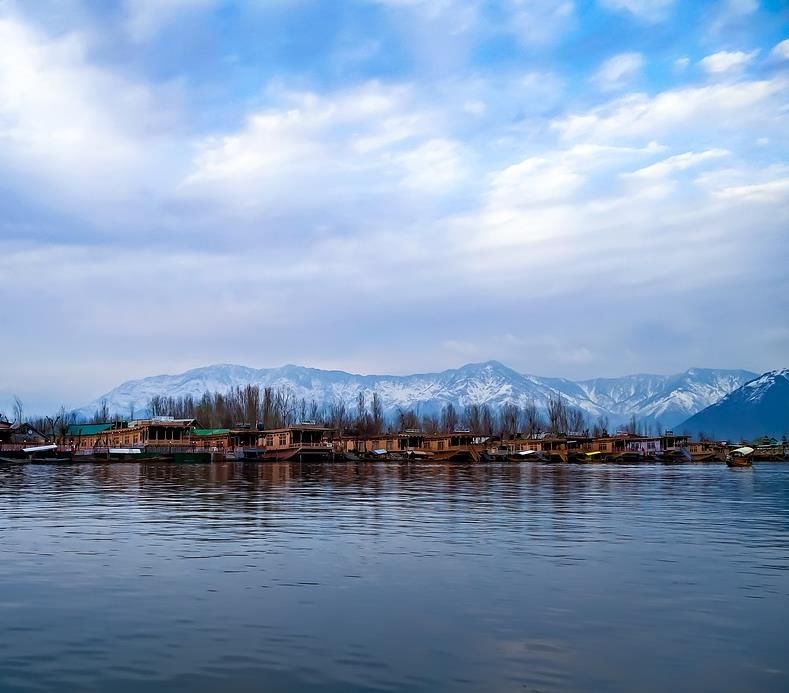
DAL LAKE IN SRINAGAR, JAMMU AND KASHMIR

 JAMMU & KASHMIR
 PARADISE ON EARTH

For updated information, please visit www.ibef.org                                  May 2018

Table of Content

  Executive Summary……………..……….….3

  Introduction…..…………………..…………..4

  Economic Snapshot…….……………….…..9

  Physical Infrastructure………………….….15

  Social Infrastructure……….…………..…...22

  Infrastructure Infrastructure ......................25

  Key Sectors………….…….…..…….......…27

  Key Procedures and Policies……..……….34

  Annexure…….………........................……42
EXECUTIVE SUMMARY
Jammu & Kashmir (J&K) is a global tourist destination. In addition to traditional recreational tourism, a vast scope
Strong tourism sector
exists for adventure, pilgrimage, spiritual & health tourism
A vast natural resource base has enabled J&K to develop land for cultivating major fruits. The state’s share in the
Leader in agro-based
overall apple production in India was 76.25 per cent in 2017-18P, with the overall production of apples in the
industry state reaching around 1.74 million MT.
With varied agro-climatic conditions, the scope for horticulture is significantly high in the state. There is
Strong considerable scope for increasing the horticulture produce, which is exported.
horticulture sector Department of Floriculture of the state has submitted a policy for floriculture development to the state
government. The policy will aim at promoting investments and fiscal incentives.
J&K has an ideal climate for floriculture and an enormous assortment of flora and fauna.
Vibrant The state has Asia’s largest tulip garden.
floriculture sector The state recorded production of 30.09 thousand metric tonnes of flowers during 2017-18* of which 29.70
thousand metric tonnes were loose flowers and 0.39 thousand metric tonnes were cut flowers.
The average rate of electricity for industrial consumers in J&K ranges from US$ 0.05–0.086, while that for
Lowest power tariffs commercial consumers ranges from US$ 0.05–0.06; these rates are relatively lower than those in most other
Indian states.
World famous Over the years, silk industry of the state witnessed huge growth. Production of raw silk in the state for 2017-18** P
handicrafts industry stood at 132 MT.
Note: P – Provision, * - 1st Advance Estimates, ** - till November 2017
Source: Ministry of Tourism, Ministry of Agriculture
3 JAMMU & KASHMIR For updated information, please visit www.ibef.org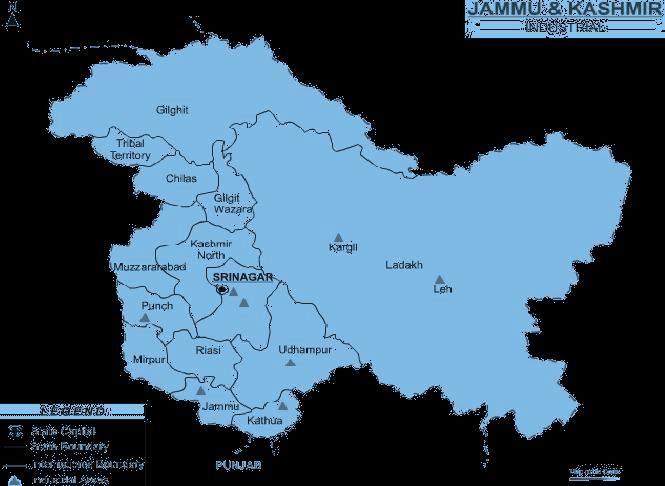
JAMMU & KASHMIR

INTRODUCTION
JAMMU & KASHMIR FACT FILE
Urdu, Kashmiri and Dogri are J&K’s official languages; Hindi, Pahari
and Ladakhi are also spoken in some parts of the state.
Important rivers flowing through J&K include the Indus, the Chenab,
the Jhelum, the Tawi and the Ravi.
Parameters Jammu & Kashmir
Summer capital – Srinagar
Capital cities
Winter capital – Jammu
Geographical area (sq km) 222,236
Source: Maps of India Administrative districts (No) 22
Population density (persons per sq km) 124
Jammu & Kashmir is the northernmost state of India. The state 12.5
Total population (million)
shares borders with Himachal Pradesh and Punjab, and the
neighbouring countries of Pakistan, China and Afghanistan. J&K Male population (million) 6.6
consists of three regions: Jammu, the Kashmir Valley and Ladakh.
Female population (million) 5.9
The important cities and towns are: Jammu, Srinagar, Gulmarg,
Pahalgam, Leh and Udhampur. 889
Sex ratio (females per 1,000 males)
The climate of J&K varies considerably with its topography. The
Literacy rate (%) 68.74
climate is primarily temperate. Jammu is known as the winter capital
of the state while Srinagar is known as the summer capital.
Source: Planning & Development Department, Government of Jammu & Kashmir, Census 2011
5 JAMMU & KASHMIR For updated information, please visit www.ibef.orgADVANTAGE JAMMU & KASHMIR
Paradise on earth Policy incentives
J&K is naturally pollution free and provides a J&K has an industrial policy that offers attractive
salubrious environment. incentives along with a single-window clearance
The natural beauty & picturesque locations have mechanism.
made it a favoured destination for tourists. Jammu Land is allotted at concessional rates in industrial
is famous for its temples, while the Kashmir Valley areas on lease for 90 years.
is known for its lakes & gardens. The cost of setting up operations is comparatively
lower than other states.
Advantage
J&K
Rich labour pool Horticulture and floriculture
J&K’s inhabitants are skilled weavers & designers J&K has agro-climatic conditions best suited for
of textile products. This provides a basis for setting horticulture & floriculture. Horticulture is the
up more textile units. mainstay of the rural economy, providing
The traditional skills of the people in craftsmanship employment to thousands.
can be utilised to meet the demands of industrial The floriculture industry supplies flowers to
processes. domestic & international markets.
6 JAMMU & KASHMIR For updated information, please visit www.ibef.orgJAMMU AND KASHMIR IN FIGURES
Jammu & Kashmir’s Contribution to Indian Economy (2017-18) Physical Infrastructure in Jammu & Kashmir
Jammu &
Parameter India Parameter Jammu & Kashmir India
Kashmir
GSDP as a percentage of all Installed power capacity
0.84 100.00 3,424.82 343,788.39
states’ GSDP (MW)*
GSDP growth rate (%) 11.71 9.80 Wireless subscribers (No)
13,653,037 1,183,408,611
(as of March 2018)
Per capita GSDP (US$) 1577.86 1,966.20
Internet subscribers (Mn)
5,020,000 445,960,000
Social Indicators (as of December 2017)
Jammu & National highway length
Parameter India 2,601 122,432
Kashmir (km)#
Literacy rate (%) 68.7 73.0 Airports (No) 3 125
Birth rate (per 1,000
15.7 20.4
population)
Industrial Infrastructure Investments (as of December 2017)
Jammu & Jammu &
Parameter India Parameter India
Kashmir Kashmir
PPP projects under
6 794
construction Cumulative FDI equity inflows
0.006 367.932
since April 2000 (US$ billion)
Note: GSDP, per capita GSDP figures are at current prices, exchange rates used is average of 2017-18 i.e. 64.45, For source refer to Annexure , * April 2018, # - As of February 2018
7 JAMMU & KASHMIR For updated information, please visit www.ibef.orgJAMMU & KASHMIR VISION
Develop vocational
Develop transportation network training centres to impart skilled
to enhance rural connectivity. training to women in various
Reform institutional machinery crafts and traditional trades.
to create public transport Create training facilities for
facilities. agriculture and cottage
industries.
Sustainable and balanced
Create an environment to attract Skill industrial growth with focus on
Transport
private investment in job-oriented Development employment generation by
projects. attracting large companies.
Encourage development of small Optimal utilisation of natural
Investment
and medium-scale sectors. Industries resources, 60 per cent of which are
promotion
commercially viable.
Develop eco-tourism in the state
Vision
Address the issue of shrinking
apart from developing the state as Tourism Environment natural water resources due to
adventure, heritage and religious
pollution, encroachment and
tourist destination.
siltation.
Promote rural tourism to provide
Agriculture Infrastructure Conserve forests from depletion
employment to rural people who are
dependent on agriculture for income. due to population expansion.
Develop fisheries to provide rural To make the state self-sufficient in
employment. energy supply and reduce
Promote organic farming to help dependence on other states.
control degradation of natural Develop better roads in the
resources by avoiding large- mountain regions for farmers to
scale use of chemicals. market their products.
Source: Government of Jammu & Kashmir
8 JAMMU & KASHMIR For updated information, please visit www.ibef.orgJAMMU & KASHMIR ECONOMIC SNAPSHOT
ECONOMIC SNAPSHOT – GSDP
GSDP of J&K at current prices #Per capita GSDP
30.00 1.8 2,000 1,20,000
*CAGR (In Rs) 10.30% *CAGR (In Rs) 8.64%
1.6 1,800
1,11,905.44
25.00 1,00,000
1.57
1736.31
1,600
1,01,693.34
1.4
24.42
1.41
1577.86
92,503.74
1,400
21.86
88,604.00
20.00 1.2
1.26
80,000
1378.80
1.19
1353.56
1319.37
336.4
1 1,200
303.5
1249.18
74,275.00
73,322.00
1216.36
1216.43
16.69
15.00
0.98
16.10
67,843.00
16.05
0.96
15.86
0.8 1,000 60,000
0.87
61,852.00
0.78
10.00 0.6 800
40,000
0.4 600
5.00
400
0.2 20,000
200
0.00 0
2011-12
2012-13
2013-14
2014-15
2015-16
2016-17
2017-18E
2018-19F
0 0
2011-12
2012-13
2013-14
2014-15
2015-16
2016-17
2017-18E
2018-19F
US$ billion Rs trillion US$ Rs
At current prices, GSDP of J&K has been estimated at Rs 1.41 J&K’s per capita GSDP^ in 2017-18 is estimated at around Rs
trillion (US$ 21.86 billion) in 2017-18. 1577.86 (US$ 1,319.4).
The state’s GSDP grew at a CAGR of 10.30 per cent, during 2011- The per capita GSDP increased at an average rate of 8.64 per
12 to 2017-18. The GSDP is expected to grow at 11.71 per cent (in cent between 2011-12 and 2017-18. The per capita GSDP is
Rs) by 2018-19 to reach Rs 1.57 trillion (US$ 24.42 billion). expected to reach Rs 111,905 (US$ 1,736.31) in 2018-19.
Note: E – Estimate, F – Forecast, *CAGR in Rs is up to 2017-18, Per Capita GSDP^ - calculated using GSDP million US$/Population in million, #At constant Census 2011 population
Source: Economic Survey 2017, Directorate of Economics & Statistics of Jammu & Kashmir, Central Statistics Office, J & K Economic Survey 2017
10 JAMMU & KASHMIR For updated information, please visit www.ibef.orgECONOMIC SNAPSHOT – NSDP
NSDP of J&K at current prices #Per capita NSDP
25.00 *CAGR (in Rs) 10.02% 1.6 1,600.00 CAGR (in Rs) 8.37% 1,00,000
90,000
94992.00
1.4 1,400.00
1473.89
20.00
86108.00
80,000
1.34
20.73
1336.04
1.2
1,200.00
77918.00
1.19
18.51
70,000
73054.00
1
336.4
1134.24
1.06
15.00
303.5
336.4
1,000.00
1.00
303.5
60,000
1046.47
1013.74
14.35
1002.05
0.8
61185.00
61108.00
13.44
13.27
13.22
0.81
56834.00
0.80
10.00 800.00 50,000
53173.00
0.73
0.6
0.67
600.00 40,000
0.4
5.00 30,000
0.2 400.00
20,000
0.00 0 200.00 10,000
2011-12
2012-13
2013-14
2014-15
2015-16
2016-17
2017-18E
2018-19F
0.00 0
2011-12
2012-13
2013-14
2014-15
2015-16
2016-17
2017-18E
2018-19F
US$ billion Rs trillion
US$ Rs
In 2017-18, J&K’s NSDP is estimated at around Rs 1.19 trillion J&K’s per capita NSDP^ in 2017-18 was estimated at Rs
(US$ 18.51 billion). 86,108.00 (US$ 1,336.04).
The state’s NSDP increased at a CAGR (in Rs) of 10.02 per cent The per capita NSDP of J&K increased at a CAGR (in Rs) of 8.37
from 2011-12 to 2017-18. The state’s NSDP is expected to reach per cent between 2011-12 and 2017-18. The per capita NSDP for
Rs 1.34 trillion (US$ 20.73 billion) in 2018-19. 2017-18 is forecasted to grow 10.32 per cent in 2018-19 to reach
Rs 94,992 (US$ 1,473.89).
Note: E – Estimate, F – Forecast, *CAGR in Rs is up to 2017-18, Per Capita NSDP^ - calculated using NSDP million US$/Population in million, #At constant Census 2011 population
Source: Directorate of Economics & Statistics of Jammu & Kashmir, Central Statistics Office, J & K Economic Survey 2017
11 JAMMU & KASHMIR For updated information, please visit www.ibef.orgECONOMIC SNAPSHOT – PERCENTAGE
DISTRIBUTION OF GSVA
At current prices, the services sector contributed 56.98 per cent to Visakhapatnam
Percentageport
distribution
traffic (million
of GSVAtonnes)
J&K’s GSVA in 2017-18(A) followed by the industry 22.02 per cent
and agriculture and allied industries 21.00 per cent sectors.
100%
Agriculture and allied sectors witnessed fastest growth among the 54.44% CAGR 56.98%
three sectors, during 2011-12 to 2017-18(A), witnessing growth at a 90%
CAGR of 13.51 per cent . 10.92%
80%
Industry sector expanded at a CAGR of 5.70 per cent from 2011-12
to 2017-18(A), driven by manufacturing, construction, electricity, gas 70%
and water supply.
60%
Services sector increased at a CAGR of 10.92 per cent between
2011-12 and 2017-18(A). 50%
40% 28.09%
22.02%
5.70%
30%
20%
21.00%
17.47%
10%
13.51%
0%
2011-12 2017-18 (A)
Agriculture & Allied Industries Industry Services
Note: A – Advance Estimates
Source: Directorate of Economics & Statistics of Jammu & Kashmir, Central Statistics Office, J & K Economic Survey 2017
12 JAMMU & KASHMIR For updated information, please visit www.ibef.orgECONOMIC SNAPSHOT – INVESTMENTS
According to the DIPP, cumulative FDI inflows, during April 2000 to Cumulative FDI equity inflows from April 2000-December 2017
Visakhapatnam port traffic (million tonnes)
December 2017, were valued at US$ 6 million. (US$ million)
The electricity and services sectors are the major contributors in the 7
economic growth of the state.
Moreover, due to the state being mineral rich, there exist numerous 6 6 6
6
business opportunities in various sectors - mainly, agriculture,
handloom, handicrafts, etc.
5
In March 2018, the Cabinet approved Rs 2,000 crore (US$ 310.32
million) package for refugees from Pakistan-occupied Kashmir(PoK).
4
The financial aid will be provided to 36,384 families, who are mostly 4
living in Jammu region, after their displacement from PoK post-
independence.
3
2
1
0.2
0
2013-14 2014-15 2015-16 2016-17 2017-18*
Note: * - Till December 2017, conversion rate = US$ = Rs 64.45
Source: Department of Industrial Policy & Promotion
13 JAMMU & KASHMIR For updated information, please visit www.ibef.orgECONOMIC SNAPSHOT – JAMMU & KASHMIR EXPORT
TRENDS
J&K exports superior quality carpets, embroiderical clothes, woolen shawls and other valuable crafts. In addition to this, the handicraft sector also
contributes considerably towards accumulating foreign exchange earnings.
Such craft products being produced in the state in addition with the crewel, namda, wood carving, papier-mâché, jewellery, kani shawls and chain
stich, have a significant share in the overall production and exports of the state.
The state is a major exporter of walnut & its international market share is about 7 per cent. Export of fruits from the state, has occupied a
prominent place in its trade but it is showing a fluctuating trend over the years.
Handicraft exports from Kashmir for 2017-18* is Rs 514.20 crore (US$ 79.78 million)
Exports 2016-17
Indicators Units 2014-15 2015-16 2016-17
Export of Fresh Fruits ‘000 MT 1,255 1,458 1,288
Export of Dry Fruits ‘000 MT 17 22 18
Export of Handicrafts Goods US$ million 191.92 157.85 171.56
Note: Conversion rate: as per slide 43, * Upto September 2017
Source: Planning and Development Department, Government of Jammu and Kashmir.
14 JAMMU & KASHMIR For updated information, please visit www.ibef.orgJAMMU & KASHMIR PHYSICAL INFRASTRUCTURE
PHYSICAL INFRASTRUCTURE – ROADS
Road Type Road length (km) As of February 2018
Jammu and Kashmir State Road Transport Corporation (JKSRTC)
provides public transportation in the state. As per J&K economic National highways 2,601
survey 2017-18 the state had a total road length of 35,289 km of
#
which national highways constituted 2,601 km. Total road length 35,289
There are 3,892 eligible habitations under PMGSY in the state. As of
April 2018, out of the total eligible habitations, 2,297 have been
cleared, 1,480 have been connected and 817 are yet to be
connected.
Asia's longest 'Chenani-Nashri Highway Tunnel' is on Jammu-
Srinagar Highway. Five other tunnels are being developed in the
state at a cost of US$ 3.42 billion by National Highway Infrastructure
Development Corporation (NHIDCL. The tunnels will have all
weather access, and will be completed by 2024.
The Border Roads Organization (BRO) is going to take up
upgradation of Jammu-Poonch highway into a four-lane
expressway. The Detailed Project Report of the project has been
submitted to Ministry of Road, Transport and Highways and it is
expected that the work will begin in 2019.
Source: Maps of India
Note:, # - As of 1st April 2017
Source: Ministry of Road Transport & Highways, NHAI - National Highways Authority of India, JKSRTC - Jammu & Kashmir State Road Transport Corporation, Economic Survey 2017-18
16 JAMMU & KASHMIR For updated information, please visit www.ibef.orgPHYSICAL INFRASTRUCTURE – RAILWAYS
Work on connecting Srinagar and Baramullah is underway. The
Katra–Qazigund (129 km) and Qazigund–Baramullah (119 km) rail
links have been taken up for construction as national priority
projects. The work on the Udhampur–Katra (25 km) section of the
rail link has been completed.
In May 2017, the government hired Konkan Railways to construct
the world’s tallest railway bridge over the river Chenab. The 1.315
km-long track is being built at a height of 359 metre, and will cost
around US$ 1.78 billion. The project is expected to be completed by
May 2019.
Udhampur to Baramulla Railway Line
Udhampur- Katra- Qazigund-
Item
Katra Qazigund Baramulla
Route length
25 129 119
(km)
Bridges 38 62 811
Source: Maps of India
Tunnels Length
Due to its predominantly mountainous terrain, J&K is linked with 10.90 103.00 0
(km)
the country’s rail network up to the Udhampur district.
Longest tunnel
The Government of India is planning to develop a 345 km long 3.15 10.96 -
(km)
railway line for joining the Kashmir valley and Indian Railways
network, so as to provide an alternate and reliable transportation Stations 3 11 15
system to the people of J&K state.
Source: Economic Survey of J&K, 2014-15
17 JAMMU & KASHMIR For updated information, please visit www.ibef.orgPHYSICAL INFRASTRUCTURE – AIRPORTS
The air travel in the state connects all the three regions of the state
Airport indicators in J&K
which include: Srinagar, Jammu and Leh. The Sheik-ul-Alam Airport
at Srinagar is a major international airport. Jammu and Leh are the Number of passengers (nos.)
domestic airports in the state. The state also has an airport in Kargil,
which is served by Djkota service. \ Airports 2014-15 2015-16 2016-17 2017-18
The domestic airlines and destinations connecting the Srinagar Srinagar 2,040,808 2,310,829 2,101,762 2,440,467
airport include GoAir (Goa, Pune, Delhi, Jammu, Mumbai, Patna,
Jammu 952,641 1,117,252 1,159,937 1,443,965
Chandigarh, Bengaluru), Air India (Delhi, Jammu, Leh), JetKonnect
(Delhi, Bengaluru, Leh) and SpiceJet (Mumbai, Bengaluru, Delhi, Leh 403,243 408,541 563,800 692,010
Jammu).
Aircraft movement (nos.)
In 2017-18, the total number of passengers recorded in Srinagar,
Jammu and Leh were 2,440,467, 1,443,965 and 692,010 Airports 2014-15 2015-16 2016-17 2017-18
respectively. The total number aircraft movements for the same time
period recorded in Srinagar, Jammu and Leh were 17,918, 14,378 Srinagar 14,828 16,268 15,543 17,918
and 5,982 respectively. Jammu 10,065 10,766 10,852 14,378
In 2017-18, the total freight recorded in Srinagar, Jammu and Leh Leh 3,462 3,434 4,904 5,982
amounted to 7,226 tonnes, 1,813 tonnes, 1,622 tonnes respectively.
Freight (Tonnes)
Airports 2014-15 2015-16 2016-17 2017-18
Srinagar 5,636 5,396 4,882 7,226
Jammu 1,685 1,685 2,242 1,813
Leh 1,339 1,442 1,665 1,622
Source: Airport Authority of India, Economic Survey 2014-15
18 JAMMU & KASHMIR For updated information, please visit www.ibef.orgPHYSICAL INFRASTRUCTURE – POWER
State-owned power is generated by the JKSPDCL. PDD is Installed power capacity (MW)
responsible for all functions related to transmission and distribution of
power in the state. Industrial units are allowed to install their captive- 4000.0
power generation plants, which are exempted from paying electricity 3500.0
3428.3
3424.8
duty. 3000.0
3273.6
3123.2
2500.0
The identified hydro power potential for the state is 16,475 MW out of
2611.3
2578.5
2393.6
the estimated 20,000 MW. The Chenab basin comprises of 11,283 2000.0
MW, Jhelum basin consists of 3,084 MW, Ravi basin comprises of 1500.0
500 MW and the Indus basin accounts for 1,608 MW. 1000.0
500.0
As of April 2018, J&K had a total installed power generation capacity
0.0
of 3,428.32 MW, comprising 1,842.93 MW under central utilities, 2012-13 2013-14 2014-15 2015-16 2016-17 2017-18 2018-19*
1,534.03 MW under state utilities and 51.36 MW under private
utilities. Power generation in the state during April 2018 reached Break-up of installed capacity by source of power generation
1,198.45 GW. (April 2018)
Of the total installed power generation capacity, 2,369.48 MW was
contributed by hydropower, 810.47 MW by thermal power, 180.39 5.26% 1.98%
Hydropower
MW by renewable power and 67.98 MW by nuclear power.
The village electrification programme in J&K has been pursued 23.64% Thermal Power
diligently. All 6,337 inhabited villages in the state have been
electrified as on April 30th 2018 Renewable
Power
Nuclear Power
69.11%
Note: JKSPDCL - Jammu & Kashmir State Power Development, Corporation Limited, PDD - Power Development Department, * - Up to April 2018
Source: Central Electricity Authority
19 JAMMU & KASHMIR For updated information, please visit www.ibef.orgPHYSICAL INFRASTRUCTURE – TELECOM
There are five secondary switching areas in the area: Jammu, Telecom infrastructure (As of March 2018)
Srinagar, Udhampur, Rajouri and Leh. BSNL is one of the major
service providers of basic telephony and value added services in
Wireless subscribers 13,653,037
J&K telecom circle.
Wire-line subscribers 115,678
According to the Telecom Regulatory Authority of India, J&K had 1
Internet subscribers 5,020,000
around 13.65 million wireless subscribers and 115,678 wire-line
subscribers with a tele density of 108.63 per cent, as of March 2018. Teledensity (in%) 108.63
2
As of December 2017, the state of J&K had 5.02 million internet Post offices 1,702
subscribers.
Performance status of NOFN project (As of April 2018)
As of March 2017, the state has 1,702 post offices, of which 9 are
head offices, 257 are sub post offices and the remaining 1,436 are
Number of GPs in Phase-I 624
appointed to Extra Departmental Branch Offices (EDBOs). Three 3
post offices are seasonal post offices that work only for two months Pipe Laid (Km) 427
i.e. during Amarnath Yatra period. By the end of March 2018, OFC Laid (Km) 527
688,816 subscribers had submitted requests for mobile number No. of GPs where OFC laid 267
portability in Jammu & Kashmir.
Major telecom operators in Jammu & Kashmir
Bharat Sanchar Nigam Limited (BSNL)
Bharti Airtel
Aircel Limited
Vodafone Essar
IDEA Cellular
Reliance
Idea
Note: 1As of December 2017, 2 - of March 2017, 3As of July 2017, GP-Gram Panchayat
Source: Telecom Regulatory Authority of India, India Post, Ministry of Communications and Information Technology
20 JAMMU & KASHMIR For updated information, please visit www.ibef.orgPHYSICAL INFRASTRUCTURE – URBAN
DEVELOPMENT
Among the hilly states of India, J&K is the most urbanised state, with 81 notified urban areas and 86 statutory towns. As per Census 2011, the
total urban population in the state was 27.37 per cent. The district of Srinagar ranked first with the highest urban population of 98.6 per cent,
followed by Jammu district having 50 per cent of urban population. Hence, Srinagar and Jammu cities are the focal points of urbanisation in the
state.
As of April 2018, Jammu & Kashmir has been allocated Rs 593.05 crore (US$ 92.02 million) under AMRUT (Atal Mission for Rejuvenation and
Urban Transformation) scheme.
As per State Budget 2018-19, Government of Jammu & Kashmir allocated Rs 200 crore (US$ 30.89 million) under NABARD for taking up major
Water Supply Schemes.
Also, as per State Budget 2018-19, there are 1,069 ongoing water supply scheme under National Rural Development Program (NRDP) which are
at various stages of execution. The government allocated Rs 50 crore (US$ 7.72 million) for expediting completion of the schemes.
Component Approved cost sanctioned by SLSC (in US$ million)
Water supply 11.69
Road 12.7
Solid waste management 1.82
Sewerage 9.85
Note: Conversion rate: US$ = Rs 64.45
Source: JNNURM, Ministry of Urban Development, Government of India, Economic Survey of J&K, 2014-15, News articles
21 JAMMU & KASHMIR For updated information, please visit www.ibef.orgJAMMU & KASHMIR SOCIAL INFRASTRUCTURE
SOCIAL INFRASTRUCTURE – EDUCATION
Education is one of top priorities of the state government. Jammu Literacy rates (%)
district has 960 primary schools, 300 middle schools, 108 high
schools and 62 higher secondary schools.
Literacy rate 68.74
J&K is the only state where education is free up to the university
Male literacy 78.26
level. Seasonal schools have been opened for people in the hilly
areas and underprivileged population. Female literacy 58.01
J&K has a literacy rate of 68.74 per cent, the male literacy rate is
78.26 per cent and female literacy rate is 58.01 per cent.
In State Budget 2018-19, the state government allocated US$
1,017.44 million as revenue expenditure for education sector.
Premier institutions in J&K
National Institute of Technology
University of Jammu
University of Kashmir
Sher-e-Kashmir University of Agricultural Sciences and Technology
of Jammu
Sher-e-Kashmir University of Agricultural Sciences and Technology
of Kashmir
Shri Mata Vaishno Devi University
Islamic University of Science & Technology
Baba Ghulam Shah Badhshah University
Source: Economic Survey of Jammu & Kashmir, 2014-15, State Budget 2015-16
23 JAMMU & KASHMIR For updated information, please visit www.ibef.orgSOCIAL INFRASTRUCTURE – HEALTH
As of May 2018, J&K had 31 district hospitals, 741 primary health
centres, 2,862 sub-centres and 135 community health centres. Health infrastructure (as of May 2018)
Under National Rural Health Mission (NRHM), Rs 485.82 crore (Rs
District hospitals 31
75.38 million) has been allocated for the state out of which Rs
373.26 (US$ 57.91 million) has been released for 2017-18. Primary health centres 741
In the State Budget 2018-19, an allocation of US$ 545.10 million was Sub-centres 2,862
made for health and medical education.
Community health centres 135
As per Economic Survey 2017-18, the state government is
implementing various healthcare schemes. Some of which are listed Source: NRHM
below
Health indicators (2016)
Schemes as per Economic Survey 2017-18
(1)
Scheme Objective Birth rate 15.7
(1)
Focuses on nutritional status of children (6 months -6 Death rate 5.0
ICDS year) and pregnant & lactating women enrolled in (2)
Infant mortality rate 24
anganwadi centres across the state.
Sabla and Provide supplementary nutrition to school adolescent
Life expectancy at birth (years)
KSY girls in the age group of 11-18 years
Provide financial assistance to pregnant and lactating Male (March 2014) 66.5
MBP
women ensuring their delivery conditions and regular
(PMMVY) Female (March 2014) 69.3
check-up of mother and the child.
Source: Sample Registration System (SRS) Bulletin September 2014, State Budget 2016-
Ladli Beti To improve the skewed child-sex ratio. 17, Economic Survey of J&K, 2014-15
Note: (1)Per thousand persons, (2)Per thousand live births, conversion rate: US$ = Rs 64.45, ICDS - (Integrated Child Development Services), KSY – Kishore Shakti Yojana, MBP – Maternity
Benefit Program
Source: NRHM, Economic Survey 2017-18
24 JAMMU & KASHMIR For updated information, please visit www.ibef.orgJAMMU & KASHMIR INDUSTRIAL INFRASTRUCTURE
INDUSTRIAL INFRASTRUCTURE - INDUSTRIAL
                  ESTATES

                                                                                                                     Industrial Growth
                                                                                                                     Centre, Budgam

     Electronic Complex,
     Rangreth
     Khonmoh Industrial
     Complex
     Zainakote and Zakura
     Industrial Estates
     Software Technology
     Park, Rangreth
                                                                                                                     Bari Brahmana
     Agri Processing Zone
                                                                                                                     Industrial Complex
     for Apples
     Pulwama Industrial                                                                                              Gangyal Industrial
     Complex                                                                                                         Estate
     Agri Processing Zone                                                                                            Export Promotion
     for Walnuts                                                                                                     Industrial Park, Kartholi

     Integrated Infrastructure
     Development Project,                               Industrial Growth   Textiles Park, Kathua
     Udhampur                                           Centre, Samba

 Source: J&K SIDCO State Industrial Development Corporation

26      JAMMU & KASHMIR                                                                     For updated information, please visit www.ibef.org
JAMMU & KASHMIR KEY SECTORS Agriculture and Allied Activities Handicraft and Handloom Tourism Sericulture
KEY SECTORS – AGRICULTURE AND ALLIED
ACTIVITIES… (1/2)
Food processing & agro-based industries (excluding conventional Crop Annual production in 2017-18 (‘000 tonnes)
grinding and extraction units) thrive in the state due to an excellent
climate for horticulture & floriculture. Total production@ of horticulture Apple 1,744.07
crops in the state in 2017-18* stood at 3.70 million tonnes with
456.41 thousand hectares area under production. Rice** 596.3
The Kashmir region is known for its horticulture industry. The
industry plays a vital role in the state’s economic development. In Honey* 1.16
2017-18*, total production of fruits in the state stood at around 2.24
million metric tonnes. The state is a leading producer of apples and Wheat # 473.0
walnuts; the total apple production, in 2017-18P, stood at around
1.74 million metric tonnes. Spices* 0.96
Wood from Kashmir willows is used to make cricket bats. Moreover,
Onion* 69.85
Kashmiri saffron is renowned globally and generates export
revenues for the state.
Total pulses** 8.6
The State Government is promoting organic production of crops. It
aims to minimise the use of fertilisers to Leh and Kargil districts so
Total oilseeds # 43.1
that all crops cultivated there are on organic lines.
Vegetable* 1,770.29
Note: * - As per 1st Advance Estimates. P – Provisional, ** - As per 2nd Advance Estimates , # - Production 2016-17, @ - Includes Fruits, Vegetables, Spices, Honey, Plantation, Aromatic
and Flowers
Source: Economic Survey of J&K 2016, State Budget 2018-19 Department of Horticulture, Government of Jammu and Kashmir
28 JAMMU & KASHMIR For updated information, please visit www.ibef.orgKEY SECTORS – AGRICULTURE AND ALLIED
ACTIVITIES… (2/2)
Krishi Rasayan Group is involved in the basic manufacturing of formulations and export of agrochemicals.
The company has a factory at Samba in Jammu.
Krishi Rasayan
Group
Zamindara Rice & General Mills was established in 1978 at Ranbir Singh Pura, Jammu.
The company has been recognised over the years for supplying of high quality basmati rice to its customers in the
Zamindara Rice & state.
General Mills
Sarveshwar Rice was founded by the late Shri Mulamal Ji in 1890 with Headquarters in Jammu.
Product range includes the complete range of Indian traditional Basmati rice, 1121 Basmati Rice, Pusa Basmati
Rice, Sharbati Rice, PR 11 rice, IR 8 rice, and so on
Sarveshwar Rice
29 JAMMU & KASHMIR For updated information, please visit www.ibef.orgKEY SECTORS – HANDICRAFTS AND HANDLOOM…
(1/2)
Handicraft is J&K’s traditional industry and occupies an important Handicraft Exports 2017-18* (US$ million)
place in the economy of the state. Kashmiri silk carpets are famous
globally and earn substantial foreign exchange. Wood from Kashmir,
Carpet 30.42
popularly known as Kashmir willow, is used to make high-quality
cricket bats. The cottage handicrafts industry provides direct and Woolen Shawl 19.58
gainful employment to around 340,000 artisans.
Papier-mâché 1.05
The state has established the Jammu & Kashmir Handicrafts Sales &
Export Promotion Corporation and Jammu and Kashmir State Other Item 28.50
Handloom Development Corporation to promote development and
growth of the handicraft sector. The handicrafts and handloom
sectors have engaged a number of people as artisans and weavers.
The total number of handicrafts and handloom establishments in the
state are 60,397.
There are 523 registered handloom industrial cooperative societies in
the state and have a membership of 15,275 weavers. During 2017- Fabric Production
18, fabric production in the state reached 9.498 million meters,
valued at US$ 33.3 million.
2017-18 (up
Industries 2015-16 2016-17
to Oct)
Amount of fabric
produced (million 10.95 13.911 9.498
meters)
Value (US$ million) 38.38 48.78 33.30
Note: * Till October 2017
Source: Economic Survey of J&K, 2014-15, Ministry of Textiles
30 JAMMU & KASHMIR For updated information, please visit www.ibef.orgKEY SECTORS – HANDICRAFTS AND HANDLOOM…
(2/2)
Sutlej Textiles and Industries is a part of the K K Birla Group; the company entered the state when Chenab
Textile Mills of J&K merged with Sutlej Textiles in 1997.
Sutlej is an integrated company in the textiles industry. Its product range includes yarn, fabrics, home furnishing
and garments.
Chenab Textile Mills, a unit of Sutlej Textiles and Industries Ltd, is located in Kathua, J&K; it manufactures cotton
yarn and man-made fibre yarn.
Sutlej Textiles and
Industries Ltd The company has installed production capacity of 416,616 pieces for spindles and 62 home textile looms. In
2015, company acquired Birla Textile Mills. In 2014-15, Birla Textile Mills has installed capacity of 83,376 spindle.
31 JAMMU & KASHMIR For updated information, please visit www.ibef.orgKEY SECTORS – TOURISM
Jammu is famous for its temples, while the Kashmir Valley is known Tourist Arrivals in Jammu & Kashmir (million)
for its scenic beauty. The tourism sector in the state has a huge
employment potential for skilled persons as well as for people 14.00
without any specialised skills such as guides, sledgewallas,
ponywallas, etc. 12.00
12.50
Major tourist attractions include Chashma Shahi Springs, Shalimar
10.95
10.00
Bagh and the Dal Lake in Srinagar; Gulmarg, Pahalgam and
9.53
9.20
Sonamarg in the Kashmir Valley; and Ladakh, Vaishno Devi temple 8.00
8.43
and Patnitop near Jammu. Total tourist arrivals to the state reached
7.31
6.00
7.31 million in 2017*.
Ladakh festival in September and Sindhu Darshan in June are 4.00
popular events in the state. The Department of Tourism of J&K has
2.00
launched aero ballooning to boost the influx of tourists.
In order to attract tourists, the government has developed new 0.00
2017*
2012
2013
2014
2015
2016
destinations such as the valleys of Dodhpathri, Lolaab & Gurez. The
tourism board has also revived the heritage events in Kashmir &
Leh-Ladakh, river rafting, light & sound show in Sonmarg, along with
various new trekking trails to tap the beauty of 2,200 natural lakes,
that remain unexplored by tourists.
Note: * up to October 2017
Source: Ministry of Tourism, Economic Survey 2017-18
32 JAMMU & KASHMIR For updated information, please visit www.ibef.orgKEY SECTORS – SERICULTURE
Kashmir is well known for its quality of silk and traditional silk-weaving Raw Silk Production
industry. Sericulture is an agro-based labour intensive cottage industry,
providing gainful employment to about 30,000 families in rural areas of YEAR Production (MT)
the state.
J&K’s Sericulture Development Department organises cocoon auction 2013-14 136
markets in the state to facilitate farmers to sell their cocoon produce at
competitive rates. The state produces around 1,022 MT of cocoons,
annually, which help in generating huge income for the state through silk 2014-15 138
production.
The Department has envisaged an ambitious vision programme in the
form of a document for the next twenty years to cover about 500,000 2015-16 127
farmers in the activity of sericulture to take the cocoon production to
newer heights of upto 25,000MT.
2016-17 145
About 150,000 metres of silk cloth is produced per annum in J&K.
2017-18 (P)
132
(Till November 2017)
Note: P – Provisional,
Source: Economic Survey of J&K, 2014-15, State Budget 2016-17
33 JAMMU & KASHMIR For updated information, please visit www.ibef.orgJAMMU & KASHMIR KEY PROCEDURES & POLICIES
SINGLE-WINDOW CLEARANCE MECHANISM
APCC, a high-power clearance committee, has been set up to rapidly clear projects under the chairmanship of the Chief Secretary of the State.
The committee serves as a single-window clearance system for projects related to all cases of export-oriented units and prestigious units.
Examination of proposal
Proposal sent to various boards such as Pollution Control Board and
Power Department
Receipt of response from these boards
Proposal sent for review to APCC, which is chaired by the Chief
Secretary of state and relevant secretaries
Decision on whether the project is feasible or not
Land allotment and provisional registration
The entire procedure is completed within a maximum time-frame of two months.
Note: APCC – Apex Projects Clearance Committee
35 JAMMU & KASHMIR For updated information, please visit www.ibef.orgKEY NODAL AGENCIES FOR SINGLE-WINDOW
CLEARANCE
Agency Description
Jammu and Kashmir SIDCO is the nodal agency for promotion and development of medium and large
scale industries in the state.
Established in 1967, its purpose is to act as a catalyst to inspire and accelerate industrial development.
Jammu & Kashmir State Industrial Since its inception, Jammu and Kashmir SIDCO has acted as a prime mover in the state for promotion of
Development Corporation (Jammu industrial ventures. It plays the role of ‘institutional entrepreneur’.
and Kashmir SIDCO): State-level The corporation’s activities include supporting modernisation, brand promotion, rehabilitation of sick units
nodal agency for single-window and export promotion.
clearance Jammu and Kashmir SIDCO acquires land, constructs internal roads and affluent disposal facilities, and
provides for supply of water and power in the industrial estate.
The corporation offers a variety of financial assistance programmes for setting up new units and for
expansion, diversification and modernisation of existing units.
Directorate of Industries and The directorate provides sanctions and clearances to set up small scale industrial units in the state.
Commerce: District-level committee
The General Manager (GM) is the key nodal officer for sanctions.
for single-window clearance
Jammu and Kashmir Industrial and Set up in April 1997 as a subsidiary of Industrial Development Bank of India.
Technical Consultancy
Primary objective is to provide consultancy services to existing and potential micro, small and medium
Organisation Limited
scale industrial units.
(Jammu and Kashmir ITCO)
Established to act as a regional development bank with the aim of promoting industries and boosting
Jammu and Kashmir State economic development in the state.
Financial Corporation (JKSFC) Offers term finance to existing units for their expansion, diversification, renovation, modernisation and
procurement of quality control equipment and energy saving devices.
Micro, Small and Medium
Enterprises (MSME) – Formerly known as Small Industries Service Institute, it provides a comprehensive range of industrial
Development Institute, extension services, including identification of suitable line of production and marketing of the product.
Jammu/Srinagar
36 JAMMU & KASHMIR For updated information, please visit www.ibef.orgCONTACTS
Agency Contact information
Drabu House, Rambagh,
Srinagar - 190 015.
Jammu & Kashmir State Industrial Development Phone: 91-194-2430 036, 2434 402
Corporation (Jammu and Kashmir SIDCO) Fax: 91-194-2430 036
Email: info@jksidco.org
Website: http://www.jksidco.org/
Sheikh-ul-Alam Complex, Near Govt. Silk Factory,
SPO Rajbagh, Srinagar, J&K, 190008
Jammu and Kashmir State Financial Corporation (JKSFC)
Phone: 91-194-2310567, Fax: 0194-2312672
Website: http://jksfc.nic.in
Industrial Estate, Digiana,
Jammu - 180 010 ( Jammu and Kashmir)
Micro, Small and Medium Enterprises (MSME) – Phone: 91-191-2431077, 2435425
Development
Institute, Jammu/Srinagar Fax: 91-191-2431077
E-mail: dcdi-jammu@dcmsme.gov.in
Website: www.msmedijammu.gov.in
37 JAMMU & KASHMIR For updated information, please visit www.ibef.orgCOST OF DOING BUSINESS IN JAMMU & KASHMIR
Cost parameter Cost estimate Source
Hotel costs (per room per night) US$ 15-200 Leading hotels in the state
Office space rent (per sq ft per month) US$ 0.4-2.0 Industry sources
Residential rent (2,000 sq ft house) US$ 200-700 per month Industry sources
Commercial: US$ 0.05-0.086 Jammu and Kashmir State Electricity Regulatory
Power cost (per kWh)
Industrial: US$ 0.05-0.06 Commission
Labor costs US$ 6.3-9.3 Labour Bureau, Government of India, April 2015
38 JAMMU & KASHMIR For updated information, please visit www.ibef.orgSTATE ACTS AND POLICIES … (1/3)
Objectives
To attract large investments and generate high employment opportunities in the state for the production of goods
New Industrial Policy, as well as services.
2016
To ensure the upliftment of the weavers, artisans as well as traders across the handloom and handicrafts sector.
Read more
New "Contractual"
Formulated to make appointments against gazetted and non-gazetted vacancies on contractual basis.
Recruitment Policy, 2015
Read more
Incentives for
Development
To catalyse the industrial development in Jammu & Kashmir, the state government has sanctioned incentives for
Large/Medium/Small
the development of large/medium/small and tiny industries in the industrially backward areas of the state.
Scale and Tiny Sector
Industries Read more
Group Janta Personal
Accidental Insurance Securing a policy for its employees to cover accidental deaths and disabilities under the scheme.
Policy, 2015
Read more
39 JAMMU & KASHMIR For updated information, please visit www.ibef.orgSTATE ACTS AND POLICIES … (2/3)
Objectives
Solar Power Policy for To promote the generation of green and clean power in the state using solar energy.
Jammu and Kashmir
2013 To create environmental consciousness among citizens.
Read more
To engage private players through initiatives such as ‘Udaan’ and ‘Himayat’.
Skill Development Policy
To move from a state owned institutional framework to a larger non-Governmental effort.
2012–17
To triple the existing training facilities.
Read more
Securitisation and
Reconstruction of
Financial Assets and The Act aims to help banks in debt recovery, which would increase the credit-deposit ratio of banks.
Enforcement of Securities
(SARFAESI) Act Read more
Policy for Development To introduce investment-friendly incentives, attract private sector interest in the hydel projects, devise measures to
of Small Hydro Energy support the private sector in mobilizing financing and facilitate the establishment of a domestic manufacturing base
for Power Generation for small hydel technology in the state.
Read more
40 JAMMU & KASHMIR For updated information, please visit www.ibef.orgSTATE ACTS AND POLICIES … (3/3)
Objectives
To conserve forest resources for the ecosystem.
The Jammu and Kashmir
To meet the population’s need for forest produce.
State Forest Policy 2011
To alleviate poverty through developmental activities.
Read more
Jammu and Kashmir
Water Resource To ensure judicious and optimum utilisation of the state’s water resources.
Regularisation & To advance reforms in the water sector.
Management Act 2010
Read more
Sher-e-Kashmir
Employment & Welfare
To address issues related to unemployment among the state’s educated youth.
Programme for the
Youth 2009
Read more
To bring SMART governance in the state by using IT in the Government processes.
Jammu & Kashmir IT To increase the use of IT in all sectors and make it a sunrise industry.
Policy 2004
To encourage and accelerate investments and growth in IT hardware, software, internet, training, IT-enabled
services, telecom, e-commerce and related sectors in the state. Read more
41 JAMMU & KASHMIR For updated information, please visit www.ibef.orgANNEXURE…(1/2)- SOURCES
Data Sources
GSDP (state) Directorate of Economics & Statistics of Jammu & Kashmir, Central Statistics Office
Per capita GSDP figures Directorate of Economics & Statistics of Jammu & Kashmir, Central Statistics Office
GSDP (India) Directorate of Economics & Statistics of Jammu & Kashmir, Central Statistics Office
Installed power capacity (MW) Central Electricity Authority, as of March 2018
Wireless subscribers (No) Telecom Regulatory Authority of India, as of January 2018
Internet subscribers (Mn) Telecom Regulatory Authority of India, as of December 2017
National highway length (km) NHAI & Roads and Building Department
Airports (No) Airports Authority of India
Literacy rate (%) Census 2011
Birth rate (per 1,000 population) SRS Bulletin, September 2017
Cumulative FDI equity inflows (US$ billion) Department of Industrial Policy & Promotion, April 2000 to December 2017
Operational PPP projects (No) DEA , Ministry of Finance, Government of India
42 JAMMU & KASHMIR For updated information, please visit www.ibef.orgANNEXURE…(2/2)- EXCHANGE RATES
Exchange Rates (Fiscal Year) Exchange Rates (Calendar Year)
Year INR INR Equivalent of one US$ Year INR Equivalent of one US$
2004–05 44.95 2005 44.11
2005–06 44.28 2006 45.33
2006–07 45.29 2007 41.29
2007–08 40.24
2008 43.42
2008–09 45.91
2009 48.35
2009–10 47.42
2010 45.74
2010–11 45.58
2011 46.67
2011–12 47.95
2012 53.49
2012–13 54.45
2013 58.63
2013–14 60.50
2014 61.03
2014-15 61.15
2015-16 65.46 2015 64.15
2016-17 67.09 2016 67.21
2017-18 64.45 2017 65.12
Source: Reserve bank of India, Average for the year
43 JAMMU & KASHMIR For updated information, please visit www.ibef.orgDISCLAIMER
India Brand Equity Foundation (IBEF) engaged Aranca to prepare this presentation and the same has been prepared by Aranca in consultation with
IBEF.
All rights reserved. All copyright in this presentation and related works is solely and exclusively owned by IBEF. The same may not be reproduced,
wholly or in part in any material form (including photocopying or storing it in any medium by electronic means and whether or not transiently or
incidentally to some other use of this presentation), modified or in any manner communicated to any third party except with the written approval of
IBEF.
This presentation is for information purposes only. While due care has been taken during the compilation of this presentation to ensure that the
information is accurate to the best of Aranca and IBEF’s knowledge and belief, the content is not to be construed in any manner whatsoever as a
substitute for professional advice.
Aranca and IBEF neither recommend nor endorse any specific products or services that may have been mentioned in this presentation and nor do
they assume any liability or responsibility for the outcome of decisions taken as a result of any reliance placed on this presentation.
Neither Aranca nor IBEF shall be liable for any direct or indirect damages that may arise due to any act or omission on the part of the user due to any
reliance placed or guidance taken from any portion of this presentation.
44 JAMMU & KASHMIR For updated information, please visit www.ibef.orgYou can also read


