NASA LUNAR PROGRAMS Improved Mission Guidance Needed as Artemis Complexity Grows - Report to Congressional Addressees
←
→
Page content transcription
If your browser does not render page correctly, please read the page content below
United States Government Accountability Office
                 Report to Congressional Addressees

                 NASA LUNAR
September 2022

                 PROGRAMS

                 Improved Mission
                 Guidance Needed as
                 Artemis Complexity
                 Grows

GAO-22-105323
September 2022

                                               NASA LUNAR PROGRAMS
                                               Improved Mission Guidance Needed as Artemis
                                               Complexity Grows
Highlights of GAO-22-105323, a report to
congressional addressees

Why GAO Did This Study                         What GAO Found
In May 2021, GAO found that NASA               The National Aeronautics and Space Administration (NASA) plans to conduct
faced many challenges to its ambitious         Artemis missions—a series of missions that will return astronauts to the moon,
goal of returning astronauts to the            build a sustainable lunar presence, and ultimately bring humans to Mars—into
moon by 2024. Subsequently, NASA               the 2030s.
delayed the planned lunar landing,
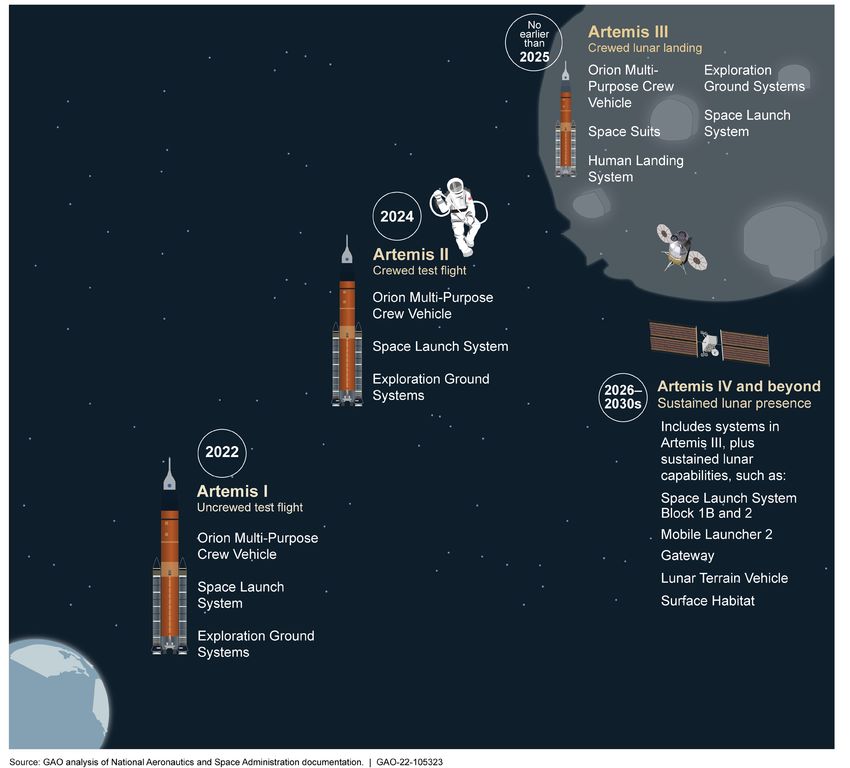
known as Artemis III, to no earlier than       Artemis Missions and the Number of Programs Needed for Each Mission
2025. Artemis III is one in a planned
series of missions to eventually
establish a sustainable lunar presence
and a path to Mars over the next
decade-plus. Successfully executing
these missions requires extensive
coordination across several NASA
programs and with a wide range of
contractors to ensure systems operate
together seamlessly and safely.
A House report to an appropriations bill
included a provision for GAO to review
NASA's proposed lunar-focused
programs. This report assesses the
extent to which NASA (1) is managing           To do this, NASA will need to develop, acquire, and integrate a number of new
mission integration risks; (2) developed       systems. NASA has made progress on integration and risk management for the
Artemis mission-level schedules; and           first lunar landing mission, Artemis III. For example, NASA established
(3) assessed the ability of the Artemis        integration processes, roles, and responsibilities, and recently took additional
workforce to manage and oversee                steps to manage risks for the series of missions.
lunar landing missions.
                                               NASA, however, does not yet have guidance for creating or managing Artemis
GAO reviewed relevant NASA                     mission schedules that will help integrate the individual programs required for
documents, schedules, and plans and            launch. NASA is using existing schedule management guidance developed for
interviewed NASA headquarters and
                                               individual programs, not multi-program missions. Without guidance specifically
center officials.
                                               for multi-program missions, NASA lacks reasonable assurance it has consistent
What GAO Recommends                            schedule management practices in place for the Artemis schedules. Schedule
                                               management guidance would also assist coordination, which will be increasingly
GAO is making four recommendations,            necessary as the Artemis missions will involve more programs over time and
including that NASA develop Artemis            therefore become more complex.
mission-level schedule management
guidance and develop guidance on               NASA conducts workforce planning through the programs that comprise the
conducting Artemis workforce scenario          Artemis missions across the next 5 budget years. NASA faces uncertainties
planning. NASA concurred with all four         beyond that horizon that have hindered longer-term planning. However, NASA is
of the recommendations.                        committing billions of dollars in development and production contracts for future
                                               Artemis missions that extend into the 2030s. This will require an extensive
                                               workforce to execute. Prior GAO work found that other agencies facing
                                               uncertainty assessed a range of future options, known as scenario planning,
                                               which provided flexibility to determine future workforce needs. In May 2022,
                                               NASA officials said they were examining the use of scenario planning to help
View GAO-22-105323. For more information,      future workforce planning efforts. But they have not yet completed or
contact William Russell at (202) 512-4841 or   implemented guidance to do so. As NASA begins to execute the first of many
RussellW@gao.gov.                              Artemis missions, it has the opportunity to use scenario planning to inform future
                                               workforce environments it may face and address broader workforce challenges.
                                                                                         United States Government Accountability Office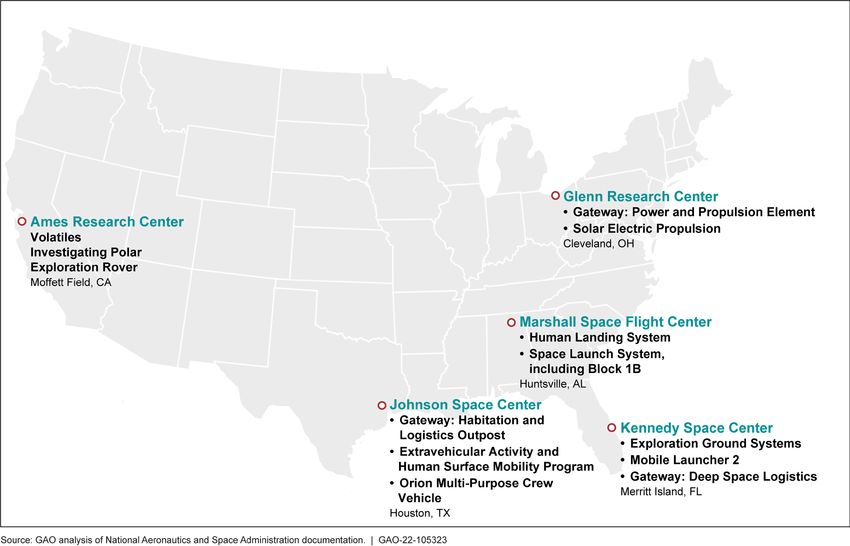
Contents

Letter                                                                                1
               Background                                                             3
               Artemis Mission Integration and Risk Management Plans Have
                 Progressed                                                         11
               Lack of Mission-Level Guidance Affects Artemis Schedules and
                 Hampers Planning                                                   16
               NASA’s Workforce Planning Does Not Assess Long-term Artemis
                 Needs                                                              23
               Conclusions                                                          31
               Recommendations for Executive Action                                 31
               Agency Comments and Our Evaluation                                   32

Appendix I     Programs, Projects, and Key Partners
               Supporting Artemis Missions                                          33

Appendix II    Results of GAO’s Assessment of Artemis II
               Schedule against Key Scheduling Best Practices                       36

Appendix III   National Aeronautics and Space Administration Comments               38

Appendix IV    GAO Contact and Staff Acknowledgments                                42

Tables
               Table 1: Status of Selected Advanced Exploration Systems (AES)
                       Governance, Mission Integration, and Risk Management
                       Documents for Artemis III and Beyond                         12
               Table 2: Programs and Key Partners Supporting Artemis Missions       33
               Table 3: Results of GAO’s Assessment of Artemis II Schedule
                       against Key Scheduling Best Practices                        36

Figures
               Figure 1: Artemis Missions and the Programs Needed to
                        Accomplish Each Mission                                       5

               Page i                                  GAO-22-105323 NASA Lunar Programs
Figure 2: Generic NASA Mission Directorate Organization and
         Reporting Structure                                            7
Figure 3: Artemis Missions I through III Delays since GAO’s May
         2021 Lunar Programs Report                                     9
Figure 4: Exploration Systems Development Division’s Artemis II
         Schedule Creation Process                                    18
Figure 5: Advanced Exploration Systems Division’s Artemis III
         Schedule Creation Process                                    21
Figure 6: National Aeronautics and Space Administration Centers
         and the Artemis Programs They Manage                         24

Page ii                                  GAO-22-105323 NASA Lunar Programs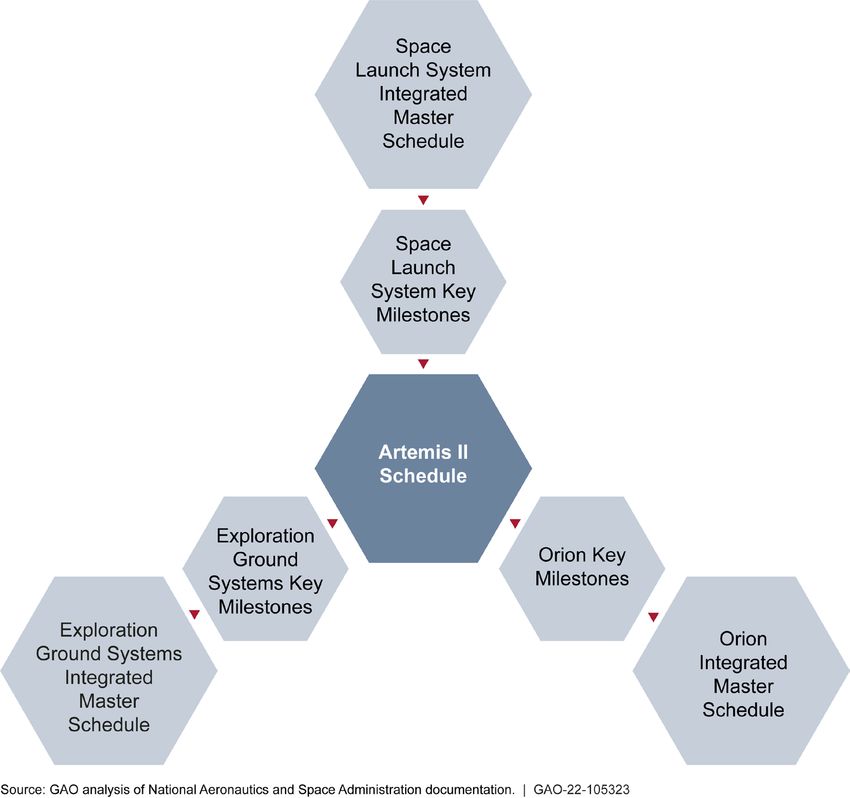
Abbreviations

AES               Advanced Exploration Systems
ASAP              Aerospace Safety Advisory Panel
ESD               Exploration Systems Development
EGS               Exploration Ground Systems
HALO              Habitation and Logistics Outpost
HEOMD             Human Exploration and Operations Mission Directorate
HLS               Human Landing System
IMS               integrated master schedule
NASA              National Aeronautics and Space Administration
OCHCO             Office of the Chief Human Capital Officer
OCFO              Office of the Chief Financial Officer
OPM               U.S. Office of Personnel Management
Orion             Orion Multi-Purpose Crew Vehicle
PPBE              Planning, Programming, Budgeting, and Execution
PPE               Power and Propulsion Element
SLS               Space Launch System
SpaceX            Space Exploration Technologies Corporation
SRA               schedule risk analysis
VIPER             Volatiles Investigating Polar Exploration Rover

This is a work of the U.S. government and is not subject to copyright protection in the
United States. The published product may be reproduced and distributed in its entirety
without further permission from GAO. However, because this work may contain
copyrighted images or other material, permission from the copyright holder may be
necessary if you wish to reproduce this material separately.

Page iii                                             GAO-22-105323 NASA Lunar Programs

Letter

441 G St. N.W.
Washington, DC 20548

                       September 8, 2022

                       The Honorable Jeanne Shaheen
                       Chair
                       The Honorable Jerry Moran
                       Ranking Member
                       Subcommittee on Commerce, Justice, Science, and Related Agencies
                       Committee on Appropriations
                       United States Senate

                       The Honorable Eddie Bernice Johnson
                       Chairwoman
                       Committee on Science, Space, and Technology
                       House of Representatives

                       The Honorable Matt Cartwright
                       Chairman
                       The Honorable Robert B. Aderholt
                       Ranking Member
                       Subcommittee on Commerce, Justice, Science, and Related Agencies
                       Committee on Appropriations
                       House of Representatives

                       The National Aeronautics and Space Administration (NASA) plans to
                       return astronauts to the moon, build a sustainable lunar presence over
                       the next decade, and ultimately travel to Mars. To accomplish these
                       goals, NASA plans to partner with industry to execute a series of missions
                       known collectively as Artemis. Each Artemis mission is comprised of
                       multiple, integrated programs. The first and second Artemis missions will
                       serve as demonstrations of the Space Launch System (SLS) launch
                       vehicle, Orion Multi-Purpose Crew Vehicle (Orion), and associated
                       ground systems known as Exploration Ground Systems (EGS).

                       Artemis III—which NASA estimates will occur no earlier than 2025—and
                       later missions will rely on new programs to develop systems needed to
                       land astronauts on the moon, including a Human Landing System (HLS)
                       to transport crew to and from the lunar surface and space suits for lunar
                       surface operations. For the Artemis IV mission and beyond, NASA is also
                       developing a lunar orbiting outpost known as Gateway to act as a habitat
                       and safe work environment for astronauts and as a communications relay
                       between the lunar surface and the Earth. Gateway will help support

                       Page 1                                     GAO-22-105323 NASA Lunar Programs
NASA’s longer-term lunar exploration goals to create a sustained
presence on the moon.

In the fiscal year 2023 President’s budget request, NASA requested
almost $35 billion over the next 5 years to support Artemis missions.
Successfully executing these missions requires extensive coordination
across several NASA programs and with a wide range of contractors to
address the risks inherent in integrating multiple systems to ensure they
operate together seamlessly and safely. In addition, NASA will need to
ensure that the lunar programs, once in operation, will be safe for the
crew and can operate in a challenging deep space environment.

The House Report accompanying H.R. 4505, Commerce, Science,
Justice, and Related Agencies Appropriations Bill, 2022 included a
provision for GAO to review NASA’s lunar-focused programs. This report
assesses the extent to which NASA has (1) managed integration risks for
the Artemis III mission; (2) developed mission-level schedules to inform
planning for Artemis; and (3) assessed the ability of the Artemis workforce
to manage and oversee missions. This is our third report on NASA’s
Artemis enterprise. 1

To assess the extent to which NASA managed integration risks for the
Artemis III mission, we reviewed the risk management plan, concept of
operations document, Systems Engineering Management plan, and
charter documents for the various control boards that oversee Artemis
missions. 2 We also reviewed Artemis risk review briefing documents to
determine the extent to which officials identified mission level risks and
how they are coordinated and managed. We interviewed NASA officials
to determine the status of establishing key roles and responsibilities and
developing internal processes and products to manage cross-program
and mission-level risks.

1GAO,  NASA Lunar Programs: Significant Work Remains, Underscoring Challenges to
Achieving Moon Landing in 2024, GAO-21-330 (Washington, D.C.: May 26, 2021); and
NASA Lunar Programs: Opportunities Exist to Strengthen Analyses and Plans for Moon
Landing, GAO-20-68 (Washington, D.C.: Dec. 19, 2019).
2NASA    defines risk as an uncertain future event that could threaten the achievement of
explicitly established and stated performance objectives/requirements related to safety,
mission success, cost and schedule. NASA, Advanced Exploration Systems Risk
Management Plan (Oct. 19, 2021).

Page 2                                               GAO-22-105323 NASA Lunar Programs
To assess the extent to which NASA has developed Artemis mission-level
                         schedules and used them to inform planning, we reviewed Artemis II
                         mission and Orion program schedule data and schedule management
                         plans. Specifically, we assessed how NASA integrated program and
                         mission-level schedules. We analyzed the Artemis II mission-level
                         schedule to determine the extent to which NASA followed applicable GAO
                         scheduling best practices. 3 To assess the extent to which NASA
                         developed an Artemis III schedule, we interviewed officials about
                         progress made and reviewed a draft schedule management plan. We
                         also interviewed NASA officials to determine how they develop and use
                         mission-level schedules.

                         To assess the ability of the Artemis workforce to manage and oversee
                         lunar landing missions, we reviewed NASA center workforce plans, and
                         interviewed human capital, Artemis management, and center officials. We
                         also determined the extent to which NASA has assessed its Artemis
                         workforce, including the extent to which skills gaps exist, by comparing
                         NASA’s process and documentation against NASA policy and guidance
                         and relevant principles for strategic workforce planning that we previously
                         identified. 4

                         We conducted this performance audit from June 2021 to September 2022
                         in accordance with generally accepted government auditing standards.
                         Those standards require that we plan and perform the audit to obtain
                         sufficient, appropriate evidence to provide a reasonable basis for our
                         findings and conclusions based on our audit objectives. We believe that
                         the evidence obtained provides a reasonable basis for our findings and
                         conclusions based on our audit objectives.

Background
Key Elements of NASA’s   The goal of NASA’s Artemis enterprise is to return U.S. astronauts to the
Planned Return to the    surface of the moon, including a sustained lunar presence and ultimately
                         human exploration of Mars. To do so, NASA programs are developing
Moon
                         multiple highly complex and interdependent systems that will need to be

                         3GAO,GAO Schedule Assessment Guide: Best Practices for Project Schedules,
                         GAO-16-89G (Washington D.C.: Dec. 22, 2015).
                         4GAO,Human Capital: Key Principles for Effective Strategic Workforce Planning,
                         GAO-04-39 (Washington, D.C.: Dec. 11, 2003).

                         Page 3                                            GAO-22-105323 NASA Lunar Programs
integrated to support individual Artemis missions. 5 The Artemis I and II missions are the first planned uncrewed and crewed demonstration missions, respectively, of the SLS, Orion, and EGS programs. In addition to SLS, Orion, and EGS, NASA’s Artemis III mission incorporates new programs, which are developing space suits and a landing system to put humans on the surface of the moon. See figure 1 for programs needed to accomplish the Artemis missions. 5NASA distinguishes between programs and projects in its policies and guidance. A NASA program has a dedicated funding profile and defined management structure, and may include several projects. Projects are specific investments under a program that have defined requirements, life-cycle costs, schedules, and their own management structure. For the purposes of this report, we refer to both programs and projects as programs. Page 4 GAO-22-105323 NASA Lunar Programs
Figure 1: Artemis Missions and the Programs Needed to Accomplish Each Mission

                                       Page 5                                   GAO-22-105323 NASA Lunar Programs
In March 2022, we found that the success of this complex series of
missions depends on NASA successfully managing and integrating the
individual programs. 6 See appendix I for more information on the
programs that comprise the Artemis missions and the contractors and
international partners that support them.
NASA’s Artemis Mission In September 2021, NASA announced plans to reorganize its Human
Management Organization Exploration and Operations Mission Directorate (HEOMD). HEOMD was
previously responsible for managing programs to enable human
exploration of the solar system, including to the moon and eventually
Mars. Within HEOMD, two divisions were primarily responsible for
overseeing the programs necessary for Artemis missions—Exploration
Systems Development (ESD) and Advanced Exploration Systems (AES).
ESD was responsible for managing the Artemis I and II missions and the
individual SLS, Orion, and EGS programs. AES was responsible for
managing Artemis III and beyond. The reorganization split HEOMD into
two new directorates, with one focused on existing space operations and
the other focused on exploration systems for the Artemis missions. The
newly formed Exploration Systems Development Mission Directorate
oversees the Common Exploration Systems Development Division
(formerly ESD) as well as the Artemis Campaign Development Division
(formerly AES). Since the majority of our audit work was conducted prior
to the reorganization, we will refer to groups by their previous names.
In April 2022, NASA finalized the plans for the reorganization. Officials
explained that NASA’s reorganization of its human spaceflight mission
directorate is intended to result in lunar programs sharing people and
resources across the agency. Under the reorganization, the general
mission directorate management structure remains the same (see fig. 2).
6GAO,NASA Lunar Programs: Moon Landing Plans are Advancing but Challenges
Remain, GAO-22-105533 (Washington, D.C.: Mar. 1, 2022).
Page 6 GAO-22-105323 NASA Lunar ProgramsFigure 2: Generic NASA Mission Directorate Organization and Reporting Structure
In addition to the mission directorate and division management, the
programs supporting Artemis missions are spread across various NASA
centers. Center directors are responsible for providing and obtaining
resources, overseeing the assignment of workforce and facilities, and
managing center operations to facilitate program execution. According to
NASA policy, the key role of the center director is to determine how best
to execute the various programs at the center while balancing resources
across mission directorate needs in accordance with agency priorities. 7
Prior GAO Reports on Over the past 8 years, we issued two reports assessing the progress of
Artemis Missions and NASA’s Artemis efforts, as well as several other reports on the programs
that support the Artemis missions. 8 For example, in December 2019, we
Programs
found that NASA had refocused its acquisition plans to support an
accelerated plan to land astronauts on the moon by 2024, 4 years earlier
than planned. 9 In that same report, we found that NASA had begun
7NASA, The NASA Organization with Change 85, NASA Policy Directive 1000.3E (Apr.
15, 2015).
8GAO-21-330; NASA Human Space Exploration: Significant Investments in Future
Capabilities Require Strengthened Management Oversight, GAO-21-105 (Washington,
D.C.: Dec. 15, 2020); GAO-20-68; NASA Human Space Exploration: Persistent Delays
and Cost Growth Reinforce Concerns over Management of Programs, GAO-19-377
(Washington, D.C.: June 19, 2019); NASA Human Space Exploration: Integration
Approach Presents Challenges to Oversight and Independence, GAO-18-28 (Washington,
D.C.: Oct.19, 2017); and GAO, Space Launch System: Resources Need to be Matched to
Requirements to Decrease Risk and Support Long Term Affordability, GAO-14-631
(Washington, D.C.: July 23, 2014).
9GAO-20-68.
Page 7 GAO-22-105323 NASA Lunar Programsmaking decisions related to requirements, cost, and schedule for programs but was behind in taking these steps for the whole lunar mission. We found that NASA risked discovering integration challenges late in the development process because it established some requirements for individual lunar programs before finalizing requirements for the overall lunar mission. At the time of that report, we found that NASA planned to take steps to mitigate this risk by holding reviews to ensure that requirements aligned across programs. We made six recommendations to NASA, including to (1) create a cost estimate for the Artemis III mission and commit to a completion date, and (2) finalize a cohesive document outlining the rationale for selecting its lunar plans. NASA concurred with all six of the recommendations, and to date has implemented the recommendation to define and schedule reviews that align requirements across lunar programs. In May 2021, we found that NASA had made progress in achieving its goal of returning humans to the moon but the ambitious schedule decreased the likelihood of NASA achieving its goal. 10 We made four recommendations in the 2021 report, including that NASA should document the process for determining key programmatic and technical tools for the Artemis missions. NASA concurred with three of the recommendations, but did not concur with the fourth, which related to the costs included in a lunar rover’s cost estimate. Since our May 2021 report, NASA delayed Artemis mission time frames and key program milestones several times. For example, most recently, NASA experienced technical challenges in attempting to fuel the Artemis I launch vehicle during the final test prior to launch. Addressing these challenges will further delay the launch until at least September 2022, almost 4 years past the original November 2018 launch date. Delays to the Artemis I launch have a cascading effect on the Artemis II and III mission schedules because there is a minimum time needed between those missions. NASA also delayed the Artemis II mission to May 2024, 13 months past the original April 2023 launch date, as a result of revising the Orion program’s schedule. Figure 3 illustrates recent Artemis mission delays. 10GAO-21-330. Page 8 GAO-22-105323 NASA Lunar Programs
Figure 3: Artemis Missions I through III Delays since GAO’s May 2021 Lunar Programs Report

                                        Note: Due to delays with Artemis I, the minimum time between missions now exceeds the planned
                                        Artemis II launch date.

                                        In November 2021, NASA announced that it was no longer working to its
                                        goal of an Artemis III lunar landing in 2024 and that the new date would
                                        be no earlier than 2025. NASA officials attributed this change to a 7-
                                        month delay in working on the lunar lander, subsequent to a bid protest
                                        and federal court complaint regarding the award of the lander’s contract.
                                        In announcing the delay, senior NASA officials acknowledged that the
                                        prior 2024 goal was unrealistic. Although NASA has made progress on
                                        the Artemis III mission, in March 2022, we found NASA faced a number of
                                        challenges to its schedule. 11

                                        11GAO-22-105533.

                                        Page 9                                                  GAO-22-105323 NASA Lunar Programs
NASA Efforts on Strategic NASA established a strategic workforce planning policy and issues
Workforce Planning guidance to its centers annually to assist in planning its workforce. 12 In
January 2016, NASA assessed its strategic workforce planning efforts
and found that its strategic workforce planning capability was not effective
and posed a high risk to the agency. 13 Specifically, centers were
independently trying to assess future needs with minimal guidance from
the mission directorate, and there was minimal to no integration across
other centers.
As a result, in June 2016, NASA developed a plan to address and
implement actions to help strategic workforce planning efforts. The plan
outlined an approach for centers to each create a workforce master plan
covering a 5- to 20-year future horizon reflecting a top-down look at key
changes necessary to maintain the health and alignment of the workforce.
NASA intended for these actions to reflect the work demand for near-term
as well as long-term needs. In 2018 and 2019, NASA took steps to
implement some of the items it identified in its 2016 plan. For example,
NASA piloted Center Workforce Master Plans and subsequently worked
with all centers to develop them.
In December 2019, NASA issued a memo titled NASA’s Strategic
Workforce Planning Guidance for Mission Workforce. 14 The memo
established guiding principles for NASA workforce planning such as
developing a demand-driven, agile, and strategically shaped workforce.
NASA also established workforce requirements to reduce the permanent
civil service workforce between fiscal years 2021 and 2025 and leverage
more term-limited employees.
12NASA, Strategic Workforce Planning, NASA Policy Directive (NPD) 3010.1B (Feb. 11,
2022).
13NASA, Mission Support Council Decision Package, Business Services Assessment
Human Capital Recommendations, MSC-2015-01-001b (January 22, 2016). NASA
defines a strategic workforce plan as an integrated, agency-wide multi-year workforce
transformation plan that integrates both horizontally across centers, mission directorates,
and capability managers, and vertically from the agency level down to the individual
employee, all in strategic alignment with current and future mission priorities.
14NASA, NASA Strategic Workforce Planning Guidance for Mission Workforce (Dec. 16,
2019). The memo called for detailed guidance to be included in NASA’s Office of the Chief
Human Capital Office’s Planning, Programming, Budgeting, and Execution (PPBE)
strategic workforce planning guidance for fiscal year 2022.
Page 10 GAO-22-105323 NASA Lunar ProgramsIn May 2022, NASA issued a memo on improving the workforce
forecasting and the strategic planning process for the mission
workforce. 15 Among other things, the memo established goals for process
and planning improvements for forecasting workforce demand and
strategic workforce planning. The memo directed mission directorates to
issue workforce planning guidance for the near term—the next 1 to 5
years—and the long term—5 years and beyond. Included in this
requirement, the memo directed mission directorates to draft and share
this guidance by fall 2022 with the intent for annual updates.
NASA continues to make progress on its integration and risk
Artemis Mission management plans for the first crewed lunar landing mission, Artemis III.
Integration and Risk For example, the AES division held the first in a series of planned reviews
to align requirements for Artemis III and later missions and issued several
Management Plans key requirements and governance documents. NASA also established
Have Progressed integration processes, roles, and responsibilities for Artemis III, and
matured its processes for managing risks for the overall series of Artemis
missions. Previously, AES primarily used a bottom-up approach to risk
management; however, it has recently taken steps to increase focused
and defined management attention to help ensure that mission risks are
captured in a timely manner.
NASA Has Made Progress Since we last reported in May 2021, the AES division—responsible for the
Establishing Artemis III Artemis III mission and beyond—held its first synchronization review in
September 2021, which accomplished several important objectives
Integration Processes,
related to integration and ensuring requirements are aligned across
Products, and Roles and program and mission levels. 16 For example, the review confirmed that
Responsibilities Artemis mission products, processes, and organizational responsibilities
were defined; systems were properly integrated as part of the overall
architecture; and integrated technical and programmatic risks, mitigation
plans, and resources were identified. The review focused primarily on the
Artemis III mission, but also supported mission planning for later Artemis
missions.
During the synchronization review, NASA officials also reviewed whether
the technical baseline was sufficiently mature and requirements were
aligned across the human exploration and operations mission directorate,
AES division, and individual Artemis programs. For example, the division
15NASA, Improving PPBE/Workforce Forecasting and the Strategic Planning Process for
Mission Workforce (Washington, D.C.: May 26, 2022).
16GAO-21-330.
Page 11 GAO-22-105323 NASA Lunar Programscompared its communications requirements, among other identified
priority areas, against mission directorate-level requirements to ensure
they aligned. The division identified additional analysis in several areas
that was needed to ensure that all requirements are easily
understandable and verifiable. For example, the review identified that
additional requirements related to extravehicular activities and mass
limitations need to be verified, among others. This is significant because,
as we reported in December 2019, NASA faced a potential for
requirements gaps due to having to reconcile requirements among
multiple organizational levels. 17 Further, we reported in May 2021 that late
discovery of such gaps could contribute to cost or schedule growth. 18 As
we reported, NASA officials acknowledged this risk, and planned to hold
periodic synchronization reviews to help mitigate it. According to an
agency official, the AES division plans to hold these reviews
approximately annually.
As part of the synchronization review process, the AES division
additionally issued several documents that together define the division’s
governance structure, integration processes, and risk management
strategy for Artemis missions. Other relevant documents are currently in
draft form, and according to officials, nearing completion (see table 1).
Table 1: Status of Selected Advanced Exploration Systems (AES) Governance, Mission Integration, and Risk Management
Documents for Artemis III and Beyond
Document Description Date Issued
AES Lunar Exploration Establishes the requirements baseline for the systems that AES manages, such as July 2021
Requirements the Human Landing System and the Gateway.
AES Integrated Concept Specifies a framework for requirements, to provide operational context to the September 2021
of Operations programs and supporting organizations that will enable Artemis Ill and subsequent
missions. With the Division Requirements Document, this concept of operations
provides programs with the information required to identify system requirements
and interfaces with other programs and support organizations, and perform
systems analyses to create integrated program requirements.
Systems Engineering Describes systems engineering and integration roles and responsibilities, September 2021
Management Plan describes framework for integration of AES programs, and addresses integration
with Exploration Systems Development programs.
17GAO-20-68.
18GAO-21-330.
Page 12 GAO-22-105323 NASA Lunar ProgramsDocument Description Date Issued
AES Risk Management Provides a systematic process for identifying, analyzing, and handling risks, while October 2021
Plan considering cost, schedule, performance, and safety concerns; describes
horizontal and vertical risk communication processes; provides roles and
responsibilities of personnel involved in risk management; and establishes the risk
database tool used to document and communicate risks
AES Control Board Establishes the AES Control Board and defines the board’s responsibility, January 2022
Charter / Joint AES / authority, functions, and membership. This charter also establishes the Joint AES
Exploration Systems Control Board / Exploration Systems Development Control Board.
Development Control
Board Charter
Verification and Expected to identify the activities that will establish compliance with the Draft - TBD
Validation Plan requirements (verification) and that the system will meet the customers’
expectations (validation).
Implementation Plan Expected to describe (1) division roles and responsibilities, (2) responsibility for Draft - TBD
systems integration activities required to integrate elements for Artemis III from
agency components and external stakeholders, (3) tailoring of entrance and
success criteria for technical reviews, and (4) the governance structure for
approving and overseeing programmatic and technical baselines, among other
information
Source: GAO analysis of National Aeronautics and Space Administration documentation. | GAO-22-105323
AES has generally established risk management roles and
responsibilities for Artemis III and later missions, including how AES
leadership will collaborate with its counterparts in ESD on risks that affect
programs in both divisions. According to AES officials, their Artemis roles
and responsibilities are similar to those established previously for the
ESD division, and officials from the two divisions frequently collaborate
with each other. For example, the divisions each have risk manager
positions that work in parallel with each other. The division risk managers
each chair Integrated Risk Working Groups that examine risks from
respective Artemis programs, and they attend each other’s group
meetings.
In addition, AES finalized a written charter for its AES Joint Integration
Control Board in December 2021. This board manages cross-program
integration for the AES division and serves as an additional forum to
discuss, integrate, and elevate risks to higher levels of agency
management, as it deems appropriate. ESD also has a control board that
performs similar functions. In addition, the AES/ESD Joint Integration
Control Board is used when decision-making affects programs in more
than one division. The divisions elevate decisions and risks to the mission
directorate level as needed, where ultimate decision authority resides.
Page 13 GAO-22-105323 NASA Lunar ProgramsNASA Is Maturing its NASA established several mechanisms for identifying and tracking
Processes for Identifying Artemis III risks and has begun implementing them. For example:
and Managing Artemis III • Risk Database: AES and ESD division leadership each use the same
Mission Risks risk management database, which serves as a repository for risk
information across the divisions. According to officials, the individual
programs that the divisions each manage input risk information into
this database. In addition, risks from external parties, such as
international partners and contractors, are manually added and
updated. Officials stated that these external parties typically have their
own risk management systems. However, if an external party risk
becomes significant enough to escalate or if it has multiple programs
as stakeholders, the respective program will add it to the database so
that it is accessible to all the relevant parties.
• Risk Scorecard: AES officials said that the division recently
developed a similar risk scorecard to that previously in use by ESD to
score the likelihood and potential consequences of risks. An AES
official noted that they made some conscious decisions to deviate
slightly from ESD’s scorecard. For example, ESD’s scorecard is
broken out in more detail for risks with lower–rated consequences to
certain requirements, whereas AES’s scorecard is more detailed for
risks that have higher-rated consequences. Officials also said that
individual programs within the divisions are generally expected to use
the scorecard for their respective division. Organizations that had
already developed risk criteria before the division scorecard was in
use are allowed to continue using their own scorecard for internal
risks, but are required to rescore risks according to the AES scorecard
when they become significant enough to escalate or if they have
multiple programs as stakeholders.
• Risk Reviews: AES holds Cross-Program Risk Reviews informed by
the integrated risk working groups discussed above. These reviews
examine cross-program risks, or those risks that have implications for
more than one Artemis program. These could include risks to Artemis
III that are owned by ESD or an external party. A cross-program risk
could highlight similar issues in multiple programs, which may indicate
important trends or the need for a system-wide risk mitigation solution
instead of a program-owned solution. Additionally, the AES division
holds an AES Top Risk Review to discuss the status of top program
and division risks, proposals to escalate a risk from program-level to
division-level, and proposals to de-escalate a top division risk to a
lower level, as well as other risk-related topics, as needed. The AES
division began using formal risk reviews to review top risks in
February 2020. In December 2021, the risk review was renamed to
Page 14 GAO-22-105323 NASA Lunar ProgramsArtemis Top Risk Review and is used to review Artemis III and later
mission risks. For example, the review documentation includes
several program-level risks specifically related to the Human Landing
System, which will first be used on Artemis III. Such risks include the
integration of hardware and software and potential mass concerns,
among others.
NASA’s approach for Artemis III risk management has primarily been
bottom-up, meaning that individual programs are responsible for elevating
risks to the divisions and, in turn, divisions are responsible for elevating
risks to the mission directorate level. Officials said risk identification often
occurs at the program level because that is where it usually becomes
apparent that a requirement or objective may not be met. From there, the
risk is communicated horizontally and vertically to affected stakeholders.
During the course of our review, in January 2022, we found that NASA’s
risk management plans did not have a formal top–down process to
identify risk. Without focused and defined management attention, NASA
could have missed identifying potential aggregated risks that could affect
the success of a particular mission. NASA’s risk management policy
notes the importance of ensuring that risks are coordinated both
horizontally and vertically, as well as across and within programs and
institutions. 19 It states that a risk management plan should include
establishing risk communication protocols between management levels,
including the frequency and content of reporting. The policy also notes
that for some purposes, it is not adequate to consider a list of risks, but
rather it is necessary to consider risks in the aggregate.
Officials told us that it had been their practice at risk reviews and other
forums to purposefully ask management to give concerted thought to
aggregation of risks and consider what risks might be missing. However,
this process was not a formal part of the agenda at such sessions. In
response to our discussions, in June 2022, officials reported that they
added a top-down review of risks to the recurring agenda for the AES Top
Program Risk Review to ensure a level of focused management attention.
According to NASA officials, this action was intended to ensure regular
discussions as to whether the top identified risks adequately convey risk
posture, what additional risks need to be created in order to encompass
the most significant challenges, and whether certain risks should be
consolidated or if parent risks should be created. Formally establishing a
19NASA, Agency Risk Management Procedural Requirements, NASA Procedural
Requirements (NPR) 8000.4B (Dec. 6, 2017).
Page 15 GAO-22-105323 NASA Lunar Programsprocess for management review and consideration of potential new risks
is a positive step because it will help ensure regular, focused
management attention to the identification of risks that could affect
mission success.
NASA does not yet have agency-wide, mission-level schedule
Lack of Mission-Level management guidance to inform realistic integration schedules and
Guidance Affects launch dates for Artemis missions, which NASA plans to conduct into the
2030s. Currently, NASA is using parts of its existing program-level
Artemis Schedules schedule management guidance to develop schedules for these Artemis
and Hampers missions. Further, while the agency developed an Artemis II mission-level
schedule, it has not yet conducted an Artemis II schedule risk analysis
Planning (SRA). An SRA is an important tool that could help NASA to identify a
realistic risk-informed launch date. NASA also has not yet developed a
mission-level schedule for the Artemis III mission, but plans to develop
one by the end of 2022, approximately 2 years from the mission’s earliest
planned launch.
NASA Does Not Have NASA does not have agency-wide schedule management guidance
Agency-wide Guidance for specific to creating or managing multi-program mission-level schedules,
such as those needed for Artemis missions. Existing schedule
Developing and Managing
management guidance, such as the Office of the Chief Financial Officer’s
Mission-level Schedules (OCFO) NASA Schedule Management Handbook, applies to programs
and does not specify its applicability to mission-level schedules. OCFO
officials noted that examples in the handbook may have some
applicability for mission-level schedules, which are composed of multiple
program schedules. However, without documenting mission-level
schedule expectations in guidance, NASA lacks reasonable assurance it
has consistent schedule management practices in place for the Artemis
schedules.
Further, without mission-level schedule management guidance, there
may not be the same level of schedule development oversight and
management for missions as there is for programs. For example, a
program’s independent assessment team typically evaluates schedule
best practices at key decision point reviews. However, because NASA
does not manage Artemis as a program, Artemis missions do not have
key decision point reviews or the same dedicated independent review
process for schedules. Similarly, NASA’s Schedule Management
Handbook ties best practices to program life cycles and key decision
points to guide when and where to apply best practices, but Artemis
missions do not follow the same life cycle process as programs. As a
Page 16 GAO-22-105323 NASA Lunar Programsresult, the process of creating a mission-level schedule that follows
similar best practices to program schedules is not consistent.
We found differences between the divisions’ approaches to create and
maintain mission-level schedules due to a lack of mission-level schedule
management guidance. For example, schedulers from each program in
the ESD division update the Artemis II mission-level schedule, whereas
AES division officials collect each program’s schedule and extract key
information to make the Artemis III and beyond mission-level schedules.
Mission-level guidance could help standardize schedule management
across divisions, which will be increasingly important as the Artemis
missions involve more programs and become more complex over time.
Standards for Internal Control in the Federal Government states that
management should design control activities—such as policies and
procedures—to achieve objectives and respond to risks. 20 Further, these
standards state that management should implement control activities
through policies. NASA’s Schedule Management Handbook for programs
also states that consistent schedule guidance supports an efficient and
effective decision-making process and can help ensure NASA meets
internal and external stakeholder expectations. Mission-level schedule
management guidance could help set expectations and produce
consistent schedules for future Artemis missions, which NASA plans to
execute at least through 2030.
NASA Has Not Performed Without mission-level schedule management guidance, in July 2018, the
Key Schedule Risk ESD division created its own Schedule Management Plan, which outlined
a mission-level schedule creation process for Artemis II. According to
Analysis for Artemis II to
NASA’s Schedule Management Handbook, developing a schedule
Inform Realistic Launch management plan is not required but it is a best practice. Officials
Date explained that the division’s Schedule Management Plan draws on
existing NASA schedule guidance for programs. The Artemis II schedule
is a high-level summary schedule composed of key program milestones
and integration activities leading up to launch. A summary schedule rolls
up lower-level schedule information to provide a strategic view of
activities and milestones necessary to complete the mission. Each of the
three programs needed for the Artemis II mission has scheduling
personnel who update the mission-level schedule each month with key
20GAO, Standards for Internal Control in the Federal Government, GAO-14-704G
(Washington, D.C.: September 2014).
Page 17 GAO-22-105323 NASA Lunar Programsactivities from their integrated master schedules (IMS) (see fig. 4). 21 ESD requires that, at a minimum, programs report their top three critical paths in the mission-level schedule. 22 OCFO officials also told us there is no agency policy on what should be included in summary schedules, such as the Artemis II mission schedule. Figure 4: Exploration Systems Development Division’s Artemis II Schedule Creation Process 21An integrated master schedule is a schedule document that combines all planned work in a logical sequence of activities. 22The critical path is the longest continuous sequence of activities in a schedule and defines the earliest completion date. Page 18 GAO-22-105323 NASA Lunar Programs
After evaluating the quality of the Artemis II schedule, we found that it
generally followed the best practices for scheduling that we assessed it
against. 23 When we initially assessed vertical traceability—which ensures
data are consistent between different levels of a schedule—we were
unable to trace information between the Orion IMS and the Artemis II
schedule. Without vertical traceability between the two schedules,
different decision makers may be working toward different schedule
expectations. In response to our analysis of vertical traceability, NASA
added additional information to the Artemis II schedule. This improved the
ability to trace Orion key milestones to the Artemis II schedule, though
dates did not align. NASA officials explained that this is because
program-level schedule data may have a lag, but are input into the
Artemis II schedule to try to reflect the most current information. Appendix
II provides more information on our assessment of NASA’s schedule
against scheduling best practices.

Although NASA has an Artemis II schedule, the ESD division has not
conducted an SRA. An SRA is an analysis that uses statistical techniques
to predict the likelihood of a project’s completion date, or in this case, a
launch date. Using the Artemis II schedule, ESD officials said they plan to
conduct an initial SRA sometime in 2022 after Artemis I launches, but
they do not have a planned completion date. Conducting a high quality
SRA as close as possible after the Artemis I mission would give NASA a
more informed launch date for Artemis II—currently scheduled for May
2024—as it begins key integration activities.

The NASA Schedule Management Handbook states that programs
should conduct an SRA sometime between the program’s concept and
preliminary design and then update it as needed. Because there is no
mission-level schedule management guidance, missions are not bound to
the same timelines as programs for conducting an SRA. However, all
three programs required for Artemis II are past preliminary design.
Additionally, a lesson learned that NASA identified from the Artemis I
SRA was to build an SRA model early, even if it requires high-level
assumptions. The GAO Schedule Guide also states that in addition to
conducting an SRA, agencies should update it to incorporate new risks
and schedule updates. 24 Therefore, with less than 2 years until launch,

23GAO-16-89G.

24GAO-16-89G.

Page 19                                     GAO-22-105323 NASA Lunar Programs
ESD should have already completed an initial SRA and be updating it as
                           changes arise.

                           Comparatively, NASA completed an initial mission-level SRA for Artemis I
                           by 2018. Shortly after completing the SRA, NASA announced that the
                           December 2019 to June 2020 planned launch window was unlikely.
                           According to officials, ESD updated the Artemis I SRA multiple times to
                           incorporate major schedule changes such as programs rebaselining. After
                           conducting an SRA for Artemis I, NASA reported that the analysis
                           focused management attention on key areas, served as a catalyst for
                           more robust schedule analysis, and provided additional data and insight
                           into the way risks may affect multiple programs, among other things.

                           NASA is already underestimating risks to achieving the current Artemis II
                           launch date. Specifically, NASA estimates it will require about 27 months
                           between Artemis I and Artemis II due to Orion integration activities and
                           reuse of avionics from the Artemis I crew capsule on the Artemis II crew
                           capsule. Officials noted that the time between missions depends on the
                           amount of risk assumed. Since Artemis I is scheduled to launch in
                           September 2022, Artemis II cannot logistically happen before December
                           2024, 7 months beyond the planned May 2024 date. If NASA does not
                           conduct an Artemis II SRA based on a high-quality mission schedule,
                           NASA decision makers may not be able to identify the schedule risks
                           most likely to further delay the launch.

NASA Has Not Yet           The AES division—which is responsible for managing the Artemis III and
Completed a Schedule for   later missions—does not yet have a completed Artemis III mission-level
                           schedule. In lieu of mission-level guidance, the division is creating its own
Artemis III Mission, but
                           Schedule Management Plan that it expects to finalize by June 2022.
Plans to Do So             Officials said the schedule management plan will incorporate scheduling
                           processes from NASA’s Schedule Management Handbook since most of
                           its best practices apply to the Artemis schedule, and will outline the
                           division’s process for developing mission-level schedules and SRAs.

                           AES plans to extract key activities and critical path information from
                           individual program IMSs to develop a mission-level schedule for Artemis
                           III and beyond. This includes gathering schedule information from
                           programs managed by the ESD division as well (see fig. 5). The AES and
                           ESD divisions plan to collaborate on mission-level schedules and SRAs
                           for Artemis III and later missions.

                           Page 20                                      GAO-22-105323 NASA Lunar Programs
Figure 5: Advanced Exploration Systems Division’s Artemis III Schedule Creation Process
Page 21 GAO-22-105323 NASA Lunar ProgramsIn November 2021, AES officials indicated they have not yet developed an Artemis III schedule because they were waiting on schedule information for two programs: (1) HLS, which experienced delays after the resolution of a contract award bid protest and U.S. Federal Court complaint, and (2) Space Suits, which recently changed its acquisition strategy and was evaluating contractor proposals. 25 Officials reported they have since received the HLS schedule and Artemis III schedule development is underway. AES officials said the division plans to complete the schedule by September 2022 and update it monthly. This means NASA would create its Artemis III schedule a little over 2 years from its earliest planned launch date. After completing the Artemis III schedule, AES officials said the division plans to conduct an SRA and update it twice a year, or as needed. Officials said the SRA results will inform the likelihood and reasonableness of the Artemis III mission date planned for no earlier than 2025 as well as inform management decisions. Although AES and ESD reported working together closely and frequently, there is no division-level data sharing policy across the divisions for the Artemis III mission. AES officials said the division’s Schedule Management Plan—currently in draft—will provide guidance on data sharing. Additionally, while NASA typically requires programs, as part of the independent review process, to document internal partnerships, Artemis is not a program. 26 Our prior work found that articulating coordination agreements in formal documents can strengthen the commitment to work collaboratively. 27 Documenting schedule data sharing policies could also help bolster the quality of information for decision makers by assigning roles and responsibilities and establishing compatible policies for division-level data sharing. Conversely, a lack of guidance on how to coordinate data sharing, as groups at NASA become more interdependent, could affect the agency’s 25On June 1, 2022, NASA announced that it selected two contractors to design, develop, and deliver space suits for Artemis missions and the International Space Station. Space suits, also known as the Exploration Extravehicular Activity program, is part of NASA’s Extravehicular Activity and Human Surface Mobility Program. 26NASA, Standard Operating Procedure Instruction, SOPI 6.0, SRB Programmatic Assessment Process (May 23, 2017). Specifically, NASA’s standard operating procedure requires internal partners—partners between a project and other NASA Centers, research institutions, international partners, or other business arrangements not involving contracts or procurements—to document schedule reporting requirements in specified documents, such as a letter of agreement. 27GAO, Managing for Results: Key Considerations for Implementing Interagency Collaborative Mechanisms, GAO-12-1022 (Washington, D.C.: September 2012). Page 22 GAO-22-105323 NASA Lunar Programs
ability to effectively make decisions, communicate quality information, and
                            leverage previous investments.

                            NASA conducts workforce planning for the programs that comprise the
NASA’s Workforce            Artemis missions across the next 5 budget years. NASA, however, does
Planning Does Not           not conduct workforce planning past the 5 year budget horizon because,
                            according to officials we spoke with, it faces uncertainty that makes long-
Assess Long-term            term workforce planning challenging. At the same time, NASA is
Artemis Needs               committing billions of dollars in development and production contracts for
                            future Artemis missions that extend into the 2030s. This will require a
                            skilled, agile, and effective workforce to execute. The agency is also
                            undergoing broader changes, such as a large segment of its workforce
                            approaching retirement, which will affect Artemis missions. NASA has
                            identified long-term workforce planning as a goal since 2016 but has not
                            yet completed guidance.

NASA Workforce Planning     NASA centers capture Artemis mission workforce needs through the
Processes Broadly Include   annual budget request process and through annual center-developed
                            workforce plans. NASA’s Office of the Chief Human Capital Officer
Artemis Needs in the
                            (OCHCO) leads the workforce planning activities and analysis and
Near-term                   develops guidance with input from agency and mission directorate
                            leadership. During this process, mission directorates determine civil
                            service and contractor workforce demand, including the skills needed for
                            each center for a 5-year budget-planning horizon. This process supports
                            the proposed budget request to Congress.

                            Artemis missions are comprised of programs located across various
                            NASA centers (see fig. 6). Those centers conduct the workforce planning
                            that includes their respective Artemis programs.

                            Page 23                                     GAO-22-105323 NASA Lunar Programs
Figure 6: National Aeronautics and Space Administration Centers and the Artemis Programs They Manage
It is NASA policy to conduct workforce planning activities annually for a 5-
year budget horizon to ensure it has a workforce that is sufficiently agile
in size and mix and strategically shaped to provide the mix of skills to
meet the agency missions. 28 The mission directorates are responsible for
defining current and future work requirements for their respective areas
and anticipating the duration of those requirements. In turn, NASA center
directors are responsible for assigning workforce resources, including
personnel with the needed skills, to programs within the center to meet
the requirements set by the mission directorates.
28NASA, Strategic Workforce Planning, NASA Procedural Directive (NPD) 3010.B (Feb.
11, 2022).
Page 24 GAO-22-105323 NASA Lunar ProgramsIn 2019, NASA issued a memo on strategic workforce planning efforts to
guide the agency’s efforts to manage its workforce strategically to be
demand-driven, agile, and strategically shaped. According to the memo,
strategically planning its workforce will help NASA keep pace with
technological advances and a thriving aerospace industry as well as
manage increased reliance on commercial and academic partners. 29
Additionally, the centers recently began producing annual center
workforce plans, which are aligned with the budget request process.
These plans are intended to identify the current workforce makeup,
project future workforce requirements, and identify skills critical to
continued mission success. NASA’s February 2022 strategic workforce
planning policy further directs the centers to develop center workforce
plans to describe workforce planning activities over the next 5 fiscal years
and include an analysis of any workforce gaps the centers identify. 30
These center workforce plans broadly capture Artemis mission workforce
issues because they assess the programs that comprise the Artemis
missions.
NASA Does Not Conduct Officials we spoke to at the headquarters and center levels told us that
Workforce Planning they do not conduct workforce planning beyond a 5-year budget-planning
horizon. They identified several reasons for not doing so, including the
Beyond 5 Years into the
following:
Future, which Limits
Insight into Long-Term • Undefined mission requirements. Officials from two centers told us
Artemis Workforce Needs that the centers do not know mission directorate goals relative to
Artemis missions past the 5-year budget horizon, which hinders their
ability to conduct formal workforce planning. NASA’s fiscal year 2022
executive summary of center workforce plans found that a lack of
long-term demand data makes long-term workforce planning difficult.
One center director indicated that the agency’s tendency to focus on
the current year of budget execution plus 1 or 2 years restricts the
center’s ability to make hiring plans that align with mission
requirements that stretch across a longer time horizon. According to
officials, the specifics of the Artemis missions are needed to
determine the number and skillset of the required workforce. Center
officials from one center said that without insight into the specific
goals of a given Artemis mission and how programs plan to acquire
29NASA, NASA Strategic Workforce Planning Guidance for Mission Workforce (Dec. 16,
2019).
30NASA, Strategic Workforce Planning, NASA Procedural Directive (NPD) 3010.1B (Feb.
11, 2022).
Page 25 GAO-22-105323 NASA Lunar ProgramsYou can also read


