Northern Ireland Railways Network Statement 2019 - For Working Timetable December 2019 - December 2020
←
→
Page content transcription
If your browser does not render page correctly, please read the page content below
Northern Ireland Railways
Network Statement 2019
For Working Timetable
December 2019 - December 2020
01/04/2019
Northern Ireland Railways
             Infrastructure Manager
               Network Statement

  Northern Ireland Railways

Network Statement 2020
             for
     Working Timetable
December 2019 - December 2020

         Published: 1st April 2019
Northern Ireland Railways
Network Statement 2020
Northern Ireland Railways
Northern Ireland Railways Infrastructure Manager
Infrastructure Manager Network Statement
Network Statement
Table of Contents
Document Control 1 General Information .............................................................................................. 5
1.1 Introduction .................................................................................................................. 5
Revision Date Status Changes 1.2 Objective ...................................................................................................................... 5
1.0 01/04/2019 Published - 1.3 Legal Framework ......................................................................................................... 5
1.4 Legal Status ................................................................................................................. 6
1.5 Structure of Network Statement................................................................................... 7
1.6 Validity and Updating Process ..................................................................................... 7
1.7 Publishing .................................................................................................................... 7
1.8 Contacts....................................................................................................................... 8
1.9 Rail Freight Corridors................................................................................................... 8
1.10 RailNetEurope – International Cooperation Between Infrastructure Managers ........... 8
1.11 Definitions .................................................................................................................... 8
2 Access Conditions ................................................................................................ 9
2.1 Introduction .................................................................................................................. 9
2.2 General Access Requirements .................................................................................... 9
2.3 General Business/Commercial Conditions ................................................................ 10
2.4 Operational Rules ...................................................................................................... 11
2.5 Exceptional Transports .............................................................................................. 11
2.6 Dangerous Goods...................................................................................................... 11
2.7 Rolling Stock Acceptance Process Guidelines .......................................................... 11
2.8 Staff Acceptance Process.......................................................................................... 12
3 Infrastructure ....................................................................................................... 13
3.1 Introduction ................................................................................................................ 13
3.2 Extent of Network ...................................................................................................... 13
3.3 Network Description................................................................................................... 14
3.4 Traffic Restrictions ..................................................................................................... 16
3.5 Availability of the Infrastructure.................................................................................. 17
3.6 Service Facilities ........................................................................................................ 18
3.7 Infrastructure Development ....................................................................................... 20
4 Capacity Allocation ............................................................................................. 22
4.1 Introduction ................................................................................................................ 22
4.2 Description of Process ............................................................................................... 22
4.3 Schedule for Path Requests and Allocation Process ................................................ 22
4.4 Allocation Process ..................................................................................................... 23
4.5 Allocation of Capacity for Maintenance, Renewal and Enhancements ..................... 25
4.6 Non-Usage / Cancellation Rules................................................................................ 25
4.7 Exceptional Transports and Dangerous Goods ......................................................... 26
4.8 Special Measures to be taken in the Event of Disturbance ....................................... 26
4.9 Allocation of Capacity for Service Facilities ............................................................... 26
5 Services .............................................................................................................. 27
5.1 Introduction ................................................................................................................ 27
5.2 Minimum Access Package......................................................................................... 27
5.3 Track Access to Services Facilities and Supply of Services...................................... 27
5.4 Additional Services .................................................................................................... 29
5.5 Ancillary Services ...................................................................................................... 29
6 Charges .............................................................................................................. 31
6.1 Charging Principles.................................................................................................... 31
6.2 Charging System ....................................................................................................... 32
6.3 Tariffs ......................................................................................................................... 33
6.4 Performance Scheme ................................................................................................ 33
6.5 Non-Usage Charges .................................................................................................. 34
6.6 Changes to Charges .................................................................................................. 34
PAGE 2 PAGE 3
Page 3 of 46Northern Ireland Railways
Network Statement 2020
Northern Ireland Railways Northern Ireland Railways
Infrastructure Manager Infrastructure Manager
Network Statement Network Statement
6.7 Billing Arrangements.................................................................................................. 34 1 General Information
Appendices
Appendix 1 Glossary of Terms and Abbreviations 36 1.1 Introduction
Appendix 2 Overview Map of the Railway Network and main Nodes 37 Translink is Northern Ireland’s primary public transport provider and one of Northern
Ireland's largest employers with almost 4,000 employees and a turnover in excess of
Appendix 3 Details of Stations and Halts 38
£220m.
Appendix 4 Passenger Rolling Stock currently authorised for use 40
The Translink Group consists of a Public Non-Financial Corporation, the Northern
Appendix 5 Technical Facilities 41
Ireland Transport Holding Company (‘NITHC’) which owns and controls seven private
Appendix 6 Template for Track Access Agreements 42 limited subsidiary companies: Northern Ireland Railways Company Limited (‘NIR’);
Appendix 7 Template for Requests for Capacity 43 NIR Networks Limited; NIR Operations Limited; Citybus Limited (‘Metro’); Flexibus
Appendix 8 Template for Ad Hoc Requests 45 Limited; Ulsterbus Limited; and, Translink (NI) Limited.
Appendix 9 Environmental Restrictions 46 NITHC was established under the ‘Transport Act (Northern Ireland) 1967’. Under this
Act it is the duty of NIR to provide or secure the provision of railway services in
Northern Ireland with due regard to efficiency, economy and safety of operation.
NIR Networks Limited in conjunction with NIR act as Infrastructure Manager (IM).
The mainline railway network in Northern Ireland consists of approximately 300
route-km of railway including single and double-track, stations, halts, signalling and
telecoms systems, and structures such as bridges, cuttings, embankments, sea-
defences, tunnels and viaducts. The network supports approximately 15 million
passenger journeys each year.
1.2 Objective
The objective of this Network Statement is to supply potential Applicants with the
essential information needed to apply to gain access to, and to use the mainline
railway infrastructure in Northern Ireland.
This Network Statement has been produced in response to Regulation 13 of the
Railways Infrastructure (Access, Management and Licensing of Railway
Undertakings) Regulations (Northern Ireland) 2016 (SRNI 2016/420).
1.3 Legal Framework
The wider legal framework for the Northern Ireland rail sector is governed by a
range of legislation, some of which applies to both Great Britain and Northern
Ireland, and some which applies solely to Northern Ireland. Table 1 overleaf
summarises the main legislative documentation which is currently applicable.
(N.B. The following table is intended only to provide an overview and should not be
considered as a comprehensive list).
PAGE 4 PAGE 5Northern Ireland Railways
Network Statement 2020
Northern Ireland Railways Northern Ireland Railways
Infrastructure Manager Infrastructure Manager
Network Statement Network Statement
Term Topic Reference Applicable Legislation in NI Link no liability for loss or damage ensuing from apparent mistakes or printing errors
Primary Transport 1967 Chapter 37 Transport Act (Northern Ireland) Link to 1967/37 contained in this Network Statement.
Legislation 1967 The IM accepts no responsibility for information owned or supplied by Third Parties
Transport 2011 Chapter 11 Transport Act (Northern Ireland) Link to 2011/11 which may be referred to or utilised in the compilation of this Network Statement.
2011
Railway Safety 2002 Chapter 8 Railway Safety Act (Northern Link to 2002/8 1.4.3 Appeals Procedure
Ireland) 2002 In the event of an Applicant wishing to appeal against any action or decision taken by
Statutory Health and Safety SRNI-1978/1039 Health and Safety at Work Link to 1978/1039
the IM, including the content of this document, in the first instance, please refer to the
Instrument at work. as amended (Northern Ireland) Order 1978
Dispute Resolution Process (Capacity Allocation) (I-SYP-PRO-1805) via the following
Working Time SRNI-2008/315 The Cross-border Railway Link to 2008/1660
Services (Working Time) link: Link for Dispute Resolution Process. If the Applicant is not satisfied with the
Regulations (Northern Ireland) action or decision following this, please contact the ORR at
2008 track.access@orr.gsi.gov.uk. (See also SRNI 2016/420 Regulation 31).
First • Access SRNI-2016/420 The Railways Infrastructure Link to 2016/420
Railway • Management (Access, Management and 1.5 Structure of Network Statement
Package • Licensing of Licensing of Railway
Undertakings) Regulations The Network Statement has been developed using the template and guidance
RUs
(Northern Ireland) 2016 provided by RailNetEurope (RNE) and follows the applicable guidance set-out in that
Second • Safety SRNI-2006/237 The Railways (Safety Link to 2006/237 document. This Network Statement applied the RNE NS Common Structure so that
Railway • Interoperability Management) Regulations all Applicants can access similar documents in different countries, finding consistent
Package (Northern Ireland) 2006 information at the same place in each one. The template and guidance document
SRNI-2007/47 The Railway Safety Regulations Link to 2007/47 can be found at the following web page: Link to RNE Guidance. The version dated 6
(Northern Ireland) 2007 March 2018 has been used in compiling this version of the NIR Network Statement.
SRNI-2011/261 The Railways (Safety Link to 2011/261
Management) (Amendment)
Regulations (Northern Ireland)
1.6 Validity and Updating Process
2011 1.6.1 Validity Period
UKSI-2011/3066 The Railways (Interoperability) Link to 2011/3066
Regulations 2011 This version of the Network Statement is valid from the date of publication and
Third • Train Driving SRNI-2010/132 The Train Driving Licences and Link to 2010/132 throughout the period of the Working Timetable coming into force at 00:00hrs on
Railway Licences Certificates Regulations (Northern Sunday 15th December 2019. This Network Statement is valid for the 2020 Working
Package • Passenger Ireland) 2010 Timetable, or until replaced with an updated version.
Rights SRNI-2011/134 Rail Passenger Rights and Link to 2011/134
Obligations (Exemptions) 1.6.2 Updating Process
Regulations (Northern Ireland) The IM does not anticipate any major operational or timetabling changes during the
2011 period for which this Network Statement is valid.
Table 1
In the event that any other significant changes occur relating to the information held
The IM is regulated by the Office of Rail and Road (ORR) and holds the necessary in the Network Statement, the IM will revise the document or provide supplementary
IM Safety Authorisation as issued by the Safety Authority (DfI). information and publish as appropriate. A suitable indication or commentary will be
provided to highlight the changes.
1.4 Legal Status The IM has published the 2020 Network Statement in line with the timescales
1.4.1 General Remarks required for consultation for applications for Capacity for the Working Timetable (for
December 2019 – December 2020).
This Network Statement is intended as a source of information for Applicants for
capacity and has no contractual force. In the event of any material differences
between this Network Statement and the applicable legislation, the legislation takes 1.7 Publishing
precedence. The Network Statement will be published electronically, in English and in French, on
the Translink website. We have taken care to make sure that both the English and
1.4.2 Liability French versions of the Network Statement are aligned, however, in the event of
The IM applies all reasonable efforts to ensure that the information provided within inconsistencies or interpretation difficulties between versions, the English version
this Network Statement is correct at the time of print and that it will be maintained up- prevails.
to-date, however the onus is upon Applicants to gain assurances on critical
information before entering into any formal agreement with the IM. The IM accepts Paper copies will not normally be published, however, a paper copy can be provided
upon request, subject to a fee to cover the cost of printing and postage. Please
submit requests to NIR Access Enquiries, contact details are provided below.
PAGE 6 PAGE 7
Page 6 of 46 Page 7 of 46Northern Ireland Railways
Network Statement 2020
Northern Ireland Railways Northern Ireland Railways
Infrastructure Manager Infrastructure Manager
Network Statement Network Statement
1.8 Contacts 2 Access Conditions
Department for Infrastructure (DfI) Scope / Responsibility 2.1 Introduction
Translink Sponsor Unit Safety Authorisation This section sets out the requirements for obtaining access to operate on the
Clarence Court Safety Certificates network.
Adelaide Street National Vehicle Register
Belfast Train Driving Licences Access to the rail network is principally governed by the Transport Acts (Northern
BT2 8GB Ireland) (1967 and 2011) and SRNI 2016/420.
Email:ptddso@infrastructure-ni.gov.uk In order to operate on any part of the rail network, any entity must first negotiate
Telephone: +44 (0) 28 9054 0077 access agreements with the relevant party or parties (e.g. the Facility Owner).
Northern Ireland Railways Scope / Responsibility 2.2 General Access Requirements
Company Limited Service & Technical Facilities
NIR Access Enquiries Supply of Services 2.2.1 Requirements to Apply for a Train Path
25 Duncue Street Information on Planned Engineering Activities In order to apply for a passenger train path, Applicants must, at the time of
Belfast Information on Charges for Access & Supply application:
BT3 9AR Framework Agreements
NI Railways Standards & Rule Book • be a Railway Undertaking (RU), or an international grouping of Railway
Email:niraccessenquiries@translink.co.uk
NIR Company Standards Undertakings for the purposes of operating International Passenger or Freight
Telephone: +44 (0) 28 9035 1201
NIR Route Maps Train Services;
Information on Network & Infrastructure
Any other operational rules • be licensed in accordance with the provisions of Directive 2012/34/EU and in
accordance with SRNI 2016/420 (i.e. hold a ‘European Licence); and,
Office of Rail and Road Scope / Responsibility
• hold valid Safety Certificates for the part(s) of the network over which the
1 Kemble Street Comments on Draft Working Timetable
path(s) will run.
London Appeal Capacity Allocation
WC2B 4AN The IM will not accept applications from third parties for train paths on behalf of RUs.
Email: contact.cct@orr.gsi.gov.uk
Telephone: +44 (0) 20 7282 2000 Once a train path has been allocated to a RU, it cannot be transferred to, or traded
with, any other RU.
Applications must be accompanied, as appropriate, by:
1.9 Rail Freight Corridors
1.) the Application Fee and the Reservation Charge (see section 6 for details), and
There are currently no designated Rail Freight Corridors on the network.
2.) proof of the items listed above.
1.10 RailNetEurope – International Cooperation Between Applicants must have executed all necessary access agreements with the relevant
Infrastructure Managers party, such as a Facility Owner(s), which is to provide the required access (e.g. track,
stations or depots) prior to using any allocated Capacity.
Information on RailNetEurope (RNE) can be found on the RNE website: Link to RNE.
(NB NIR is not currently a member of RailNetEurope)
2.2.2 Freight Train Operations
1.11 Definitions
There are currently no freight train operations on the network. Applicants wishing to
RNE provide a Glossary of terms used in Network Statements at the following web
carry out freight operations must, at the time of application, be licensed to carry out
page: Link to RNE_NetworkStatementGlossary__V8_2016
freight operations.
A summary of any additional abbreviations and terms used in this Network Statement
is provided in Appendix 1. 2.2.3 Licences
The Department for Infrastructure (DfI) is responsible for issuing Licences and
associated Statement of National Regualtory Provisions (SNRP), in accordance with
SRNI 2016/420 which sets out a number of qualifications to be fulfilled in order to be
granted a Licence. Railway Undertakings must demonstrate:
• Good repute
• Financial fitness
PAGE 8 PAGE 9Northern Ireland Railways
Network Statement 2020
Northern Ireland Railways Northern Ireland Railways
Infrastructure Manager Infrastructure Manager
Network Statement Network Statement
• Professional competence For further information, please contact NIR Access Enquiries (see Section 1.8 for
• Insurance cover. contact details).
2.2.4 Safety Certificates 2.4 Operational Rules
Applicants seeking to operate a train in NI will be required to establish and maintain
an appropriate Safety Management System. Safety Certificates are issued by the 2.4.1 NI Railway Standards and the Rule Book
DfI, see Section 1.8 for contact details, or refer to the website at: Link to DfI. There are a number of technical standards and operating procedures contributing to
safe railway system operation and interworking, compliance with which is mandatory.
2.2.5 Cover of Liabilities
These documents can be accessed by contacting NIR Access Enquiries, see Section
The IM maintains insurance cover for Third Party Public Liability at a financial limit 1.8 for contact details.
which takes into account the risk exposure of the Organisation. This limit is based on
the estimated MPL (Maximum Possible Loss). All reasonable steps are taken to The documents include the Rule Book, Technical Specifications for Interoperability,
identify those risks which should be insured. The level of cover and exclusions are Notified National Technical Rules and National Safety Rules. The Rule Book is a
part of the Translink Group’s commercial insurance portfolio and as such is approved document that includes procedures and specific working instructions in relation to
by the Board, having regard to industry practice and similar transport operations. general safety responsibilities; signals; degraded working; level crossings; train
working and station duties; shunting; mishaps; working by pilotman; on-track plant
RUs must maintain adequate insurance cover, or have made arrangements having and machines; speeds; track and signalling work; train signalling regulations and
equivalent effect, covering its liabilities in any event resulting in damage or injury to signalling general instructions. All documents are updated as appropriate.
passengers, luggage, freight, mail and third parties. Insurance cover shall be
considered to be adequate if it has been approved by the DfI, see Section 1.8 for 2.4.2 Other Operational Rules
contact details. All operations are conducted in the English language.
RUs must also maintain adequate insurance cover, or have made arrangements Other operational rules may apply for specific issues. Information can be obtained
having equivalent effect for any other areas detailed in any Access Agreements from NIR Access Enquiries, see Section 1.8 for contact details.
entered into by the RU.
2.5 Exceptional Transports
2.3 General Business/Commercial Conditions At the time of writing there are no facilities for exceptional transports on the railway
2.3.1 Contracts with RUs network. Facilities do exist to accommodate test trains which are in the process of
the Rolling Stock Acceptance Process (see Section 2.7). Please contact NIR Access
A Track Access Agreement is required before the use of infrastructure capacity can
Enquiries if you have a requirement in this area (see Section 1.8 for contact details).
be permitted. The template of an example Track Access Agreement is available at
the following link: Link to Track Access Agreement
2.6 Dangerous Goods
Dangerous Goods (defined as those goods which are capable of posing a risk to
2.3.2 Access Contracts health, safety, property and the environment during carriage by rail and are classified
Eligible Applicants seeking access to the network must enter into an Agreement with according to the Regulations concerning the International Carriage of Dangerous
the IM to cover the full scope of the intended operations, including track access and Goods by Rail) are not permitted anywhere on the network.
any other services, before those operations may begin. RUs seeking access to
facilities or services such as stations or maintenance depots, that they do not operate 2.7 Rolling Stock Acceptance Process Guidelines
themselves, will need to enter into separate agreements with the relevant party (e.g.
Rolling Stock to be used on the network must be approved and registered on the
Facility Owner) or request that access is included in the Track Access Agreement.
National Vehicle Register (NVR). For further information on the NVR please contact
For further information please contact NIR Access Enquiries (see Section 1.8 for the DfI, see Section 1.8 for details.
contact details) or see Appendix 6 for a sample agreement.
Any Party wishing to introduce a new vehicle onto the main rail network or make a
2.3.3 Framework Agreements change to the operation or engineering of an existing vehicle must consider the effect
A Framework Agreement for the purposes of SRNI 2016/420 specifies the of this on all other RUs and on the IM. To aid RUs in the discharge of this, the IM
characteristics of the infrastructure capacity allocated to an Applicant for capacity engages in compatibility consultation processes with all stakeholders which provides
over a period of time exceeding the duration of a single Working Timetable period. It a structured mechanism for assessing and agreeing any capacity, safety, regulatory
does not specify train paths in detail but provides an assurance that suitable access and commercial issues that exist between the RU and the IM. This is carried out as
rights will be available to meet the commercial needs of the Applicant. part of the Projects / Change Management Process.
The function of the framework agreement is fulfilled by track access agreements. The Consultation is required for:
template of an example Track Access Agreement is available at the following link: a) introduction of new rail vehicles
Link to Track Access Agreement. b) extension of route(s) for existing vehicles, and/or
c) substantial alterations to vehicles.
PAGE 10 PAGE 11
Page 10 of 46 Page 11 of 46Northern Ireland Railways
Network Statement 2020
Northern Ireland Railways Northern Ireland Railways
Infrastructure Manager Infrastructure Manager
Network Statement Network Statement
An important consideration for the introduction of new rolling stock is its dynamic fit 3 Infrastructure
within the loading gauge of the network – that is the physical space provided above
rail level by structures such as tunnels, bridges and platforms. Information regarding
loading gauge is available in engineering standards. However, owing to the 3.1 Introduction
complexity of the subject, any party considering introducing new (including modified) A description of Northern Ireland Railways’ infrastructure is provided in this section.
vehicles is advised not to rely solely on written sources to guide their design. It is It provides a technical overview of the railway network managed by the IM at a level
essential that they make early contact to discuss their plans and seek guidance from of detail to facilitate Applicants to apply for capacity on the network. Information is
NIR Access Enquiries, see Section 1.8 for contact details. provided on a ‘by exception’ basis – i.e. where a statement applies generally to the
network only exceptions are mentioned specifically. However, owing to the nature of
2.8 Staff Acceptance Process the infrastructure, Applicants are advised not to rely solely on written sources to
guide their application. It is essential that they make early contact to discuss their
RUs are responsible for ensuring that their staff who are involved with or affect the
plans and seek guidance from NIR Access Enquiries, see Section 1.8 for contact
movement of trains possess the necessary skills and competencies to perform their
details.
duties.
For further information please contact the DfI, (Link to DfI) see Section 1.8 for contact 3.2 Extent of Network
details.
3.2.1 Limits
Train Driving Licences and Certificates
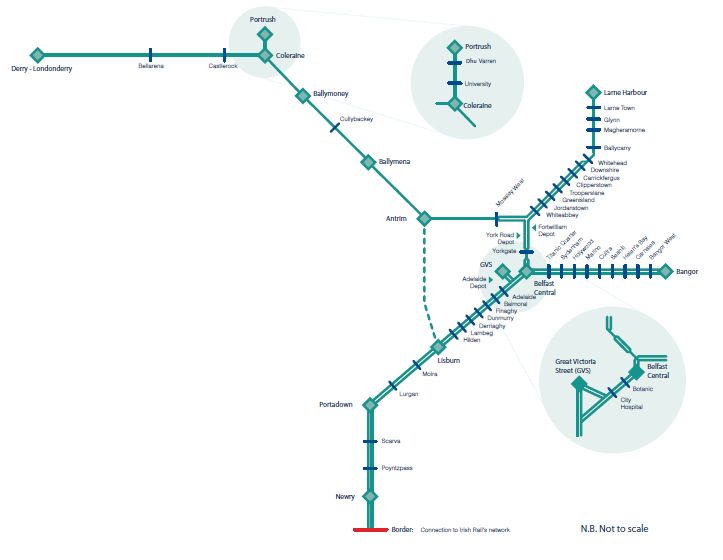
The geographic extent of the network is illustrated in Appendix 2. The lines connect
The European Commission Directive 2014/82/EC (on the certification of Train as follows:
Drivers) establishes a licensing and certification system for train drivers on the 1. Belfast – Border (connection to Irish Rail network)
European Union rail network. It is aimed not only at drivers but also at other train 2. Belfast – Bangor
crew who participate directly or indirectly in driving and whose professional 3. Belfast – Larne
qualifications therefore contribute to transport safety. This Directive was transposed 4. Belfast – Derry~Londonderry
in domestic legislation in Northern Ireland by the Train Driving Licences and 5. Coleraine – Portrush
Certificates Regulations 2010 (TDLCR). (Link to 1020/724) 6. Antrim – Knockmore.
All train crew who participate directly or indirectly in driving and whose professional N.B. At the time of writing the railway line between Antrim and Knockmore is not
qualifications therefore contribute to transport safety must therefore be appropriately normally available for passenger service. It is available as an emergency alternate
licensed. route and for special train movements only.
For further information on: 3.2.2 Connected Railway Networks
• Train Driving Licences please contact DfI, (Link to Driving Licences) The network is connected to one other network, Irish Rail. The only international
border crossing with Irish Rail is 54 miles from Belfast Lanyon Place at the 59.5
• Train Driving Certificates please contact NIR Access Enquiries. milepost. There are some connections to private sidings at Whitehead and Cultra.
Please see Section 1.8 for contact details. Appendix 2 provides an overview of the Network.
3.2.3 Further Information
Further information on the infrastructure may be obtained by contacting NIR Access
Enquiries (see Section 1.8 for contact details).
PAGE 12 PAGE 13
Page 12 of 46 Page 13 of 46Northern Ireland Railways
Network Statement 2020
Northern Ireland Railways Northern Ireland Railways
Infrastructure Manager Infrastructure Manager
Network Statement Network Statement
3.3 Network Description 3.3.2.2 Weight Limits
The IM can provide details on weight limits for particular line sections. As a guide
3.3.1 Geographic Identification for potential Applicants, Appendix 4 provides a list of all types of rolling stock that
are currently accepted for operation on the railway network. Further information
3.3.1.1 Track Typologies can be obtained from NIR Access Enquiries, see Section 1.8 for contact details.
The location of single-track and double-track is illustrated in Appendix 2.
The table below provides details on lengths of single, double and multiple-track. 3.3.2.3 Line Gradients
The steepest sections on the network reach a gradient of 1:65.
Location (Milepost) Total Total
Type Line (Route- (Route- 3.3.2.4 Line Speeds
Start Finish Miles) km)
Single Antrim-Knockmore 103.5 105 1.50 2.4 Speed limits are cited in miles-per-hour (mph) on all documentation and lineside
Track 103.5/0 18.5 18.50 29.8 signage.
Lagan Junction - Yorkgate 114.0 114.75 0.75 1.2 Maximum line speed on the network is 90mph (~148km/h), on sections of the
Larne Line 18.5 Dublin Line, and between Monkstown Junction and Templepatrick, and some
12.75 24.25 11.50
(Kilroot-Larne) sections between Coleraine and Derry~Londonderry on the Derry~Londonderry
Derry~Londonderry Line 8.5 95.5 87.0 140.0 Line. Other lines are maximum 70mph (~112km/h).
Portrush Line 61.75 67.75 6.00 9.7
Sub-total 124.75 201.6 Temporary Speed Restrictions (TSRs) are communicated via the Weekly Operating
Double- Border-Bangor 59.50 126.00 66.5 107.0 Notice (WON). The WON is not published but is issued in a controlled distribution
Track Yorkgate – York Road 114.75 115.0/0.0 0.25 0.4 to interested parties.
York Road - Kilroot 0 12.75 12.75 20.5
BleachGreen - Monkstown 7.25 8.5 1.25 2.0 3.3.2.5 Maximum Train Lengths
Sub-total 80.75 129.9 Due to track and platform length, the maximum train length currently permitted on
Multiple Great Victoria Street any part of the network for normal passenger service is 207m. Longer trains,
- ~1.0 ~1.0 ~1.6
Track including freight trains, can possibly be accommodated and are considered on a
Sub-total ~1.0 ~1.6
case by case basis, but may need to be operated with Special Instructions.
TOTAL 206.5 ~333.1
The maximum train lengths that can be accommodated at particular locations
Table 2
(e.g. stations and halts) are detailed in the NIR Route Maps.
3.3.1.2 Track Gauges
3.3.2.6 Power Supply
The nominal track gauge is 1600mm over the entire network.
No part of the network is electrified.
3.3.1.3 Stations and Nodes 3.3.3 Traffic Control and Communication Systems
An overview of stations and nodes is provided in the NIR Route Maps.
Copies of the NIR Route Maps can be obtained by request from NIR Access 3.3.3.1 Signalling Systems
Enquiries, see Section 1.8 for contact details. The majority of the routes are controlled via two, three and four aspect colour-light
The stations and halts on the network are listed in Appendix 3. The list also signalling.
provides an overview of their main characteristics. Class B train protection systems are fitted on the network. All main route signals
The European Register of Infrastructure refers to Article 49 of Directive (EU) are fitted with Automatic Warning System (AWS). Some signals have been fitted
2016/797 and provides transparency concerning the main features of the European additionally with Train Protection and Warning System (TPWS) for increased
Railway infrastructure. The RINF Decision obliges each Member State to set up protection from SPADs (Signals Passed At Danger without authority).
and maintain a register of infrastructure. The IM register can be found online at: All signalling interlockings are of the Route Relay type (RRI).
Link to RINF. Signal Cabins are situated in Belfast Central (Lanyon Place), Portadown and
Coleraine and consist of Westronic and Entry / Exit panels.
3.3.2 Capabilities Automatic Train Detection, where provided, is via DC (Direct Current) track circuits.
There is no automatic route setting anywhere on the network.
3.3.2.1 Loading Gauge Indications on the status of track circuits, level-crossing equipment, points and
The loading gauge is defined in the NIR Company Standard “Requirements for signals are displayed for Signallers on the Westronic and Entry / Exit panels.
Defining and Maintaining the Size of Railway Vehicles”, (Ref.: I/STR/RGS/2149). A There are 45 Automatic Half Barrier (AHB) Public Road Level Crossings operated
copy of this NIR Company Standard is available upon request from NIR Access by automatic Train Detection with treadle back-up.
Enquiries, see Section 1.8 for contact details.
PAGE 14 PAGE 15
Page 14 of 46 Page 15 of 46Northern Ireland Railways
Network Statement 2020
Northern Ireland Railways Northern Ireland Railways
Infrastructure Manager Infrastructure Manager
Network Statement Network Statement
There are 16 Manually Controlled Public Road Barriers, 3 locally controlled and 13 3.4.4 Tunnel Restrictions
with Closed-Circuit Television (MCB CCTV), controlled from the 3 main Signal There are currently no additional technical or operational restrictions for tunnels on
cabins. the network. RUs may require the application of operating restrictions for their
There are 10 MSL (Miniature Stop Lights) throughout the NI Railways network with Rolling Stock in tunnels, for example turning engines off if stationary in a tunnel.
101 User Worked Crossings.
3.4.5 Bridge Restrictions
3.3.3.2 Traffic Control Systems There are currently no additional technical or operational restrictions for bridges on
Real time information on the progress of trains against timetable is obtained from the network. However, restrictions may be applied to specific types of rolling stock
the Train Describer which gets information from the signalling system. The Train as part of the vehicle acceptance process.
Describer information is provided on display screens for Traffic Managers, Traffic The Bann Bridge, on the Derry~Londonderry Line between Coleraine and Castlerock
Controllers and platform staff. crosses a navigable waterway. Current protocol requires the lifting-span on the
The information from the Train Describer is used to provide audible announcements bridge to be opened to give priority to shipping. Trains may be required to wait until
at stations and halts and also to provide visual displays at main stations. the ship has passed.
Train despatch is facilitated by station staff or Conductors and, at some locations,
3.4.6 Other Restrictions
via ‘OFF’ indicators and ‘Ready-to-Start’ information (RTS Buttons).
At City of Derry Airport (CoDA) on the Derry~Londonderry Line there are signalling
There are currently no Driver-Only Operation (Passenger), DOO(P), facilities at any
protection arrangements due to the proximity of the runway to the railway. Priority is
location.
normally given to trains, however in some circumstances trains may be required to
wait whilst an aircraft lands.
3.3.3.3 Communication Systems
All stop signals are fitted with Signal-Post Telephones to facilitate direct 3.5 Availability of the Infrastructure
communication between the Train Driver and the relevant Signal Cabin.
Chapter 4.5 describes the process for allocation of the infrastructure in relation to
The train radio system is a Class B open channel analogue system. It gives radio maintenance, renewals or upgrades.
coverage to 98% of the network outside of tunnels and cuttings.
There are five distinct radio channels across the network. Radio channel-change At the time of writing it is the intention that the network is normally unavailable to RUs
boards are mounted trackside to indicate to the Train Driver when channels need to as follows (due to infrastructure engineering activities):
be changed. Saturday 00:20 to Saturday 05:30
A radio check is required to be performed before each train leaves the depot each Sunday 00:20 to Sunday 08:00
morning. This is recorded electronically. Sunday 23:30 to Monday 05:30
Portable radios are available for emergency use for vehicles which are not Weekly Tuesday 00:20 to Tuesday 05:30
permanently fitted with a compatible radio. Wednesday 00:20 to Wednesday 05:30
Thursday 00:20 to Thursday 05:30
3.3.3.4 ATC Systems Friday 00:20 to Friday 05:30
The IM does not currently provide any Automatic Train Control (ATC) Systems. Public Holidays Normally 00:20 to 05:30
th th
25 and 26 December Network closed
3.4 Traffic Restrictions Table 3
Where engineering activities are known, they are published in the Network
3.4.1 Specialised Infrastructure Statement, otherwise applications for closures or restrictions will go through the
There is no specialised infrastructure or designation on the network. normal consultation process and interested parties notified in a timely manner.
Planned additional closures for infrastructure engineering works are detailed below:
3.4.2 Environmental Restrictions
There are some environmental restrictions relating to railways in Northern Ireland.
Date Location
For example, noise restrictions for rolling stock are defined in the Rolling Stock 07/03/20 – 09/03/20 Whitehead - Larne
Technical Specification for Interoperability. There may also be additional operational 13/03/20 – 15/03/20 Bangor Line
restrictions on noise at some locations on the network and at certain times of the day. April / May - 2 weekends Carrick - Larne
Further details on noise restrictions are provided in Appendix 9. May – 1 weekend Ballymoney - Coleraine
25/07/20 – 27/07/20 Portadown – Border
3.4.3 Dangerous Goods 08/08/20 – 10/08/20 Portadown – Border
Dangerous Goods (defined as those goods which are capable of posing a risk to 25/07/20 – 26/07/20 Great Victoria Street – Lanyon Place
health, safety, property and the environment during carriage by rail and are classified 01/08/20 – 02/08/20
according to the Regulations concerning the International Carriage of Dangerous 08/08/20 – 09/08/20
Goods by Rail) are not permitted anywhere on the network. 26/09/20 – 28/09/20 Fortwilliam – Bleach Green Junction
PAGE 16 PAGE 17
Page 16 of 46 Page 17 of 46Northern Ireland Railways
Network Statement 2020
Northern Ireland Railways Northern Ireland Railways
Infrastructure Manager Infrastructure Manager
Network Statement Network Statement
Date Location Location No. of Roads Cumulative Length
25/12/20 – 03/01/21 Yorkgate – Carrick Central Station 2 400m
Yorkgate - Antrim (Lanyon Place)
Table 4
Bangor 1 300m
Adelaide Depot 6 2000m
Please note that full consultations are yet to be carried out and these dates and Lislea Drive 1 500m
locations may be subject to change.
Lisburn 3 400m
Portadown Yard 3 600m
3.6 Service Facilities Portadown Sidings 2 400m
Further information on the service facilities may be obtained by contacting NIR Table 6
Access Enquiries. (see Section 1.8 for contact details). Detail on charging for access
* Note: these are cumulative lengths of storage sidings at each location. For details
to service facilities is included in Section 6.1.3.
of maximum lengths of trains or individual units which can be accommodated or for
3.6.1 Passenger Terminals (Stations) any other information you may require please contact NIR Access Enquiries (see
A list of passenger terminals (stations and halts) is provided in Appendix 3. The Section 1.8 for contact details).
information provided includes: 3.6.5 Maintenance Facilities
• Platform Accessibility for persons of reduced mobility Train maintenance facilities are available as follows:
• Passenger Facilities such as:
Location Maintenance Facilities
o Ticket Offices
York Road Yard Normal ‘running’ maintenance
o Toilet(s)
York Road Workshops Maintenance
o Waiting Room(s).
York Road Diesel Shed Wheel Turning
3.6.2 Freight Terminals Fortwilliam Maintenance Depot Train Cleaning
There are currently no freight terminals on the network. If you require such facilities Adelaide Maintenance Depot Normal ‘running’ maintenance.
please submit a capacity request to NIR Access Enquiries (see Section 1.8 for Table 7
contact details) and the capacity enhancement process will be initiated. To obtain further information please contact NIR Access Enquiries (see Section 1.8
for contact details).
3.6.3 Train Formation Yards
Trains of the lengths indicated can currently be formed at the following locations: 3.6.6 Technical Facilities
Location Max. Train Length Information on Technical facilities and the locations at which they are available is
York Road Engineering Depot 207m provided in Appendix 5.
To obtain further information please contact NIR Access Enquiries (see Section 1.8
Fortwilliam Maintenance Depot 138m
for contact details).
Adelaide Maintenance Depot 138m
Table 5
It is possible that longer trains could be accommodated at these locations under 3.6.7 Maritime and Inland Port Facilities
certain conditions. Please contact NIR Access Enquiries if you have a specific There are no maritime or inland port facilities on the Network.
requirement which exceeds the lengths indicated above, see Section 1.8 for contact
details. 3.6.8 Relief Facilities
If you require further information on relief facilities available, please contact NIR
3.6.4 Storage Sidings Access Enquiries (see Section 1.8 for contact details).
Storage sidings are available at the following locations (total lengths of sidings at
each location*): 3.6.9 Refuelling Facilities
Refuelling facilities are available at Adelaide, Fortwilliam and York Road Depots. To
Location No. of Roads Cumulative Length obtain further information, please contact NIR Access Enquiries (see Section 1.8 for
Portrush 1 300m contact details).
Antrim 2 600m
Coleraine 2 400m 3.6.10 Other Facilities
Derry~Londonderry 1 300m At the time of writing there are no other facilities available to Applicants. There are,
Ballymena 4 600m however, some locations where other organisations have private sidings that can be
Larne Harbour 2 400m accessed from the railway network.
Fortwilliam Depot 4 600m
York Road 5/6 2000m
PAGE 18 PAGE 19
Page 18 of 46 Page 19 of 46Northern Ireland Railways
Network Statement 2020
Northern Ireland Railways Northern Ireland Railways
Infrastructure Manager Infrastructure Manager
Network Statement Network Statement
If you require further information or require other facilities, please contact NIR Access Primary Purpose Expected
Enquiries (see Section 1.8 for contact details) and a process will be initiated to Start Completion
consider the request and provide a response. Activity – 2019/20 Safety Capacity Date Date
Embankments & Cuttings Strengthening
3.7 Infrastructure Development Programme
ü Jan-21 Apr-32
The table below provides an outline of the main items relating to development of the Fortwilliam - Bleach Green Signalling Renewals ü Feb-19 Jun-20
Infrastructure. The activities are categorised as ‘Ongoing and immediate future’ and Switch and Cross Renewal Programme Lislea,
‘Longer-term: 2020+’, and an indication is provided as to whether the primary ü Aug-19 Nov-21
Lisburn South, Lagan Jct, Newry, Lanyon Place
purpose is to enhance Safety or Capacity.
Cullybackey Level Crossings MCB Upgrade Jul-19 Jan-21
ü
Primary Purpose Expected
Start Completion Lisburn Interlocking Renewal ü May-22 Sept-23
Activity – 2019/20 Safety Capacity Date Date Lurgan Area Track Renewals ü Apr-19 Sept-19
Lurgan Railway Station Redevelopment ü May-19 Apr-22
Ongoing and Immediate Future
Foyle River Defence Strengthening ü Aug-19 Nov-19
Brokerstown Stream Culverts ü Mar-19 Aug-19
Lineside Fencing Programme 2018/19 ü Apr-18 Mar-19 Yorkgate Station Redevelopment ü May-20 Dec-21
Castlerock & Downhill Tunnel Repairs ü Nov-18 Apr-19 SPAD Over Speeding Mitigation ü Aug-20 Apr-23
Dunmurry – Lisburn Signal Route Renewal Jan-19 Apr-20 Northern Ireland Railway Operations Centre
ü Nov-19 Nov-20
(NIROC) Phase 1
UWC Safety Improvement Programme Phase 2a ü Apr-17 Jun-20
Rail Milling Programme ü Dec-19 Feb-39
UWC Safety Improvement Programme Phase 2b ü Mar-18 Jun-23
Whitehead MSC Upgrade to MCB CCTV ü May–18 Dec-21
Platform Safety Measures ü Jul-19 Nov-19
Lurgan Level Crossing signaling Alterations ü Aug–18 July-23
Portadown Park and Ride ü Jul-17 Jan-19
Portrush Railway Station Development ü Apr-18 May-19 Culvert Strengthening Programme ü Oct–19 Apr-20
NW Hub – Derry~Londonderry Station Table 8
ü Sep-18 Aug-20
Development
Longer term: 2020+
Park & Ride Programme
• Moira Station (Phase 3) Park and Ride Apr-19 Nov-19
• Lisburn West - New Halt and Park & Ride On Hold On Hold
• Ballymoney Park and Ride - Phase 2 ü May-19 Jun-20
• Mossley West Park and Ride Extension Apr-20 Mar-20
• Finaghy Park and Ride Apr-19 Jan-20
• Cullybackey Park and Ride Phase 2 Sep-20 Mar-21
Adelaide / Boucher Road Halt Development ü ü Nov-19 Feb-22
Ballymena Bus / Rail Integrated Station ü Hold Hold
Holywood Sea Defences ü June-19 Oct-20
Belfast Transport Hub – Enabling Works ü Jun-19 Jun-21
Bellarena Permanent Way Storage & Stabling
ü Jan-19 May-19
Facility
Bridge Refurbishment & Strengthening
ü Nov-19 Jan-21
Programme Phase 2
Dark Arch Whiteabbey Track Renewal ü June-20 Oct-20
Lisburn - Knockmore – Line Speed recovery ü Mar-20 Dec-20
Cross Border Level Crossing Upgrade
ü Oct-19 Aug-19
(Poyntzpass)
Donegall Quay - Yorkgate Dualling Phase 1 ü On Hold -
PAGE 20 PAGE 21
Page 20 of 46 Page 21 of 46Northern Ireland Railways
Network Statement 2020
Northern Ireland Railways Northern Ireland Railways
Infrastructure Manager Infrastructure Manager
Network Statement Network Statement
4 Capacity Allocation 4.3.2 Schedule for Train Path Requests Outside the Timetabling
Process (Ad Hoc Requests)
4.1 Introduction Ad hoc requests can be made throughout the Working Timetable period to utilise any
This section outlines the process for Capacity Allocation. available spare capacity without a Framework Agreement. Details of the available
spare capacity in the 2020 Working Timetable can be obtained from NIR Access
The legal framework for Capacity Allocation is governed by SRNI 2016/420, in Enquiries, see Section 1.8 for contact details, when that Working Timetable has been
particular Part 5 and Schedule 3. finalised.
The IM will aim to respond to all ad hoc requests for spare capacity within 5 working
4.2 Description of Process days. Please see Appendix 7 for Ad Hoc Request form.
An application for the allocation of infrastructure capacity must be submitted to the IM
for each Working Timetable period. 4.4 Allocation Process
Applicants, including RUs which are party to ongoing agreements with the IM, such
as a Framework Agreement, will apply for specific paths during this process. 4.4.1 Coordination Process
The IM will consider all applications from valid Applicants and, within 4 months of the
Applicants must provide evidence that the Access Requirements described in deadline for applications, will circulate a Draft Working Timetable with interested
Section 2 have been met. parties. Interested parties must submit their comments within one calendar month of
The following information must be provided for each path requested: issue of the Draft Working Timetable. The complexity of arranging international
• days on which the train is to operate, paths means these paths will be given priority in the process of coordinating capacity
• periods (or specific dates) of operation, requests.
• point of origin and required departure time, Interested parties will include:
• destination and required arrival time,
• all Applicants for infrastructure capacity as part of the specific allocation
• train type (passenger or freight), process to which the Draft Working Timetable relates, and
• details of rolling stock including the vehicle serial numbers and the numbers • other parties who have indicated to the ORR that they wish to have the
of units per series, opportunity to comment on how the Draft Working Timetable may affect their
• technical details of rolling stock (e.g. maximum permitted speed, brake type, ability to procure rail services during the Working Timetable period to which
length, tonnage, etc.) as requested. the Draft Working Timetable relates.
The following information must also be provided on request, where required: Subject to the requirements of SRNI 2016/420, the IM will allocate capacity on a fair
• stops of passenger trains / handling points of freight trains, and equitable basis, based on the Draft Working Timetable and taking account of the
• details of exceptional loads or dangerous goods, views of all interested parties. In doing so, the IM will take account of all constraints
• any other information relating to the operation of the train. on Applicants, including the economic effect on their business.
Requests for capacity must be made in writing to NIR Access Enquiries by 1st August Capacity will only be allocated to parties who already meet the requirements outlined
2019 - see Section 1.8 for contact details. in Section 2.2.1. The IM will as far as possible, meet all requests for capacity from
The processes for allocating capacity, including priorities for where capacity is such parties, including for train paths which cross more than one network.
oversubscribed is described in Sections 4.4 (RUs) and 4.5 (IM). The IM may not refuse an application for a train path if there is no other application
for all or part of that path, subject to the other requirements being met.
4.3 Schedule for Path Requests and Allocation Process In the event of conflict between different requests for infrastructure capacity, the IM
4.3.1 Schedule for Working Timetable will use all best endeavours, in consultation with the appropriate Applicants, to
coordinate the requests and, insofar as it is reasonable to do so, may propose
The timescales for development of the working timetable and allocation of specific
alternative infrastructure capacity to that which was requested.
train paths (national and international) is shown in Figure 1 below.
If it is not possible to reach agreement with all the Applicants, even though the
Applicants have not unreasonably refused to agree to alternative infrastructure
capacity, the IM will allocate the path to the Applicant who has the contractual right to
use the path (or a substantially similar path) at the time of application. Where no
such right exists, the IM will allocate the path to one of the Applicants on a non-
discriminatory basis. The IM may refuse any application if, in its opinion, the
Applicant has unreasonably refused to agree to an offer of alternative infrastructure
Figure 1 - Allocation Timescales capacity.
Decisions concerning applications will be communicated in writing to the Applicant.
In the case of a refusal, this will include the reasons for the refusal. In cases where
PAGE 22 PAGE 23
Page 22 of 46 Page 23 of 46Northern Ireland Railways
Network Statement 2020
Northern Ireland Railways Northern Ireland Railways
Infrastructure Manager Infrastructure Manager
Network Statement Network Statement
the application is refused on the grounds of insufficient capacity, it will additionally • international passenger traffic
include advice that the element of infrastructure concerned has been declared • off peak passenger traffic
congested and the Applicant will be advised of the results of the Capacity Analysis • special / charter passenger traffic
and of the Capacity Enhancement Plan (see Section 4.4.3). • freight traffic including international freight traffic
4.4.2 Track Access Dispute Resolution Process • infrastructure maintenance traffic*.
If differences are not resolved during the coordination process, the IM will reach a * In an emergency, infrastructure maintenance traffic will be given a higher priority if
decision based on the following considerations: required to deal with an incident.
To request information on the procedure for congested infrastructure, please contact
• overall impact on the timetable NIR Access Enquiries, see Section 1.8 for contact details.
• optimisation of capacity utilisation
• priority rules for congested infrastructure
• the number of identical paths used, and 4.4.4 Impact of Framework Agreements
• the chronological order in which requests were received.
As stated in section 4.4.2, where a Framework Agreement is in place with any RU,
Where a Framework Agreement is in place with any RU, paths requested by that subject to the terms and conditions of that Agreement, access requests made by that
undertaking will be given a higher priority than requests from another undertaking RU will be given a higher priority than requests from another undertaking which
which would have the same priority but where no Framework Agreement is in place. would have the same priority but where no Framework Agreement is in place.
Applicants must respond within 10 working days of the final decision if they wish to
dispute the capacity allocated in the Draft Working Timetable. All efforts will then be 4.5 Allocation of Capacity for Maintenance, Renewal and
made to reach a decision within 10 working days of receipt of the dispute. Applicants Enhancements
may then appeal directly to the ORR, or seek to resolve within the Dispute Resolution
Process (Capacity Allocation) (I-SYP-PRO-1805) found at: Link to Dispute Resolution 4.5.1 Process
Process. In order to ensure the required levels of safety, reliability and quality of the
infrastructure, the IM must reserve part of the available infrastructure capacity for
In the event that Applicants’ concerns are not resolved within the Dispute Resolution
maintenance, renewal and enhancement works.
Process, the Applicant may also appeal to ORR. The details and timescales of the
Appeals Process can be obtained from ORR at: Link to ORR guidance. Planned engineering activities known at the time of writing are detailed in section 3.5
The Dispute Resolution Process will operate in parallel with the Capacity Allocation of the Network Statement. Allocation of Capacity for movement of engineering
vehicles/trains is obtained as part of the Capacity Allocation Process. To request
process and will not be permitted to delay Allocation of Capacity for the Working
information on the scheduling of planned maintenance work and the procedures for
Timetable Period.
unforeseen maintenance work, please contact NIR Access Enquiries, see Section
To request information on the dispute resolution process, please contact NIR Access 1.8 for contact details.
Enquiries, see Section 1.8 for contact details.
4.5.2 Possession Planning
Some maintenance, renewal and enhancement works require blockades outside the
4.4.3 Congested Infrastructure: Definition, Priority Criteria and normal times. The IM will aim to give minimum notice of planned possessions as
Process follows:
Regulation 26 of SRNI 2016/420 sets out the criteria for dealing with Congested Duration of Possession Notice Period
Infrastructure, although at the time of publishing there have been no parts of the Emergency None
network declared congested. 24 hours or less 2 weeks
Where, after the coordination of requests for capacity and consultation with the 24 - 56 hours 2 months
Applicants, it is not possible to satisfy requests for a particular element of 56 hours - 1 week 4 months
infrastructure adequately, the IM will declare that element of infrastructure to be Table 9
congested. Normally, planned blockades of greater than one week’s duration will be advised in
Where appropriate, the IM may set an additional levy during periods of congestion, to the Network Statement, unless other timescales have been agreed by mutual
reflect the scarcity of capacity on that element of infrastructure. consent by the IM and affected RUs. Planned line closures during normal timetabled
hours of operation will be consulted with all affected RUs and service providers.
Where coordination (and any additional access levy charged, if applicable) does not
sufficiently reduce demand for an element of infrastructure, the IM will allocate 4.6 Non-Usage / Cancellation Rules
capacity utilising the following priority criteria:
The IM reserves the right to revoke allocated capacity unless this was caused by non
• Passenger Service Obligations economic reasons outside the alleged and proven control of the RU.
• peak commuter passenger traffic
PAGE 24 PAGE 25
Page 24 of 46 Page 25 of 46You can also read


