Mobile Health Apps That Help With COVID-19 Management: Scoping Review - XSL FO
←
→
Page content transcription
If your browser does not render page correctly, please read the page content below
JMIR NURSING                                                                                                               John Leon Singh et al

     Review

     Mobile Health Apps That Help With COVID-19 Management:
     Scoping Review

     Hanson John Leon Singh1, MBBS; Danielle Couch2, PhD; Kevin Yap1, PhD
     1
      Department of Public Health, School of Psychology and Public Health, La Trobe University, Melbourne, Australia
     2
      School of Rural Health, Faculty of Medicine, Nursing and Health Sciences, Monash University, Bendigo, Australia

     Corresponding Author:
     Kevin Yap, PhD
     Department of Public Health
     School of Psychology and Public Health
     La Trobe University
     Health Sciences 2 Building
     Melbourne, 3086
     Australia
     Phone: 61 3 9479 6068
     Email: kevinyap.ehealth@gmail.com

     Abstract
     Background: Mobile health (mHealth) apps have played an important role in mitigating the coronavirus disease (COVID-19)
     response. However, there is no resource that provides a holistic picture of the available mHealth apps that have been developed
     to combat this pandemic.
     Objective: Our aim is to scope the evidence base on apps that were developed in response to COVID-19.
     Methods: Following the PRISMA (Preferred Reporting Items for Systematic Reviews and Meta-Analyses) guidelines for
     scoping reviews, literature searches were conducted on Google Search, Google Scholar, and PubMed using the country’s name
     as keywords and “coronavirus,” “COVID-19,” “nCOV19,” “contact tracing,” “information providing apps,” “symptom tracking,”
     “mobile apps,” “mobile applications,” “smartphone,” “mobile phone,” and “mHealth.” Countries most affected by COVID-19
     and those that first rolled out COVID-19–related apps were included.
     Results: A total of 46 articles were reviewed from 19 countries, resulting in a total of 29 apps. Among them, 15 (52%) apps
     were on contact tracing, 7 (24%) apps on quarantine, 7 (24%) on symptom monitoring, and 1 (3%) on information provision.
     More than half (n=20, 69%) were from governmental sources, only 3 (10%) were from private organizations, and 3 (10%) from
     universities. There were 6 (21%) apps available on either Android or iOS, and 10 (34%) were available on both platforms.
     Bluetooth was used in 10 (34%) apps for collecting data, 12 (41%) apps used GPS, and 12 (41%) used other forms of data
     collection.
     Conclusions: This review identifies that the majority of COVID-19 apps were for contact tracing and symptom monitoring.
     However, these apps are effective only if taken up by the community. The sharing of good practices across different countries
     can enable governments to learn from each other and develop effective strategies to combat and manage this pandemic.

     (JMIR Nursing 2020;3(1):e20596) doi: 10.2196/20596

     KEYWORDS
     COVID-19; mobile apps; mHealth; contact tracing; symptom monitoring; information provision; mobile health

                                                                               coronavirus in January 2020 [3]. SARS-CoV-2 affects
     Introduction                                                              individuals of all ages and spreads through droplets when the
     The novel coronavirus, severe acute respiratory syndrome                  infected individuals cough or sneeze [3]. The droplets can still
     coronavirus 2 (SARS-CoV-2) [1], manifests the coronavirus                 be infectious even after deposition onto surfaces. Infection
     disease (COVID-19) and was first identified in Wuhan, China               occurs when these droplets are inhaled or when the contaminated
     in December 2019 [2]. It first presented as severe cases of               surfaces are touched followed by the touching of one’s eyes,
     pneumonia of unknown origin and was identified as a                       nose, or mouth. Transmission of infection is possible during its

     https://nursing.jmir.org/2020/1/e20596/                                                                  JMIR Nursing 2020 | vol. 3 | iss. 1 | e20596 | p. 1
                                                                                                                     (page number not for citation purposes)
XSL• FO
RenderX
JMIR NURSING John Leon Singh et al
incubation phase (2-14 days), and common symptoms include developers who were trying to take advantage of the situation
fever, cough, sore throat, headache, myalgia, fatigue, and by creating fake apps [20], as well as ransomware apps that
breathlessness [3]. The symptoms and manifestations vary mandated users to transfer money and threatened deletion of
greatly among individuals; some have serious consequences the phone’s storage if money was not transferred [21]. There
like acute respiratory distress syndrome and organ failure, while were also large amounts of misinformation on the internet [22].
others can be asymptomatic [3]. Older adults and individuals In response, the WHO worked with Google as well as popular
with comorbidities like diabetes, hypertension, and social media sites like Facebook, Twitter, Tencent, and TikTok
cardiovascular problems are more susceptible and can manifest to combat this misinformation [23]. Furthermore, steps were
more severe symptoms when infected [4]. taken by social media apps like Facebook, YouTube, Twitter,
Instagram, and Snapchat to limit the rapid spread of
Since the public announcement of the first few cases,
misinformation to their massive audience reach [24]. In addition,
SARS-CoV-2 has spread worldwide and was declared as a
Apple and Google made efforts to regulate COVID-19–related
pandemic on March 11, 2020, by the World Health Organization
apps released in their app stores, only allowing apps developed
(WHO) [5]. As of August 1, 2020, there were over 17.9 million
by credible organizations [25]. WhatsApp, a popular
cases recorded and over 680,000 deaths due to COVID-19 [6].
communication app, also limited the number of times users
As COVID-19 spread worldwide into countries with different
could forward messages related to COVID-19 to reduce the
health systems and responses, the number of infected cases
spread of misinformation about the coronavirus [26].
constantly changed. To control its spread, several prevention
strategies were adopted by various countries. These strategies Amid the rapidly evolving COVID-19 environment, mHealth
included self-isolation and quarantine for individuals who were apps have been playing an important role in mitigating the
suspected cases of infection or showed mild symptoms [3], COVID-19 response, but to date, there has not been any
wearing of face masks, and adherence to hygienic practices [3]. overview and comparisons of the mHealth apps that have been
Public gatherings were also avoided to limit the number of close developed to combat this pandemic. The aim of this review is
contacts among individuals [3]. During the first wave of to scope the evidence base for articles that described apps that
COVID-19, various mobile health (mHealth) apps were rapidly were developed in response to the COVID-19 pandemic. This
developed in response to tackle the virus. paper categorizes and compares the available apps by providing
a description of these apps, their purposes, and the features
The first COVID-19 apps that were developed and widely
employed. A recommendation of useful features is also provided
publicized were contact tracing apps, which were created to
for developers and interested stakeholders.
notify its users if they had crossed paths with another person
infected with the coronavirus [7]. The first national app was
developed in Singapore, which used Bluetooth technology for
Methods
contact tracing [8]. If someone was in close proximity with an This review was conducted following the guidelines of the
infected individual, the app would send a push notification to PRISMA (Preferred Reporting Items for Systematic Reviews
alert them of possible COVID-19 infection and further suggest and Meta-Analyses) extension for scoping reviews [27]. The
that they undergo testing [9]. The technology was made open search period for information was from March 25, 2020, to May
source and shared internationally for other countries to build 5, 2020, when the outbreak rapidly spread to all parts of the
similar apps for their own populations [10-12]. Since then, there world, including the United States [28]. Google search, Google
have been various other types of contact tracing apps available, Scholar, Scopus, and PubMed were used to find apps specific
each using different methods of data collection to track the for each country. Considering the rapid pace of articles being
movements of its users. published on COVID-19, Google Scholar, Scopus, and PubMed
Symptom monitoring apps have also emerged in response to were selected, as these were common databases used by
COVID-19. These apps commonly collect information about clinicians and would encompass a broad scope of journal articles
the user’s health by posing a list of questions related to symptom that would be relevant to clinical and public health practices.
identification, from which a differential diagnosis is made [13]. The keywords used were: “coronavirus,” “COVID-19,”
However, other innovative methods have also been used, such “nCOV19,” “contact tracing,” “information providing apps,”
as automatic collection and recording of the user’s health-related “symptom tracking,” “mobile apps,” “mobile applications,”
data (eg, temperature and pulse rates) from wearables like “smartphone,” “mobile phone,” and “mHealth,” and the country
wristbands [14,15]. In the case of a suspected COVID-19 names from the top 10 countries that had the greatest number
infection, the user is alerted and advised to go for a checkup at of COVID-19 cases as of April 27, 2020. These countries were
a nearby clinic. China, France, Germany, Iran, Italy, Russia, Spain, Turkey, the
United Kingdom, and the United States [6]. Another 9 countries
The importance of credible information that can be provided in were added to the list, as they were among the first in releasing
a timely manner to the public has in part been addressed by apps specific for COVID-19 based on articles found during the
some of the information providing apps developed for initial stages of the research from the period of March 25, 2020,
COVID-19. Information providing apps give details about the to April 1, 2020. These countries included Hong Kong, Iceland,
coronavirus, disease, good hygiene practices, and guidelines to India, Indonesia, Malaysia, Poland, Singapore, South Korea,
follow, like social distancing and the importance of wearing and Taiwan.
face masks [16-19]. However, during the initial stages of the
pandemic, the mHealth markets saw the emergence of
https://nursing.jmir.org/2020/1/e20596/ JMIR Nursing 2020 | vol. 3 | iss. 1 | e20596 | p. 2
(page number not for citation purposes)
XSL• FO
RenderXJMIR NURSING John Leon Singh et al
Due to the rapidly changing nature of the COVID-19 pandemic, sites. The majority (13/19, 68.4%) of the countries studied either
the main sources of evidence were mainly from online news already had contact tracing apps or the apps were under
articles. Information from government websites and health development, followed by symptom monitoring apps (6/19,
departments of different countries were also reviewed as they 31.6%). There was 1 app from Malaysia that had both symptom
were considered to be credible sources and would have the most monitoring and information providing abilities (MySejahtera)
up-to-date information available for the country [1,5,13,29,30]. [31]. Some countries like Italy, France, Germany, and 1 app
Selected articles were limited to the first 10 pages of the Google from Malaysia were in the process of developing apps for
search results, after which the articles were found to be irrelevant contact tracing [31-34]. There was 1 global app found in the
to COVID-19. All articles included in our review were after review [35].
December 9, 2019, which was the day when the first infection
Of all the apps evaluated (N=29), there were 14 (48%) apps on
was reported in China [2].
contact tracing alone, 1 (3%) app with both contact tracing and
The inclusion criteria were articles that had a clear description quarantine features, and 6 (21%) apps purely for enforcing
about the features used in the apps. Articles from December 9, quarantine (n=15 for contact tracing, n=7 for quarantine).
2019, to May 5, 2020, were included. Apps that were not Similarly, there were 5 (17%) apps on symptom monitoring
relevant to the disease and those that were in a language other alone, 1 (3%) app having both symptom monitoring and
than English were excluded. If the articles had limited information provision features, 1 (3%) app with symptom
information about the app, such as type of feature used, a second monitoring feature and for research purposes, and 1 (3%) app
Google search was conducted with the specific app-related was solely for research purposes (Table 1). There were 20 (69%)
parameters to source for further information. This ensured that apps released from governments, 3 (10%) from private
a complete profile of each app was obtained. organizations, and 3 (10%) from universities. There were 3
(10%) apps that did not provide information about their source;
Results 4 (14%) were web-based, 6 (21%) were available on only
Android or iOS, and 10 (34%) were available on both platforms.
Overview There were 12 apps (41%) that did not provide information on
A total of 46 articles that described apps from 19 different their platform availability. In terms of the technology used, 10
countries were reviewed (Figure 1). Most of the articles were (34%) apps used Bluetooth for collecting data, 12 (41%) apps
from news sites, health care organizations, and government used GPS, and 12 (41%) used other forms of data collection
such as manual input of details and questionnaires.
https://nursing.jmir.org/2020/1/e20596/ JMIR Nursing 2020 | vol. 3 | iss. 1 | e20596 | p. 3
(page number not for citation purposes)
XSL• FO
RenderXJMIR NURSING John Leon Singh et al
Figure 1. Flowchart of methodology. COVID-19: coronavirus disease; mHealth: mobile health.
https://nursing.jmir.org/2020/1/e20596/ JMIR Nursing 2020 | vol. 3 | iss. 1 | e20596 | p. 4
(page number not for citation purposes)
XSL• FO
RenderXJMIR NURSING John Leon Singh et al
Table 1. Mobile health apps related to COVID-19a (N=29).
Country, App Organiza- Platforms Purpose Technology/method used to collect
name tion/institu- data
tion
Contact Symptom Informa- Research Quarantine Bluetooth GPS Others
tracing monitor- tion provi- (n=2) (n=7) (n=10) (n=12) (n=12)
(n=15) ing (n=7) sion
(n=1)
China
Beijing Govern- N/Ac ✓ Input of
Cares mentb daily tem-
[36,37] perature
France
Under devel- Government N/A ✓ ✓ N/A
opment [33]
Germany
Corona- Government iOSd and ✓ ✓ Smart-
Datenspende e watch
Android
[14,15] monitor-
ing
Under devel- Government N/A ✓ N/A
opment [34]
Hong Kong
StayHome- Government iOS and ✓ ✓ ✓ Includes
Safe [29,38] Android a wear-
able de-
vice and
uses Wi-
Fi and
geospa-
tial sig-
nals
Iceland
Rakning C- Government iOS ✓ ✓ N/A
19 [39,40]
India
Corontine Universityf Android ✓ ✓ N/A
[41,42] (Indian Insti-
tute of Tech-
nology)
GoCorona- University N/A ✓ ✓ ✓ ✓ N/A
Go [43] (Indian Insti-
tute of Sci-
ence)
Aarogya Se- Government N/A ✓ ✓ N/A
tu [44]
COVID-Lo- N/A N/A ✓ ✓ N/A
cator [45]
Indonesia
PeduliLin- Government N/A ✓ ✓ N/A
dungi [46]
Iran
AC19 [47] Government Android ✓ ✓ Question-
naire
Italy
https://nursing.jmir.org/2020/1/e20596/ JMIR Nursing 2020 | vol. 3 | iss. 1 | e20596 | p. 5
(page number not for citation purposes)
XSL• FO
RenderXJMIR NURSING John Leon Singh et al
Country, App Organiza- Platforms Purpose Technology/method used to collect
name tion/institu- data
tion
Contact Symptom Informa- Research Quarantine Bluetooth GPS Others
tracing monitor- tion provi- (n=2) (n=7) (n=10) (n=12) (n=12)
(n=15) ing (n=7) sion
(n=1)
Under devel- Government N/A ✓ ✓ N/A
opment [32]
Malaysia
Under devel- Government N/A ✓ ✓ Self-input
opment (My-
Sejahtera)
[31]
MyTrace Government Android ✓ ✓ N/A
[48] (iOS under
develop-
ment)
Poland
Home Quar- Government iOS and ✓ ✓ Capturing
antine Android a selfie
[49,50]
Russia
Social Moni- Government iOS and ✓ ✓ N/A
toring [51] Android
Singapore
TraceTogeth- Government iOS and ✓ ✓ N/A
er [7] Android
COVID-19 Government Webg ✓ Question-
Symptom naire
Checker [13]
South Korea
Corona Private orga- iOS and ✓ ✓ Govern-
100m nizationh Android ment
[30,52-54] surveil-
lance data
(ATMi
transac-
tions and
surveil-
lance da-
ta)
Self-quaran- Government iOS and ✓ ✓ N/A
tine Safety Android
Protection
[55,56]
Spain (Community of Madrid)
Asistencia- Government Web, iOS, ✓ Question-
COVID-19 and An- naire
[57,58] droid
Taiwan
Not avail- Government N/A ✓ Mobile
able [59,60] signals
Turkey
Corowarner Government N/A ✓ ✓ ✓ N/A
[61]
https://nursing.jmir.org/2020/1/e20596/ JMIR Nursing 2020 | vol. 3 | iss. 1 | e20596 | p. 6
(page number not for citation purposes)
XSL• FO
RenderXJMIR NURSING John Leon Singh et al
Country, App Organiza- Platforms Purpose Technology/method used to collect
name tion/institu- data
tion
Contact Symptom Informa- Research Quarantine Bluetooth GPS Others
tracing monitor- tion provi- (n=2) (n=7) (n=10) (n=12) (n=12)
(n=15) ing (n=7) sion
(n=1)
United Kingdom
C-19 Private orga- iOS and ✓ Self-re-
COVID nization Android porting
Symptom
Tracker
[62-64]
Under devel- N/A N/A ✓ N/A
opment [65]
COVID-19 N/A Web and ✓ N/A
Sounds Android
[66,67]
United States
Private Kit: University iOS and ✓ ✓ ✓ N/A
Safe Paths (Mas- Android
[68,69] sachusetts
Institute of
Technology)
Global
COVID-19 Private orga- Web and ✓ Question-
Screening nization (Ap- iOS naire
Tool [35] ple)
a
COVID-19: coronavirus disease.
b
n=20.
c
N/A: not applicable.
d
n=13.
e
n=14.
f
n=3.
g
n=4.
h
n=3.
i
ATM: automated teller machine.
and credit card transactions [30,52-54]. The most common
Contact Tracing Apps method for contact tracing apps was Bluetooth (n=9, 60%).
There were many varieties of contact tracing apps. China was These apps anonymously notified healthy individuals if they
the first country to develop an app specific for contact tracing had been in close contact with an infected individual. This was
by using sophisticated tracking and surveillance methods in contrast to other techniques, such as the one used by China,
[36,37]. They involved tracking of infected individuals and their using strict surveillance methods that raised privacy concerns
contacts, while others were allowed to carry on with their normal since the technologies could track the person’s location and
lives [38]. Other countries followed suit after a study conducted obtain personal data as well [36,37]. GPS and Bluetooth were
by the University of Oxford suggested that the release of contact used in combination by three contact tracing apps released by
tracing apps played a major role in decreasing the spread within the United States, India, and Turkey [43,61,68,69]. All these
the community [70]. Malaysia, Singapore, India, Indonesia, and apps were either supported by the government or from
Iceland were fast at developing individual apps for contact recognized health organizations after restrictions were imposed
tracing [7,39-41,43-46,48]. On the other hand, Italy, Germany, by the Apple and Google Play Stores.
France, and the United Kingdom had apps in the development
stage during the period of this review [32-34,65]. Quarantine Apps
In addition to contact tracing apps, various countries have also
Of the 15 contact tracing apps analyzed, 6 (40%) apps had used
come up with quarantine apps to ensure that quarantine measures
GPS technology. South Korea’s Corona 100m app used data
are being followed. For example, geofencing apps enforce the
such as the user’s last GPS history and a range of information
quarantine by using mobile phone signals and GPS to track the
from government information systems, surveillance footage,
movements of users. The concept is to create a virtual fence
https://nursing.jmir.org/2020/1/e20596/ JMIR Nursing 2020 | vol. 3 | iss. 1 | e20596 | p. 7
(page number not for citation purposes)
XSL• FO
RenderXJMIR NURSING John Leon Singh et al
around people’s houses so that when they disobey the apps identify if the user is experiencing symptoms related to
regulations and go outside their houses, the authorities will be COVID-19. If the user’s responses indicate that the user may
notified [43,71]. One of the countries that has adopted this have COVID-19, they are provided with simple management
technique is India [41,42,71]. Taiwan also uses the same advice to follow. Generally, these apps pose a series of
technology to geofence affected individuals who are required diagnostic questions that include symptoms like fever, type of
to self-isolate or quarantine at home [59]. The geofencing app cough, body aches, contact with any infected individual, and
works by using base station triangulation, which is not as precise recent travel, among others, which help identify via a back end
as GPS, but it provides the location with an accuracy of 300 algorithm whether the user is suspected to have COVID-19. If
meters. Quarantined individuals are assigned a social worker the user is suspected to be infected, these apps will generally
who calls and checks on them twice a day. If unresponsive, the provide information on what to do in that scenario (eg, wearing
police are notified and will then visit their house [60]. In a face mask to reduce the spread and providing information
addition, Taiwan has also accepted the help of its citizens to about nearby hospitals). For example, the United Kingdom’s
develop tools to solve issues like sourcing and distributing face symptom monitoring app, called C-19 COVID Symptom
masks to avoid shortage in the affected areas [62]. Tracker was made by a private developer [62-64]. It was highly
welcomed by the public with 2,979,018 contributors as of May
In Hong Kong, quarantine is enforced by providing a wearable
6, 2020 [62]. The app was also helpful in identifying that 1 in
device (wristband) and a mobile app to people who arrive from
10 people in the United Kingdom had coronavirus symptoms
other countries. The wristband is scanned and integrated to the
[74]. In addition, Spain’s app could also alert officials on
app upon installation, and it works by using GPS, Bluetooth,
whether quarantine measures were being followed by the public
Wi-Fi, and geospatial signals in the neighborhood to determine
in an area [58].
position. If there is a difference in these signals, the app notifies
its user and a quarantine officer [29,38]. When it was released, An advanced variation of symptom monitoring apps is
the public had doubts as to whether the wristband technology Germany’s Corona-Datenspende app, which uses smartwatches
could work effectively, since it was paper-like and did not look or smart bands to collect data on the user’s biometrics such as
robust. However, the majority adhered to wearing the wristbands temperature and pulse that are then assessed for possible
because they believed that it would help them prevent the spread COVID-19 infections [14]. Similarly, the COVID-19 Sounds
of the virus [72]. App is a web-based app developed in the United Kingdom that
is able to record a user’s cough sounds and detect whether the
Other countries that have enforced quarantine apps include
user is infected with the coronavirus based on machine learning
South Korea, Russia, and Poland. For example, the
of their cough sounds [66].
Self-Quarantine Safety Protection app by South Korea uses
GPS to track quarantined individuals. Individuals who opt out Among all the symptom monitoring apps reviewed in this study,
of using the app are monitored by calls twice a day from an besides the apps from Germany and the United Kingdom that
assigned quarantine officer [55,56]. On the other hand, Moscow were able to automatically monitor and record the patient’s
has also made it mandatory for individuals who tested positive health parameters, all of the other apps involved manual
for the coronavirus to download and install the Social recording of symptoms or answering questionnaires provided
Monitoring quarantine app, which uses GPS to monitor by the app. Another app, called AC19, was released by the
movement [51]. Individuals who do not own smartphones will Iranian government in the Android app store for symptom
be provided with one that already has the app downloaded so monitoring but was later found to be using GPS technology to
that they can be tracked. In contrast, in addition to GPS tracking, track suspected infected individuals. This app was found to be
Poland’s Home Quarantine app also requires the quarantined linked to a suspicious app developer company that had a history
individual to take a selfie when randomly prompted to ensure of developing other apps that collected and provided data to
that the individual is at their residence. Upon release of the app Iranian intelligence agencies. The app was later banned from
in Poland, people had the option to either use this app or agree the Google Play store but is still available through the
to be visited by a police officer every day, but it was later made developer’s website and other third-party app stores [47].
mandatory for everyone under quarantine [49,50]. According
to a user of the app, she felt angry and stressed because she
Information Providing Apps
missed the alerts several times early in the morning and the Various governmental organizations and health agencies have
police checked up on her at her home. In the second week, the used social media platforms like Facebook, WhatsApp,
number of alerts “doubled” and drained her phone battery. Instagram, and Twitter to provide specific information about
Furthermore, she became more stressed as she felt that she had COVID-19 to the public. Although these platforms have app
to be on standby, even during a shower [73]. functionalities, Facebook, Instagram, and Twitter can also be
used on a browser, and thus, information provision is not just
Symptom Monitoring Apps limited to mobile app users. WhatsApp has been widely popular
One of the global apps for symptom monitoring is the iPhone and is one of the main methods of providing information on
and web-based COVID-19 Screening Tool app developed by COVID-19 in many countries. For example, government
Apple [35]. This is available for all iPhone users, irrespective agencies from Australia, India, Singapore, and the United
of their location. Furthermore, countries such as Spain, the Kingdom harnessed the WhatsApp platform by developing their
United Kingdom, Germany, Singapore, and Malaysia have also own chatbots to disseminate information to their citizens on the
developed symptom monitoring apps [13-15,31,57,66,67]. These country’s COVID-19 situation and local measures taken during
https://nursing.jmir.org/2020/1/e20596/ JMIR Nursing 2020 | vol. 3 | iss. 1 | e20596 | p. 8
(page number not for citation purposes)
XSL• FO
RenderXJMIR NURSING John Leon Singh et al
this pandemic [17-19,75,76]. However, in response to the the world by making its development code open source [10].
infodemic that has surrounded COVID-19, it was necessary to This helped other countries roll out similar apps at a faster rate.
regulate the information that was spread by users through Germany used an interesting and different approach of wearable
WhatsApp [75]. WhatsApp also collaborated with the WHO devices for the automatic monitoring of vitals. The public
and developed an information providing tool, which works by acceptance of this technology is yet to be studied.
users messaging a designated number to request for information
Although the responses to contact tracing apps were welcomed
about COVID-19, such as infection numbers, hygiene practices,
by most countries, it is still early to determine whether they are
and locations of medical centers, among others [16,77]. The
really effective in limiting the spread of the coronavirus [79].
GovTech Agency in Singapore also developed its own artificial
It has been suggested that ~80% of the population needs to
intelligence (AI) tool on WhatsApp to translate official news
install such apps for it to be effective [80]. This is a concern
from English to other languages such as Chinese, Malay and
because highly susceptible populations for COVID-19, such as
Tamil to disseminate relevant information to its citizens [76].
older adults, are not adept with technology [81]. Furthermore,
It works similar to the WHO bot that provides a set of
the majority of the contact tracing apps only register nearby
programmed responses that are updated with the information
users every 5 minutes and, hence, may have the possibility of
that has been requested by users. Malaysia has also proposed
missing out individuals. The range of Bluetooth is also farther
its own MySejahtera app, which is still under development and
than the recommended 1.5 meters advised by the WHO, thus
will include information provision features such as a hotline
giving rise to the possibility of over reporting the number of
number and a Virtual Health Advisory along with symptom
cases, especially in multistory buildings where the Bluetooth
monitoring features [31].
signal can pass through the walls [81]. Lastly, a Bluetooth-based
contact tracing app will stop working altogether when the user
Discussion opens a game app such as “Candy Crush.” Despite these
Principal Findings problems, authorities are still advocating these apps even though
the uptake of such apps are low, as it can play a role in
From our review, contact tracing, symptom monitoring, and benefiting the population to some extent [79,82].
information providing apps were the key types of apps that had
been developed for the management of COVID-19, with the Instead of having contact tracing apps specific to each country,
majority being developed by health organizations and a joint effort to develop a universal app for contact tracing may
governments. To combat misinformation surrounding be more beneficial, since useful trends on the COVID-19 spread
COVID-19, many organizations, including the two major mobile among the different countries can be identified and compared
app players in the market—Apple and Google—made efforts by international organizations such as the WHO. Hypothetically,
to curate the COVID-19–related apps available in the app stores. the codes for developing such a universal app can be made open
Apps that provided misleading information were banned from sourced and modified to suit each individual country’s needs
their respective app stores, resulting in apps that were more and privacy laws. In fact, Apple and Google are collaborating
credible and developed by established health care organizations to develop a universal app in the near future for contact tracing
and governments [25]. [83]. Their proposed method is to use Bluetooth to develop the
app, similar to the way that Singapore had created their contact
Not surprisingly, most of the apps identified from our review tracing app. However, the intended app will not use GPS data
were for contact tracing. These apps were developed to alleviate and will not store information online so that it can address the
the time and resources required for the manual contact tracing privacy concerns of many individuals. The Bluetooth app uses
process, which could be channeled to other resources instead. the “decentralized” approach since there is no recording of
However, a key issue for developers was to support information information into a back end database; thus, it is safer in terms
collection without compromising user privacy. The advantage of privacy because there is less risk of hackers accessing
of using GPS surveillance methods was the accuracy of the sensitive information. However, the disadvantage is that it may
user’s identification. China’s method of data collection was be difficult to enforce downloads and use of such apps [84]. On
deemed to be intrusive, as it invaded the privacy of individuals. the other hand, the United Kingdom had opted for a
However, this method was effective in identifying individuals “centralized” approach, where information would be stored and
who had breached the quarantine laws. Hence, it was welcomed analyzed online, and notifications sent out based on interactions
by the general public in China, and they supported the [84]. Although the centralized approach would pose a privacy
government on its efforts to reduce the transmission of infection. risk, officials justified that this data would be helpful to identify
Although this method could work in China, it could not be trends of the disease spread [84]. However, there was concern
replicated in other countries due to the differences in their regarding privacy by the general public, and the app did not
political and cultural stances on privacy [78]. Therefore, other function properly on iPhone devices during testing. Therefore,
countries explored and employed other data collection methods the United Kingdom government has subsequently decided to
that were more mindful of privacy issues. Bluetooth-enabled use the Apple and Google Bluetooth app to aid in its
contact tracing was the most popular method, since only when development, resulting in the app being decentralized as well
users had crossed paths would they have been detected, and [85].
data was not transferred and stored to any online server. A
well-designed Bluetooth-enabled contact tracing app was first Symptom monitoring apps were also useful in identifying
developed by Singapore, which was later shared to the rest of disease trends and possible infection zones. Although most
countries developed symptom monitoring apps based on manual
https://nursing.jmir.org/2020/1/e20596/ JMIR Nursing 2020 | vol. 3 | iss. 1 | e20596 | p. 9
(page number not for citation purposes)
XSL• FO
RenderXJMIR NURSING John Leon Singh et al
input of symptoms and questionnaires, the symptom monitoring advocate the uptake of contact tracing apps by the public by
app developed in Germany could automatically collect the user’s educating about the benefits of using such apps, perhaps through
vitals such as temperature and pulse, thus identifying patients social media and public health campaigns. The
who are symptomatic and possible infection zones through an Bluetooth-enabled contact tracing method is by far the most
interactive map [15]. This pandemic has also rapidly enhanced popular in terms of effectiveness and maintenance of privacy.
the uptake of telehealth systems in many countries. When The universal app that is currently being developed by Apple
combined with the use of wearable devices, it may be possible and Google can help limit the spread on a larger scale, as the
to conduct home screening and remote monitoring of COVID-19 reach of such an app will be greater and can provide an
symptoms through other integrated features such as mobile opportunity to prepare for similar future outbreaks
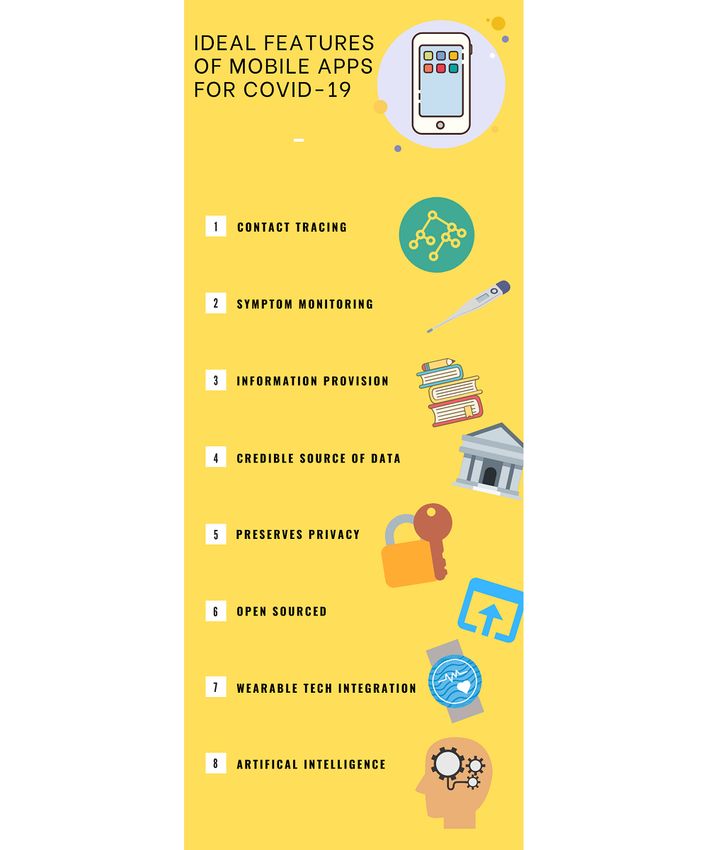
doctors or telehealth systems. internationally. Figure 2 suggests some features that should be
available in mobile apps for COVID-19. Other important
Our review managed to identify certain apps that had integrated
functionalities that can be integrated into these contact tracing
information providing features with the other contact tracing
apps include features for automatic symptom monitoring and
and symptom monitoring features. Another popular method to
information provision. The addition of these features will
disseminate COVID-19–related information was through social
provide a more holistic public health approach in response to
media platforms such as WhatsApp. Given the high rates of
the situation. As technology advances, the symptom monitoring
social media use, using social media channels to provide factual
algorithm can be enhanced and tailored to the pandemic to
COVID-19 information would likely ensure the rapid and
improve its accuracy in diagnosis. Wearable devices such as
widespread access to relevant health information [86]. Combined
smartwatches and smart bands will become more common and
with the fact that these apps are harnessed by various
integrated with daily lives; thus, these can potentially aid in the
governments to provide reliable information about COVID-19,
vital monitoring of health statuses of vulnerable populations.
information such as advice to follow and precautions to take to
Through machine learning and AI methods, automatic and rapid
prevent or avoid the spread of COVID-19 can be disseminated
identification of suspected infections will become more accurate
to the public in “chunks” as an educational resource, as well as
in the future. Lastly, consolidated information that is provided
to clarify their doubts. By combining with other features, a
by credible organizations such as the WHO can avoid any
multipurpose app that provides all information and services
unnecessary confusion as to which advice to follow in a
about COVID-19 will potentially be attractive to users and the
pandemic situation. Governments can then adapt and tailor the
public.
information to suit their populations. With advancement in
Future of Pandemic Management telehealth and mHealth systems, mobile doctors will be the way
To effectively tackle a pandemic such as COVID-19, a to go in situations like this where self-isolation is needed.
multipronged approach should be used. A proper contact tracing However, with the advancements in technology, “digital
app that is implemented at the starting stages of the outbreak is humans” may potentially be the solution to reduce the burden
important. Furthermore, authorities should make it a priority to of health care professionals in future pandemics [87].
https://nursing.jmir.org/2020/1/e20596/ JMIR Nursing 2020 | vol. 3 | iss. 1 | e20596 | p. 10
(page number not for citation purposes)
XSL• FO
RenderXJMIR NURSING John Leon Singh et al
Figure 2. Ideal features of mobile apps for COVID-19. COVID-19: coronavirus disease.
evaluated. Hence, we could only obtain information from the
Limitations and Future Work news articles and webpages that were found, but the details on
Since COVID-19 is a new outbreak and the situation is rapidly the various apps were also not comprehensive in these articles.
evolving, the articles in this review were mainly from news In addition, the databases searched (Google Search Engine,
articles and online webpages. There were few peer-reviewed Google Scholar, Scopus, and PubMed) might not have been
journal articles about mobile apps related to COVID-19. able to provide information on certain apps due to country
Furthermore, we could not conduct a thorough search of the restrictions, for example, apps from China. Another limitation
Google and Apple apps stores as most of the apps were was that sources in languages other than English were also not
country-specific; thus, they could not be downloaded and included in this review. From these sources, we could only
https://nursing.jmir.org/2020/1/e20596/ JMIR Nursing 2020 | vol. 3 | iss. 1 | e20596 | p. 11
(page number not for citation purposes)
XSL• FO
RenderXJMIR NURSING John Leon Singh et al
collate apps that were either already available to the general symptom monitoring. However, these apps, especially those
public or still under development during the period of review. for contact tracing, can only be effective if they are advocated
We advocate that a more comprehensive review should be done by the government and taken up by the community. Contact
in the near future when the situation is stabilized, possibly tracing at an early stage, along with proper hygiene and social
post–COVID-19. Future work on how effective these apps were distancing practices, remain the ideal way to deal with
in decreasing the coronavirus spread should also be undertaken. COVID-19. Governments can also benefit by encouraging their
This will help identify apps and features that are beneficial in citizens to participate in their efforts to combat the pandemic,
future pandemics. as in the case of Taiwan. In addition, the sharing of good
practices across different countries, such as the case of
Conclusion Singapore, can enable governments to learn from each other so
This review has identified a variety of apps that may be that effective strategies to combat and manage this pandemic
potentially useful to curb the spread of COVID-19. The majority can be developed to control the spread of the coronavirus.
of the apps were for the purposes of contact tracing and
Authors' Contributions
KY and DC conceived and designed the study. HS conducted and analyzed the results. HS, KY, and DC wrote and revised the
manuscript. All authors agreed to the publication of the manuscript.
Conflicts of Interest
None declared.
References
1. Naming the coronavirus disease (COVID-19) and the virus that causes it. World Health Organization. URL: https://www.
who.int/emergencies/diseases/novel-coronavirus-2019/technical-guidance/
naming-the-coronavirus-disease-(covid-2019)-and-the-virus-that-causes-it [accessed 2020-05-17]
2. Hui DS, I Azhar E, Madani TA, Ntoumi F, Kock R, Dar O, et al. The continuing 2019-nCoV epidemic threat of novel
coronaviruses to global health - The latest 2019 novel coronavirus outbreak in Wuhan, China. Int J Infect Dis 2020
Feb;91:264-266 [FREE Full text] [doi: 10.1016/j.ijid.2020.01.009] [Medline: 31953166]
3. Singhal T. A review of coronavirus disease-2019 (COVID-19). Indian J Pediatr 2020 Apr;87(4):281-286 [FREE Full text]
[doi: 10.1007/s12098-020-03263-6] [Medline: 32166607]
4. Jordan RE, Adab P, Cheng KK. Covid-19: risk factors for severe disease and death. BMJ 2020 Mar 26;368:m1198. [doi:
10.1136/bmj.m1198] [Medline: 32217618]
5. WHO Director-General's opening remarks at the media briefing on COVID-19 - 11 March 2020. World Health Organization.
2020 Mar 11. URL: https://www.who.int/dg/speeches/detail/
who-director-general-s-opening-remarks-at-the-media-briefing-on-covid-19---11-march-2020 [accessed 2020-03-29]
6. COVID-19 coronavirus pandemic. Worldometers. URL: https://www.worldometers.info/coronavirus/ [accessed 2020-06-21]
7. Baharudin H. Coronavirus: S'pore Government to make its contact-tracing app freely available to developers worldwide.
The Straits Times. 2020 Mar 23. URL: https://www.straitstimes.com/singapore/
coronavirus-spore-government-to-make-its-contact-tracing-app-freely-available-to [accessed 2020-05-17]
8. Hui M. Singapore wants all its citizens to download contact tracing apps to fight the coronavirus. Quartz. 2020 Apr 21.
URL: https://qz.com/1842200/singapore-wants-everyone-to-download-covid-19-contact-tracing-apps/ [accessed 2020-04-25]
9. Koh D. Singapore government launches new app for contact tracing to combat spread of COVID-19. MobiHealthNews.
2020 Mar 20. URL: https://www.mobihealthnews.com/news/asia-pacific/
singapore-government-launches-new-app-contact-tracing-combat-spread-covid-19 [accessed 2020-03-25]
10. Choudhury SR. Singapore says it will make its contact tracing tech freely available to developers. CNBC. 2020 Mar 25.
URL: https://www.cnbc.com/2020/03/25/coronavirus-singapore-to-make-contact-tracing-tech-open-source.html [accessed
2020-05-19]
11. Ungku F. Covid-19: Singapore launches contact tracing mobile app to track coronavirus infections. The Star. 2020 Mar
20. URL: https://www.thestar.com.my/tech/tech-news/2020/03/20/
covid-19-singapore-launches-contact-tracing-mobile-app-to-track-coronavirus-infections [accessed 2020-03-25]
12. Kit TS, Mahmud AH. Singapore launches TraceTogether mobile app to boost COVID-19 contact tracing efforts. CNA.
2020 Mar 20. URL: https://www.channelnewsasia.com/news/singapore/
covid19-trace-together-mobile-app-contact-tracing-coronavirus-12560616 [accessed 2020-03-25]
13. Singapore COVID-19 Symptom Checker. URL: https://sgcovidcheck.gov.sg/ [accessed 2020-04-09]
14. Busvine D. Covid-19: Germany launches smartwatch app to monitor coronavirus spread. The Star. 2020 Apr 07. URL:
https://www.thestar.com.my/tech/tech-news/2020/04/07/
covid-19-germany-launches-smartwatch-app-to-monitor-coronavirus-spread [accessed 2020-05-17]
https://nursing.jmir.org/2020/1/e20596/ JMIR Nursing 2020 | vol. 3 | iss. 1 | e20596 | p. 12
(page number not for citation purposes)
XSL• FO
RenderXJMIR NURSING John Leon Singh et al
15. Draper S. Germany’s public health authority launches smartwatch app to monitor Covid-19 spread. Wearable Technologies.
2020 Apr 08. URL: https://www.wearable-technologies.com/2020/04/
germanys-public-health-authority-launches-smartwatch-app-to-monitor-covid-19-spread/ [accessed 2020-04-10]
16. Hutchinson A. WhatsApp launches World Health Organization chatbot to answer COVID-19 queries. Social Media Today.
2020 Mar 21. URL: https://www.socialmediatoday.com/news/
whatsapp-launches-world-health-organization-chatbot-to-answer-covid-19-quer/574617/ [accessed 2020-04-10]
17. Basford S. Here’s how to access the government’s coronavirus WhatsApp (and how to use it). Lifehacker Australia. 2020
Apr 06. URL: https://www.lifehacker.com.au/2020/03/
heres-how-to-access-the-governments-coronavirus-whatsapp-and-how-to-use-it/ [accessed 2020-05-17]
18. Singh M. India launches WhatsApp chatbot to create awareness about coronavirus, asks social media services to curb spread
of misinformation. TechCrunch. 2020 Mar 21. URL: https://techcrunch.com/2020/03/21/
india-whatsapp-mygov-corona-helpdesk-bot/ [accessed 2020-03-29]
19. Warwick S. UK government launches WhatsApp coronavirus information service. Android Central. 2020 Mar 27. URL:
https://www.androidcentral.com/uk-government-launches-whatsapp-coronavirus-information-service [accessed 2020-03-30]
20. Peters J. Google has banned the Infowars Android app over false coronavirus claims. The Verge. 2020 Mar 27. URL: https:/
/www.theverge.com/2020/3/27/21197701/google-banned-infowars-android-app-play-store-coronavirus [accessed 2020-04-01]
21. Villas-Boas A. A fake coronavirus tracking app is actually ransomware that threatens to leak social media accounts and
delete a phone's storage unless a victim pays $100 in bitcoin. Business Insider Australia. 2020 Mar 17. URL: https://www.
businessinsider.com.au/
coronavirus-fake-app-ransomware-malware-bitcoin-android-demands-ransom-domaintools-2020-3?r=US&IR=T [accessed
2020-04-10]
22. Child D. Fighting fake news: the new front in the coronavirus battle. Al Jazeera. 2020 Apr 13. URL: https://www.
aljazeera.com/news/2020/04/fighting-fake-news-front-coronavirus-battle-200413164832300.html [accessed 2020-05-17]
23. WHO launches campaign against misinformation on coronavirus. The Straits Times. 2020 Feb 03. URL: https://www.
straitstimes.com/world/europe/coronavirus-who-launches-campaign-against-misinformation [accessed 2020-02-15]
24. How are digital platforms stopping misinformation on COVID-19 - public knowledge. Public Knowledge. URL: https:/
/www.publicknowledge.org/tracking-report-covid19-misinformation/ [accessed 2020-04-28]
25. Leswing K. Apple is rejecting coronavirus apps that aren’t from health organizations, app makers say. CNBC. 2020 Mar
05. URL: https://www.cnbc.com/2020/03/05/apple-rejects-coronavirus-apps-that-arent-from-health-organizations.html
[accessed 2020-04-10]
26. WhatsApp to further limit forwarding of messages to one chat at a time to combat misinformation during COVID-19
outbreak. The Online Citizen. 2020 Apr 07. URL: https://www.theonlinecitizen.com/2020/04/07/
whatsapp-to-further-limit-forwarding-of-messages-to-one-chat-at-a-time-to-combat-misinformation-during-covid-19-outbreak/
[accessed 2020-04-10]
27. Tricco AC, Lillie E, Zarin W, O'Brien KK, Colquhoun H, Levac D, et al. PRISMA extension for scoping reviews
(PRISMA-ScR): checklist and explanation. Ann Intern Med 2018 Oct 02;169(7):467-473. [doi: 10.7326/M18-0850]
[Medline: 30178033]
28. Taylor DB. How the coronavirus pandemic unfolded: a timeline. The New York Times. 2020. URL: https://www.nytimes.com/
article/coronavirus-timeline.html [accessed 2020-06-21]
29. “StayHomeSafe” Mobile App User Guide. COVID-19 Thematic Website - Together, We Fight the Virus. 2020. URL:
https://www.coronavirus.gov.hk/eng/stay-home-safe.html [accessed 2020-06-16]
30. Review of mobile application technology to enhance contact tracing capacity for COVID-19. Johns Hopkins Center for
Health Security. 2020 Apr 08. URL: https://www.centerforhealthsecurity.org/resources/COVID-19/COVID-19-fact-sheets/
200408-contact-tracing-factsheet.pdf [accessed 2020-05-17]
31. Sagar M. Malaysia Government next to launch app to monitor COVID-19 outbreak. OpenGov Asia. URL: https://www.
opengovasia.com/malaysia-government-next-to-launch-app-to-monitor-covid-19-outbreak/ [accessed 2020-04-10]
32. Pollina E. Covid-19: Italy tests contact-tracing app to speed lockdown exit. The Star. 2020 Apr 17. URL: https://www.
thestar.com.my/tech/tech-news/2020/04/17/covid-19-italy-tests-contact-tracing-app-to-speed-lockdown-exit [accessed
2020-04-19]
33. France's Covid-19 tracing app won't be ready for parliamentary debate. France 24. 2020 Apr 17. URL: https://www.
france24.com/en/20200417-france-s-covid-19-tracing-app-won-t-be-ready-for-parliamentary-debate [accessed 2020-04-18]
34. Germany gradually warming up to COVID-19 tracking app. DW News. 2020 Apr 07. URL: https://www.dw.com/en/
germany-gradually-warming-up-to-covid-19-tracking-app/av-53022217 [accessed 2020-04-17]
35. COVID-19 Screening Tool. Apple. URL: https://www.apple.com/covid19/ [accessed 2020-05-22]
36. Law E, Choon CM. How China, South Korea and Taiwan are using tech to curb coronavirus outbreak. The Straits Times.
2020 Mar 21. URL: https://www.straitstimes.com/asia/east-asia/
how-china-s-korea-and-taiwan-are-using-tech-to-curb-outbreak [accessed 2020-03-27]
https://nursing.jmir.org/2020/1/e20596/ JMIR Nursing 2020 | vol. 3 | iss. 1 | e20596 | p. 13
(page number not for citation purposes)
XSL• FO
RenderXJMIR NURSING John Leon Singh et al
37. Mozur P, Zhong R, Krolik A. In coronavirus fight, China gives citizens a color code, with red flags. The New York Times.
2020 Mar 01. URL: https://www.nytimes.com/2020/03/01/business/china-coronavirus-surveillance.html [accessed
2020-03-15]
38. Huang Y, Sun M, Sui Y. How digital contact tracing slowed Covid-19 in East Asia. Harvard Business Review. 2020 Apr
15. URL: https://hbr.org/2020/04/how-digital-contact-tracing-slowed-covid-19-in-east-asia [accessed 2020-04-22]
39. Ćirić J. Icelanders can download app to help with coronavirus contact tracing. Iceland Review. 2020 Apr 02. URL: https:/
/www.icelandreview.com/sci-tech/icelanders-can-download-app-to-help-with-coronavirus-contact-tracing/ [accessed
2020-04-10]
40. Askham P. COVID-19 tracking app launches today. The Reykjavík Grapevine. 2020 Apr 01. URL: https://grapevine.is/
news/2020/04/01/covid-19-tracking-app-launches-today/ [accessed 2020-05-17]
41. Das S. Corontine platform by IIT profs to help govt, private firms build COVID-19 trackers. News 18. 2020 Apr 09. URL:
https://www.news18.com/news/tech/
corontine-platform-by-iit-profs-to-help-govt-private-firms-build-covid-19-trackers-2555947.html [accessed 2020-04-10]
42. Sukumar R. Coronavirus: IIT Bombay’s ‘Corontine’ app to track the quarantined. Careers360. 2020 Mar 28. URL: https:/
/news.careers360.com/coronovirus-iit-bombays-corontine-app-track-quarantined [accessed 2020-05-23]
43. Dalal M. Coronavirus tracking apps: from 'GoCoronaGo' to 'Sampark-o-Meter'. Mint. 2020. URL: https://www.livemint.com/
news/india/coronavirus-tracking-apps-from-gocoronago-to-sampark-o-meter-11586409396134.html [accessed 2020-04-29]
44. Kumar A. Coronavirus: India to trace covid-19 patients through app-based Bluetooth handshake. India Today. 2020 Apr
02. URL: https://www.indiatoday.in/technology/news/story/
coronavirus-india-to-trace-covid-19-patients-through-app-based-bluetooth-handshake-1662617-2020-04-02 [accessed
2020-04-10]
45. Coronavirus India: Goa Govt launches 'COVID-Locator' app to track quarantined suspects. Indo-Asian News Service. 2020
Apr 05. URL: https://news.abplive.com/news/india/
coronavirus-india-goa-govt-launches-covid-locator-app-to-track-quarantined-suspects-1190362 [accessed 2020-05-17]
46. Fachriansyah R, Syakriah A. COVID-19: Indonesia develops surveillance app to bolster contact tracing, tracking. The
Jakarta Post. 2020 Mar 20. URL: https://www.thejakartapost.com/news/2020/03/30/
covid-19-indonesia-develops-surveillance-app-to-bolster-contact-tracing-tracking.html [accessed 2020-04-05]
47. Cimpanu C. Spying concerns raised over Iran's official COVID-19 detection app. ZDNet. 2020 Mar 09. URL: https://www.
zdnet.com/article/spying-concerns-raised-over-irans-official-covid-19-detection-app/ [accessed 2020-05-17]
48. Covid-19: ‘MyTrace’ app to help in contact tracing, says senior minister. Malay Mail. 2020 May 03. URL: https://www.
malaymail.com/news/malaysia/2020/05/03/covid-19-mytrace-app-to-help-in-contact-tracing-says-senior-minister/1862624
[accessed 2020-05-05]
49. Scott M, Wanat Z. Poland’s coronavirus app offers playbook for other governments. Politico. 2020 Apr 02. URL: https:/
/www.politico.eu/article/poland-coronavirus-app-offers-playbook-for-other-governments/ [accessed 2020-06-21]
50. O'Kane C. Poland is making quarantined citizens use a selfie app to prove they're staying inside. CBS News. 2020 Mar 23.
URL: https://www.cbsnews.com/news/
coronavirus-update-poland-quarantine-app-asks-selfies-to-prove-isolation-social-distancing-police-patients/ [accessed
2020-06-21]
51. Flegontova T. Moscow to enforce virus quarantine with QR codes, smartphone app. The Moscow Times. 2020 Apr 01.
URL: https://www.themoscowtimes.com/2020/04/01/
moscow-to-enforce-virus-quarantine-with-qr-codes-smartphone-app-a69819 [accessed 2020-06-24]
52. Dujmovic J. Wildly popular coronavirus-tracker app helps South Koreans steer clear of outbreak areas. MarketWatch. 2020
Mar 18. URL: https://www.marketwatch.com/story/
wildly-popular-coronavirus-tracker-app-helps-south-koreans-steer-clear-of-outbreak-areas-2020-03-18 [accessed 2020-03-25]
53. Wray S. South Korea to step-up online coronavirus tracking. Smart Cities World. 2020 Mar 12. URL: https://www.
smartcitiesworld.net/news/news/south-korea-to-step-up-online-coronavirus-tracking-5109 [accessed 2020-03-17]
54. Watson I, Jeong S. Coronavirus mobile apps are surging in popularity in South Korea. CNN Business. 2020 Feb 28. URL:
https://edition.cnn.com/2020/02/28/tech/korea-coronavirus-tracking-apps/index.html [accessed 2020-04-20]
55. Bodenstein Z. New coronavirus app developed to assist South Korean government with self-quarantine. 680 News. 2020
Mar 09. URL: https://www.680news.com/2020/03/09/
new-coronavirus-app-developed-to-assist-south-korean-government-with-self-quarantine/ [accessed 2020-06-21]
56. Kim MS. South Korea is watching quarantined citizens with a smartphone app. MIT Technology Review. 2020 Mar 06.
URL: https://www.technologyreview.com/2020/03/06/905459/coronavirus-south-korea-smartphone-app-quarantine/
[accessed 2020-06-21]
57. Rushton D. AsistenciaCOVID-19 available in five new regions of Spain. CARTO. 2020 Apr 06. URL: https://carto.com/
blog/asistencia-covid-19-available-in-new-regions/ [accessed 2020-04-10]
58. ForceManager N. ForceManager participates in the creation of ‘Asistencia COVID-19’ App. ForceManager. URL: https:/
/www.forcemanager.com/blog/app-asistencia-covid19/ [accessed 2020-05-19]
https://nursing.jmir.org/2020/1/e20596/ JMIR Nursing 2020 | vol. 3 | iss. 1 | e20596 | p. 14
(page number not for citation purposes)
XSL• FO
RenderXJMIR NURSING John Leon Singh et al
59. Ghaffary S. What the US can learn from other countries using phones to track Covid-19. Vox. 2020 Apr 22. URL: https:/
/www.vox.com/recode/2020/4/18/21224178/
covid-19-tech-tracking-phones-china-singapore-taiwan-korea-google-apple-contact-tracing-digital [accessed 2020-04-29]
60. Smith N. Taiwan offers its contact tracing apps to UK. The Telegraph. 2020 May 09. URL: https://www.telegraph.co.uk/
news/2020/05/09/taiwan-offers-contact-tracing-apps-uk/ [accessed 2020-05-22]
61. Bayar G. Turkey to use contact-tracing app to detect coronavirus. Anadolu Agency. 2020 Apr 14. URL: https://www.
aa.com.tr/en/latest-on-coronavirus-outbreak/turkey-to-use-contact-tracing-app-to-detect-coronavirus/1804425 [accessed
2020-05-17]
62. Kluth A. If we must build a surveillance state, let’s do it properly. Bloomburg. 2020 Apr 22. URL: https://www.
bloomberg.com/opinion/articles/2020-04-22/taiwan-offers-the-best-model-for-coronavirus-data-tracking [accessed
2020-04-29]
63. Lunden I. Self-reporting app tracking COVID-19 symptoms in UK sees 750K downloads in 24 hours. TechCrunch. 2020
Mar 25. URL: https://techcrunch.com/2020/03/25/
self-reporting-app-for-covid-19-symptoms-for-uk-research-sees-650k-downloads-in-24-hours/ [accessed 2020-04-10]
64. Spector T. Our free coronavirus symptom-tracking app has been used by two million people – here’s what we’re learning.
The Conversation. 2020 Mar 27. URL: https://theconversation.com/
our-free-coronavirus-symptom-tracking-app-has-been-used-by-two-million-people-heres-what-were-learning-134923
[accessed 2020-04-05]
65. Phelan D. COVID-19: U.K. Government unveils NHS contact-tracing phone app as next step in fighting disease. Forbes.
2020 Apr 12. URL: https://www.forbes.com/sites/davidphelan/2020/04/12/
covid-19-uk-government-unveils-contact-tracing-phone-app-as-next-step-in-fighting-disease/#14ace244539a [accessed
2020-04-13]
66. Collins S. New app collects the sounds of COVID-19. University of Cambridge. 2020 Apr 06. URL: https://www.cam.ac.uk/
research/news/new-app-collects-the-sounds-of-covid-19 [accessed 2020-04-10]
67. COVID-19 Sounds App. URL: https://www.covid-19-sounds.org/en/ [accessed 2020-04-10]
68. Waltz E. Halting COVID-19: the benefits and risks of digital contact tracing. IEEE Spectrum. 2020 Mar 25. URL: https:/
/spectrum.ieee.org/the-human-os/biomedical/ethics/halting-covid19-benefits-risks-digital-contact-tracing [accessed
2020-03-30]
69. Raskar R, Schunemann I, Barbar R, Vilcans K, Gray J, Vepakomma P, et al. Apps gone rogue: maintaining personal privacy
in an epidemic. arXiv 2020 Mar 19:A [FREE Full text]
70. Ferretti L, Wymant C, Kendall M, Zhao L, Nurtay A, Abeler-Dörner L, et al. Quantifying SARS-CoV-2 transmission
suggests epidemic control with digital contact tracing. Science 2020 May 08;368(6491):eabb6936 [FREE Full text] [doi:
10.1126/science.abb6936] [Medline: 32234805]
71. Singh V. Geo-fencing app will be used to locate quarantine violators. The Hindu. 2020 Apr 03. URL: https://www.
thehindu.com/news/national/coronavirus-geo-fencing-app-will-be-used-to-locate-quarantine-violators/article31241055.ece
[accessed 2020-04-15]
72. Murphy H. Quarantine in Hong Kong: do wristbands and phone tracking work? The Irish Times. 2020 Apr 12. URL: https:/
/www.irishtimes.com/life-and-style/health-family/quarantine-in-hong-kong-do-wristbands-and-phone-tracking-work-1.
4223950 [accessed 2020-06-21]
73. Uibu K. Poland is making its citizens use a 'selfie' app during the coronavirus crisis. ABC News. 2020 Apr 24. URL: https:/
/www.abc.net.au/news/2020-04-25/coronavirus-poland-tracking-quarantine-selfie-app/12173884 [accessed 2020-06-21]
74. Knapton S. Covid-19 tracker app shows one in 10 users has coronavirus symptoms. The Telegraph. 2020 Mar 25. URL:
https://www.telegraph.co.uk/news/2020/03/25/monitoring-app-suggests-65-million-people-uk-may-already-have/ [accessed
2020-04-10]
75. Hutchinson A. WhatsApp launches new COVID-19 info hub amid concerns around misinformation being shared in-app.
Social Media Today. 2020 Mar 19. URL: https://www.socialmediatoday.com/news/
whatsapp-launches-new-covid-19-info-hub-amid-concerns-around-misinformation/574416/ [accessed 2020-04-20]
76. Basu M. How Singapore sends daily Whatsapp updates on coronavirus. GovInsider. 2020 Mar 02. URL: https://govinsider.
asia/innovation/singapore-coronavirus-whatsapp-covid19-open-government-products-govtech/ [accessed 2020-05-17]
77. Newman L. WhatsApp is at the center of coronavirus response. WIRED. 2020 Mar 20. URL: https://www.wired.com/story/
whatsapp-coronavirus-who-information-app/ [accessed 2020-03-20]
78. Huang Y. China's approach to containing coronavirus cannot be replicated. Al Jazeera. 2020 Mar 23. URL: https://www.
aljazeera.com/indepth/opinion/china-approach-coronavirus-replicated-200323080154581.html [accessed 2020-04-10]
79. Vaughan A. There are many reasons why Covid-19 contact-tracing apps may not work. New Scientist. 2020 Apr 17. URL:
https://www.newscientist.com/article/2241041-there-are-many-reasons-why-covid-19-contact-tracing-apps-may-not-work/
#ixzz6KudCNCPO [accessed 2020-04-20]
80. Hinch R, Probert W, Nurtay A, Kendall M, Wymant C, Hall M, et al. Effective configurations of a digital contact tracing
app: a report to NHSX. MedSci 2020 Apr 16:A [FREE Full text]
https://nursing.jmir.org/2020/1/e20596/ JMIR Nursing 2020 | vol. 3 | iss. 1 | e20596 | p. 15
(page number not for citation purposes)
XSL• FO
RenderXYou can also read


