5G AND CONNECTIVITY March 2021 - A study commissioned by: Calgary Economic Development
←
→
Page content transcription
If your browser does not render page correctly, please read the page content below

March 2021

5G AND CONNECTIVITY
A study commissioned by:
Calgary Economic Development

Authored by:
Dr. Gregory Taylor, Associate Professor
Department of Communication, Media and Film
University of Calgary

                                              1
TABLE OF CONTENTS
INTRODUCTION: THE NEXT GENERATION                     3
What Is 5G?                                           4
Evolving Environment                                  6
5G: Challenges and Opportunities                      8
Key takeaways                                         9

CURRENT STATE IN CALGARY                              10

CALGARY COMPARED WITH CANADIAN CITIES                 13
Calgary                                               13
Vancouver                                             13
Edmonton                                              14
Winnipeg                                              14
Toronto                                               15
Ottawa                                                15
Montreal                                              16
Halifax                                               16
Key takeaways                                         16

CONCLUSION: BECOMING ‘CANADA’S MOST CONNECTED CITY’   17
Key Recommendations                                   17
List of References                                    18

                                                           2
INTRODUCTION:
THE NEXT GENERATION
The “anytime, anywhere” ethos that drives media access today
reflects our wireless world.

An upgrade in the technical infrastructure supporting our
ubiquitous wireless devices has the potential to bring great
change. It will impact not only the way people communicate
but also how an increasing number of essential machines and
devices exchange information.

5G promises to move mobile data at volumes and speeds
beyond anything we have seen, greatly changing our
increasingly connected lives. Significant matters of public
interest are also involved in its development.

This study draws on published reports and original research
to assess the potential for 5G and connectivity in Calgary.
It explores the current environment and compares Calgary
with select Canadian cities to establish our place in advancing
applications of a nascent technology.

This evolution in mobile connectivity may prove to be the
foundation for society-shifting developments, however,
fundamental questions about this new technology, and the
ensuing public policy implications, must be addressed.

One thing is certain: business and governments worldwide
are embracing 5G. The mobile communications industry is
certainly investing heavily.

Wireless spectrum, the public resource that underpins all                                                                                             Presumably carriers expect consumers will pay even more for a
mobile data, is being sold by governments around the world                                                                                            truly exponential expansion in service.
for mobile providers to expand 5G service. A 2020 auction
                                                                                                                                                      The Government of Canada has jurisdiction over the spectrum
of spectrum suited for 5G by the United States Federal
                                                                                                                                                      carrying wireless data, but the technological specifics of 5G,
Communications Commission, for example, generated $80.9
                                                                                                                                                      including shorter range of signals on higher frequencies,
billion US, almost double the previous record.1
                                                                                                                                                      require access to significant municipal infrastructure to
While many of the benefits of 5G have yet to be fully realized,                                                                                       achieve the leap in service.
the telecommunications industry is confident it is a game
                                                                                                                                                      The role of municipal governments in the development of this
changer for its fastest growing and most profitable sector;
                                                                                                                                                      digital infrastructure is an important question and this report
mobile. In 2019, the Canadian mobile sector generated
                                                                                                                                                      examines how municipalities are on both the physical and
revenue of $28 billion while landline internet generated $12.8
                                                                                                                                                      political front lines of the growth of 5G.
billion.
                                                                                                                                                      It also explores what Calgary is doing to be at the forefront
Mobile providers are aware consumers will pay for enhanced
                                                                                                                                                      of wireless innovation compared with other cities in five
service: the average mobile revenue per subscriber increased
                                                                                                                                                      key areas: municipal fibre, public Wi-Fi access, local internet
from $64.07 in 2015 to $69.00 in 2019 as subscribers sought
                                                                                                                                                      exchange points, 5G policy and digital action plan.
higher data plans.2 This was before the arrival of 5G.

1
    F ederal Communications Commission. (Jan 15, 2021) First Phase of Record-Breaking 5G Spectrum Auction Concludes. https://www.fcc.gov/document/
     first-phase-record-breaking-5g-spectrum-auction-concludes
2
     anadian Radio-Television and Telecommunications Commission. (2020). Communications Monitoring Report. Retrieved from https://crtc.gc.ca/pubs/
    C
    cmr2020-en.pdf
                                                                                                                                                                                                                        3
WHAT IS 5G?
5G is digital technology that promises exponential increases                                                                                 A fibre optic foundation is essential before the potential of 5G
in the speed of data transfers that current mobile technology                                                                                can be realized. It is even required for many of the experiments
achieved with the leap to fourth generation or 4G wireless                                                                                   required to test the boundaries of the new technological
(also known as LTE, or Long-Term Evolution) a decade ago.                                                                                    paradigm.

While forecasts vary, 5G promises greater speed (to move                                                                                     Truly wireless technology is a misnomer.
more data), lower latency (to be more responsive) and the
ability to connect far more devices at once (for sensors and                                                                                 At some point, usually below an antenna site, wireless data
smart devices).                                                                                                                              requires a wire. It is why deployment of fibre optic wires
                                                                                                                                             (strands of glass transporting data at the speed of light) is
The 5G Council of Canada, an industry group of telecom                                                                                       essential to accelerate 5G technology. 5G will not perform
operators, characterizes 5G as the “next generation” of mobile                                                                               optimally with a copper-wire conduit, or Asymmetric Digital
wireless standards and technologies. It says 5G will enable a                                                                                Subscriber Line (ADSL). Only fibre can handle the data flow
fully connected mobile society and deliver unprecedented                                                                                     required to achieve the transformative potential of 5G.
benefits to citizens, industry and government.
                                                                                                                                             Most 4G technology used by Canadians in the past decade
While current networks focus primarily on data transmission                                                                                  came from inventive uses of copper wires to deliver “high-
(e.g., throughput), 5G networks are being designed to provide                                                                                speed internet.” However, it has a data ceiling well below the
faster transmission, ensure more widespread coverage,                                                                                        potential of 5G. Without a fibre foundation, a 5G network
handle more connected devices and traffic types, and support                                                                                 cannot be created.
different uses.

5G promises a range of new and improved services and
applications across industries.

    Figure 1. Description of benefits of 5G4

4
    Ofcom. (2021). What is 5G? Retrieved from https://www.ofcom.org.uk/phones-telecoms-and-internet/advice-for-consumers/advice/what-is-5g

                                                                                                                                                                                                                4
The standalone 5G technical standard is newly in place as of
20205 and plentiful and affordable access to fibre networks
remains critical to success. 5G can be deployed in three
different parts of the spectrum:

• Low-band 5G spectrum (below 1 GHz) can potentially
   achieve speeds of 250 megabits per second (Mbps), or faster
   than current 4G but not the exponential increase promised
   by 5G advocates.6 However, low band has greater coverage,
   so carriers need fewer towers.

• Mid-band 5G spectrum (1 –6 GHz) has broad geographic
   reach and speeds up to 1 gigabits per second (Gbps).
   Innovation, Science and Economic Development Canada
   (ISED) has auctioned 600 MHz (low) band spectrum in 2019
   and plans auctions in the 3500 MHz bands in 2021 and 3800
   MHz spectrum in the near future.7
                                                                                                                                                                  To achieve transformative 5G, service providers will need to
• The very top speeds associated with 5G require millimeter-
                                                                                                                                                                  work with municipal governments to gain access to essential
   wave (or mmWave) technology, at the high end of the
                                                                                                                                                                  local infrastructure such as streetlights and utility poles as the
   wireless spectrum. 5G in these frequencies could potentially
                                                                                                                                                                  role of municipalities expands significantly.
   enable 10-Gbps speeds; however, mmWave signals have a
   short radius and can be disrupted by common obstacles like                                                                                                     True 5G benefits occur when carried at higher frequencies
   trees, buildings and even rain. ISED released its Decision on                                                                                                  than is widely available in 2021. Higher frequencies will mean
   Releasing Millimetre Wave Spectrum to Support 5G in June                                                                                                       faster data transfers and higher capacity. A challenge of this
   of 2019.                                                                                                                                                       technological advancement is the costly nature of 5G for
                                                                                                                                                                  municipalities.
To make high frequency deployment practical, carriers must
install large numbers of small access points rather than the
few large cell towers used for 4G.

5G Scenarios

Figure 2. 5G applications with various frequency deployment8

5
   oziol, M. (August 7 2020). 5G Just Got Weird. IEEE Spectrum. Retrieved from https://spectrum.ieee.org/tech-talk/
  K                                                                                                                    8
                                                                                                                            ruppo Tim. (2017). Future use of millimetre waves for 5G Session 9: Towards the WTDC 2017 and WRC 2019.
                                                                                                                           G
  telecom/standards/5g-release-16 see also https://www.itu.int/en/mediacentre/Pages/pr26-2020-evaluation-                  Retrieved from https://www.itu.int/en/ITU-D/Regional-Presence/Europe/Documents/Events/2017/Spectrum%20
  global-affirmation-imt-2020-5g.aspx                                                                                      Management/Simoni%20-%20Future%20use%20of%20millimetre%20waves%20in%205G%20v1.1.pdf
6
  Finley, K., & Pealstein, J. (Sept 10, 2020). The Wired Guide to 5G. Wired. Retrieved from https://www.wired.com/
   story/wired-guide-5g/
7
   Innovation, Science and Economic Development (June 2019). Decision on Releasing Millimetre Wave Spectrum
    to Support 5G. Retrieved from https://www.ic.gc.ca/eic/site/smt-gst.nsf/vwapj/SLPB-003-19EN.pdf/$file/
    SLPB-003-19EN.pdf
                                                                                                                                                                                                                                       5
EVOLVING ENVIRONMENT
5G has great potential, but it is imperative to separate
marketing from reality. 5G service offered in Canada in 2021
is a combination of 5G and 4G systems. A true, universal 5G                                                                                                                          COVID FRIENDLY
network is still on the horizon.                                                                                                                                                     Calgary’s public Wi-Fi system had unforeseen
                                                                                                                                                                                     benefits during the COVID-19 pandemic.
“Anticipation continues to grow around the introduction of
5G which had been announced throughout 2019. However,                                                                                                                                While some municipalities reported people
limited capital expenditures were reported in 2019, and 5G                                                                                                                           congregating around places to access Wi-Fi
has yet to be made readily available to Canadians across                                                                                                                             during lockdowns, Calgary could offer a wide
Canada,” said the 2020 Communications Monitoring Report                                                                                                                              range of access points and people avoided
from the Canadian Radio-television and Telecommunications                                                                                                                            congregating at limited hotspots that would
Commission (CRTC).                                                                                                                                                                   have caused COVID-19 transmission concerns12.
The Government of Canada is working to advance 5G. ISED
suggested the auction plan for 5G spectrum put forward in
2018 would place Canada in the Top 5 of its international peers
in speed of deployment, ahead of countries like Australia or
Germany.9 ISED announced plans for three spectrum auctions
by 2021 and deployment was under way in 202010

5G service with major carriers was deployed in cities over
spectrum in the 600MHz band and is also available using
the 2,500 MHz band for 5G capable phones. The initial
deployments had faster speeds but few of the other benefits
from 5G. Technology journal PC Mag said in November 2020
“Canadian carriers have installed 5G on channels that they
could have used for 4G.”

In 2021, across Canada, Bell, Telus and Rogers are utilizing
spectrum primarily used for 4G networks to deliver their initial
5G service. Bell and Telus use the AWS-3 band (1755-1780 MHz
and 2155-2180 MHz), while Rogers uses 600MHz and 2,100
MHz, and where it has ownership, 2,500 MHz band.

Higher frequency spectrum, such as the 3,500 MHz spectrum,
is expected to be auctioned in Canada in 2021 after a COVID-
related delay.

The long-term applications of 5G are still being imagined. The
first 4G phones in the U.S. appeared in 2010 but applications
with real impact arrived later. 4G enabled technologies, such
as Snapchat, came in 2012 and Uber became widespread in
2013. Video conferencing over LTE became widespread around
2013.13

A degree of faith is involved when making a generational leap
towards new infrastructure and Calgary’s approach involves

9
  J ackson, B. (June 6, 2018). 5G spectrum auctions to be complete by 2021, says Innovation Minister. IT World        Report. Retrieved from https://www.thewirereport.ca/2020/06/29/experts-say-5g-will-eventually-deliver-but-
   Canada. Retrieved from https://www.itworldcanada.com/article/5g-spectrum-auctions-to-be-complete-by-                just-a-speed-boost-for-now/
   2021-says-innovation-minister/406006                                                                             12
                                                                                                                       Taylor, G., Anderson, K., & Cramer, D. (March, 2021). Municipal digital infrastructure and the COVID-19 pandemic:
10
     Bains, N. (June 6, 2018). Speech: 2018 Canadian Telecom Summit. Retrieved from https://www.canada.ca/en/          A case study of Calgary, Canada. Journal of Digital Media & Policy, 1(12).
      innovation-science-economic-development/news/2018/06/2018-canadian-telecom-summit.html                        13
                                                                                                                        Segan, S. (2016). What is 5G? PC Magazine. Retrieved from https://www.pcmag.com/news/what-is-5g
11
    L angenberg, A. (June 29, 2020). Experts say 5G will eventually deliver, but a speed boost for now. The Wire                                                                                                                           6
laying a solid foundation to allow for opportunities for
experimentation.
                                                                                                                                                                                    GREEN WAVE
“The advent of 5G will allow entrepreneurs to create new
technologies and products that we don’t even know we need
                                                                                                                                                                                    The 5G Council of Canada, which represents
yet. Ten years ago, most consumers didn’t have a smartphone;                                                                                                                        mobile carriers, said in an October 2020 report
now most can’t live without them,” former U.S. Federal                                                                                                                              a 5G network uses about eight to 15 per cent
Communications Commissioner (FCC) Robert McDowell wrote                                                                                                                             of the electricity of a 4G cell site. The report
in the Wall Street Journal in 2018.                                                                                                                                                 promises further greenhouse gas reductions
                                                                                                                                                                                    from the millimetre-wave spectrum that may
With mobile speeds up to 100 times faster than 4G, 5G could                                                                                                                         reduce energy consumption to one or two per
enable driverless cars to avoid accidents, transform medicine
                                                                                                                                                                                    cent of a 4G site.16
through implanted medical devices, and produce smarter
cities and energy grids through the Internet of Things (IoT),
McDowell wrote. He said countries that build 5G networks
first will be in a better position to experiment with and deploy                                                                                                            One indication of the increasing centrality of 5G to the
tomorrow’s technologies.14                                                                                                                                                  communications industry came in October 2020 when Apple,
                                                                                                                                                                            long a holdout on 5G, announced its new line of iPhones
That said, there remain fundamental questions on                                                                                                                            equipped to work in a 5G environment.
what constitutes this new technology, and the ensuing
social implications remain to be answered. Another
FCC commissioner, and current acting FCC Chair Jessica
Rosenworcel, wrote in Wired: “The heat-seeking headlines
about 5G are hard to resist. But the reality on the ground
needs attention, too.”15 She advised caution and noted the
problems of the U.S. rush to high spectrum deployment that
offers little to rural regions.

14
   McDowell, R. M. (Sept 27, 2018). To Boost 5G, Keep the Industry Free. Wall Street Journal. Retrieved from https://www.wsj.com/articles/to-boost-5g-keep-the-industry-
    free-1538088285
15
    osenworcel, J. (June 18, 2019). Choosing the Wrong Lane in the Race to 5G. Wired. Retrieved from https://www.wired.com/story/choosing-the-wrong-lane-in-the-race-
   R
   to-5g/?GuidesLearnMore
16
    Canadian Wireless Telecommunications Association. (2020). Telecommunications Industry Directly Contributes $74.5 Billion Annually to Canada’s Economy and Supports
     638,000 Jobs, According to New Report Retrieved from https://www.cwta.ca/                                                                                                                                                         7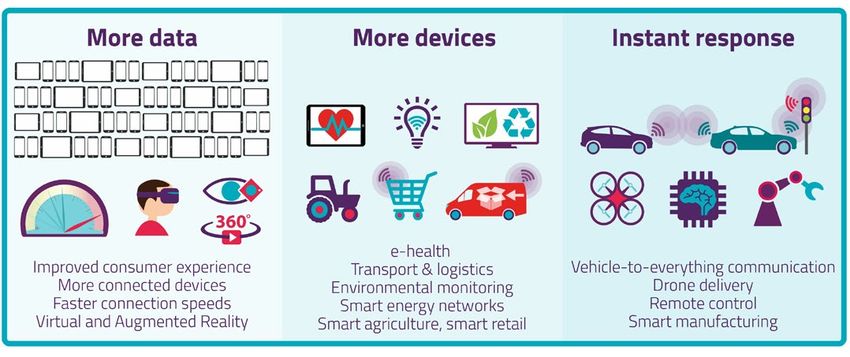
5G: CHALLENGES &
OPPORTUNITIES
5G essentially promises three things: better service and                                                                                                            Yet, there is reason to be optimistic about Canadian mobile
speeds, IoT connectivity and latency improvements for critical                                                                                                      networks and the potential of 5G. The CRTC reported in 2019
services.17 However, the 5G Council of Canada cites three                                                                                                           Canadian telecommunication service providers generated
challenges to widespread deployment; significant capital                                                                                                            more than $100 million in revenues and spent $11.9 billion
investment; availability of spectrum; and efficient regulations                                                                                                     on capital expenditures to upgrade networks, $8.9 billion of
and processes.18                                                                                                                                                    which was spent on wireline networks.21

5G proponents cite the interconnection of machines and                                                                                                              Canada has built impressive internet networks. Telus
devices as a primary benefit (connected vehicles are touted                                                                                                         announced a $16-billion multi-year investment in Alberta in
as a significant breakthrough) though the technical standard                                                                                                        2019 and Shaw invested $20 billion in its network in the last
required to make that possible was only finalized in 2020.19                                                                                                        seven years.
There is a strong correlation between the functionality of
automated vehicles and 5G deployment, but as Forbes                                                                                                                 Tests conducted in 2020 by Seattle-based Ookla on
Magazine cautioned in 2018: “Autonomous cars will become                                                                                                            international 5G performance demonstrates that the 5G
a reality, but it won’t happen until 5G data networks are                                                                                                           offered in Canada stands with some of the best in the world.23
ubiquitous.”20

Figure 3. 5G performance comparison in some G7 countries24

17
   5G Council Canada. 5G Primer. Retrieved from https://www.5gcc.ca/5g-primer/                                          22
                                                                                                                           S haw Communications Inc. (May 27, 2020). Shaw Launches Fibre+ Gig: the Largest Deployment of Gigabit Speeds for
18
   Ibid.                                                                                                                    Residential Internet Customers in Western Canada [Press release]. Retrieved from https://www.globenewswire.com/
19
   Koziol, M. (August 7 2020). 5G Just Got Weird. IEEE Spectrum. Retrieved from https://spectrum.ieee.org/tech-talk/        news-release/2020/05/27/2039453/0/en/Shaw-Launches-Fibre-Gig-the-Largest-Deployment-of-Gigabit-Speeds-for-
telecom/standards/5g-release-16                                                                                             Residential-Internet-Customers-in-Western-Canada.html
20
   Khosravi, B. (March 25, 2018). Autonomous Cars Won’t Work - Until We Have 5G. Forbes. Retrieved from https://www.   23
                                                                                                                            Malik, A. (December 10, 2020). Canada had the third fastest 5G median download speed of G7 countries in 2020:
    forbes.com/sites/bijankhosravi/2018/03/25/autonomous-cars-wont-work-until-we-have-5g/?sh=7f0a2c38437e                    report. Mobilesyrup. Retrieved from https://mobilesyrup.com/2020/12/10/canada-had-the-third-fastest-5g-median-
21
   Canadian Radio-Television and Telecommunications Commission. (2020). Communications Monitoring Report.
Retrieved from https://crtc.gc.ca/pubs/cmr2020-en.pdf                                                                   24
                                                                                                                             download-speed-of-g7-countries-in-2020-report/
                                                                                                                           Ibid.
                                                                                                                                                                                                                                               8
A 2020 study by London-based Opensignal also placed Canada among the top performers
                                       for 5G, far ahead of traditional points of comparison, including the U.S. and U.K.25:

Figure 4. 5G speeds compared to 4G speeds26

               KEY TAKEAWAYS:
               1. Without a strong fibre infrastructure, the                                                                                                       4. T
                                                                                                                                                                        he race to deploy 5G is not about who’s first,
                   potentials of 5G cannot be realized.                                                                                                                but about doing it right.

               2. While 5G was launched in Canada in 2020,                                                                                                         5. 5
                                                                                                                                                                        G may prove to be a key paradigm shift,
                   5G is a technology in development in 2021.                                                                                                          but we will not know for years.

               3. E
                   arly 5G development in Canada shows
                  promise.

25
     Fogg, I. (October 13, 2020). Benchmarking the global 5G user experience – October update. Opensignal. Retrieved from https://www.opensignal com/2020/10/13/
      benchmarking-the-global-5g-user-experience-october-update
26
     Ibid
                                                                                                                                                                                                                          9
CURRENT STATE
IN CALGARY
The City of Calgary launched its Digital Strategy in 2015 to                                                                                                              It is estimated 80 to 85 percent of the cost of deploying fibre is
provide accessible services; pursue and build partnerships; be                                                                                                            putting the wire in the ground. In 2015, for example, the cost
transparent; provide platforms for citizens to participate and                                                                                                            of installing fibre in Calgary that involved digging up roads
value innovation. It then released the 2015 Fibre Infrastructure                                                                                                          was approximately $200 per metre; whereas installing fibre
Strategy to support the Digital Strategy and highlighted the                                                                                                              into an existing conduit was about $11 per metre.”31
criticality of technological innovation in the 2019 economic
strategy Calgary in the New Economy.                                                                                                                                      The City’s Fibre Strategy has been financially beneficial. The
                                                                                                                                                                          City of Calgary Fibre Infrastructure Strategy Annual Update
Since 2001, the City has built 550 kilometres of fibre network                                                                                                            for 2020 reported revenues surpassed the $1 million threshold
across all four of its quadrants on City-owned rights of way.27                                                                                                           in 2019, a 180 per cent increase from 2015 and well above
Calgary is deemed a non-dominant ISP by the CRTC. It leases                                                                                                               the $180,000 projected.”32 However, fiscal challenges saw the
access to its fibre but does not provide internet service or                                                                                                              budget reduced from $20 million in 2015-2018 to $8 million for
network equipment. The fibre remains dark until a service                                                                                                                 2019-2022.
makes use of it.

“Typically, the buildout of broadband infrastructure has been
left to the telecoms. But municipalities are closest to their
residents and should be empowered to respond to their
                                                                                                                                                                                                 TELEPORTATION DEVICE
needs,” wrote consultants KPMG in August 2020 article for the                                                                                                                                    Researchers at the University of Calgary
Globe and Mail.28                                                                                                                                                                                demonstrated the teleportation of a light
                                                                                                                                                                                                 particle’s properties between their lab on
Bell, Telus and Rogers say they have Calgary covered by 5G                                                                                                                                       campus and the city’s downtown, six kilometres
service. Their networks are built upon legacy ADSL copper                                                                                                                                        away in 2016.33 The study received international
wires and coaxial cable, complimented by investments in
                                                                                                                                                                                                 recognition and would not have been possible
fibre deployment and spectrum licenses. Calgary-based Shaw
                                                                                                                                                                                                 without access to a dedicated fibre line.
Communications announced its 5G roll out for early 2021.”29

IN CASE OF EMERGENCY
The 2020 City of Calgary Fibre Infrastructure
Strategy Annual Update reported: “When a city
owns its fibre, it can respond with greater agility
during extreme events. This was exemplified
during the 2013 flood where a catastrophic loss
in network resources was mitigated due to the
control, agility and capacity afforded through
City fibre.”30

27
    ity of Calgary. (2020). Chief Financial Officer’s Report to Gas, Power and Telecommunications. https://pub-
   C                                                                                                                      31
                                                                                                                              ity of Calgary. (December 21, 2015). The City of Calgary - Submission Regarding Notice No. DGTP-002-2015,
                                                                                                                             C
   calgary.escribemeetings.com/filestream.ashx?DocumentId=122883 or https://pub-calgary.escribemeetings.                     Petition to the Governor in Council concerning Telecom Regulatory Policy CRTC 2015-326 by Bell Canada.
   com/filestream.ashx?DocumentId=123167                                                                                     Retrieved from https://www.ic.gc.ca/eic/site/smt-gst.nsf/vwapj/DGTP-002-2015-CityofCalgary-Submission.
28
    Benay, A. (August 28, 2020). Why cities are key to a connected Canada. The Globe and Mail. Retrieved from https://      pdf/$FILE/DGTP-002-2015-CityofCalgary-Submission.pdf
     www.theglobeandmail.com/business/commentary/article-why-cities-are-key-to-a-connected-canada/                        32
                                                                                                                             City of Calgary. (2020). Chief Financial Officer’s Department – Information Technology: Fibre infrastructure
29
   Shaw Communications Inc. (2021). Shaw Mobile: about 5G. Retrieved from https://support.shaw.ca/t5/mobile-                 strategy annual update. https://pub-calgary.escribemeetings.com/filestream.ashx?DocumentId=122884
    articles/shaw-mobile-about-5g/ta-p/20370                                                                              33
                                                                                                                              Fletcher, R. (September 20, 2016). Teleportation across Calgary marks ‘major step’ toward creation of ‘quantum
30
     City of Calgary. (2020). Chief Financial Officer’s Department – Information Technology: Fibre infrastructure             internet’. CBC News. Retrieved from https://www.cbc.ca/news/canada/calgary/calgary-teleportation-quantum-            10
      strategy annual update. https://pub-calgary.escribemeetings.com/filestream.ashx?DocumentId=122884                        networking-city-hall-1.3770440
Municipally owned fibre and private fibre infrastructure are
not in competition. The City does not provide internet service
but does provide broadband access. IoT SENSORS
Calgary is home to one of North America’s First
Wireless service providers typically build their own 5G
infrastructure to ensure network reliability and flexibility to City-owned-Long Range Low Power Wide-
build additional infrastructure in the future. Private businesses Area Network (LoRaWAN). It gives the City, and
can use municipal fibre for testing applications and the City’s businesses, an opportunity to experiment with
fibre deployment was created with intentional excess capacity IoT sensors that use LoRaWAN to keep informed
to facilitate future technology developments.34 of everything from air quality to soil conditions,
to river activity.38 It is a technology advancement
The City’s fibre network connects most municipal buildings,
that would not happen without the fibre base.
civic partners, non-profits and businesses deploying network
applications. The City’s fibre network manages light rail transit
operations and a grid to ensure clean drinking water. It is
open access, and the City advertises fibre network speeds and
bandwidth capacity are virtually unlimited.35
Calgary is one of many cities exploring the creation of
innovation districts that are potential 5G innovators.
A 2014 report “The Rise of Innovation Districts” from the
Brookings Institution noted “In the United States, districts
are emerging near anchor institutions in the downtowns and
midtowns of cities like Atlanta, Baltimore, Buffalo, Cambridge,
Cleveland, Detroit, Houston, Philadelphia, Pittsburgh, St. Louis
and San Diego. They are developing in Boston, Brooklyn,
Chicago, Portland, Providence, San Francisco and Seattle
where underutilized areas (particularly older industrial
areas) are being re-imagined and remade.”36 These districts
serve to enable technology ecosystems with a foundation
of digital infrastructure to support pilots and testing of new
technologies and their applications.
The City is working to create a 5G application test zone in
downtown Calgary. In collaboration with wireless service
providers, it created guidelines and processes to test 5G,
including drafting an open access policy for smaller wireless
service providers to access the infrastructure.
In addition to local accelerators including Platform, Harvest
Builder, Creative Destructive Labs-Rockies and others, Toronto-
based MaRS, North America’s largest urban innovation hub,
announced it was in talks with the University of Calgary
to create a hub to support Alberta’s growing innovation
economy.37
By encouraging experimentation along an extensive dark fibre
foundation, Calgary positions itself at the forefront of what is
to come.
34
City of Calgary. (2020). Access the City of Calgary’s dark fibre. https://www.calgary.ca/cfod/it/Pages/Dark-fibre.aspx
35
Ibid
36
Katz, B., & Wagner, J. (May, 2014). The Rise of Innovation Districts: A New Geography of Innovation in America. Brookings Institution. Retrieved from https://
www.brookings.edu/essay/rise-of-innovation-districts/
37
MaRS. (Sept 23, 2020). MaRS seeking to bring hub model to Calgary to accelerate the innovation economy [Press release]. Retrieved from https://www.marsdd.
38
com/media-centre/mars-seeking-to-bring-hub-model-to-calgary-to-accelerate-the-innovation-economy/
City of Calgary. (2020). Smart city story: Long range, low power technology. https://www.calgary.ca/general/smartcity/lorawan.html
11CALGARY COMPARED
WITH CANADIAN CITIES 39
Based on research for this study, and previous work by the Local Internet Exchange Point (IXP): A local IXP ensures data
author, the following criteria were used to determine a city’s largely avoids the expense and latency time of traveling to a
preparedness for development of 5G and overall connectivity. host server in another city or country. Local IXPs can increase
response speeds and offer an alternative to data traffic
Municipal Fibre: 5G moves at the speed of fibre. Municipal crossing jurisdictional boundaries such as the U.S. border to
dark fibre is accessible to any party including private business. major exchanges such as Seattle. Public internet exchanges
Municipalities regularly have cause to dig and it reduces a provide open, non-proprietary pathways for data to travel
major expense of fibre deployment. Fibre availability is an from one point to another.
essential indicator of a municipalities’ 5G preparedness.
5G Policy Process: A streamlined approach for wireless
Digital Action Plan: An overarching strategy demonstrates service providers and other businesses to deploy and test 5G
commitment to a coordinated, intentional and comprehensive eases administrative challenges, reduces costs and provides
approach to 5G and connectivity. Strategies often identify certainty. It also signals a municipality is interested in working
critical risks and opportunities presented by 5G and provide with businesses, including development of policies, guidelines
confidence a municipality understands how to mitigate and and processes related to building 5G infrastructure.
manage these.
In the summer and fall of 2020, interviews were conducted
The Government of Canada launched the Smart Cities with officials from seven municipalities in Canada. The
Challenge in 2017, with winners in various categories purpose was to understand where Calgary stood in terms of
announced in 2019. Some Canadian cities still cite their Smart 5G preparedness and overall municipal connectivity. Each
City plans as synonymous with a digital strategy; however, municipality was asked similar questions:
for purposes of this comparison, this report did not see Smart
1. Do you have your own municipal fibre?
City plans as comparable to a clear digital strategy since those
plans often were not accompanied by clear policy direction. 2. Does your city have a formal digital strategy?
Still, points from the Smart strategies are discussed in this 3. Do you have a broad publicly accessible Wi-Fi network?
section. 4. Does the municipal government support the local IXP?
Public Wi-Fi Network: If a city is committed to a digital future, 5. What is the permit process for 5G infrastructure access?
citizens must always be able to access connectivity. Since
Canada has consistently high mobile rate costs in international
comparisons, a public Wi-Fi network ensures no one is
excluded. Public Wi-Fi is indicative of a connected city.
CANADIAN CITIES: Points of Comparison
Municipal Digital Public Municipal 5G specific
Fibre Action plan Wi-Fi relationship agreement
Network or Strategy network with local IXP structures with City
Calgary Yes Yes Yes Yes Yes
Vancouver Yes Yes Yes Yes No
Edmonton Yes Yes Yes No No
Winnipeg No No Yes No No
Toronto No Yes Yes No No
Ottawa No Yes Yes No No
Montreal No Yes Yes No Yes
Halifax No No Yes No No
39
Significant contributions from University of Calgary PhD student Katelyn Anderson.
12Calgary
Calgary’s digital advantages go well beyond its extensive fibre require extensive coordination with municipal authorities.
foundation. For example, access to streetlight posts and other city-owned
infrastructure are required to provide the kind of short-radius,
Calgary’s municipal Wi-Fi network is an effective municipal- high data volume needed to realize the applications of 5G.
private partnership. In 2013, Shaw Communications was
selected to construct a publicly accessible Wi-Fi network Calgary is leading the national movement for a coordinated
available to City-owned sites, including recreation facilities, effort to standardize the policy process of putting 5G
parks and LRT stations. infrastructure into the urban environment.
The non-profit Calgary Internet Exchange (YYCIX) provides
a free or low-cost option for community organizations and
businesses to increase transfer speeds by increasing the
quality and quantity of connections. The City of Calgary hosts
some of the exchange’s switches in its data centres, and any
other entity leasing City fibre can cross-connect at no charge.
“With support from City Fibre Infrastructure, YYCIX has quickly
become the fourth largest IX in Canada,” said the 2017 Digital
Infrastructure Update.40 “An entire community can benefit
from having a local IX ... those benefits include improved
internet experience; encouraging competition, including
smaller ISPs; lower prices; enhanced security, because traffic
stays local; and attracting large technology companies and
content providers.”41 Vancouver
Along with local IXPs, processing of information at data The City of Vancouver’s digital strategy is guided by a Smart
centres is also crucial to reduce latency. In a 2018 article Cities plan from a 2019 Infrastructure Canada competition.
entitled With 5G on the Horizon, Startups See Potential in
Small Data Hubs the Wall Street Journal noted the growth The City received significant support when fibre optic cables
in “localized data centres to process data quickly for specific were installed ahead of the 2010 Olympics and today it owns
towns and neighborhoods”.42 How data centres are locally and operates more than 300 kilometres of fibre connecting
organized in a city will impact the performance of 5G. more than 200 locations. Where the City does not have fibre, it
leases from Telus.
When 13 of Bell’s major data centres in Canada, including three
in Calgary, were purchased by international group Equinix in The network has grown since 2015 thanks to a “dig once”
202043 Theo de Raadt, Network Manager for YYCIX, said “this is program and now installs conduit as part of routine municipal
going to make a bigger difference in the internet (in Calgary) construction. The City also has micro trench fibre built
over the next four years than anything else that’s going to into sidewalks that, while fragile, is low cost to install. It is
happen.” implementing IoT pilot projects, including using 5G to monitor
street lighting, parking metres and locate traffic efficiencies,
De Raadt sees strong benefits for smaller and newer service which includes building a conceptual model for smart vehicles.
providers offering 5G services which needs fast latency.
Companies with relationships with Equinix elsewhere in the Vancouver is the only city other than Calgary that has a formal
world may find it easier to establish in Calgary. The often- relationship with its IXP, the Vancouver Internet Exchange
invisible elements such as data centres, exchange points and (VANIX). The City has a presence within VANIX’s main location
fibre offer a solid foundation for Calgary connectivity. at Harbour Centre, as well as in smaller subsidiary locations.
Calgary is working with wireless service providers on a The City’s public Wi-Fi network has more than 600 sites and
new process for rapid 5G deployment with a streamlined has been run at different stages by Telus and Shaw. The City
approach to access City-owned infrastructure.44 The City has offered incentives in permitting processes in underserved
and ENMAX Telecommunications Services Inc. are working areas if the carrier includes public Wi-Fi as part of the project.
on a partnership to leverage assets such as streetlight poles The City is developing its plans to access to city infrastructure
and power poles to serve 5G.45 By its very design, 5G will for 5G.
40
City of Calgary. (2017). Chief Financial Officer’s Department – Information Technology: Fibre infrastructure strategy 44
City of Calgary. (2021). Wireless infrastructure deployment – submit inquiry. Retrieved from https://www.calgary.ca/
annual update. https://pub-calgary.escribemeetings.com/filestream.ashx?DocumentId=32757 cs/iis/wireless-infrastructure/wireless-infrastructure.html
41
Ibid 45
ity of Calgary. (2020). Chief Financial Officer’s Report to Gas, Power and Telecommunications. https://pub-calgary.
C
42
FitzGerald, D. (September 12, 2018). With 5G on the Horizon, Startups See Potential in Small Data Hubs. The Wall St. escribemeetings.com/filestream.ashx?DocumentId=122883 or https://pub-calgary.escribemeetings.com/filestream.
Journal. Retrieved from https://www.wsj.com/articles/with-5g-on-the-horizon-startups-see-potential-in-small-data- ashx?DocumentId=123167
hubs-153680412
Equinix. (June 1, 2020). Equinix to Expand Canadian Operations with US$750 Million Acquisition of 13 Bell Data Center
13
43
Sites [Press release]. Retrieved from https://www.equinix.com/newsroom/press-releases/pr/123952/Equinix-to-
Expand-Canadian-Operations-with-US-Million-Acquisition-of--Bell-Data-Center-Sites/Edmonton
The City of Edmonton owns and operates more than 200
kilometers of fibre but does not lease to third parties. The City
operates its network while Edmonton Transit has a separate
network. The City sees its role as working with carriers rather
than as a broadband service provider.
The City’s Digital Action Plan was adopted in 2019 and a
further report is due in 2021.46
The City’s Open City public Wi-Fi network is operated by
Shaw, provides 1,100 access points in the city. It is free but,
for example, does not permit “Peer to Peer” program (e.g.,
BitTorrent, KaZaa, Gnutella, Morpheus).47
The City of Edmonton does not have a formal relationship
with the Edmonton Internet Exchange (YEGIX). In 2020, peers
of YEGIX included AXIA Connect, Cybera, Edmonton Public
Library, Hurricane Electric, MacEwan University and University
of Alberta.
The City is in discussions with telecommunication companies
about its 5G permit process, specific to its fee structure and
creating a competitive marketplace. It is examining rates, as
the smaller 5G antennas do not take up as much real estate as
existing infrastructure. However, more are required. Winnipeg
The vast majority of the City is covered by a municipal Winnipeg does not have its own fibre network, instead it
LoRaWAN that monitors soil moisture, gathers data on predominantly leases fibre needed to operate. The City had a
pedestrian traffic, provides connectivity to City facilities growing municipal fibre network but lost it when Winnipeg
and traffic intersection signal controls. Rather than 5G, the Hydro was bought by Manitoba Hydro in 2002, forcing the City
infrastructure consists of six radio towers that use licensed to lease the network. In 2006, Winnipeg built a ring of shallow
and unlicensed spectrum frequencies. The project is like the trench fibre throughout the City. Burying the fibre closer to the
LoRaWAN system in Calgary. The current pilot projects do not surface reduced costs on the initial installation and allowed
require immediate real time communication and positions the for easier repair access. However, the repairs were frequent
city well for the introduction of 5G. due to road construction and the fibre was vulnerable to
extreme temperature changes in Winnipeg. This experience
demonstrates the importance of local considerations; a
one-size-fits-all strategy for fibre deployment is not always
successful.
The Winnipeg Smart Cities was developed in 2018.48
The strategy acts as a framework to develop a culture of
innovation, identify Smart City opportunities and build an
overarching digital framework.
Winnipeg’s City Wi-Fi has 50 locations with no technical data
caps. In addition, Shaw Go has 150 sites in the city. The City
piloted free Wi-Fi on buses but discontinued it due to high
cost. Winnipeg has two public internet exchanges, but the City
does not connect with them or have a formal relationship.
Winnipeg does not have a permitting structure in place for 5G
but is working to ensure the permitting process is effective as
possible.
46
City of Edmonton. (2019). Edmonton’s Digital Action Plan 2019. Retrieved from https://www.edmonton.ca/city_government/documents/CoE_Digital-Action-Plan.pdf
47
City of Edmonton. (2021). Open City Wi-Fi. Retrieved from https://www.edmonton.ca/programs_services/open-wifi.aspx
48
City of Winnipeg. (2019). Smart Cities Challenge Proposal. Retrieved from https://winnipeg.ca/interhom/SmartCitiesChallenge/CoW-Smart_Cities.pdf
14Ottawa
The City of Ottawa does not own a substantial municipal
network, but has some fibre assets, including for traffic
operations as well as fibre owned by Hydro Ottawa. While
there is “a lot of legend of dark fibre” due to the growth of
Nortel in the 1990s, it is not prevalent and is already being
utilized.
Ottawa’s Smart City Strategy includes plans to assess the state
of connectivity and provide a framework to ensure residents
and businesses have access to affordable, high-speed internet.
The plan was updated in 2019, introducing Open Ottawa Beta,
a public data portal.
Ottawa is unique as much of the population of the Capitol
Region is rural, which poses a challenge for delivering high-
speed internet service. There is less incentive for investment as
Toronto customers are spread out. Low band 5G has been discussed as
a potential solution to solving rural connectivity issues.
Toronto’s digital action plan is not a formal document but
consists of two pieces of strategy. One looks at internal Ottawa has a public Wi-Fi program, which is offered at 30
processes, such as how the City can leverage data, guard locations, including municipal recreation centres, as well as
against siloed decision making, and inform day-to-day public Wi-Fi available at public libraries. It also has free public
decisions. The other revolves around digital infrastructure, Wi-Fi on train platforms, operated by Telus.
including developing a strategy to enable coordinated
response to outside proposals. Ottawa does not have a formal relationship with its public
internet exchange, National Capital Internet Exchange,
The City cites Toronto’s competitive marketplace for internet operating as Ottawa-Gatineau Internet Exchange. Ottawa
service providers as why it has not offered its own municipal is working on its 5G permitting process as carriers currently
network. Most Torontonians have access to the CRTC’s apply under the existing rights-of-way permit process.
minimum speeds (50 megabytes per second download, 10
mbps upload) but affordability is sometimes a challenge.
The City has a limited public Wi-Fi network. Wi-Fi is available
at a handful of civic centres, parts of public transit and City-
owned recreation centres. Public libraries offer their own
public Wi-Fi.
Toronto launched a low-income Wi-Fi project in 2020 with
free internet access for 25 buildings across the city. With
contributions from Cisco and Bell, it is implementing a fixed
wireless system, by running fibre to rooftops and installing
access points aimed at buildings.
Toronto has Canada’s largest public internet exchange, TORIX,
but the City does not have a formal relationship with the IXP.
It also does not have a dedicated procurement process for
5G access but is looking to address rights-of-way concerns
created by 5G.
In January 2021, Toronto launched a proposal to build a
broadband network called ConnectTO similar to what Calgary
developed over two decades to complement private service
providers by filling gaps in fibre connectivity to underserved
areas.
15Montreal
Montreal is seen as a leader in 5G development. The City
of Montreal won Infrastructure Canada’s first Smart Cities
challenge in 2019, which came with a $50 million investment.
The City’s digital action plan, launched in 2015, calls for
funding to fast-track fibre-to-the-home, an inventory of the
City’s available fibre and real-time transit data for citizens.49
The City does not have its own municipal network, but leases
most of the fibre it uses. It has launched a review to revaluate
its existing fibre assets and future business plan.
Montreal has a large public Wi-Fi network that is a partnership
Halifax
between the municipality and ZAP and has 850 access Halifax is assessing its fibre assets. While the city owns some
points. The network is an evolution of non-profit, Ils Sans Fil, dark fibre, the process aims to get a better sense of the state
one of Canada’s first public Wi-Fi networks. With the City’s of municipal network infrastructure. The municipality’s plan
involvement, they reduce costs by building the fibre for Wi-Fi to create a report aimed at building a digital strategy was
connection while doing municipal construction. delayed by COVID-19 related budget cuts in 2020.
Montreal does not have a formal relationship with its public The City’s Municipal Public Wi-Fi initiative has 10 locations,
internet exchange, the non-profit Montreal Internet Exchange. which are operated by Bell. In addition, the public Wi-Fi is
available at Halifax Public Libraries. Halifax has an internet
Montreal is working with providers to test 5G, gain insight
exchange, HFXIX, which has been operating since 2014,
into the technology and right-of-way permitting for 5G. The
however the City does not have a formal relationship with it.
City is working in collaboration with Encqor, funded by the
federal government, Quebec and Ontario, to create an open There is no dedicated permit process for 5G infrastructure and
platform to test 5G technology and use cases. Encqor includes the City deals with requests on a case-by-case basis. Central
the City, university research centres and entrepreneurs to to the City’s review process is assessing the public versus
identify use cases and find solutions to challenges that arise as commercial benefits for the technology.
a consequence of 5G.
Montreal also has a pilot project zone downtown where it
is testing 5G infrastructure. The aim is to create a “drag and KEY TAKEAWAYS
drop” permitting solution to install 5G antennas on City
1. C
algary is the only city in this survey that
infrastructure.
scored positively in all criteria.
2. T
here is intense competition to attract
high tech industries and strategies for 5G
and digital development vary greatly.
3. A city’s connectivity options are more
limited without a municipally owned
fibre foundation.
4. There is no one-size-fits-all strategy.
Local considerations must be factored
into planning.
5. A city benefits from essential
infrastructure elements including
a formal relationship with the local
internet exchange and data centres to
support 5G.
49
Montréal. (May 2015). Montréal: Smart and Digital City. Retrieved from https://laburbain.montreal.ca/sites/villeintelligente.montreal.ca/files/plan-action-bvin-ce-6-mai-2015-eng.pdf
16CONCLUSION: BECOMING
“CANADA’S MOST CONNECTED CITY”
There is no one path to building a connected city that For years, the City of Calgary has been making decisions
provides opportunity for growth and experimentation in new to put itself at the forefront of Canadian municipal digital
mobile technologies, but there is strong reason to conclude infrastructure with great opportunities for growth. Given the
Calgary is positioned to act as a centre for 5G development direct relationship between 5G and fibre, Calgary’s wealth of
and application. privately developed and municipally owned options should be
attractive to potential 5G-based digital industries.
Calgary has a wealth of digital riches: excess fibre capacity
allows more smaller or middle-size players to have more Calgary has positioned itself in such a way as to offer real
choice to reach wider locations or build up infrastructure strength and innovation in the development of 5G. The
they require. The City also assists with clear regulations and foundation is here. As this report demonstrates, there is
processes. ample evidence to say Calgary is a leading Canadian city in 5G
preparedness and overall connectivity.
Calgary has an opportunity to make the claim to be Canada’s
most connected city. In the past two decades, it demonstrated
remarkable policy and process foresight that makes it an
attractive place to develop 5G technologies and applications.
KEY RECOMMENDATIONS
As the comparisons with other Canadian cities demonstrate, 1. Build for the future, not just 5G. The underlying
Calgary is well positioned among its urban peer group.
technology must be generationally agnostic. 6G
The wireless world is changing rapidly and new opportunities is already in development.54
are emerging.
2. Municipalities must be recognized for their
The COVID-era has demonstrated that geographic proximity essential role in getting this right. 5G will have a
to the industrial centre of the digital world was no longer a major impact on municipal infrastructures such
central concern for a great number of workers. What matters as streetlights and utility poles. Cities need a
is the quality of life and the ability to access reliable digital unified voice and a seat at the table with other
infrastructure. orders of government for decisions that affect
In January 2021, a New York Times story headlined They them.
Can’t Leave the Bay Area Fast Enough, chronicled the rapid
3. G
overnment has a role to play; private sector
movement of high-tech companies from the San Francisco
infrastructure should not be the only option.
area in search of better standards of living for employees.50
Partnerships with industry can work when
Perhaps some will look north, considering Canada was listed municipalities work with the WSPs to develop
#1 for quality of life in a 2020 study by U.S. News and World guidelines and policies related to 5G, as the
Report, particularly being popular with millennials. Calgary City of Calgary continues to do. Policy foresight
has ranked in the top five most liveable cities in the world is essential and this has been exemplified in
for each of the past 10 years in The Economist Intelligence Calgary.
Unit’s Global Liveability Index. In 2019, it was named the most
liveable city in North America and fifth most livable in the 4. D
ig once. It is unfortunate we are still
world.52 saying this in 2021. Fibre is cheap, digging is
expensive.
However, none of these accolades will matter unless Calgary
has the foundation to support a growing tech sector. There is 5. A
dopt an “if you build it, they will come”
still much work to do: in one 2020 study, Calgary ranked 51st philosophy. There are no guarantees of success,
of 100 cities worldwide in emerging ecosystems for business
however, without a solid technological and
start-up opportunity.53
administrative foundation, there is little chance
Calgary is also hardly alone in trying to attract new digital of making your city into a location of choice.
business opportunities.
50
Bowles, N. (January 14, 2021). They Can’t Leave the Bay Area Fast Enough. New York Times. Retrieved from https://www.nytimes.com/2021/01/14/technology/san-
francisco-covid-work-moving.html
51
.S. News. (2020). Overall Best Countries Ranking. Retrieved from https://www.usnews.com/news/best-countries/overall-rankings
U
52
Kaufmann, B. (September 4, 2019). Calgary edges out Vancouver and Toronto to rank as world’s fifth most livable city: the Economist. Calgary Herald. Retrieved from
https://calgaryherald.com/news/local-news/calgary-edges-out-vancouver-and-toronto-to-rank-as-worlds-fifth-most-liveable-city-the-economist
Startup Genome. (2020). Rankings 2020: Top 100 Emerging Ecosystems. Retrieved from https://startupgenome.com/ecosystems/calgary
17
53
54
Segan, S. (December 11, 2020). What is 6G? PC Magazine. Retrieved from https://www.pcmag.com/news/what-is-6gLIST OF REFERENCES
1. Federal Communications Commission. (Jan 15, 2021) First Phase of Record-Breaking 5G Spectrum Auction Concludes. https://www.fcc.gov/
document/first-phase-record-breaking-5g-spectrum-auction-concludes
2. C
anadian Radio-Television and Telecommunications Commission. (2020). Communications Monitoring Report. Retrieved from https://crtc.
gc.ca/pubs/cmr2020-en.pdf
3. 5
G Council Canada. 5G Primer. Retrieved from https://www.5gcc.ca/5g-primer/
4. Ofcom. (2021). What is 5G? Retrieved from https://www.ofcom.org.uk/phones-telecoms-and-internet/advice-for-consumers/advice/what-is-
5g
5. Koziol, M. (August 7 2020). 5G Just Got Weird. IEEE Spectrum. Retrieved from https://spectrum.ieee.org/tech-talk/telecom/standards/5g-
release-16 see also https://www.itu.int/en/mediacentre/Pages/pr26-2020-evaluation-global-affirmation-imt-2020-5g.aspx
6. Finley, K., & Pealstein, J. (Sept 10, 2020). The Wired Guide to 5G. Wired. Retrieved from https://www.wired.com/story/wired-guide-5g/
7. Innovation, Science and Economic Development (June 2019). Decision on Releasing Millimetre Wave Spectrum to Support 5G. Retrieved from
https://www.ic.gc.ca/eic/site/smt-gst.nsf/vwapj/SLPB-003-19EN.pdf/$file/SLPB-003-19EN.pdf
8. Gruppo Tim. (2017). Future use of millimetre waves for 5G Session 9: Towards the WTDC 2017 and WRC 2019. Retrieved from https://www.itu.
int/en/ITU-D/Regional-Presence/Europe/Documents/Events/2017/Spectrum%20Management/Simoni%20-%20Future%20use%20of%20
millimetre%20waves%20in%205G%20v1.1.pdf
9. J ackson, B. (June 6, 2018). 5G spectrum auctions to be complete by 2021, says Innovation Minister. IT World Canada. Retrieved from https://
www.itworldcanada.com/article/5g-spectrum-auctions-to-be-complete-by-2021-says-innovation-minister/406006
10. B
ains, N. (June 6, 2018). Speech: 2018 Canadian Telecom Summit. Retrieved from https://www.canada.ca/en/innovation-science-economic-
development/news/2018/06/2018-canadian-telecom-summit.html
11. Langenberg, A. (June 29, 2020). Experts say 5G will eventually deliver, but a speed boost for now. The Wire Report. Retrieved from https://
www.thewirereport.ca/2020/06/29/experts-say-5g-will-eventually-deliver-but-just-a-speed-boost-for-now/
12. T aylor, G., Anderson, K., & Cramer, D. (March, 2021). Municipal digital infrastructure and the COVID-19 pandemic: A case study of Calgary,
Canada. Journal of Digital Media & Policy, 1(12).
13. Segan, S. (2016). What is 5G? PC Magazine. Retrieved from https://www.pcmag.com/news/what-is-5g
14. M
cDowell, R. M. (Sept 27, 2018). To Boost 5G, Keep the Industry Free. Wall Street Journal. Retrieved from https://www.wsj.com/articles/to-
boost-5g-keep-the-industry-free-1538088285
15. Rosenworcel, J. (June 18, 2019). Choosing the Wrong Lane in the Race to 5G. Wired. Retrieved from https://www.wired.com/story/choosing-
the-wrong-lane-in-the-race-to-5g/?GuidesLearnMore
16. Canadian Wireless Telecommunications Association. (2020). Telecommunications Industry Directly Contributes $74.5 Billion Annually to
Canada’s Economy and Supports 638,000 Jobs, According to New Report Retrieved from https://www.cwta.ca/
17. 5G Council Canada. 5G Primer. Retrieved from https://www.5gcc.ca/5g-primer/
18. Ibid.
19. K
oziol, M. (August 7 2020). 5G Just Got Weird. IEEE Spectrum. Retrieved from https://spectrum.ieee.org/tech-talk/telecom/standards/5g-
release-16
20. K
hosravi, B. (March 25, 2018). Autonomous Cars Won’t Work - Until We Have 5G. Forbes. Retrieved from https://www.forbes.com/sites/
bijankhosravi/2018/03/25/autonomous-cars-wont-work-until-we-have-5g/?sh=7f0a2c38437e
21. C
anadian Radio-Television and Telecommunications Commission. (2 20). Communications Monitoring Report. Retrieved from https://crtc.
gc.ca/pubs/cmr2020-en.pdf
22. Shaw Communications Inc. (May 27, 2020). Shaw Launches Fibre+ Gig: the Largest Deployment of Gigabit Speeds for Residential Internet
Customers in Western Canada [Press release]. Retrieved from https://www.globenewswire.com/news-release/2020/05/27/2039453/0/en/
Shaw-Launches-Fibre-Gig-the-Largest-Deployment-of-Gigabit-Speeds-for-Residential-Internet-Customers-in-Western-Canada.html
1823. M
alik, A. (December 10, 2020). Canada had the third fastest 5G median download speed of G7 countries in 2020: report. Mobilesyrup.
Retrieved from https://mobilesyrup.com/2020/12/10/canada-had-the-third-fastest-5g-median-download-speed-of-g7-countries-in-2020-
report/
24. Ibid.
25. Fogg, I. (October 13, 2020). Benchmarking the global 5G user experience – October update. Opensignal. Retrieved from https://www.
opensignal.com/2020/10/13/benchmarking-the-global-5g-user-experience-october-update
26. Ibid.
27. City of Calgary. (2020). Chief Financial Officer’s Report to Gas, Power and Telecommunications. https://pub-calgary.escribemeetings.com/
filestream.ashx?DocumentId=122883 or https://pub-calgary.escribemeetings.com/filestream.ashx?DocumentId=123167
28. Benay, A. (August 28, 2020). Why cities are key to a connected Canada. The Globe and Mail. Retrieved from https://www.theglobeandmail.
com/business/commentary/article-why-cities-are-key-to-a-connected-canada/
29. Shaw Communications Inc. (2021). Shaw Mobile: about 5G. Retrieved from https://support.shaw.ca/t5/mobile-articles/shaw-mobile-about-
5g/ta-p/20370
30. C
ity of Calgary. (2020). Chief Financial Officer’s Department – Information Technology: Fibre infrastructure strategy annual update. Retrieved
from https://pub-calgary.escribemeetings.com/filestream.ashx?DocumentId=122884
31. City of Calgary. (December 21, 2015). The City of Calgary - Submission Regarding Notice No. DGTP-002-2015, Petition to the Governor in
Council concerning Telecom Regulatory Policy CRTC 2015-326 by Bell Canada. Retrieved from https://www.ic.gc.ca/eic/site/smt-gst.nsf/
vwapj/DGTP-002-2015-CityofCalgary-Submission.pdf/$FILE/DGTP-002-2015-CityofCalgary-Submission.pdf
32. C
ity of Calgary. (2020). Chief Financial Officer’s Department – Information Technology: Fibre infrastructure strategy annual update. https://
pub-calgary.escribemeetings.com/filestream.ashx?DocumentId=122884
33. F letcher, R. (September 20, 2016). Teleportation across Calgary marks ‘major step’ toward creation of ‘quantum internet’. CBC News.
Retrieved from https://www.cbc.ca/news/canada/calgary/calgary-teleportation-quantum-networking-city-hall-1.3770440
34. City of Calgary. (2020). Access the City of Calgary’s dark fibre. Retrieved from https://www.calgary.ca/cfod/it/Pages/Dark-fibre.aspx
35. Ibid.
36. Katz, B., & Wagner, J. (May, 2014). The Rise of Innovation Districts: A New Geography of Innovation in America. Brookings Institution.
Retrieved from https://www.brookings.edu/essay/rise-of-innovation-districts/
37. M
aRS. (Sept 23, 2020). MaRS seeking to bring hub model to Calgary to accelerate the innovation economy [Press release]. Retrieved from
https://www.marsdd.com/media-centre/mars-seeking-to-bring-hub-model-to-calgary-to-accelerate-the-innovation-economy/
38. C
ity of Calgary. (2020). Smart city story: Long range, low power technology. https://www.calgary.ca/general/smartcity/lorawan.html
39. S ignificant contributions from University of Calgary PhD student Katelyn Anderson.
40. City of Calgary. (2017). Chief Financial Officer’s Department – Information Technology: Fibre infrastructure strategy annual update. https://
pub-calgary.escribemeetings.com/filestream.ashx?DocumentId=32757
41. Ibid.
42. FitzGerald, D. (September 12, 2018). With 5G on the Horizon, Startups See Potential in Small Data Hubs. The Wall St. Journal. Retrieved from
https://www.wsj.com/articles/with-5g-on-the-horizon-startups-see-potential-in-small-data-hubs-153680412
43. Equinix. (June 1, 2020). Equinix to Expand Canadian Operations with US$750 Million Acquisition of 13 Bell Data Center Sites [Press release].
Retrieved from https://www.equinix.com/newsroom/press-releases/pr/123952/Equinix-to-Expand-Canadian-Operations-with-US-Million-
Acquisition-of--Bell-Data-Center-Sites/
44. C
ity of Calgary. (2021). Wireless infrastructure deployment – submit inquiry. Retrieved from https://www.calgary.ca/cs/iis/wireless-
infrastructure/wireless-infrastructure.html
45. City of Calgary. (2020). Chief Financial Officer’s Report to Gas, Power and Telecommunications. https://pub-calgary.escribemeetings.com/
filestream.ashx?DocumentId=122883 or https://pub-calgary.escribemeetings.com/filestream.ashx?DocumentId=123167
19You can also read


