Occupancy & Daylight Sensor Solutions - Flexibility Versatility Simplicity - Jademar Lighting
←
→
Page content transcription
If your browser does not render page correctly, please read the page content below

Occupancy & Daylight Sensor Solutions

   Flexibility   Versatility   Simplicity

20 / 21

Table of Contents

Foreword .............................................................. 1
About TRANS Sensor Family ................................. 2
Interchangeable EMO ............................................ 3
Friendly Configuration ............................................ 3
                        ....................................
Diverse Mounting Options				4
                       ....................................
Changeable Lens Options				4
                      ............................................
Versatile Applications					5
TRANS Occupancy Sensor				6
                      ...................................
                     .........................................
TRANS Daylight Sensor					10
Appendix ...............................................................
             						12
FOREWORD
Many unoccupied spaces with continued lighting operations result
in a substantial waste of energy for non-residential buildings.
Numerous case studies and reports have concluded substantial
energy savings through broad application of occupancy and
daylight sensing controls. As a dedicated manufacturer of sensor
and control solutions for sustainable buildings, IR-TEC strive to
develop more sensors that not only provide excellent occupancy
and daylight sensing performances, but also offer versatile controls
to help achieve maximum energy savings.

 Maximizing energy savings
 through broad application of
 occupancy and daylight sensing controls

                                                                       TRANS   1
About TRANS Sensor Family
    Introducing the TRANS from IR-TEC, a standalone control sensor family developed
    from an industry leading design innovation that delivers interchangeable Electrical,
    Mechanical, and Optical options to its members.

    This innovative modular concept has helped creating the TRANS family with numerous
    types of occupancy and daylight sensors featuring distinctive functionality and electrical
    characteristics to achieve the highest level of energy saving performance.

    The TRANS sensor family ranges
              •   from occupancy to daylight sensors
              •   from line voltage to low voltage power
              •   from single PIR/HFD to dual technology
              •   from for indoor use to IP-66 wet location
              •   from for high-bay to wide angle detection
              •   from for load switching to BMS signaling
              •   from manual setting to remote programming
              •   from 24-hour sensing to ambient light inhibited
              •   from for fixture integration to building installation
              •   from for standalone control to system integration
              •   from for on-off switching to DALI/0-10V dimming
              •   from multi-level StepDIM to continuous SmartDIM

2   TRANS
Interchangeable EMO
Not all applications have the same conditions and control requirements, thus different
types of sensor may be required for mounting at different heights in different ways. The
innovative “Interchangeable EMO” design concept helps create the TRANS sensor family
with unparalleled flexibility.

                                                                    E Electrical

                                                                    M Mechanical

                                                                    O Optical

Numerous types of sensor featuring distinctive power supply, switching/dimming control,
and signaling output are available in the same appearance. Most TRANS sensors can be
flexibly integrated with OEM luminaires or mounted on the ceilings with different mounting
brackets. Multiple lens options can be selected for PIR based TRANS sensors to provide
different detection coverage at different mounting heights.

Simple and User Friendly Configurations

Most sensors require certain settings, such as control
scheme, delay time, ambient lux threshold, dim level…etc. to
achieve optimal control performance. TRANS sensors employ
DIP switches, Accu-Set potentiometers, or 2-way IR remote
programmer to make sensor setting an easy, intuitive, and
always accurate job.

                                                                                             TRANS   3
Diverse Mounting Options
    Not only does the structural diversity of today's building spaces require ceiling sensors to be mounted in
    many different options, the diversity of luminaires in the market today can also make sensor integration a
    challenge.

    To spread the use of sensors, TRANS offers diverse mounting options for all types of applications. The
    TRANS sensor can be directly integrated or externally attached with OEM luminaires for indoor or outdoor,
    flexibly installed on the ceiling with junction box, surface or recess mounting bracket.

    Changeable Lens Options
    Every PIR based sensor requires an optical
    lens to "see" the occupant within its range,
    which also determines the detection pattern
    by lens design. Lenses with different segment
    formats will provide different detection pattern
    and ranges.

    Different building spaces require different
    lenses to provide optimal detection ranges.
    Every PIR based TRANS occupancy sensor
    is designed with an innovative twist-lock
    mechanism which allows an installed sensor
    to provide different detection coverage by
    simply changing a lens.

4   TRANS
Maximize Savings through Broad Applications
To meet the fast changing mandatory requirements of energy savings, TRANS sensor family offers a wide
range of line voltage and low voltage sensors for broad applications. These sensors are packed with
innovative features, superior performance, and versatile controls for direct load switching or control signal
output.

           Classroom                                    Office

           Cold storage                                 Outdoor

           Corridor/hallway                             Parking garage

           Emergency exit                               Retail

           Hazardous/                                   Public restroom
           chemical area

           Lecture hall                                 Stairwell

           Manufacturing                                Warehouse

                                                                                                      TRANS     5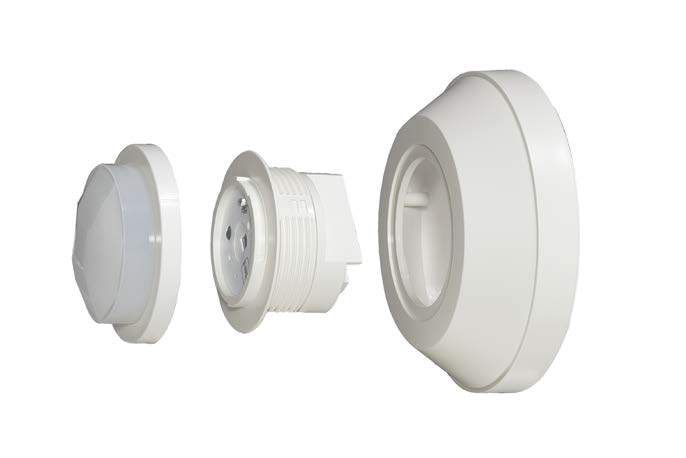
TRANS Occupancy Sensors
    Occupancy sensors ensure maximum energy savings through automatically
    turning off or dimming the lights to a lower level where and when they are not
    needed. IR-TEC’s TRANS family offers a broad range of occupancy sensors
    utilizing different sensing technologies for your selection.

                    TRANS-PIR                         TRANS-HFD                        TRANS-DUO

    TRANS-PIR Occupancy Sensor

    Passive Infrared is the most popular and widely applied occupancy sensing
    technology in the market. The PIR sensor senses the presence and motions of
    occupant by detecting the change of infrared energy emitted from a warm object             with lens F
    (human body or vehicle) in motion and the background space.

    Every PIR sensor requires an optical device, generally a plastic lens with
    multiple segments called Fresnel lens, to collect the infrared energy emitted
    by the occupant to the infrared sensing component. The Fresnel lens divides
    the detection coverage into multiple zones corresponding to the respective
                                                                                        M3 sensor with Lens F
    segments. In general, PIR sensors are more sensitive to the movements across
    the detection zones than toward the sensors. The closer the occupant is to the
    sensor, the better detection to the motion.

    TRANS family offers many types of PIR based occupancy sensors for selection
    (refer to page 9 or Appendix).

    Mounting Options                                                                    M3 sensor with Lens A

    Lens Options

    STANDARD     EXTRA WIDE      HIGH BAY     STANDARD      EXTRA WIDE     AISLE WAY    HIGH BAY   LONG AISLE

6       TRANS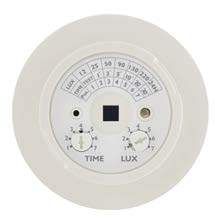
TRANS-HFD Occupancy Sensor

High Frequency Doppler (HFD) technology senses the presence and
motions of occupant by detecting the frequency shift bounced back
from a moving object. TRANS-HFD occupancy sensor employs a HFD
transceiver module operating with very high frequency radio waves
to provide excellent minor motions detection, without requiring an
unobstructed line-of-sight placement like PIR sensor, thus making the
TRANS-HFD sensor suitable for applications such as an office with
partitions, a library with cubicles or a restroom with stalls.

All TRANS-HFD occupancy sensors can be supplied with specific
mounting options as below.

Mounting Options

TRANS-DUO Occupancy Sensor

As no single occupancy sensing technology is perfect, thus the
TRANS-DUO occupancy sensor is created to provide better reliability
and performance by combining PIR and HFD sensing technologies into
a low profile housing. By utilizing the advantages of each single sensing
technology with advanced processing logic from both TRANS-PIR and
TRANS-HFD sensors, the TRANS-DUO occupancy sensor is the best for
most applications, as it not only provides superior sensing performance,
but also greatly reduces the possibility of false activating caused by
environmental interference.                                                                with lens A/B/C

The TRANS-DUO Occupancy Sensor can be supplied with specific lens
to provide different PIR detection coverage.

Lens Options

  STANDARD      EXTRA WIDE     HIGH BAY      STANDARD      EXTRA WIDE       AISLE WAY   HIGH BAY    LONG AISLE

                                                                                                       TRANS     7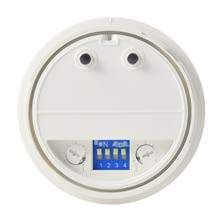
Lighting Control Strategies
    IR-TEC’s TRANS occupancy sensors are designed with different lighting control
    strategies to fulfill different requirements of applications. In addition to the typical
    ON/OFF switching, many TRANS sensors also offer Bi-Level StepDIM and/or
    sophisticated continuous SmartDIM control.
    On/Off Switching

    On/Off switching has been a typical lighting control strategy commonly used in most applications. Most energy
    codes require automatic shutoff control to save energy from unused lighting in many spaces, most TRANS
    occupancy and daylight sensors are designed, or can be set to switch on the electrical lights as needed, and
    automatically switch off when electrical lights are unneeded.

       Space vacant                Occupancy presence         Occupant leave - Delay time start   Delay time end
       Light is off                Light auto on              Light remains on                    Light auto off

    Bi-Level StepDIM Control

    Bi-level StepDIM control is an ideal control strategy with proven performance in energy savings, while still
    maintaining certain level of lighting for public safety and comfort. This control strategy requires using an
    occupancy sensor designed with bi-level control functionality that will keep dimmable lighting at a low-dim level
    during vacancy period or nighttime, instead of complete shutoff.

        Light is off @day          LOW DIM @night              Occupant presence
                                                               HIGH DIM or 100% on

                                   Occupant leave              Delay time end                     Light off @day
                                   Delay time start            LOW DIM @night

8   TRANS
Continuous SmartDIM Dimming
SmartDIM is a sophisticated dimming control technology developed by IR-TEC to enable the sensor to maintain
the ambient light level within a pre-set range by continuously adjusting the lighting output, based on the amount
of daylight available in the space. IR-TEC’s SmartDIM control not only provides a smooth dimming performance
to ensure occupant satisfaction while achieving maximum energy savings, but also helps extend the operational
life of luminaire through dynamically adjusting the lighting output at optimal level.
Electric Light Daylight Total Light
Light level
TRANS Occupancy Sensor Selection Reference
Model No. x - Mounting y - Lens On/Off StepDIM SmartDIM Tech Setting ALS Power Output HS
HRD-600Sxy P A/B/C/D/F/G/H/L ● ● ● PIR Remote ● 347/480 VAC SLV & AO
LRD-609Sxy A A/B/C/D/F/G/H/L ● ● ● PIR Remote ● 120/277 VAC SLV & AO ●
LRD-509Sxy F/W/E/P/S/C A/B/C/D/F/G/H/L ● ● ● PIR Remote ● 120/277 VAC SLV & AO ●
LRD-309S* -- -- ● ● ● PIR Remote ● 120/277 VAC SLV & AO ●
LRD-309SP* -- -- ● ● ● PIR Remote ● 120/277 VAC SLV & AO ●
LRS-509Sxy F/W/E/P/S/C A/B/C/D/F/G/H/L ● PIR Remote ● 120/277 VAC SLV ●
LOD-509Sxy F/W/E/P/S/C A/B/C/D/F/G/H/L ● ● PIR Manual ● 120/277 VAC SLV & AO ●
LOD-500Sxy F/W/E/P/S/C A/B/C/D/F/G/H/L ● ● PIR Manual ● 120/277 VAC SLV & AO
LOS-509Sxy F/W/E/P/S/C A/B/C/D/F/G/H/L ● PIR Manual ● 120/277 VAC SLV ●
LMD-509Sx F/W/E/P/S/C/I -- ● ● HFD Manual ● 120/277 VAC SLV & AO ●
LMS-509Sx F/W/E/P/S/C/I -- ● HFD Manual ● 120/277 VAC SLV ●
MRD-510Sxy F/W/E/P/S/C A/B/C/D/F/G/H/L ● ● ● PIR Remote ● 230 VAC or DALI DALI
MOD-510Sxy F/W/E/P/S/C A/B/C/D/F/G/H/L ● ● PIR Manual ● 230 VAC or DALI DALI
BRD-500Sxy F/W/E/P/S/C/R A/B/C/D/F/G/H/L ● ● ● PIR Remote ● 12-24 VDC IDC & AO
BOA-516Sxy F/W/E/P/S/C/R A/B/C/D/F/G/H/L ● ● PIR Manual ● 12-24 VDC AO
BOA-517Sxy F/W/E/P/S/C/R A/B/C/D/F/G/H/L ● PIR Manual ● 12-24 VDC DO & AO
BOM-515Sxy S/C/R A/B/C/D/F/G/H/L ● PIR Manual ● 12-24 VDC DOx2
BOS-515Sxy S/C/R A/B/C/D/F/G/H/L ● PIR Manual ● 12-24 VAC/DC IDC
BOS-515Nxy S/C/R A/B/C/D/F/G/H/L ● PIR Manual 12-24 VAC/DC IDC
COS-516Sxy F/W/E/P/S/C/R A/B/C/D/F/G/H/L ● ● PIR Manual ● 12-48 VDC RDP
BDS-600Sxy S A/B/C/D/F/G/H/L ● DUO Manual ● 12-24 VDC IDC
* Please purchase lens seperately
Legends HS: Hybrid Switching SLV: Switched Line Voltage AO: Analog Output (0-10V)
IDC: Isolated Dry Contact DO: Digital Output RDP: Regulated DC Power TRANS 9TRANS Daylight Sensors
Daylight sensing control is a common lighting control strategy. It typically
refers to the use of a daylight sensor to inhibit or dim the electric lights
in a daylight area by sensing the available natural light. The principle
is simple, an ambient light sensor (ALS) measures either the level of
daylight contribution or the overall combined natural and electric light as
the key component of switching or dimming the controlled lights in one
TRANS-LUX
or multiple zones to achieve an optimal lighting level based on the
pre-determined parameters.
To provide the most delicate daylight sensing control with the best installation flexibility for
today’s sustainable buildings, the TRANS daylight sensors can be supplied with specific
mounting options as below.
Mounting Options
TRANS Daylight Sensor Selection Reference
Model No. x - Mounting On/Off SmartDIM Setting Power Output HS
LPS-509Sx F/W/E/P/S/C ● Manual 120/277 VAC SLV ●
BED-500Sx F/W/E/P/S/C/R ● ● Remote 12-24 VDC IDC & AO
BED-510Sx F/W/E/P/S/C/R ● ● Remote 12-24 VDC IDC & AO
BPD-500Sx F/W/E/P/S/C/R ● Manual 12-24 VDC IDC & AO
BPD-510Sx F/W/E/P/S/C/R ● Manual 12-24 VDC IDC & AO
BPD-502Sx F/W/E/P/S/C/R ● Manual 12-24 VDC IDC & AO
BPD-512Sx F/W/E/P/S/C/R ● Manual 12-24 VDC IDC & AO
Legends HS: Hybrid Switching SLV: Switched Line Voltage AO: Analog Output (0-10V)
IDC: Isolated Dry Contact
10 TRANSControl Strategies
On/Off Switching
On/Off switching is a typical daylighting control strategy used in many commercial spaces. The sensor will turn
on and off the electric lights based on the amount of daylight available in the space. This type of control may
require setting an adjustable delay time before shutting off the electric lights to prevent frequent on-off switching
behavior. However, the space may be over lit just before there is enough daylight to provide the minimum
required light level.
Electric Light Daylight Total Light
Light ON
Light OFF
Light level
Off-level
On-level
SmartDIM Continuous Dimming
Continuous Dimming, some may refer as Constant Lighting, is an advanced control strategy for the lighting
in the daylight zones. This strategy typically refers to the use of a daylight sensor with SmartDIM capabilities
that will continuously adjust the output of electric lights to maintain the combined light level within a desired
range, based on the amount of daylight available in the space. This control can only be achieved by using the
sensor designed with continuous dimming capability, and the lighting under controlled MUST be “dimmable”
as specified. A smooth continuous dimming control is the key to ensure occupant satisfaction while achieving
energy savings as expected.
Electric Light Daylight Total Light
Light level
TRANS 11Appendix
TRANS Sensor Family Product Code
Type Series Option
A B C - 1 2 3 d e f
Lens option - A, B, C, D, F, G, H (Only for TRANS PIR & TRANS DUO)
Mounting option - F, W, E, P, S, C, R, A, I
ALS sensor - N: No ALS S: With ALS
Specification - 0, 1, 2, 3... 9
Connection - 0: Wire leads 1: Terminal blocks
Housing - 3: M3 sensor 5: Flex-mount 6: Uni-mount
Type Tech Sensor Description & Functionality Power Output Setting
HRD PIR Line voltage SmartDIM occupancy sensor 347/480 VAC SLV & AO Remote
LRD PIR Line voltage SmartDIM occupancy sensor 120/277 VAC SLV & AO Remote
LRS PIR Line voltage occupancy sensor 120/277 VAC SLV Remote
LOD PIR Line voltage occupancy sensor 120/277 VAC SLV & AO Manual
LOS PIR Line voltage occupancy sensor 120/277 VAC SLV Manual
LMD HFD Line voltage bi-level occupancy sensor 120/277 VAC SLV & AO Manual
LMS HFD Line voltage occupancy sensor 120/277 VAC SLV Manual
MRD PIR SmartDALI occupancy sensor 230 VAC or DALI DALI broadcast Remote
MOD PIR DALI occupancy sensor 230 VAC or DALI DALI broadcast Manual
BRD PIR Low voltage SmartDIM occupancy sensor 12-24 VDC IDC & AO Remote
BOA PIR Low voltage bi-level occupancy sensor 12-24 VDC DO & AO Manual
BOM PIR Low voltage occupancy sensor 12-24 VDC DOx2 Manual
BOS PIR Low voltage occupancy sensor 12-24 VAC/DC IDC Manual
COS PIR LED control occupancy sensor 12-48 VDC RDP Manual
BDS DUO Low voltage dual-tech occupancy sensor 12-24 VDC IDC Manual
LPS LUX Line voltage daylight sensor 120/277 VAC SLV Manual
BED LUX Low voltage SmartDIM daylight sensor 12-24 VDC IDC & AO Remote
BPD LUX Low voltage daylight sensor 12-24 VDC IDC & AO Manual
Legends HS: Hybrid Switching SLV: Switched Line Voltage AO: Analog Output (0-10V)
IDC: Isolated Dry Contact DO: Digital Output RDP: Regulated DC Power
12 TRANSMounting Options
Mounting option Code Bracket # TRANS-PIR TRANS-HFD TRANS-LUX
Fixture Integrated F ---
IP-66 Fixture Integrated W ---
Fixture External E EMB-500
IP-66 Fixture External P PMB-500
Ceiling Surface S SMB-500
Junction Box C CMB-500
Ceiling Recess R RMB-500
Fixture Internal I IMB-500 --- ---
IP-66 Universal
A --- --- ---
Attached
Lens Options
Lens Standard Extra Wide High Bay Standard Wide Angle Aisle Way High Bay Long Aisle
Code A B C D F G H L
M. Height (X) 8~15 ft 8~10 ft 15~30 ft 8~20 ft 8~20 ft 8~40 ft 30~50ft 8~10ft
Coverage 2X 6X 3X 2X 4X 3X 1X 6X
Exterior
Lens C/G may be mounted up to 40/50 ft or higher at the area providing with motions of large objects,
such as forklift trucks. Before installing all sensors, please ensure that the sensor can have optimal
detection at expected height.
TRANS 13DISTRIBUTOR 1295 S Lewis ST Anaheim, CA 92805 ©2020 IR-TEC America, Inc. All rights reserved. This document contains information relating to IR-TEC product portfolio which is subject to change. IR-TEC does not give any representation or warranty as to the accuracy or completeness of the information included herein, and shall not be liable for any action in reliance thereon. The information presented on this document is not intended as any commercial offer and does not form part of any quotation or contract. Trademarks are the property of IR-TEC America, Inc. or other respective owners.
You can also read


