Ocean Restoration Methods: JUNE 2018 - State of California
←
→
Page content transcription
If your browser does not render page correctly, please read the page content below
Ocean
                         Restoration
                           Methods:
                                          S CIENTIFIC GU IDANCE FO R O NCE-THR OUGH

                                          COO L ING MITIGATION PO L ICY

A Working Group of the                                                    JUNE 2018
Ocean Protection Council Science Advisory Team
OCEAN RESTORATION METHODS

Contributors                                                        Acknowledgements
Ocean Protection Council Science                                    THIS WORK WAS SUPPORTED
Advisory Team Working Group                                         BY THE CALIFORNIA OCEAN
The role of the Ocean Protection Council Science Advisory           PROTECTION COUNCIL .
Team (OPC-SAT) is to provide scientific advice to the California    We would like to thank our State
Ocean Protection Council (OPC). The work of the OPC-SAT             partners for their guidance and
is supported by the California Ocean Protection Council and         review throughout this project:
administered by Ocean Science Trust. OPC-SAT working groups
bring together experts from within and outside the OPC-SAT          CALIFORNIA OCEAN
with the ability to access, analyze, and interpret the best         PROTECTION COUNCIL
available scientific information on a selected topic.               Cyndi Dawson, Marine Protected Areas
                                                                    Policy Advisor/Senior Program Manager
California Ocean Science Trust                                      Tova Handelman, Marine Protected
California Ocean Science Trust is an independent, non-profit
                                                                    Areas Program Manager
organization that brings together governments, scientists, and
                                                                    Michael Esgro, California Sea Grant
citizens to build trust and understanding in ocean and coastal
                                                                    State Fellow, Marine Protected Areas
science issues. We empower participation in the decisions that
are shaping the future of our oceans. We were established by
                                                                    CALIFORNIA DEPARTMENT OF
the California Ocean Resources Stewardship Act to support
                                                                    FISH AND WILDLIFE
managers and policymakers with sound science. For more
                                                                    Becky Ota, Habitat Conservation
information, visit our website at www.oceansciencetrust.org.
                                                                    Program Manager Marine Region

                                                                    CALIFORNIA STATE WATER
Contact                                                             RESOURCES CONTROL BOARD
Errin Ramanujam, Senior Scientist, Ocean Science Trust              Katherine Faick, Environmental
errin.ramanujam@oceansciencetrust.org                               Scientist Ocean Standards Unit,
Melissa Kent, Project Scientist, Ocean Science Trust                Division of Water Quality
melissa.kent@oceansciencetrust.org
                                                                    This report is endorsed by the full
                                                                    Ocean Protection Council Science
Working Group Members                                               Advisory Team.
Richard Ambrose*, University of California, Los Angeles, Co-chair
Peter Raimondi, University of California, Santa Cruz, Co-chair
Sean Anderson, California State University, Channel Islands
Marissa Baskett, University of California, Davis
Jennifer Caselle, University of California, Santa Barbara
Mark Carr*, University of California, Santa Cruz
Christopher Edwards, University of California, Santa Cruz
Kerry Nickols, California State University, Northridge
Nathalie Reyns, University of San Diego
Adrian Stier, University of California, Santa Barbara

* Denotes OPC-SAT Member
OCEAN RESTORATION METHODS

About this Report

          CALIFORNIA MANAGEMENT CONTEXT
          California’s Once-Through Cooling Policy (Policy) was adopted by the State
          Water Resources Control Board (State Water Board) in 2010 and amended
          in 2011, 2013, 2016, and 2017. The Policy establishes technology-based
          standards to implement federal Clean Water Act section 316(b) and reduce
          the harmful effects associated with cooling water intake structures on
          marine and estuarine life. The Immediate and Interim Requirements Section
          3(e) of the Policy states, “It is the preference of the State Water Board that
          funding is provided to the California Coastal Conservancy1, working with the
          California Ocean Protection Council, for mitigation projects directed toward
          increases in marine life associated with the State’s Marine Protected Areas in
          the geographic region of the facility” (State Water Board, 2015). As the OPC
          considers how to design a funding program, they seek scientific guidance
          from the OPC-SAT on where restoration efforts should be targeted and how
          to evaluate potential restoration strategies.

          GOAL OF THIS REPORT
          This report was produced by an OPC-SAT working group and California
          Ocean Science Trust on behalf of the OPC and the broader community
          of California managers. This report applies the latest scientific data and
          expertise to inform the implementation of the adopted Once-Through
          Cooling (OTC) Policy. The working group focused on tractable scientific
          questions embedded in the Policy language regarding defining the spatial
          extent of OTC impacts around each facility, the spatial extent of association
          with the State’s marine protected areas (MPAs), and building a framework
          to define increases in marine life. The Ocean Protection Council’s OTC
          Interim Mitigation Program includes four components that guide the
          implementation of the OTC Policy related to California’s MPA Network; 1)
          enforcement; 2) outreach to improve compliance; 3) research to understand
          how existing MPAs may be mitigating for OTC impacts (Dawson et al.,
          2016); and 4) restoration that increases marine life in the geographic region
          of the facility. This report is narrowly focused on applying the best science
          available to inform the implementation of the restoration component.

          1. In 2013, the Ocean Protection Council moved to be housed in the California Natural Resources Agency which is the successor agency to the
          California Coastal Conservancy in this case.

                                                                                                                            ABOUT THIS REPORT           |   3
OCEAN RESTORATION METHODS

Executive Summary

         California’s Once-Through Cooling Policy (Policy) was adopted by the State Water
         Resources Control Board (State Water Board) in 2010 and amended in 2011, 2013,
         2016, and 2017. The Policy establishes technology-based standards to implement
         federal Clean Water Act section 316(b) and reduce the harmful effects associated
         with cooling water intake structures on marine and estuarine life. The Immediate
         and Interim Requirements Section 3(e) of the Policy states, “It is the preference
         of the State Water Board that funding is provided to the California Coastal
         Conservancy, working with the California Ocean Protection Council, for mitigation
         projects directed toward increases in marine life associated with the State’s
         Marine Protected Areas in the geographic region of the facility” (State Water
         Board, 2015). The working group of the OPC-SAT was charged with answering the
         following questions where current scientific knowledge and understanding could
         provide key insights and guidance to OPC in designing a funding program to
         disburse OTC funds.

               The Policy states that it is the preference for mitigation funds to be
          1
               directed towards projects that are within the “geographic region of the
               facility.” However, the Policy does not define that geographic range. What
               is the “geographic region” specific to the ten power plants that are part of
               the program?

               The Policy states that it is the preference for mitigation funds to be
          2
               directed towards projects that may lead to “increases in marine life
               associated with the State’s Marine Protected Areas.” How do we evaluate if
               common open coast restoration methods will lead to increases in marine
               life associated with the State’s MPA Network based on currently available
               scientific evidence?

         In this report, we define clear boundaries for the geographic range in Section 2
         which can bound the areas where impacts can be assumed to occur based on
         our current scientific knowledge. We also encourage the State to revisit these
         boundaries as more advanced models become available in the near-term. These
         models will help to better understand and refine the area of impact due to their
         ability to tell us about not just where the organisms were coming from, but their
         destination had they not been impinged or entrained by an OTC power plant.

         We also provide a scientific definition of “associated with the State’s marine
         protected areas” and “increases in marine life” in Section 3. These definitions should
         be the umbrella with which the framework in Section 4 is applied. We utilize these
         definitions and the framework for evaluating restoration methods in the examples
         in Section 5 to better illuminate how the State can determine if common open coast
         restoration methods will lead to increases in marine life associated with the State’s
         MPA Network using best available science. Through applying the framework, we are
         able to refine it and feel confident that it will serve to examine the scientific rigor
         and ability of projects to meet the scientific elements of the Policy.

                                                                           EXECUTIVE SUMMARY   |   4
OCEAN RESTORATION METHODS

Table of Contents

1. INTRODUCTION                                                                           6
    1.1    Policy Directive                                                               7
    1.2    Scientific Approach                                                            8

2. GEOGR APHIC REGION OF THE FACILIT Y                                                   10
    2.1    Results: Areas of Impact                                                      11
    2.2 Near-term Considerations                                                         12

3. SCIENTIFIC DEFINITIONS FOR INTERPRETING OTC POLICY                                    13
    3.1    Key Definition: “Associated with the State’s Marine                           14
		         Protected Areas”
    3.2 Key Definition: “Increases in Marine Life”                                       14

4. FR AME WORK FOR E VALUATING RESTOR ATION ME THODS                                     16
    4.1    Guiding Principles                                                            17
    4.2 Using the Framework                                                              18

5 . A P P LY I N G T H E F R A M E W O R K                                               19
    5.1    Reducing novel stressors: Marine and estuarine invasive                       20
		         macroalgae removal
    5.2 Community enhancement: Urchin removal for kelp-bed                               22
		 restoration
    5.3 Structural manipulation: Artificial reefs in shallow water                       24

6. CONCLUSIONS                                                                           27

7. R E F E R E N C E S                                                                   29

8. APPENDICES                                                                            34
    Appendix A: Workshop Agenda, March 6, 2018

                                                                 TABLE OF CONTENTS   |    5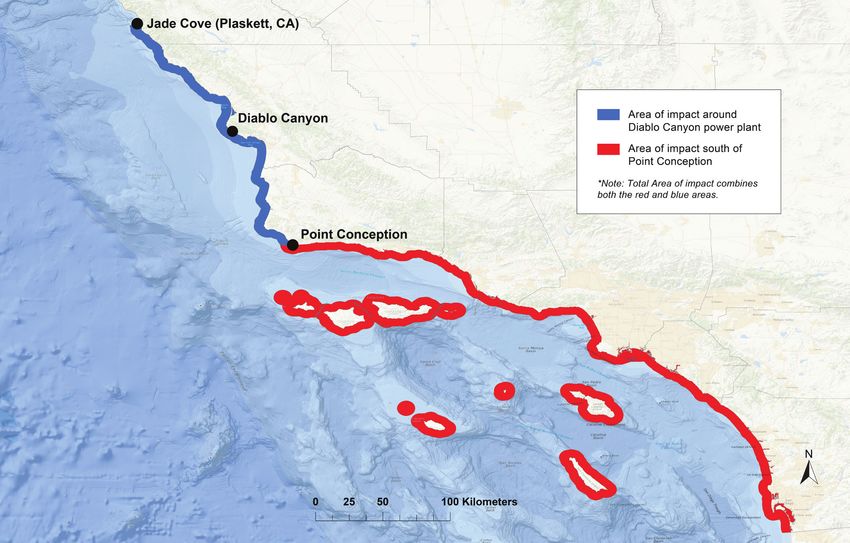
OCEAN RESTORATION METHODS

1. Introduction
            Once-through cooling (OTC) technology pulls water from the
            ocean to cool power plants. The sea water taken in is itself habitat
            with a high biodiversity of zoo- and phytoplankton, including
            billions of eggs and larvae of marine fishes and invertebrates,
            and the gametes, spores, and seeds of seaweeds and marine
            plants, such as eelgrass and kelp. These organisms are killed in
            the process. Small organisms are entrained in circulated water,
            subjected to thermal, physical, and/or chemical stresses as the
            water is brought from the ocean to the plant. Larger organisms
            can also be be harmed, even though they do not pass through
            intake screens into the plant, by being pinned against the
            sea water intake screens (a process known as impingement)
            (Raimondi, 2011). These impacts contribute to the decline of
            fisheries and the degradation of marine habitats in the vicinity of
            power plants using OTC (State Water Board, 2008).

                                                                      INTRODUCTION   |   6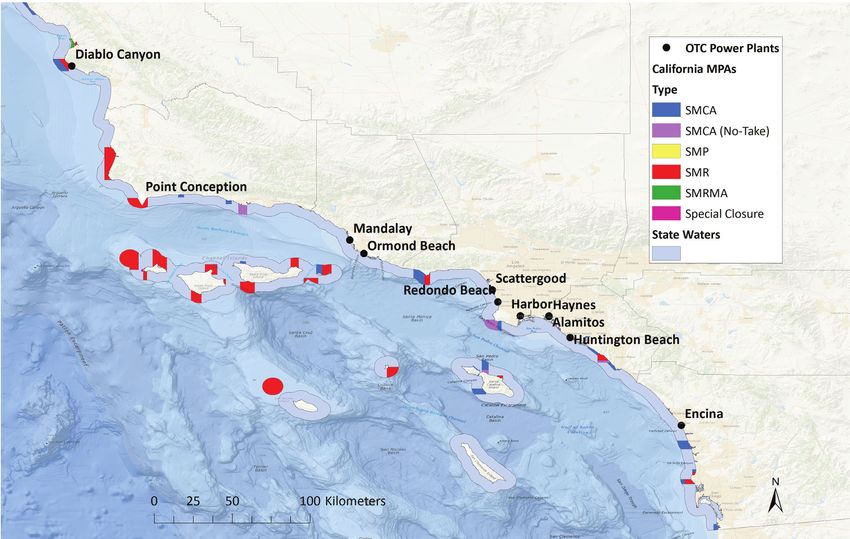
OCEAN RESTORATION METHODS

                                 1.1 Policy Directive
                                 California’s Once-Through Cooling Policy (Policy) establishes technology-based
                                 standards to implement federal Clean Water Act section 316(b) and reduce the
                                 harmful effects on marine and estuarine life associated with cooling water intake
                                 structures. The Policy requires that power plants that have not met the technology-
                                 based standards by October 2015 mitigate the impacts of their non-compliance.
                                 Plant operators may meet this obligation either by undertaking mitigation projects
                                 or paying into a mitigation fund (State Water Board, 2015). This interim mitigation
                                 obligation ends when the plant achieves compliance with the technology-based
                                 standards, which require that plant operators reduce water intake rates or
                                 impingement mortality and entrainment to levels equivalent to those achieved by
                                 plants using closed cycle cooling.

                                 The Policy directs the California Ocean Protection Council (OPC) to spend interim
                                 mitigation funds on mitigation projects (see Box 1). OPC is not obligated to spend
                                 the funds as direct compensatory mitigation, where projects would have to target
                                 the precise species lost at a particular plant. Rather, the Policy states, “It is the
                                 preference of the State Water Board that funding is provided to the California
                                 Coastal Conservancy, 2 working with the California Ocean Protection Council, for
                                 mitigation projects directed toward increases in marine life associated with the
                                 State’s Marine Protected Areas (MPAs) in the geographic region of the facility”
                                 (State Water Board, 2015)(emphasis added). The facilities still operating along with
                                 their proximity to MPAs are shown in Figure 1.

BOX 1

MITIGATION                                         protection of marine life in existing                                 Although the Policy language refers
OR RESTOR ATION?                                   marine habitat, for example through                                   to “mitigation projects,” for clarity
                                                   the funding of implementation and/                                    in this report, we will use the term
A “mitigation project” is defined in               or management of Marine Protected                                     “restoration methods” to describe
the Policy as a project “to restore                Areas” (State Water Board, 2015).                                     these projects. This OPC-SAT
marine life lost through impingement               This is different from compensatory                                   working group was asked to give
mortality and entrainment.                         mitigation in that the payments into                                  scientific guidance on restoration
Restoration of marine life may                     the OTC Interim Mitigation Program                                    methods.
include projects to restore and/or                 may be used to increase marine life
enhance coastal marine or estuarine                associated with the State’s MPAs in
habitat, and may also include                      the geographic region of the facility.

                                 2. In 2013, the Ocean Protection Council moved to be housed in the California Natural Resources Agency which is the successor agency to the
                                 California Coastal Conservancy in this case.

                                                                                                                                                          INTRODUCTION         |   7
OCEAN RESTORATION METHODS

Figure 1. There are ten power plants in the OTC Interim Mitigation Program (the other OTC plants have either come into
          compliance with the guidelines in the Policy or have ceased operations): Alamitos, Diablo Canyon, Encina, Harbor,
          Haynes, Huntington Beach, Mandalay, Ormond Beach, Redondo Beach, and Scattergood.

                               1.2 Scientific Guidance on OTC Policy
                               The Policy recommends that OPC directs funds towards mitigation projects
                               (or “restoration methods”) likely to lead to increases in marine life associated with
                               MPAs (see Box 1). OPC’s OTC Interim Mitigation Program has four components for
                               implementing the Policy related to California’s MPA Network. The four components
                               were chosen due to their ability to increase marine life associated with MPAs. They
                               are: 1) enforcement; 2) outreach to improve compliance; 3) research to understand
                               how existing MPAs may be mitigating for OTC impacts (Dawson et al., 2016); and 4)
                               restoration that increases marine life in the geographic region of the facility. There
                               is significant scientific consensus and guidance for how enforcement, education,
                               and research can improve MPA functions and lead to increases in marine life (IUCN,
                               2008; Sheehan et al., 2013; Botsford et al., 2014; Starr et al., 2015). However there is
                               less scientific syntheses and guidance from the literature for how to define the area
                               of impact in California and what types of restoration methods are likely to lead to
                               increases in marine life associated with MPAs.

                                                                                                           INTRODUCTION   |   8
OCEAN RESTORATION METHODS

For this reason, the OPC asked the OPC-SAT working group to answer the following
questions where current scientific knowledge and understanding could provide key
insights and guidance.

     The Policy states that it is the preference for mitigation funds to be
 1
     directed towards projects that are within the “geographic region of the
     facility.” However, the Policy does not define that geographic range. What
     is the “geographic region” specific to the ten power plants that are part of
     the program?

     The Policy states that it is the preference for mitigation funds to be
 2
     directed towards projects that may lead to “increases in marine life
     associated with the State’s Marine Protected Areas.” How do we evaluate if
     common open coast restoration methods will lead to increases in marine
     life associated with the State’s MPA Network based on currently available
     scientific evidence?

To help answer question 2, we have established a scientific framework of guiding
principles for evaluating a restoration method’s likelihood of success (Section 4),
and we provide three examples to illustrate the use of the framework (Section 5).

                                                                      INTRODUCTION    |   9
OCEAN RESTORATION METHODS

2. Geographic Region of the Facility
           Here we define the section of the Policy that directs payments
           toward restoration methods in the geographic region of the
           facility, or what we will refer to as the “area of impact.”
           See Figure 1 for a map of the power plants subject to the Policy.

           In order to assess the area of impact, we want to consider every possible
           combination of organisms that could have been lost to the MPA N etwork from
           OTC plant operations. We want to consider both where the organisms have come
           from and where they might have gone had they not been entrained or impinged.
           There are a variety of mechanisms for understanding this. Models are the main
           tool scientists use to study and predict the movement of all sizes of organisms.
           One way to geographically assess the impacts is to use an Empirical Transport
           Model (ETM), a model used previously in work related to OTC impacts. As defined
           in Raimondi (2011), an ETM estimates “the portion of a larval population at risk to
           entrainment” by determining both the amount of larvae from that population that
           will be entrained as well as the size of the larval populations found in the source
           water body based on data collected from the source water body. The source water
           body is “the area where larvae are at risk of being entrained and is determined by
           biological and oceanographic factors” (Raimondi, 2011). ETM is a model that is fully
           developed (i.e. ready to use right now) that can take field sampling data and use it
           to predict where the entrained organisms may have come from.

                                                             GEOGRAPHIC REGION OF THE FACILITY   |   10
OCEAN RESTORATION METHODS
To define the geographic region, the working group to organisms, we used the results of the ETM and
looked for a scientifically rigorous technique that the source water bodies for each power plant to
is currently usable. While other methods are under define the geographic area of impact. Results of
development, and still being tested, the timeline the ETM generated a source water body for each
for their completion (including rigorous scientific target species. Additionally, the results of the ETM
peer review) will not meet the timelines for which are also in close alignment with theoretical models
OPC needs to initiate their program. The ETM uses that include the observation that nearshore water
sampling data of target species from the intake motion decreases toward shore, often in the vicinity
water, which are collected at regular intervals of intakes (White et al., 2010b; Nickols et al., 2012).
(Raimondi, 2011). One step of the ETM is to estimate For this report, we considered the largest source
the source water body; this estimation closely aligns water body to define the area of impact because it
with our understanding of the area of impact. For will include all possible combinations of entrained
these reasons, and because this methodology has and impinged species that could be lost from the
been determined by the State Water Board as the MPA Network.
preferred method to determine impacts of OTC
2.1 Results: Areas of Impact
Figure 2. The areas of impact for the ten power plants complying with the interim mitigation requirements of the OTC
Policy (red areas and blue area combined).
GEOGRAPHIC REGION OF THE FACILITY | 11OCEAN RESTORATION METHODS
Figure 2 is a map of the areas of impact for the ten weather forecast models used to predict atmospheric
power plants that are operating under the interim winds. Driven by realistic atmospheric fields at the
mitigation requirements of the Policy. The power surface, various applications resolve the California
plants are clustered closely together in Southern Current in its entirety at coarse resolution (2 km - 10
California, and their source water bodies overlap, km) (Marchesiello et al., 2003; Veneziani et al., 2009;
creating an area of impact that spans the entirety Kurapov et al., 2017) and nest higher resolution grids
of State waters (3 nautical miles from the coastline, down to km scale or hundreds of meters in more
the extent of this analysis) from Point Conception localized regions (Dong et al., 2009; Suanda et al.,
in the north, to the California/Mexico border to the 2016). Ocean currents produced by these models are
south (Figure 2, red areas). Although outside the used to model the transport of larvae throughout the
ETM results, we also include the waters around the California Current. While some dispersal studies are
Channel Islands, as research shows these waters to generic (Mitarai et al., 2009; Drake et al., 2011), others
be connected to the mainland through the larval are more targeted with species-specific emphasis
transport of species of interest (Mitarai et al., 2009; (Watson et al., 2009; Drake et al., 2013; Johansson
Watson et al., 2010). et al., 2016).
North of Point Conception, the Diablo Canyon Studies such as these may provide a better
power plant determines the area of impact, which understanding in the near-term for the State on the
extends roughly 100km north of and south of the areas of impact from OTC, allowing the State to
plant in State waters (Figure 2, blue area). The consider not just where organisms came from, but
northern limit is in the vacinity of Jade Cove, near also where they might have gone. We recommend
Plaskett, California. that the State consider using these models as
they mature.
2.2 Near-term Considerations
ETM was the chosen method for this report for a
number of reasons: 1) it is the model currently used
by the State, 2) the data used are from samples
taken from a location adjacent to or in the intake,
3) the results provide a method that has been
vetted, and 4) the results provide species-specific
estimation. However, more sophisticated methods
using state-of-the-science numerical models
that represent realistic ocean currents and their
variability along the entire coast of California are
increasingly available. When coupled to particle
transport algorithms, such models can predict larval
transport within the MPA Network.
One advanced numerical ocean model that is widely
used in the California Current and other locations
worldwide is the Regional Ocean Modeling System
(ROMS) (Shchepetkin & McWilliams, 2005). This
model is similar in structure and complexity to
GEOGRAPHIC REGION OF THE FACILITY | 12OCEAN RESTORATION METHODS
3. Scientific Definitions for
Interpreting OTC Policy
In order for us to provide the needed scientific guidance for the
questions outlined in Section 1, we determined that there was a
need to define two of the phrases from the Policy in scientific
terms. We note that these definitions are for the purposes of
interpreting and applying the questions given to this OPC-SAT
working group.
Section 2 above defines the geographic region of the facility and those boundaries
are based on the best available scientific information. OPC also asked us what
types of projects will lead to increases in marine life associated with MPAs.
However, in order to answer that question, we need to apply a scientific definition
to two discrete phrases from the Policy: “associated with the State’s Marine
Protected Areas” and “increases in marine life.”
SCIENTIFIC DEFINITIONS FOR INTERPRETING OTC POLICY | 13OCEAN RESTORATION METHODS
3.1 K
ey Definition: “Associated California’s MPA Network being inclusive of the MPAs
themselves as well as the spaces in between for the
with the State’s Marine
area of impact as defined in Section 2.1.
Protected Areas”
The Marine Life Protection Act (MLPA) (Marine Life
Protection Act, 1999) directed the State to design 3.2 K
ey Definition:
a network of MPAs to be created and managed “Increases in Marine Life”
using sound science and stakeholder input. As of
California’s MPA Network was established with
December 19, 2012 (after a rigorous and multi-year
many goals, which include protecting and sustaining
planning and implementation process that included
diversity and abundance of marine life populations,
stakeholders, tribes, scientists, decision makers, and
protecting the structure, function, and integrity
the public) the MPA Network is in effect for the entire
of marine ecosystems, and rebuilding marine
coast of California.
populations that are depleted (California Department
of Fish and Wildlife, 2016). The OTC Policy has
California’s MPA Network was designed to be
language that is in alignment with California’s MPA
ecologically connected through ocean currents that
Network goals as well as other MPAs across the
transport eggs, spores, larvae, and individuals across
globe: “increases in marine life associated with
the Network both into MPAs and into the spaces in
the State’s MPAs.” We have provided our scientific
between. Different species spend different amounts
interpretation of this language in order to inform our
of time and are transported different distances
guidance of restoration methods that are likely to
by ocean currents before settling in their juvenile
lead to these types of increases.
habitats. Here we refer to this period as “transport
time.” Most abalone, for example, have transport
Increases in marine life could come from a variety
times of about 5-10 days (Haaker et al., 2001). Other
of mechanisms; they are not just about numerical
species, like California spiny lobster (Panulirus
changes in particular species, but about improving
interruptus), can have much longer transport times
the ecosystem functions within the MPA Network
of 7-10 months (Pringle, 1986). The connectivity
as a whole, and is in alignment with the goals in
across the MPA Network is a core principle of both
the MLPA (Marine Life Protection Act, 1999). Our
the design of the MPA Network itself and the related
definition of increases in marine life is drawn from
performance evaluation monitoring. Due to this
ecological first principles about population dynamics
connectivity, we consider that “associated with
and the ecosystem features that support them
MPAs” includes both the areas inside and outside
(Marquet et al., 2015).
of individual MPA boundaries (White et al., 2010a).
Therefore, the area of impact is the entire area as
The following metrics, and therefore species we refer
defined in Section 2.1 above, not just the discrete
to below in the metrics, are those that are important
MPAs that are within that area of impact.
to perpetuating the structure and integrity of a
healthy, functioning ecosystem through time and
The mandates in the MLPA for design and
therefore lead to increases in marine life as stated
performance evaluation strongly align with this
in the Policy. While we don’t expect every project
definition as well. The MLPA focus on the importance
to meet every metric, we do recommend that they
of connectivity both in design and evaluation is
should be considered together, not discretely, and
being reflected in the forthcoming MPA Monitoring
should have reference points (discussed below)
Action Plan (California Ocean Protection Council,
associated with each one when applying to a
2018). All these factors taken together, both from the
particular method or approach.
best available ecological science and existing policy,
provide robust alignment with the definition of
SCIENTIFIC DEFINITIONS FOR INTERPRETING OTC POLICY | 14OCEAN RESTORATION METHODS
In each of these metrics the types of species we These metrics seek to create a definition of “increases
are referring to are those that are important to in marine life” that is quantifiable and measurable.
perpetuating the structure and integrity of a healthy, We recommend the use of reference points9 for each
functioning ecosystem through time and therefore of these metrics, in order to not only better measure
lead to increases in marine life1,2 . these metrics, but also to answer the question: What
are we restoring to and/or from? The reference
DE NSIT Y 3 : increases in the density of a particular point should be in the same unit of measurement
species or suite of species. This could mean methods as the goal or metric. The reference point could be
that directly increase density of native species or based on that metric from a different time, specific
include indirect methods, such as removal of invasive species, population, or ecosystem state, or a new
species, indirectly leading to increases in density of reference point due to changing ocean conditions,
species that enhance ecosystem health. etc. Additionally, other metrics, like resiliency, have
been difficult to measure or to define reference
BIODIVE RSIT Y4 : increases in diversity of species, points, and even more difficult to render successful.
populations, communities, ecosystems, and/or We know that these other metrics are important and
functions. This includes increasing the diversity of should not be ignored when considering restoration
age or size classes or other ecologically-relevant methods. However, we recommend that they be
traits within a population, genetic representation, considered together with the above metrics, rather
community and/or habitats in an ecosystem, etc. than in isolation.
BIOMASS 5 : increases in biomass of a particular or
suite of species.
FU NC TION 6 : increases in the functionality of
ecosystem components such as connectivity,
resilience of species, functional groups or habitat,
productivity, water quality, etc.
POPU L ATION SIZE 8 : increases in a species
population either spatially or genetically.
1-E cosystem health- condition of the ecosystem. A healthy ecosystem is defined as being ‘stable and sustainable’; maintaining its organization and autonomy over time and its resilience to
stress (Costanza 1994; Rapport et al., 1998).
2-Ecosystem function- “the flow of energy and materials through the arrangement of biotic and abiotic components of an ecosystem” (Diaz & Cabido 2001).
3-Density- is usually used to refer to the number of items per unit area, for example, barnacles/m 2 .
4-Biodiversity- includes four main components:
• Genetic diversity refers to the genetic variation that occurs among members of the same species.
• Species diversity (taxonomic diversity) refers to the variety of species or other taxonomic groups in an ecosystem.
• Ecosystem diversity refers to the variety of biological communities found on earth, usually consider at two levels, communities and ecosystems.
• Functional diversity refers to the variety of biological processes, functions, or characteristics of a particular ecosystem (Thorne- Miller 1999).
5-B iomass- is the mass of living biological organisms in a given area or ecosystem at a given time. Biomass can refer to species biomass, which is the mass of one or more species, or to community
biomass, which is the mass of all species in the community (IUPAC, 1997). Biomass therefore considers the size structure of the species or community, in addition to abundance or density.
6-Function- role, or function, that a species plays in the community or ecosystem in which they occur (e.g. primary producer, consumer, top predator, etc.).
7-Resilience- can include both engineering resilience (how quickly a system returns to the original state from disturbance) and ecological resilience (likelihood of a state switch following
disturbance).
8-Population size- amount (number or area) of individuals of the same species, and can include increases in functionality of the role of the population in the ecosystem.
9-Reference point- basis or standard for evaluation, assessment, or comparison; a criterion.
SCIENTIFIC DEFINITIONS FOR INTERPRETING OTC POLICY | 15OCEAN RESTORATION METHODS
4. Framework for Evaluating
Restoration Methods
We have taken an ecological first principles (Marquet et al.,
2015) approach for creating a scientific framework for evaluating
restoration methods in alignment with the goals outlined in the
Policy. The guiding principles that make up this framework are
intended for use in evaluating whether or not a restoration method
is likely to reach the goal of increasing marine life associated with
MPAs from a scientific perspective. They are meant to be taken
in conjunction with the definitions described in Section 3 and the
geographic confines described in Section 2. Restoration methods
should be assessed for alignment with these definitions and within
the defined geographic scope before applying these principles to
assess whether they are scientifically likely to lead to increases in
marine life associated with MPAs.
FRAMEWORK FOR EVALUATING RESTORATION METHODS | 16OCEAN RESTORATION METHODS
4.1 Guiding Principles
Principle 1 Restoration method has a high Principle 2 Restoration method has a high
likelihood of restoring the integrity of the likelihood of success at a scale that can provide
coastal ecosystem. meaningful ecological benefits.
Integrity of an ecosystem is defined here as the Scale here refers to both spatial and/or temporal
natural structure and functions of an ecosystem, aspects of a proposed method. If approaches are
including the populations, communities, and habitats too spatially restricted, or are done for too short a
that constitute the ecosystem, which exist in the period of a time, they might not increase marine life
absence of or prior to industrial-era anthropogenic in a meaningful way. This includes both methods that
influences. Restoration methods should seek to can be executed at a large scale (at least hundreds
facilitate and protect the integrity of the MPA of meters) or executed in a small area but have
Network and demonstrate a long-term outcome larger impacts, or reverberate through a system. For
for increasing marine life at the community level example, removal of an invasive species at an early
rather than species level. Restoration methods that stage in a pristine long-protected environment could
have a high likelihood of restoring the integrity of have large scale impacts over time by preventing
the coastal ecosystem are likely to increase marine establishment of an irreversible invasion that could
life both inside and outside of MPAs, even if the decrease the integrity of a pristine marine habitat.
approach is not applied within an MPA itself. Feasibility of success at scale also includes the
potential for the approach to be implemented on
This principle takes into account that restoring short enough time scales and small enough spatial
to a pre-industrial-era anthropogenic status may scales to be realistically possible while still having
not be possible or appropriate given our current ecosystem level outcomes.
understanding of how our ocean ecosystems may
be and are changing (species range shifts, ocean
acidification, harmful algal blooms, sea surface Principle 3 Restoration method has a high
temperature changes, etc.). A component of likelihood of being self-sustaining.
ecosystem integrity is the capacity for a system to
respond to change (e.g. across locations, maintain
the capacity for range shifts to occur), and within a Restoration method is able to maintain benefits
location, maintain ecosystem function as some of the over a long time period with minimal external inputs
underlying community composition changes. or maintenance. The method is likely to be highly
resistant or resilient to natural and anthropogenic
We recommend methods that may produce disturbances over time and space. The method will
community wide benefits, rather than single species have demonstrated a high likelihood of being able
benefits. This can mean either enhancement at the to maintain its desired effects after a disturbance
level of ecosystems or communities (e.g., increases through demonstrating either minimal effects or
in species biodiversity, habitat diversity, community- recovery over space and/or time.
wide productivity) or enhancement at the level of
species populations. Population level enhancement
of a single species should target those species
that have broader community-wide influences, or
those that are threatened or endangered by human
impacts. However, single-species approaches might
have ramifications for other species, but would
not have as high priority as approaches with broad
community benefits.
FRAMEWORK FOR EVALUATING RESTORATION METHODS | 17OCEAN RESTORATION METHODS
4.2 Using the Framework
Applying these three principles to proposed restoration methods will help to
determine if the method is scientifically likely to be effective at increasing marine
life associated with MPAs. We anticipate that some restoration methods will be
shown to be effective through previous work in particular habitats while other
habitats or methods will have little to no previous applications. In these areas, we
recommend and believe that innovative research and development will be a key
tool to achieving long-term success in reaching the goals that are outlined in the
Policy. It is essential that any new restoration methods proposed are designed to
inform the utility of the new method. Regardless, all restoration methods should
be grounded in science and include scientifically rigorous and specific predictions
of ecosystem responses to the restoration method. In the following section, we
provide some examples on how the framework can be applied.
FRAMEWORK FOR EVALUATING RESTORATION METHODS | 18OCEAN RESTORATION METHODS
5. Applying the Framework
Here we apply the framework and guiding principles, presented
in Section 4, to three restoration methods to demonstrate how
the framework can be used. Our goal was to both test and refine
the guiding principles themselves in addition to demonstrating
their application. These examples also document current scientific
understanding of how these methods may or may not be likely
to lead to increases in marine life associated with MPAs. We
chose three broad categories for review, and present a specific
restoration method for each category to bound the exercise:
RE DUCING NOVE L STRESSORS: m
itigating anthropogenically-driven elements
(both biotic and abiotic)
COMM U NIT Y E NHANCE ME NT: manipulating naturally-occuring biotic elements
STRUC TU R AL MANIPU L ATION : enhancement of abiotic elements
APPLYING THE FRAMEWORK | 19OCEAN RESTORATION METHODS
The following demonstrations are by no means
a comprehensive list of restoration categories Principle 1 Restoration method has a high
or methods. The examples presented here are likelihood of restoring the integrity of the
not meant to limit the types of restoration or coastal ecosystem.
projects that should be considered for funding
under OPC’s OTC Interim Mitigation Program. We A review of impacts by introduced macroalgae
chose restoration methods for which there is not indicates that these species most commonly alter
necessarily a deep body of scientific evidence community composition or monopolize space;
demonstrating outcomes. Other restoration methods, other documented ecological impacts include
like wetland restoration, are well documented. reduced abundances, richness, and diversity of
native macroalgae and associated fauna, altered
habitat characteristics due to changing sediment
5.1 Reducing novel stressors: accumulation by introduced macroalgae, and
Marine and estuarine changing food web linkages (Davidson et al., 2015).
invasive macroalgae removal Thus, the expectation is that removal of invasive
macroalgae would help restore the impacted
ecological functions of the coastal ecosystem.
INTRODUC TION
However, in many cases we know little about
Given the difficulties in establishing effective the ecological impacts of invasive species, and
measures to prevent the spread of marine and ecosystem processes and functions are among
estuarine invasive species, management options fall the most overlooked effects of invasive species
under control and eradication (Williams & Grosholz, in estuarine and coastal environments (Williams
2008). There are currently no ready-made protocols & Grosholz, 2008). Furthermore, while restoring
for invasive species control or eradication, rather, ecological integrity is often the ultimate goal of an
methods must be tailored to the specific physical and eradication program, most simply score success by
biological conditions of the impacted area as well proximate goals such as invasive species removal
as characteristics of the invader (Anderson, 2007). (Prior et al., 2018). Studies also indicate that the
Eradication can be accomplished using physical ecological consequences of an invader depend
removal, applying biocides, biological control by on the degree to which a habitat is degraded
introducing predators, parasites or viruses, or (Tamburello et al., 2015). For example, removal
through genetic modification techniques (Thresher of an invasive marine alga had positive ecological
& Kuris, 2004). For the purposes of this case study, effects on native algae at sites with little exposure to
we chose to focus on physical (i.e. mechanical) anthropogenic influences (Bulleri et al., 2016).
removal of invasive macroalgae from rocky marine
environments, as this approach has been most
commonly used to control and eradicate invasive
species (Thresher & Kuris, 2004). Physical methods
include manipulations in or around the impacted area
with the objective of either removing, burying, or
killing the invasive macroalgae.
APPLYING THE FRAMEWORK | 20OCEAN RESTORATION METHODS
Monitoring to ensure that recolonization following
Principle 2 Restoration method has a high removal does not take place is also important.
likelihood of success at a scale that can provide
meaningful ecological benefits. DISCUSSION
Most studies indicate that eradication of invasive
species is almost impossible and always expensive.
The few documented cases of total eradication of
In a review of 151 studies on the efficacy of invasive
a marine invasive algae occurred when the invasion
species removal (across terrestrial and aquatic
was caught early, the invasion scale was small or in
habitats), there were 1) positive or mixed effects on
an isolated area, the response was rapid and well-
ecological recovery for most studies, although 31%
coordinated by cooperating government agencies,
of studies lacked ecological recovery, or observed
and the biological and ecological characteristics
negative effects such as increases in non-target
of the invader were well understood (Caulerpa
invasive species; 2) ecological recovery was more
taxifolia, Anderson, 2005; Ascophyllum nodosum,
likely in areas with less anthropogenic disturbance
Miller et al., 2004).
and fewer other invaders; 3) ecological recovery was
more likely for animal rather than plant populations
Physical removal is unlikely to result in complete
and communities; and 4) the likelihood of ecological
eradication unless the invasion is limited to a
recovery did not change if invaders were completely
relatively small area. The studies of hand removal
removed or strongly suppressed (at least 90%
(and ‘super sucker’ suction device) from Kaneohe
removal) (Prior et al., 2018). In general, examples
Bay, HI and Catalina Island, CA, both made
of eradication successes have occurred when the
estimates of the human-hours (people-time)
introduced populations were small and restricted,
required to remove measured amounts of algae
human and financial resources were available,
but neither study extrapolated to the total time or
there was existing knowledge about the ecological
cost for complete eradication at the scale of the
characteristics of the invader, and early action was
respective invasions (Conklin & Smith, 2005; Marks
taken. To help gauge success, invasive macroalgae
et al., 2017). Most eradication programs require
removal projects should consider the following:
multiple years for completion, making it difficult
to evaluate the ecological benefits of removing an
• How conspicuous is the invasive species? How
invasive macroalgae.
easily can it be identified?
• The timing of removal relative to reproduction of
Principle 3 Restoration method has a high the invasive species and relative to environmental
likelihood of being self-sustaining. conditions.
• The mode of reproduction of the invasive
Total eradication might be possible with early
species. Will the method of removal cause
detection, when the invader is in small or isolated
spread via dispersal of reproductive parts or
areas, and when efficient removal methods are
can fragmented parts recolonize and asexually
applied. Complete eradication is preferable rather
reproduce?
than invasion control because it is likely to be more
self-sustaining. To be sustainable, a physical removal
• Is the species susceptible to changing ocean
method needs to make sure that algal gametes,
conditions (i.e. changing water temperature)?
zoospores, and fragments (for asexually-reproducing
forms) are contained so that dispersal to other areas
does not occur during removal (example of such • What stage is the invasion? What is the spatial
recolonizations following removal: Kappaphycus spp., scale of the colonization?
Conklin & Smith, 2005; Caulerpa taxifolia, Ivesa et al.,
2006; Sargassum horneri, Marks et al., 2017). • How degraded or ‘healthy’ is the habitat?
APPLYING THE FRAMEWORK | 21OCEAN RESTORATION METHODS
5.2 C
ommunity enhancement: Urchin
Principle 1 Restoration method has a high
removal for kelp-bed restoration likelihood of restoring the integrity of the
coastal ecosystem.
INTRODUC TION
When disturbances to an ecosystem or habitat
Under the right circumstances, manual reduction of
occur simultaneously with other changes, such
sea urchin densities has a high likelihood of restoring
as loss of a foundational species or increases in
the integrity of kelp forest ecosystems. Where high
consumers, it can limit the options for restoration.
urchin densities have resulted in overgrazing of kelp
For example, recent widespread loss of several
(“urchin barrens”), reduction of urchin densities can
species of surface canopy-forming giant and bull kelp
result in recovery of kelp (Wilson et al., 1979; Ling et
(Macrocystis, Nereocystis) and sub-canopy forming
al., 2010) along with the species associated with it
kelps (Pterygophora, Laminaria, Pluerophycus) in
(Graham, 2004). However, not all instances of kelp
central and northern California has co-occurred with
decline are driven by overgrazing urchins. Kelp
increases in densities of exposed purple sea urchins
declines can be driven by other factors, such as poor
(Strongylocentrotus purpuratus). Past research
water quality/high turbidity, sedimentation, and
strongly suggests that the presence of high densities
oceanographic conditions (Catton et al., 2016; Foster
of sea urchins can prevent or delay recovery of kelp
& Schiel, 2010). In these cases, reducing urchin
forests (Ling et al., 2015). Two potential methods
densities may not help a kelp forest to recover. Thus,
for ecosystem restoration or enhancement of
for each location, the efficacy of sea urchin removal
kelp forests where purple sea urchin densities
will depend on the causes of kelp decline and
have increased are 1) to increase the consumer’s
whether those causes will persist.
predator(s) or 2) manually reduce the density of
the consumer. Of the potential methods of reducing
Even in cases where reducing urchin densities can
sea urchin grazing (e.g. increasing urchin predators,
result in kelp recovery, the magnitude of density
manual reductions of sea urchins, etc.), we chose
reduction needs to be determined based on the
manual reductions for this review, as it is currently
characteristics of the system. The urchin-dominated
receiving much consideration in California.
system is often considered an alternate stable state,
and it is possible that reducing urchins to “normal”
densities won’t be sufficient to facilitate kelp
recovery. In those cases, urchin densities might need
to be reduced to much lower-than-normal densities
for kelp to recover (Ling et al., 2015).
Principle 2 Restoration method has a high
likelihood of success at a scale that can provide
meaningful ecological benefits.
For localized kelp bed loss, it is feasible to reduce
urchin densities to achieve local restoration that
would provide meaningful ecological benefits at that
location (Ford & Meux, 2010). If the loss of kelp forest
is associated with a localized anthropogenic impact,
then reducing urchin densities at that location has a
high likelihood of being done at the scale that would
provide meaningful ecological benefits.
APPLYING THE FRAMEWORK | 22OCEAN RESTORATION METHODS
For kelp bed loss at a regional scale, it would be (Ford & Meux, 2010), there is limited peer-reviewed
very difficult to scale up manual removal of urchins literature available documenting lasting success in
to achieve a region-wide restoration of kelp forests. California rocky reef ecosystems. If the kelp forest
For example, in northern California, where the loss is not likely to be self-sustaining after the initial
of kelp forests has been coast-wide and the aim reduction of urchin densities and future intervention
may be to facilitate broad scale recovery, manual is likely to be required to maintain the forest, then the
removal of urchins along the entire coast is not likely frequency and extent of the intervention needed to
due to the amount of effort it would take. However, sustain the kelp needs to be considered.
local removals could be positioned strategically
across a region, creating distributed sources of kelp DISCUSSION
spore production to expedite broad-scale recovery The likelihood of restoring kelp forests over the
upon regional declines in urchins by natural long term using manual removal of urchins requires
processes (e.g. disease, storms), providing some careful consideration of other factors, including:
regional benefit by having spatially distributed kelp
forests. However, to our knowledge, this approach • The cause of the kelp loss and increase in sea
has never been applied. urchin grazing. If changes were associated
with a short-term natural or anthropogenic
It is unknown what the minimum area required would perturbation such as an unprecedented storm
be for local urchin reduction and kelp recovery to event, then reestablishment of the forested reef
persist at a scale that is meaningful or beneficial. might persist for a prolonged period with little
Recent patch dynamic and metapopulation studies subsequent intervention. If the decline in kelp or
of giant kelp forests (Macrocystis) in southern increase in sea urchins was caused by a chronic
California (Castorani et al., 2015; 2017) and central perturbation, such as a change in water quality or
California (Young et al., 2016) may inform the reduction in urchin predators, manual reductions
relationship between the spatial scale of forests in urchins may not result in kelp increases,
and their persistence. Depending on the specific but even if they do, kelp still might not persist
goals of the restoration (i.e. local or regional), there without continual maintenance efforts.
may be a minimum restoration area for those goals
to be realized. However, these relationships may • Ecological feedbacks needed to maintain the
differ between the two kelp forest-forming species reestablished forest are intact. For example,
in California, giant kelp (Macrocystis) and bull kelp there must be sufficient numbers and diversity
(Nereocystis), given their very different life histories of sea urchin predators to continue to control
(perennial and annual, respectively). the number of sea urchins subsequent to urchin
density reduction. With sufficient ecological
feedbacks and no chronic perturbations, a
Principle 3 Restoration method has a high restored kelp forest should be as resilient to
likelihood of being self-sustaining. future perturbations as a natural forest.
• Disturbances that may impact the ability of a site
In theory, manual reduction of urchin densities has a to maintain the restoration application. These
high likelihood of being self-sustaining. The concept might include, but are not limited to, the frequency
behind this method is that reducing urchin densities and magnitude of disturbances, known future
to an appropriate level would allow a kelp forest to disturbances such as nutrient-poor temperature
re-establish and be self-sustaining. In practice, many anomalies or storms, changes in water quality, or
factors will determine whether manual reduction disturbances that occur before the kelp forest has
of urchins is self-sustaining. Although there are fully recovered. These types of disturbances may
suggestions that manual reduction of sea urchins mean that a restoration site is not likely to maintain
may lead to the return of canopy-forming kelps the effects of urchin removal.
APPLYING THE FRAMEWORK | 23OCEAN RESTORATION METHODS
• Timing of episodes of strong sea urchin
recruitment relative to the rate of recovery of
a forest. Once recovered, an intact forest can
likely resist subsequent strong episodes of sea
urchin recruitment. However, if an episode of
strong sea urchin recruitment occurs prior to the
recovery of a forest, it could preempt successful
reestablishment of a forest. Therefore, the
likelihood of an episode of a strong sea urchin
recruitment event occurring during the recovery
period of a forest should be considered in
forecasting the necessary duration of sustained
sea urchin removal.
5.3 S
tructural manipulation:
Artificial reefs in shallow water
INTRODUC TION
Structural manipulation refers to creating change
in the bottom substrate, for example, the creation Principle 1 Restoration method has a high
of artificial reefs to increase rocky bottom habitat likelihood of restoring the integrity of the
availability or to convert upland areas to coastal coastal ecosystem.
estuarine habitat. Artificial reefs are human-made
structures that are submerged under the water
and can be placed intentionally or unintentionally. Because artificial reefs are so diverse in terms
Artificial reefs have been placed in the water for of purpose, design, construction material, and
a wide variety of purposes, including increasing placement, there is an equally wide diversity
recreational opportunities such as fishing and of outcomes (Baine, 2001). Many artificial reefs
diving, enhancing commercial and recreational (especially those created a few decades ago when
fisheries, reducing beach erosion, mitigating interest in artificial reefs began) were constructed
habitat loss from anthropogenic actions, ecosystem from non-natural materials such as tires, coal ash,
restoration, and research. Here, we will concentrate sunken ships, oil platform structures, and concrete
the discussion on shallow (OCEAN RESTORATION METHODS
In California, which has a long history of artificial
reef construction starting in the 1950s (Carlisle et Principle 2 Restoration method has a high
al., 1964; Turner et al., 1969), a series of artificial likelihood of success at a scale that can provide
reefs were constructed from quarry rock in the meaningful ecological benefits.
1980s, and the biological communities of these reefs
resembled communities on natural reefs (Ambrose,
Artificial reefs can be constructed at a scale that can
1987; Ambrose & Swarbrick, 1989). Besides similar
provide meaningful ecological benefits. For example,
community structure, quarry rock reefs in southern
the WNAR, at 71 ha, is larger than many natural reefs.
California have been shown to support fish growth
However, in order to be done at a meaningful scale,
and production (DeMartini et al., 1989; Johnson et al.,
there needs to be enough habitat available for reef
1989). Biological communities on some artificial reefs
creation. For example, assuming the goal is a shallow
constructed from concrete have also been shown
rocky reef that could support kelp, the target area
to be similar to natural reefs (Ambrose & Swarbrick,
would be a shallow (8-20 meters depth depending
1989; Reed et al., 2006).
on location and water visibility) sandy habitat with
a narrow lens of sand over bedrock (typically the
The most intensively studied artificial reef in the
goal is not more than ~.5 - .75 meters of sand over
world is the Wheeler North Artificial Reef (WNAR),
bedrock with appropriate water clarity and sediment
a 71-ha reef constructed from quarry rock in a
movement/scour for kelp establishment).
low-relief design (i.e., a single layer of rocks ~1 m
high). This reef has had benthic algae, invertebrates,
Note also that any habitat addition to an area
and fish assemblages with abundance and species
results in destruction or, at the least, substantial
richness similar to nearby natural reefs, as well as
modification to the pre-existing habitat. It is
similar fish production (Reed et al., 2017).
important to assess what species and processes
will be disturbed as a result of reef creation and an
In addition to construction material, reef design is
assessment of whether the tradeoff is appropriate.
likely to be an important factor determining the
This is particularly important for large-scale habitat
degree to which an artificial reef enhances marine
creation. In areas such as southern California, subtidal
resources. WNAR was designed to mimic nearby low-
rocky reef habitat is much less common than sandy
relief natural reefs and evidence indicates it functions
bottom habitat, so replacement of sandy habitat by
like those natural reefs. It is not clear that designs
rocky reef habitat has been judged environmentally
that differ from natural reef structure will function
beneficial and this is unlikely to change, even with
like natural reefs, so evidence of reef function would
extensive artificial reef construction. However, in
need to be provided before it could be concluded
other regions, or after extensive construction of
that they provide a high likelihood of restoring the
artificial reefs, sandy bottom habitat might be judged
integrity of the coastal ecosystem.
so valuable that replacement by rocky reef habitat
would not be desirable.
After an extensive literature review, Baine (2001)
concluded that many of the problems associated
with artificial reefs have been related to general
planning and management issues. Although artificial
reefs constructed of human-made materials or
with designs focused on attracting fish cannot be
assumed to support reef communities with structure
and function similar to natural reefs, artificial reefs
that are carefully designed to provide productive
habitat have a high likelihood of restoring the
integrity of coastal ecosystems (Baine, 2001).
APPLYING THE FRAMEWORK | 25You can also read


