Oracle FLEXCUBE Universal Banking - EMS Interface User Guide Part No. F42208-01 - Oracle Help Center
←
→
Page content transcription
If your browser does not render page correctly, please read the page content below
EMS Interface User Guide
Oracle FLEXCUBE Universal Banking
Release 14.5.0.0.0

Part No. F42208-01

May 2021
EMS Interface User Guide
Oracle Financial Services Software Limited
Oracle Park

Off Western Express Highway
Goregaon (East)
Mumbai, Maharashtra 400 063
India
Worldwide Inquiries:
Phone: +91 22 6718 3000
Fax: +91 22 6718 3001
https://www.oracle.com/industries/financial-services/index.html

Copyright © 2007, 2021, Oracle and/or its affiliates. All rights reserved.

Oracle and Java are registered trademarks of Oracle and/or its affiliates. Other names may be trademarks of their respective
owners.

U.S. GOVERNMENT END USERS: Oracle programs, including any operating system, integrated software, any programs installed
on the hardware, and/or documentation, delivered to U.S. Government end users are “commercial computer software” pursuant to
the applicable Federal Acquisition Regulation and agency-specific supplemental regulations. As such, use, duplication, disclosure,
modification, and adaptation of the programs, including any operating system, integrated software, any programs installed on the
hardware, and/or documentation, shall be subject to license terms and license restrictions applicable to the programs. No other
rights are granted to the U.S. Government.

This software or hardware is developed for general use in a variety of information management applications. It is not developed or
intended for use in any inherently dangerous applications, including applications that may create a risk of personal injury. If you use
this software or hardware in dangerous applications, then you shall be responsible to take all appropriate failsafe, backup,
redundancy, and other measures to ensure its safe use. Oracle Corporation and its affiliates disclaim any liability for any damages
caused by use of this software or hardware in dangerous applications.

This software and related documentation are provided under a license agreement containing restrictions on use and disclosure and
are protected by intellectual property laws. Except as expressly permitted in your license agreement or allowed by law, you may
not use, copy, reproduce, translate, broadcast, modify, license, transmit, distribute, exhibit, perform, publish or display any part, in
any form, or by any means. Reverse engineering, disassembly, or decompilation of this software, unless required by law for
interoperability, is prohibited.
The information contained herein is subject to change without notice and is not warranted to be error-free. If you find any errors,
please report them to us in writing.

This software or hardware and documentation may provide access to or information on content, products and services from third
parties. Oracle Corporation and its affiliates are not responsible for and expressly disclaim all warranties of any kind with respect
to third-party content, products, and services. Oracle Corporation and its affiliates will not be responsible for any loss, costs, or
damages incurred due to your access to or use of third-party content, products, or services.
Contents

1.   Preface ...................................................................................................... 1-1
     1.1     Introduction..............................................................................................................   1-1
     1.2     Audience..................................................................................................................   1-1
     1.3     Documentation Accessibility....................................................................................              1-1
     1.4     Organization ............................................................................................................    1-1
     1.5     Acronyms and Abbreviations...................................................................................                1-2
     1.6     Related Documents .................................................................................................          1-2
     1.7     Glossary of Icons.....................................................................................................       1-2
2.   The Oracle FLEXCUBE EMS Interface ................................................... 2-1
     2.1     Brief Description of the Process ..............................................................................              2-1
             2.1.1 For Incoming Messages .............................................................................                    2-1
             2.1.2 For Outgoing Messages .............................................................................                    2-1
     2.2     EMS Details Maintenance ......................................................................................               2-2
             2.2.1 Maintaining Message Media.......................................................................                       2-2
             2.2.2 Message Media Control .............................................................................                    2-3
             2.2.3 Maintaining Folder Structure ......................................................................                    2-4
             2.2.4 Specifying Parameters and Values for fcubs.properties File ......................                                      2-5
3.   Maintaining Interface specific Details ................................................... 3-1
     3.1     Account Statement Report ...................................................................................... 3-1
             3.1.1 Maintaining Account Statement Handoff .................................................... 3-2
4.   Function ID Glossary ............................................................................... 4-1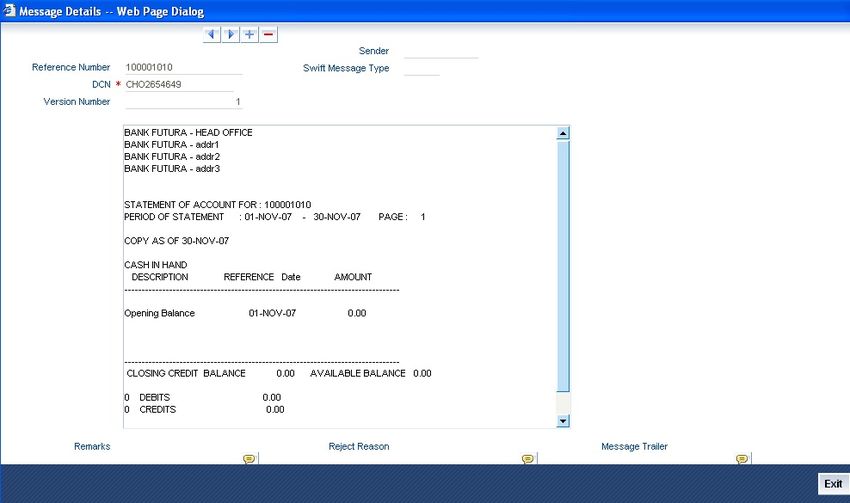
1. Preface
1.1   Introduction
      This manual is designed to help acquaint you with the interface between Oracle FLEXCUBE
      and the other systems within your bank.

      This manual provides you extensive explanations about the various maintenances required
      for the smooth exchange of data between Oracle FLEXCUBE and the applicable systems
      through the interface. It also gives you an insight into the processes involved in the actual
      exchange of data.

1.2   Audience
      This manual is intended for the following User/User Roles:

       Role                              Function

       Back office data entry Clerks     Input functions for maintenance related to the interface.

       Back office Managers/Officers     Authorization functions.

1.3   Documentation Accessibility
      For information about Oracle's commitment to accessibility, visit the Oracle Accessibility
      Program website at http://www.oracle.com/pls/topic/lookup?ctx=acc&id=docacc.

1.4   Organization
      This manual is organized as follows:

       Chapter          Description

                        About this Manual gives information on the intended audience. It
       Chapter 1
                        also lists the various chapters covered in this User Manual.

                        The Oracle FLEXCUBE EMS Interface explains about the EMS
       Chapter 2        (Electronic Messaging Service) interface between external systems
                        and Oracle FLEXCUBE.

                        Maintaining Interface specific Details deals with the maintenance of
       Chapter 3
                        various customer account transactions through EMS.

                        Function ID Glossary has alphabetical listing of Function/Screen ID's
       Chapter 4
                        used in the module with page references for quick navigation.

                                              1-1
1.5 Acronyms and Abbreviations
Abbreviation Description
System Unless and otherwise specified, it shall always refer to Oracle FLEX-
CUBE system
1.6 Related Documents
XML Interface document – outlines the details of the interface mechanism between
Oracle FLEXCUBE and a system external to it
The Procedure User Manual
1.7 Glossary of Icons
This User Manual may refer to all or some of the following icons.
Icons Function
Exit
Add row
Delete row
Option List
1-22. The Oracle FLEXCUBE EMS Interface
The EMS or the Electronic Messaging Service is a messaging interface between external
systems and Oracle FLEXCUBE. This interface is implemented with the help of two windows
services, one each for In and Out processing. This interface enables a connection to be
established between Oracle FLEXCUBE and the external systems network resource for
sending and receiving information.
The in-service connects to the external system resource (Windows machine, UNIX machine
or MSMQ server) and transfers the data to the local windows machine, where the message
is processed and uploaded to Oracle FLEXCUBE.
The out-service polls on an Oracle FLEXCUBE out table. As soon as a message is generated
in the out table, it is picked up, formatted if required (for example, as a MS-Word document)
and delivered to the external system through one of the delivery modes (FTP, MSMQ etc.).
This chapter contains the following sections:
Section 2.1, "Brief Description of the Process"
Section 2.2, "EMS Details Maintenance "
2.1 Brief Description of the Process
This section contains the following topics:
Section 2.1.1, "For Incoming Messages"
Section 2.1.2, "For Outgoing Messages"
2.1.1 For Incoming Messages
For the delivery modes NT and FTP
The message files are to be placed in the EMS\SWIFT\In\Ready, in the EMS server. The
incoming message service (In-service) copies the file to the folder EMS\SWIFT\IN\WIP and
performs further processes like formatting etc. Once the processes are completed, the file is
moved to the folder EMS\SWIFT\IN\PROCESSED.
Though all the folders are maintained in the EMS server, they can be mapped to any system.
For the QUEUE delivery mode
The messages are placed by the external system in the in queue. They are moved from there
to the backup queue and sent for processing. Once processing is successful, the message is
moved to the final queue.
2.1.2 For Outgoing Messages
For delivery modes NT and FTP
The messages are selected from the Oracle FLEXCUBE out table, formatted if required and
moved to the folder EMS\SWIFT\OUT\WIP. From here, the file is picked up and moved to
EMS\SWIFT\OUT.
For the QUEUE delivery mode
The messages are sent to the out queue.
2-12.2 EMS Details Maintenance
The following maintenances are required for the EMS:
Message Media Maintenance
Message Media Control Maintenance
Maintaining Folder structure
Specifying Parameters and Values
This section contains the following topics:
Section 2.2.1, "Maintaining Message Media"
Section 2.2.2, "Message Media Control "
Section 2.2.3, "Maintaining Folder Structure"
Section 2.2.4, "Specifying Parameters and Values for fcubs.properties File"
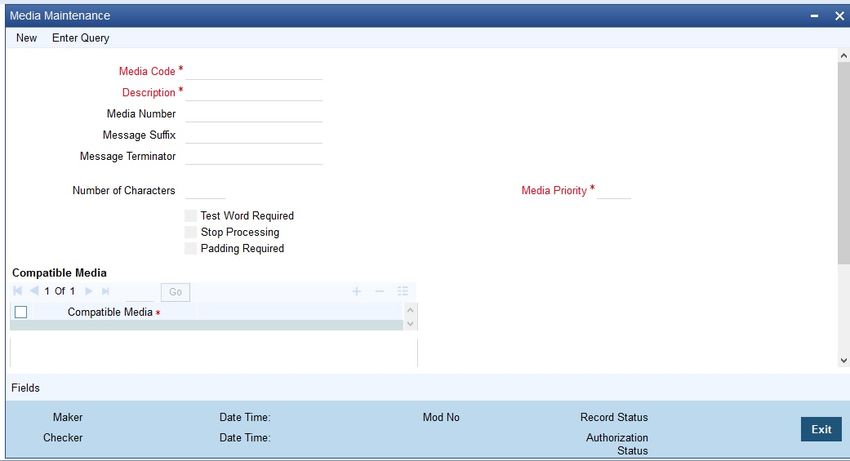
2.2.1 Maintaining Message Media
You can invoke the ‘Message Media Maintenance’ screen by typing ‘MSDMEDMT’ in the field
at the top right corner of the Application tool bar and clicking the adjoining arrow button. The
below given screen displays:
Specify the following details:
Media Code
Specify the media used for message propagation. For instance, SWIFT, MAIL etc
2-2Media Description
Describe the media code.
Message Suffix
Specify the suffix to be added in the message.
Message Terminator
Specify the terminator to be used for terminating the message.
Number of Characters
Specify the total length of the message.
Media Priority
Specify the media priority. Based on the priority, the messages are processed with the media
concerned.
Padding Required
Check this option if padding is required. Padding letters will be added at the end of each
message.
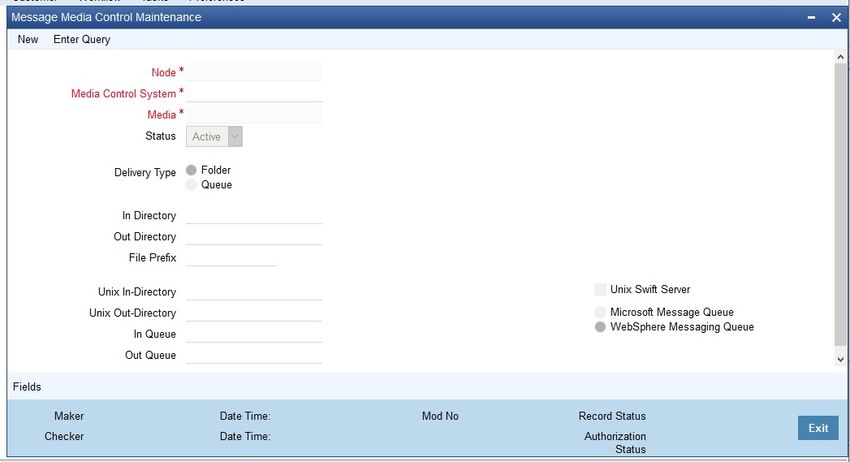
2.2.2 Message Media Control
You can invoke the ‘Message Media Control Maintenance’ screen by typing ‘MSDMGMCS’ in
the field at the top right corner of the Application tool bar and clicking the adjoining arrow
button. The below given screen displays:
Specify the following details:
Node
Specify the DB instance name.
Media
Select the media from the adjoining option list. The option list displays all the valid media
maintained in the system.
Status
Select the status. The following are the options available:
Active
Passive
2-3Delivery Type
Indicate the Mode of delivery. The following are the options available:
Folder
Queue
In Directory
Specify the directory in which the message files are to be placed by external system (Only for
EMS_IN if delivery type is ‘Folder’).
Out Directory
Specify the directory in which the message files are sends to external system (Only for
EMS_OUT).
In Queue
Specify the queue in which the message files are to be placed by external system (Only for
EMS_IN if Delivery type is ‘Queue’).
Out Queue
Specify the queue in which the message files are sends to external system (Only for
EMS_OUT).
Message Queue
Select the queuing software being used in bank.
2.2.3 Maintaining Folder Structure
Maintain the following folder structure:
2.2.3.1 Folder Structure for Delivery Mode Folder
You should maintain the following folder structure on the Application server machine:
The sub-folders for the media – MAIL and SWIFT – exist under the parent folder EMS.
2-42.2.3.2 Folder Structure for Delivery Mode Queue
You should maintain the following folder structure on the Application server machine:
The sub-folders for the media – SWIFT – exist under the parent folder EMS.
2.2.4 Specifying Parameters and Values for fcubs.properties File
You should be specify the following parameter values in fcubs.properties file.
2.2.4.1 For Delivery Mode Folder
Parameter Description
EMS_INT_QCF Internal Queue Connection Factory. Example:
(EmsQcf)
EMS_OUT_JMS_DLQ Out messages dead letter queue. Example: (NOTI-
FY_QUEUE_DLQ)
EMS_IN_JMS_DLQ In messages dead letter queue. Example: (NOTI-
FY_QUEUE_DLQ)
EMS_FILE_TRANSFER_MODE Mode of file transfer. Example: FTP etc.
FTP_SRVR FTP Server IP Address. Example: 169.165.98.11(if
file Transfer Mode is ftp)
FTP_ID FTP Server userId (if file Transfer Mode is ftp)
FTP_PWD FTP Server Password. Example:
2fb0x66QSug=(FTP Server Password in encrypt
format)
FILE_TYPE file type. Example: .txt,.xlsx etc
SWIFT_FORMAT 1
MSG_DELIMITER YES
MSG_TERMINATOR YES
MEDIA SWIFT
2-52.2.4.2 For Delivery Mode Queue
Parameter Description
EMS_EXT_QCF Out Queue Connection Factory - External System
EMS_INT_QCF Internal Queue Connection Factory Examples(
EmsQcf)
EMS_OUT_JMS_DLQ Out messages dead letter queue Examples (NOTI-
FY_QUEUE_DLQ)
EMS_IN_JMS_DLQ in messages dead letter queue Examples (NOTI-
FY_QUEUE_DLQ)
EMS_INIT_CTX_FACT Application server context factory class in which
server external queue create examples (web-
logic.jndi.WLInitialContextFactory)
EMS_PRVDR_URL Application server ip address in which server exter-
nal queue create example weblogic server t3://
127.0.0.1:7001
EMS_QUEUE_PRINCIPAL Application server User Id in which external queue
create.
EMS_QUEUE_CREDENTIALS Application server Password in which external
queue create.
EMS_FILE_TRANSFER_MODE Mode of file transfer Examples FTP etc..
FTP_SRVR FTP Server IP Address Examples 169.165.98.11(if
file Transfer Mode is ftp)
FTP_ID FTP Server userId (if file Transfer Mode is ftp)
FTP_PWD FTP Server Password Examples
2fb0x66QSug=(FTP Server Password in encrypt
format)
FILE_TYPE file type examples .txt,.xlsx etc ..
SWIFT_FORMAT 1
MSG_DELIMITER YES
MSG_TERMINATOR YES
MEDIA SWIFT
2-63. Maintaining Interface specific Details
Oracle FLEXCUBE is an international universal banking solution catering to the treasury back
office functions among other modules.
The details of all customer account transactions can be handed off to the external systems
existing within your bank, through an interface. This document outlines the specifications of
the interface between Oracle FLEXCUBE and the external systems.
The interface handles (hands off) data pertaining to the following functions:
Account Statement hand off – the account statement hand off is performed based on
the account statement cycle, maintained in the customer account maintenance,
whereby the details of all account statements are generated.
The salient features of the interface are as follows:
Data is transferred to the external system (s) through ASCII files in predefined file
formats.
Data is handed off at the end of the business day as a Batch file to the external system.
Note
If Handoff fails you will need to trigger it once again.
This chapter contains the following section:
Section 3.1, "Account Statement Report"
3.1 Account Statement Report
This section contains the following topic:
Section 3.1.1, "Maintaining Account Statement Handoff"
3-13.1.1 Maintaining Account Statement Handoff
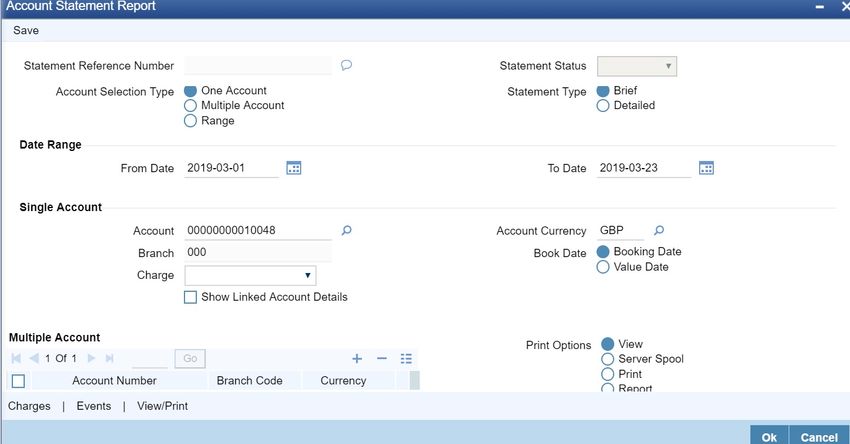
In Oracle FLEXCUBE, you can trigger the account statement generation online by typing
‘ACDOPTN’ in the field at the top right corner of the Application tool bar and clicking the
adjoining arrow button. System generates one file for each account.
In this screen you can capture the following attributes for generating the account statement:
Specifying the account number
This is a valid account number maintained in the system. The branch where the account is
held will be displayed upon selecting the account.
Specifying the date range for account statement
The From and To date represent the date range for generating the account statement for the
account. Enter the dates in date–month-year format.
Specifying the account currency
This is a valid currency of the account for which the statement needs to be generated.
3-2After the fields have been entered, the following screen with the account details will be
displayed.
Selecting multiple account numbers
In this section you can capture the following attributes for generating consolidated account
statement for the customer having many accounts:
Customer Number – a valid customer number maintained in the system.
To Date – the date till which the account statement has to be generated.
3-34. Function ID Glossary
A M
ACDOPTN .........................3-2 MSDMGMCS .................... 2-3
MSDMEDMT ..................... 2-2
4-1You can also read


