Outbreaks of Suspected or Confirmed Norovirus Policy - V7.0 December 2018 - RCHT
←
→
Page content transcription
If your browser does not render page correctly, please read the page content below
Outbreaks of Suspected or Confirmed
         Norovirus Policy

               V7.0

          December 2018
Summary. Norovirus Flowchart
Patient has developed sudden
onset diarrhoea.
Complete diarrhoea risk assessment tool.
Is infective cause suspected?
NO YES
Isolation not Is Norovirus
required suspected?
YES NO
Isolate patient in side room on the Isolate patient
same ward in side room
Obtain specimen Complete
terminal clean
Close the bay of bed space
To determine the need to keep the
bay closed, prompt review of the
situation is required by:
o In hours – IPAC, Nurse in
charge, consultant /medical
team
o Out of hours – site coordinator,
on-call microbiologist,
consultant /senior doctor
Outbreaks of Suspected or Confirmed Norovirus Policy V7.0
Page 2 of 35Table of Contents
Summary. Norovirus Flowchart ............................................................................................ 2
1. Introduction ................................................................................................................... 5
2. Purpose of this Policy/Procedure .................................................................................. 5
3. Scope ........................................................................................................................... 5
4. Definitions / Glossary .................................................................................................... 7
5. Ownership and Responsibilities .................................................................................... 7
5.1. Role of General Managers/Clinical Leads ............................................................. 7
5.2. Role of Wards Sisters/Charge Nurses and Departmental Managers..................... 7
5.3. Role of Individual Staff ........................................................................................... 7
5.4. Role of Ward Staff – action card number 14 .......................................................... 7
5.5. Infection Prevention and Control (IPAC) Team – action card number 9 ................ 8
5.6. Role of Microbiology Department .......................................................................... 8
5.7. Role of Occupational Health Department .............................................................. 8
5.8. Role of the Hospital Infection and Control Committee ........................................... 8
5.9. Role of the Outbreak Control Group ...................................................................... 8
5.10. Role of the Clinical Site Co-ordinators – Action card ......................................... 8
6. Standards and Practice ................................................................................................ 8
6.1. Ward Management ................................................................................................ 8
6.2. Personal Protective Equipment (PPE) ................................................................. 10
6.3. Hand Hygiene ...................................................................................................... 10
6.4. Patient Movement................................................................................................ 10
6.5. Staff ..................................................................................................................... 11
6.6. Ward Staff............................................................................................................ 12
6.7. Ward Cleaning ..................................................................................................... 12
6.8. Visiting ................................................................................................................. 12
6.9. Ward Re-opening ................................................................................................ 13
6.10. Communication ................................................................................................ 13
6.11. Escalation Procedure ....................................................................................... 13
7. Dissemination and Implementation ............................................................................. 13
8. Monitoring compliance and effectiveness ................................................................... 14
9. Updating and Review.................................................................................................. 14
10. Equality and Diversity .............................................................................................. 14
Appendix 1. Governance Information ................................................................................ 15
Appendix 2. Initial Equality Impact Assessment Form ....................................................... 18
Appendix 3. Escalation Levels ........................................................................................... 21
Outbreaks of Suspected or Confirmed Norovirus Policy V7.0
Page 3 of 35Appendix 4. Outbreak Form - Patients ............................................................................... 22
Appendix 5. Outbreak Form - Staff .................................................................................... 23
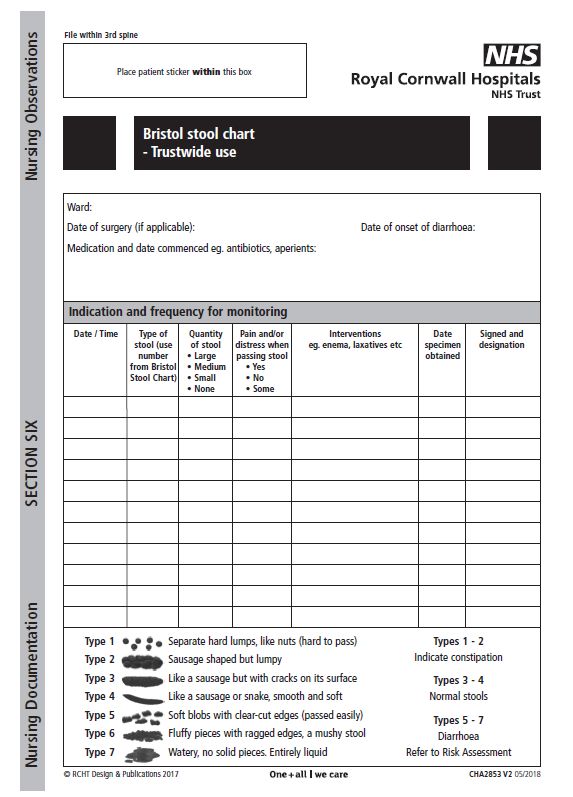
Appendix 6. Bristol Stool Chart .......................................................................................... 24
Appendix 7. Terminal Clean Sign-off Form ........................................................................ 25
Appendix 8. Norovirus Action Card – ED Staff................................................................... 27
Appendix 9. Norovirus Action Card – IPAC Team ............................................................. 28
Appendix 10. Norovirus Action Card – Medical Staff ......................................................... 29
Appendix 11. Norovirus Action Card – Clinical Site Co-ordinators..................................... 30
Appendix 12. Norovirus Action Card – Support Staff (Porters, Supplies, etc.) ................... 31
Appendix 13. Norovirus Action Card – Therapies Staff/Pharmacists ................................. 32
Appendix 14. Norovirus Action Card – Ward Staff ............................................................. 33
Appendix 15. Norovirus Action Card – Domestics ............................................................. 34
Appendix 16. Action Card Housekeepers .......................................................................... 35
Outbreaks of Suspected or Confirmed Norovirus Policy V7.0
Page 4 of 351. Introduction
1.1. Norovirus is a major cause of acute gastroenteritis and diarrhoea in children
and adults. The cause of illness, Norovirus (previously known as Norwalk-like or
Small Round Structured Virus) was described in 1968 in samples from an elementary
school in Norwalk, Ohio. The disease is often termed Winter Vomiting Disease
because of the increased prevalence in the winter months; however it can be
detected throughout the year.
1.2. Norovirus is the most common cause of outbreaks of gastro-enteritis in
hospitals and can also cause outbreaks in other settings such as schools, nursing
homes and cruise ships. Hospital outbreaks often cause major disruption in hospital
activity resulting ward closures, cancelled admissions and delayed discharges which
can significantly reduce clinical activity for the duration of the outbreak. Failure to
observe and comply with Infection Control guidelines/policy can lead to further
spread of infection and a delay in the hospital returning to normal activity. Outbreaks
can affect both patients and staff, sometimes with attack rates in excess of 50%. For
this reason, staff shortages can be severe, particularly if several wards are involved
at the same time. It is therefore essential that cases are detected early and isolated
appropriately to prevent spread and major outbreaks.
2. Purpose of this Policy/Procedure
This policy has been developed to provide a practical document to equip all
healthcare staff at the Royal Cornwall Hospitals NHS Trust with the necessary
information on the recognition, management and treatment of outbreaks of Norovirus
and should be read in conjunction with the Outbreak Policy.
This version supersedes any previous versions of this document.
3. Scope
This document applies to all staff including bank and agency staff working within the
Royal Cornwall Hospitals NHS Trust.
3.1. Signs and Symptoms of Norovirus
3.1.1. The average incubation period for Norovirus associated gastro-
enteritis is 12-48 hours.
3.1.2. The illness is characterized by a sudden acute onset of:
Vomiting (This is the predominant symptom, often projectile, and is seen in
50% of cases, however, clusters can occur where vomiting is infrequent or
absent altogether).
Watery diarrhoea and abdominal cramps
Nausea
3.1.3. In addition headache, myalgia, fever and malaise are common. Some
or all of the above symptoms may be present.
Outbreaks of Suspected or Confirmed Norovirus Policy V7.0
Page 5 of 353.1.4. Symptoms last between one and three days and recovery is usually
rapid.
3.1.5. Dehydration is the most common complication and patients may
require replacement fluids.
3.2. Transmission
3.2.1. Noroviruses are highly contagious. It is estimated that around
30,000,000 (30 million) viral particles are released during one vomiting incident.
However, it only takes around 100 of these particles to cause illness.
Noroviruses are transmitted primarily through the faecal–oral route either by
person to person spread or via contaminated food or water. In addition
Noroviruses can be spread via aerosol dissemination of infected particles
following vomiting.
3.2.2. Transmission can also occur through hand transfer of the virus to the
oral mucosa following contact with environmental surfaces, fomites and
equipment which have been contaminated with either faeces or vomit.
Norovirus can survive for up to 12 days on some surfaces.
3.3. Diagnosis
3.3.1. Norovirus may be suspected clinically in patients and staff with a
history of vomiting of sudden onset followed by diarrhoea. During an outbreak
several people are commonly affected over a short space of time and cases
with typical features may be ascribed to Norovirus infection without further
testing.
3.3.2. Confirmation of Norovirus infection depends on a PCR test performed
on faecal samples. This is useful in confirming the nature of an outbreak early
on. Once Norovirus is identified on a ward, further testing will only be
performed in order to determine whether Norovirus shedding is occurring in
cases of persistent diarrhoea or whether the virus has spread throughout the
ward. Norovirus testing may be performed in order to identify atypical or outlying
cases. The test will only be performed after discussion with the Infection Control
team or Microbiologists. Testing is available daily with a result available the
same day for samples arriving at the laboratory before 09.30hrs.
3.3.3. When an outbreak is suspected, it is imperative to institute infection
control measures immediately without waiting for virological confirmation from
stool testing.
3.4. Treatment
3.4.1. There is no effective treatment for Noroviruses. It is a self-limiting
illness which will cease within a few days. It is important to ensure prompt fluid
replacement to prevent dehydration and its complications.
3.4.2. Anti-emetics or anti-motility agents must not be prescribed.
Outbreaks of Suspected or Confirmed Norovirus Policy V7.0
Page 6 of 354. Definitions / Glossary
4.1. Norovirus – a highly contagious small round structured virus capable of
causing symptoms of diarrhoea and/or vomiting.
4.2. Outbreak - An incident in which two or more people experiencing a similar
illness are linked in time/place; or a greater than expected rate of infection compared
with the usual background rate for the place and time where the outbreak has
occurred.
5. Ownership and Responsibilities
5.1. Role of General Managers/Clinical Leads
Divisional Managers/ clinical leads must ensure that resources are available for
health care workers to undertake effective standard and isolation precautions.
5.2. Role of Wards Sisters/Charge Nurses and Departmental
Managers
Are responsible for ensuring that staff are aware of this guidance and that the
guidance is implemented.
They are responsible for ensuring that the toolbox talk on Norovirus is cascaded
to all staff during the first 2 weeks of November. Any member of staff who is
absent during this period should receive an update as soon as possible on their
return.
They are responsible for ensuring that Occupational Health have been informed
of any staff with symptoms of Diarrhoea and/or vomiting during outbreaks of
Norovirus.
5.3. Role of Individual Staff
All staff have a clinical and ethical responsibility to carry out effective Infection
prevention and control procedures and to act in a way, which minimises risk to
the patient. All staff are responsible for attending a tool box talk during the first
two weeks of November if they work in a clinical area. Any member of staff who
is absent during this period should receive an update as soon as possible on
their return.
5.4. Role of Ward Staff – action card number 14
Ward staff are required to be vigilant for all cases of diarrhoea and report any cases
of suspected infectious diarrhoea to the IPAC team or Site Co-ordinators out of
hours.
Ward staff are responsible for ensuring stool specimens are collected and
submitted promptly and that the completion of the relevant documentation has been
carried out ie stool charts.
Ward staff working on those wards that are affected with Norovirus, are responsible
for reporting and recording details of patients with suspected Norovirus and providing
an up to date list on a daily basis to the IPAC team.
Outbreaks of Suspected or Confirmed Norovirus Policy V7.0
Page 7 of 355.5. Infection Prevention and Control (IPAC) Team – action card
number 9
The IPAC team are responsible for providing appropriate advice on the
management of patients diagnosed as having or suspected as having Norovirus. The
IPAC team are responsible for the coordination of specimen collection and testing
(see below) and dealing with the infection control aspects of results.
The IPAC team are responsible for reviewing and updating this policy.
5.6. Role of Microbiology Department
The laboratory will provide a daily same-day testing service for faecal samples
received by 14.30pm weekdays and 09.30am weekends and sanctioned by the
IPAC/microbiologists/site coordinators.
5.7. Role of Occupational Health Department
The Occupational Health Department are responsible for collating information on
staff with symptoms of diarrhoea and/or vomiting and for informing the IPAC
team of areas with increased incidence of symptoms.
5.8. Role of the Hospital Infection and Control Committee
The Hospital Infection Prevention and Control Committee is responsible for
approving this policy.
5.9. Role of the Outbreak Control Group
The outbreak control group is responsible for monitoring compliance with this
policy via the outbreak meetings.
5.10. Role of the Clinical Site Co-ordinators – Action card
The Clinical site co-ordinators are responsible for ensuring suspected cases of
Norovirus are isolated in accordance with this policy and to ensure there is no
inappropriate movement of patients unless there is an urgent clinical need. They
are responsible for co-ordinating cleaning plan when areas are due to re-open.
6. Standards and Practice
6.1. Ward Management
6.1.1. Isolation
6.1.1.1. Any patient admitted with symptoms suggestive of Norovirus
must be triaged in the Emergency Department and fast tracked to the
isolation ward. Where the patient condition does not allow admission to
the isolation ward, they must be admitted to a side room preferably on a
base ward to avoid admitting to MAU. The Infection Prevention and
Control Team should be informed at the earliest opportunity of the
patient’s admission.
6.1.1.2. The priority is to ensure that patient care is not compromised
and at the same time prevent the spread of the virus to other susceptible
patients and prevent a major hospital outbreak.
6.1.1.3. Doors to bays/ rooms MUST remain closed.
Outbreaks of Suspected or Confirmed Norovirus Policy V7.0
Page 8 of 356.1.1.4. Symptomatic patients must have dedicated commodes/toilet
facilities.
6.1.1.5. Symptomatic patients must have dedicated equipment e.g.
monitoring equipment. Patient equipment must be cleaned and disinfected
with a chlorine based disinfectant between each patient use.
6.1.1.6. Patients on an affected ward should be provided with a leaflet
with measures to reduce the risk of acquiring Norovirus (RCHT1502 V2).
6.1.1.7. The allocation of a single room will generally take precedence
over all other “alert” organisms with the exception of
suspected/confirmed pulmonary tuberculosis, suspected/confirmed
symptomatic Clostridium difficile, suspected/confirmed bacterial meningitis
(for the first 24 hours of antibiotic therapy), chicken pox, Typhoid, CPE.
6.1.1.8. If staff are unsure as to whether a patient already in a single
room can be de-isolated, the Infection Prevention and Control Team must
be contacted (out of hours, Microbiologist via switchboard).
6.1.1.9. A poster (available in ward norovirus pack) must be displayed
at the entrance of the ward advising that there is an outbreak of diarrhoea
and vomiting.
6.1.2. Ward Closure
6.1.2.1. Ward closure will be made following risk assessment of the
area where the diarrhoea has occurred. When 2 or more bays are
affected, actions are required to ensure that the unaffected bays in a ward
can remain open, including: revised staffing to enable separate staffing of
affected and unaffected areas, confirming that the ward design permits
effective isolation of affected from unaffected areas, and availability of
designated toilet facilities. Full ward closure should be undertaken if it is
not possible to implement the identified additional infection prevention
actions, and the ward must be closed until those required measures have
been achieved. The open/closed status of any affected ward must be
reviewed and decided by the Outbreak Control Group.
6.1.2.2. If a patient develops symptoms of suspected Norovirus and
they are in a bay with others, the patient should be isolated in a side room
on that ward and the whole bay must be closed immediately in an attempt
to contain the spread of infection from both affected and exposed patients.
This decision should be made:
Within hours by the Ward Sister/Matron and Infection Prevention and
Control Team
Out of hours by the Ward Sister/Matron and Site Coordinator
6.1.2.3. An urgent senior clinical assessment must be completed to
determine if the bay closure should remain closed. This should be carried
out by the following:
Outbreaks of Suspected or Confirmed Norovirus Policy V7.0
Page 9 of 35 Within hours - the Infection Prevention and Control team, Matron/ward
sister and Consultant/Medical team
Out of hours - the Site Coordinator, On-Call Microbiologist and On-
Call registrar/Consultant.
6.1.2.4. There must be no further admissions to the closed bay/ward
until advised by the IPAC team.
6.1.2.5. Dedicated nursing staff must be allocated to nurse symptomatic
/exposed patients.
6.2. Personal Protective Equipment (PPE)
6.2.1. PPE e.g.: aprons and gloves must be used appropriately (single use
items) and for each episode of care/treatment/examination on all patients by all
staff.
6.2.2. Long sleeved gowns must be worn by staff who are not specifically
allocated to care for affected patients but who are called on to assist with the
care of affected patients plus any visiting personnel required to have patient
contact. These must be changed for each episode of care.
6.2.3. There is currently no evidence to support the wearing of face masks
for either patients or staff.
6.3. Hand Hygiene
6.3.1. The hands of healthcare staff can provide the vehicle for the
transmission of Norovirus. It is essential that all staff wash their hands when
required using the correct washing technique to help reduce the risk of
transmission.
6.3.2. Alcohol gel is not effective against these viruses and therefore hands
must be washed with soap and water before and after every patient contact and
contact with potentially infectious equipment, furnishings or other fomites.
6.3.3. Gloves do not obviate the need to wash hands.
6.3.4. Patients must be provided with the opportunity to wash their hands or
use hand wipes after each toileting episode and also before each meal.
6.4. Patient Movement
6.4.1. There must be no transfer of patients to other
departments/wards/hospitals from Norovirus affected wards unless there is an
urgent clinical need in which case the receiving department must be informed.
In this situation, the patient must be seen immediately on arrival to the
department and preferably at the end of a list. Minimal numbers of staff should
attend the patient. Long sleeved gowns and gloves must be worn. All
equipment that the patient has come in contact with must be cleaned with a
chlorine based disinfectant e.g. Actichlor plus. The patient must return directly
to the ward and must not wait in a waiting area with others.
Outbreaks of Suspected or Confirmed Norovirus Policy V7.0
Page 10 of 356.4.2. In the event of the patient requiring surgery, theatre staff must be
informed that the patient is from a Norovirus affected ward. The patient must be
placed last on the list. The patient must go directly to the anaesthetic room and
must be recovered in theatre. The patient must not be recovered in the
Recovery area with other patients. Minimal numbers of staff should be in the
theatre. The theatre, all equipment and anaesthetic room must be cleaned
thoroughly using a chlorine based disinfectant after the patient has left theatre.
If the patient is due to have elective surgery and has symptoms of Norovirus it is
advised not to continue with surgery until symptoms have resolved.
6.4.3. The movement of affected patients from one ward to another for
cohort management is NOT recommended.
6.4.4. Patients from Norovirus affected wards must not be discharged to
Care Home facilities unless they have had the illness and are 72 hours
symptom free or they have been admitted from a Home with confirmed
Norovirus. Patients can however be discharged to their own homes.
6.5. Staff
6.5.1. Non-essential staff must not visit the affected bay/ward. Wherever
practicable/possible procedures i.e. venepuncture, ECG’s should be undertaken
by ward staff. Where bays only are closed, a team of dedicated staff should be
allocated to these bays. Staff (nursing, domestic) who are working on affected
wards must not be moved to work in other parts of the hospital within the shift,
They can work on other wards if necessary the following day providing 12 hours
have elapsed, they have showered, wear a clean uniform and feel well. The
use of Bank and Agency staff is not advised on affected areas. Allied Health
Professionals (AHP’s) should allocate a nominated individual to affected wards.
If this is not possible, the affected wards must be visited last and long sleeved
disposable gowns must be worn.
6.5.2. If an AHP, who has been allocated to the affected wards, is working
on an affected ward when it is re-opened they may continue working on the
ward if they have already started treatments. If they are off the ward when the
ward is re-opened they should stay off the ward and staff who are allocated to
non-affected wards should take over treatments on this particular ward.
6.5.3. Wherever possible, medical staff should be allocated to the affected
wards. If this is not possible, the affected wards must be visited last the
exception being where emergency treatment is required. Hands must be
washed with soap and water before and after each patient contact or contact
with their immediate environment. Aprons and gloves must be worn for each
patient contact however if medical staff have to visit other wards long sleeved
disposable gowns must be worn for patient contact.
6.5.4. Staff who become symptomatic with diarrhoea and /or vomiting must
leave the area immediately and must not return to work until 48 hours symptom
free. They must inform the person in charge of the area to ensure that any toilet
facilities are terminally cleaned.
6.5.5. Staff maybe required to submit a sample of faeces to assist with
outbreak investigation.
Outbreaks of Suspected or Confirmed Norovirus Policy V7.0
Page 11 of 356.5.6. Staff should inform Occupational Health of their symptoms. A
message can be left on the answerphone outside of working hours.
6.6. Ward Staff
6.6.1. An outbreak form (Appendix 3) for symptomatic patients and Staff
(Appendix 4) must be maintained by the ward team. This will be reviewed daily
by a member of the Infection Prevention and Control Team.
6.6.2. Bristol Stool (Appendix 5) and fluid balance charts must be maintained
on all affected patients.
6.6.3. Ward staff must inform domestic services of the situation and advise
the use of Antichlor Plus.
6.6.4. Water jugs must be kept covered to prevent the water from becoming
contaminated, washed thoroughly each day in a dish washer, and the water
changed frequently.
6.6.5. Bowls of fruit and open packets of food, i.e. biscuits, must be removed
as they may become contaminated as a result of aerosol contamination.
6.6.6. Eating and drinking in the open ward is not permitted.
6.6.7. It is essential that if a ward is affected by Norovirus discharge
planning is continued to ensure prompt discharge of patients once the ward re-
opens.
6.7. Ward Cleaning
Whilst a bay or ward is closed during an outbreak, the area must be cleaned
daily with both detergent and chlorine e.g. Actichlor Plus. Frequently used areas
such as toilet areas should be cleaned at least three times daily and more
frequently should the need arise. A decision regarding the frequency of cleaning
must be made by the Outbreak Control Group.
6.8. Visiting
6.8.1. Visiting should be restricted to close family members and friends only
- preferably the same people visiting for the period of the ward/bay closure.
6.8.2. No children to be allowed to visit unless the patient is critically ill.
6.8.3. Visitors must not visit if they have had diarrhoea and vomiting. They
must be 48 hours symptom free before they can visit. They should not visit if
they have been in contact with anyone with diarrhoea and vomiting until 48
hours after contact.
6.8.4. On entering the ward, visitors must be instructed to wash their hands
with soap and water.
6.8.5. They should visit only the patient they have come to see and not go
from bed to bed.
Outbreaks of Suspected or Confirmed Norovirus Policy V7.0
Page 12 of 356.8.6. On leaving the ward, visitors should be instructed to wash their hands
with soap and water.
6.8.7. If a visitor to an affected ward needs to visit a non-affected ward, this
should be discouraged. If however this is essential then the visit to the affected
ward should be carried out last.
6.9. Ward Re-opening
6.9.1. Rooms, Bays, or the Ward may be terminally cleaned and reopened
72 hours after the last symptomatic episode, on the instruction of the IPAC
team, Infection Control Doctor or Microbiologist (in accordance with the Ward
Closure Policy). Equipment that cannot be decontaminated must be disposed
of. Any patients remaining in the bay should be decanted out of the bay to a bed
within the ward (do not transfer patients to other wards) to facilitate an
effective terminal clean. If this cannot be achieved at least one bed space
should be available to facilitate effective cleaning of the bay.
6.9.2. The terminal clean must be monitored by either the IPAC team, Site
Co-ordinator, Ward Sister/Charge Nurse or Matron. Whenever possible,
following a clean using a detergent solution and completion of the Terminal
clean sign off form, appendix 7, Hydrogen Peroxide Vapour
(HPV) must be used.
6.9.3. On occasions where it is inappropriate to use HPV i.e. previously
closed bays unable to be vacated prior to the terminal clean, a Hypochlorite
based solution i.e. Actichlor should be used.
6.9.4. The ward/bay must not be re-opened until approved by nurse in
charge/ IPAC team or site co-ordinator.
6.10. Communication
For the duration of any period of closure the Chief Executive, Executive
Directors, Divisional Directors, Chief Operating Officer and any other relevant
personnel will be updated by the Infection Prevention and Control Team on a
daily basis.
6.11. Escalation Procedure
When a bay/ward has been closed with confirmed Norovirus, an outbreak
control group will be convened by the DIPC. Once convened, the outbreak
control group will determine the frequency of future meetings.
7. Dissemination and Implementation
This policy will be implemented via the following routes:
The policy will be included in the Trust’s Document Library.
The policy will be circulated to all Link Practitioners and Matrons
Outbreaks of Suspected or Confirmed Norovirus Policy V7.0
Page 13 of 358. Monitoring compliance and effectiveness
Element to be Ward management of patients with confirmed or suspected
monitored Norovirus.
Lead Louise Dickinson
Joint DIPC/Consultant Nurse Infection Prevention and Control
This will be monitored against the actions specified in section 8
Tool
This will be monitored daily and via any outbreak meetings that are
Frequency
convened.
Reporting Any actions requiring immediate attention will be reported to the
arrangements ward sister or nurse in charge at that time. An outbreak report will
be completed by the DIPC at the end of any outbreak of norovirus
which will be submitted to the Hospital Infection Prevention and
Control Committee.
Acting on The Hospital Infection Prevention and Control Committee will
recommendations undertake subsequent recommendations and action planning for
and Lead(s) any or all deficiencies and recommendations within reasonable
timeframes
Required actions will be identified and completed in a specified
timeframe
Change in Required changes to practice will be identified and actioned
practice and immediately where necessary. A lead member of the team will be
lessons to be identified to take each change forward where appropriate. Lessons
shared will be shared with all the relevant stakeholders
9. Updating and Review
This policy will be reviewed within 3 years
10. Equality and Diversity
10.1.This document complies with the Royal Cornwall Hospitals NHS Trust
service Equality and Diversity statement which can be found in the 'Equality,
Diversity & Human Rights Policy' or the Equality and Diversity website.
10.2. The Initial Equality Impact Assessment Screening Form is at Appendix 2.
Outbreaks of Suspected or Confirmed Norovirus Policy V7.0
Page 14 of 35Appendix 1. Governance Information
Outbreaks of Suspected or Confirmed Norovirus
Document Title
Policy V7.0
Date Issued/Approved: 12 November 2018
Date Valid From: December 2018
Date Valid To: December 2021
Directorate / Department Louise Dickinson, Joint DIPC/Consultant Nurse
responsible (author/owner): Infection Prevention & Control
Contact details: 01872 254969
This policy has been developed to provide a
practical document to equip all healthcare staff at
the Royal Cornwall Hospitals NHS Trust with the
Brief summary of contents
necessary information on the recognition,
management and treatment of outbreaks of
Norovirus.
Suggested Keywords: None
RCHT CFT KCCG
Target Audience
Executive Director responsible
Nurse Executive
for Policy:
Date revised: October 2018
Policy for the Management of outbreaks of
This document replaces (exact
suspected/confirmed Norovirus V6.0
title of previous version):
Approval route (names of
Hospital Infection Prevention & Control Committee
committees)/consultation:
Divisional Manager confirming
Louise Dickinson
approval processes
Name and Post Title of additional
Not required
signatories
Name and Signature of
Divisional/Directorate {Original Copy Signed}
Governance Lead confirming
approval by specialty and Louise Dickinson
divisional management meetings
Signature of Executive Director {Original Copy Signed}
giving approval
Outbreaks of Suspected or Confirmed Norovirus Policy V7.0
Page 15 of 35Publication Location (refer to
Policy on Policies – Approvals Internet & Intranet Intranet Only
and Ratification):
Document Library Folder/Sub
Clinical / Infection Prevention & Control
Folder
Links to key external standards Regulation 12
Health Protection Agency (2007) Guidance for the
Management of Norovirus Infection in Cruise
Ships. London. HPA
Lopman B. et al (2004) Epidemiology and cost of
nosocomial gastroenteritis, Avon, England.
Emerging Infectious Diseases 10 (10) 1827.
Lopman B. et al (2004) Clinical manifestation of
Norovirus gastroenteritis in healthcare settings.
Clinical Infectious Disease. 39 (3) 318- 24
Related Documents:
Norovirus Working Party (2012) Guidelines for the
management of norovirus outbreaks in acute and
community health and social care settings.
Public Health England (2016) Norovirus Toolkit
Haill CF et al (2012) Compartmentalisation of
wards to cohort symptomatic patients at the
beginning and end of norovirus outbreaks.
Journal of Hospital Infection 82 30-35
Training Need Identified? No
Outbreaks of Suspected or Confirmed Norovirus Policy V7.0
Page 16 of 35Version Control Table
Version Changes Made by
Date Summary of Changes
No (Name and Job Title)
14.01.10 1.0 New Policy Louise Dickinson
Consultant Nurse
Infection Prevention
and Control
07.11.11 2.0 Formatted into new Policy format. Updated in Louise Dickinson
accordance with new Community wide Consultant Nurse
Norovirus Plan. Infection Prevention
and Control
22.05.13 3.0 Revision Louise Dickinson
Consultant Nurse
Infection Prevention
and Control
11.09.13 4.0 Updated following debrief in response to Louise Dickinson
outbreak in 2013. Re-formatted to new policy Consultant Nurse
format. Infection Prevention
and Control
Louise Dickinson
Revised and reformatted. Updated following
Consultant Nurse
07.07.15 5.0 debrief in response to the outbreak in
Infection Prevention
2014/15.
and Control
Amendments to section 10 ward closure and Louise Dickinson
subsequent amendments to action cards. Consultant Nurse
18.11.16 6.0
Introduction of action card for domestics and Infection Prevention
housekeepers. and Control.
Jean James
CNS
01.09.17 6.1 Added clarity on cleaning
Infection Prevention
and Control
Louise Dickinson
Amendments made to reflect timing of Consultant Nurse
26.10.18 7.0
specimen to lab. Stool chart updated. Infection Prevention
and Control.
All or part of this document can be released under the Freedom of Information
Act 2000
This document is to be retained for 10 years from the date of expiry.
This document is only valid on the day of printing
Controlled Document
This document has been created following the Royal Cornwall Hospitals NHS Trust
Policy for the Development and Management of Knowledge, Procedural and Web
Documents (The Policy on Policies). It should not be altered in any way without the
express permission of the author or their Line Manager.
Outbreaks of Suspected or Confirmed Norovirus Policy V7.0
Page 17 of 35Appendix 2. Initial Equality Impact Assessment Form
Name of the strategy / policy /proposal / service function to be assessed (hereafter referred to
as policy):
Outbreaks of Suspected or Confirmed Norovirus Policy V7.0
Directorate and service area: Is this a new or existing Policy?
Infection Prevention and Control Existing
Name of individual completing Telephone: 01872 254969
assessment: Louise Dickinson
1. Policy Aim* To protect patients, staff and the general public by preventing cross-
infection and contamination of the environment.
2. Policy Objectives* To provide clear infection prevention and control guidance for the
management and control of a confirmed or suspected outbreak of
transmissible infection. It supplements the guidance provided in the
Major outbreak Policy.
3. Policy – intended To reduce the risk of cross infection and escalation of the outbreak
Outcomes* situation.
To reduce the number of unnecessary ward closures
4. *How will you Daily at bed management meetings and arranged outbreak meetings
measure the
outcome?
5. Who is intended to All Staff and patients at risk.
benefit from the
policy?
6a Who did you Workforce Patients Local External Other
consult with groups organisations
X
Please record specific names of groups
b). Please identify the
Infection Prevention and Control Steering Group
groups who have
Hospital Infection Control Committee
been consulted about
this procedure.
What was the Policy approved
outcome of the
consultation?
Outbreaks of Suspected or Confirmed Norovirus Policy V7.0
Page 18 of 357. The Impact
Are there concerns that the policy could have differential impact on:
Equality Strands: Yes No Unsure Rationale for Assessment / Existing Evidence
Age
Sex (male,
female, trans-
gender / gender
reassignment)
Race / Ethnic
communities
/groups
Disability -
Learning disability,
physical
impairment,
sensory
impairment, mental
health conditions
and some long term
health conditions.
Religion /
other beliefs
Marriage and
Civil partnership
Pregnancy and
maternity
Sexual
Orientation,
Bisexual, Gay,
heterosexual,
Lesbian
You will need to continue to a full Equality Impact Assessment if the following have
been highlighted:
You have ticked “Yes” in any column above and
No consultation or evidence of there being consultation- this excludes any policies
which have been identified as not requiring consultation. or
Major this relates to service redesign or development
8. Please indicate if a full equality analysis is recommended. Yes No
9. If you are not recommending a Full Impact assessment please explain why.
None of the equality strands have been identified in the initial impact assessment.
Outbreaks of Suspected or Confirmed Norovirus Policy V7.0
Page 19 of 35Signature of policy developer / lead manager / director Date of completion and submission
Louise Dickinson 12 November 2018
Names and signatures of 1. Louise Dickinson
members carrying out the 2. Human Rights, Equality &
Screening Assessment Inclusion Lead
Keep one copy and send a copy to the Human Rights, Equality and Inclusion Lead
c/o Royal Cornwall Hospitals NHS Trust, Human Resources Department, Knowledge Spa,
Truro, Cornwall, TR1 3HD
This EIA will not be uploaded to the Trust website without the signature of the
Human Rights, Equality & Inclusion Lead.
A summary of the results will be published on the Trust’s web site.
Signed __ Louise Dickinson_____
Date ____12 November 2018___
Outbreaks of Suspected or Confirmed Norovirus Policy V7.0
Page 20 of 35Appendix 3. Escalation Levels
Level Situation Actions
Green All areas open No specific actions. Vigilance required
to patients being admitted with
diarrhoea and vomiting or exposure
to, particularly between the months of
October and April.
Monitor activity in the community and
alert admitting areas to any Care
Homes/Community Hospitals that
maybe affected.
Risk assessment to be completed.
Commence toolbox talks during the
first 2 weeks of November if norovirus
has not yet been isolated within the
hospital.
Amber Norovirus confirmed. As above plus:
Two bays closed (one First outbreak meeting to be
bay in two ward settings) convened. Frequency to be
norovirus confirmed. determined by the outbreak control
Or group.
One ward closed with All staff to follow actions in their action
confirmed norovirus cards.
Restrict movement of patients unless
urgent clinical need.
Red Norovirus confirmed. As above plus:
MAU 1 or 2 closed Daily outbreak meetings to be
Or convened (invite PHE and KCCG).
Two wards closed with
confirmed norovirus
Black Norovirus confirmed As above plus:
Both MAU 1&2 closed Seek advice from Public Health
Or England.
3 or more wards closed Consider opening the control room
with confirmed and running as a business continuity
norovirus. incident.
Outbreaks of Suspected or Confirmed Norovirus Policy V7.0
Page 21 of 35Appendix 4. Outbreak Form - Patients
Hospital: …………………………. Ward: ……………………………………… Start Date: ………………………………
Time Bay closed: ……………….. Closed By: …………………………………..
Name Date of Bed/Bay Specimen Relevant Clinical Details / Record number of episodes and type of stools daily
Patient Number Admission sent Antibiotics
DOB (date) Mon Tue Wed Thur Fri Sat Sun
Key: D = Diarrhoea V = Vomit Dclin = diarrhoea ?clinical LS = Loose Stool -ve = no symptoms SR = side room O/N = Over Night Closed = closed to
admissions
Relevant Clinical Details: Con = constipated; Lax = taking prescribed laxatives; Nutrit = receiving nutritional support, eg PEG feeding; Anti = antibiotics prescribed.
Please also include any medical / clinical condition that may cause vomiting or diarrhoea, ie inflammatory bowel disease.
Policy for the management of outbreaks of suspected/confirmed Norovirus V7.0
Page 22 of 35Appendix 5. Outbreak Form - Staff
Hospital: …………………………. Ward: ……………………………………… Start Date: ………………………………
Name Job title Symptoms Start of symptoms Specimen End of
Submission Date symptoms
Policy for the management of outbreaks of suspected/confirmed Norovirus V7.0
Page 23 of 35Appendix 6. Bristol Stool Chart
Policy for the management of outbreaks of suspected/confirmed Norovirus V7.0
Page 24 of 35Appendix 7. Terminal Clean Sign-off Form
Ward: Bay or side room:
Section 1-7 to be completed for each bay/room
Section 8-9 to be completed for each Dirty Utility
Section 10 to be completed for each bathroom
Section 11 to be completed for the ward corridor
Mitie Supervisor to complete sign off prior to contacting IPAC or Site Co-Ordinator.
Yes No Yes No
Mitie RCHT
1 Have all curtains been removed ?
2 Have all bedside telephones been cleaned and earpieces changed?
( check all phones, the TV wall mounting, TV arms and TV screens in each bay)
3 Are all high levels dust free?
( check curtain tracks, bedside lights, top of door frame to the bay/room, window cill,
tops of cupboards, shelves, clock, Window blind track and vertical slats)
4 Are all low levels dust/stain free?
( check skirting board, underside of bed frames, flooring ,any visible pipe work,
waste bins and radiator. Radiator covers must be removed and Sealant of the
radiator must be removed from flooring)
5 Are all items of bedside furniture clean?
All parts of the locker must be unlocked/accessible.
(tables, chairs, lockers, urinal holders, drip poles, - check all pieces of furniture in
bay by turning furniture up-side down / taken apart)
6 Have all items that cannot be cleaned been disposed of?
7 If equipment is to be left in a room to be HPV’d -
Have all re-usable patient devices ie dynamap, been cleaned with detergent and are
all surfaces dust / stain free ?
8 Is the Dirty Utility clean ?
(check skirting board, flooring and any visible pipe work are dust/stain free. Radiator
covers must be removed and Sealant of the radiator must be removed from
flooring).
Are all high levels dust / stain free?
Are all low levels dust / stain free?
9 Are all commodes clean? All commodes must be visibly clean (check by turning
equipment upside down )
Is the Macerator stain free ?
10 Is the toilet area clean (including those in bathrooms)?
(check all toilet and seat surfaces, toilet roll holder, skirting board, flooring and any
visible pipe work are dust/stain free Radiator covers must be removed and Sealant
of the radiator must be removed from flooring.)
11 Ward corridor
Are all high levels dust / stain free?
Are all low levels dust / stain free?
( check skirting board, around base of desks )
Are the walls free from tape / tack/ dust /stains ?
Is the flooring dust / stain free?
12 The Sister’s office, Dr’s office, Treatment room, clinical prep room etc are dust free.
These areas should be kept dust free via the daily cleaning schedule.
Policy for the management of outbreaks of suspected/confirmed Norovirus V7.0
Page 25 of 35Mitie staff
Name of person undertaking sign off: ____________________________________
Signature of person undertaking sign off:________________________________
Designation: _________________________________________
Date ___________________________
RCHT staff
Name of person undertaking sign off: ____________________________________
Signature of person undertaking sign off:________________________________
Designation: _________________________________________
Date ___________________________
Terminal Clean Sign off form to be retained by the MItie Domestic Supervisor
Domestic Supervisor to scan the form and email it to the infection prevention and control
GroupWise account.
Policy for the management of outbreaks of suspected/confirmed Norovirus V7.0
Page 26 of 35Appendix 8. Norovirus Action Card – ED Staff
Level Action Required
Green Be alert to any new cases of diarrhoea and/or vomiting.
All areas open Participate in Norovirus toolbox talk
Report any concerns to IPAC team
Amber Question all new admissions to determine if they have had
Norovirus confirmed. symptoms of D&V or in contact with anyone with D&V in the
Two bays closed last 48 hours.
(one bay in two Complete diarrhoea assessment documentation in
ward settings) admission pack and the diarrhoea risk assessment tool for
Norovirus patients with diarrhoea.
confirmed. All new admissions with history of diarrhoea and/or vomiting
Or or contact with the same within 48 hours to be directed
One ward closed promptly to the isolation ward. If bed not available on the
with confirmed isolation ward isolate in side room in the department until a
Norovirus side room is available on a base ward rather than admit to
MAU.
Ensure posters are displayed in the waiting area and each
cubicle.
Ensure information regarding the patients infectious state is
forwarded to the receiving area prior to transfer.
Red As above
Norovirus confirmed.
MAU 1 or 2
closed
Or
Two wards closed
with confirmed
Norovirus
Black As above
Norovirus confirmed
Both MAU 1&2
closed
Or
3 or more wards
closed with
confirmed
Norovirus
Policy for the management of outbreaks of suspected/confirmed Norovirus V7.0
Page 27 of 35Appendix 9. Norovirus Action Card – IPAC Team
Level Action Required
Green Be alert to any new cases of diarrhoea and/or vomiting.
All areas open Carry out spot checks of stool charts on ward visits.
Amber In conjunction with the nurse in charge/Consultant or Senior
Norovirus confirmed. medic determine whether a bay that has been closed on
Two bays closed (one suspicion of Norovirus needs to remain closed.
bay in two ward settings) Initiate outbreak meeting – DIPC or ICD.
Norovirus confirmed. Visit affected areas daily Monday – Friday
Or Check outbreak form for details of new cases
One ward closed with Review stool charts of symptomatic cases
confirmed Norovirus Co-ordinate Norovirus testing list
Attend outbreak meeting ensuring all relevant information
available for discussion
Report results to the clinical site coordinators and ward staff
once available as soon as possible
Circulate outbreak report on a daily basis
Maintain side room log Monday – Friday
Liaise with site co-ordinators regarding the re-opening of areas.
In conjunction with the nurse in charge and the Domestic
Supervisor formulate a cleaning plan and forward a copy to the
site co-ordinator and the Domestic Supervisor.
Complete an outbreak summary for each area once outbreak
declared over
Complete outbreak report once outbreak declared over
Commence weekend on-call to advise on any new areas that
are affected and co-ordinate the Norovirus testing.
Red As above
Norovirus confirmed. Attend daily outbreak meetings
MAU 1 or 2 closed Invite PHE and CCG to outbreak meetings
Or
Two wards closed with
confirmed Norovirus
Black As above
Norovirus confirmed
Both MAU 1&2 closed
Or
3 or more wards closed
with confirmed Norovirus
Policy for the management of outbreaks of suspected/confirmed Norovirus V7.0
Page 28 of 35Appendix 10. Norovirus Action Card – Medical Staff
Level Action Required
Green Be alert to any new cases of diarrhoea and/or vomiting.
All areas open Participate in Norovirus toolbox talk
Report any concerns to IPAC team
Amber Question all new admissions to determine if they have had symptoms of
Norovirus confirmed. D&V or in contact with anyone with D&V in the last 48 hours.
Two bays closed (one In conjunction with:
bay in two ward Within hours - the Infection Prevention and Control team, Matron/ward
settings) Norovirus sister
confirmed. Out of hours - the Site Coordinator, On-Call Microbiologist
Or Review any area that has been closed provisionally to determine if the
One ward closed with area needs to remain closed.
confirmed Norovirus All new admissions with history of diarrhoea and/or vomiting or contact
with the same within 48 hours to be directed promptly to the isolation
ward. If bed not available on the isolation ward isolate on a base ward
rather than admit to MAU.
Do not transfer any patients from the affected ward to other wards within
the Trust unless this is clinically indicated in which case the patient should
be transferred to a side room.
Do not transfer patients to other wards even when the ward has been re-
opened unless clinically indicated.
Where possible allocate dedicated staff to an affected ward.
If not possible then visit affected area last and wear long sleeved gowns
when entering an affected bay.
Wash hands with soap and water on entering and leaving the ward.
Do not eat or drink on a ward that has confirmed/suspected norovirus.
Do not come to work with symptoms of diarrhoea and/or vomiting. Do not
return to work until 48 hours symptom free. Inform Occupational Health of
symptoms.
If you have symptoms of diarrhoea and/or vomiting whilst at work inform
your manager, leave promptly and inform someone which toilet has been
used to ensure this is cleaned appropriately.
Continue discharge planning.
Red As above
Norovirus confirmed.
MAU 1 or 2 closed
Or
Two wards closed with
confirmed Norovirus
Black As above
Norovirus confirmed
Both MAU 1&2 closed
Or
3 or more wards
closed with confirmed
Norovirus
Policy for the management of outbreaks of suspected/confirmed Norovirus V7.0
Page 29 of 35Appendix 11. Norovirus Action Card – Clinical Site Co-ordinators
Level Action Required
Green Be alert to any new cases of diarrhoea and/or vomiting.
All areas open Report concerns to IPAC team/microbiologist.
Amber All new admissions with history of diarrhoea and/or vomiting or
Norovirus confirmed. contact with the same within 48 hours to be directed promptly to
Two bays closed the isolation ward. If bed not available on the isolation ward
(one bay in two ward isolate on a base ward rather than admit to MAU.
settings) Norovirus Liaise with staff on the isolation ward to ensure that a bed can be
confirmed. made available at all times.
Or If a ward contacts the site co-ordinator to inform them of a
One ward closed with possible Norovirus case (out of hours) following risk assessment
confirmed Norovirus with the on-call microbiologist and registrar ensure patient is
isolated on the affected ward and close the bay/ward. Inform
IPAC team at the earliest opportunity.
Do not admit any new admissions to the affected bay/ward.
Do not transfer any patients from the affected ward to other
wards within the Trust unless this is clinically indicated in which
case the patient should be transferred to a side room.
Attend outbreak meetings and undertake any actions requested
by the Outbreak Control Group.
Once advised by IPAC that bay/ward can be re-opened, arrange
for terminal clean of the area, patients will need to be transferred
out of the bay where possible. Check terminal clean using the
Terminal Clean sign off sheet.
Do not transfer patients to other wards even when the ward has
been re-opened unless clinically indicated.
At weekends ensure the IPAC team are notified of any areas that
are closed promptly at 8am.
Red As above
Norovirus confirmed.
MAU 1 or 2 closed
Or
Two wards closed
with confirmed
Norovirus
Black As above
Norovirus confirmed
Both MAU 1&2
closed
Or
3 or more wards
closed with
confirmed Norovirus
Policy for the management of outbreaks of suspected/confirmed Norovirus V7.0
Page 30 of 35Appendix 12. Norovirus Action Card – Support Staff (Porters, Supplies,
etc.)
Level Action Required
Green Continue normal ward visits
All areas open
Amber Do not enter the ward unless absolutely necessary.
Norovirus confirmed. Contact the ward before visiting to ask them to meet you at the
Two bays closed (one door.
bay in two ward settings) If entry to the ward is required wash hands with soap and
Norovirus confirmed. water on entering and leaving the ward.
Or Do not come to work with symptoms of diarrhoea and/or
One ward closed with vomiting. Do not return to work until 48 hours symptom free.
confirmed Norovirus If you have symptoms of diarrhoea and/or vomiting whilst at
work inform your manager, leave promptly and inform
someone which toilet has been used to ensure this is cleaned
appropriately.
Inform the Occupational Health of symptoms (ansaphone at
weekends and evenings)
Red As above
Norovirus confirmed.
MAU 1 or 2 closed
Or
Two wards closed
with confirmed
Norovirus
Black As above
Norovirus confirmed
Both MAU 1&2
closed
Or
3 or more wards
closed with
confirmed Norovirus
Policy for the management of outbreaks of suspected/confirmed Norovirus V7.0
Page 31 of 35Appendix 13. Norovirus Action Card – Therapies Staff/Pharmacists
Level Action Required
Green Participate in Norovirus toolbox talk.
All areas open
Amber Where possible allocate dedicated staff to an affected ward.
Norovirus confirmed. If not possible then visit affected area last and wear long
Two bays closed (one sleeved gowns when entering an affected bay.
bay in two ward settings) Wash hands with soap and water on entering and leaving the
Norovirus confirmed. ward.
Or Do not eat or drink on a ward that has confirmed/suspected
One ward closed with Norovirus.
confirmed Norovirus Do not come to work with symptoms of diarrhoea and/or
vomiting. Do not return to work until 48 hours symptom free.
If you have symptoms of diarrhoea and/or vomiting whilst at
work inform your manager, leave promptly and inform someone
which toilet has been used to ensure this is cleaned
appropriately.
Inform the Occupational Health of symptoms (ansaphone at
weekends and evenings)
Continue discharge planning.
Red As above
Norovirus confirmed.
MAU 1 or 2 closed
Or
Two wards closed
with confirmed
Norovirus
Black As above
Norovirus confirmed
Both MAU 1&2
closed
Or
3 or more wards
closed with
confirmed Norovirus
Policy for the management of outbreaks of suspected/confirmed Norovirus V7.0
Page 32 of 35Appendix 14. Norovirus Action Card – Ward Staff
Level Action Required
Green
Be alert to any new cases of diarrhoea and/or vomiting and complete diarrhoea
All areas open risk assessment tool.
Ensure all patients have a stool chart.
Report concerns to IPAC team/site co-ordinators
Participate in Norovirus Safety Briefing
Amber As above and:
Norovirus confirmed. Question all new admissions to determine if they have had symptoms of D&V
Two bays closed or in contact with anyone with D&V in the last 48 hours – question within an
(one bay in two hour of admission.
ward settings) If patients are in a bay and answer yes to the above. Isolate the patient within
Norovirus the ward template and close the bay, contact the site co-ordinator and contact
confirmed. IPAC team immediately. Leave a message on ansaphone if out of hours.
Or If patient has diarrhoea, collect specimen straight away and send to lab.
One ward closed Specimens need to be in the lab for 14.30 weekdays 9.30 weekends to ensure
with confirmed testing that day.
Norovirus Cohorting of the bay is essential to prevent spread to other parts of the ward.
Staff to be allocated to this bay only.
Ensure long sleeved gowns available for visiting staff or staff who need to
assist.
Identify bathroom and toilet for the use of patients in the closed bay.
If Norovirus confirmed:
Water jugs must be kept covered to prevent the water from becoming
contaminated.
Bowls of fruit and open packets of food, i.e. biscuits, must be removed as they
may become contaminated as a result of aerosol contamination.
Eating and drinking in the open ward is not permitted.
Maintain outbreak form with all relevant information.
Restrict visiting as per section 6.1.9 of this policy
Restrict patient movement unless clinically necessary
Continue discharge planning.
Once advised by IPAC that bay can be re-opened, arrange for terminal clean
of the area, patients will need to be transferred out of the bay where possible.
Do not transfer patients to other wards even when the ward has been re-
opened unless there is a clinical need to do so.
Do not allow staff onto the ward who do not need to be there, meet them at the
ward entrance.
Ensure patients receive information leaflets on how to reduce the risk of
acquiring Norovirus
Ensure all visitors receive the Norovirus visiting leaflet
Ensure all appropriate signage is displayed.
Red As above
Norovirus confirmed.
MAU 1 or 2 closed
Or
Two wards closed with confirmed Norovirus
Black As above
Norovirus confirmed Be ready to initiate Business Continuity Plans
Both MAU 1&2 closed
Or
3 or more wards closed with confirmed Norovirus.
Policy for the management of outbreaks of suspected/confirmed Norovirus V7.0
Page 33 of 35You can also read


