PREVALENCE AND INCIDENCE OF FOUR COMMON BEAN
←
→
Page content transcription
If your browser does not render page correctly, please read the page content below
Expl Agric. (2018), volume 54 (6), pp. 888–900    C Cambridge University Press 2017.   This is an
               Open Access article, distributed under the terms of the Creative Commons Attribution licence
               (http://creativecommons.org/licenses/by/4.0/), which permits unrestricted re-use, distribution, and
               reproduction in any medium, provided the original work is properly cited.
               doi:10.1017/S0014479717000461
                P R E VA L E N C E A N D I N C I D E N C E O F F O U R C O M M O N B E A N
                                      RO OT ROT S I N U G A N DA

                        By P. PAPARU†‡, A. ACUR†, F. KATO§, C. ACAM§, J. NAKIBUULE†,
                                S. MUSOKE§, S. NKALUBO† and C. MUKANKUSI§
                †National Crops Resources Research Institute, Namulonge, PO Box 7084, Kampala, Uganda and
                   §Centro Internacional de Agricultura Tropical (CIAT), PO Box 6247, Kampala, Uganda

                                 (Accepted 28 October 2016; First published online 25 September 2017)

                                                                        SUMMARY
                      Root rots are one of the main biotic constraints to common bean (Phaseolus vulgaris L.) production, causing
                      losses estimated at 221 000 metric tons a year in sub-Saharan Africa. Until recently, root rots in Ugandan
                      common bean agroecologies were mostly caused by Pythium and Fusarium spp., especially in high altitude
                      areas. But now, severe root rots are observed in low and medium altitude agroecologies characterized by
                      dry and warm conditions. The objective of our study was therefore to ascertain the current prevalence
                      and incidence of common bean root rot diseases in Ugandan common bean agroecologies. Our results
                      show that root rots were present in all seven agroecologies surveyed. Overall, the most rampant root
                      rot was southern blight caused by Sclerotium rolfsii Sacc., followed by root rots caused by Fusarium spp.,
                      Pythium spp. and Rhizoctonia solani, respectively. Our study clearly showed the influence of environmental
                      conditions on the prevalence and incidence of common bean root rots. While Fusarium and Pythium root
                      rots are favoured under low air temperature and high air humidity in highland areas, high incidence of
                      southern blight is favoured by warm and moist conditions of lowland areas. The prevalence and incidence
                      of common bean root rots was mapped, providing a reliable baseline for future studies. Similarly, hotspots
                      identified for common bean root rots will be a very useful resource for evaluation of germplasm and
                      breeding lines for resistance to root rots.

                                                                   I N T RO D U C T I O N

               The common bean (Phaseolus vulgaris L.) is an important food crop worldwide
               (Wortmann et al., 1998), acclaimed for nutritive benefits such as high protein,
               micronutrients, vitamins and dietary fibre (Widders, 2006). The crop is the second
               most important source of calories after maize in sub-Saharan Africa, with over 200
               million people depending on the crop as a primary staple (Akibode and Maredia,
               2011). The production of common bean is; however, constrained by soil-borne
               pathogens that cause root rot. Common bean root rots cause significant yield losses
               and are widespread in Central and South America, and Africa (Abawi and Pastor
               Corrales, 1990; Buruchara et al., 2015). The most common soil-borne pathogens that
               cause common bean root rots include Pythium spp., Fusarium spp., Rhizoctonia solani and
               Sclerotium rolfsii Sacc., the asexual stage of Athelia rolfsii (Curzi) Tu and Kimbrough.

               ‡Corresponding author. Email: bomella@yahoo.co.uk; pamela.paparu@gmail.com

Downloaded from https://www.cambridge.org/core. IP address: 46.4.80.155, on 30 Jan 2021 at 09:01:45, subject to the Cambridge Core terms of use, available at
https://www.cambridge.org/core/terms. https://doi.org/10.1017/S0014479717000461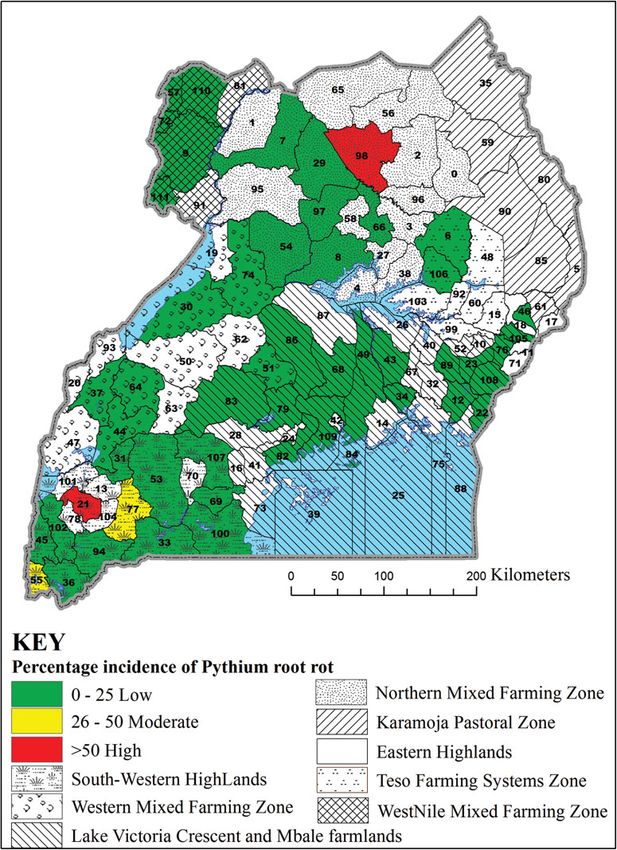
Root rots of common bean in Uganda                                               889

              These four pathogens may cause losses of up to 100% in susceptible varieties under
              moist conditions and impoverished soils.
                 In Uganda, common bean root rots were previously known to be caused by Pythium
              and Fusarium spps., and the most severely affected areas were highlands, where air
              temperature is low and air relative humidity high (Buruchara and Rusuku, 1992; Opio
              et al., 2007). Due to changing environmental conditions, such as higher temperatures
              and more frequent floods, the pattern of root rot diseases seems to be changing,
              with severe root rots occurring in low to mid-altitude areas. Farrow et al. (2011)
              predicted that the incidence of root rots would rise in East Africa due to higher rainfall
              during the cropping season. In the last 12 years, there has been no comprehensive
              research in Uganda to determine the incidence and severity of common bean root rot
              diseases and the contribution of the different root rot pathogens to the current disease
              upsurge. Past studies only focused on single pathogens (Mukalazi, 2004; Mukankusi,
              2008; Tusiime, 2003). Similarly, earlier studies focused on very few common bean
              agroecologies. Wortmann and Eledu (1999) divided Uganda into 14 agroecological
              zones based on altitude, rainfall and soil type. However, Kalyebara et al. (2006)
              aggregated the 14 agroecologies into eight common bean agroecologies based on
              ecology, farming systems and the types of bean grown.
                 The objective of our study was to ascertain the current prevalence and incidence
              of common bean root rot diseases in seven of the eight common bean agroecologies
              in Uganda.

                                                        M AT E R I A L S A N D M E T H O D S

              Survey area
                 We conducted surveys in seven bean agroecologies over three growing seasons,
              March–June 2013 (2013A), August–November 2013 (2013B) and March–June 2014
              (2014A). In 2013A, we surveyed 622 fields in seven bean agroecologies: Eastern
              Highlands (annual rainfall >1200 mm, altitude 1500–2200 m), Lake Victoria Basin
              and Mbale Farmlands (annual rainfall >1215–1328 mm, altitude 1040–1433 m),
              Northern Mixed Farming Zone (annual rainfall >1197 mm, altitude 942–1182 m),
              South Western Highlands (annual rainfall >1200 mm, altitude 1247–2313 m), Teso
              Farming System Zone (annual rainfall 1000–1200 mm, altitude 1052–1501 m)
              and West Nile Mixed Farming System (annual rainfall >1340–1371 mm, altitude
              918–1454 m). Temperature and rainfall data were obtained from www.erails.net/
              UG/aris/kms and presented in Supplementary Figures S1 and S2, while altitude is
              from GPS readings taken during our surveys. In 2013B, we surveyed 375 fields in
              the Northern Mixed Farming Zone, Western Mixed Farming System, Lake Victoria
              Basin and Mbale Farmlands and South Western Highlands. In 2014A, we surveyed
              120 fields in the Western Mixed Farming System, Lake Victoria Basin and Mbale
              Farmlands, and South Western Highlands. Thus, the total number of fields surveyed
              was 1117. Though some agroecologies were surveyed more than once, different fields
              were surveyed during each visit.

Downloaded from https://www.cambridge.org/core. IP address: 46.4.80.155, on 30 Jan 2021 at 09:01:45, subject to the Cambridge Core terms of use, available at
https://www.cambridge.org/core/terms. https://doi.org/10.1017/S0014479717000461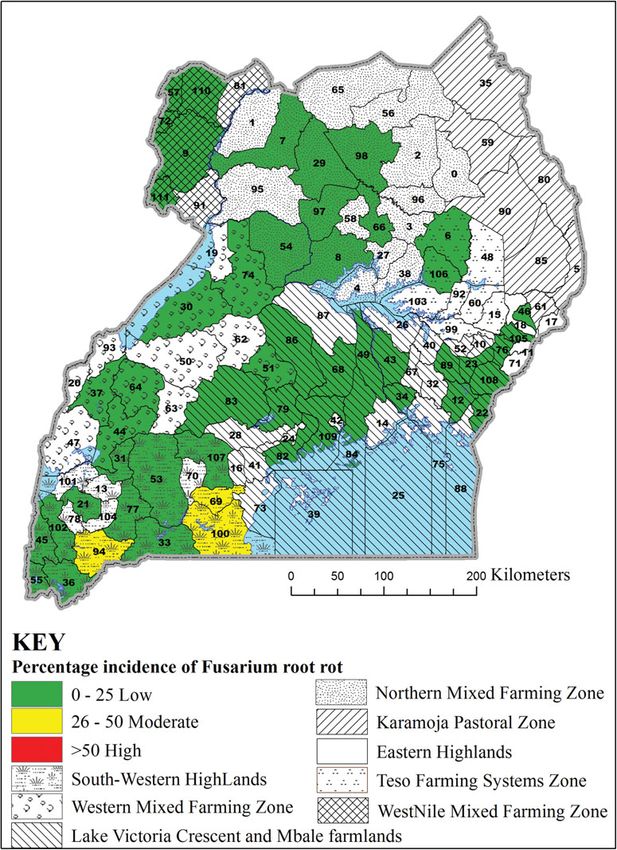
890                                                   P. PA PA RU     et al.

                  In each agroecology, we chose districts to survey based on common bean
               production records published by Kalyebara et al. (2006). Districts with high common
               bean production rates and those where the crop in the field was at a suitable stage
               for root rot disease assessment were surveyed. In each district, we surveyed two sub-
               counties. In each sub-county, 20 fields randomly chosen at distances of 1–5 km along
               the survey route were surveyed. A survey route here refers to gravel roads in the chosen
               villages that could be accessed by our field vehicle. However, in some districts, we
               surveyed fewer fields because the crop was not at a suitable stage for assessing root
               rot disease. The average size of farms surveyed in all agroecologies was 0.7 ha. In the
               fields sampled, the growth stage of the crop ranged from primary leaf stage to pod
               initiation. Field size was measured using GPS and the prevalence and incidence of
               root rot was assessed through field observation.

               Data collected
                  To determine the prevalence of root rot disease, we walked along a Z transect
               in each field and observed the presence or absence of wilting due to common bean
               root rot diseases. Disease prevalence refers to the incidence of diseased plants in a
               defined geographic area (Nutter et al., 1991). To determine root rot disease incidence,
               we randomly selected a minimum of 20 wilting plants showing the characteristic
               symptoms of root rot diseases along the Z transect. Disease incidence refers to the
               number of sampled plants that are diseased, expressed as percentage of the total
               number of samples (Nutter et al., 1991). We then identified the symptoms shown by
               each wilting plant using the guidelines in the Centro Internacional de Agricultura
               Tropical (CIAT) handbook for bean disease and pest identification (Buruchara et al.,
               2010). The symptoms we used to identify the pathogens were: (1) for Fusarium spp.
               root rot – narrow, longitudinal reddish-brown lesions on hypocotyl, accompanied by
               longitudinal fissures or cracks; (2) for Pythium spp. root rot – elongated water-soaked
               areas on hypocotyl appearing 1–3 weeks after planting, dry and brown lesions; (3) for
               Sclerotium rolfsii root rot (southern blight) – grey water-soaked lesions on hypocotyl just
               below the soil line, later becoming brown and extending to the tap root, abundant
               silky mycelium and large round sclerotia at the base of the stem and (4) for Rhizoctonia
               solani root rot – dark, circular and oblong cankers delimited by brown margins on
               the hypocotyl, later becoming red, rough, dry and pithy. Diseased plant samples were
               collected for each root rot disease and used for pathogen isolation in the laboratory
               (data not shown).

               Data analysis
                  We computed the mean percentage prevalence and incidence of common bean
               root rots by season, agroecology and district, and performed analysis of variance
               (ANOVA) for percentage prevalence and incidence of common bean root rots
               using the general linear model (GLM). Statistical differences between districts were
               determined using Fisher’s Protected Least Significant difference test. Differences for
               seasons and agroecologies were separated using Tukey Studentized range test. For

Downloaded from https://www.cambridge.org/core. IP address: 46.4.80.155, on 30 Jan 2021 at 09:01:45, subject to the Cambridge Core terms of use, available at
https://www.cambridge.org/core/terms. https://doi.org/10.1017/S0014479717000461
Root rots of common bean in Uganda 891
Figure 1. Seasonal prevalence (a) and incidence (b) of Pythium, Fusarium, Sclerotium and Rhizoctonia root rots in
Ugandan common bean agroecologies across three seasons (2013A, 2013B and 2014A) between March 2013 and
June 2014. For each root rot type, bars followed by different letters are significantly different (p ≤ 0.05, Tukey’s
Studentized range test).
all tests, significance was evaluated at p ≤ 0.05. All analyses were performed using
Statistical Analysis Systems version 9.1 (SAS Institute, Cary NC, USA).
R E S U LT S
Root rot prevalence
Common bean root rots were observed in all sampled agroecologies (Table 1).
However, the prevalence of root rots varied across seasons (Figure 1a). For
agroecologies sampled in two or three seasons, the prevalence of Pythium root
rot was different across seasons (F = 14.72, p < 0.0001) (Figure 1a). The same
Downloaded from https://www.cambridge.org/core. IP address: 46.4.80.155, on 30 Jan 2021 at 09:01:45, subject to the Cambridge Core terms of use, available at
https://www.cambridge.org/core/terms. https://doi.org/10.1017/S0014479717000461https://www.cambridge.org/core/terms. https://doi.org/10.1017/S0014479717000461
Downloaded from https://www.cambridge.org/core. IP address: 46.4.80.155, on 30 Jan 2021 at 09:01:45, subject to the Cambridge Core terms of use, available at
892
Table 1. Percentage prevalence and incidence of common bean root rots in seven agroecologies surveyed across three seasons (2013A, 2013B and 2014A) between March 2013
and June 2014.
Percentage prevalence of root rots†,‡ Percentage incidence of root rots†,‡
Agroecology∗ season Pythium Fusarium Southern blight Rhizoctonia Pythium Fusarium Southern blight Rhizoctonia
EH 2013A 0.0 c 50.0 ab 83.3 a 0.0 a 0.0 b 7.5 abc 17.1 bc 0.0 a
LVC 2013A 14.9 bcAB 14.5 dcA 89.6 aAB 3.3 a B 1.0 bA 2.0 bcA 34.2 abB 0.7 aB
NM 2013A 17.8 bcA 22.2 bcdA 88.9 aA 4.4 aA 1.8 bB 4.1 bcA 43.9 aA 0.2 aA
SWH 2013A 75.7 aA 65.6 aA 46.1 bA 7.8 aC 35.3 aA 13.9 aA 6.9 cB 0.9 aB
P. PA PA RU
TFS 2013A 87.5 a 6.3 d 75 a 0.0 a 4.4 b 0.3 c 3.8 c 0.0 a
WM 2013A 27.1 bB 47.9 abA 90.6 aA 5.2 aB 6.1 bAB 10.8 abA 38.2 aA 0.5 aB
WNM 2013A 4.2 bc 38.9 abc 90.3 a 0.0 a 0.3 b 6.8 abc 41.1 a 0.0 a
LVC 2013B 24.6 bA 14.0 bA 82.5 abB 28.1 aA 2.3 cA 1.9 bA 20.7 bC 3.1 aA
NM 2013B 25.5 b A 8.5 bB 86.6 aA 13.4 aA 10.0 bA 1.1 bB 34.9 aA 1.5 aA
et al.
SWH 2013B 80.3 aA 47.0 aA 39.4 cA 22.7 aB 23.8 aB 6.8 aB 4.4 cB 2.8 aB
WM 2013B 67.3 aA 23.6 bA 67.3 bB 16.4 aB 12.1 bA 1.9 bA 11.5 cB 1.1 aB
LVC 2014A 3.8 bB 12.5 bA 98.1 aA 26.7 a A 1.1 aA 2.2 bA 50.0 aA 2.1 aAB
SWH 2014A 33.3 aB 58.3 aA 54.2 bA 54.2 aA 4.9 aC 4.3 aB 18.0 bA 6.1 aA
WM 2014A 0.0 bC 23.5 bA 94.1 aA 35.3 aA 0.0 aB 3.5 bA 19.7 bB 3.1 aA
∗ EH = Eastern Highlands, LVC = Lake Victoria Basin and Mbale Farmlands, NM = Northern Mixed Farming Zone, SWH = South Western Highlands, TFS =Teso Farming
System Zone, WM = Western Mixed Farming System and WNM = West Nile Mixed Farming System.
† For each season, means within a column followed by different lower case letters are significantly different (p ≤ 0.05, Tukey’s Studentized range test).
‡ For each agroecology surveyed more than once means within a column followed by different upper case superscript letters are significantly different across seasons (p ≤ 0.05,
Tukey’s Studentized range test).Root rots of common bean in Uganda 893
was true for Fusarium (F = 11.33, p < 0.0001) and Rhizoctonia (F = 59.88,
p < 0.0001) root rots (Figure 1a). On the other hand, the prevalence of southern
blight did not vary across seasons (F = 2.10, p = 0.12). Although more than
half the fields surveyed (52%) were affected by a single root rot pathogen, several
fields were affected by more than one root rot pathogen. The percentage of fields
affected by two, three or four root rot pathogens simultaneously was 34, 10 and
1%, respectively. Individual plants were also infected by more than one root rot
pathogen.
Analysis by season showed significant differences in the prevalence of common
bean root rots in Ugandan bean agroecologies. Whereas the prevalence of Pythium,
Fusarium and Sclerotium root rots was significantly different across agroecologies
surveyed in 2013A (F = 47.41, p < 0.001; F = 23.53, p < 0.001; F = 24.80,
p < 0.001 for Pythium, Fusarium and Sclerotium root rots, respectively), the
prevalence of Rhizoctonia root rot was not (F = 1.58, p = 0.15). The highest
prevalence of Pythium root rot was in the Teso Farming Systems Zone (87.5%),
followed by the South Western Highlands (Table 1). The highest prevalence of
Fusarium root rot was in the South Western Highlands, followed by the Eastern
Highlands and these were significantly higher than prevalence in three other
agroecologies surveyed in the same season (Table 1). Apart from the South Western
Highland agroecology that showed the least prevalence of southern blight (46.1%),
prevalence in the other six agroecologies was between 75–90.6% in 2013A
(Table 1).
As in 2013A, the prevalence of Pythium, Fusarium and Sclerotium root rots was
significantly different across agroecologies in 2013B (F = 36.29, p < 0.001; F =
15.15, p < 0.001; F = 21.17, p < 0.001 for Pythium, Fusarium and Sclerotium root
rots, respectively). Again the prevalence of Rhizoctonia root rot was not significantly
different across agroecologies (F = 2.71, p = 0.054). The highest prevalence of
Pythium root rot was in the South Western Highlands and in the Western Mixed
Farming System (Table 1). Fusarium root rot was most prevalent in the South Western
Highlands, and this was significantly higher than prevalence in other agroecologies
(Table 1). The highest prevalence of southern blight was observed in the Northern
Mixed Farming Zone, whereas the lowest prevalence occurred in the South Western
Highlands.
In 2014A, the highest prevalence of both Pythium and Fusarium root rots occurred
in the South Western Highlands (Table 1). As found in 2013A and 2013B, the South
Western Highlands registered the lowest prevalence of southern blight in 2014A.
However, the highest prevalence of southern blight was observed in the Lake Victoria
Basin and Mbale Farmlands agroecology.
Significant differences were observed in the prevalence of common bean root
rots among the districts in different agroecologies (Supplementary Table S3). In
districts such as Bugiri, Busia, Butalejja and Jinja in the Lake Victoria Basin
and Mbale Farmlands agroecology, the prevalence of southern blight was 100%
(all farms surveyed had beans wilting as a result of southern blight). While
southern blight was present in all districts surveyed, the other three root rots
Downloaded from https://www.cambridge.org/core. IP address: 46.4.80.155, on 30 Jan 2021 at 09:01:45, subject to the Cambridge Core terms of use, available at
https://www.cambridge.org/core/terms. https://doi.org/10.1017/S0014479717000461894 P. PA PA RU et al.
were not observed in some districts. For example, Pythium root rot was absent
in the neighbouring districts of Bugiri, Busia, Butalejja, Jinja and Namutumba
and in Lira and Oyam. Similarly, Fusarium root rot was absent in the districts
of Nakaseke, Mukono and Namutumba. Rhizoctonia root rot was also not
observed in all the districts surveyed in West Nile Mixed Farming System
agroecology.
Root rot disease incidence
The incidence of bean root rots also varied across seasons (Figure 1b). For
agroecologies sampled in two or three seasons, incidence of Pythium root rot was
different across seasons (F = 8.02, p = 0.0004). The same was true for Fusarium (F =
14.04, p < 0.0001), Sclerotium (F = 15.09, p < 0.0001) and Rhizoctonia (F = 20.05,
p < 0.0001) root rots.
In 2013A, the incidence of Pythium root rot was different among agroecologies
surveyed (F = 64.61, p < 0.0001), being highest in the South Western Highlands
(Table 1). Unexpectedly, the highest incidence of Pythium root rot (71%) among
the districts surveyed was in Pader in the Northern Mixed Farming Zone, which
is in a warm and low altitude zone (Figure 2). The second highest incidence of
Pythium root rot disease (53%) was in Bushenyi district in the cool and high
altitude South Western Highlands agroecology. Similarly, significant differences were
observed in the incidence of Fusarium root rot among agroecologies in 2013A
(F = 13.65, p < 0.0001) (Table 1), with the highest incidence registered in the
South Western Highlands agroecology. However, two neighbouring districts of
Rakai and Lwengo in the Lake Victoria Basin and Mbale Farmlands agroecology
presented the highest (about 38%) incidences of Fusarium root rot (Figure 3). In
Kanungu in the South Western Highlands, incidence of Fusarium root rot was
23%. The incidence of southern blight also varied across agroecologies surveyed
in 2013A (F = 21.41, p < 0.0001), with the highest incidence observed in the
Northern Mixed Farming Zone, the West Nile Mixed Farming System and Western
Mixed Farming System (Table 1). Bugiri district in Lake Victoria Basin and Mbale
Farmlands registered the highest incidence of southern blight (84%) and other
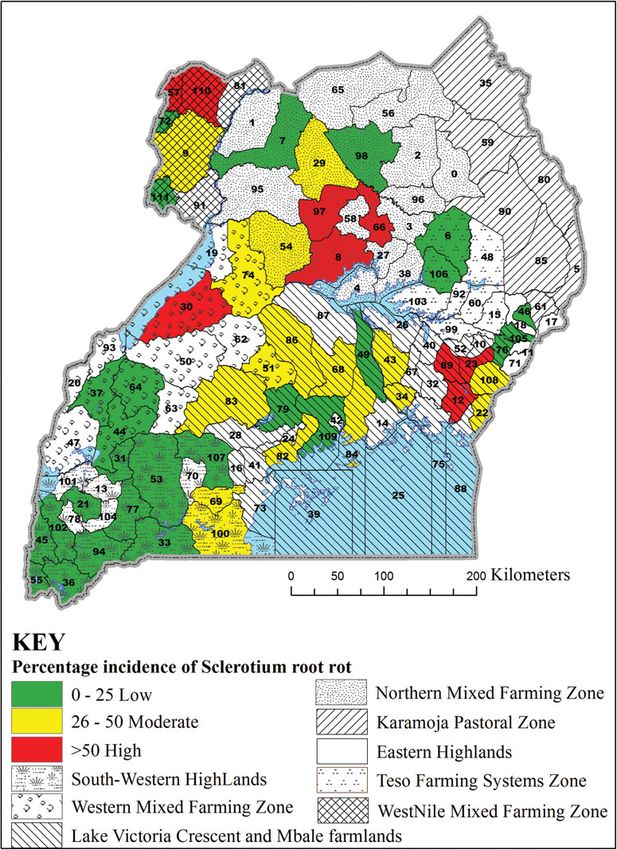
districts with high southern blight incidences were Koboko, Hoima, Oyam and Lira
(Figure 4).
The incidence of Pythium, Fusarium and Sclerotium root rots was also different
across agroecologies surveyed in 2013B (F = 29.33, p < 0.001; F = 9.92, p < 0.001; F
= 27.49, p < 0.001 for Pythium, Fusarium and Sclerotium root rots, respectively).
Again, the incidence of Rhizoctonia root rot did not vary across agroecologies
(F = 2.54, p = 0.056). The highest incidence of both Pythium and Fusarium root
rots was observed in the South Western Highlands and this was significantly higher
than that for three other agroecologies surveyed in 2013B (Table 1). The highest
incidence of southern blight was noticed in the Northern Mixed Farming Zone
(Table 1). In 2014A, the highest incidence of both Pythium and Fusarium root
rots still occurred in the South Western Highlands (Table 1). However, the highest
Downloaded from https://www.cambridge.org/core. IP address: 46.4.80.155, on 30 Jan 2021 at 09:01:45, subject to the Cambridge Core terms of use, available at
https://www.cambridge.org/core/terms. https://doi.org/10.1017/S0014479717000461Root rots of common bean in Uganda 895
Figure 2. Incidence of Pythium root rot in selected districts in seven common bean agroecologies in Uganda. District
6 = Amuria, 7 = Amuru, 8 = Apac, 9 = Arua, 12 = Bugiri, 21 = Bushenyi, 22 = Busia, 23 = Butaleja, 30 =
Hoima, 31 = Ibanda, 33 = Isingiro, 34 = Jinja, 36 = Kabale, 43 = Kamuli, 44 = Kamwenge, 46 = Kapchorwa,
49 = Kayunga, 51 = Kiboga, 53 = Kiruhura, 54 = Kiryadongo, 55 = Kisoro, 56 = Kitgum, 57 = Koboko, 64 =
Kyenjojo, 66 = Lira, 68 = Luwero, 69 = Lwengo, 72 = Maracha, 74 = Masindi, 76 = Mbale, 77 = Mbarara, 79 =
Mityana, 82 = Mpigi, 83 = Mubende, 84 = Mukono, 86 = Nakaseke, 94 = Ntungamo, 97 = Oyam, 98 = Pader,
100 = Rakai, 102 = Rukungiri, 105 = Sironko, 109 = Wakiso, 110 = Yumbe and 111 = Zombo.
Downloaded from https://www.cambridge.org/core. IP address: 46.4.80.155, on 30 Jan 2021 at 09:01:45, subject to the Cambridge Core terms of use, available at
https://www.cambridge.org/core/terms. https://doi.org/10.1017/S0014479717000461896 P. PA PA RU et al.
Figure 3. Incidence of Fusarium root rot in selected districts in seven common bean agroecologies in Uganda. District
6 = Amuria, 7 = Amuru, 8 = Apac, 9 = Arua, 12 = Bugiri, 21 = Bushenyi, 22 = Busia, 23 = Butaleja, 30 = Hoima,
31 = Ibanda, 33 = Isingiro, 34 = Jinja, 36 = Kabale, 43 = Kamuli, 44 = Kamwenge, 46 = Kapchorwa, 49
= Kayunga, 51 = Kiboga, 53 = Kiruhura, 54 = Kiryadongo, 55 = Kisoro, 56 = Kitgum, 57 = Koboko, 64 =
Kyenjojo, 66 = Lira, 68 = Luwero, 69 = Lwengo, 72 = Maracha, 74 = Masindi, 76 = Mbale, 77 = Mbarara, 79 =
Mityana, 82 = Mpigi, 83 = Mubende, 84 = Mukono, 86 = Nakaseke, 94 = Ntungamo, 97 = Oyam, 98 = Pader,
100 = Rakai, 102 = Rukungiri, 105 = Sironko, 109 = Wakiso, 110 = Yumbe and 111 = Zombo.
Downloaded from https://www.cambridge.org/core. IP address: 46.4.80.155, on 30 Jan 2021 at 09:01:45, subject to the Cambridge Core terms of use, available at
https://www.cambridge.org/core/terms. https://doi.org/10.1017/S0014479717000461Root rots of common bean in Uganda 897
Figure 4. Incidence of southern blight in selected districts in seven common bean agroecologies in Uganda. District
6 = Amuria, 7 = Amuru, 8 = Apac, 9 = Arua, 12 = Bugiri, 21 = Bushenyi, 22 = Busia, 23 = Butaleja, 30 =
Hoima, 31 = Ibanda, 33 = Isingiro, 34 = Jinja, 36 = Kabale, 43 = Kamuli, 44 = Kamwenge, 46 = Kapchorwa,
49 = Kayunga, 51 = Kiboga, 53 = Kiruhura, 54 = Kiryadongo, 55 = Kisoro, 56 = Kitgum, 57 = Koboko, 64 =
Kyenjojo, 66 = Lira, 68 = Luwero, 69 = Lwengo, 72 = Maracha, 74 = Masindi, 76 = Mbale, 77 = Mbarara, 79 =
Mityana, 82 = Mpigi, 83 = Mubende, 84 = Mukono, 86 = Nakaseke, 94 = Ntungamo, 97 = Oyam, 98 = Pader,
100 = Rakai, 102 = Rukungiri, 105 = Sironko, 109 = Wakiso, 110 = Yumbe and 111 = Zombo.
Downloaded from https://www.cambridge.org/core. IP address: 46.4.80.155, on 30 Jan 2021 at 09:01:45, subject to the Cambridge Core terms of use, available at
https://www.cambridge.org/core/terms. https://doi.org/10.1017/S0014479717000461898 P. PA PA RU et al.
incidence of Southern blight was in the Lake Victoria Basin and Mbale Farmlands
agroecology.
DISCUSSION
Our study is the first known systematic survey to determine the prevalence and
incidence of common bean root rots in Uganda. The survey found that root rots were
present in all seven common bean agroecologies and the occurrence of more than one
root rot disease on a single plant was observed. Where symptoms were vague or in
an initial stage for the second or third pathogen on a single plant, an underestimation
of prevalence and incidence may have occurred. However, symptoms of root rots
observed in the field were characteristic of the pathogens Fusarium spp., Pythium spp.,
Rhizoctonia solani and Sclerotium rolfsii and we did not look for root rot diseases other
than the above. We confirmed our field observations by isolating the pathogens from
wilting plants (data not shown). Notably, wilting in several instances was caused by the
bean stem maggot (Ophiomyia phaseoli).
The prevalence of the different bean root rots varied among bean agroecologies. A
high prevalence of Pythium root rot was observed in the Teso Farming Systems Zone
and South Western Highlands (Table 1). However, the high prevalence of Pythium
root rot in Teso Farming Systems Zone needs to be confirmed because we assessed
root rot disease in only 18 fields. In addition, the surveys in the Teso Farming Systems
Zone were conducted only in a single season and a second data collection is needed
in order to draw meaningful conclusions. Fusarium root rot was most common in the
South Western Highlands and the Eastern Highlands (Table 1), confirming earlier
findings by Tusiime (2003). The most common root rot was southern blight with 77–
90% prevalence in most agroecologies (Table 1). The highest prevalence of southern
blight was in the West Nile Mixed Farming System and the lowest in the South
Western Highlands (Table 1).
Interestingly, the incidence of root rots followed the same pattern as their
prevalence (Table 1). The high prevalence and incidence of Fusarium and Pythium
root rots in the South Western Highlands may be because Fusarium and Pythium
spp. pathogens thrive in similar environments. According to Abawi and Pastor
Corrales (1990), a synergistic interaction between Fusarium solani f.sp. phaseoli and
Pythium ultimum results in greater damage than the action of each pathogen alone.
Environmental conditions, soil and cropping systems may also influence the severity
of common bean root rots across regions (Abawi and Pastor Corrales, 1990). The
same phenomenon has been reported for other crops and types of wilt. For example,
the incidence of Phytophthora blight and Verticillium wilt in pepper varied across
regions and was believed to be influenced by environmental conditions and cropping
practices (Sanoga and Carpenter, 2006). Our study clearly showed the influence of
environmental conditions on the prevalence and incidence of the different bean root
rots: Fusarium and Pythium root rots are favoured by cool temperatures and high air
humidity of highland areas and southern blight by the warm and moist conditions in
lowland areas.
Downloaded from https://www.cambridge.org/core. IP address: 46.4.80.155, on 30 Jan 2021 at 09:01:45, subject to the Cambridge Core terms of use, available at
https://www.cambridge.org/core/terms. https://doi.org/10.1017/S0014479717000461Root rots of common bean in Uganda 899
The identification of southern blight as the most common root rot is significant
because Sclerotium rolfsii also causes root and stem rots in crops such as groundnut
(Le et al., 2012), maize (Ahmed et al., 1984), tomato, onion and soybean (Flores-
Moctezuma et al., 2006), which are commonly grown in Ugandan common bean
production regions. Our study showed that farmers commonly rotate beans with
crops such as groundnuts and maize, hence perpetuating the occurrence of southern
blight in their fields. Other crops have also been shown to harbour pathogens that
cause bean root rot and possibly act as alternate hosts (Gichuru, 2008). Our study
has identified hot spots for bean root rot diseases (Figures 2, 3 and 4). These are
locations where high prevalence and incidence of the different root rots was observed.
For example, districts such as Bugiri, Hoima, Koboko and Oyam could be marked
as hot spots for southern blight (Figure 4), while Lwengo, Ntungamo and Rakai for
Fusarium root rot (Figure 3), and Bushenyi, Kisoro and Mbarara for Pythium root
rot (Figure 2). Pathologists and plant breeders can use such hot spots for evaluation of
germplasm and breeding lines.
This study provides a baseline for mapping changes in the prevalence and incidence
of common bean root rots in future. Due to its importance in forecasting and setting
disease management priorities, regular disease mapping is becoming increasingly vital
because of global environmental changes that greatly impact the occurrence of crop
diseases.
C O N C LU S I O N S
The results of the surveys we conducted show that root rots are still a major
constraint to common bean production in Uganda. Whereas the prevalence
and incidence of previously studied root rots such as Pythium and Fusarium
have not changed significantly, there is a high prevalence and incidence of
southern blight in several common bean producing districts. The latter therefore
necessitates further investigations to determine the effect of the observed root
rot occurrences on crop losses, and to develop or validate root rot management
practices that can reduce losses on-farm as well as developing and releasing resistant
varieties.
Acknowledgements. We acknowledge the Biotechnology and Biological Sciences
Research Council (BBSRC), the Department for International Development (DFID)
and (through a grant awarded to BBSRC) the Bill & Melinda Gates Foundation,
for funding the work presented in this paper. We acknowledge additional funding
from the U.S. Department of Agriculture National Institute of Food and Agriculture
(USDA NIFA) through Michigan State University.
S U P P L E M E N TA RY M AT E R I A L
To view supplementary material for this article, please visit https://doi.org/10.1017/
S0014479717000461
Downloaded from https://www.cambridge.org/core. IP address: 46.4.80.155, on 30 Jan 2021 at 09:01:45, subject to the Cambridge Core terms of use, available at
https://www.cambridge.org/core/terms. https://doi.org/10.1017/S0014479717000461900 P. PA PA RU et al.
REFERENCES
Abawi, G. S. and Pastor Corrales, M. A. (1990). Root Rots of Beans in Latin America and Africa: Diagnosis, Research
Methodologies, and Management Strategies. Cali: CIAT.
Ahmed, Y., Mirza, M. S. and Aslam, M. (1984). Sclerotium rolfsii on maize. FAO Plant Protection Bulletin 32:147.
Akibode, S. and Maredia, M. (2011). Global and regional trends in production, trade and consumption of food legume
crops. Report submitted to the CGIAR Standing Panel on Impact Assessment (SPIA). http://impact.cgiar.org/
sites/default/files/images/Legumetrendsv2.pdf.
Buruchara, R. A. and Rusuku, G. (1992). Root rots in the Great Lakes Region. Proceedings of the Pan-African Bean
Pathology Working Group Meeting, Thika, Kenya. May 26–30, 1992. CIAT Workshop Series 23:49–55.
Buruchara, R. A., Mukakusi, C. and Ampofo, K. (2010). Bean disease and pest identification and management.
Centro Internacional de Agricultura Tropical (CIAT), Kampala. Publication No. 371, 67p.
Buruchara, R., Estevez de Jensen, C., Godoy, C., Abawi, G., Pasche, J., Lobo Junior, M. and Mukankusi, C. (2015). A
review of root rot diseases in common beans with emphasis on Latin America and Africa. Common Bean Diseases
Workshop on Angular Leaf Spot and Root Rots, July 20–23, Protea Hotel, Kruger Gate, Skukuza.
Farrow, A., Musoni, D., Cook, S. and Buruchara, R. (2011). Assessing the risk of root rots in common beans in East
Africa using simulated, estimated and observed daily rainfall data. Experimental Agriculture 47:357–373.
Flores-Moctezuma, H. E., Montes-Belmont, R., Jiménez-Pérez, A. and Nava-Juárez, R. (2006). Pathogenic diversity
of Sclerotium rolfsii isolates from Mexico, and potential control of southern blight through solarization and organic
amendments. Crop Protection 25:195–201.
Gichuru, G. V. (2008). Influence of Farming Systems and Crop Host Varieties on Pythium Root Rots Epidemics in a Highland
Agroecology of South Western Uganda. Kampala: MUK.
Kalyebara, M. R., Mugisha, K. S., Andima, D. and Nasirumbi, L. (2006). The Impact of Improved Bush Bean Varieties and
Management Technologies in Uganda. Kampala: CIAT.
Le, C. N., Mendes, R., Kruijt, M. and Raaijmakers, J. M. (2012). Genetic and phenotypic diversity of Sclerotium rolfsii
in groundnut fields in central Vietnam. Plant Disease 96:389–397.
Mukalazi, J. (2004). Pathogen Variation and Quantification of Pythium Spp. In Bean Fields in Uganda. Kampala: MUK.
Mukankusi, C. (2008). Improving Resistance to Fusarium Root Rot (Fusarium Solani f.sp. Phaseoli) in Common Bean (Phaseolus
vulgaris L.) in Uganda. Kwazulu-Natal: UKN.
Nutter, F. W. Jr., Teng, P. S. and Shokes, F. M. (1991). Disease Assessment terms and concepts. Plant Disease
75(11):1187–1188.
Opio, F., Ugen, M., Namayanja, A., Mugagga, I. and Mawejje, D. (2007). Improving food security in south-
western Uganda by transferring and promoting resistant varieties and integrated management packages for BRR.
Biotechnology, Breeding and Seed Systems for African Crops Conference, 23–30 March 2007. Maputo: IIAM.
Sanoga, S. and Carpenter, J. (2006). Incidence of Phytophthora blight and Verticillium wilt within Chile pepper fields
in New Mexico. Plant Disease 90:291–296.
Tusiime, G. (2003). Variation and Detection of Fusarium Solani f.sp.phaseoli and Quantification of Soil Inoculum in Common Bean
Fields. Kampala: MUK.
Widders, I. E. (2006). The beans for health alliance: A public-private sector partnership to support research on the
nutritional and health attributes of beans. Annual Report of Bean Improvement Cooperative 49:3–5.
Wortmann, C. S. and Eledu, C. A. (1999). Uganda’s Agroecological Zones: A Guide for Planners and Policy Makers. Kampala:
CIAT.
Wortmann, C. S., Kirkby, R. A., Aledu, C. A. and Allen, D. J. (1998). Atlas of Common Bean (Phaseolus vulgaris L)
Production in Africa. Cali: CIAT.
Downloaded from https://www.cambridge.org/core. IP address: 46.4.80.155, on 30 Jan 2021 at 09:01:45, subject to the Cambridge Core terms of use, available at
https://www.cambridge.org/core/terms. https://doi.org/10.1017/S0014479717000461You can also read


