Proceedings of the Workshop on Post-2020 Audit Reform: Mission Possible - Budgetary Affairs
←
→
Page content transcription
If your browser does not render page correctly, please read the page content below
Study
for the CONT committee

              Proceedings of the
                Workshop on
               Post-2020 Audit
                   Reform:
               Mission Possible
                           Budgetary Affairs

             Policy Department D for Budgetary Affairs
               Directorate General for Internal Policies of the Union
                            PE 603.805 - October 2017
                                                                        EN
DIRECTORATE GENERAL FOR INTERNAL POLICIES
                    POLICY DEPARTMENT D: BUDGETARY AFFAIRS

 Proceedings of the Workshop on Post-2020 Audit
            Reform: Mission Possible

                                     WORKSHOP

Audit work has changed over the years. Compliance audits look principally at the legality and
regularity of payments, but they say nothing about whether the political and economic objectives
were achieved. A bridge in the middle of nowhere may have been built in respect of public
procurement rules and contract obligations. These compliance audits are increasingly
supplemented by performance audits, in which you try to answer the question whether the
objective was achieved in an economic, effective and efficient manner. In spite of the growing
complexity of the audit process the administrative burden for beneficiaries should remain
reasonable. The key question is: How do we strike the right balance between providing easy access
to European public funds for beneficiaries, while guaranteeing sound financial management. One
element which has to be put in place for this purpose is a single audit chain, where one level builds
on the work of the other.

This document can not constitute an authentic record of proceedings. The workshop was public
and live webstreamed. The video record can be found under the following link:
http://www.europarl.europa.eu/ep-live/en/committees/video?event=20171011-0900-COMMITTEE-CONT

                                                                                       23/10/2017
PE 603.805                                                                                     EN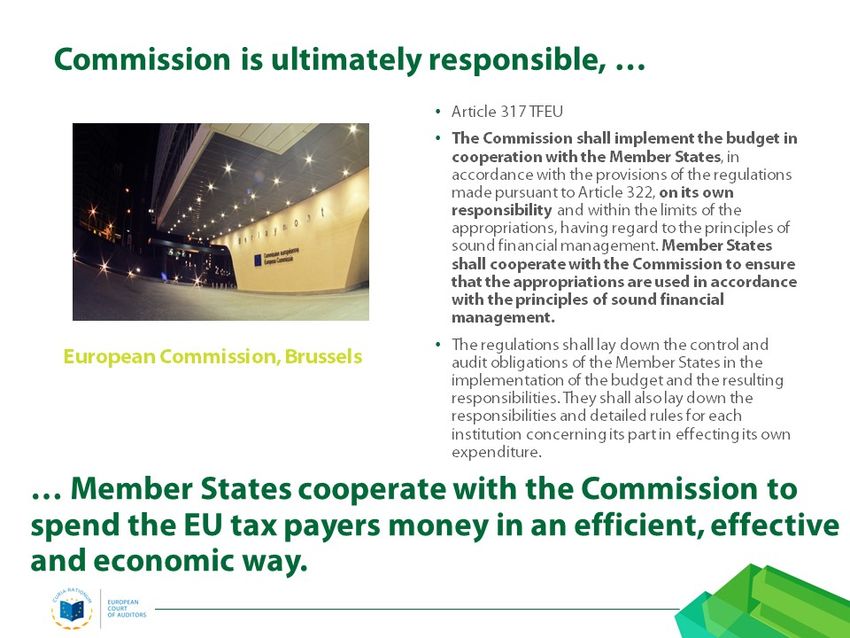
CONTRIBUTING EXPERTS

Mr Lazaros S. LAZAROU, Member of the European Court of Auditors, Dean of Chamber V Financing and
administering the Union
Mr Olivier WAELBROECK, Director, Directorate D for Central Financial Service, DG BUDG, European
Commission
Ms Christina BORCHMANN, Director, Directorate H for Assurance and Audit, DG AGRI, European Commission
Mr Franck SÉBERT, Director, Directorate C for Audit, DG REGIO, European Commission
Mr Stanislav BURES, Head of Department, Audit authority, Ministry of Finance of the Czech Republic
Ms Malina KROUMOVA, Deputy Minister, Head of the Central Coordination Unit, Ministry of Regional
Development and Public Works, Bulgaria

RESPONSIBLE ADMINISTRATOR

Ms Vera MILICEVIC
Policy Department D: Budgetary Affairs
European Parliament
B-1047 Brussels
E-mail: poldep-budg@europarl.europa.eu

LINGUISTIC VERSIONS

Original: EN

ABOUT THE EDITOR

Policy Departments provide in-house and external expertise to support European Parliament's committees
and other parliamentary bodies in shaping legislation and exercising democratic scrutiny over EU policies.
To contact the Policy Department or to subscribe to its newsletter please write to:
poldep-budg@europarl.europa.eu

Manuscript completed in October 2017.
Brussels, © European Union, 2017.

This document is available on the Internet at:
http://www.europarl.europa.eu/supporting-analyses

DISCLAIMER

The opinions expressed in this document are the sole responsibility of the author(s) and do not necessarily
represent the official position of the European Parliament.

Reproduction and translation for non-commercial purposes are authorized, provided the source is
acknowledged and the publisher is given prior notice and sent a copy.

Proceedings of the Workshop on Post-2020 Audit Reform in the EU: Mission Possible
__________________________________________________________________________________________

                                    TABLE OF CONTENTS

PART A: WORKSHOP PROCEEDINGS ................................................................................. 5
PART B: WORKSHOP BACKGROUND INFORMATION ....................................................... 5
  1. WORKSHOP PROGRAMME ....................................................................................... 9
  2. BIOGRAPHIES OF SPEAKERS.................................................................................. 11
  3. PRESENTATIONS..................................................................................................... 19
  4. USEFUL LINKS ......................................................................................................... 55

                                                             3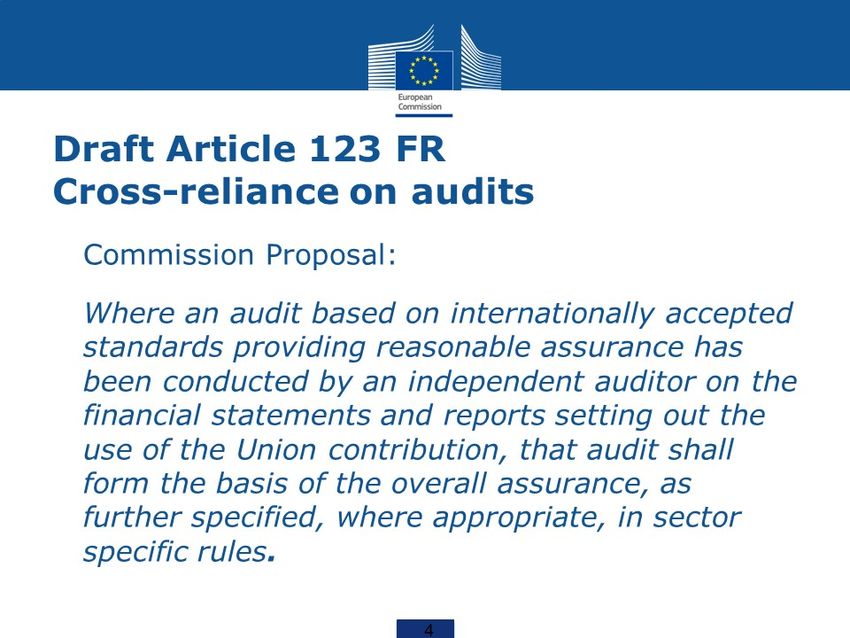
Policy Department D: Budgetary Affairs
__________________________________________________________________________________________

                                            4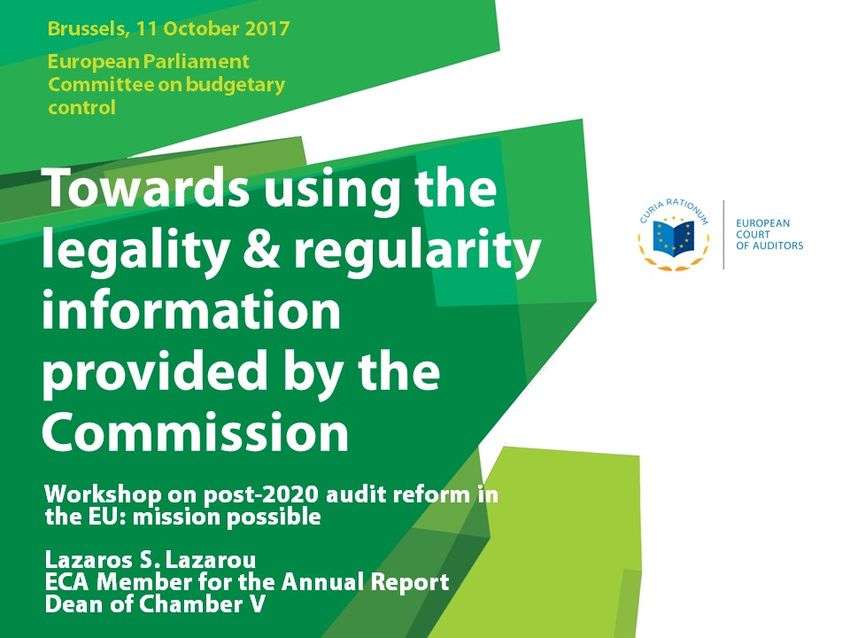
Proceedings of the Workshop on Post-2020 Audit Reform in the EU: Mission Possible
__________________________________________________________________________________________

PART A: WORKSHOP PROCEEDINGS

On Wednesday, 11 October 2017, the CONT committee held a workshop under the title “Post-2020
Audit Reform: Mission Possible”.

Under the moderation of the CONT chair, Dr Ingeborg Gräßle, and the rapporteur in charge, Mr
Andrey Novakov, speakers from the European Court of Auditors, the Commission DGs BUDG, AGRI
and REGIO, as well as representatives from the governments of the Czech Republic and Bulgaria
presented their views on the perspectives of Post-2020 Audit Reform. M. Novakov opened the
workshop stating that the discussion on the future audit arrangement in the European Union is an
important element of the ongoing debates on next MFF and the Financial Regulation.

The speakers found a consensus on a number of issues. These include the need to simplify the
current audit system, as well as to place a stronger emphasis on performance.

The need for simplification was an issue that was raised by almost all speakers. Emphasis was placed
on simplifying the process, in particular by decreasing the administrative burden on
beneficiaries. Franck Sebert, Audit Director from DG REGIO pointed out that a simplification of the
cost option would be a significant improvement, among others, because simpler cost options are
less error-prone. This point was supported by Malina Kroumova, Head of the Central Coordination
Unit in the Ministry of Regional Development in Bulgaria. She also remarked that any simplifications
would need to happen in concurrence with the aims of the system as a whole. Any changes should
also be in line with international standards, as Lararos Lazarou from the European Court of Auditors
pointed out. Franck Sebert further emphasized the need for simplification due to the fact that the
multi-layer basis of checks and balances would stop potential beneficiaries from wanting to
participate.

A further point that is related to this, is the “single audit” based on international standards.
Specifically, Mr Lazarou and Ms Kroumova highlighted that a single accountability report made
consistently on time by the European Commission could lead to better results. Numerous speakers
supported this idea in their presentations, making reference to the fact that, in many cases, work is
duplicated at several levels. Olivier Waelbroack, DG BUDG Director, complained that, currently, the
spending of the same euro is checked multiple times.

Lazaros Lazarou and Olivier Waelbroack reminded the audience that, despite the planned
simplifications of auditing procedure and the single audit, all levels of control remain important.
Specifically, the role of authorities in the Member States should be recognised as an important
aspect of auditing, despite the fact that the ultimate responsibility lies within the European
Commission. On top of that, since 80% of the EU budget is used on a shared-management model,
the lack of adequate information among the national management authorities and the auditors
creates serious issues on accountability procedures.

The implementation of the single audit goes hand-in-hand with the increase of trust among the
auditing authorities, especially between the national and EU levels. Olivier Waelbroack suggested
that the trust principle should be introduced to indirect management, thereby reducing the need
for double checks and thus facilitating the creation of the single audit. More specifically, Mr
Waelbroack spoke about cross reliance on audit, contacted by independent auditors on a sector rules
logic. However, a number of speakers, including Lazaros Lazarou of the ECA, reminded the audience
that trust must not be given automatically, but instead has to be gained. Olivier Waelbroack asked
the Commission in general to be more trusting of its partners where positive results were achieved.

                                                 5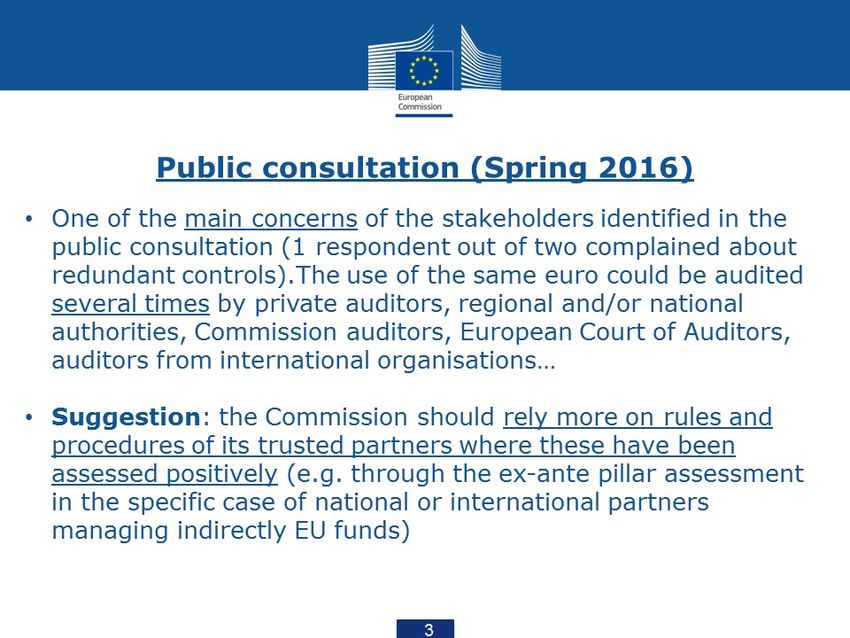
Policy Department D: Budgetary Affairs
__________________________________________________________________________________________
While considering increased trust as a key feature of Post 2020 auditing, the need for increasing
cooperation between different players in the auditing chain was also widely recognized. Stanislav
Burres, Audit Authority of the Czech Republic, thanked the Commission DGs REGIO and EMPL for
their help with workshops that were able to improve the internal mechanisms at the national level.
He encouraged the organization of further conferences and workshops to facilitate capacity
building, especially at the national level. Olivier Waelbroack pointed out that, in order for cross
reliance and a functioning single audit system to be established, trust and dialogue are vital.

Furthermore, a strong emphasis was placed on the need for preventative action, a move away from
ex-post auditing in favour of stronger ex-ante monitoring. Malina Kroumova recommended that
preventative measures would be more suitable to reduce future errors than ex-post sanctions.
She also suggested a stronger role of rewarding good practice, rather than only punishing errors as
a method of preventing errors.

Christina Borchmann, DG AGRI Director explained a case study where the use of new technology
could reduce the need for on side auditing by using remote controls. This method has been
successfully implemented in the agricultural sector and has helped to improve the quality of
auditing. Committee Chair, Ingeborg Gräßle, complimented the idea, but referred to the
unwillingness of the Commission to allow the use of the tool in other sectors.

A further aspect that many speakers referred to is that of the balance between performance
related checks and those aimed at finding irregularities, taking into consideration the principle of
proportionality. Speakers, such as Malina Kroumova, favoured a stronger orientation towards
performance and results (‘rebalancing compliance with performance’). This view was shared by,
among others, Stanislav Burres and Christina Borchmann.

Lazaros Lazarou of the ECA pointed out that, in the current system, efficiency gains are required. In
particular, he requested that the European Commission submits the evidence earlier, in order to
allow more time for evaluation. Mr Lazarou also added the aspect of special reports on certification
bodies.

Christina Borchman mentioned, among others, that the complexity of the legal framework, on top
of that of the administrative burden, can lead to a different interpretation and, consequently,
different conclusions on similar behavior on the side of auditors.

On the other hand, Franck Sebert commented that the management verifications on all operations
by beneficiaries are more than enough and, therefore, there is no need for further improvement of
the current model.

A further point raised by Lazaros Lazarou, was that the system needs to become more flexible in
order to be able to respond to the sometimes unique situations, which occur in auditing.
Franck Sebert concurred, reminding the audience that the different funding programmes have their
individual properties, which have to be considered and that any reforms to the auditing system has
to respect these properties. The above mentioned use of remote monitoring in the agricultural
sector that has, so far, not been implemented in other sectors is a good example of this.

Last but not least, sharing the experience of the two member states was an important contribution.
As far as the administrative burden and the need for a more simplified system is concerned, Ms
Kroumova specified that the member states’ auditors and the managing authorities are the ones that
are implementing more and more audit tasks, which leads to re-performance and increases the
burden on the beneficiaries. She also commented on the need to reward the good examples; since
the emphasis of the media is on showing the negative findings. Finally, she suggested dividing the

                                                 6
Proceedings of the Workshop on Post-2020 Audit Reform in the EU: Mission Possible
__________________________________________________________________________________________
work of auditors and leaving the operations of financial audit to the national authorities and
then having the European Commission focus on performance and results in order to better
achieve the single audit approach.

During the discussion period the CONT Chair, Ingeborg Gräßle, made a few additional points to move
the debate along. She reiterated the need for balance between performance and legality, a point
made by a number of speakers before her. She also declared that, in a majority of cases, where errors
are found in the auditing procedures, it is authorities at the member state level that are responsible
and not the EU. She called for an increase in on-site checks and stressed that financial checks must
be separate from these on-site audits. She also asked the ECA representative to outline the role that
the Court sees for itself in the new auditing system, suggesting the possibility that the Court may be
obsolete. Ms Gräßle also criticised the practices used by some member states with regard to opening
bids for public and EU funds. She insisted, that criteria for calls for bids must be clearly defined and
that competition between different bidders is necessary and must be facilitated by the public
authorities. As an example, Hungary was named, where out of 36% of bids, only 1 application is
submitted. Although the results of the approved projects may be satisfactory, support for practices
as such would mean that, indirectly, the EU would support the construction and maintenance of
monopoly structures. Ms Gräßle also called for country specific reports on audit practices to be
produced by the ECA, which would guarantee the impartiality of the Court. Country reports are
currently not being published by the ECA, however the issue is being discussed by the Court, as its
representative confirmed. Rapporteur Andrey Novaktov thanked the participants for a fruitful
debate and closed the meeting.

                                                   7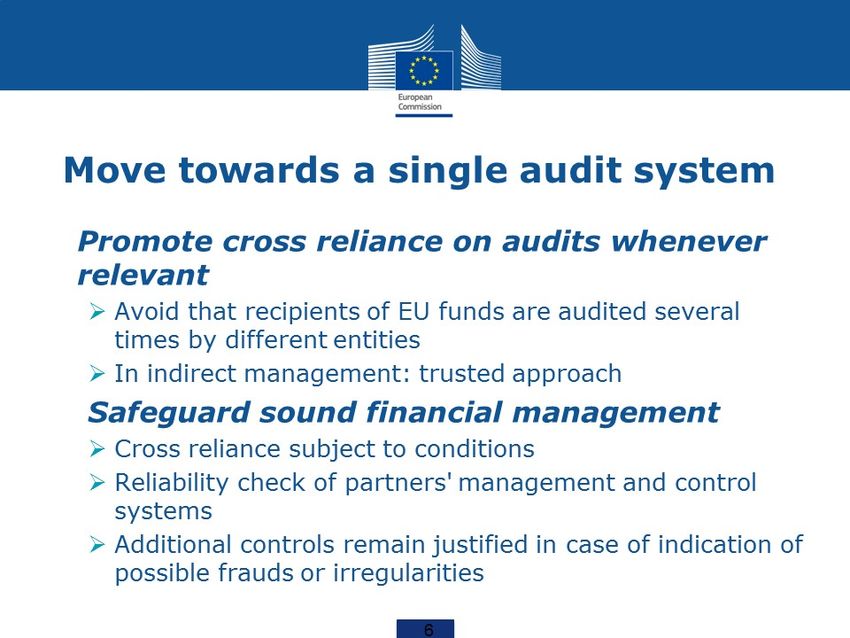
Policy Department D: Budgetary Affairs
__________________________________________________________________________________________

                                            8
Proceedings of the Workshop on Post-2020 Audit Reform in the EU: Mission Possible
__________________________________________________________________________________________
PART B: WORKSHOP BACKGROUND INFORMATION
1. WORKSHOP PROGRAMME
WORKSHOP ON
POST-2020 AUDIT REFORM IN THE EU:
MISSION POSSIBLE
Organised by the Policy Department on Budgetary Affairs for
The Committee on Budgetary Control
Wednesday, 11 October 2017
09:00 - 11:00
Altiero Spinelli Building, Room ASP 3G3
European Parliament, Brussels
DRAFT WORKSHOP PROGRAMME
Welcome and introduction
09:00-09:15 Dr Ingeborg GRÄSSLE, MEP
Chair of the Committee on Budgetary Control
Mr Andrey NOVAKOV, MEP
Rapporteur
***
Interventions
09:15-09:25 Mr Lazaros S. LAZAROU, Member of the European Court of Auditors, Dean
of Chamber V Financing and administering the Union
09:25-09:35 Mr Olivier WAELBROECK, Director, Directorate D for Central Financial
Service, DG BUDG, European Commission
09:35-09:45 Ms Christina BORCHMANN, Director, Directorate H for Assurance and
Audit, DG AGRI, European Commission
9Policy Department D: Budgetary Affairs
__________________________________________________________________________________________
09:45-09:55 Mr Franck SÉBERT, Director, Directorate C for Audit, DG REGIO,
European Commission
09:55-10:05 Mr Stanislav BURES, Head of Department, Audit authority, Ministry of
Finance of the Czech Republic
10:05-10:15 Ms Malina KROUMOVA, Deputy Minister, Head of the Central Coordination
Unit, Ministry of Regional Development and Public Works, Bulgaria
10:15-10:45 QUESTIONS AND ANSWERS
***
Closing remarks
10:45-11:00 Mr Andrey NOVAKOV, MEP
Rapporteur
Dr Ingeborg GRÄSSLE, MEP
Chair of the Committee on Budgetary
***
10Proceedings of the Workshop on Post-2020 Audit Reform in the EU: Mission Possible
__________________________________________________________________________________________
2. BIOGRAPHIES OF SPEAKERS
Mr Lazaros S. LAZAROU,
Member of the European Court of Auditors, Dean of
Chamber V Financing and administering the Union
Lazaros S. Lazarou (Member of the European Court of Auditors since November 2010) is the Dean of
Chamber V ‘‘Financing and administering the Union’’ and the Member responsible for ECA’s Annual
Report.
He began his professional career with audit firms in the UK and Cyprus for seven years and then served
in the Inland Revenue Department for ten years. In January 2000 he was appointed Accountant General
of the Republic of Cyprus serving until his appointment to the European Court of Auditors.
He is a Member of the Association of Chartered Certified Accountants (ACCA) and holds a Master degree
in Public Administration from the Kennedy School of Government, Harvard University and a Bachelor
degree in Economics from the University of Hull, UK.
11Policy Department D: Budgetary Affairs
__________________________________________________________________________________________
Mr Olivier WAELBROECK,
Director, Directorate D for Central Financial Service, DG
BUDG, European Commission
Olivier holds Master in International Business Law (LLM) from the London School of Economics (Foreign
and Commonwealth Scholarship) and is a law graduate from the Université Libre de Bruxelles.
After spending several years at the Court of Justice of the EU (Cabinet of a judge and later of the
President), he joined the European Commission in 2005 first as part of the Secretariat General and later
of the Directorate-General for Budget, where he was appointed assistant to Director General (2009), Head
of Unit "Financial Regulations" (2011) and Director of the Central Financial Service (2015).
Olivier is one of the two permanent Members of the EU Exclusion Panel representing the European
Commission as the owner of the EU Early Detection and Exclusion System (EDES).
12Proceedings of the Workshop on Post-2020 Audit Reform in the EU: Mission Possible
__________________________________________________________________________________________
Ms Christina BORCHMANN,
Director, Directorate H for Assurance and Audit, DG AGRI,
European Commission
Education
9/1983 - 9/1991: Cand.Scient.Pol. Institut for Statskundskab,
University of Aarhus, Aarhus, Denmark
9/1988 - 6/1989: Special Student at Political Science. Harvard
University - Cambridge, Massachussets, United
States
Work experience
12/2014 - (ongoing): Director Assurance and Audit, DG AGRI, European Commission. The
objective of the directorate is to provide the Commission with reasonable assurance that
expenditure financed by the EU in the area of agriculture and rural development has been
effected in conformity with EU rules and, where this is not the case, to exclude the expenditure
concerned from EU financing so as to protect the EU financial interests; and contribute to
improve the management and control systems in the area of agriculture and rural
development.
3/2014 - (ongoing): Head of Unit, Implementation Support, Monitoring, IACS and LPIS, DG AGRI,
European Commission. The unit is completely new created to assist Member States in
implementing the Direct Aids schemes, in particular the Integrated Administration and Control
System (IACS) including the Land Parcel Identification System (LPIS). The unit is also
responsible for the IACS legislation. The unit only took up its functions on 17 March 2014.
2/2008 - 3/2014: Head of Unit, Budget Management, Directorate-General for AGRI, European
Commission. Head of Unit for budget management (23 staff), preparing and negotiating CAP
budget of around 57 billion €, budget monitoring, following all AGRI initiatives with financial
implications, participation in negotiations on the Multiannual Financial Framework,
preparation and negotiation of agricultural legislation as regards sound financial and
budgetary management.
11/2004 - 2/2008: Member of the Cabinet Fischer Boel, European Commission. In particular
responsible for Budget, control, discharge, management by activities and Rural Development.
Assistance to Head of Cabinet on human resources question also for DG AGRI. The job included
negotiations for the Financial Perspectives 2007-2013, Annual Policy Strategy, following the
Rural Development legislation negotiations and subsequent programming, Discharge,
relations with COCOBU, relations with European Court of Auditors, Commission Work and
Legislative Programme and all internal budget and human resources negotiations within the
Commission. Preparation and participation in Commission Audit Progress Committee.
13Policy Department D: Budgetary Affairs
__________________________________________________________________________________________
5/2000 - 11/2004: Administrator, DG REGIO, European Commission. Audit and relations with
the European Court of Auditors and OLAF unit (H.2). Conducting audits of Member States’
administration of Regional Policy and projects directly funded by the Commission. Task
included DG REGIO liaison to OLAF and Team leader (3 A-staff and 2 B-staff) for horizontal
issues including, audit manual, financial corrections, enlargement, contracts with private audit
firms; and particular issues relating to direct expenditure.
9/1999 - 5/2000: Member of the Cabinet Nielson, European Commission. Member of cabinet
responsible for Humanitarian Aid (ECHO), budgetary issues, audit, discharge. Accompanying
the Commissioner on missions to developing countries in need of humanitarian aid.
2/1999 - 8/1999: Member of the Cabinet Gradin, European Commission. Member of Cabinet
responsible for Uclaf/OLAF, budgetary issues.
4/1994 - 2/1999: Auditor Clearance of Accounts, DG AGRI, European Commission. Auditor,
responsible for audit of Member States as regards CAP subsidies, in particular animal premia
and public storage. Responsible for preparation of some internal guidelines and assistance to
head of unit (around 90 staff) on recruitment.
10/1991 - 4/1994: Head of Sector, Danish Court of Auditors, Rigsrevisionen (Danish Court of
Auditors). Head of Sector responsible for audit of Danish Paying Agency for EU agricultural
subsidies.
14Proceedings of the Workshop on Post-2020 Audit Reform in the EU: Mission Possible
__________________________________________________________________________________________
Mr Franck SÉBERT,
Director, Directorate C for Audit, DG REGIO, European
Commission
Éducation:
6/1989: M.A. en Affaires Européennes, Collège d’Europe
(promotion Christopher Dawson), Bruges, Belgique
6/1988: Diplôme de l’Institut des sciences politiques de Paris,
Paris, France
6/1985: Baccalauréat scientifique, lycée Paul Claudel — Laon,
France
Carrière:
Depuis le 16/10/2014 : Directeur, Direction de l'audit au sein de la Direction Générale Politique
Régionale et Urbaine, Commission Européenne.
08/2010-10/2014: Chef de l’unité «Coordination, Relations avec la Cour des comptes et l’OLAF» à la
Commission européenne, au sein de la Direction Générale Politique Régionale et Urbaine (coordination
de l’audit, au sein de la Commission et avec les États membres; méthodologie d’audit pour le
FEDER/Fonds de cohésion; rédaction de la législation sur les systèmes de mise en œuvre; relations avec
la Cour des comptes européenne; procédures de la DAS (déclaration d'assurance) et de la Décharge;
relations avec l’OLAF et mise au point de la stratégie de lutte contre la fraude; Contribution aux rapports
stratégiques de la Direction Générale).
10/2007-7/2010: Chef de l’unité «Relations avec les autorités de contrôle et Affaires juridiques» de la
Commission européenne, Direction Générale de l’Emploi, des Affaires sociales et de l’Inclusion
(interprétation juridique et procédures contentieuses à la suite de constatations d’audit du FSE;
rédaction de la législation sur les systèmes de mise en œuvre; procédures de correction financière;
relations avec la Cour des comptes européenne; Procédures de la DAS (déclaration d'assurance) et de
la Décharge; relations avec l’OLAF et mise au point de la stratégie antifraude).
8/1999-10/2007: Auditeur/chef d’équipe/chef d’unité adjoint (à partir de avril 2004) au sein de la
Commission européenne, unité d’audit du FSE de, Direction Générale de l’Emploi, de l’Intégration et
des Affaires sociales (auditeur du FSE dans différents États membres; Conseiller en audit auprès de pays
en phase de pré-adhésion; planification des audits et élaboration de la méthodologie d’audit).
10/1998-7/1999: Assistant du Directeur PHARE/TACIS au sein de la Commission européenne, Service
Commun RELEX (SCR).
3/1994-10/1998: Auditeur pour les Fonds structurels au sein de la Commission européenne, Direction
Générale du Contrôle financier (audits FSE et FEOGA dans les États membres; contrôle ex ante des
transactions financières du FSE; définition des règles d’éligibilité pour les Fonds structurels; élaboration
de protocoles sur la méthodologie d’audit et au sujet de la coordination entre le Contrôleur Financier
et ses «homologues» dans les États membres).
6/1991-2/1994: Responsable administratif et financier, administrateur, SETEX SA (groupe Compagnie
générale des eaux), Athènes — Grèce.
9/1989-6/1991: Agent administratif au sein du Ministère français des Affaires étrangères (Paris, France),
puis coopérant scientifique à l’Ambassade de France à Athènes et assistant du doyen de l’Université
des sciences politiques Panteion pour le programme Erasmus (Athènes, Grèce).
15Policy Department D: Budgetary Affairs
__________________________________________________________________________________________
Mr Stanislav BUREŠ,
Head of Department, Audit authority, Ministry of
Finance of the Czech Republic
Headquarters: Letenská 15, 118 10 Praha 1, CZ
Office: Politických vězňů 11, 110 00 Praha 1, CZ
Phone: +420 257 042 580
Cell: +420 601 300 007
E-mail: stanislav.bures@mfcr.cz
Stanislav Bureš is the Director of the Czech Audit authority of ESIF, AMIF/ISF and EEA and Norway
Grants since 2016.
Stanislav was born in Brno and graduated at Masaryk University Faculty of Law. During his
studies he also deepened his knowledge of the law at Faculty of Law in Vienna, Austria and in
Rostock, Germany.
He started his career as a lawyer – auditor at the Supreme Audit Office of the Czech Republic in
the department responsible for audits of EU structural policies.
Since 2012 Stanislav works for Ministry of Finance – Audit authority as a lawyer and was involved
in all audit activities.
In the course of 2014 Stanislav had become a deputy Head of Unit – Methodology, Quality and
Support for Audits. At the same time he had been promoted, as a matter of fact, to a senior
lawyer.
Throughout his professional career, Stanislav focuses mainly on laws of public procurement,
state aid, financial control and budgetary rules. He also presents audit approach and audit
results of Audit authority at conferences for professionals and authorities.
Stanislav is a member or alternate to a member of various working groups of implementing
authorities such as national coordination working group, working group for risk management
of the ESIF or working groups for public procurement, state aid or legal issues.
16Proceedings of the Workshop on Post-2020 Audit Reform in the EU: Mission Possible
__________________________________________________________________________________________
Ms Malina KROUMOVA,
Deputy Minister, Head of the Central Coordination
Unit, Ministry of Regional Development and Public
Works, Bulgaria
Malina Kroumova was born in 1976.
In 1998 she graduated from the American University, in Blagoevgrad, with a degree in Politics
and International Relations.
She holds a Master's degree from a joint program at the University of Bologna and the University
of Sarajevo on Democracy and Human Rights in Southeast Europe.
Since 1998 she has been involved in project and program management.
In 2007 she joined the Ministry of Environment and Waters as an expert in the Managing
Authority of the Operational Program "Environment 2007 - 2013" and from 2009 she is Director
of the Directorate and Head of the Operational Program.
Between March and May 2013, she is Deputy Minister of Environment and Water.
Since November 2014 she has been in the Administration of the Council of Ministers and is
involved in the coordination of the European structural and investment Funds. She is a member
of the High Level Group set up by the European Commission to simplify Cohesion Policy.
Between January and May 2017, she is the Deputy Prime Minister for European Funds.
On May 9, 2017, she was appointed Deputy Minister of Regional Development and Public Works.
17Policy Department D: Budgetary Affairs
__________________________________________________________________________________________
18Proceedings of the Workshop on Post-2020 Audit Reform in the EU: Mission Possible
__________________________________________________________________________________________
3. PRESENTATIONS
Presentation by Mr Lazaros S. Lazarou
19Policy Department D: Budgetary Affairs
__________________________________________________________________________________________
20Proceedings of the Workshop on Post-2020 Audit Reform in the EU: Mission Possible
__________________________________________________________________________________________
21Policy Department D: Budgetary Affairs
__________________________________________________________________________________________
22Proceedings of the Workshop on Post-2020 Audit Reform in the EU: Mission Possible
__________________________________________________________________________________________
23Policy Department D: Budgetary Affairs
__________________________________________________________________________________________
Presentation by Mr Olivier Waelbroeck
24Proceedings of the Workshop on Post-2020 Audit Reform in the EU: Mission Possible
__________________________________________________________________________________________
25Policy Department D: Budgetary Affairs
__________________________________________________________________________________________
26Proceedings of the Workshop on Post-2020 Audit Reform in the EU: Mission Possible
__________________________________________________________________________________________
27Policy Department D: Budgetary Affairs
__________________________________________________________________________________________
28Proceedings of the Workshop on Post-2020 Audit Reform in the EU: Mission Possible
__________________________________________________________________________________________
29Policy Department D: Budgetary Affairs
__________________________________________________________________________________________
Presentation by Mrs Christina Borchmann
30Proceedings of the Workshop on Post-2020 Audit Reform in the EU: Mission Possible
__________________________________________________________________________________________
31Policy Department D: Budgetary Affairs
__________________________________________________________________________________________
32Proceedings of the Workshop on Post-2020 Audit Reform in the EU: Mission Possible
__________________________________________________________________________________________
33Policy Department D: Budgetary Affairs
__________________________________________________________________________________________
34Proceedings of the Workshop on Post-2020 Audit Reform in the EU: Mission Possible
__________________________________________________________________________________________
35Policy Department D: Budgetary Affairs
__________________________________________________________________________________________
36Proceedings of the Workshop on Post-2020 Audit Reform in the EU: Mission Possible
__________________________________________________________________________________________
Presentation by Mr Franck Sébert
37Policy Department D: Budgetary Affairs
__________________________________________________________________________________________
38Proceedings of the Workshop on Post-2020 Audit Reform in the EU: Mission Possible
__________________________________________________________________________________________
39Policy Department D: Budgetary Affairs
__________________________________________________________________________________________
40Proceedings of the Workshop on Post-2020 Audit Reform in the EU: Mission Possible
__________________________________________________________________________________________
41Policy Department D: Budgetary Affairs
__________________________________________________________________________________________
42Proceedings of the Workshop on Post-2020 Audit Reform in the EU: Mission Possible
__________________________________________________________________________________________
43Policy Department D: Budgetary Affairs
__________________________________________________________________________________________
44Proceedings of the Workshop on Post-2020 Audit Reform in the EU: Mission Possible
__________________________________________________________________________________________
45Policy Department D: Budgetary Affairs
__________________________________________________________________________________________
46Proceedings of the Workshop on Post-2020 Audit Reform in the EU: Mission Possible
__________________________________________________________________________________________
Presentation by Mr Stanislav Bureš
47Policy Department D: Budgetary Affairs
__________________________________________________________________________________________
48Proceedings of the Workshop on Post-2020 Audit Reform in the EU: Mission Possible
__________________________________________________________________________________________
49Policy Department D: Budgetary Affairs
__________________________________________________________________________________________
50Proceedings of the Workshop on Post-2020 Audit Reform in the EU: Mission Possible
__________________________________________________________________________________________
Presentation by Ms Malina KROUMOVA
51Policy Department D: Budgetary Affairs
__________________________________________________________________________________________
52Proceedings of the Workshop on Post-2020 Audit Reform in the EU: Mission Possible
__________________________________________________________________________________________
53Policy Department D: Budgetary Affairs
__________________________________________________________________________________________
54Proceedings of the Workshop on Post-2020 Audit Reform in the EU: Mission Possible
__________________________________________________________________________________________
4. USEFUL LINKS
• European Commission, Simplify ESIF, Report on ¨Evidence on cross-cutting audit
issues¨ - 6th meeting of the High Level Group,
https://ec.europa.eu/futurium/en/content/report-evidence-cross-cutting-audit-issues-
6th-meeting-high-level-group-0
• OECD, Supreme Audit Institutions and Good Governance: Oversight, Insight and
Foresight, Paris. OECD Publishing, 2016
This report maps the activities of ten leading Supreme Audit Institutions (SAIs) in Brazil,
Canada, Chile, France, Korea, the Netherlands, Poland, Portugal, South Africa and the
United States. In particular, it looks at how these SAIs assess key stages of the policy cycle
as well as resulting policies and programmes. SAIs have untapped potential to go beyond
their traditional oversight role and contribute evidence for more informed policy-making.
The report provides examples and case studies of SAIs’ activities that consider and
support the integration of international good practices into policy and programme
formulation, implementation and evaluation. It provides guidance for SAIs seeking to
engage in oversight, insight and foresight, taking into account the SAI’s internal strategy
as well as policy challenges and actors in the external environment
http://www.oecd.org/governance/supreme-audit-institutions-and-good-governance-
9789264263871-en.htm
• OECD, Public Governance and Territorial Development Directorate, Recommendation
of the Council on Budgetary Governance (including specific guidance on the role of
audit),
https://www.oecd.org/gov/budgeting/Recommendation-of-the-Council-on-Budgetary-
Governance.pdf
• OECD, Budgeting and performance in the European Union: A review by the OECD in
the context of EU budget focused on results, Ronnie Downes, Delphine Moretti,
Scherie Nicol. Paris OECD Journal on Budgeting, 05 September 2017.
The European Union has a unique system of institutions and relationships between
different levels of government resulting in a close attention to the performance aspects
of budgeting. The EU system of budgeting for performance and results is advanced and
highly specified, scoring higher than any OECD country in the standard index of
performance budgeting frameworks. Aimed at improving the effectiveness of the EU
budget in contributing to the achievement of EU objectives for growth, the EU Budget
Focused on Results initiative is one that is gaining more focus and importance since it
was launched in 2015. This report is the OECD’s independent assessment of how the EU
model of budgeting for performance and results compares with good practice around
the world, in line with the long-established practice of OECD Budget Reviews; and offers
suggestions for how the current reform agenda might be advanced.
http://dx.doi.org/10.1787/budget-17-5jfnx7fj38r2
• OECD, Developing Effective Working Relationships between Supreme Audit
Institutions and Parliaments, Bianca Brétéché, Alastair Swarbrick, SIGMA Papers, No. 54,
225 p. Paris. OECD Publishing, 2017
Supreme audit institutions and parliaments have an important role in holding governments
to account for the use of public funds. Parliaments rely on the objective and professional work
55Policy Department D: Budgetary Affairs
__________________________________________________________________________________________
of supreme audit institutions to provide them with information about the use of public
resources. Parliaments, however, will only use the work of the supreme audit institutions if it
is interesting and relevant.
http://dx.doi.org/10.1787/d56ab899-en
• OECD (2017), Brazil's Federal Court of Accounts: Insight and Foresight for Better
Governance, Paris. OECD Publishing, 2017. http://dx.doi.org/10.1787/9789264279247-en
• OECD, Auditing for greater policy coherence in Brazil
http://www.oecd-ilibrary.org/governance/brazil-s-federal-court-of-accounts/auditing-
for-greater-policy-coherence-in-brazil_9789264279254-5-en
• OECD, Auditing for more strategic and sustainable budgeting in Brazil
http://www.oecd-ilibrary.org/governance/brazil-s-federal-court-of-accounts/auditing-
for-more-strategic-and-sustainable-budgeting-in-brazil_9789264279254-6-en
• OECD, Auditing for more robust internal control and risk management systems
http://www.oecd-ilibrary.org/governance/brazil-s-federal-court-of-accounts/auditing-
for-more-robust-internal-control-and-risk-management-systems_9789264279254-7-en
• OECD, Auditing for more effective government-wide monitoring and evaluation
http://www.oecd-ilibrary.org/governance/brazil-s-federal-court-of-accounts/auditing-
for-more-effective-government-wide-monitoring-and-evaluation_9789264279254-8-en
• OECD, Mexico's National Auditing System: Strengthening Accountable Governance.
Paris. OECD Publishing, 2017
http://dx.doi.org/10.1787/9789264264748-en
• OECD, Audit of Procurement, SIGMA Public Procurement Briefs, No. 28, 13 p. Paris. OECD
publishing, 2013
SIGMA Brief 28 aims to give guidance to auditors dealing with public procurement
processes. Based on audit experience, it examines the stages that are worth looking at
and explains why. It highlights those aspects that are recommended to be considered in
more detail. It also gives advice as to which documents the auditor is suggested to
scrutinise in order to find evidence. Brief case studies, where available, and checklist
questions for the auditor illustrate the main aspects. The Brief mainly concentrates on
individual procurement procedures but concessions and public-private partnerships are
also touched on at the end of the Brief.
http://dx.doi.org/10.1787/5js4vmnd3g9x-en
• OECD, Internal Control and Internal Audit: Ensuring Public Sector Integrity and
Accountability, Paris, OECD Publishing, 2011
The public sector needs to ensure integrity, transparency, and accountability. Calls for
government transparency and accountability have increased following the financial and
economic crisis. The scale of government intervention and spending that the crisis has
induced, have placed integrity at the core of the good governance agenda worldwide.
https://www.oecd.org/governance/47638204.pdf
56Audit work has changed over the years. Compliance audits look principally at
the legality and regularity of payments, but they say nothing about whether
the political and economic objectives were achieved. A bridge in the middle
of nowhere may have been built in respect of public procurement rules and
contract obligations. These compliance audits are increasingly
supplemented by performance audits, in which you try to answer the
question whether the objective was achieved in an economic, effective and
efficient manner. In spite of the growing complexity of the audit process the
administrative burden for beneficiaries should remain reasonable. The key
question is: How do we strike the right balance between providing easy
access to European public funds for beneficiaries, while guaranteeing sound
financial management. One element which has to be put in place for this
purpose is a single audit chain, where one level builds on the work of the
other.
DISCLAIMER
This document is addressed to the Members and staff of the European Parliament to assist them in their
parliamentary work. The content of the document is the sole responsibility of its authors and should
not be taken to represent an official position of the European Parliament.You can also read


