Promising results for early survivorship using the Persona Knee with the ROSA Knee System
←
→
Page content transcription
If your browser does not render page correctly, please read the page content below
Promising results for early survivorship using the
                   Persona® Knee with the ROSA® Knee System
  An Automated Industry Report from the Australian Orthopaedic Association National Joint Replacement Registry
                                                 Mike B. Anderson, MSc, Konstanze Hueller, Dipl. Ing.
                                                                    May 2021

Key Findings
The CPR for Persona Knee CR and PS bearings is 1.9 (95% CI, 1.6 – 2.2) at five years, compared to a CPR of 3.4 (95% CI, 3.4-
3.5) for the same follow-up time with all other total knees. The revisions/100 observation years was 0.39 (95% CI, 0.14
– 0.86) for robotic assisted TKA using the Persona knee compared to 0.60 (95% CI, 0.52– 0.68) without robotic assistance
for the same implants. This demonstrates a relative reduction in revisions of 35% when robotic assistance was used.

Introduction
    The robotic age of arthroplasty is upon us, and the                                           The report provides survivorship information on the
utilization of these robotic systems in total knee arthroplasty                                   Persona Knee compared to all other TKA procedures in the
(TKA) continues to rise1. Compared to conventional                                                registry. All robotic TKAs using the Persona Knee (n=2,179)
instrumentation, multiple studies have confirmed improved                                         were performed using the ROSA Knee System.
accuracy and reliability with bone resections2-7 using a                                              The first Persona Knee procedure was performed in
robotic surgical assistant, and some have demonstrated                                            Australia on 13 January 2013. Since then, 23,268 TKA
improved early outcomes and implant survivorship7-11. A                                           procedures (20,024 patients) have been performed with
novel robotic orthopaedic surgical assistant (ROSA ® Knee                                         either a Persona Cruciate Retaining (CR) or Posterior
System, Zimmer Biomet, Warsaw, IN, USA) was recently                                              Stabilized (PS) implant. The mean follow-up time for the
introduced into the global market and little is known about                                       entire Persona Knee cohort was 1.77 ± 1.3 years (min 0.00,
its performance. As such, we reviewed an automated                                                max 8.12).
industry report12 (AIRS) from the Australian Orthopaedic                                              Charts and data from the AIRS are provided; additional
Association National Joint Replacement Registry (AOANJRR)                                         access to the remainder of the report is available upon
in order to evaluate the one-year survivorship following TKA                                      request. Revisions of the implants systems (Persona Knee
using the Persona® Knee (Zimmer Biomet, Warsaw, IN, USA)                                          versus all others) are reported using the cumulative percent
with the ROSA Knee System.                                                                        revision (CPR) rate13. Revisions per 100 observed component
                                                                                                  years for robotic and non-robotic cases are presented.
                                                                                                  This measure has been recommended by the European
Methods                                                                                           Federation of National Associations of Orthopaedics and
   The AOANJRR is a national registry of joint replacement
                                                                                                  Traumatology (EFORT) and introduced into the world of
procedures that was established with the intent to
                                                                                                  arthroplasty by the AOANJRR13,14. The calculation of risk is
“perform routine data collection, analysis, and reporting”
                                                                                                  based on the number of days from the index procedure until
of arthroplasty procedures performed in Australia13. In
                                                                                                  the date of revision, death, or end of study.
the latest report, there are over 1.6 million arthroplasty
                                                                                                      The distribution of age, gender, ASA grade, body mass
procedures in the registry, with nearly 850,000 TKA
                                                                                                  index, and diagnosis between procedures performed using
procedures13. The Automated Industry Report System (AIRS)
                                                                                                  the Persona Knee and all other total knee cases appears
(#3845) was generated from the AOANJRR on 18 March
                                                                                                  consistent between the groups (Tables 1 - 5).
202112. Data provided was collected from 1 September
1999 to 16 March 2021 per the AOANJRR reporting process.
  Table 1. Primary Total Knee Replacement by Model and Age (All Diagnoses) (Table 5, AOANJRR, 18/03/2021)

                            1 | Promising results for early survivorship using the Persona Knee with the ROSA Knee System
Table 2. Primary Total Knee Replacement by Model and Gender (All Diagnoses) (Table 6, AOANJRR, 18/03/2021)
Table 3. Primary Total Knee Replacement by Model and ASA Grade (All Diagnoses) (Table 7, AOANJRR, 18/03/2021)
Note: The AOANJRR commenced collection of ASA data in 2013. 95 Persona CR & Persona PS procedures with no ASA Grade recorded are excluded from this table
Table 4. Primary Total Knee Replacement by Model and BMI (All Diagnoses) (Table 8, AOANJRR, 18/03/2021)
Note: The AOANJRR commenced collection of BMI data in 2015. 642 Persona CR & Persona PS procedures with no BMI recorded are excluded from this table
Table 5. Primary Total Knee Replacement by Model and Primary Diagnosis (Table 9, AOANJRR, 18/03/2021)
2 | Promising results for early survivorship using the Persona Knee with the ROSA Knee SystemResults
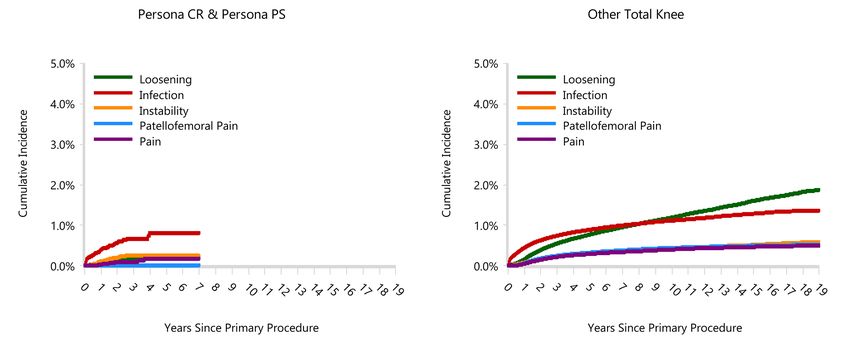
The cumulative percent revision (CPR) for Persona The primary reasons for revision included loosening,
Knee CR and PS bearings is less than those reported for all infection, instability, and pain (Figure 1). Interestingly,
other total knee implants (Table 6). For example, the CPR loosening appears to be less frequent (graphically) when
for Persona Knee CR and PS bearings is 1.9 (95% CI, 1.6 – the Persona knee was used. These indications for revision
2.2) at five years, compared to a CPR of 3.4 (95% CI, 3.4- are consistent with those reported in the AOANJRR 2020
3.5) for the same follow-up time with all other total knees. Annual report13.
Table 6. Yearly Cumulative Percent Revision of Primary Total Knee Replacement by Model (All Diagnoses) (Table 11, AOANJRR, 18/03/2021)
Figure 1. Cumulative Incidence Revision Diagnosis of Primary Total Knee Replacement by Model (All Diagnoses) (Figure 2, AOANJRR, 18/03/2021)
The CPR for Persona Knee CR and PS bearings is 1.9 (95% CI, 1.6 – 2.2) at five years, compared to a CPR of 3.4 (95% CI, 3.4-
3.5) for the same follow-up time with all other total knees. The revisions/100 observation years was 0.39 (95% CI, 0.14
– 0.86) for robotic assisted TKA using the Persona knee compared to 0.60 (95% CI, 0.52– 0.68) without robotic assistance
for the same implants (Table 7). This demonstrates a relative reduction in revisions of 35% when robotic assistance was
used.
Table 7. Revision Rates of Persona CR & Persona PS Primary Total Knee Replacement by Robotic Assistance (All Diagnoses) (Table 22, AOANJRR, 18/03/2021)
3 | Promising results for early survivorship using the Persona Knee with the ROSA Knee SystemDiscussion & Conclusion
The Persona Knee was reported to have lower CPR rates (UKA) given the reduced number of revisions in robotic
compared to all other knee implant systems. Further, even cases compared to conventional UKA. Cool et al.17 reported
though the ROSA Knee System has only been available in significantly lower costs in the 90-day episode of care
the Australian Market since 2019, the early revision rates following robotic TKA compared to conventional TKA in a
are promising with a relative reduction of 35% compared US Medicare population. The reduction in the episode of
to conventional instrumentation using the same implants. care costs included lower index facility costs, fewer patients
Thus, the combination of the Persona Knee with the ROSA discharged to skilled nursing facilities, fewer post-acute
Knee System may provide improved survivorship in patients care services, and a reduction in readmissions by 33%.
undergoing primary TKA. The data presented in the current report corroborate these
However, these results should be considered with findings with a lower overall risk of revision in the robotic
some limitations. First, this is a novel robotic system in procedures, and though early, it should be noted that the
the Australian market and though early evaluations are cost benefits reported in the other studies were seen in
promising, substantial follow-up is still needed to evaluate the early phases by reducing immediate postoperative
the differences in long-term survivorship between robotic complications and healthcare utilization.
and conventional TKA. Second, the data is limited to the The survivorship reported within the AOANJRR of
Australian healthcare system and may not be generalizable Persona Knee implants combined with early data from the
to other populations. ROSA Knee System is promising. Improved component
A recent report by Macri15 noted the benefits of medical positioning2, personalized implant sizing18, and the potential
technology in the Australian population, yet emphasized for fewer soft-tissue releases19 should result in fewer early
the challenges facing new technologies as they must “not revisions associated with surgical errors, and may underlie
only improve the health and well-being of citizens,” but the observed reduction in revision procedures. Further
that they must also be cost effective. This is important analysis of mid- and long-term survivorship is needed to
when considering the high cost of robotic assistants. When evaluate the intra- and post-operative outcomes of this
using “cost per revision avoided” as a primary outcome, novel robotic orthopaedic surgical assistant.
Yeroushalmi et al.16 noted reduced costs in higher volume
centers performing unicompartmental knee arthroplasty
4 | Promising results for early survivorship using the Persona Knee with the ROSA Knee SystemReferences
1. Antonios JK, Korber S, Sivasundaram L, et al. Trends in computer navigation and robotic assistance for total knee arthroplasty in the
United States: an analysis of patient and hospital factors. Arthroplast Today. 2019;5(1):88-95.
2. Seidenstein A, Birmingham M, Foran J, Ogden S. Better accuracy and reproducibility of a new robotically-assisted system for total
knee arthroplasty compared to conventional instrumentation: a cadaveric study. Knee Surg Sports Traumatol Arthrosc. 2020.
Cadaveric studies are not necessarily indicative of clinical performance.
3. Liow MH, Xia Z, Wong MK, Tay KJ, Yeo SJ, Chin PL. Robot-assisted total knee arthroplasty accurately restores the joint line and mechanical
axis. A prospective randomised study. J Arthroplasty. 2014;29(12):2373-2377.
4. Mannan A, Vun J, Lodge C, Eyre-Brook A, Jones S. Increased precision of coronal plane outcomes in robotic-assisted total knee
arthroplasty: A systematic review and meta-analysis. Surgeon. 2018;16(4):237-244.
5. Scholl LY, Hampp EL, de Souza KM, et al. How Does Robotic-Arm Assisted Technology Influence Total Knee Arthroplasty Implant
Placement for Surgeons in Fellowship Training? J Knee Surg. 2020.
6. Ren Y, Cao S, Wu J, Weng X, Feng B. Efficacy and reliability of active robotic-assisted total knee arthroplasty compared with conventional
total knee arthroplasty: a systematic review and meta-analysis. Postgrad Med J. 2019;95(1121):125-133.
7. Kayani B, Konan S, Ayuob A, Onochie E, Al-Jabri T, Haddad FS. Robotic technology in total knee arthroplasty: a systematic review. EFORT
Open Rev. 2019;4(10):611-617.
8. Wakelin EA, Shalhoub S, Lawrence JM, et al. Improved total knee arthroplasty pain outcome when joint gap targets are achieved
throughout flexion. Knee Surg Sports Traumatol Arthrosc. 2021.
9. Hamilton DA, Ononuju U, Nowak C, Chen C, Darwiche H. Differences in Immediate Postoperative Outcomes Between Robotic-Assisted
TKA and Conventional TKA. Arthroplasty Today. 2021;8:57-62.
10. King CA, Jordan M, Bradley AT, Wlodarski C, Tauchen A, Puri L. Transitioning a Practice to Robotic Total Knee Arthroplasty Is Correlated
with Favorable Short-Term Clinical Outcomes-A Single Surgeon Experience. J Knee Surg. 2020.
11. Marchand RC, Sodhi N, Anis HK, et al. One-Year Patient Outcomes for Robotic-Arm-Assisted versus Manual Total Knee Arthroplasty. J
Knee Surg. 2019;32(11):1063-1068.
12. Australian Orthopaedic Association National Joint Replacement Registry (AOANJRR), Automated Industry Report System (AIRS) ID No.
3845 for Zimmer Biomet Australia Persona CR & Persona PS Total Knee, procedures from 1 September 1999 - 18 March 2021. 18 March
2021.
13. Australian Orthopaedic Association National Joint Replacement Registry (AOANJRR). Hip, Knee, & Shoulder Arthroplasty: 2020 Annual
Report. In:2020.
14. Labek G, Group QS. Quality of Publications regarding the Outcome of Revision Rate after Arthroplasty. Medical University of Innsbruck,
Dept. of Orthopaedic Surgery;2010.
15. Macri J. Australia’s Health System: Some Issues and Challenges. J Health Med Econ. 2016;2(2).
16. Yeroushalmi D, Feng J, Nherera L, Trueman P, Schwarzkopf R. Early Economic Analysis of Robotic-Assisted Unicondylar Knee Arthroplasty
May Be Cost Effective in Patients with End-Stage Osteoarthritis. J Knee Surg. 2020.
17. Cool CL, Jacofsky DJ, Seeger KA, Sodhi N, Mont MA. A 90-day episode-of-care cost analysis of robotic-arm assisted total knee
arthroplasty. J Comp Eff Res. 2019;8(5):327-336.
18. Massé V, Ghate RS. Using standard X-ray images to create 3D digital bone models and patient-matched guides for aiding implant
positioning and sizing in total knee arthroplasty. Computer Assisted Surgery. 2021;26(1):31-40.
19. Alessi A, Fitzcharles E, Weber IC, Cafferky NL. The Functionality of a Novel Robotic Surgical Assistant for Total Knee Arthroplasty: A Case
Series. Case Reports in Orthopedics. 2021;2021:6659707.
AOANJRR Automated Industry Report #3845, 18 March 2021
The AOANJRR has taken every care to ensure that the data supplied are accurate but does not warrant
that the data are error free and does not accept any liability for errors or omissions in the data.
This material is intended for health care professionals. Distribution to any other recipient is prohibited.
Check for country product clearances and reference product specific instructions for use. For
indications, contraindications, warnings, precautions, potential adverse effects and patient counseling
information, see the package insert or contact your local representative; visit www.zimmerbiomet.com
for additional product information. All content herein is protected by copyright, trademarks and other
intellectual property rights, as applicable, owned by or licensed to Zimmer Biomet or its affiliates unless
otherwise indicated, and must not be redistributed, duplicated or disclosed, in whole or in part, without
the express written consent of Zimmer Biomet.
3511.1-GLBL-en-Issue Date 2021-06-11 ©2021 Zimmer BiometYou can also read


