Prosopidicola mexicana gen. et. sp. nov., causing a new pod disease of Prosopis species
←
→
Page content transcription
If your browser does not render page correctly, please read the page content below
STUDIES IN MYCOLOGY 50: 187–194. 2004.

Prosopidicola mexicana gen. et. sp. nov., causing a new pod disease of
Prosopis species

Cheryl L. Lennox1*, Maryna Serdani1, Johannes Z. Groenewald2 and Pedro W. Crous2
1
 ARC-PPRI Weeds Division, Private Bag X5017, Stellenbosch 7599, South Africa; 2Centraalbureau voor Schimmelcultures,
Fungal Biodiversity Centre, Uppsalalaan 8, 3584 CT Utrecht, The Netherlands

*Correspondence: Cheryl L. Lennox, vredcl@plant3.agric.za

Abstract: Species of Prosopis introduced into South Africa from the Americas for fuel wood, shade and fodder, have become
naturalized and widespread in the dry northwestern areas of this country. Invasive Prosopis species have been the target of a
biological control programme in South Africa since 1985. During a survey for potential fungal biological control agents in
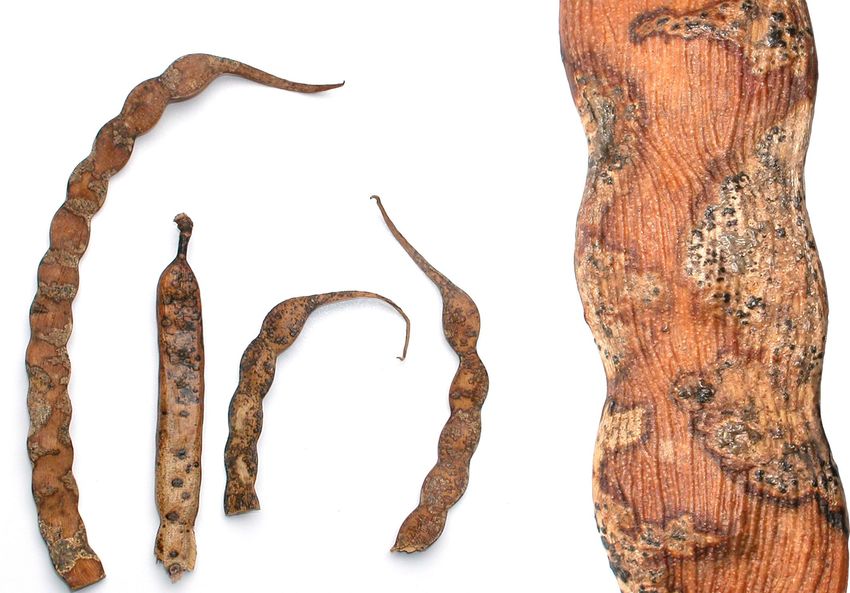
Mexico and Texas in 2001, a pod disease was recorded on Prosopis glandulosa in both countries. The disease is characterized
by black/grey pycnidia, flattening of the pods, and seed decay. Morphological investigations of the causal organism showed it
to be a Coniothyrium-like coelomycete. However, based on conidiogenous cell morphology and proliferation, we concluded
that the organism is not congeneric with Coniothyrium s. str. Phylogenetic analysis of the SSU gene placed this fungus in the
Diaporthales. Parsimony analysis of the ITS region (ITS-1, 5.8S, ITS-2) revealed it to group closely to Cryphonectria and
Endothia. Consequently, a new genus, Prosopidicola, with type species Prosopidicola mexicana, is proposed.

Taxonomic novelties: Prosopidicola Crous & C.L. Lennox gen. nov., Prosopidicola mexicana Crous & C.L. Lennox sp. nov.
Key words: Coniothyrium, invasive weed, pod rot, Prosopidicola, Prosopis, systematics.

INTRODUCTION                                                     diminishing its usefulness (Zimmerman 1991, Moran
                                                                 et al. 1993, Impson et al. 1999). The extent of the area
Members of the genus Prosopis L. are thorny, legu-               invaded by Prosopis, and recent estimates of water
minous shrubs or trees. During the late 1800s a num-             usage by this plant (Le Maitre et al. 1996), have lent
ber of Prosopis species were introduced into South               government support for research on the use of fungi as
Africa from North and South America for fodder                   agents for its biological control. Both classical and
(pods), shade and firewood (Harding 1978, Poynton                mycoherbicide approaches are being investigated by
1987). Harding (1978) recognized the presence of six             researchers in the Weed Pathology Unit of ARC-
taxa in southern Africa, four of which have become               PPRI, Stellenbosch, South Africa.
naturalized and widespread in the dry northwestern                   In September and October 2001, an extensive
areas of South Africa. In this country Prosopis glan-            survey and collections were made of pathogens occur-
dulosa Torr. var. torreyana (L.D. Benson) E. Murray              ring on P. glandulosa var. torreyana and P. velutina
(honey mesquite) hybridises with P. velutina Wooton              in Mexico and Texas. All necessary export and import
(velvet mesquite) and P. chilensis Stuntz (mesquite),            permits had been obtained prior to the start of the
making identification difficult (Henderson 2001).                survey and collection trip. Of particular interest was a
These Prosopis species and their hybrids have in-                pod disease collected in Mexico and Texas. Prosopis
vaded riverbeds, riverbanks and drainage lines in the            glandulosa pods with similar symptoms had previ-
arid northwest (Henderson 2001). In some areas the               ously been collected by S. Neser in 1989 near La
invasion has been so extensive that impenetrable                 Joya, Texas (Fig. 1). The fungal causal organism had
stands have formed and the land has been largely lost            been isolated and lodged (Culture number C158) in
for agricultural purposes. Mechanical and chemical               the culture collection of the Weeds Pathology Unit,
control is both difficult, due to the tree’s thorny multi-       ARC-PPRI, Stellenbosch, South Africa.
stemmed nature, and expensive, in an area of low land                The objectives of this paper are to report on a new
value. Moran et al. (1993) stated that long-term,                pod disease of Prosopis, and to discuss the taxonomy
economically viable management of Prosopis in                    and identity of this pod disease in the light of the
South Africa will probably only be achieved through              morphological and molecular characteristics of the
biological control. As the plant still has some useful           pathogen.
attributes (fodder, firewood, charcoal and wood for
flooring), biological control has, until recently, been
restricted to the use of seed-feeding beetles that re-
duce the reproductive capacity of the plant without

                                                                                                                        187
LENNOX ET AL.
MATERIALS AND METHODS tion of the ARC-PPRI Weeds Pathology Unit, Stel-
lenbosch, South Africa. Reference strains and herbar-
Isolates ium specimens have been deposited at the Centraalbu-
During a survey and collection of pathogens occurring reau voor Schimmelcultures (CBS) in Utrecht, The
on P. glandulosa and P. velutina species in Mexico Netherlands.
and Texas in 2001, a severe pod disease was noted on
these trees growing north of Chihuahua (Mexico), and DNA isolation and amplification
near the towns of Zapata, La Joya and Raymondville The isolation protocol of Crous et al. (2000) was used
(Texas). Symptoms of this pod disease, caused by an to isolate genomic DNA from fungal mycelia grown
as yet unidentified coelomycete, were characterised on MEA plates. The primers ITS1 and ITS4 (White et
by black/grey pycnidia, flattening of the pods and al. 1990) were used to amplify part of the nuclear
seed decay. Symptomatic pods were collected, la- rRNA operon spanning the 3’ end of the 18S (small
belled and placed in brown paper bags. The pods subunit) rRNA gene, the first internal transcribed
collected each day were examined using a Zeiss field spacer (ITS1), the 5.8S rRNA gene, the second ITS
microscope for signs of the causal organism. Symp- (ITS2) region and the 5’ end of the 28S (large subunit)
tomatic material was wrapped in tissue paper, placed of the rRNA gene. Part of the 18S rRNA gene was
in brown paper bags and stored in a cooler box. Col- amplified using primers NS1 and NS4 (White et al.
lected pods were sent to South Africa via a courier 1990). The reaction mixture contained 5 µL of diluted
service. On arrival in South Africa, the material was sample, 1 PCR buffer (Bioline), 8 mM MgCl2, 500
taken directly into the plant pathogen quarantine µM of each of the dNTPs, 2.5 U Taq polymerase
facility at ARC-PPRI Weeds Pathology Unit in Stel- (Bioline) and 10 pmoles of each primer and made up
lenbosch. Once in quarantine, the diseased pods were to a total volume of 25 µL with sterile water. The
re-examined for signs of the causal organism, and cycling conditions comprised denaturing at 96 °C for
isolations made from symptomatic tissue. Sympto- 5 min, followed by 30 cycles of denaturation at 96 C
matic tissue was surface-sterilized in 70 % ethanol for (30 s), annealing 55 C (30 s) and elongation at 72 C
30 s, 1 % sodium hypochlorite for 2 min, and 70 % (90 s). A final elongation step at 72 C for 7 min was
ethanol for 30 s. Sections of tissue (5 mm2) were included. PCR products were separated by electropho-
transferred to Petri dishes containing potato dextrose resis at 75 V for 1 h in a 0.8 % (w/v) agarose gel in
agar (PDA) (39 g Difco PDA, 1 L distilled H2O) and 0.5 TAE buffer (0.4 M Tris, 0.05 M NaAc, and 0.01
incubated at 25 oC under continuous cool day-light- M EDTA, pH 7.85) and visualised under UV light
type white fluorescent light. Single-conidial cultures using a GeneGenius Gel Documentation and Analysis
were subsequently established for all pod disease System (Syngene, Cambridge, U.K.) following
isolates. Axenic cultures were maintained on PDA ethidium bromide staining.
slants at 5 oC in the dark in the fungal culture collec-
Fig. 1. Disease symptoms associated with Prosopidicola mexicana on pods of Prosopis glandulosa.LENNOX ET AL.
Table 1. Coniothyrium and Coniothyrium-like isolates included in this study for sequence analysis and/or morphological
comparison.
Species Accession no.1 Substrate Country Collector GenBank accession
ITS SSU
“Coniothyrium” leuco- CBS 114035 = Protea repens South J.E. Taylor AY720707 AY720711
spermi STE-U 2852 Africa
Coniothyrium palmarum CBS 400.71 Chamaerops Italy W. Gams AY720708 AY720712
humilis
“Coniothyrium ovatum” STE-U 18 Eucalyptus South P.W. Crous AY720713
cladocalyx Africa
“Coniothyrium ovatum” CBS 111149 = E. cladocalyx South P.W. Crous AY720714
STE-U 23 Africa
“Coniothyrium ovatum” CBS 110906 = E. cladocalyx South P.W. Crous AY720715
STE-U 40 Africa
“Coniothyrium ovatum” CBS 113621 = E. cladocalyx South P.W. Crous AY720716
STE-U 42 Africa
Prosopidicola mexicana CBS 113529 Prosopis U.S.A. C. Lennox AY720709 AY720717
glandulosa
Prosopidicola mexicana CBS 113530 P. glandulosa U.S.A. S. Neser AY720710
1
CBS: Centraalbureau voor Schimmelcultures, Utrecht, The Netherlands; STE-U: Department of Plant Pathology, University
of Stellenbosch, South Africa.
The amplification products were purified by using (CI, RI and RC). Resulting trees were printed with
a GFX PCR DNA and Gel Band Purification Kit TreeView v. 1.6.6 (Page 1996).
(Amersham Pharmacia Biotech Europe GmbH, Ger-
many) according to the manufacturer’s instructions. Morphology
The cycle sequencing reaction with 20 to 40 ng of Isolates were plated onto PDA and incubated at 25 oC
purified PCR products and 10 pmoles of primer in a under near-UV light to promote sporulation. Slide
total volume of 10 L was carried out with an ABI preparations were made in lactic acid and 30 examples
PRISM BigDye Terminator v. 3.0 Cycle Sequencing of each structure measured ( 1000) using a Zeiss
Ready Reaction Kit (PE Biosystems, Foster City, CA, Axioskop light microscope. The 95 % confidence
U.S.A.) containing AmpliTaq DNA Polymerase intervals were also determined for conidial dimen-
following the instructions of the manufacturer. The sions, with the extremes in conidium length and width
resulting fragments were analysed on an ABI Prism given in parentheses. Colony colour (reverse) was
3100 DNA Sequencer (Perkin-Elmer, Norwalk, Con- determined on PDA after 8 d at 25–30 oC in the dark
necticut, U.S.A.). using the colour designations of Rayner (1970). For
additional clarification of morphological characteris-
Phylogenetic analysis tics, fungal pycnidia were prepared for scanning
The nucleotide sequences of the 18S rDNA gene electron microscopy according to the methodology
generated in this study were added to the outgroups, employed by Lennox & Rijkenberg (1989). This
Candida fukuyamaensis AB013566 and a Debaryo- material was examined using a Leo S440 scanning
myces sp., AB022440 and other sequences obtained electron microscope.
from GenBank (http://www.ncbi.nlm.nih.gov/) using
Sequence Alignment Editor v. 2.0b11 (Rambaut
2002). For the ITS alignment, Coniothyrium palma- RESULTS
rum and two Phaeosphaeria species were used as
outgroups. Adjustments for improvement were made Phylogenetic analysis
by eye where necessary. Phylogenetic analyses with Approximately 1 kb was determined for the SSU
both parsimony and neighbour-joining (using uncor- rRNA gene and the alignment contained 1046 charac-
rected "p", Jukes-Cantor and Kimura-2-parameter ters and 41 taxa including the two outgroup taxa.
models) were done using PAUP (Phylogenetic Analy- Approximately 550 to 600 bases were determined for
sis Using Parsimony) v. 4.0b10 (Swofford 2000). Any each isolate, of which approximately 520 to 580 bases
ties that were encountered were broken randomly. For per sequence (spanning ITS1, 5.8S rRNA gene, ITS2
parsimony analysis, alignment gaps were treated as and the first part of the small subunit gene) were
both a new character and as missing, and all charac- added to the alignment. The manually adjusted align-
ters were taken as unordered and of equal weight. The ments of the nucleotide sequences contained 590
robustness of the trees was evaluated by 1000 boot- characters including alignment gaps (data not shown)
strap replications (Hillis & Bull 1993). Other meas- and 24 taxa including the three outgroup taxa. Se-
ures calculated included tree length, consistency quences were deposited in GenBank (Table 1), and
index, retention index and rescaled consistency index the alignment in TreeBASE (S1150).LENNOX ET AL.
The phylogenetic analysis of the SSU sequence Setting the gapmode to a new state yielded two
data resulted in the neighbour-joining tree shown in equally parsimonious trees (one of which is shown in
Fig. 2. The topology of the tree stayed the same, Fig. 3) with the same topology but a slight difference
irrespective of which substitution model was used. in branch length, while scoring gaps as missing char-
Four well-supported clades were obtained, each acters increased the number of equally parsimonious
containing taxa originally identified as Coniothyrium trees to 22. The strict consensus tree of the 22 equally
or Coniothyrium-like. The first clade (100 % bootstrap parsimonious trees had the same topology as the
support) places the type strain of Prosopidicola mexi- bootstrap consensus tree obtained when scoring gaps
cana in the Diaporthales. The Mycosphaerellaceae as fifth characters. The results of the neighbour-
form the second main clade and contain a well- joining analyses of the ITS data were the same for the
supported group (100 % bootstrap support) of four three substitution models tested (data not shown).
Coniothyrium ovatum H.J. Swart isolates. The third However, when compared to the parsimonious trees,
clade (99 % bootstrap support) contains representa- Leucostoma persoonii (Nitschke) Höhn. was found to
tives of the black yeasts and also contains the isolate group with sequences of Diaporthe Nitschke species,
Coniothyrium leucospermi Crous & Denman which apart from Prosopidicola mexicana and Cryphonec-
groups with 92 % bootstrap support with Dothidea tria (Sacc.) Sacc. & D. Sacc. A BLASTn search of the
insculpta Wallr. and Dothidea ribesia (Pers.) Fr. The ITS sequences of the two strains of Prosopidicola
last clade (100 % bootstrap support) contains Conio- mexicana did not return any hits with high similarity,
thyrium palmarum Corda and belongs to the Pleospo- as is evident from the ITS phylogram. The two Pro-
rales. sopidicola mexicana isolates grouped with a clade
To study the phylogenetic placement of Prosopidi- containing sequences of Cryphonectria and Endothia
cola mexicana, the ITS gene was also sequenced. (93 % bootstrap support).
Candida fukuyamaensis AB013566
Debaryomyces sp. AB022440
Prosopidicola mexicana CBS 113529
Discula quercina AF277108
100
Endothia eugeniae AF277115 Valsaceae,
Valsa ambiens subsp. leucostomoides AF277120 Diaporthales
78
Leucostoma persoonii M83259
82
Cryphonectria parasitica L42441
Cryphonectria radicalis L42442
Dissoconium dekkeri STE-U 1535 AY251101
82 Mycosphaerella populorum AF271130
Mycosphaerella punctiformis AY490775
95 Mycosphaerella latebrosa AY251114
58
Cercospora zebrina AY251104
83 Cercospora cruenta AY251105
73
Pseudocercospora angolensis AY251106
55
Pseudocercospora protearum var. leucadendri AY251107
Passalora dodonaea AY251108 Mycosphaerellaceae,
56
Passalora fulva AY251109 Dothideales
51 Mycosphaerella nubilosa AY251120
85
“Coniothyrium ovatum” STE-U 18
100
“Coniothyrium ovatum ” STE-U 23
67 “Coniothyrium ovatum ” STE-U 40
“Coniothyrium ovatum ” STE-U 42
100
100
Cladosporium colocasiae AY251092
Cladosporium cladosporioides U20381
Davidiella tassiana AY251096
Hormonema dematioides AY150054
92 “Coniothyrium” leucospermi STE-U 2852
88 Dothidea insculpta U42474 Black yeasts
99 Dothidea ribesia AY016343
Discosphaerina fagi AY016342
96
Aureobasidium pullulans AY137505
Pleospora herbarum U43458
100 Leptosphaeria maculans U04233
Pleospora betae U43466
Leptosphaeriaceae,
Leptosphaeria microscopica U04235
Phaeosphaeriaceae,
71 Paraphaeosphaeria agavensis AF250823 Pleosporales
51 Coniothyrium palmarum CBS 400.71
Phoma glomerata AY293783
96
Phoma herbarum AY337712
0.1 substitutions per site
Fig. 2. Neighbour-joining tree obtained from a search of the SSU data set using the Kimura 2-parameter substitution model.
The tree was rooted to Candida fukuyamaensis and a Debaryomyces species. Bootstrap support values from 1000 replicates are
shown at the nodes. The bar indicates 0.1 substitutions per site and all new sequences are shown in bold type.PROSOPIDICOLA MEXICANA GEN. ET. SP. NOV.
Leucostoma persoonii AF191176
100
Prosopidicola mexicana CBS 113529
90
Prosopidicola mexicana CBS 113530
98 Cryphonectria cubensis AF265657
93
78
Cryphonectria cubensis AF265654
Endothia gyrosa AF368326
100 94 99
Endothia gyrosa AF368324
100 Cryphonectria parasitica AF368330
Cryphonectria macrospora AF368331
Diaporthe helianthi AJ312349
100 94
Diaporthe phaseolorum AF001028
Diaporthe meridionalis AF000566
100
Diaporthe phaseolorum AF001016
Dothidea insculpta AF027764
100 Kabatina thujae AF013226
92
“Coniothyrium” leucospermi STE-U 2852
Kabatina juniperi AF182376
58 Hormonema macrosporum AJ244247
Aureobasidium pullulans AF423114
100
Hormonema dematioides AJ278928
53
Sydowia polyspora AJ244262
Coniothyrium palmarum CBS 400.71
100 Phaeosphaeria vagans AF439508
10 changes
Phaeosphaeria nodorum AF250830
Fig. 3. One of two most parsimonious trees obtained from a heuristic search of the ITS data set with 100 random taxon addi-
tions (TL = 940 steps, CI = 0.751, RI = 0.880, RC = 0.661). The trees were rooted to Coniothyrium palmarum and two
Phaeosphaeria species. Bootstrap support values from 1000 replicates are shown at the nodes. The bar indicates 10 changes
and all new sequences are shown in bold type.
Morphology Etymology: Prosopidicola (L. genitive of Prosopis)
The Prosopis pathogen was initially identified as a indicating the species association with the genus
member of Coniothyrium. This complex is character- Prosopis L.
ized by having thin-walled, unilocular pycnidia, with
hyaline, percurrently proliferating conidiogenous cells Genus anamorphum pycnidiale, Coniothyrio simile. Co-
that give rise to brown, thick-walled, 0–1-euseptate, nidiophora ramosa, cellulae conidiogenae percurrenter,
ellipsoidal to subcylindrical conidia. The Prosopis nonnumquam sympodialiter proliferentes, viridi-brunneae,
pathogen is clearly not congeneric with Coniothyrium in summo verrucosae.
s. str. in that it has branched conidiophores which
Typus: Prosopidicola mexicana Crous & C.L. Lennox, sp.
have green-brown conidiogenous cells that proliferate
nov.
percurrently, and in some cases also sympodially. The
conidiogenous cells are also unique in that they have
Genus asexual, conidiomata pycnidial, resembling
an irregular, wart-like, green-brown apical region.
those of Coniothyrium. Conidiophores brown; co-
From these differences it is clear that a new genus has
nidiogenous cells proliferating percurrently, rarely
to be proposed to accommodate this fungus.
sympodially, green-grown, roughened at apex.
Prosopidicola mexicana Crous & C.L. Lennox,
Taxonomy
sp. nov. MycoBank MB500049. Figs 4–12.
Prosopidicola Crous & C.L. Lennox, gen. nov. Legumina hospitis putrescens, laesiones irregulares, ad 7
MycoBank MB500048. 2–3 mm, pallide brunneae, margine elevata, rubro-brunnea
vel fusca. Mycelium internum, ex hyphis ramosis, septatis,
levibus, brunneis, 2–3.5 µm latis compositum. Conidiomata
amphigena, sparsa, nigra, subepidermalia, deinde
187LENNOX ET AL.
erumpentia, globosa vel subglobosa, unilocularia, Typus: Herb. CBS 7948, in legumine Prosopidis
pycnidialia, nonnumquam acervulos fingentia, ad 250 m glandulosae, U.S.A., Texas, La Joya, 24 Sept. 2001, C.L.
diam, paries ad 15 m crassus, e 3–4 stratis cellularum Lennox C 564 (cultura viva CBS 113529).
angularium rubro-brunnearum compositus. Conidiophora Lesions associated with pod rot symptoms, irregular,
totam superficiem internam obtegentia, subcylindrica, covering the pod, 2–3 mm wide and up to 7 mm long,
ramosa, 0–3-septata, recta vel irregulariter curvata, dilute extending across the width of the pod, pale brown
brunnea vel deorsum viridi-brunnea, deinde etiam viridi- with a raised, red-brown to dark brown margin. Myce-
brunnea in parte distali, 5–50 3–4 m. Cellulae lium internal, consisting of branched, septate, smooth,
conidiogenae pallide viridi-brunneae, primum leves, deinde
fuscius viridi-brunneae et verrucosae, subcylindricae vel
medium brown hyphae, 2–3.5 µm wide. Conidiomata
lageniformes; primum sicut phialides sporulantes, apice amphigenous, scattered, black, subepidermal, becom-
angusto (1.5–2 m) periclinaliter inspissato, sed etiam ing erumpent, globose to subglobose, unilocular,
percurrenter proliferentes, collaria extensa, 3–4 m lata pycnidial, in some cases appearing acervular, up to
relinquentes; raro duo loci conidiogeni iuxta formati; 250 µm diam; wall up to 15 µm thick, consisting of 3–
cellulae 5–16 3–4 m. Conidia in massa nigra exsudata, 4 layers of medium red-brown textura angularis.
late ellipsoidea, brunnea, recta vel modice curvata, sursum Conidiophores lining the inner layer of the wall,
rotundata, basi subtruncata, hilo inconspicuo praedita, levia, covering the whole cavity, subcylindrical, branched,
tenuitunicata, unicellularia, (8–)10–13(–20) (3.5–)4.5– 0–3-septate, straight to irregularly curved, pale brown
5.5(–6) m. to green-brown below, becoming medium green-
brown in the upper conidiogenous region, 5–50 3–4
µm.
Figs 4–9. Conidiogenous cells and conidia of Prosopidicola mexicana, showing percurrent proliferation, the verrucose apical
region of conidiogenous cells, and the basal scar on conidia. Scale bars = 1 µm.PROSOPIDICOLA MEXICANA GEN. ET. SP. NOV.
Conidiogenous cells green-brown and smooth when DISCUSSION
young, becoming medium to dark green-brown and
warty with maturity, subcylindrical to lageniform; Coelomycetes having pycnidia with brown, 0–1-
proliferation appearing phialidic when young, with septate conidia that are formed on conidiophores that
prominent periclinal thickening and a narrow apex have been reduced to percurrently proliferating co-
(1.5–2 µm), but proliferating percurrently with age, nidiogenous cells, usually suggest that the fungus is
apex obtaining flared collarettes, 3–4 µm wide; rarely representative of Coniothyrium s.l. However, the
with two loci per conidiogenous cell, proliferations phylogeny derived in Fig. 2 clearly illustrates that this
aggregating and becoming dark green-brown, provid- morphology type has evolved more than once, and can
ing a warty, irregular appearance with age, with even be found in different orders.
prominent periclinal thickening visible at the apical The type species of Coniothyrium is C. palmarum,
part of the conidiogenous cell, 5–16 3–4 µ m. Co- which is allied to the Leptosphaeriaceae/Phaeosphae-
nidia solitary, exuding in black masses, broadly riaceae/Pleosporales subclade (Fig. 2), and clusters
ellipsoidal, medium brown, straight to slightly curved, with species having Paraphaeosphaeria-like teleo-
rounded at the apex, tapering to a subtruncate base, morphs. The genus Paraphaeosphaeria, however, is
with an inconspicuous dehiscence scar, smooth, thin- typified by P. michotii (Westend.) O.E. Erikss., and
walled, aseptate, (8–)10–13(–20) (3.5–)4.5–5.5(–6) clusters quite apart from this clade, and appears to be
µm (av. 11 5 µm). conspecific to C. minitans W.A. Campb. The latter
fungus is an important biocontrol organism, which
Cultural characteristics: Colonies on PDA (reverse) also appears to be incorrectly classified in Coniothy-
smoke grey (21´´´´d) to greyish sepia (15´´´´i); colony rium and is transferred to Paraconiothyrium by Verk-
margin fimbriate; colonies reaching a mean radial ley et al. (this volume).
growth of 46–55 mm at 30 oC in the dark after 8 d. Other than these two subclades, additional sub-
Cardinal temperatures for growth: minimum above 10 clades within the Pleosporales can also be found that
o
C, optimum 30 oC, maximum below 40 oC. have Coniothyrium-like anamorphs, suggesting that
more anamorph and possibly teleomorph genera need
Substrate and distribution: Pathogenic to pods of to be distinguished here (Câmara et al. 2001, 2002,
Prosopis glandulosa; Mexico, U.S.A. (TX). 2003).
The yeast-like growth and peculiar nature of C.
leucospermi, a minor foliicolous pathogen of Pro-
teaceae, has been discussed in detail by Taylor &
Crous (2001). It is not surprising, therefore, to see this
fungus cluster with other members of the black yeasts
(Fig. 2). Although it is clearly not congeneric with
Coniothyrium s. str., its correct taxonomic position
remains unresolved.
Although Corlett (1991) lists Coniothyrium as an
anamorph of Mycosphaerella, this has never been
proven in culture, and hence Crous et al. (2000)
argued that these links were probably incorrect. Much
to our astonishment, however, we found that certain
species that resemble Coniothyrium in general mor-
phology, notably the Eucalyptus leaf pathogen C.
Figs 10–12. Prosopidicola mexicana. 10. Vertical section
ovatum H.J. Swart (Crous 1998), and the canker
through a pycnidium. 11. Conidia. 12. Range of variation
observed among young (left) to mature (right) conidio-
pathogen C. zuluense M.J. Wingf., Crous & T.A.
phores and conidiogenous cells. Scale bars = 10 µm. Cout. (Wingfield et al. 1997), belong in Mycosphae-
rella, and would need to be accommodated in a genus
Specimens examined: Mexico, Chihuahua, on pods of other than Coniothyrium.
Prosopis glandulosa, 8 Sept. 2001, C.L. Lennox C 559, The clustering of Prosopidicola in a clade separate
Herbarium specimen WH 65 (6). U.S.A., Texas, La Joya, from Coniothyrium s. str. is not surprising, given its
on pods of Prosopis glandulosa, 24 Sept. 2001, C.L. rather unusual conidiogenous cell morphology, and
Lennox, holotype Herb. CBS 7948, culture ex-type CBS mode of conidium proliferation. The fact that it clus-
113529; Texas, Zapata, on pods of Prosopis glandulosa, 24 ters in the Diaporthales with genera such as
Sept. 2001, C.L. Lennox 72c; Texas, Raymondville, on Diaporthe (Phomopsis), Cryphonectria and Endothia
pods of Prosopis glandulosa, 25 Sept. 2001, C.L. Lennox C (Endothiella) is, however, totally unexpected. From
570, C 571, C 572, C 573, Herbarium specimen WH 65 (7);
these results it is clear that the Coniothyrium-like
Texas, La Joya, on pods of Prosopis glandulosa, 24 Aug.
1989, S. Neser, C 158, culture CBS 113530.
morphology has evolved more than once within
different fungal orders, and that plant pathologists will
187LENNOX ET AL.
be faced with increasing difficulties related to the Hillis DM, Bull JJ (1993). An empirical test of bootstrap-
identification of these organisms, as the standard ping as a method for assessing confidence in phyloge-
circumscription of Coniothyrium (Sutton 1980), can netic analysis. Systematic Biology 42: 182–192.
no longer be applied with certainty. Furthermore, the Impson FAC, Moran VC, Hoffman JH (1999). A review of
the effectiveness of seed-feeding bruchid beetles in the
value of conidiogenesis within the Coniothy-
biological control of mesquite, Prosopis species (Fa-
rium/Microsphaeropsis complex, as well as conidio- baceae), in South Africa. African Entomology Memoir
matal structure in Coniothyrium/Cyclothyrium, will 1: 81–88.
also require further clarification. Le Maitre DC, Van Wilgen BW, Chapman RA, McKelley
For the long-term management of Prosopis as an DH (1996). Invasive plants and water resources in the
alien invasive weed in South Africa, a decision was Western Cape Province, South Africa: modeling the
taken at a national workshop to fully explore those consequences of a lack of management. Journal of Ap-
biological control agents that target flowers, pods and plied Ecology 33: 161–172.
seeds. Based on this, and preliminary tests, the poten- Lennox CL, Rijkenberg FHJ (1989). Scanning electron
tial of Prosopidicola mexicana as a biological agent to microscopy study of infection structure formation of
Puccinia graminis f. sp. tritici in host and non-host ce-
control invasive Prosopis species is being further
real species. Plant Pathology 38: 547–556.
investigated. Moran VC, Hoffmann JH, Zimmermann HG (1993).
Objectives, constraints, and tactics in the biological con-
trol of mesquite weeds (Prosopis) in South Africa. Bio-
ACKNOWLEDGEMENTS logical Control 3: 80–83.
Page RDM (1996). TREEVIEW: An application to display
Cheryl L. Lennox acknowledges the DWAF, Working for phylogenetic trees on personal computers. Computer
Water Programme for financial support. Applications in the Biosciences 12: 357–358.
Poynton RJ (1987). Tree planting in South Africa No. 3,
other genera: Prosopis spp. Report of the Department of
Forestry, South Africa.
REFERENCES Rambaut A (2002). Sequence Alignment Editor v2.0 (pro-
gramme distributed by the author). Department of Zool-
Câmara MPS, Palm ME, Van Berkum P, O’Neill NR ogy, University of Oxford, South Parks Road, Oxford
(2002). Molecular phylogeny of Leptosphaeria and OX1 3PS, U.K.
Phaeosphaeria. Mycologia 94: 630–640. Rayner RW (1970). A mycological colour chart. Common-
Câmara MPS, Palm ME, Van Berkum P, Stewart EL wealth Mycological Institute, Kew.
(2001). Systematics of Paraphaeosphaeria: a molecular Stewart EL, Liu Z, Crous PW, Szabo LJ (1999). Phyloge-
and morphological approach. Mycological Research netic relationships among some cercosporoid ana-
105: 41–56. morphs of Mycosphaerella based on rDNA sequence
Câmara MPS, Ramaley AW, Castlebury LA, Palm ME analysis. Mycological Research 103: 1491–1499.
(2003). Neophaeosphaeria and Phaeosphaeriopsis, Sutton BC (1980). The Coelomycetes: fungi imperfecti with
segregates of Paraphaeosphaeria. Mycological pycnidia, acervuli and stromata. Commonwealth Myco-
Research 107: 516–522. logical Institute, Kew, UK.
Corlett M (1991). An annotated list of the published names Swofford DL (2000). PAUP* 4.0: Phylogenetic analysis
in Mycosphaerella and Sphaerella. Mycologia Memoir using parsimony (*and other methods). Sinauer Associ-
18: 1–328. ates, Sunderland, MA, U.S.A.
Crous PW (1998). Mycosphaerella spp. and their ana- Taylor JE, Crous PW (2001). Morphological variation and
morphs associated with leaf spot diseases of Eucalyptus. cultural characteristics of Coniothyrium leucospermi
Mycologia Memoir 21:1–170. associated with leaf spots of Proteaceae. Mycoscience
Crous PW, Aptroot A, Kang JC, Braun U, Wingfield MJ 42: 265–271.
(2000). The genus Mycosphaerella and its anamorphs. White TJ, Bruns T, Lee S, Taylor J (1990). Amplification
In: Molecules, morphology and classification: towards and direct sequencing of fungal ribosomal RNA genes
monophyletic genera in the ascomycetes (Seifert KA, for phylogenetics. In: PCR protocols: a guide to meth-
Gams W, Crous PW, Samuels G, eds). Studies in My- ods and applications (Innis MA, Gelfand DA, Sninsky
cology 45: 107–121. JJ, White TJ, eds). Academic Press, San Diego, CA,
Harding GB (1978). Mesquite. In: Plant invaders. Beautiful U.S.A.: 315–322.
but dangerous (Stirton CH, ed.). Department of Nature Wingfield MJ, Crous PW, Coutinho TA (1997). A serious
and Environmental Conservation, Cape Provincial Ad- canker disease of Eucalyptus in South Africa caused by
ministration, Cape Town: 128–131. a new species of Coniothyrium. Mycopathologia 136:
Henderson L (2001). Alien weeds and invasive plants: A 139–145.
complete guide to declared weeds and invaders in South Zimmerman HG (1991). Biological control of mesquite,
Africa. Plant Protection Research Institute Handbook Prosopis spp. (Fabaceae), in South Africa. Agriculture,
No. 12. ARC-PPRI, Pretoria. Ecosystems and Environment 37: 175–186.You can also read


