Public-Private Engagement in Japan - Activities based on the Meteorological Service Act and a new consortium: WXBC - WMO Library
←
→
Page content transcription
If your browser does not render page correctly, please read the page content below
Public-Private Engagement in Japan
- Activities based on the Meteorological Service Act
            and a new consortium: WXBC -

                     Tatsuya KIMURA
   Director, Public Awareness and Partnerships Division
            Japan Meteorological Agency (JMA)
Outline
• Meteorological Service Act
• Efforts to Ensure Quality of Data & Private Services
Observation and Verification
Entrustment; Tech Stds, Notification & Verification;
Guidance; Big Data
Forecasting
Data provision; Licensing for Forecasting Services;
Certified Weather Forecaster System
• A New Hope: WXBC, a new consortium
2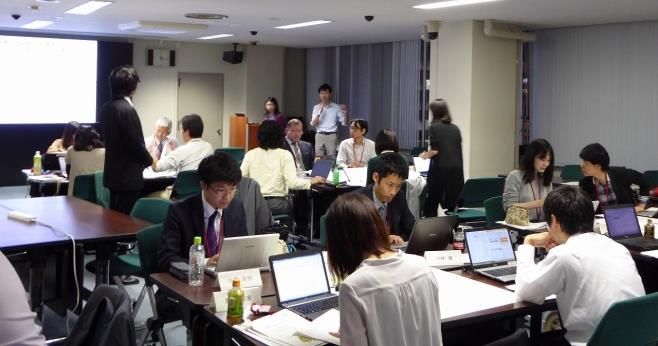
Meteorological Service Act of Japan (1/3)
 • 106 articles, established in 1952 and revised
   more that 30 times
 • Prescribed duties: JMA DG duties reflecting the
   organization’s mission are defined to help JMA
   fulfill its obligations to WMO Members.
 • The Meteorological Service Act clarifies the
   different roles to be played by the public sector
   (in this case, JMA) and by the private and
   academic sectors.
 • Specifically, Article 23 highlights JMA's sole
   authority with the restrictive specification,
   "No party other than JMA shall issue warnings".
                                                       3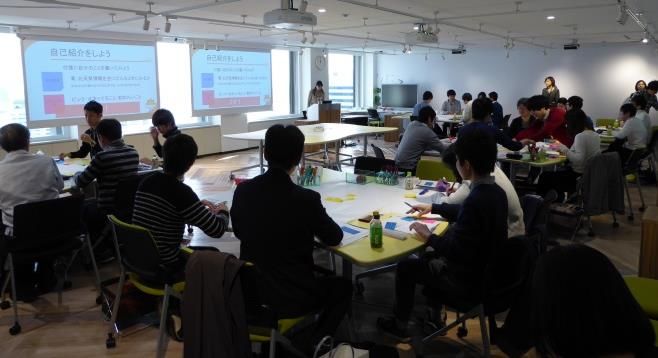
Meteorological Service Act of Japan (2/3)
Article 1 of the Act says,,,
• The purpose of this Act is
to ensure the sound development of meteorological services*#
by prescribing basic systems concerning meteorological services,
and thereby to contribute
to the promotion of public welfare such as
prevention of disaster,
securing of traffic safety, and
prosperity of industries
and to offer international cooperation concerning
meteorological services.
* Article 46 of the Act for the Establishment of the Ministry of
Land, Infrastructure, Transport and Tourism (MLIT) also
stipulates that the mission of the Japan Meteorological Agency
is to ensure the sound development of meteorological services.
# Meteorological services include private services
4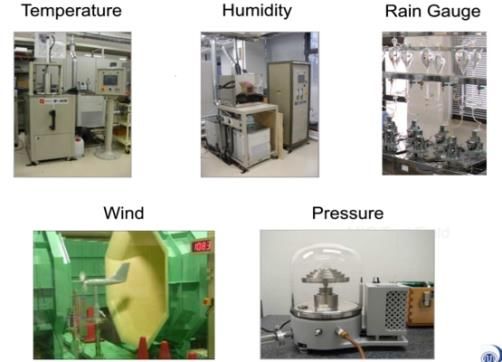
Meteorological Service Act of Japan (3/3)
• The act is also intended to optimize commercial
opportunities for private meteorological services in Japan.
• Major stipulations related to private services include the
specification of JMA’s authority for:
Observation and verification -> Slide 7 & 8 (a major
revision to the Act in 2001)
Licensing for forecasting services, including relevant
Certified Weather Forecasters’ roles & data provision
-> Slide 9, 10 & 11 (a major revision to the Act in 1993
followed by repeated deregulation)
For further details, see the following web site.
http://www.japaneselawtranslation.go.jp/law/detail/?printID=&ft=1&re=01&dn=1&co=01&ky=%E6%
B0%97%E8%B1%A1%E6%A5%AD%E5%8B%99%E6%B3%95&page=1&vm=02 5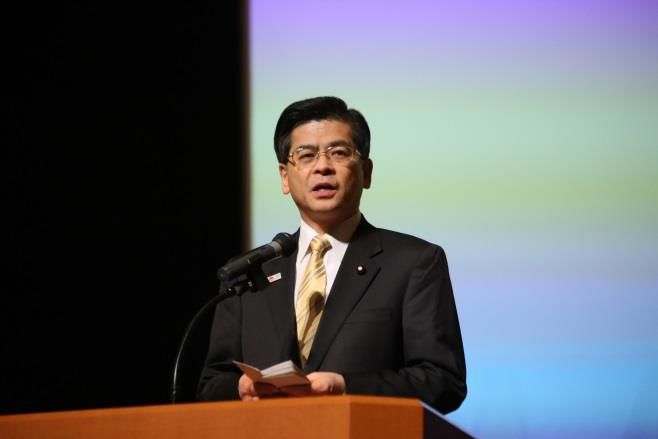
Efforts to Ensure Quality of Data & Private Services (1/5)
Observation (Articles 4 - 12) & Verification System (Articles 27 – 34) (1/2)
 The following regulations are indispensable to conduct observations efficiently or
 to prevent confusion in one of the most disaster-prone nations like Japan.
 Entrustment
  • Article 5 stipulates that JMA may entrust group(s) or individual(s) with
    (i) observations of phenomena and (ii) provision of the results.
    → E.g., JMA has entrusted municipalities and the private
         sector with observation at most of the airports.
 Technical Standards, Notification & Verification
  • Article 6 stipulates that observations intended for
    announcements and DRR must follow technical
    standards, and installation of such observation
    stations shall be notified to JMA.
  • Article 9 requires observations performed in compliance
                                                            Facilities for Verification:
    with the above-mentioned technical standards        Verified instruments must be
    to use instruments verified by a registered body.   used for announcement- 6 and
                                                                  DRR-purpose observation.
Efforts to Ensure Quality of Data & Private Services (2/5)
Observation (Articles 4 - 12) & Verification System (Articles 27 – 34) (2/2)
 (cont'd)
 Guidance
  • Article 10 authorizes JMA to provide guidance on observations.
    → E.g., JMA provides a variety of guidance manuals; latest renewal
        was in March, taking account of increase in privately observed data.

 Latest recommendation (JMA 2030 Vision) by a JMA advisory body
 calls for:
      further integrated usage of observation data
      obtained/collected by various bodies,
      by overcoming challenges such as ensuring of data
      quality and development of big-data utilization
      technology.
                                                                        7
Efforts to Ensure Quality of Data & Private Services (3/5)
Data Provision to the Private Sector (Articles 24-28 – 24-33)
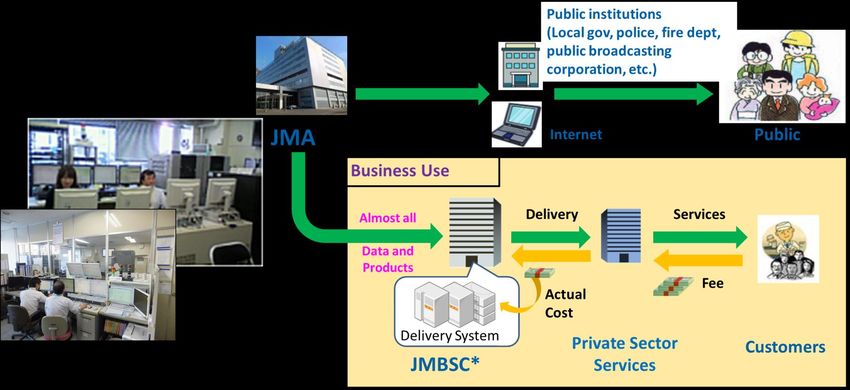
• JMA actively engages in open-data activities.
• Since 1995, JMA provides most of the data/information it
collects and/or formulates to the private sectors at cost for
commercial usage, via JMBSC (a designated public foundation).
• Fee structures are revised every three years.
• Number of users: Approximately 300 (as of March 2018)
8Efforts to Ensure Quality of Data & Private Services (4/5)
Licensing for Forecasting Services (Articles 17 – 22)
• Any party intending to provide forecasting services A wide variety of
must be licensed by JMA’s DG. private weather
service customers
• This provision is intended to meet the general public
interest and to ensure social order and security.
• Standards for licensing are defined in relation to Ship routing
facilities and personnel* involved in data collection
and analysis and to receive warnings (*See the
Certified Weather Forecaster System information in Farming
the next slide).
• A total of 73 commercial entities are licensed to Manufacturing
issue weather forecasts in Japan.
Health
Construction !
Retail &
Daily life Tourism Energy 9
TransportationEfforts to Ensure Quality of Data & Private Services (5/5)
Certified Weather Forecaster System (Articles 24-2 – 24-27)
• Commercial entities licensed to provide weather
forecasts must employ Certified Weather Forecasters,
with the requisite levels of expertise to perform the
core part of forecasting (i.e., prediction of phenomena).
• The above stipulation is intended to ensure the quality
of private weather services.
• The national Certified Weather
Forecaster exam is held twice
a year (average pass rate: 5.6%) .
Most of weathermen or
weatherwomen in Japan are qualified
10
as a Certified Weather Forecaster!However,,,
• Sales of private weather
service companies in Japan
have slowed down…
• Working-age population decreases…
• Big-data era came. 気象事業者の年間総売上高と事業者数の推移
• There must be an enormous amount of room for users to
utilize weather data along with other big data for analysis
and prediction…
Why don’t we start a new project
to improve productivity and providing a range of services
based on the combination of weather information
with various types of big data and advanced technology?
11A New Hope (1/5)
Weather Business Consortium (WXBC)
• The Weather Business Consortium (WXBC) was
established on 7 March, 2017, in Tokyo, Japan, by
public, private and academic sectors including
current and potential meteorological data users.
• JMA functions as the consortium’s secretariat via the
newly established Office of Public-Private-Academic
Collaboration (under me!).
Group photo
at 1st Weather Biz Forum Minister Keiichi ISHII
at 2nd Weather Biz Forum 12A New Hope (2/5)
Weather Business Consortium (WXBC)
To put it formally,,,
• Purpose: to drive commerce involving intensive usage
of meteorological data in technologies such as IoT and
AI via extensive joint efforts in the public, private and
academic sectors, thereby enhancing socio-economic
productivity in Japan
• Number of Members: 416 (as of 3 October, 2018)
To put it very informally,,,
• Now rebooting weather-for-business activities in Japan
for advanced use of weather data in business involving
new users 13A New Hope (3/5)
Weather Business Consortium (WXBC)
From the basics to Dialogues & business matching
I’ll go in
actual application We’ve got with that. That’s it!
WXBC detailed model
prediction…
How 'bout
using
Seminars & Why don’t
Himawari?
trainings we use them
altogether?
Training Session for
Weather Data Analysis 14
Weather Biz Idea ContestA New Hope (4/5)
Weather Business Consortium (WXBC)
• Major activities: organization of major fora, seminars,
training sessions, idea contests and matching events
based on decisions, discussions and dialogue from
the organization’s Congress, Governing Board and
working groups (Human Resource Development WG
and New Business WG)
• JMA supports members’ commercial activities both
as the secretariat and via further provision of
meteorological data based on commercial needs, as
well as improving data usage environments and
promoting deregulation.
15A New Hope (5/5)
Weather Business Consortium (WXBC)
• Typical example of emerging commercial application:
advanced utilization of Himawari imagery for pasture
grass harvesting in Hokkaido, Japan
Solar
Himawari radiation
Imagery prediction
I wanna eat
yummy grass… How can I efficiently
New data and support
Definitely not wet deploy combine I’ll go in
with that. That’s it!
nor damaged… harvesters in foggy
We’ve got
detailed model How 'bout
areas? prediction… using
Himawari?
It’s so difficult to Why don’t
predict and grasp we use them
altogether?
how fog comes in
from sea...
A WXBC
Member
(Agricultural
expert)
16Summary
• My presentation highlighted JMA’s efforts to
increase socio-economic productivity in Japan.
• JMA actively promotes the sound development
of private meteorological services and facilitates
further advanced use of meteorological data by
the private sector through a variety of initiatives,
including public-private partnerships within a
new consortium called WXBC.
17Thank you for your attention!
tkimura@met.kishou.go.jp
(tatsuya.kimura@gmail.com)
18You can also read


