Public Service Reform Board
←
→
Page content transcription
If your browser does not render page correctly, please read the page content below
Public Document Pack

                        Public Service Reform Board

Date:        Thursday 4 March 2021

Time:        2.00 pm                    Public meeting              Yes

Venue:       This meeting is being held entirely by video conferencing facilities
             Click here to view the meeting

Membership
Councillor Maria Crompton (Chair)               Sandwell Metropolitan Borough Council
Councillor Mike Bird                            Walsall Metropolitan Borough Council
Councillor Ian Brookfield                       City of Wolverhampton Council
Councillor Karen Calder                         Shropshire County Council
Councillor George Duggins                       Coventry City Council
Councillor Karen Grinsell                       Solihull Metropolitan Borough Council
Councillor Brigid Jones                         Birmingham City Council
Councillor Ian Kettle                           Dudley Metropolitan Borough Council
Councillor Sebastian Lowe                       Rugby Borough Council
Councillor Izzi Seccombe                        Warwickshire County Council
Henrietta Brealey                               Greater Birmingham Chamber of Commerce
Laura Caulfield                                 Higher Education
Sue Ibbotson                                    Public Health England
Vanessa Jardine                                 West Midlands Police
Paul Jennings                                   Chief Executive NHS Birmingham & Solihull
                                                CCG
Tom McNeil                                      Office of the Police and Crime Commissioner
Catherine Mangan                                Higher Education
Sarah Middleton                                 CEO Black Country Consortium
Jatinder Sharma                                 Further Education
Alison Tonge                                    Director of Commissioning ,NHSE
Phil Loach                                      West Midlands Fire Service

Quorum for this meeting shall be one third of its members

If you have any queries about this meeting, please contact:

Contact            Wendy Slater, Senior Governance Services Officer
Telephone          (0121) 214 7016
Email              wendy.slater@wmca.org.uk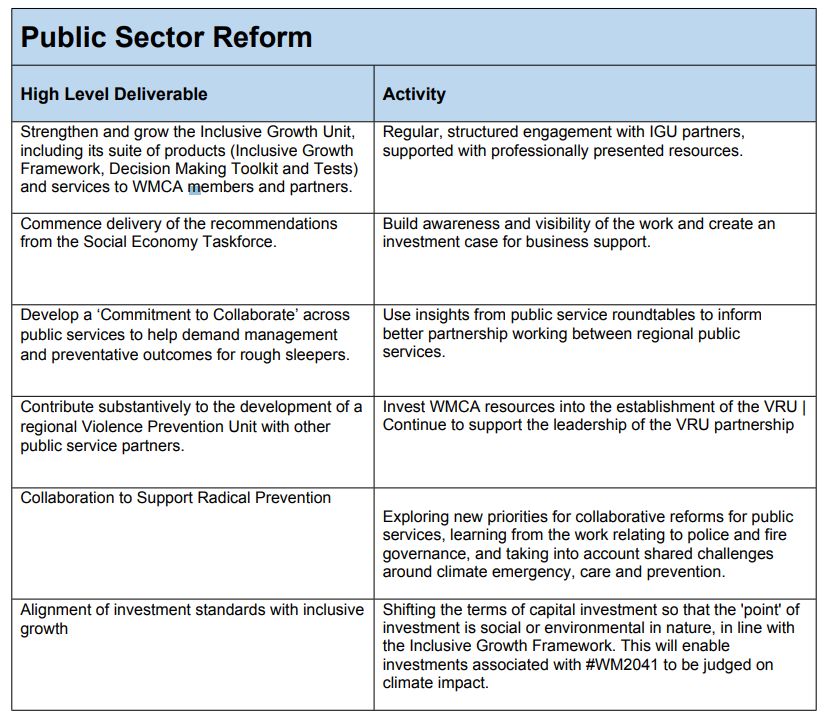
AGENDA
No.   Item                                                 Presenting         Pages

1.    Apologies for absence                                   Chair           None

2.    Declarations of Interest                                Chair           None
      Members are reminded of the need to declare
      any disclosable pecuniary interests they have in
      an item being discussed during the course of the
      meeting. In addition, the receipt of any gift or
      hospitality should be declared where the value is
      thought to have exceeded £25 (gifts) or £40
      (hospitality).

3.    Chair's Remarks (if any)                                Chair           None

4.    Minutes of the last meeting                             Chair            1-6

5.    Matters Arising                                         Chair           None

6.    Community Recovery                                   Claire Dhami       7 - 10

7.    PSR Annual Business Plan : High Level                  Ed Cox           11 - 18
      Deliverables

8.    Homelessness Taskforce : Child and Families         Neelam Sunder       None
      Taskgroup

9.    Verbal Updates :                                    Claire Spencer   Verbal Report
      Inclusive Growth                                     Claire Dhami
      Punishing Abuse                                     Claire Spencer
      Social Economy Business Plan

                                                                                   Agenda
                                                                                Page 2 of 2
Agenda Item 4
Public Service Reform Board
Tuesday 15 December 2020 at 2.00 pm
Minutes
Present
Councillor Maria Crompton (Chair) Sandwell Metropolitan Borough Council
Councillor Karen Grinsell Solihull Metropolitan Borough Council
Councillor Brigid Jones Birmingham City Council
Councillor Ian Kettle Dudley Metropolitan Borough Council
Councillor Louise Miles City of Wolverhampton Council
John Adams Further Education
Laura Caulfield Higher Education
Tom McNeil Office of the Police and Crime
Commissioner
Rachel O' Connor NHS
In Attendance
Ed Cox West Midlands Combined Authority
Neelam Sunder West Midlands Combined Authority
Claire Dhami West Midlands Combined Authority
Claire Spencer West Midlands Combined Authority
Item Title
No.
12. Apologies for Absence
Apologies for absence were received from Councillor Brookfield (City of
Wolverhampton Council), Henrietta Brearley (Greater Birmingham Chamber
of Commerce), Vanessa Jardine (West Midlands Police), Paul Jennings
(NHS), Phil Loach (West Midlands Fire Service), Sarah Middleton (Black
Country Consortium), Jatinder Sharma (Further Education) and Alison Tonge
(NHSE).
13. Nomination of substitutes
Rachel O’ Connor had been nominated as a substitute for Paul Jennings,
Councillor Louise Miles had been nominated as a substitute for Councillor
Ian Brookfield and John Adams had been nominated as a substitute for
Jatinder Sharma.
14. Declarations of Interest
No declarations were made relative to the items under consideration at the
meeting.
15. Appointment of Vice-Chair
The Chair proposed that Councillor Brigid Jones be appointed as the Vice-
Page 1 of 5
Page 1Chair of the board for the remainder of the current municipal year.
The board agreed the appointment.
Resolved: That Councillor Brigid Jones be appointed as the Vice-Chair of the
board for the remainder of 2020/21.
16. Minutes - 10 September 2020
The minutes of the meeting held on 10 September 2020 were agreed as a
true record.
17. Single Assurance Framework - Impact on Thematic Board Terms of
Reference and Role
The Director of Inclusive Growth and Public Service Reform, Ed Cox,
presented a report on the Single Assurance Framework that was adopted by
the WMCA Board on 24 July 2020.
The report set out the purpose of the Single Assurance Framework, the
proposed core roles and implications for thematic boards and portfolio
improvements.
Ed Cox reported that standardised terms of reference had been developed
for thematic boards to support core roles and to ensure a consistent
approach is delivered across the WMCA for each portfolio area.
He added that non-voting members of the board would continue to play an
important role in partnership working in the development and delivery of the
portfolio programmes and projects.
The Chair and Vice-Chair both welcomed the opportunity for elected
members without a Cabinet Lead position to join as non-voting members as
this would allow them to put forward their views and would at the same time,
develop their interest and talent.
In relation to the membership of the board, it was noted that the
appointments of Chair and Vice-Chair were made from the existing
membership and were not additional positions.
In relation to the appointments from the 3 Local Enterprise Partnerships
(LEPs), it was noted that each LEP determined their own representative on
the board.
Resolved:
1. That the Single Assurance Framework requirements for thematic
boards be noted;
2. That the proposed portfolio improvements for the Public Service
Reform Board be noted and
3. That the amended terms of reference for the board as set out in
Appendix A of the report be endorsed subject to clarification regarding
Page 2 of 5
Page 2the appointment of the roles of Chair and Vice-Chair and LEP
representatives .
18. Recovery Co-ordination Group - Community Recovery Priorities
The Head of Public Service Reform and Prevention, Claire Dhami, presented
a report that provided an update on the programme of activity to respond to
the community recovery priorities and principles presented to the Recovery
Forum in July and September 2020.
Claire Dhami outlined the work of the Recovery Co-ordination Group (RCG)
and the document ‘Levelling up West Midlands: our road to community
recovery and prospectus for government’ that was agreed by the RCG,
Leaders and Portfolio Holders on 20 November. It was noted that the
document sets out the vision for recovery based on 6 priorities and 4 cross-
cutting principles agreed by the Citizens Panel.
In relation to the next steps, Claire Dhami reported that a ‘sponsor’ would be
sought from Leaders within the constituent local authorities to take forward
one of the 6 priority areas and work was underway to develop the top 5
collaborative opportunities identified by local authorities which would have
the most impact.
With regards to the open innovation competition that would launch in January
2021 to provide communities with the opportunity to win cash to take forward
projects to support recovery, it was noted that details would be sent to
communication leads early in New Year along and a website would also be
set up to promote the competition.
In relation to enquiry from Rachel O’ Connor as to how the health sector/
STP could help promote the work of RCG, Claire Dhami undertook to contact
Rachel O’Connor outside of the meeting on the matter.
Resolved : That the ‘Levelling-up the West Midlands: Our roadmap to
community recovery and prospectus for government and the next steps
of the programme of activity to respond to the community recovery
priorities and principles developed by the Recovery Coordination Group,
and presented to the Recovery Forum be noted and disseminated.
19. Update on Inclusive Growth in Practice and Next Steps
The board received an update on Inclusive Growth in practice and next steps
from the Senior Policy Adviser, Public Services and Inclusive Growth, Claire
Spencer.
The presentation commenced with an overview of the Inclusive Growth
Framework (‘what good looks like’), the Inclusive Growth Decision-Making
Toolkit (‘making all investments inclusive’) and Inclusive Growth Tests
(‘keeping us true’).
Page 3 of 5
Page 3Claire Spencer provided an overview of the work being undertaken, which
included progress on Inclusive Growth Corridors since March 2020
(Kingshurst, Solihull) and East Birmingham) and the next steps.
In relation to a comment from Councillor Kettle regarding the apparent
absence of the Black Country authorities in this workstream, Claire Spencer
advised that this was not a reflection on the WMCA’s focus and the Inclusive
Growth Corridor work would be hopefully be rolled-out to other areas in due
course once the toolkit had been proven.
The Director of Inclusive Growth and Public Service Reform, Ed Cox added
that if there were regeneration projects that local authorities and partners
wanted the WMCA to explore, colleagues were welcome to contact the team
who would be more than happy to assist in this regard.
The Chair asked that members contact officers within their authority/
organisation to ask if they need assistance from the WMCA with any
projects.
Resolved : That the update be noted.
20. Update on Homelessness Taskforce
The Programme Manager for Homelessness, Neelam Sunder provided an
update on the work of the Homelessness Taskforce since March 2020. This
included details of the Covid-19 homelessness response, the rough sleeping
initiative 2020/21, next steps accommodation programme 2020/21, research
to inform work, the homelessness proposal submitted as part of the
Comprehensive Spending Review and the taskforce priorities until March
2021.
Neelam Sunder explained how the pressures of the pandemic had resulted
in more joined-up working, sharing of information/ risks and rapid decision-
making at the business end of the process that has led to successful
outcomes in moving people to long-term accommodation which should lead
to key policy changes and practices moving forward to tackle homelessness.
Neelam Sunder undertook to circulate papers on the work of Homelessness
Taskforce to the board for information.
Resolved : That the update be noted.
21. Punishing Abuse
Claire Dhami, Head of Public Service Reform and Prevention and Tom
McNeil, Strategic Adviser to the West Midlands Police and Crime
Commissioner, presented a report that provided an update on progress
regarding punishing abuse research into the extent of childhood adversity,
abuse, loss and trauma in children involved in the criminal justice system in
the West Midlands.
It was noted that the research was led by Dr Alex Chard and his report,
Page 4 of 5
Page 4‘Punishing Abuse’ was expected to be published in January 2021 along with
a joint policy response by the WMCA and OPCC. The report provides the
evidence for key policy proposals, the reform of youth justice services and for
further discussion and collaboration between local authorities on the wider
reform of services for children.
Claire Dhami and Tom Mc Neil outlined the key findings, recommendations
and next steps and advised that the policy recommendations would form part
of the Comprehensive Spending Review asks to Government.
The Chair commented on the very positive work highlighted in the report and
hoped that the recommendations would be taken forward following
publication of the report in January.
Resolved:
1. That progress on research be noted and
2. That publication of the full report be approved.
22. Learning from Lockdown
Claire Spencer reported that it was proposed to hold a private workshop style
session early in the new year to capture the learning from lockdown and this
would also include the learning from Homelessness Taskforce.
The board endorsed the proposal.
Resolved : That a workshop be held early in the new year to focus on the
learning from lockdown.
The meeting ended at 3.30 pm.
Page 5 of 5
Page 5This page is intentionally left blank
Agenda Item 6
Public Service Reform Board
Date 4 March 2021
Report title Community Recovery
Portfolio Lead Councillor Maria Crompton - Public Service Reform
Accountable Chief Deborah Cadman, West Midlands Combined Authority
Executive Deborah.Cadman@wmca.org.uk
Accountable Ed Cox, Director of Inclusive Growth & Public Service
Employee Reform
Ed.Cox@wmca.org.uk
Claire Dhami, Head of Public Service Reform and
Prevention
Claire.dhami@wmca.org.uk
Report has been
considered by
Recommendation(s) for action or decision:
Public Service Reform Board is recommended to:
Note progress since publishing the Levelling-up the West Midlands: Our roadmap to
community recovery and prospectus for government.
1. Context
At its meeting in November, the Recovery Forum approved the roadmap and next steps.
Progress on the roadmap is driven by the Recovery Coordination Group (RCG). The
PSR Board received a copy of the roadmap in December 2020.
2. Community recovery progress to date
There have been three key areas of progress since publication of the Roadmap;
Each of the Local Authorities have agreed to lead a specific focused piece of work
One area for future collaboration has been prioritised and progressed
Page 7 A Community Recovery Innovation Challenge launched on 10th February
3. Community recovery priority themes
Each of the six priority areas identified by the Citizens’ Panel and taken forward into the
Roadmap are being led by a local authority ‘sponsor’ as well as one of the cross-cutting
principles (Extra help to the most affected) as follows;
Local Authority Area
Birmingham Extra Help to the Most Affected
Coventry Local Businesses and High Streets
Dudley Living Safely with Coronavirus
Sandwell Accessing Healthcare and Improving
Physical Health
Solihull Jobs and Training
Walsall Mental Health Support and
Awareness
Wolverhampton Education and Young People
Each of the priority areas are at different stages of development in progressing their
focused activity. Examples of activity include:
In the Extra Help to the Most Affected theme, work has been commissioned with the
ODA to carry out data analysis identifying the number and location of households at
risk of eviction through debt or arrears;
In the Living Safely with Coronavirus theme, the universities of Wolverhampton and
Coventry, together with BVSC have produced a report about the role of the voluntary
and community sector during lockdown. This was presented at two workshops and
recommendations are being taken forward in partnership with Dudley Council.
We are working with colleagues at Walsall Council to reconvene the Mental Health
Commission with a view to exploring the role of regional co-ordination regarding the
mental health challenges arising out of the pandemic.
4. Digital Inclusion
The main priority for collaborative development identified through the community recovery
roadmap was digital inclusion. This work is being taken forward through a Coalition on Digital
Inclusion co-chaired by officers from Birmingham and Wolverhampton councils. It has also
secured a secondee from the Good Things Foundation.
It’s emerging priority areas for work include:
Nurturing the grassroots ecosystems to support digital skills, confidence and
motivation;
The provision of devices and affordable data;
Supporting the role of the voluntary and community sector in tackling digital
exclusion;
Page 8 Identifying resources and lobbying government.
5. Community Recovery Innovation Challenge
On 10th February we launched a Community Recovery Innovation Competition targeting
grassroots organisations and SMEs who have an idea or innovation to improve the lives of
our citizens or communities. This could be an existing project to scale up or take to the next
stage or a new innovation. Entries are encouraged to address one of twelve key areas
including people-powered health and homelessness or debt issues.
The top 20 ideas will receive a £500 cash prize and an invitation to a business development
masterclass delivered by Power to Change, the top 3 ideas will receive support, investment
and coaching to the value of £15,000 each. The challenge closes on 21st March, more details
can be found here.
6. Financial Implications
6.1 The financial implications of the community recovery innovation challenge are budgeted
for in the 2020/21 budget. The Community Recovery Roadmap and Prospectus to
Government includes over over £2bn of asks to Government. Any new or extended
activity generated by successful Comprehensive Spending Review asks will require
officer time to develop and implement.
7. Legal Implications
7.1 There are no legal implications associated with this report.
8. Equalities Implications
8.1 The prospectus draws upon current and existing partner research – such as the State of
the Region Health report – to ensure that the people who have borne the heaviest burden
during the pandemic are prioritised for focus as part of community recovery. Local
authority, public health and wider partners are working to ensure that the insight coming
into this work reflects that.
9. Inclusive Growth Implications
9.1 There is a risk to inclusive growth if the people identified as part of 8.1 are not prioritised
in the wider WMCA ‘Recharge’ document. As such, this community recovery-focused
work is a vital ‘bridge’ between planned investments and those people, ensuring that
everyone is benefiting from wider investments into the region.
10. Geographical Area of Report’s Implications
10.1 This work is relevant across the WMCA 3-LEP region, but focuses specifically on the
seven metropolitan authorities.
Page 911. Other Implications
None.
12. Schedule of Background Papers
Community recovery report to December Board
https://governance.wmca.org.uk/documents/s5008/Report.pdf
13. Appendices
Page 10Agenda Item 7
Public Service Reform Board
Date 4 March 2021
Report title PSR Annual Business Plan: High Level Deliverables
Portfolio Lead Councillor Maria Crompton - Public Service Reform
Accountable Chief Deborah Cadman, West Midlands Combined Authority
Executive Deborah.Cadman@wmca.org.uk
Accountable Ed Cox, Director of Inclusive Growth & Public Service
Employee Reform
Ed.Cox@wmca.org.uk
Claire Dhami, Head of Public Service Reform and
Prevention
Claire.dhami@wmca.org.uk
Report has been
considered by
Recommendation(s) for action or decision:
Public Service Reform Board is recommended to:
(1) Consider the progress to date on 2020/21 High Level Deliverables
(2) Review and endorse the proposed High Level Deliverables for 2021/22
(3) Agree to receive an update on the High Level Deliverables at each future Board
meeting.
1. Purpose
1.1 On 24 July 2020 the WMCA Board adopted a revised ‘Single’ Assurance Framework.
The Assurance Framework sets out how the West Midlands Combined Authority
(WMCA) will use public money responsibly, both openly and transparently, and achieve
best value for money.
1.2 The role of Thematic Boards within the new framework is to develop and approve the
portfolio annual business plan, including demonstrating a ‘golden thread’ to the the
WMCA’s annual plan, providing oversight of the Portfolio Project pipleline, advising and
Page 11consulting on major policy changes within the portfolio and performance manging
project delivery within the portfolio.
2. Public Service Reform in 2020/21
2.1 The WMCA budget 2020/21 was approved by WMCA Board on 14 February 2020 and
included a summary of the planned deliverables for Public Service Reform as follows;
2.2 A draft Annual Plan for 2020/21 was then developed. The intention was that this would
be presented to the WMCA Board and published as an interim delivery plan - as part of
a strategic planning process that was designed to take account of the planned Mayoral
Elections (in May 2020) and facilitate the development of multi-year Strategic Plan. That
Plan would have taken into account agreed political priorities, including the newly elected
Mayor’s manifesto priorities, and align with the medium-term financial plan.
Page 122.3 However, the outbreak of COVID-19 had significant implications for the 2020/21 planning
process. The Mayoral Election was postponed for one year, and the social and economic
impacts of the virus significantly changed the context WMCA, and our partners, operate
within.
2.4 There was consequently a need to reassess the deliverables originally agreed for 2020/21
(on 14th February) and also review the portfolio’s ongoing activity, strategic aims and
planning processes in the context of the Region’s recovery.
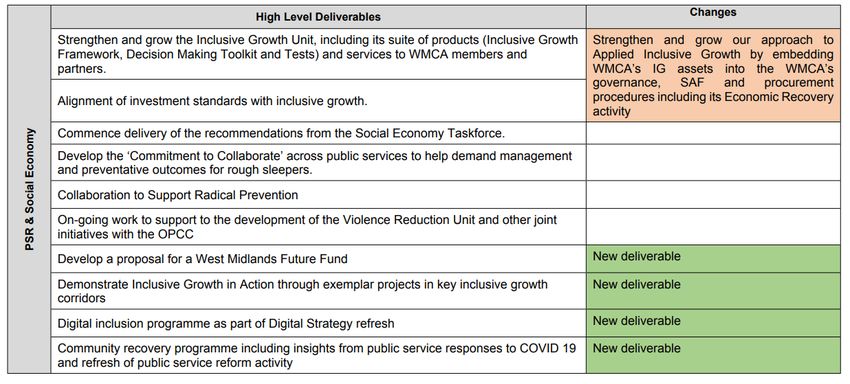
2.5 A review of portfolio deliverables was undertaken, and agreed by the WMCA Board on
18 September 2020 which included an assessment of changes to activity in light of Covid-
19 and the post pandemic recovery context. There were a small number of changes to
deliverables which are summarised in the table below.
2.6 The directorates progress against high level deliverables 2020/21 is largely positive. There
have been some delays to projected completion dates due to the pandemic, where providers
or partners have been directly involved in the pandemic response.
High Level Deliverable Progress to date RAG rating
Strengthen and grow our The framework for an inclusive growth user journey and Green in all
approach to Applied associated microsite has been developed, this is linked to the aspects
Inclusive Growth by corporate refresh of the WMCA website. Internal inclusive
embedding WMCA’s IG growth business partners recruitment process is underway. All
assets into the WMCA’s amendments to SAF process, including FID, SOC and OBC
governance, SAF and incorporated. An IG taskforce is being considered through a
procurement procedures design sprint process to the end of March 2021. All CSR
including its Economic submission’s are being analysed for IG implications. Ongoing
Recovery activity work with WM REDI and cross directorate to use the IG
Framework to establish evaluation framework for economic
recovery programme.
Commence delivery of the Report was published in January 2020, in response to the report Green / Amber
recommendations from the we have commissioned a sector-led business planning process split
Social Economy for the next decade. A first draft has been developed. The report
Taskforce. will be complete for the end of March 2021, but may not be
Page 13published until after the Mayoral election, in line with pre-
election period guidance.
Develop the ‘Commitment The homelessness taskforce launched the commitment to Green / Amber
to Collaborate’ across collaborate concept in June 2020 and commissioned the split
public services to help development of a committiment to collaborate (C2C) toolkit, due
demand management and to the pandemic response completion of the toolkit has been
preventative outcomes for delayed to March 2021, a first draft has been received. Once
rough sleepers. the report is launched pledges will be formaly sought (note that
there are many ‘soft’ commitments already in place and having
an impact).
Collaboration to Support The proposed Radical Health Prevention Fund has been Green
Radical Prevention submitted to DHSC and continues to be developed. Ongoing
developments to support the regions adult social care sector are
progressing, but with some challenges owing to the covid
pandemic.
On-going work to support We have continued to provide practice and ongoing support to Green / Amber
to the development of the the VRU at an executive level, including chairing the regional split
Violence Reduction Unit sports partnership on behalf of the VRU. We continue to support
and other joint initiatives the LCJB and other regional criminal justice forum (including
with the OPCC domestic abuse, violence against women and girls and
reducing reoffending) to link the WMCA programmes and wider
determinants and prevention and early intervention strategies.
The unique research ‘punishing abuse’ has been completed
and a joint policy response agreed both due for publication on
12 March 2021.
Develop a proposal for The initial proposal for West Midlands Future Funds has been Green
West Midlands future drafted will be refined and shared once the WM2041 Five Year
funds Plan and the Social Economy business plan have been signed
off, as it will be aligned to these pieces of work.
Demonstrate Inclusive The partnership in East Birmingham North Solihull is maturing, Green / Amber
Growth in Action through with tangible outputs from sustained partnership and the / Red split
exemplar projects in key application and co-design of inclusive growth programmes and
inclusive growth corridors tools. An initial 'art of the possible' report for a further corridor is
underway. Further work with Sandwell MBC is being scheduled,
alongside supporting the area's Community Wealth & Economic
Resilience Board.
One target for this year was to establish an IG corridors board
which has not yet been completed, terms of reference have bee
drafted and are being considered.
We had also planned to deliver relevant exemplar projects in
each: zero carbon and affordable homes, better connectivity,
jobs and skills opportunities, procurement, public service
reform, etc. Kingshurst is underway, involving low carbon
affordable homes and reconfigured health services. Various
opportunities in line with East Birmingham's IG strategy, but
delivery programme for Y1 is still being shaped.
Digital inclusion Following an initial scoping exercise the West Midlands Digital Green / Amber
programme as part of Roadmap was unveiled at Venturefest West Midlands in split
Digital Strategy refresh February 2021 and states its first mission as securing access
for everyone to digital opportunities, particularly those in poverty
with digital inclusion woven into each of the remaining four
missions.
The Coalition for digital incusion launched on 22 January 2021
and is developing its acion plan.
Community recovery Levelling up the West Midlands: A roadmap for community Green / Amber
programme including recovery and prospectus to Government was undertaken / Red split
Page 14insights from public service following a collaborative eprocess with a wide range of partners
responses to COVID 19 in November 2020. Further actions have been agreed to
and refresh of public progress key workstreams. Some areas of future collaboration
service reform activity continue to be developed and the process of knitting community
recovery with economic recovery is ongoing.
Three learning from lockdown pieces of research have been
completed addressing the enterprise and innovation in public
services, the social economy and homelessness sectors each
with clear recommendations.
2.7 Our Key achievements in 2020/21
Collaborative development and publication of levelling up the West Midlands: our
roadmap to community recovery and prosectus to government which includes 41
areas of good practice from across the region, 27 shared ambitions for recovery, 29
asks of government and 15 initial areas for future collaboration.
Launch of the coalition for digital inclusion.
Developed a programme of activity on alleviating rough sleeping through Rough
Sleeping Initiative (RSI) funding from MHCLG, adding value to RSI awards at local
level.
Established a £20K spot purchase fund with Royal British Legion to support
veterans at risk of homelessness.
Developing a Commitment to Collaborate Toolkit to support partners across the
region in designing out homelessness.
Through a successful collaboration with Solihull MBC, building an inclusive growth
outcomes framework for the Kingshurst redevelopment, and supported the council in
applying it to decisions around the investment.
Supporting East Birmingham Board in shaping its inclusive growth strategy, the
collaborative governance around its delivery, and in building its first delivery plan.
Developed rich insight from civil society, public services and a range of partners into
the incredible innovation, enterprise and flexibility undertaken during the pandemic.
Working with a social economy consortium to build a business plan for doubling the
size of the social economy in a decade, as per the recommendations of the
independent Social Economy Taskforce.
A joint policy response in partnership with the OPCC and local authorities to the
research ‘punishing abuse’ led by the WMCA in partnership with the OPCC and
LA’s. abuse
3. Proposed high level Deliverables for 2021/22
3.1 As we progress into 2021/22 the directorate is developing its programme of work using a
theory of change aligned to a social innovation spiral. In order to achieve our core mission
of creating a ‘fairer, greener, healthier’ West Midlands we will maximise our opportunities
to enable, influence and delivery system change using the following steps;
1. Identifying need, opportunities & challenges - Build a picture from data and
insight, including from citizens and 'experts by experience
2. Generating ideas and the space for collaborative endeavour – workshops,
mapping, reports, learning from elsewhere
3. Bringing system partners together – forming partnerships, working groups
etc.
Page 154. Developing & testing – prototypes, trials – failing quickly and sharing lessons
5. Making the case – developing business cases, attracting funding, devolution,
clarifying outcomes, benchmarks etc.
6. Delivering & implementing – including risk & reward sharing
7. Growing & scaling – breaking down silos as system collaboration strengthens
8. Changing systems –emboldening local leadership and strengthening case for
further devolution
Different aspects of our directorate wil be at different stages of the continuum and we will
learn and grow with our partners.
3.2 Our proposed High levels Deliverables (subject to budget approval) for 2021/22 are
below. We will table an update on impact and progress against each deliverable, along
with partners involved at every future PSR Board meeting.
High Level Deliverable* Activity
PSR01 Add value to the work of our LAs through regional homelessness
programmes
Facilitation of the Contribute to ongoing public service reform and inclusive growth
Homelessness Taskforce to through encouraging a systemic approach to designing out
develop, co-ordinate and homelessness across all WMCA strategies and programmes
embed a regional approach to Support public services to develop a voluntary commitment to
designing-out homelessness collaborate to prevent and relieve homelessness in all its forms
PSR02 Provide oversight for WM Housing First Pilot
Commissioning and delivery of Rough Sleepers Initiative
Commission and provide programme
oversight for grant-funded Commission 2 research projects on Housing First and Families in
homelessness programmes Temporary Accommodation
Secure funding for future programmes
PSR03 Bring together partners in a coalition to support digital inclusion
Engage with Govt with a single, amplified voice to secure further
Community Recovery Project resource
A: Improve digital inclusion in Share and disseminate best practice
the region through partnerships Provide data and evidence to inform approach
with Local Authorities and Civil
Society Organisations
PSR04 Details to be developed depending on local authority prioritisation
Facilitate collaborative
project/programme B identified
through Community Recovery
process
PSR05 Research into costs of key areas of ‘failure demand’ on the system
Analysis of merits of life-course approach
Research and analysis around Good practice cases studies
early intervention and Report setting out findings and ideas for intervention
prevention in the West Action planning and/or business case development
Midlands
Page 16PSR06 Further exploration of mechanisms including SIB projects; WM
Future Fund; VCS Community Recovery Fund; RHPF
Unlock investment in an area Business case development around most likely proposition
of public service reform Engage with partners and government to secure investment
through at least one social Support delivery as appropriate
investment innovation
High Level Deliverable* Activity
IG01 Development and roll-out of IG Business Partners programme
Development of guidance to support Single Assurance Framework
Embedding inclusive growth
procees
within the WMCA and its
Development of IG ‘user journey ‘microsite’
partners
Exemplar case studies for key investment cases
IG02 Establish IG Taskforce and develop initial forward plan
Carry out initial Taskforce ‘inquiry’
Develop and support Inclusive Produce two half-yearly inclusive growth monitor reports
Growth Taskforce and IG
monitoring and evaluation
IG03 Work to develop East Birmingham Rapid Response Unit building on
EBB strategy
Support local authorities and Further work with SMBC around Kingshurst regeneration
their partners with 3 local Explore further opportunities – Chelmsley Wood, Black Country
Inclusive-Growth-In-Action
initiatives
IG04 Publish the Social Economy Business Plan
Support relevant actions and partners
Unlock investment and co- Seek investment in key elements
ordinate delivery to drive
forward the Social Economy
Business Plan
IG05 SUBJECT TO ADDITIONAL FUNDING
Develop and support Inclusive
Growth Corridors Board
4. Financial Implications
4.1 The WMCA budget agreed in February has been built around these draft High Level
Deliverables. There are no other direct spend or budgetary implications as a result of the
recommendations within this report.
5. Legal Implications
5.1 It is a statutory requirement that the Combined Authority has an assurance framework in
place. The assurance framework approved by the WMCA Board on 24 July 2020
Page 17stipulates the requirement of the Public Service Reform Board to approve and monitor
the deliverables of the portfolio.
6. Equalities Implications to update
6.1 The composition of the Thematic Boards and other governance structures of the WMCA
normally reflect the composition of the political leadership in constituent local authorities.
To this extent, at the current time, they do not reflect the full diversity of the West Midlands
region and decision-making might be skewed by unconscious bias. Where there is scope
for local authorities to consider diversifying who might represent them on such Boards
this could be considered and where there is scope for the Thematic Board to consider co-
opting non-voting members on the grounds of their gender or protected characteristics
then this too could be considered.
7. Inclusive Growth Implications
7.1 This paper sets out plans to lead the WMCA’s approach to Inclusive Growth in 2021/22
and the good progress that has been made in the current financial year.
8. Geographical Area of Report’s Implications
8.1 The work of the Public Service Reform Board applies to relevant activity across both
Constituent and Non-constituent areas.
9. Other Implications
9.1 None.
10. Schedule of Background Papers
10.1 None.
11. Appendices
Page 18You can also read


