Quality Corridors - Property Improvement Fund (PIF) - Blackpool Council
←
→
Page content transcription
If your browser does not render page correctly, please read the page content below

Quality Corridors -
Property Improvement Fund (PIF)
Guidance for Applicants
Version 1: 20/02/18

How do I apply or find out more?
Please contact Deborah Makin, Quality Corridors Grant Officer, who will
provide you with further information and guidance on how to apply,
on 01253 477147 or via email info@blackpoolunlimited.com

Please visit www.blackpool.gov.uk/PIF
for full terms and conditions.

Quality Corridors -
Property Improvement Fund (PIF)
Contents

1.    Introduction                                          01

2.    Design Principles & Project Management                03

3.    The Grant Application/Approval Process                04

4.    Grant Payments                                        06

5.    State Aid                                             07

6.    Business Support                                      08

7.    Key Contacts                                          09

Appendix A - Single property process chart                  10

Appendix B - Pre designed block improvement process chart   11

Appendix C - Eligibility of works                           12
Quality Corridors -
Property Improvement Fund (PIF)
1. Introduction

1.1 What Is The Quality Corridors Project?                   1.2 Which Buildings Are Eligible For Grant
The aim of the Quality Corridors Project is to encourage     Aid?
the economic revitalisation of Blackpool town centre         This grant aided scheme focuses on assisting commercial
through a programme of highways, public realm and            properties with a frontage onto areas of planned public
building improvement schemes. The programme is jointly       realm and highways improvements funded by the Quality
funded by the Lancashire Enterprise Partnership (LEP)        Corridors scheme.
and Blackpool Council and is administered by the Council.
Funding has been agreed to support projects until 2020.      Eligible properties have already been externally assessed
                                                             visually to establish the capacity of the project to deliver
There are two distinct elements to the project, the first    improvements across the area on an equitable basis.
and largest being improvements to the highways network
in the town centre. This element will renew road surfaces,   Particular priority will be placed on achieving property
improve paving and pedestrian access across the town         improvements in Church Street, Edward Street,
centre and improve traffic flow. There may also be an        Deansgate, Topping Street and Talbot Road. Applications
element of public art and green infrastructure.              to improve properties in other areas of investment falling
                                                             within this project (i.e. Cookson Street, Caunce Street and
The second element, focused on building improvements         Dickson Road) may still be considered on a case by case
will offer improvement grants to business premises in        basis, subject to the quality of the investment proposal
defined areas within the scheme. Up to £1million is          and available grant budget.
available with grants of up to 95% considered for schemes
that preserve and enhance the quality and character of       Eligible businesses will be those which provide a positive
the town centre through the repair and refurbishment of      contribution to the economic benefit of the surrounding
buildings. The Fund will be available until March 2020.      area. The project will not support properties to be
                                                             used for gambling, high interest loan providers or low
The Quality Corridors project represents a key               value alcohol or cigarette shops or any other use that is
partnership initiative in the Council’s economic             detrimental to the surrounding area.
regeneration strategy for Blackpool. It builds upon
positive changes achieved through previous regeneration      Map 1 overleaf shows the extent of the Quality Corridors
projects such as the Townscape Heritage Initiative           Investment Area (marked in blue) and priority streets for
(2005-2009), the purchase and continuing refurbishment       commercial property improvement (cross hatched area).
of Blackpool Winter Gardens (started 2010) and the
Talbot Gateway Phase I work (2012-2014). The project is
designed to complement other development schemes
currently in the pipeline, including the Tramway Extension
(starting 2018) and Talbot Gateway Phase II (2018+).

The contribution, imagination and enthusiasm of local
businesses and property owners will be vital in maximising
the potential of the scheme to achieve both essential and
aesthetic property improvements, and an improved range
of quality sustainable businesses in the town centre.

Guidance for Applicants                                                                                                     1
Quality Corridors -
Property Improvement Fund (PIF)
1.3 What Type Of Work Is Eligible? 2. Design Principles & Project
In order to qualify for grant assistance, a comprehensive
scheme for your building will need to be developed in Management
conjunction with the Quality Corridors Grant Officer. The
type of work that will be considered for grant assistance
2.1 Design Quality & the Historic Built
includes the following:
Environment
• Shopfront and upper floor repairs It is essential that all schemes are of the highest possible
• Some structural repairs quality in terms of design, materials and methods
• Some structural timber repairs of repair. This covers matters such as submission
• Re-roofing, including repairs to chimneys, requirements, appropriate materials and workmanship as
lead-work and rainwater goods well as architectural, signage and lighting design.
• Brickwork and stonework repair and re-pointing All work must be undertaken with respect for the
• Render repairs and re-rendering character and integrity of the building or structure and of
• Joinery repairs the area in which it lies, in accordance with the relevant
national and Local Plan policies.
• Specialist treatments
Single Property
For more detailed information on eligible and non-
If the Project Board agrees that an applicant can progress
eligible works, see Appendix C.
its application for grant as a standalone property then it
will be the applicant’s responsibility to submit designs and
1.4 How Much Grant Is Available? plans along with detailed costs/quotes (at full application
The precise grant award will be dependent on your stage – see 3.1). The applicant will be responsible for
detailed costed schedule of works 1 that will need to project managing all aspects of approved works, and
be prepared as part of a scheme submission. These will client-contractor relationship, together with grant claims to
enable potential eligible works to be assessed in terms of Blackpool Council. The applicant may wish to seek quotes
meeting the grant award criteria (eligible spend) and in from the Council’s appointed contractor previously assessed
delivering value for money for you and the scheme. as being suitably qualified.
In addition to an assessment of the property Pre Designed Improvement
improvement, taking into account the complexity of Some streets have been identified as having the potential
repairs or extent of work required, a further assessment for improvement against a common design theme; in this
will be made of the additional economic benefits instance the Council will provide a basic design which
generated by the investment including vacant properties will be used as a basis for discussion with applicants
and space brought back into use, and jobs created or to understand individual requirements. The Council
safeguarded. will project manage the scheme using our preferred
contractor who has demonstrated competences in
dealing with this type of project. In this scenario, there
1.5. Who Gives The Approval? will be some upfront costs to engage with property
The Quality Corridors Project Board 2 will review each professionals. These costs will be the responsibility of the
case presented by the Grant Officer, and decide how applicant but can become part of the grant claim if your
much grant to award. Levels of award are discretionary application is successful.
and all applications will be decided on their merits. The
In most cases, a photographic and written record of the
Board’s decision will be final and there is no appeal
building or structure will be made by the grant officer as
procedure.
work commences to offset any dilapidations or damage
claims.
1 Schedule of Works (SOW) = a list of proposed improvements to the property together with associated costs. See template to complete at full application stage.
2 The QCPB consists of senior Council officers from transport, planning, economic development, procurement, legal and finance departments.
Guidance for Applicants 3Quality Corridors -
Property Improvement Fund (PIF)
Incorporating your business ambitions within the scheme ensure that all works are completed satisfactorily and
will be an important part of creating something that in accordance with approved plans. Payment of agreed
works for you. The grant officer will discuss the design contracted works and grant claims will differ for this
with you and advise how your ideas and needs might be scheme (see section 4 for details).
incorporated into the project.
The Quality Corridors Grant Officer will offer advice
regarding all the above processes.
2.2 Shop Fronts
Most buildings within the scheme area have shop fronts
at ground floor level. Repairs to and replacement of shop 3. The Grant Application/
fronts will form the vast majority of eligible schemes. Approval Process
Where traditional shop fronts have been replaced with
plastic or other inappropriate materials, the new shop
front will need to be constructed to traditional design as 3.1 How Do I Apply For A Grant?
closely as possible in terms of its form and proportions
In order to apply for grant you must have a freehold
in line with Council guidance. Where evidence as to the
interest in the property or an un-expired lease of at least
appearance of the original shop front is unavailable, it will
five years (evidence of the lease terms and period will be
be acceptable to install a shop front that is appropriately
required to be submitted along with the written consent
designed and proportioned to correspond with the period
of the landlord for proposed works at the full application
property to which it is attached.
stage).
For examples of other shopfronts the Council has
There are two applications stages – a simple expression
funded in this way, you can look at those created by the
of interest to check eligibility, and a more detailed full
Townscape Heritage Initiative on Cedar Square which
application stage leading to a grant decision.
demonstrates how traditional materials can be used in
different ways to deliver individual business requirements. 1. Expression of Interest (EOI) stage– where you can
There is likely to be more leeway on design and materials complete some basic details about you, your property,
in the Quality Corridors scheme as it is intended to be property ownership and your basic ambition for your
an economic catalyst but these buildings offer good property and end use. This will trigger contact from
examples of how the scheme is likely to look. the Grant Officer who will come and visit you and
advise you on your eligibility for grant, and the details
2.3 How Will My Project Be Managed? that are needed to submit a full application and gain
approval. You will also be able to indicate if you prefer
All projects will be administered and monitored by the to progress a single property application or participate
Quality Corridors Grant Officer, who will report progress in a pre-designed scheme, although the ultimate
to the Quality Corridors Project Board. decision rests with the Council.
Single Property
The applicant will be responsible for securing necessary If your property falls within a pre-designed
consents (see 3.2 ) and for ensuring the approved improvement area, you will be sent outline designs for
works are delivered within the timeframe of the funding, your property and other relevant guidance.
including paying of contractors, and making grant claims 2. Full Application Stage – you will need to supply a
in arrears (see 3.11 for details). checklist of documents as detailed by the grant officer.
Pre Designed Improvement This is likely to include as a minimum :-
If you elect to, or are directed to participate in a pre- a. A schedule of proposed works.
designed improvement scheme (see 2.1 above) you will
work with Council officers and pre-vetted contractors b. Three quotes on the proposed works – see section
chosen specifically for the Quality Corridors project 3.3. on how to seek quotes.
helping keep delays and costs to a minimum.
c. Evidence of ownership/leasehold (of at least five
Once appointed, day to day supervision of the contractor years).
will be undertaken by the Council’s Project Manager to
Guidance for Applicants 4Quality Corridors -
Property Improvement Fund (PIF)
d. Written confirmation from the property owner that • Building Regulations
works can commence. You will need to check whether building regulation
approval is required for your scheme.
e. Confirmation that any statutory permissions have
• Licensing
been granted or are being sought (as previously
If you are applying for a change of use this may
advised by the grant officer).
require a license for the proposed use if this
PLEASE NOTE: you must complete an Expression of includes alcohol, food and entertainment.
Interest (EOI) form prior to a full application. See section 6 for useful contacts.
All forms can be downloaded from:
www.blackpool.gov.uk/PIF 3.3 Quotes
Single Property
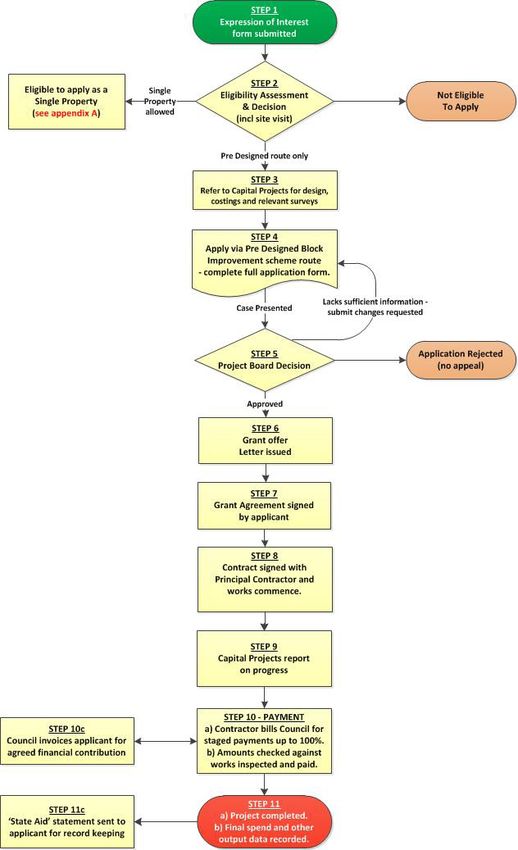
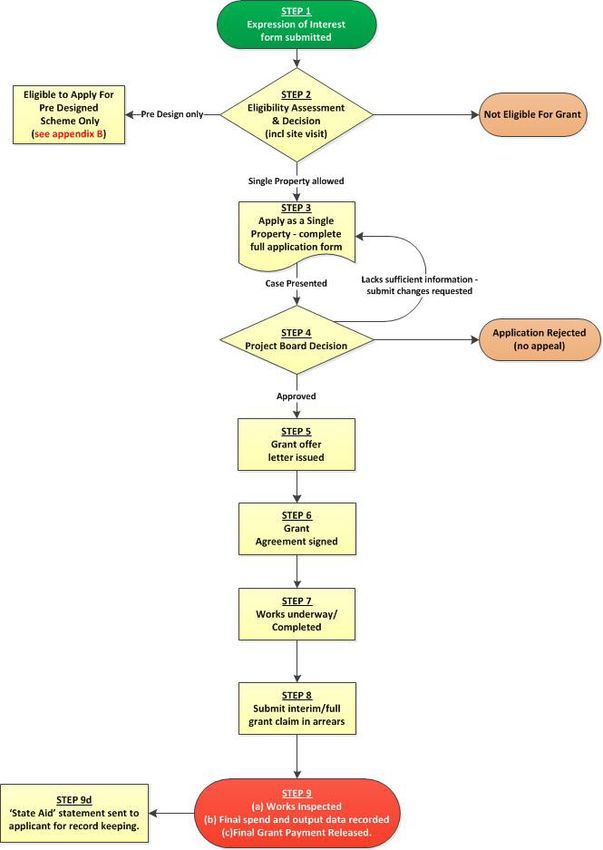
Simplified charts illustrating the grant application and
Three quotes will be needed for proposed works, either
assessment process are provided at Appendices A and B.
as a single contractor quote for completed works e.g.
Once your eligibility has been confirmed and you are clear replacement of a shop front, or works requiring more than
about which grant opportunity you can apply for (single one contractor e.g. shop front, plus brickwork repairs,
or pre-designed) you will be briefed by the grant officer plus roof repairs quoted for separately. Grant will be
on what is required at the full application stage, including paid against the lowest quotes irrespective of which
further planning and supporting documentation. contractor is appointed i.e. if contractor A quotes £1,000
and B £1,200, and you choose B, you will only receive
Structural Surveys grant towards A.
Depending on your building and the type of work
proposed, you might need to have a structural or Careful consideration will need to be given to the form of
specialist survey carried out. You will need to submit this contract entered into as grant levels will not normally be
with your application in order that a full assessment can increased to cover any un-foreseen cost arising once work
be made of the scope of the repair/improvement works commences.
required and to ensure that works carried out with grant
Pre Designed Improvement
money would not be undermined by a serious problem
Following the agreement of the applicant and Project
with the building. Grant assistance towards the cost of
Board to an agreed design and schedule of works,
the survey will usually be available.
including the successful outcome of any consent
applications, the Council’s procured contractor will be
3.2 Statutory Consents commissioned to complete the work.
The applicant is likely to need at least one or more of The level of grant assistance available towards a
the following statutory consents before schemes can be scheme cannot be confirmed until fully itemised
considered for grant approval: quotes are obtained. The applicant is responsible for
• Planning Permission paying for any works that have not been approved, or
Most building work to commercial properties unforeseen additional costs.
will require planning approval.
• Advertisement Consent 3.4 Additional Work
This may be required for any new You may be thinking of further internal works that are
fascia or hanging sign. outside the scope of the grant award criteria. You are
• Conservation Area Consent welcome to discuss your requirements with the Council’s
Conservation Area Consent may be required contractor but any such work must have a separate
for the demolition of buildings or structures. schedule of works to ensure such works do not undermine
This is now normally rolled up with planning or duplicate any grant supported work.
consent, but it is worth checking what
extra information might be required. The Council operates a Business Loan Fund that may be
able to assist towards the cost of internal or external works,
subject to the requirements of this scheme. Please contact
the Grant Officer in the first instance if this is of interest.
Guidance for Applicants 5Quality Corridors -
Property Improvement Fund (PIF)
3.5 Grant Assessment 4. Grant Payments
Once the above information has been submitted, the
grant officer will assess your application to ensure your
scheme meets the required standard to present a case 4.1 Payment Process
to the Quality Corridors Project Board. The Board will
decide the maximum amount of grant the Council is Grant payments will be processed as follows:
willing to provide for your scheme and the Grant Officer
Single Property
will inform you of the decision and offer.
You will be required to complete a grant claim form
setting out the work that has been completed, costs
3.6 Grant Offer Letter and Contract and any outputs achieved. Any grant-aided work
If your grant application is approved, you will receive a will be checked by the Quality Corridors grant officer
formal offer of grant in the form of a grant offer letter for compliance against works approved in the grant
(offering the grant in principle), once the offer has been agreement. If all work has been completed to the agreed
accepted a grant agreement will be issued which you will standard and all conditions met then you will be paid
be required to sign and return a copy to the grant officer. according to the terms laid out in your grant offer letter.
This then forms an agreement between yourself and the No grant will be paid out until payment evidence has
Council. No grant-aided work can start until the grant been supplied (invoices and bank statements showing
officer has received a signed copy of the agreement. funds paid out). Please note: cash payments are not
There will be a time limit for you to implement your works acceptable even if receipts are provided. Evidence
or your grant offer may be withdrawn. will also be required to demonstrate progress of other
outputs. For example, copies of employee contracts may
3.7 Conditions be necessary to prove the number of established jobs.
A number of conditions will be attached to the grant. It may be possible to make interim payments at
Some of these will be standard conditions and some will agreed stages of work for larger scale projects on the
be specific to a project. The grant will only be paid as and recommendation of the grant officer.
when all conditions have been certified as having been
fully complied with. Grant payments will be made to business/organisation
bank accounts via BACS. You will be asked to confirm
your account details when you authorize and return the
3.8 Work On Site grant offer letter. The bank account details should be the
The Grant Officer will monitor work on site as it same as the applicant organisation (and will not be paid
progresses, but the appointed contractor will be to personal accounts).
responsible for day to day project management. You will
need to ensure that the contractor provides access to the Pre Designed Improvement
site for monitoring and inspection by Council officers as The Council will pay the appointed contractor direct for
required. completed external works that have been grant aided (as
detailed in the grant offer letter).
3.9 Health And Safety Any agreed financial contributions from the applicant
towards grant-aided elements will be invoiced at the end
Depending on the type of work proposed you might need
of the project once the works have been reviewed by
to obtain a Health and Safety statement. This should be
both the Council and applicant. This will be a percentage
submitted along with your application and include details
of costs to an agreed limit.
of the approximate dates when the difficult elements
of the work are programmed, any scaffolding required
or disruption/closure to the highway which will result,
etc. For pre-designed schemes this requirement will be
managed for you by the Council/contractor as part of our
support.
Guidance for Applicants 6Quality Corridors -
Property Improvement Fund (PIF)
For example, if the Council agrees to award a grant of 5.1. De Minimis Aid
75% towards a £100,000 project, the Council will pay
the contractor in full and invoice the applicant for 25% Please note grant awarded under this scheme is regarded
upon completion. If the final bill is less than anticipated as state aid and will comply with limits set out in the
then the applicant will still have to pay 25% of the lesser EU De Minimis aid regulation 3 (one of a number of aid
amount. regulations).
Any additional works, agreed between the applicant and • There is a ceiling of €200,000 for all De Minimis aid
the contractor which fall outside of agreed grant aided provided to any one organisation over a three year
work, will be the direct responsibility of the applicant to fiscal period i.e. current and previous two fiscal years.
arrange payment to the contractor. • You will need to advise us of any other De
Minimis aid you have received during this
period so that our support does not exceed
4.2. Clawback the threshold of €200,000 (approx. £184,000,
All grants will be subject to claw-back rules, which may subject to exchange rate fluctuations).
require repayment of the grant if the property is sold or • Any De Minimis aid provided to you under
if the grant aided works are removed or reversed within a this scheme will contribute to the amount
specified period. For grants up to £30,000, this condition of De Minimis aid you have received.
will apply for three years from the acceptance of grant.
• You will need to declare this amount to any other
For grants between £30,000 and £60,000 this condition
awarding body who requests information from you
will apply for five years and for grants of £60,000 to
on how much De Minimis aid you have received.
£100,000 will apply for ten years.
• Upon financial completion of your project you will
Please note, grants are awarded to an individual property be provided with a letter setting out the amount of
rather than a business or owner. The grant offer will be state aid you have received. For the purposes of the
conditioned so that you cannot take any of the grant De Minimis regulation, you must retain information
funded building fixtures with you if you move. on any aid granted for ten years from the date
aid is granted and produce it on request by UK
public authorities or the European Commission.
5. State Aid
Normally public funders will provide applicants with a
grant offer stating the amount of grant to be awarded as
State aid is any advantage granted by public authorities well as an end of scheme statement as to the value of the
through state resources on a selective basis to any state aid actually provided. This is not always the case
organisations that could potentially distort competition and therefore the responsibility rests with the applicant
and trade in the European Union (EU). to declare any support previously received, and if in doubt
declare any potential support you have received that
The definition of state aid is very broad because ‘an
could be regarded as state aid. The Grant Officer will
advantage’ can take many forms. It is anything which
then review the total amount and may request further
an undertaking (an organisation engaged in economic
information to ascertain whether it has been awarded
activity) could not get on the open market. State aid
under De Minimis or another aid regulation (thus freeing
rules can (among other things) apply to grants, loans,
up the amount of De Minimis aid that could be awarded).
tax breaks, or any subsidised support such as training,
consultancy, marketing advice, where it is less than
market price.
The rules can apply to funding given to charities, public
authorities and other non-profit making bodies where
they are involved in commercial activities.
3 EC Regulation 1407/2013 (De Minimis Aid Regulation) as published in the Official Journal of the European Union 24 December 2013
Guidance for Applicants 7Quality Corridors -
Property Improvement Fund (PIF)
6. Business Support
6.1. What Other Support Is Available? d. Skills Training – the Council works with a number of
agencies and training providers who may be able
Blackpool Council’s Business Support Team may be able to offer free or subsidised support to address your
to broker additional in-house or external support for your training needs, including pre-recruitment training.
business, such as:-
e. For general information why not keep up to date with
a. Business Support – we have dedicated business the ever changing nature of business support, news
advisors who can help new and young businesses and views by registering with Blackpool’s free business
with a range of advice and training such as business portal blackpoolunlimited.com
planning, marketing and social media. This may apply
to you or businesses occupying your premises and is a
unique and free offer.
To access this support, see contacts below.
b. Blackpool Business Loans Fund – if your ambition is to Your grant officer will be able to assist you.
invest more widely in your commercial property within
the Quality Corridors area you may wish to apply for a
business loan.
c. Recruitment support - a range of support for your
company if you are looking to hire new staff, or maybe
try before you recruit by offering a work placement? If
you are looking to recruit or convert existing posts into
an apprenticeship we can put you in touch with key
agencies that will be able to assist you.
Guidance for Applicants 8Quality Corridors -
Property Improvement Fund (PIF)
7. Key Contacts
Deborah Makin Finding an Agent, Architect or Architectural Technologist
Quality Corridors Grant Officer
You may wish to appoint a suitably qualified professional
Office: (01253) 477147 to assist you in the preparation of your application or in
Mobile: (07469) 038553 the delivery phase of your property project. Such costs
are eligible.
Business Support Team
Blackpool Council There is no requirement to engage an architect, chartered
Blackpool Enterprise Centre architectural technologist or a planning agent if you are
Lytham Road competent to do the work yourself.
Blackpool FY4 1EW
You may also need the assistance of a building surveyor
Email: info@blackpoolunlimited.com to inspect your property and help you assemble a
Web: https://blackpoolunlimited.com/qualitycorridors schedule of proposed works.
However if you do engage one of the above professionals
you may achieve a more satisfactory result for the
Blackpool Council considerable outlay of time and money that you are
undertaking.
Planning:
applications, planning and conservation advice, general Architects have to be registered with the Architects
enquiries (Development Management). Registration Board who ensures that they have the
T: (01253) 476225 necessary educational qualifications and practical
E: planning@blackpool.gov.uk experience and are registered as architects.
Building Control: The Chartered Institute of Architectural Technologists
for building regulation applications. (CIAT) is another professional body, for design
T: (01253) 476219 professionals.
E: building.control@blackpool.gov.uk
The Royal Town Planning Institute oversees planning
Licensing: professionals who are trained in the planning process,
if your business is to be used to supply alcohol, provide and may in turn appoint architects or architectural
entertainment, or provide late night refreshment, such as technologists for parts of the work.
hot food and hot drinks.
There are also agents who will complete an application for
T: (01253) 478397 you however it is important that you assess qualifications
E: licensing@blackpool.gov.uk and experience of anyone who you are considering
employing.
Other business support:
access to finance, recruitment, training and general Building and other surveyors will be registered with The
business advice and growth support. Royal Institute of Chartered Surveyors (RICS).
T: (01253) 477147
E: info@blackpoolunlimited.com We are unable to recommend any particular person or
practice so please use the links above or alternatively
utilise the project frameworks as detailed in section 2.3.
Guidance for Applicants 9Appendix A: Single Property – Process Chart Guidance for Applicants 10
Appendix B: Pre Designed Block Improvement –

Guidance for Applicants                        11
Quality Corridors -
Property Improvement Fund (PIF)
Appendix C: Eligibility of Works

Eligible Categories of Work and Costs                         Repairs should be comprehensive in scope, using
                                                              appropriate techniques or methods of construction and
General Principals                                            high quality natural or traditional materials, normally on
Some areas of the building intervention element for           a like-for-like basis except where poor quality materials
the Quality Corridors project lies within the Town            (plastics or synthetics have been used). Substitute or
Centre Conservation Area. As such all work must be            artificial materials (things like plastics and powder coated
undertaken with respect for the character and integrity       metals) are ineligible and their use generally unacceptable
of conservation area and work should be appropriate in        on grant-aided projects.
terms of materials and design. The Council has a range        Repairs may include:
of published guidance on which the outline designs for
improvement have been based.                                  • Preparatory inspection is eligible including
                                                                appointment of building surveyors and erection of
Quotes will only be invited from contractors known to           scaffolding/use of cherry picker or similar for high
be able to achieve the standards of quality required            level inspection. This is in support of developing
and who are preferably VAT registered. In exceptional           a credible schedule of works and will only be
circumstances, for specialist trades, quotes may be invited     reclaimable if a full application is approved.
from non VAT registered companies. The Council reserves
                                                              • Consolidation or reinforcement of the existing
the right to check business references or nominate
                                                                structure, using the most conservative approach
subcontractors. The Council will procure a nominated
                                                                that is practicable, although limited reconstruction
contractor which can be utilized by applicants following
                                                                as existing is eligible if unavoidable.
the single property route. This scheme does not allow
for the applicant to appoint contractors who have not         • Appropriate repairs to timber frames, roof
demonstrated the relevant competencies and who have             structure, beams, floor joists and other
not been through a formal value for money tendering             structural timbers, based on a careful and
process.                                                        comprehensive survey of the existing structure.
                                                              • Dry rot eradication and timber preservative
Grant funding will not be paid for work that, in the            treatments, preferably based on an analysis
reasonable opinion of the conservation officer, does not        and specification by an independent
meet generally accepted standards of quality in materials       consultant (whose fees are also eligible), and
or workmanship appropriate to the circumstances,                using non-destructive techniques and non-
whether in conservation work or new construction.               toxic applications wherever possible.
The following categories of work and costs will attract       • Damp-proofing by traditional methods, but
grant assistance under the Quality Corridors grant              only where damp is causing structural damage
scheme.                                                         to the building. Damp-eradication measures,
                                                                such as improved drainage, the introduction
1. Building Repair                                              of French drains, or the lowering of ground
                                                                levels, are preferable where practicable.
This includes the structural and external repair of
buildings, which are in use. It can sometimes include         • Re-roofing in materials normally to match the historic
internal repairs, but only if these are necessary               covering, using new materials and/or re-using sound
for structural stability. It does not include routine           existing materials where possible. Repairs to the roof
maintenance, redecoration, or internal repairs alone unless     structure and high level external elements should be
this is needed as a direct result of eligible repair.           undertaken concurrently. Re-roofing with the artificial
                                                                or alternative materials, such as concrete tiles, cement
The objective is to put into sound repair the structure         slates, reconstructed slates, artificial stone slates or
and external envelope of buildings that make a positive         felt will only be eligible where it can be demonstrated
contribution to the character or appearance of the area.        they were used in the original construction and
                                                                are appropriate to the style of the building.

Guidance for Applicants                                                                                                 12
Quality Corridors -
Property Improvement Fund (PIF)
• Repairs to chimneys, including lining or rebuilding • The repair or reinstatement of retaining walls,
if structurally essential, provided that the chimney boundary walls and/or railings, if they contribute to
is reinstated accurately to the correct height the stability of the building, enhance its setting, or
and profile. The retention and repair of existing are of particular interest in the conservation area.
stacks may be a condition of any grant offered. • The removal of asbestos if determined to be
• Repair or renewal of existing leadwork, the present on the exterior of the building.
provision of weatherings, and the reforming of
gutters to adequate falls. GRP (glass reinforced 2. Professional services
plastic) may be considered on more modern Expenditure on fees for qualified professional advisers
buildings but use will be at the discretion of the is eligible for grant provided they belong to one of the
conservation officer within the conservation area. recognised institutions (e.g. RICS) with an appropriate
• The repair or replacement of rainwater level of specialist experience. The involvement of
goods or a rainwater disposal system to a professional advisers is encouraged. Full professional fees
building, to appropriate specifications. for services are only eligible if the professional adviser
• The repair of external stonework and brickwork, inspects the work in progress and is responsible for its
including decorative elements, to an appropriate certification on completion.
specification. Plastic in-situ resin based mortar
repairs to brickwork and stonework are not normally Non-eligible Categories of Work and Costs
acceptable or eligible, except for minor areas.
Non-eligible Work
• Selective rebuilding of existing stonework and
brickwork, if structurally necessary and to an agreed The following works will not attract grant assistance
specification. Generally, this will be using salvaged under the grant scheme they are referred to as “non-
existing materials, and/or new matching materials and eligible works”. Examples of works that are non-eligible
should be preceded by a record survey of the existing. under the terms of the grant scheme are:
Only re-pointing which is structurally necessary,
kept to the absolute minimum required and carried • Minor repairs such as replacing broken window panes
out to an appropriate specification, is eligible. unless they will be replaced by larger areas of work
• The appropriate repair (or if unavoidable, replacement) • Routine maintenance such as fixing a loose
of windows, external doors and other external slate on a roof, clearing debris out of gutters
joinery including fascia boards for signage which -redecoration (unless required as a direct
contributes to the character of the building and/ result of eligible repair or conversion)
or the conservation area. Replacement windows • Internal repairs (unless they are necessary for
in plastic will not normally be considered. structural stability, eligible repairs or conversion)
• Repairs to external render, stucco or harling • The use of substitute or artificial materials
and limited areas of renewal (there should be a
• Signage
presumption against total or substantial renewal,
unless this is unavoidable) to an approved Non-eligible Costs
specification. If such a coating has been removed in
recent years to the detriment of the performance The following project costs will not attract grant
and appearance of the building, its reinstatement assistance under the scheme:
may be the most appropriate form of repair.
• Statutory Fees - e.g. planning applications,
• The external cleaning of stonework and brickwork is advertisement consent, building regulations.
only eligible where there is such a build-up of dirt,
• Internal works are not eligible. These
paint or built-up resin coatings on the surface that
must be funded separately.
it must be removed in order to assess the extent of
necessary repair or where the surface build-up is • Contingencies - unseen extra costs are not covered.
damaging the fabric of the building by chemical action. • Insurance - this remains the owners
Cleaning for cosmetic reasons is therefore never or tenants responsibility.
eligible. Any cleaning which is agreed to be eligible • Interest on any loans taken out to
must be undertaken to an approved specification and fund your building project.
carried out by specialist conservation contractors.
J121823 0218
Guidance for Applicants 13You can also read


