Re-setting the UK - Europe Relationship for the 21st Century - Lucy Powell MP and Robert Halfon MP On behalf of the cross-party Norway Plus Group ...
←
→
Page content transcription
If your browser does not render page correctly, please read the page content below

Re-setting the UK - Europe
Relationship for the 21st Century
Lucy Powell MP and Robert Halfon MP
On behalf of the cross-party Norway Plus Group

About the ‘Norway Plus’ group

The Norway Plus Group is an informal group of MPs who are committed to
overcoming narrow tribal party-political divides, in the national interest.

We don’t have a formal committee structure, and nor do we have any official
designation or legal status. Each weekly meeting is chaired by Nick Boles MP and
Stephen Kinnock MP.

We are simply united by two core beliefs: first that MPs must act to ensure that
the UK does not crash out of the European Union (EU) without a deal, and second
that the Common Market 2.0 proposals which are set out in this document
represent the only form of Brexit that respects the referendum result whilst
protecting the jobs and livelihoods of our constituents.

Lucy Powell MP and Robert Halfon MP have co-authored this pamphlet on behalf
of the Norway Plus Group.

The Norway Plus Group wishes to thank George Peretz QC, Anneli Howard
and Adrian Yalland for the legal expertise, advice and guidance that they have
provided.
Contents

Foreword                                                                 4

Leading the way in a 21st century Common Market                          6

        Respecting the referendum result without wrecking the economy:   6
        why we need Common Market 2.0
        The path to Common Market 2.0                                    7
        A leading role in Europe, outside the EU                         8
        The EU and EFTA countries support our proposals                  8

Common Market 2.0: more control with continued economic access           11

        Common Market 2.0 offers new powers to control immigration       12
        Common Market 2.0 would enhance our national sovereignty         13
        UK payments would reduce significantly                           14
        A negotiated Customs arrangement would mean the Irish backstop   15
        would not need to be activated
        Leading Brexit campaigners supported an EFTA-based Brexit        15
        ahead of the referendum campaign

A prosperous future for the UK                                           17

        Trade                                                            17
        Workers’ rights                                                  17
        Citizenship rights                                               18
        Standards and regulations                                        18
        Participating in EU agencies                                     18
        Environmental                                                    18
        Industry and procurement                                         19
        Digital                                                          19
and trade unions;
Foreword
• Meet Labour’s six tests, and deliver on
The UK is a great country with a deep and Jeremy Corbyn’s call for a customs union
proud history. Yet, one thing most will and a strong Single Market deal.
probably agree on, we aren’t exactly covering • According to the EU’s chief negotiator
ourselves in glory right now. In fact much of Michel Barnier, offer genuinely frictionless
the public feel quite alarmed at the seeming trade with the EU as it is based on a set of
mess we have got ourselves into with Brexit. institutions and procedures that already exist.
Many are fed up to the back teeth of hearing
about all the endless “Groundhog Day” twists Substantively, we also believe our plan meets
and turns. All the while it’s getting worse, the key issues expressed in the referendum
not better, as we head towards the exit door itself and the key stumbling blocks that have
without any agreement over a deliverable plan. emerged since, as well as getting us as close as
possible to “the exact same benefits” offered
What’s more, as things stand, it’s clear that during the referendum.
there isn’t a parliamentary majority for any of
the three main options being discussed: the Our proposal takes as its starting point
Prime Minister’s deal, a no deal or a second the common refrain that we both heard
referendum. from voters in our constituencies during
the referendum campaign: “We voted for a
As MPs at the centre of all this, we feel the Common Market, not all this political stuff.”
same. However, the House of Commons In the 1970s and 1980s, the British people
has the power and the opportunity to do broadly supported our membership of the
something about it. Increasingly, MPs from all European Economic Community (EEC) because
parties are reaching the conclusion that we it delivered clear economic benefits to British
need to put aside tribal, political differences businesses and workers. It was only as the
and accept that every option carries risks and “ever closer political union” took hold, that
no one outcome is anyone’s ideal. people began to turn against it. Common
Market 2.0 offers us a way to recreate that
Today we are coming together to argue for simple economic relationship, which is free of
a Brexit deal that delivers the result of the all the political paraphernalia of the modern EU.
2016 referendum and protects the economic
interests of working people in Manchester, As members of Common Market 2.0, the UK
in Harlow and right across the UK. Our plan would still have to accept the free movement
is based on the principles of “Norway Plus” of workers from other European countries,
and establishes that after the transition, in but we would have new powers to restrict
December 2020, the UK should join a new European migration in certain circumstances if
Common Market for the twenty-first century. our government deems it necessary, because
Let’s call it Common Market 2.0. the European Economic Area (EEA) agreement
gives members the right to unilaterally suspend
Politically, the Common Market 2.0 would: the freedom of movement if it can show that
• Offer Theresa May a last chance of a deal it is having “serious economic, societal or
that can command a cross-party majority environmental difficulties”. In addition, we
and win the support of business leaders believe the government should implement
stricter enforcement of existing requirements
4for European migrants to find work within and a new customs union, and by creating
three months or otherwise demonstrate that certainty with a long-term relationship.
they can support themselves without claiming
2. Guarantee workers’ rights and protections
benefits. Successive governments have failed to
for the long-term as part of Common Market
enforce these rules properly and have let down
membership
the working class communities we represent as
a result. 3. Provide new controls over Free Movement
in certain circumstances when our
In Common Market 2.0, most EU rules would government deems it necessary
not apply to us at all as we would be outside 4. Allow more money for public services as
the common agriculture, fisheries, justice and our contributions to the Common Market 2.0
home affairs policies. UK representatives would would be significantly lower than to the EU, in
sit on the policy-shaping committees that draw fact about half.
up proposals for new Single Market legislation
5. Take the UK out of the (ever closer) political
and we would be able to resist pressure to
union, the Common Fisheries Policy,
implement new rules that we don’t like. EU
Common Agricultural Policy and the ECJ
law would no longer have either “direct effect”
or “direct applicability” in the UK. We would 6. Take back control of budgetary
leave the jurisdiction of the European Court of contributions from the EU and remove the
Justice (ECJ) and join the European Free Trade VAT element.
Association (EFTA) court whose decisions are 7. Not in any way constrain state aid. Norway
non-binding. UK courts would once again be has one of the highest levels of state aid in
supreme. Parliament would be fully sovereign. Europe.
8. Eliminate the need for the Irish backstop
Although we would still need to make a
to be activated because we would move
financial contribution for access to the
seamlessly from the transition period into
Common Market 2.0, the annual amount would
Common Market 2.0
equate to not much more than half the amount
we currently pay. This pamphlet, drafted by wider cross-party
grouping with expert legal advice, sets out,
Finally, as members of both the Single Market for the first time, the significant benefits of a
and a new customs arrangement mirroring the new Common Market 2.0 proposal for the UK
current customs union, there would be no reason when it leaves the EU. We believe this offers
for the Irish backstop ever to be activated after a genuine opportunity to not only command
the end of the transition. The union of Great a majority in Parliament but to bring together
Britain and Northern Ireland, which is precious the country around the UK leaving the EU but
to both of us, would remain intact and the creating a new, powerful Common Market
foundations of peace in Northern Ireland as set partnership with it for the long-term. Delivering
out in the Good Friday Agreement preserved in Brexit in a way that protects the economic
perpetuity. interest of the working people we represent
will require all of us to compromise. We both
In summary, the Common Market 2.0 would: believe that leaving the EU and joining a
Common Market 2.0 is a compromise that MPs
1. Safeguard jobs by offering real frictionless of all parties, and all shades of opinion, should
trade through full access to the Single Market be able to support.
51. Leading the way in a 21st century Common Market
Respecting the referendum result without wrecking the economy:
why we need Common Market 2.0
In 1973 the UK joined the EEC – otherwise The 52% to 48% margin of victory does not
known as the Common Market - a decision that represent a mandate to remain in the EU and
was subsequently supported by a public vote carry on with business as usual. But neither is
in 1975. Yet in 2016, 17.4 million people voted it a call for a hard Canada-style Brexit, nor for
to leave the EEC’s successor – the EU. So, what leaving without a deal. We must leave the EU,
changed between 1975 and 2016? but that does not mean we cannot negotiate
a continued relationship with the EU – based
The answer is clear: the British people’s on the principles of the Common Market 2.0 –
support for the UK’s relationship with the EU that will secure a close economic and trading
eroded, post-Maastricht. The EEC’s Common relationship.
Market was popular amongst the British public,
but the project of political integration advanced The democratic will of the 52% must not
by the Maastricht Treaty in 1992 caused our be ignored, and the EU referendum should
paths to diverge. Between 1992 and 1995 UK therefore be seen as a reset moment for the
public support for strengthening our country’s UK’s relationship with the EU.
relationship with Europe dropped from 38%
to 14% and never recovered. Support to leave A newly formed UK-EU Common Market for the
the EU or weaken the relationship rocketed 21st century would reflect the strong economic
to over 50%. The events that followed – Tony ties between the UK and Europe that enjoyed
Blair’s 2004 decision that the UK should accept broad democratic support throughout the
free movement of people from the so-called 1970s and 1980s, respecting the public desire
accession eight (Czech Republic, Estonia, for striking the right balance between political
Hungary, Latvia, Lithuania, Poland, Slovakia, sovereignty and economic integration. It would
Slovenia) without a transition period, then later recast our country’s relationship with the EU
the Eurozone and refugee crises – only served in a way that would better reflect our history,
to heighten concern about the UK’s place in the geography and politics.
European project.1
The cross-party group ‘Norway Plus’ is
The 2016 referendum was a call for the UK therefore advocating that the UK leaves the EU
to leave the EU and its project of ever-deeper and its political institutions in order to develop
political integration. But the 52%/48% result “Common Market 2.0” – a Brexit that respects
is also a call to maintain a strong, close and the referendum result, protects the jobs and
productive economic relationship with those livelihoods of our constituents, and begins to
500 million consumers on our doorstep. In reunite our deeply divided country.
short, the referendum result is an instruction
to move house whilst remaining in the same
neighbourhood.
1
Matthew Goodwin, Brexit Britain: The Causes and Consequences of the Leave Vote, http://www.matthewjgoodwin.org/uploads/6/4/0/2/64026337/leave_vote_lecture.pdf
6ending in December 2020 – the UK would join
The path to Common
the EEA via the EFTA pillar, sitting alongside the
Market 2.0 “EEA3” of Norway, Iceland, and Lichtenstein.
Under the plan, the UK would leave the EU EFTA is an intergovernmental organisation that
on 29 March 2019. We would leave under the promotes free trade and economic integration
current terms of the Withdrawal Agreement, without political or monetary union. It was
but with a significantly reworked Political founded in 1960. The UK was a founder
Declaration. A more detailed and specific member until it joined the EEC in 1973.
Political Declaration would outline the future
relationship between the UK and the EU after The EEA Single Market is the extension of
the transition period. We would also seek to the EU’s Internal Market to cover the EEA3
agree a side letter with the EU agreeing that (Switzerland has its own bilateral deal with the
all efforts would be made to deliver the future EU). Each EEA3 members pays into the EU but
relationship before the end of the transition only for the institutions and services that the
period – therefore, removing the need for the country accesses.
backstop ever to be activated.
The Political Declaration would commit both
sides to negotiating a future relationship
whereby – at the end of the transition period
EEA
EFTA EU
Iceland
Switzerland Liechtenstein Eu member states
Norway
7This form of Brexit would give the UK full of its component parts.2
membership of the Single Market, which the
UK helped create, and which underpins so The UK would have a central role to
many British businesses’ trading success. But play in leading a group of like-minded
we would leave the EU’s political institutions, European countries that sit outside the
the jurisdiction of the ECJ, the common political institutions of the EU but enjoy full
agricultural and fisheries policies and the EU’s participation in the Single Market. Membership
drive towards “ever closer union”. We would of this outer ring of EFTA countries would
also increase our power to control freedom of bring significant benefits to the UK, as outlined
movement. throughout this pamphlet.
EFTA countries are not in the customs union UK membership would also bring substantial
and are therefore able to negotiate their own benefits to EFTA, increasing its size ten-fold
trade deals. This should be the long-term aim to over 70 million people. EFTA’s institutions
of the UK. But to ensure a frictionless Irish would be strengthened as would EFTA’s
border – and therefore remove the need to influence in debates with the EU.
activate the Irish backstop as outlined in the
Withdrawal Agreement – the UK would also Leading and strengthening an outer ring of
need a derogation from the EFTA agreement in EFTA countries would mean an exciting new
order to secure a customs arrangement, either future for the UK, EFTA and the EU.
permanent or temporary.
The EU and EFTA countries
This new relationship would put the UK in a
strong position to prosper and project our
support our proposals
values around the world. As Nick Boles and
The EU has consistently made clear that an
Stephen Kinnock have recently written, “this is
EEA-based Brexit, combined with a form of
a plan that has been hiding in plain sight since
customs union (in order to solve the Irish
June 2016.”
border issue), is one of three options for the
UK-EU future relationship. Meanwhile, the
A leading role in Europe, governments of Norway and Iceland have also
outside the EU been positive about the UK joining EFTA.
Brexit is not just a reset moment for the UK, The EU
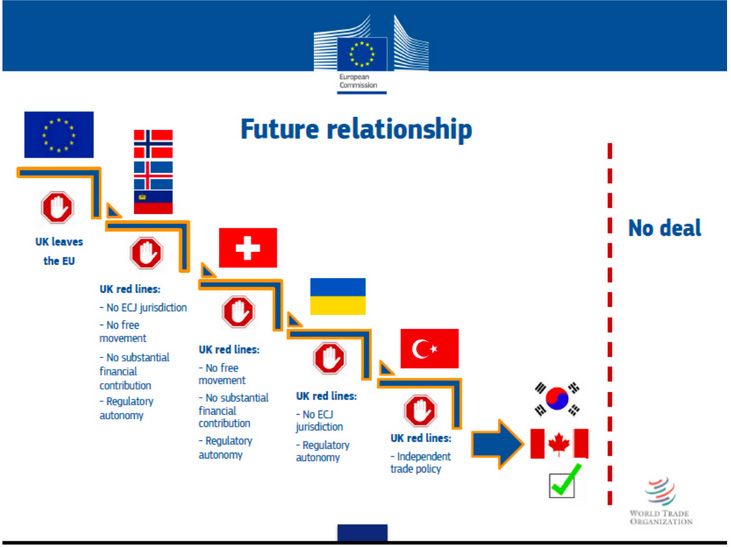
but also for Europe. By leaving the EU and The EU’s chief negotiator Michel Barnier has
joining the EEA via the EFTA pillar the UK would been clear that there are three models for the
kick-start the re-imagining of the European UK-EU future relationship: a Canada-style free
project that is so urgently and desperately trade agreement (which will inflict significant
required. harm on our economy because it doesn’t
include most services, and which would put our
European leaders recognise the limitations of union at risk because it would only be for Great
the EU’s one-size-fits-all, top-down approach Britain), World Trade Organisation rules (which
to integration. President Macron in particular would be even worse), or our EFTA Common
has spoken openly in support of a “Europe of Market model.
several circles”, that better reflects the different
histories, cultures and political temperaments
2
FT, 04 September 2018 https://www.ft.com/content/b9bc8caa-b026-11e8-99ca-68cf89602132
8In May 2018, Michel Barnier said: more specific and detailed Political Declaration.
This Political Declaration would outline the
“The only frictionless model for the future with the future relationship between the UK and the EU
UK would be Norway plus, Norway being part of based on the UK’s membership of EFTA and
the Single Market plus a customs union.” 3 EEA. At the end of the transition, the UK would
then join the EFTA. On its accession to EFTA, the
From the outset Barnier made it clear that an UK would move into the EFTA pillar of the EEA.
EEA-based Brexit would have been welcome At the same time, the UK would join a customs
from the EU side and that it had only not been union with the EU, which will mirror the current
explored because of the red lines that Theresa customs union ensuring no need to activate the
May had set out in her Lancaster House Irish backstop.
speech.4
An EEA-based Brexit and the treaty-based EEA
To deliver Brexit based on Common Market 2.0 Agreement forms a ready-made basis for the
the UK will sign up to the current Withdrawal most orderly Brexit possible, and is the only
Agreement but renegotiate a substantially acceptable, achievable agreement that can be
3
Express, 22 May 2018, https://www.express.co.uk/news/uk/963597/Brexit-news-Michel-Barnier-Northern-Ireland-border-Norway-plus-solution-EU-UK
4
Reuters, 19 December 2017, https://uk.reuters.com/article/uk-britain-eu-options/stairway-to-brexit-barnier-maps-out-uks-canadian-path-idUKKBN1ED23R
9agreed before the 29 March 2019.
EFTA countries
The Norwegian Prime Minister Erna Solberg
has made it clear that Norway will welcome us
into EFTA. She has said that Norway will help
Britain “find solutions” if we want to join (28
November 2018).
“If that is what they really want, we will find
solutions in the future.”
“To find a good agreement is important for all
European countries and I hope that we will see an
orderly deal that doesn’t disrupt economic affairs
in Europe.” 5
The only notable Norwegian politicians to claim
that Norway would reject our membership are
campaigners for Norway to leave EFTA and join
the EU.
The Icelandic Foreign Minister Guðlaugur Þór
Þórðarson told BBC’s Newsnight:
“We would be very positive towards the idea of the
UK joining EFTA or the EEA.” 6
5
MSN (28 November 2018) https://www.msn.com/nb-no/nyheter/verden/solberg-sier-britene-er-velkomne-i-efta/ar-BBQcDyS
6
Newsnight ( 27 November 2018) https://twitter.com/bbcnewsnight/status/1067551073269772288?lang=en
102. Common Market 2.0: more control with continued
economic access
As this table shows, by leaving the EU and joining the EEA via the EFTA
pillar, the UK would remove itself from a significant number of EU
commitments and increase national sovereignty across a range of areas.
UK as EU Member UK in CM21
Single Market Access Yes Yes
Financial Services Access Yes Yes
Tariff free trade with EU27 Yes Yes
Yes, but with qualified
Freedom of movement Yes
right to suspend
Savings on EU payments No ~50% per head
Voice on Global standards bodies No Yes
EU Rules Apply Only 28% apply
Right to refuse new rules No Yes
CAP and CFP Apply Exempt
Mix of Unanimity & 12%
Common Foreign & Defence Policy Exempt
QMV
Selected Opt-in’s /
Justice & Home Affairs Policy Exempt
12% QMV
European Court of Justice Subordinate Exempt
Charter of Fundamental Rights Applies Exempt
Exempt unless we choose
EU Science/Education Programs Participate
to participate
11safeguard measures. Practically, this might
Common Market 2.0 offers
involve giving priority to UK nationals in job
new powers to control centres in certain regions or by reducing the
immigration entitlement to social security payments that
new migrants could receive in certain areas of
Under Common Market 2.0 we would the country.
participate fully in the Single Market, which
entails freedom of movement. We would Article 113 of the EEA Agreement allows for
however be in an improved position in two such a renegotiation between the UK and the
significant respects (in large parts delivering other EEA countries, in order to establish a
what David Cameron attempted but failed to long-term solution. The invoking party must
secure in his renegotiation with the EU in 2016). call a conference and seek to resolve the
underlying issues which led to the measure.
Under Common Market 2.0, the UK: This is done via the offices of the Joint
Committee. If the negotiation breaks down,
• Would have a qualified but unilateral right Article 114 permits the other EEA states to
to suspend any of the “Four Freedoms”; take proportionate counter-measures but
• Have a right to seek a de-facto opt-out from only those “strictly necessary to remedy the
freedom of movement; imbalance.”
• Would be released from the EU’s “non-
It is important to note that such a safeguard
discriminatory” restrictions meaning new
power might only be used in extreme
powers to better manage migrant workers.
circumstances, but is nonetheless an important
power that the UK would benefit from.
First, we would have the power under
Article 112 of the EEA Agreement to take
Second, we would be able to exploit
“Safeguarding Measures”. This ‘safeguarding
opportunities in existing rules. Freedom of
clause’ allows an EEA EFTA state to unilaterally
movement, contrary to popular belief, is not
take ‘appropriate measures’ in the event of
an absolute right. After three months EEA
‘serious economic, societal or environmental
nationals in other EEA countries need to be
difficulties of a sectoral or regional nature
in work or have sufficient means to support
liable to persist’. This means that if immigration
themselves. If they do not, their right to reside
reached extreme levels, we would have the
may be revoked. Some EU countries already
power to impose restrictions.
follow existing rules more strictly. For example,
Belgium applies the existing rules after a six-
If used, this safeguard clause would not have
month period and other countries such as
to be the blunt instrument that some fear.
Spain and Germany have imposed restrictions
For example, if ‘difficulties’ arose of a ‘regional
consistent with this principle.
nature’ it might be possible to restrict free
movement in a particular region while keeping
Of course, we can also do more to apply the
things as they are in other less affected areas.
Single Market rules that the UK is already
This means that if Scotland wanted to continue
party to. Examples of the policies that other
freedom of movement on current terms it
countries inside the Single Market have
would be able to whilst parts of England under
adopted include restricting public sector
particularly heavy strain could implement
7
EEA Agreement, 1994, http://www.efta.int/media/documents/legal-texts/eea/the-eea-agreement/Main%20Text%20of%20the%20Agreement/EEAagreement.pdf
12jobs7 to nationals only and requiring migrants have a voice, vote and right of refusal over
planning to stay longer than a few months to proposed new EEA law.
register upon entry 8 with the relevant local
authority.9 As former Home Secretaries Alan One treaty – two independent jurisdictions
Johnson and Charles Clarke have advocated, The EEA Agreement is not ‘EU’ law, it is its
we could prevent recruitment agencies own stand-alone body of international law
advertising abroad and, in high unemployment which covers two separate and independent
sectors, new jobs could first be offered to local jurisdictions (rather like law covering the whole
unemployed people. A national identity system of the UK covers the separate jurisdictions of
would establish secure digital identities for the UK). This means as a continuing signatory
everyone, and make it easier to identify illegal state to the EEA Agreement, the law would
migration. We could also reform the posted actually be “our” law, because it would
workers directive10 to ensure that companies belong equally to all the contracting parties
bringing in workers from abroad pay at the irrespective of whether they are EU or EFTA
local rate. Finally, we should establish a well- member states.
resourced and focused migration impact fund
to help local communities manage the impact ECJ Jurisdiction ends
of rapid population change.11 A total of £35 Under Common Market 2.0 we would still
million was available through the fund for each leave the oversight of the ECJ but would come
of the financial years 2009-10 and 2010-1112. under the jurisdiction of the EFTA court. The
EFTA Court is a separate and independent
Common Market 2.0 would court covering a separate and independent
jurisdiction. And contrary to what many
enhance our national believe, except for decisions pre-dating the
sovereignty EEA Agreement in 1994, the EFTA court is not
obliged to “follow” the decisions of the ECJ.
Under the Common Market 2.0 proposal, the This again is similar to how the English courts
UK would have: are not obliged to follow the decisions of the
Scottish courts.
• A voice in the consultation process of the
proposed new EEA law Although highly authoritative; EFTA rulings are
• A vote on the EEA Joint Committee where not legally binding on the EEA EFTA states and
unanimity is required cannot be imposed. The UK would have one-
• A domestic right of refusal to implement in-four of the judges on the EFTA court (and
new EEA law into its own domestic law would likely hear every case) in contrast to
one-in-28 on the ECJ. Unlike ECJ rulings, the EEA
Common Market 2.0 would restore policy- EFTA court respects national sovereignty and
making power in a wide variety of areas, the legal supremacy of the EEA EFTA states.
end direct effect and direct applicability of
European Law, ensure British influence in the Voice, Vote and a right of refusal
shaping of Single Market regulations and end
Firstly, outside the EU and under Common
the jurisdiction of the ECJ. Contrary to how the
Market 2.0 we would restore policy-making
EEA is often misrepresented, the UK would
power in vast areas including agriculture,
8
European Union, September 2018, https://europa.eu/youreurope/citizens/residence/documents-formalities/registering-residence/index_en.htm
9
Labourlist, 25 July 2017, https://labourlist.org/2017/07/staying-in-the-single-market-doesnt-mean-accepting-complete-freedom-of-movement/
10
European Union, January 2019, https://ec.europa.eu/social/main.jsp?catId=471
11
The Guardian, 20 November 2018, https://www.theguardian.com/commentisfree/2018/nov/20/peoples-vote-eu-immigration-controls-brexit
12
The new Controlling Migration Fund for England – House of Commons Library, https://researchbriefings.parliament.uk/ResearchBriefing/Summary/CBP-7673 13fisheries, foreign and security affairs, justice required to incorporate EEA law into British
and home affairs and taxation. This would law meaning genuine democratic oversight
mean for example that we would leave the of the proposed new EEA law is achieved by
Common Fisheries and Agricultural Policies. the EFTA states’ own Parliaments. Crucially
these new EEA laws will only take effect if they
A genuine voice are incorporated into UK law by Parliament
Secondly, we will have considerable influence precisely because the ability of the EU to
over the initial shape of new EEA legislative impose law on the UK ends at Brexit and
proposals because the EU is obliged to consult the EEA Agreement “ringfences” the national
all EEA EFTA states on any new legislation. sovereignty of non-EU signatory states. This
EEA EFTA state experts participate in the means the EFTA states maintain (and have
Commission’s preparatory work and have used) a domestic right of refusal. For example,
representatives on policy-shaping committees Norway took five years to implement the EU
as well as having observer status in the EU’s ‘hygiene package’ of regulations and nine
various institutions. Furthermore, the UK would years to implement the ‘Third Energy Package’.
regain its seat at global bodies such as the Iceland is yet to do so. For example, Norway’s
WTO. This means we will actively be able to refusal to implement the ‘Third Postal Service’
shape global standards that are the basis for in 2011. This is an extreme measure and rarely
many EU and EEA laws. used because the purpose of the EEA legislative
process is to achieve legislation by consent
A genuine vote and not imposition and generally speaking, it
Thirdly, if an EEA EFTA state is not satisfied with does so. But it also means the UK would gain
a proposed Single Market law they can contest a ‘right of reservation’ over any new EEA laws
the relevance of new EEA law to the functioning it currently lacks as a member state of the EU.
of the Single Market and seek to secure Under Article 102 of the EEA Agreement the
changes, adaptations or derogations. This EU may take reasonable countermeasures
occurs through the EEA Joint Committee where including suspending that particular part of
representatives from the EU and EEA3 meet the EEA, but an EFTA country can still refuse
to “decide” on whether to ratify the proposed to implement a piece of EEA law because its
new EEA law. New EEA law is only incorporated sovereign right to do so is “ringfenced” by the
into the EEA Agreement with the unanimous EEA Agreement
agreement of the EU and the EEA EFTA states
(unlike in the EU Council where voting is on UK payments would reduce
the basis of a qualified majority) which means
that the UK would have genuine influence over
significantly
new EEA law. This process yields results. For
It is widely stated that the UK would pay
example, Norway obtained derogations from
around 64% of our current contribution to
55 legal acts and Iceland from 349 acts up until
EU budgets under an EEA/EFTA-based Brexit
June 2011.
(based on the fact that Norway pays £140 per
capita per annum vs. the UK’s current £220
A genuine right of refusal
post-rebate). Yet this is misleading. Norway
Finally, we would no longer be committed to
makes annual contributions of €450m to cover
‘ever closer union’ and the imposition of EU
the cost of Norwegian participation in joint
law into UK law through ‘direct effect’, and
programmes, schemes and agencies, and
‘direct applicability’ would end. Indeed, because
pays a €50m membership fee to EFTA. But it
of this, the UK Parliament would actually be
14also makes €390m in voluntary grants via EEA “There is no reason in principle why the UK
Grants Scheme. What is most notable about could not combine a hybrid “Norway” solution
this EEA Grants Scheme – other than it being (membership of the EEA through EFTA) with a
a voluntary “goodwill” scheme – is that it is customs union with the EU. The customs union
calculated on the basis of the Norway’s per means that the UK would continue to benefit from
capita GDP. If the UK decided to follow a similar the EU’s 50 or so free trade agreements. It would
scheme, Norway’s per capita GDP is about be necessary to negotiate a derogation from the
$76,000 per year whereas the UK current GDP obligations arising under Article 56(3) of the EFTA
is $39,000 per capita, meaning the UK would Convention (i.e. the requirement that a new EFTA
pay close to half of that figure. member to apply to join EFTA/third country trade
agreements). But given the wording on 56(1) there
It is therefore reasonable to expect that the UK is no reason why that should be problematic from
could negotiate a figure that is considerably the point of view of the EFTA States who would
lower than 64% (and maybe as low as 50%), have to agree that.”
bringing our annual contributions well south of
£5bn per annum. Leading Brexit campaigners
supported an EFTA-
A negotiated customs based Brexit ahead of the
arrangement would mean the referendum campaign
Irish backstop would not need
to be activated Support for Common Market 2.0, under its
various banners, has come from across the
The biggest concern for all MPs regarding House of Commons and across the Brexit
Theresa May’s Withdrawal Agreement is the divide. Conservatives and Labour politicians
Irish border backstop proposal, due to the are working together in the Norway Plus group,
fact that the UK cannot exit the arrangement and 76 Labour backbenchers defied the whip in
– should it be required – unilaterally. This is an June 2018 to back an EEA-based Brexit in what
unprecedented surrender of sovereignty. was the largest rebellion in the history of the
Parliamentary Labour Party.
EFTA countries are not in the EU customs union
(customs remain a domestic issue for the EFTA And a number of prominent Leave
states) and are therefore able to negotiate their campaigners – including Daniel Hannan,
own trade deals. This should be the long-term Nigel Farage and Owen Paterson MP – all
aim of the UK. consistently advocated staying in the Single
Market during the campaign.
But to ensure a frictionless Irish border –
and therefore remove the need for the Irish Daniel Hannan MEP said:
backstop– the UK would also need a derogation
from the EFTA agreement in order to secure a “Norway and Switzerland, all of these countries
have completely free trade with the EU, and by the
customs arrangement.
way, I can’t help noticing they’re doing pretty well.”
Leading QC George Peretz makes clear that: “Absolutely nobody is threatening our place in the
Single Market.”
15Nigel Farage MEP said:
“I hear people say “Wouldn’t it be terrible if we
were like Norway and Switzerland? Really? They
are rich, they’re happy and they’re self-governing
countries.”
“Norway, Iceland and Switzerland do pretty well.”
“Norway’s have no ties in terms of their foreign
policy, with their fishing industry... They are opted
out and exempted from all of the things that make
the British mad.”
Owen Paterson MP said:
“Only a madman would actually leave the
market.”
13
People’s Vote (Youtube: 17 Nov 2016) https://www.youtube.com/watch?v=0xGt3QmRSZY
163. A prosperous future for the UK
Trade additional barriers will raise costs and put
jobs at risk. For example, the UK’s highly
Common Market 2.0 would secure the successful Financial Services industry relies
prosperity of the UK through continued on its financial passports which ensures that
membership of the Single Market and a they can operate across Europe from the UK.
continued customs union arrangement with The current Political Declaration is unlikely to
the EU. This option is the only one that can maintain current trading terms in services as it
maintain frictionless trade with our largest points towards leaving the Single Market, which
trading partner. Any other option, at least until would risk businesses moving to other parts of
technological solutions can be found, involves Europe.
an increase in trade barriers and would likely
harm our economy, putting jobs at risk. Finally, once we have agreed new frictionless
customs arrangements with the EU, we will
Continued membership of the Single Market be able to explore the potential for greater
ensures tariff-free access to the EU and the flexibility in VAT rules and rates.
other EEA EFTA states. The government’s
proposal by comparison only includes an Workers’ rights
aspiration for tariff-free access. This option
would guarantee it as a treaty right under the A No-deal Brexit and the current Prime
EEA Agreement. Minister’s deal put British workers’ rights at
serious risk. The commitments within the Prime
Membership of the Single Market would, Minister’s deal to protect employment law are
along with some form of continued customs unenforceable and weak, and are excluded
arrangement and no tariffs, ensure that from the legal measures that bind the rest of
there are no additional border checks. This the agreement.14 Those arguing for a No-deal
is vital given the volume of UK trade with the Brexit have spoken openly of the desire to see
EU. For example, 2.6 million freight trucks wholesale deregulation, which would include
passed through Dover in 2016. Any additional watering down labour standards.
paperwork such as Rules of Origin Declarations
will be costly for firms and any additional Common Market 2.0 leaves us open to
checks could lead to disruptive and costly maintaining the current rights and protections
delays. Additional costs could put jobs at risk. we enjoy, as per the high EU labour standards
currently in place. It is these rights, such as
It is essential we maintain full participation in the working time directive, rights on annual
the Single Market in order to protect Services, leave, equal pay, maternity and parental leave,
which make up about 80% of the UK economy. anti-discrimination and even health safety
Common Market 2.0 delivers on this. Any laws, that British workers rely on to live a good
14
The Guardian, 26 November 2018 https://www.theguardian.com/commentisfree/2018/nov/26/theresa-may-brexit-deal-rights-at-work-eu-protectionspdf
17quality of life. Remaining a member of the This plan would also mean that the UK would
EEA would allow for the implementation of EU regain its seat at global bodies such as the
employment-related regulations into UK law, WTO. This means we will actively be able to
ensuring British people could still benefit from shape global standards that are the basis for
these protections. many EU and EEA laws.
Common Market 2.0 allows us to leave the Common Market 2.0 would give the UK more
EU as the British people have directed, but control, deciding what is best for the UK.
maintain essential employment protection
ordinary working Briton’s rely on. Participating in EU agencies
Citizenship Rights The EEA3 States participate in the agencies
below through decisions of the EEA Joint
There is no concept of “citizenship” in the EEA Committee. In addition, bilateral agreements
Agreement and the EU Charter does not apply. with the EU ensure the participation of
The EEA Agreement is an economic treaty, and individual EEA3 States in several other EU
not political one. However, Annex V obliges agencies. The EEA3 participate in numerous
EFTA state contracting parties to respect the agencies and programmes, including
Citizenship Directive rights of EU citizens, and REACH (Chemicals), EMA (medicines and
also to extend equivalent rights to their own pharmaceuticals, environment, food safety,
subjects and other EFTA state citizens even pensions, securities and markets, network
though they are not themselves citizens of and information security, railway, maritime
the EU. While this would not equate to the and aviation safety). The EEA3 also have the
continuation of EU citizenship, which will end at option of joining programmes like Erasmus,
Brexit, it should be of considerable comfort to Horizon 20/20, Copernicus (environment),
UK citizens anxious about losing key citizenship European satellite navigation systems (Galileo),
rights such as free movement, residence and Connecting Europe Facility (CEF) dealing with
healthcare. telecoms and broadband.
Standards and regulations This means, the UK would have the option of
remaining in the agencies and programmes
Those backing a No deal Brexit have spoken that we want to. This would include areas that
openly about their desire to remove the UK the Prime Minister’s current deal fails to secure
from European standards and regulations. This continued engagement in – Galileo being the
mean chlorinated chicken from the USA, and most obvious example.
unsafe appliances and toys from elsewhere.
Environmental
Common Market 2.0 is the only plan that
can ensure frictionless access to European Current members of the EEA have agreed
markets, maintaining the standards that British their ‘determination to preserve, protect and
consumers expect. It will keep identical or improve the quality of the environment and to
equivalent regulations meaning no additional ensure the prudent and rational utilisation of
costs to business and no additional paperwork. natural resources on the basis of the principle
This is vital for the around 2.6million freight of sustainable development’.
trucks passing through Dover.
18In practice, this means all EFTA EEA states In the EEA, state aid is monitored by the EFTA
commit to agreements on water, air, chemicals Surveillance Authority, meaning determinations
and waste, and the equivalent environmental are made by EEA members through a separate,
protections as EU membership15. parallel structure to that which monitors state
aid in the EU. The EFTA working group on state
Industry and procurement aid meets when required to determine the
specifics of how it will be interpreted within the
The EEA states come under the same state aid EEA, and is the means by which discussions
rules as EU members. These state aid rules on state aid between the EEA and the EU are
prevent governments giving any business an conducted.
unfair advantage that would distort trade.
Such rules do not prevent governments from Digital
nationalising already privatised industries or
prevent the state from setting up government British business, not least our vital services
backed alternatives to privatized industries. industries, rely on the free flow of data across
There are no policies in any of the major parties national borders. Data flows freely within the
manifestos from the last election that current EEA and EU, and both the EEA and EU grant
state aid rules would in any way curtail.16 ‘adequacy’ agreements with third countries
to allow the international transfer of personal
As Norway has shown, it is possible under data to countries outside of these areas. As a
existing rules of the EEA for the state to play member of the EEA, the UK would be covered
a greater role in the delivery of services. For by the existing data agreements and there
example, the Norwegian government operates would be no need for a separate agreement,
its domestic railways (and the Austrian Federal meaning frictionless data flows, benefiting
government operate the one railway line British business.17
in Lichtenstein). The Norges Statsbaner AS,
the Norwegian State Railway company, the
government owned operator of the railways,
was established in 1996, after Norway entered
into the EEA Agreement (when a larger railway
company was split into separate state-owned
operation, administration and inspectorate
bodies).
15
EFTA, January 2019, http://www.efta.int/eea/policy-areas/flanking-horizontal-policies/environment
16
Andy Tarrant, Fabian Society: https://fabians.org.uk/negotiating-the-red-lines
17
EFTA, January 2019, http://www.efta.int/EEA/Data-Protection-505036
19You can also read


