ROBOTICS EDUCATION & COMPETITION FOUNDATION - VRC Judge Guide - REC Foundation
←
→
Page content transcription
If your browser does not render page correctly, please read the page content below
ROBOTICS EDUCATION &
COMPETITION FOUNDATION

VRC Judge Guide
Judge Guide

Table of Contents

Overview ............................................................ 1 Judge Sign in Sheet ....................................... 15
  New This Year ............................................... 1 Student Interview and Discussion Tips .... 16
  Key Concepts ................................................. 1
                                                                    Sample Questions ....................................... 16
Judge Responsibilities ................................... 3 Judge’s Note to Missed Teams .................. 17
Judge Training .................................................. 4 Design Award Rubric
Judging Schedule ............................................ 4       Sheet One ..................................................... 19
Judge Advisor Responsibilities ................... 5                     Sheet Two ..................................................... 20
Judging Materials............................................. 6 Note Regarding Other Judged Awards..... 21
  VRC Judging Materials ................................. 6 VRC Awards Scoring and Ranking
  VRC Trophy Packs ........................................ 6   Sheet One ..................................................... 22
Awards Overview ............................................. 6 Sheet Two ..................................................... 24
Excellence Award............................................. 8 Standard Award Description for Judge’s
                                                                Room .................................................................. 26
  Determining the Excellence Award at
      Events ....................................................... 8   Excellence ..................................................... 27
   Deliberations .................................................. 8    Amaze............................................................ 28
                                                                         Build ............................................................... 29
Design Award .................................................... 9
                                                                         Create ............................................................ 30
VRC Design Award Rubric............................. 9                   Design ............................................................ 31
   Engineering Notebooks .............................. 10               Energy ........................................................... 32
   Design Award at VEX Worlds .................... 11                    Innovation ...................................................... 33
                                                                         Inspire ............................................................ 34
Award Description and Criteria .................. 11                     Judges Award ............................................... 35
   Amaze Award ............................................... 12        Service ........................................................... 36
   Build Award .................................................. 12     Sportsmanship ............................................. 37
   Energy Award ............................................... 12       Think .............................................................. 38
   Innovate Award ............................................ 13
   Inspire Award ............................................... 13
   Judges Award .............................................. 13
   Sportsmanship Award ................................. 13
   Volunteer of the Year Award ..................... 14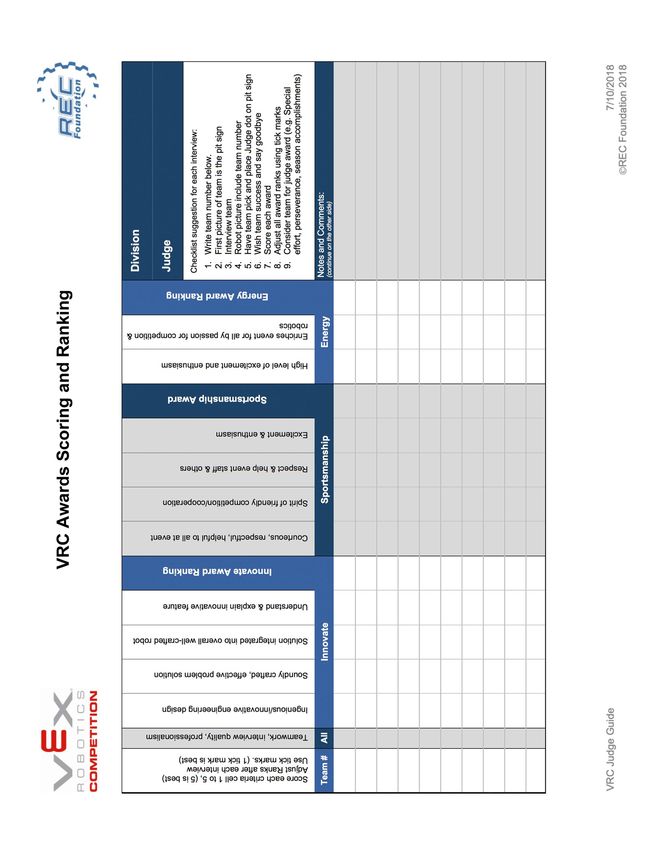
Judge Guide

Overview
Thank you for volunteering to help make the VEX Robotics
Competition a success. This guide will help Judges, Judge
                                                                          New This Year
Advisors, and Event Partners understand and follow a             Major changes to this year’s version of the
consistent judging process. The judging process in this guide    Judge Guide include:
is consistent with the judging process used at the VEX           • Removed pre-submission requirement
Robotics World Championship. Judges at local and                   for Excellence at the VEX Robotics
State/Regional/Provincial events must follow the judging           World Championship
process outlined in this guide. Official events may not          • Updated the Design Award process at
change award criteria in this guide. Events not following          local events to include quick review of
                                                                   notebooks and identification of top
the award criteria in this guide may not qualify teams to
                                                                   contenders for Design and Excellence
higher level events.                                             • Changed process for determining
Event Partners should make the Judge Advisor aware of              Excellence at larger events
concerns about the behavior or ethics of a team using the        • Deleted the Excellence Calculator
“Field Note to Judges” form, or some other form of               • Added a statement on the Judge’s room
communication that is agreed upon by the Event Partner and       • Added note on completion of awards
Judge Advisor.                                                     before semifinals at an event
                                                                 • Added note that only Judges are to
Judging deliberations should be concluded after the last           make decisions on Judged awards at an
qualifying match and before the tournament champions are           event
known. The tournament outcome should not affect any              • Added note on need for a separate
Judged awards, including the Excellence Award. Judges are          Judge’s room
to make all award decisions under the supervision of the         • Added a simple method to determine
Judge Advisor before leaving the event. Event Partners             Think Award at an event
should not make any decisions on any Judged awards.              • Included additional judging documents
The Judge Advisor should oversee the entering of                   with this guide rather than posting them
Judged Awards on the Awards tab of Tournament                      separately online
Manager.
Only a limited number of teams at each event will be awarded a Judged award. However, Judges
should interview every team at an event regardless of the team’s status in terms of contention for a
Judged award or notebook submission.
Key Concepts
Student-Centered Teams: The Robotics Education & Competition Foundation seeks to increase
student interest and involvement in science, technology, engineering, and mathematics (STEM) by
engaging students in hands-on sustainable and affordable curriculum-based robotics engineering
programs across the U.S. and internationally. Judges play an important role in our efforts to ensure that
our program remains student-centered. Teachers/Mentors/Parents providing guidance and helping
students design, fix or program robots is accepted. Adults doing the majority of the work on a robot, or
working on a robot alone without students, is not acceptable, as there is obviously limited student
learning and ownership taking place in such a situation.
Judges have the opportunity through observation and interviews to identify teams, schools and clubs
that strive to keep their program student-centered and that understand that the purpose of the program
is to enhance the learning process, not to win at all costs. Judges, with input from event staff, should
identify teams that are not student-centered.

VRC Judge Guide                                     1                                          9/17/2018
                                                                                     ©REC Foundation 2018
Examples of this may include:
   •   Robots built entirely by adults or, in the case of younger students, mentors (i.e., high school
       students building robots for middle school teams).
   •   Identical robots on two or more teams (so called ‘clone-bots’).
   •   Adults who criticize students from alliance teams for poor performance, failure to perform
       optimally or who blame other teams for low scores rather than offering positive suggestions.
Judges should not reward such teams that Judges have clearly identified as not student-centered with
any Judged awards.
The Judges Room is where all notebook evaluations and judging deliberations should be conducted.
The organizing committee should provide a room that provides Judges with the ability to hold frank,
confidential discussions. It should be separate from rooms where other volunteers congregate and allow
for Judges to post items on walls without teams or volunteers being able to see the judging materials.
Team Conduct: The REC Foundation considers the positive, respectful, and ethical conduct of all
students and adults associated with a team to be an important and essential component of the
VEX Robotics Competition program. For this reason, Judges will consider all team conduct by students
and/or adults when determining award recognition at VEX Robotics Competitions.
The Pit Area: The area that teams use as their home base during an event is called the Pit Area.
Teams are usually provided with a table for their robot, laptop, batteries, and other VEX parts. The Pit is
also the work area for the teams. This is a great place to meet with teams in an informal setting and see
them in a more relaxed environment. Judges at VEX Worlds visit teams in their pit areas to conduct
student interviews for most Judged awards. Judges at local events should help prepare teams for the
process at regional championship events and VEX Worlds by interviewing teams in the pit area.
It may be difficult to catch teams in their pit area due to tight competition schedules. Additionally, larger
teams may only have some of their team in the pit area, with the rest of the members congregating in
the stands. If at first you are unable to locate a team in their pit area, feel free to leave them a note to
inform them that the Judges are hoping to speak with them and/or check their pit area later. A standard
Judges note to missed teams is at the end of this guide.
The Competition: Robot matches take place on the competition floor in a 12’ x 12’ competition field.
Rounds last 2 minutes, including a 15-second autonomous period, and are scored by Referees. Teams
typically have one practice round, and then qualification rounds, followed by the elimination rounds. The
competition floor is a great place to see the teams in action and to evaluate how well their robots
perform. Judges who spend time viewing the competition can validate statements made by teams during
student interviews and discussions. Be certain to ask your Judge Advisor if there is time allocated for
this activity. In addition, you can get a great idea of a team’s sportsmanship, energy, and enthusiasm
while observing teams on the competition field. For robot game details, please visit:
roboticseducation.org/competition-teams/vex-robotics-competition/
The Event Partner (EP): Adult volunteer who organizes and coordinates the event.
The Judge Advisor: Adult volunteer who coordinates the event judging process.

VRC Judge Guide                                       2                                         9/17/2018
                                                                                      ©REC Foundation 2018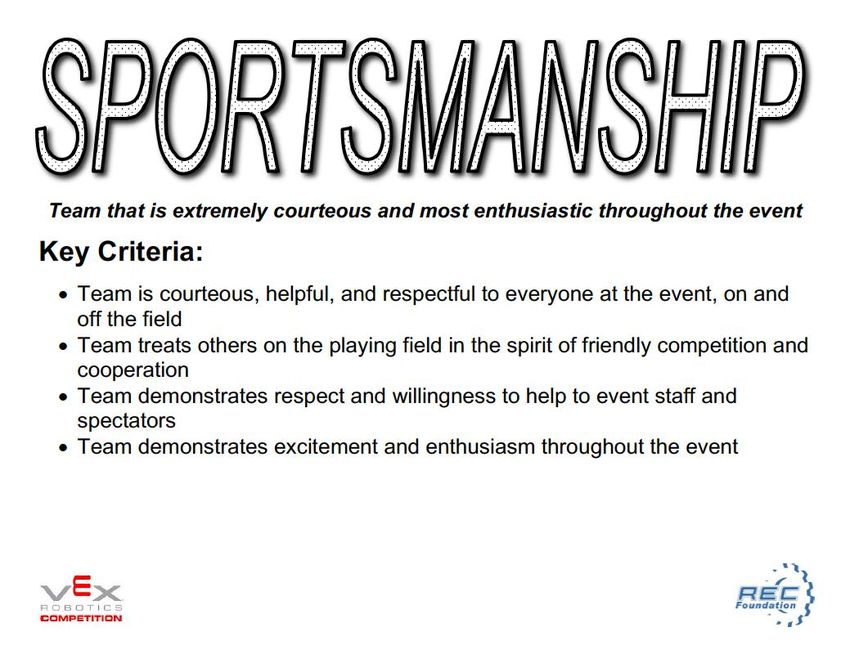
Judge Responsibilities
Judges are in a position of trust at VRC events. To ensure that the judging process is an effective,
equitable, and positive experience for all participants, it is important that Judges maintain:
   •   Confidentiality: The judging process often includes frank discussions about teams. These
       discussions must remain confidential and your judging team should take precautions to ensure
       that these discussions are not shared with or overheard by teams or other event participants.
   •   Impartiality: Proactively advise the Judge Advisor or Event Partner of any possible conflict(s) of
       interest and remove yourself from all discussions and decisions in which you may have a
       personal interest.
   •   Engagement: Demonstrate your full interest and involvement in discussions with students and
       your judging team by refraining from distractions such as phone usage or side conversations.
   •   Do not be alone with students. Always work with at least one other Judge and two or more
       students if you meet with teams in a private space.
To prepare for the event, Judges should:
   •   Review this Judges Guide, including the attached Design Award rubric.
   •   Review the Game Video, Game Description, and/or the Game Manual at:
       roboticseducation.org/competition-teams/vex-robotics-competition/
       o Knowing the tasks that teams will be trying to complete is essential to evaluating their robots
           on a technical level.
   • Review the event location, schedule, team list, awards on event posting at: robotevents.com.
   • Plan to wear comfortable closed-toed shoes and business casual clothing that is team-neutral.
   • Inform the Judge Advisor of any potential conflict of interest. Judges who are associated with a
       team at the event are not disqualified from judging. However, they should not wear team shirts or
       other items associated with their teams, they should not interview their own teams, and they
       should recuse themselves from deliberations involving their teams.
During the event, Judges should:
   •   Review the Engineering Notebooks that were submitted by the teams. Use the attached Design
       Award rubric to evaluate the Engineering Notebooks and your discussions with teams.
   •   For large events that offer one or more Technical Awards or Other Judged Awards, use the
       VEX Awards Scoring and Ranking Sheet to evaluate your discussions with teams.
   •   Conduct student interviews and discussions with teams in the Team Pit Area. The idea is to
       avoid “interviews” in a closed room where Judges do not have an opportunity to see the team as
       it interacts with others during the event.
   •   If, after several visits to the team’s pit area, you are unable to locate the team, leave a “Judge
       note to missed teams” form on their pit table. Judge Advisors should have these forms printed.
   •   Ask questions that encourage the students to explain their answers using a conversation that
       shows that you are interested in what they have to say. “How” and “why” questions work well as
       leading questions. Use the sample questions provided at the end of this guide.
   •   Take notes to support your team evaluations and Judge deliberations. Ensure that your notes
       are not included on the rubric forms and are returned to the Judge Advisor after deliberations.
   •   Rank each team you have met with for awards consideration after meeting each team. Simply
       keep your completed rubrics or notes in order of the teams’ rankings. Typically, rankings for the
       top 25% of the teams that you visited are needed during the deliberation process, but rankings
       for more teams are sometimes needed for Design Award.
   •   Attend and participate in the Opening and Awards Ceremonies, if possible.
   •   Share all questions or concerns with your Judge Advisor.

VRC Judge Guide                                     3                                         9/17/2018
                                                                                    ©REC Foundation 2018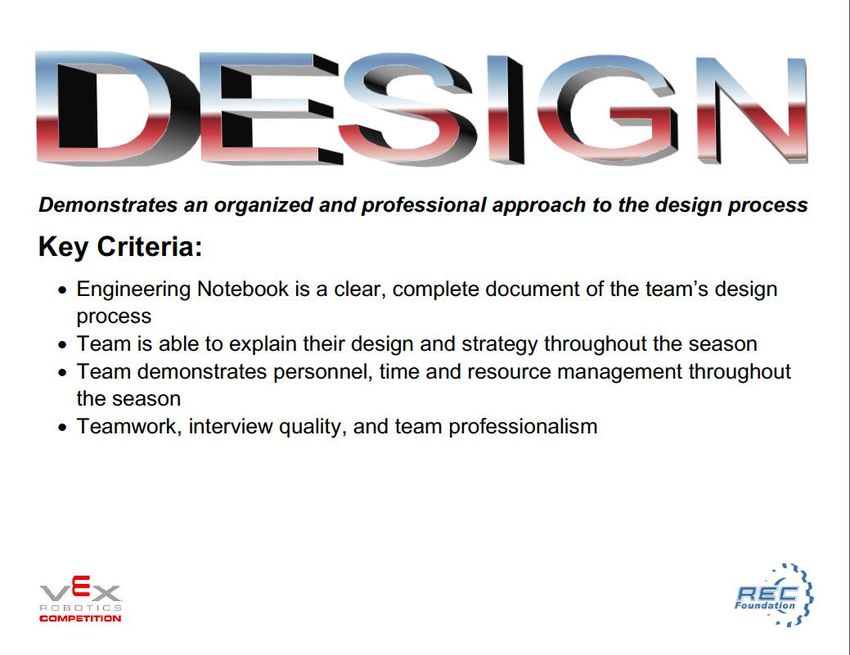
During judging deliberations, Judges should:
   •   Post or share your top-ranked teams for each award, as instructed by the Judge Advisor.
       Typically, each Judge team will initially post the top five teams for each award or one quarter of
       the Judged teams, whichever is greater. A white board, flip charts or Post-It notes may be used
       to post the top-ranked team numbers on a wall so that they are visible to all Judges.
   •   Work collaboratively with other Judges to achieve consensus on the award recipients.
   •   Remember that the deliberation process often includes frank discussions about teams.
       Therefore, the deliberation process is a confidential process. Judges’ discussions should not
       leave the Judges room. Only Judges are allowed in the Judges’ room.
   •   Remove yourself from discussions involving teams that present a conflict of interest.
   •   Share all questions or concerns with your Judge Advisor.
   •   Return all rubrics, judging notes, and materials to the Judge Advisor at the end of deliberations.

Judge Training
The Judge Advisor or Event Partner will arrange for some form of Judge training. Typically, this training
will involve reviewing this guide, the current game, and the judging rubrics. This training may take place
prior to the event and/or on the morning of the event. Check with your Judge Advisor or Event Partner
for details.
Online REC Foundation Judge training materials are available to all Judges, Judge Advisors, and Event
Partners. For the Judge training materials, please visit: roboticseducation.org/volunteers/volunteer-
resources/.
If you have specific questions regarding the judging process please send an email to Tarek Shraibati,
the National Judging Advisor, at: tarek@roboticseducation.org.
Judging Schedule
The entire judging process will take place during the competition. When scheduling teams of Judges, it
is recommended that each judging team visit one team every 10-15 minutes. Judges should meet with a
wide enough selection of teams to get a good basis of comparison. The Judge Advisor will provide a list
of teams that each judging team is responsible for interviewing, and the match schedules when these
become available.

VRC Judge Guide                                     4                                         9/17/2018
                                                                                    ©REC Foundation 2018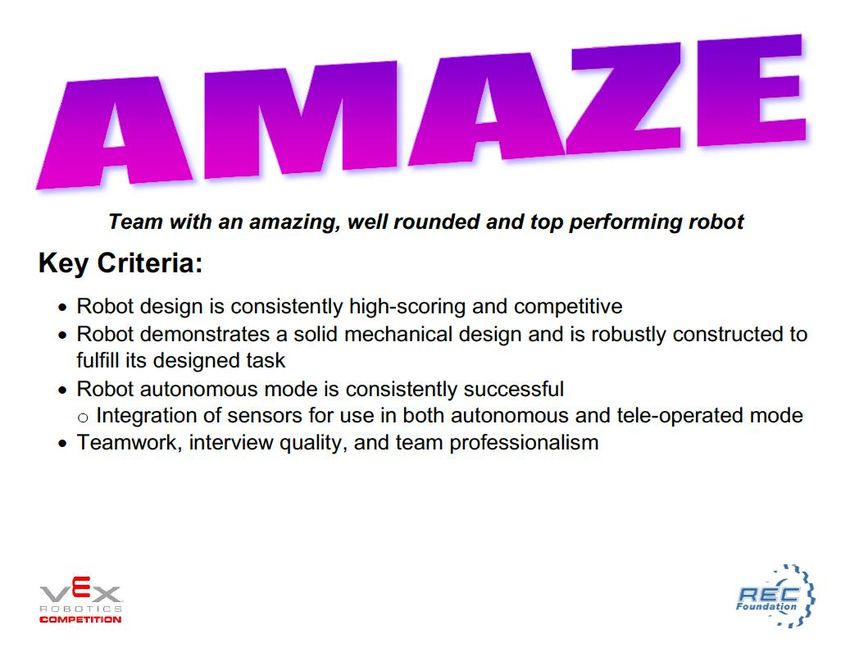
This sample schedule is typical for a tournament with 24-36 teams.
                                                Sample Schedule
7:30 – 8:00 a.m.     Judge Advisor reviews training materials and then makes assignments
8:00 – 9:45 a.m.     Judges arrive, receive training, review Engineering Notebooks, and begin interviews for assigned teams
9:45 – 10:00 a.m.    Attend Opening Ceremonies
10:00 – 11:30 a.m. Teams of Judges complete initial interview of assigned
                     Return to judging room and each panel of Judges identifies their top candidates for each award. (Use
11:30 – 12:00 p.m.
                     post-it notes to list teams)
12:00 – 1:00 p.m.    Lunch Break -Initial deliberation on top candidates for awards
                     Judges observe teams in pit area and on field and return to competition field to do follow up interviews
1:00 – 2:00 p.m.     and observation as necessary to complete rank ordering for each award category. If possible, all Judges
                     should have an opportunity to visit with top contenders for each award.
2:00 – 3:00 p.m.     Judges return to Judge room to conduct final deliberations and determine award winners.
                     Judge Advisor oversees entry of team numbers for all award winners into Tournament Manager. This
3:00 – 3:30 p.m.
                     should be completed no later than the last quarter-finals match.
                     Attend finals and award ceremony (speak to your Judge Advisor if you have other obligations that
3:30 – 6:00 p.m.
                     require you to leave).

Judge Advisor Responsibilities
The Judge Advisor is an adult, who works with the Event Partner to plan and coordinate an efficient,
effective, and equitable event judging process. Judge Advisor responsibilities may include the
recruitment and training of Judges for the event. Judges in VRC are to be adults. Good sources of
Judges include local school administrators, local businessmen with interests in technology or
engineering, VEX U college students and local service organizations. The Event Partner and Judge
Advisor consider the number of participating teams when recruiting Judges and setting the schedule.
The Judge Advisor manages time and resources, potential conflicts of interest, and a deliberative
decision-making process that determines the award recipients. The Judge Advisor is responsible for
ensuring that award winners are entered into Tournament Manager and that award scripts are printed
from Tournament Manager for presentation at the awards ceremony. This will also assure that the
award winners are ready for posting to the event listing on robotevents.com upon the completion of the
event. The Judge Advisor is responsible for ensuring that the trophies or other awards are ready for the
awards ceremony.
The Judge Advisor is not to share the completed Design Award rubrics with teams or Event Partners
after the event. The rubrics are intended to be used by Judges to narrow down the field of contenders
for each award. Multiple teams often score “perfect” 3’s on a rubric. While the rubric is quantitative in
nature, Judges are expected to apply their qualitative judgement when making a final decision
on all awards. Teams with a perfect rubric score often do not understand why they were not selected
for an award. Judges should not discuss awards or judging with teams after an event; please direct any
inquiries to the Judge Advisor or Event Partner. A Judge’s best intentions are often misinterpreted by
teams resulting in students with hurt feelings. The Judge Advisor must properly dispose of these and all
other judging materials after the event.

VRC Judge Guide                                               5                                              9/17/2018
                                                                                                   ©REC Foundation 2018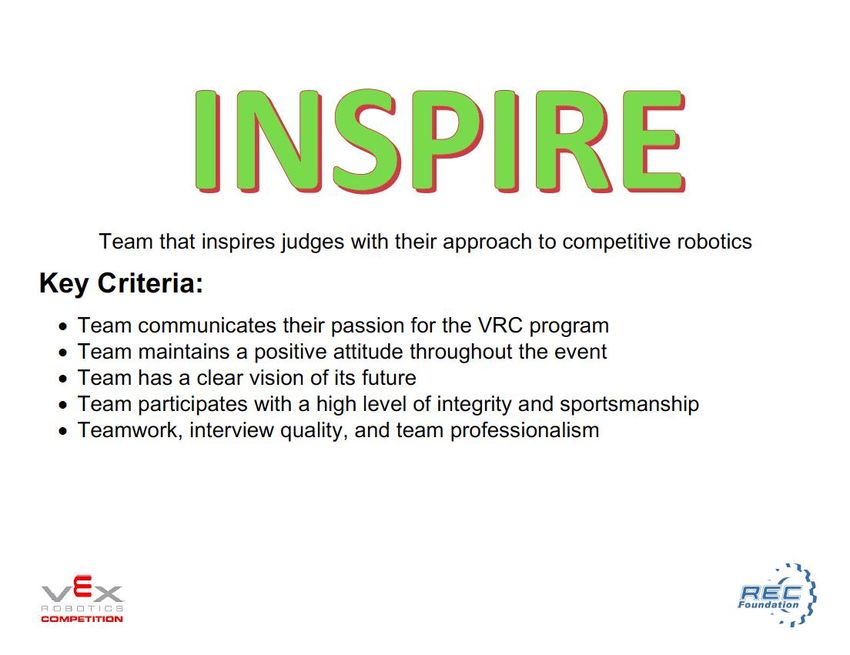
Judging Materials
The following is a list of suggested materials for the Judge Advisor and Judges to use on event day.
Judging documents are available at the end of this guide. This guide is found at:
roboticseducation.org/event-partners/event-partner-resources-documents/
                                          VRC Judging Materials
 • VRC Judge Guide (this document)                            • Awards Appendix C
 • Design Award Rubrics (one per team)                        • List of awards to be offered at the event
 • List of Judges                                             • List of teams (provided by EP)
 • Judge name tags or ID badges                               • Match list by team # (provided by EP)
 • Post-it notes, pens & highlighters                         • Transparent tape and/or painter’s tape
 • Clipboards and pens                                        • Map of the event/pit area (if available)
 • Standard Award Descriptions to be posted in                • Student Interview and Discussion Tips – one
   the Judges Room                                              copy per Judge
 • VEX Awards Scoring and Ranking Sheet (one                  • Awards Ceremony Scripts printed from
   per team if other Judged awards are offered)                 Tournament Manager
 • Colored dots to mark pit signs                             • Event Program (if available)
 • Tables for Judge Advisor, judging materials, and Judge deliberation
The following trophy packs may be purchased by the Event Partner for use at events:

                                           VRC Trophy Packs
                                                                                       Championship Event
    Qualifying Event Trophy Pack            Additional Trophy Pack
                                                                                          Trophy Pack
Trophies Included: (7) 10" Trophies    Trophies Included: (5) 10" Trophies     Trophies Included: (7) 12" Trophies

Award Plates Included:                 Award Plates Included:                  Award Plates Included:
  (1) Excellence                         (2) Tournament Finalist                 (1) Excellence
  (2) Tournament Champion                (1) Innovate                            (2) Tournament Champion
  (1) Design                             (1) Amaze                               (1) Design
  (1) Judges                             (1) Think                               (1) Judges
  (1) Robot Skills Champion              (5) Date Plate                          (1) Robot Skills Champion
  (1) Volunteer of the Year                                                      (1) Volunteer of the Year
  (7) Date Plate                                                                 (7) Date Plate

*    Event Partners receive this                                               *   This pack is available for
     trophy pack free as part of the                                               state/provincial/regional/national
     VRC Event Support Bundle.                                                     championship events.

Trophies may also be ordered individually at http://www.vexrobotics.com/event-partners/vrc-trophy.html.
Awards Overview
Awards are to be spread as equitably as possible among the teams, with no team winning more than
one Judged award. A team may win robot performance awards (Tournament Champion or Robot Skills
awards) in addition to Judged awards, but no one team should win more than one Judged award.
Individual awards given to coaches and mentors do not affect a team’s eligibility for a Judged award.
Not all awards are available at all events. Check with your Event Partner or Judge Advisor to confirm the
awards to be offered at your event and which awards qualify teams to move to either state/regional
events or VEX Worlds.

VRC Judge Guide                                           6                                               9/17/2018
                                                                                                ©REC Foundation 2018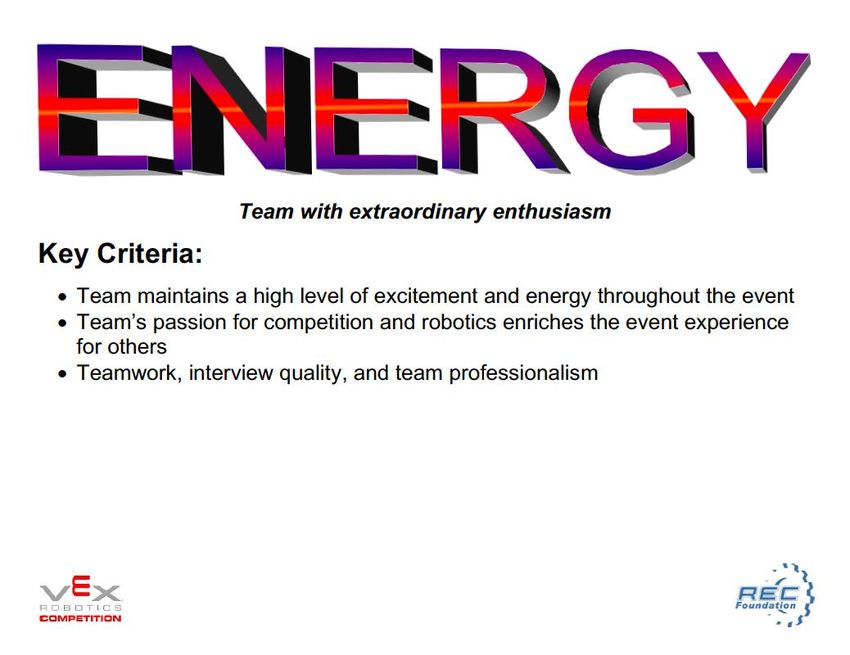
Standard Awards offered at most events:
Award                              Basic Criteria                                  Judged   Performance
Excellence                         Top All Around Team                               ✓           ✓
Tournament Champion                Winning Alliance (2 teams)                                    ✓
Design                             Team with a professional design approach          ✓
Robot Skills Champion              Top Skills Challenge Team                                     ✓
                                   Team that deserves special recognition for
Judges
                                   efforts leading up to, and during, the event      ✓
Volunteer of the Year              Recognized Event Volunteer                        ✓
Additional Awards offered at larger events:
Award                              Basic Criteria                                  Judged   Performance
Tournament Finalist                Finalist Alliance (2 teams)                                   ✓
                                   Team with an amazing, well-rounded and top
Amaze                                                                                 ✓
                                   performing robot
Build                              Team with a well-crafted robot                    ✓
Create                             Team with creative engineering solution            ✓
Energy                             Team with extraordinary enthusiasm                ✓
                                   Team that exemplifies thinking outside of the
Innovate
                                   box and innovative engineering design             ✓
                                   Team with an impressive and effective
Think
                                   autonomous programming                            ✓
Additional Awards offered at very large events such as VEX Worlds.
Award                              Basic Criteria                                  Judged   Performance
Robot Skills 2nd Place             2nd place Skills Challenge Team                               ✓
Robot Skills 3rd Place             3rd place Skills Challenge Team                               ✓
                                   Team with extraordinary community
Community                                                                            ✓
                                   involvement and awareness
                                   Team that has inspired Judges with their
Inspire                                                                              ✓
                                   approach to competitive robotics
                                   Team that goes above and beyond to assist
Service                                                                              ✓
                                   other teams at an event
                                   Team that is extremely courteous and most
Sportsmanship                                                                        ✓
                                   enthusiastic throughout the event
                                   Group with multiple teams competing and
Teamwork                                                                             ✓
                                   communicating together
Mentor of the Year                 Recognized Volunteer Team Mentor                  ✓
Partner of the Year                Recognized Event Sponsor/Supporter                ✓
Teacher of the Year                Recognized Team Teacher                           ✓
                                   Recognized Adult STEM All-Star (given at VEX
Inspiration All-Star                                                                 ✓
                                   Worlds)

VRC Judge Guide                                       7                                        9/17/2018
                                                                                     ©REC Foundation 2018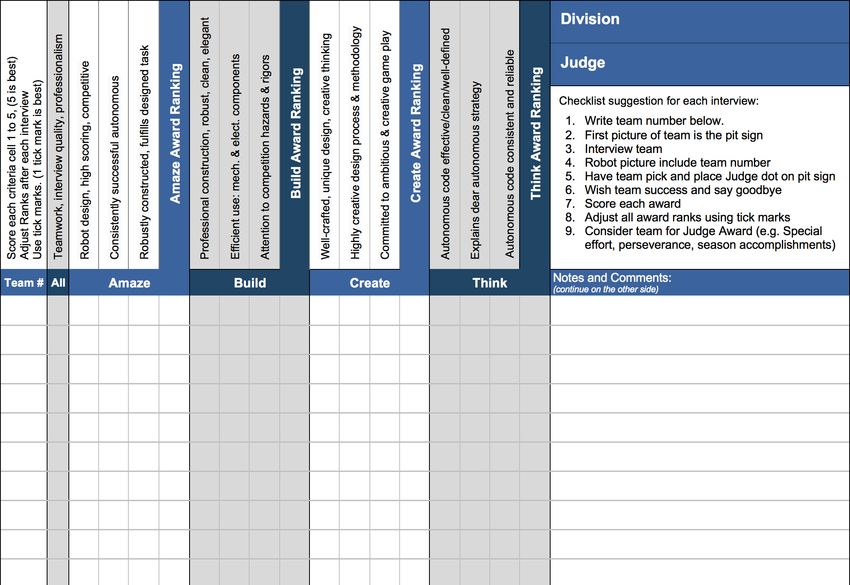
Excellence Award
The Excellence Award is the highest award presented in the VEX Robotics Competition. This award is
presented to a team that exemplifies overall excellence in building a high quality VEX Robotics program.
This team is a strong contender in numerous award categories. Excellence winners must have
submitted an Engineering Notebook.
Key criteria:
   •   Design Award ranking
   •   Tournament Qualification Matches ranking
   •   Robot Skills Challenge ranking
   •   Other Judged Award rankings
   •   High quality VEX Robotics program
Some events may offer two Excellence Awards, one for the top overall Middle School team and one for
the top overall High School team, if they have at least ten (10) teams in each group.
A team does not have to win the competition to receive the Excellence Award but must at least be
competitive in the Judge’s rankings.
Determining the Excellence Award at Events
Judges should start by selecting the top 5 or top 20%, whichever is larger, of the Design Award
candidates using the Design Award process and rubrics outlined in this guide. These top 5 teams should
be considered the top candidates for the Excellence Award at the event.
To determine the final Excellence winner at an event, Judges should consider the following for each of
these candidates:
   •   Quality of their Engineering Notebook and design process.
   •   Their on field performance (i.e., are they in the top 10 ranked teams in the qualifying matches?
       and are they in the top 5 or top 20%, whichever is larger, of the teams in skills scores?). Judges
       should use the ranking reports from Tournament Manager or the VEX Via app.
   •   The team’s dynamics: is the team student-centered and do they exhibit good sportsmanship?
       Where they considered for other Judged awards?
Deliberations
The final decision on the Excellence Award winner should be qualitative based on what Judges have
seen during their interactions with each of the teams and their observations at the event. Judges will
use their best judgment to choose the team they feel best exemplifies the best overall robotics
program. Judges should ask themselves if this team has met the criteria to be considered an excellent
team and does the team exemplify overall excellence. Would Judges want the team to be emulated by
other teams?
The Judges’ final decision on the Excellence Award should include a team’s behavior, sportsmanship,
and professionalism at the event. A team is composed of students, mentors, and adults at the
competition. Judges may wish to use the “Field Note to Judges” form to help collect information on team
sportsmanship. Teams must submit an Engineering Notebook to be eligible for the Excellence Award.
There may occasionally be cases where Judges should not award the Excellence Award to any team at
the event. This may happen when either no teams submit an Engineering Notebook or when the only
notebooks submitted are of a very poor quality.
In the case where no notebooks are submitted, there is clearly no team that meets the minimum
Excellence requirement of submitting an Engineering Notebook and Judges should not award
Excellence at the event.

VRC Judge Guide                                     8                                        9/17/2018
                                                                                   ©REC Foundation 2018
Judges should recognize that notebooks will improve during the season and that early season
notebooks will have less of the iterative design process included. However, even early in the season,
notebooks should include documentation of the robot at its current state in the design process. Evidence
of a team’s review of the current game in terms of robot functions, brainstorming and preliminary
designs should be included. These three activities correlate to having addressed the first three criteria
of the Engineering Design Notebook Rubric. If no notebooks at the event meet this criteria, then the
Excellence Award should not be given.
The idea here is to avoid recognizing a team as excellent and worthy of emulation by all other teams at
the event when no team has yet achieved this level. Judges should understand it is not to punish teams
but to encourage teams to improve. It is expected that these occasional situations will only arise early in
the season before teams have had time organize themselves. In the event a team of Judges decides not
to give out the Excellence Award, they should point out to teams that the Design Rubric and instructions
in the front of the VEX Notebook may be used as guides to help them develop their notebooks.
The idea is also to avoid the extreme case where only one or two teams turn in notebooks that consist
of a title page and little more being recognized as Excellence winners.
A team does not have to win the VRC competition to receive the Excellence Award, but must at least be
competitive in the Judge’s rankings.
Excellence Award at VEX Worlds
Teams must have been awarded the Excellence Award at an official state/regional(multi-
state)/provincial/national championship event or a REC Foundation designated signature event during
the current competition year to be eligible for Excellence at VEX Worlds. Teams must submit their
Engineering Notebook to be considered for the Excellence Award at VEX Worlds.
If an individual team from a school or organization receives the Excellence Award at VEX Worlds, then
the award is given to the entire organization, not just the single team. Each qualified team will be given a
single Excellence Award interview slot. Schools or organizations with more than one eligible team will be
given one Excellence interview slot with the score from the interview shared by all eligible teams from
the school or organization.
Team interview schedules will be sent via email to eligible teams the week of Worlds. Teams should
ensure that they have listed a contact email in their RobotEvents.com account that they may access at
the event.
Online Challenges are not required for teams to be eligible at VEX Worlds. Judges will however
consider them as part of the overall team evaluation if they are submitted.
Design Award
The Design Award is presented to a team that demonstrates an organized and professional approach
to the design process, project and time management and team organization. Only teams that submit
Engineering Notebooks are eligible for the Design Award.
Key criteria:
• Engineering Notebook is a clear, complete document of the team’s design process
• Team is able to explain their design and strategy throughout the season
• Team demonstrates personnel, time and resource management throughout the season
• Teamwork, interview quality, and team professionalism
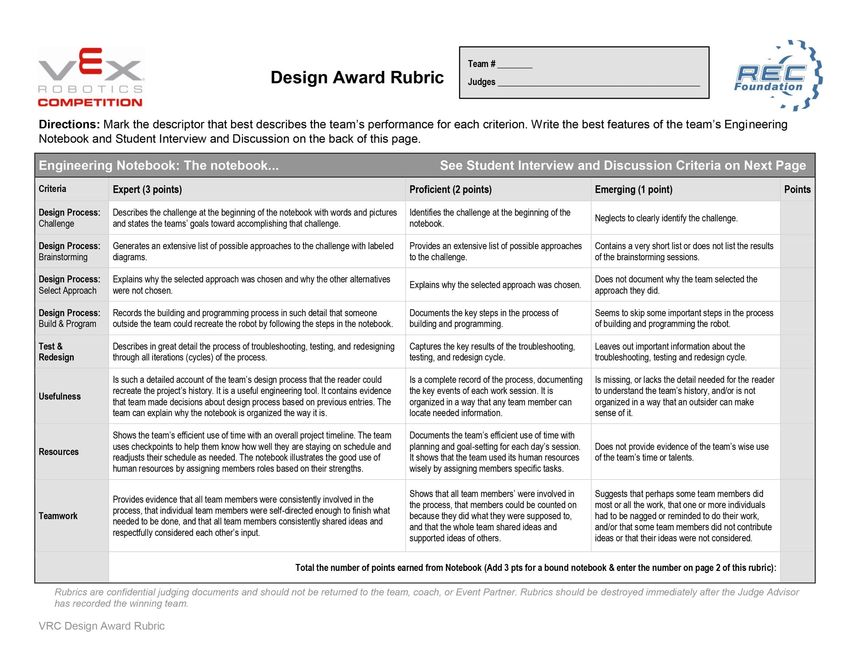
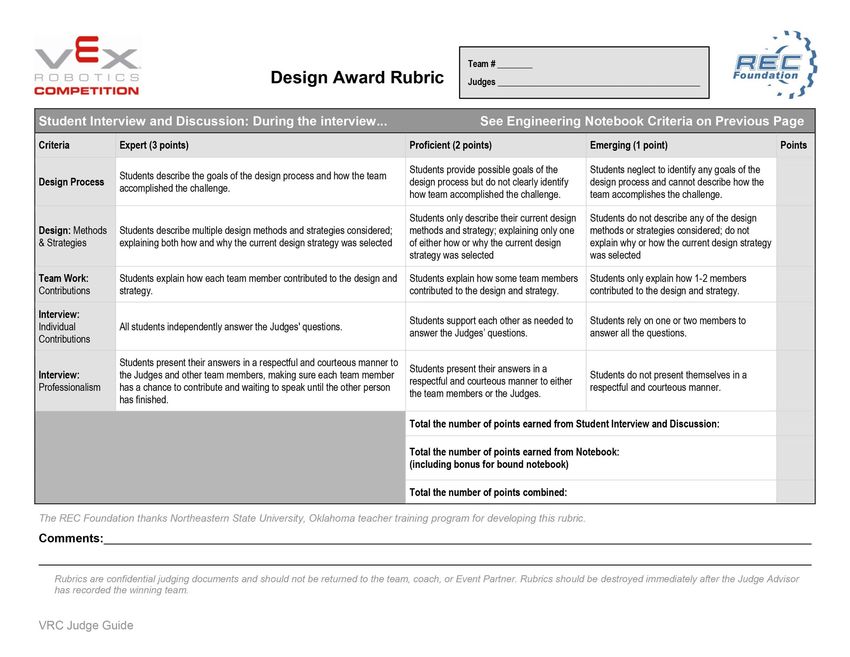
VRC Design Award Rubric
Judges must use the Design Award Rubric to evaluate the teams’ performance on the award criteria. A
record of all teams submitting notebooks shall be kept by the Judge Advisor. Notebooks shall be
collected during team check in and brought to the Judges’ room for evaluation.
VRC Judge Guide 9 9/17/2018
©REC Foundation 2018Judges may wish to perform a quick review of notebooks to separate notebooks into two categories:
developing and fully developed.
• Developing team notebooks are often turned in by new teams that have not yet developed a
strong VRC program. Mentors of these teams are often developing the idea of using a notebook
and are having their teams turn in the notebook as part of this process. These notebooks are not
going to be contenders for the Design Award. Judges may choose to not use a rubric to evaluate
these notebooks to save time. However, these notebooks should be retained in the event they
contain information that may affect decisions in other award categories, such as the Think Award
(if applicable).
• Fully developed teams are often veterans of several seasons or participate in programs with a
strong emphasis on notebooks. These Engineering Notebooks are more likely to be contenders
for the Design Award and should be evaluated using the first page of the Design Rubric.
Judging teams with fully developed notebooks may be broken down to a simple two-step process. The
first step identifies top contenders for the award, and the second step determines the award winner.
Using this process, it is not necessary for Judges to interview every team that submits an Engineering
Notebook.
Once Judges have identified fully developed notebooks using a quick review, they should then use the
first page of the Design Award Rubric to evaluate the quality of a team’s Engineering Notebook. The
Design Rubric may be found at the end of this guide. Notebooks should be separated into two
categories based on this evaluation: intermediate and outstanding. This process allows Judges to
identify the final teams that will be considered for follow up pit interviews. The intent of this process is to
allow Judges to identify top 5 or 20% of teams (which ever is larger) as contenders for the Design Award
efficiently based on their notebook.
The second step of the Design Award judging process is to use the second page of the rubric to
evaluate the top 5 (or 20%) teams’ understanding and application of an effective robot design process
during a team pit interview with Judges. The outcome of these interviews should be used to rank the top
5 (or 20%) contenders for the Design and Excellence Awards. The Design Award Rubric is found below.
Rubrics are confidential judging documents and are not to be returned to the team, coach, or Event
Partner. Rubrics are to be destroyed immediately after the Judge Advisor has recorded the winning
team.
Engineering Notebooks
One of the primary missions of the VEX Robotics Competition is to help students acquire real world life
skills that will benefit them in their academic and professional future. The Engineering Notebook is a
way for teams to document how the VEX Robotics Competition experience has helped them to better
understand the engineering design process while also practicing a variety of critical life skills including
project management, time management, brainstorming, and teamwork. Bound notebooks are preferred
by Judges and are given a 3-point bonus on the Design Rubric. Teams receive bound Engineering
Notebook when they register. Instructions and examples are included in the front of the notebook.
Each notebook is created through a concerted effort by a team to document their design decisions.
Large events may send a Design Award winner as well as the Excellence Award winner to a state or
regional championship, so teams should start their notebooks early and update them often.
Engineering is an iterative process whereby students recognize and define a problem, brainstorm and
work through various stages of the design process, test their designs, continue to improve their designs,
and continue the process until a solution has been identified. During this process, students will come
across obstacles, encounter instances of success and failure, and learn many lessons. It is this iterative
process that students should document in their Engineering Notebook.
VRC Judge Guide 10 9/17/2018
©REC Foundation 2018The Engineering Notebook is an opportunity to document everything a team does throughout the design
process. Students should include a number of items in their Engineering Notebook including:
• A table of contents
• Team meeting notes as they relate to the design process
• Design concepts, sketches and pictures
• Notes from competitions regarding observations that should be considered in the next iteration of
their design
• Programming improvements or significant modifications
• Team members’ observations and thoughts on their design
• Team organization practices as they relate to their design process
• Other documentation that a team finds useful as related to their robot’s design
The team should also document their project management practices including their use of personnel,
financial, and time resources.
A bound quad-ruled notebook is the preferred format. The Engineering Notebook provided by the REC
Foundation with team registrations includes hints and examples of good notebook practices. Teams
may use the notebook provided or purchase their own bound notebook. The team number should be on
the cover. The notebook should never be edited. Pages should never be removed from the notebook
even if they contain errors. The notebook should be written in ink with errors crossed out using a single
line. Pages should be numbered and entries should be dated in chronological order with each page
signed or initialed by the students. Additional materials such as examples of computer code or CAD
drawings should be glued or taped into the notebook.
The question of what is a ‘bound’ Engineering Notebook often arises. To be considered bound for the
purposes of the VRC program, a notebook must have been bound prior to any entries being made in it.
Teams concerned with the definition of a bound notebook are urged to simply use the VEX Engineering
Notebook they were supplied with upon registering their team or an equivalent notebook.
Judges will not accept electronic notebooks on lap tops, thumb drives, or cloud-based servers. Teams
will be interviewed in their pit area during local and state competitions.
Design Award at VEX Worlds
Teams must have been awarded the Design or Excellence Award at a state/regional/provincial/national
level championship event to be eligible for Design at VEX Worlds. Eligible teams will be notified during
the weeks prior to Worlds to submit their Engineering Notebooks at check in on Wednesday. Those
notebooks will be reviewed and teams with the highest rated Engineering Notebooks will be selected for
Design Award interviews in the team Pit Areas. Judges will complete the second page of the Design
Award Rubric following each interview. Judges will use the completed Rubrics to help determine the
Design Award winners. Teams are not given scheduled sit down interviews for the Design Award at VEX
Worlds.
Award Description and Criteria for Other Judged Awards
Not all awards will be offered at all events. Please check the event listing on robotevents.com or consult
your tournament organizer or Judge Advisor to confirm which awards will be offered at your event. The
following is a list of awards commonly offered at local qualifying events.
Most of these awards are Judged using the VEX Awards Scoring Sheet, which is available at the end of
this guide.
VRC Judge Guide 11 9/17/2018
©REC Foundation 2018The Amaze Award is presented to a team that has built an amazing, high-scoring and competitive robot
that clearly demonstrates overall quality.
Key criteria:
• Robot design is consistently high-scoring and competitive
• Robot demonstrates a solid mechanical design and is robustly constructed to fulfill designed task
• Robot programming and autonomous mode are consistently effective and successful
o Judges should consider the integration of sensors for use in both autonomous and driver-
controlled mode
• Teamwork, interview quality, and team professionalism
The Build Award is given to a team that has built a well-crafted and constructed robot that also shows a
clear dedication to safety and attention to detail.
Key criteria:
• Robot construction is of professional quality; robust, clean and elegant use of materials
o Solid construction (robot doesn’t “wobble”)
o Robust drive train and mechanisms
o Subsystems cleanly integrated, thought out and purposeful
• Robot efficiently uses mechanical and electrical components
• Robot is designed with a clear dedication to safety and attention to detail
• Robot demonstrates reliability on the field and holds up under competition conditions
• Teamwork, interview quality, and team professionalism
The Create Award is earned by a team that has a robot design that incorporates a creative engineering
solution to the design challenges of this season’s game.
Key criteria:
• Robot is a well-crafted, unique design solution, demonstrating creative thinking
• Team has demonstrated a highly creative engineering design process and methodology
• Team has committed to ambitious and creative approaches to playing the game
• Teamwork, interview quality, and team professionalism
The Energy Award is based on team enthusiasm displayed at the event. The winning team will
demonstrate boundless passion and energy throughout the competition – in the pit area, on the field,
and in the audience, even when their robot is not playing.
Key criteria:
• Team maintains a high level of excitement and energy throughout the event
• Team’s passion for competition and robotics enriches the event experience for others
• Teamwork, interview quality, and team professionalism
VRC Judge Guide 12 9/17/2018
©REC Foundation 2018The Innovate Award is presented to a team that has demonstrated a strong combination of ingenuity
and innovation in designing their VEX robot. This award will typically recognize a specific, unique piece
of engineering that exemplifies thinking outside of the box and innovative engineering design. This robot
feature should also be a part of the engineering design solution that solves the complex problems
presented by the VRC game.
Key criteria:
• Robot design demonstrates an ingenious and innovative piece of engineering
• Innovative feature is soundly crafted and is an effective solution to a design problem
• Innovative solution is integrated as a part of an overall well-crafted robot
• Students understand and explain why the innovative feature was necessary
o The award is not meant to recognize innovation for the sake of innovation, rather
innovation for the sake of excellence
• Teamwork, interview quality, and team professionalism
At VEX Worlds the Innovate Award will be presented to a top contender for the Design Award.
The Inspire Award is presented to a team that has inspired Judges with their approach to competitive
robotics. This team will effectively communicate their passion for the VRC program and maintain a
positive attitude throughout the event. The team will have a clear vision for their future and will
participate with both a high level of integrity and good sportsmanship. This team demonstrates that they
believe they can achieve what they set out to achieve through their diligence.
The Judges Award is presented to a team that the Judges determine is deserving of special
recognition. Judges consider a number of possible criteria for this award, such as team displays of
special attributes, exemplary effort and perseverance at the event, or team accomplishments or
endeavors throughout the season that may not fit under existing awards, but are nonetheless deserving
of special recognition.
The Sportsmanship Award is presented to a team that has earned the respect and admiration of the
volunteers and other teams at the event. VEX Worlds uses ballots for this award.
Key criteria:
• Team is courteous, helpful, and respectful to everyone at the event, on and off the field
• Team treats others on the playing field in the spirit of friendly competition and cooperation
• Team demonstrates respect and willingness to help to event staff and spectators
• Team demonstrates excitement and enthusiasm throughout the event
The Think Award is presented to a team that has successfully utilized autonomous programming
modes during competition. Teams must participate in the Autonomous skills challenge to be eligible for the
Think award.
Key criteria:
• All programming is cleanly written, well documented, and easy to understand
• Team has explained a clear programming strategy to solve the game challenge
• Team demonstrates their programming management process, including version history
• Team’s autonomous code is consistent and reliable
o Use of advanced programming techniques and/or sensors to control motion
o Multiple autonomous modes
o A simple mode which works consistently is preferred over an exaggerated mode which
only works occasionally
• Teamwork, interview quality, and team professionalism
VRC Judge Guide 13 9/17/2018
©REC Foundation 2018A simple way for Judges to evaluate teams for the Think Award is to watch the first two to three cycles
of qualifying matches and recording what each team does during the autonomous portion of the match.
Teams that consistently perform well during the autonomous portion of the match may be considered as
finalists for Think. Judges should then check the team notebook to see if there is documentation of the
team’s software development. This does not necessarily mean every line of code ever developed is in
the notebook, but rather that the team has documented the process of creating their code and included
examples of their code in their notebook.
The Volunteer of the Year Award is presented to an individual who demonstrates a commitment and
devotion to their community, putting in many hours of hard work with persistence and passion to help
make the event happen. In most cases, the local organizing committee or the Event Partner will choose
the winner of this award.
Robotics Education and Competition Foundation (REC Foundation) digital resources are made
freely available for competition and team use if proper REC Foundation branding is upheld.
Examples of acceptable use would be event partners or teams reproducing this document locally in
preparing for events or for use in running events. Individual pages may be printed as needed
provided their content is not modified.
VRC Judge Guide 14 9/17/2018
©REC Foundation 2018Judge Sign in Sheet
Student Interview and Discussion Tips
                           and Sample Questions for Judges

Student Interview and Discussion Tips
   •   Review the Engineering Notebooks and complete the appropriate section of the Design Award
       Rubric before meeting with teams.
   •   Be prepared to re-word your questions if you find that the team is struggling to understand or
       answer. It is important to be mindful of this point if the team or any of its members do not speak
       English as their first language.
   •   Try not to ask questions that allow the teams to answer with a yes or no, and encourage the
       teams to elaborate on their answers.
   •   The students may be nervous. A tournament can be a stressful experience. Asking them
       questions about their robot can help to put them at ease.
   •   Judges need to talk to students, not adults. Occasionally enthusiastic adults will want to answer
       a Judge’s questions. In this case, the Judge should politely remind the adult that Judges are
       there to talk with the students and that input from adults is not considered.
   •   When talking to young children, take a knee and smile. This will get you on the students’ level
       and help make them comfortable.
   •   Try to include as many student team members in your interview as possible.
   •   Being a Judge gives you a unique opportunity to impact students. They will be looking to you for
       positive reinforcement. Just a few words of encouragement can make their day. Try to leave
       each team with a positive feeling about their performance at the event.
   •   Taking a digital photo of each team with their robot oriented so that the license place is visible
       will help you identify teams and robots during deliberations.
   •   Use the provided “sorry we missed you” note in the pit area for teams that you can’t locate.
   •   Placing a colored adhesive dot on the team sign each time you meet with a team in the pit area
       will help you identify teams that have been spoken to by Judges.

Sample Questions
Getting the students talking is sometimes a harder task than it may seem. Here are some standard
questions that are typically effective in helping to get students to express themselves:
   •   Tell me about what your robot does and how?
   •   Did you turn in an Engineering Notebook? When did you start making entries?
   •   What part of your robot are you most proud of? Why?
   •   What were the challenges of this year’s game that you considered before designing your robot?
       How did you design your robot to meet those challenges?
   •   Has your approach to the game been effective? Why do you think your approach to the game
       has been effective?
   •   What does your robot do in autonomous mode? Who programed it?
   •   What makes your robot effective at playing this year’s game?
   •   Did you use any sensors? What are they used for? How do they operate in your autonomous
       mode? How do they operate in your driver-controlled mode?
   •   Based on your robot’s performance so far, what would you like to improve?
   •   Were there any other robots that inspired your robot design?
   •   How many subsystems does your robot have? Who was responsible for integrating them?

VRC Judge Guide                                    16                                        9/17/2018
                                                                                   ©REC Foundation 2018
Judge’s Note to Missed Teams
Please use the note on the next page if you have been unable to find a team in their pit area
after several attempts to interview them. This note may be left on a team’s pit table in an effort
to make sure that all teams are interviewed at an event.
VRC Judge Guide 17 9/17/2018
©REC Foundation 2018Judge’s Note to Missed Teams
Dear VEX Team number _____________,
We are sorry we missed you.
The Judges have come by to interview your team.
They will come back at _______________________________________
If you will NOT be available at this time please call _____________
We were here at:
Date: _____________ Time: _____________
Judge’s Note to Missed Teams
Dear VEX Team number _____________,
We are sorry we missed you.
The Judges have come by to interview your team.
They will come back at _______________________________________
If you will NOT be available at this time please call _____________
We were here at:
Date: _____________ Time: _____________(1 of 2)
9/17/2018(2 of 2)
9/17/2018Note Regarding Other Judged Awards
The Event Partner and Judge Advisor should determine which of the following 4 pages are to be used at
an event, if at all, and print them accordingly. Each score sheet is followed by descriptions of the awards
from the awards appendix. Not all events will need all sheets.
The Judge Advisor should instruct Judges to fill out the score sheets as follows:
“Each time you meet a team, fill in a row of scores on each scoring and ranking sheet, then rank each
team for each award. Compare each new team to the teams you ranked before. Give the new team the
appropriate number of tick marks and add one tick mark to the rank of each lower-ranked team.
Remember to look for Judges’ Award Candidates! The Judges’ Award goes to a team the Judges
decide is deserving of special recognition. Judges consider a number of possible criteria for this award,
such as team displays of special attributes, exemplary effort and perseverance at the event, and team
accomplishments or endeavors throughout the season that may not fall under existing awards but are
nonetheless deserving of special recognition.”
VRC Judge Guide 21 9/17/2018
©REC Foundation 2018VRC Awards Scoring and Ranking
9/17/2018Each time you meet a team, fill in a row of scores on each scoring and ranking sheet, then rank each
team for each award. Compare each new team to the teams you ranked before. Give the new team the
appropriate number of tick marks and add one tick mark to the rank of each lower-ranked team.
Remember to look for Judges’ Award Candidates! The Judges’ Award goes to a team the Judges
decide is deserving of special recognition. Judges consider a number of possible criteria for this award,
such as team displays of special attributes, exemplary effort and perseverance at the event, and team
accomplishments or endeavors throughout the season that may not fall under existing awards but are
nonetheless deserving of special recognition.
The Amaze Award is presented to a team that has built an amazing, high-scoring and competitive robot
that clearly demonstrates overall quality.
Key criteria:
• Robot design is consistently high-scoring and competitive
• Robot demonstrates a solid mechanical design and is robustly constructed to fulfill designed task
• Robot programming and autonomous mode are consistently effective and successful
o Integration of sensors for use in both autonomous and driver-controlled mode
• Teamwork, interview quality, and team professionalism
The Build Award is given to a team that has built a well-crafted and constructed robot that also shows a
clear dedication to safety and attention to detail.
Key criteria:
• Robot construction is of professional quality; robust, clean and elegant use of materials
o Solid construction (robot doesn’t “wobble”)
o Robust drive train and mechanisms
o Subsystems cleanly integrated, thought out and purposeful
• Robot efficiently uses mechanical and electrical components
• Robot is designed with a clear dedication to safety and attention to detail
• Robot demonstrates reliability on the field and holds up under competition conditions
• Teamwork, interview quality, and team professionalism
The Create Award is earned by a team that has a robot design that incorporates a creative engineering
solution to the design challenges of this season’s game.
Key criteria:
• Robot is a well-crafted, unique design solution, demonstrating creative thinking
• Team has demonstrated a highly creative engineering design process and methodology
• Team has committed to ambitious and creative approaches to playing the game
• Teamwork, interview quality, and team professionalism
The Think Award is presented to a team that has successfully utilized autonomous programming
modes during competition.
Key criteria:
• All programming is cleanly written, well documented, and easy to understand
• Team has explained a clear programming strategy to solve the game challenge
• Team demonstrates their programming management process, including version history
• Team’s autonomous code is consistent and reliable
o Use of advanced programming techniques and/or sensors to control motion
o Multiple autonomous modes
o A simple mode which works consistently is preferred over an exaggerated mode which only
works occasionally
• Teamwork, interview quality, and team professionalism
VRC Judge Guide 23 9/17/2018
©REC Foundation 20189/17/2018
VRC Judge Guide 24 9/17/2018
©REC Foundation 2018Each time you meet a team, fill in a row of scores on each scoring and ranking sheet, then rank each team
for each award. Compare each new team to the teams you ranked before. Give the new team the
appropriate number of tick marks and add one tick mark to the rank of each lower-ranked team.
Remember to look for Judges’ Award Candidates! The Judges’ Award goes to a team the Judges decide
is deserving of special recognition. Judges consider a number of possible criteria for this award, such as
team displays of special attributes, exemplary effort and perseverance at the event, and team
accomplishments or endeavors throughout the season that may not fall under existing awards but are
nonetheless deserving of special recognition.
The Innovate Award is presented to a team that has demonstrated a strong combination of ingenuity and
innovation in designing their VEX robot. This award will typically recognize a specific, unique piece of
engineering that exemplifies thinking outside of the box and innovative engineering design. This robot feature
should also be a part of the engineering design solution that solves the complex problems presented by the
VRC game. The design process of innovative features must be evident and well documented in the team’s
Engineering Notebook.
Key criteria:
• Robot design demonstrates an ingenious and innovative piece of engineering
• Innovative feature is soundly crafted and is an effective solution to a design problem
• Innovative solution is integrated as a part of an overall well-crafted robot
• Students understand and explain why the innovative feature was necessary
• Teamwork, interview quality, and team professionalism
The Sportsmanship Award is presented to a team that has earned the respect and admiration of the volunteers
and other teams at the event. VEX Worlds uses ballots for this award.
Key Criteria:
• Team is courteous, helpful, and respectful to everyone at the event, on and off the field
• Team treats others on the playing field in the spirit of friendly competition and cooperation
• Team demonstrates respect and willingness to help event staff, other teams and spectators
• Team demonstrates excitement and enthusiasm throughout the event
The Energy Award is presented to a team that displays a high level of enthusiasm and passion at the
event.
Key criteria:
• Team maintains a high level of excitement and energy throughout the event
• Team’s passion for competition and robotics enriches the event experience for others
• Teamwork, interview quality, and team professionalism
VRC Judge Guide 25 9/17/2018
©REC Foundation 2018You can also read


