SARS-COV-2 SEQUENCING UPDATE 15 OCTOBER 2021
←
→
Page content transcription
If your browser does not render page correctly, please read the page content below
Network for Genomic Surveillance South Africa (NGS-SA)
                                            SARS-CoV-2 Sequencing Update
                                                  15 October 2021

Prepared by the National Institute for Communicable Diseases (NICD) of the National Health Laboratory (NHLS) on behalf of the Network for Genomics Surveillance in South Africa (NGS-SA)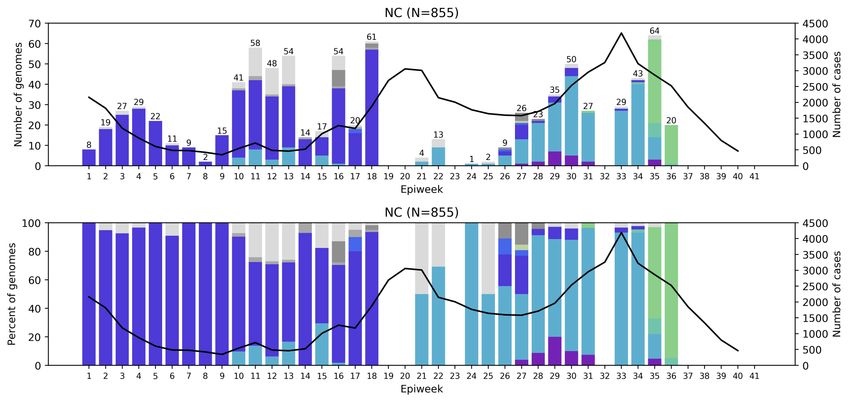
The genomic data presented here are based on South African
                                  SARS-CoV-2 sequence data downloaded from GISAID
                                       (www.gisaid.org) on 15 October at 17h20

                                    Data license: https://www.gisaid.org/registration/terms-of-use/

                          Elbe, S., and Buckland-Merrett, G. (2017) Data, disease and diplomacy: GISAID’s innovative
                          contribution to global health. Global Challenges, 1:33-46. DOI: 10.1002/gch2.1018 PMCID: 31565258
                          Shu, Y., McCauley, J. (2017) GISAID: Global initiative on sharing all influenza data – from vision to
                          reality. EuroSurveillance, 22(13) DOI: 10.2807/1560-7917.ES.2017.22.13.30494 PMCID: PMC5388101

Case data is based on specimen collection date. Cases from https://www.nicd.ac.za/diseases-a-z-index/disease-index-covid-19/surveillance-reports/weekly-
epidemiological-brief/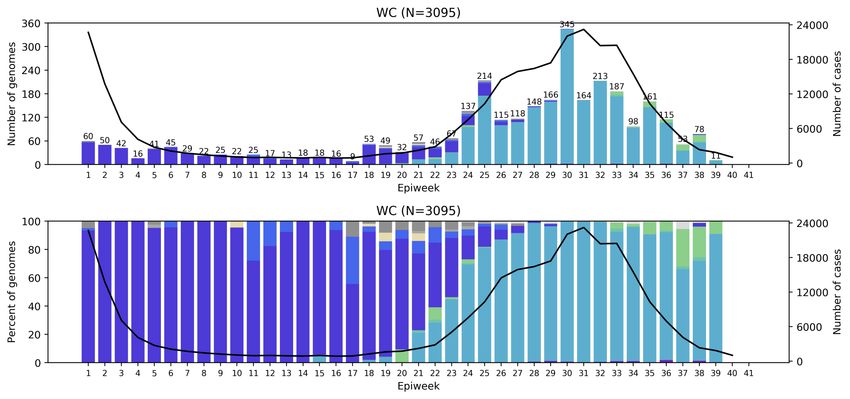
Number of South African genomes deposited on GISAID, by specimen collection week, 2020 and 2021
                                                                 (N=20 952*)

                              Total genomes: 20 952                                                                           Sequencing data ending epi
 900
                              2020 genomes: 6 083                                                                             week 39 (ending 2 October
                                                                                                                              2021)
                              2021 genomes: 14 869
                                                                                                                              Currently in epi week 41
                                                                                                                              (ending 16 October 2021)

 600
  Number of sequences

 300

                        10           20                     30                        40                        50               10              20        30
                                              2020                                                                                       2021
                                                                                                     Epidemiological week
*This represents the cleaned, de-duplicated dataset of unique sequences. This dataset will be used for all further figures.
GISAID genomes vs total cases, 2020 and 2021 (N=20 952)

All provinces, apart from GP, KZN, and WC, have comparable percentage of overall cases and overall sequenced genomes
Distribution and number of clades in South Africa, 2021 (N= 14 869)
                                                                                                   Delta has recently
                                                                                                   been split into
                                                                                                   three clades (21A,
                                                                                                   21I, 21J). We are
                                                                                                   in the process of
                                                                                                   updating the
                                                                                                   classification of all
                                                                                                   Delta samples
                                                                                                   submitted to date.

                                                                                                   Sequencing data
                                                                                                   ending epi week 39
                                                                                                   (ending 2 October
                                                                                                   2021)

                                                                                                   Currently in epi
                                                                                                   week 41 (ending 16
                                                                                                   October 2021)

Delta came to dominate by end June at >65% , in July at >85% and in August and September at >90%
                           C.1.2 present at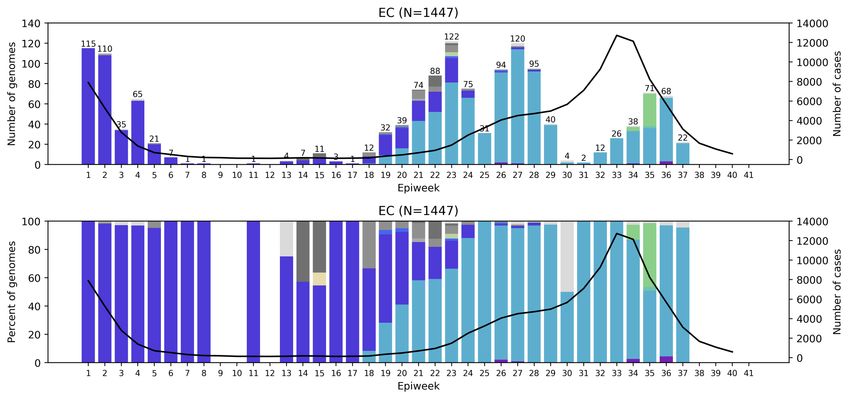
Prevalence of Variants of Concern (VOC) and Variants of Interest (VOI)
           in May and June 2021 sequences, South Africa
                                                                      June (N=3016)
      May (N=1186)

 Beta (20H, V2)
 (n=779, 66%)
                                                                 Delta (21A)
                                                                 (n=1974, 65%)

      Beta variant dominated in May, but the Delta variant started to dominate in June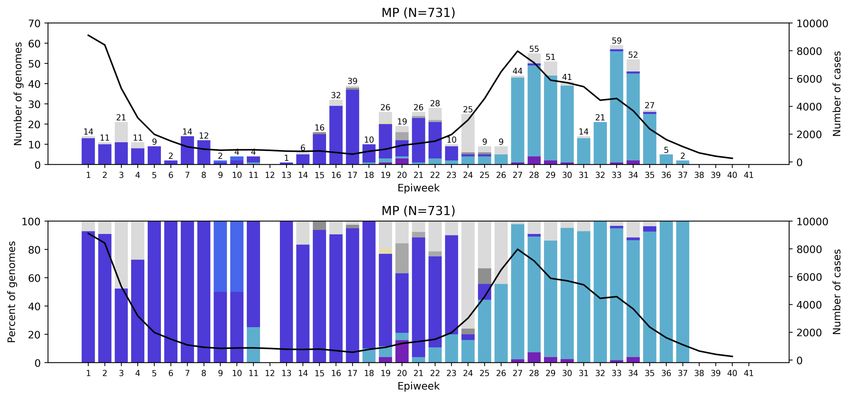
Prevalence of Variants of Concern (VOC) and Variants of Interest (VOI)
                   in July – September 2021 sequences, South Africa
        July (N=3963)                                                                        September (N=875)

  Delta (21A)
  (n=3536, 89%)                                         August (N=2323)

                                                                                        Delta (21A)
                                                                                        (n=669, 76%)

                                           Delta (21A)
                                           (n=2039, 95%)

The Delta variant dominated in July and August in South Africa, and appears to still dominate in early September.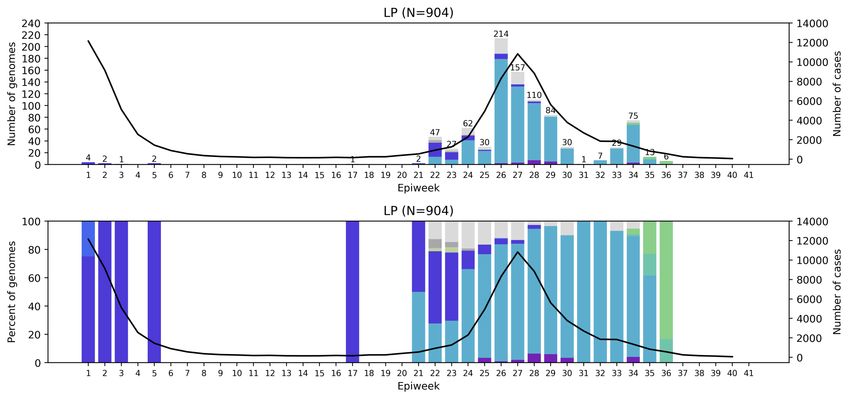
Genomes sequenced from specimens collected in May to mid-September 2021
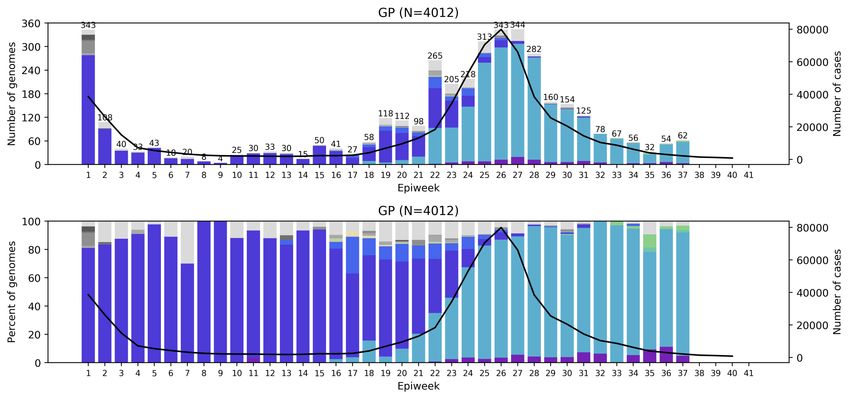
  (epiweeks 18 – 41) from Eastern Cape, Free State and Gauteng Provinces

  Delta dominates the third wave in Eastern Cape, Free State and Gauteng provinces
Genomes sequenced from specimens collected in May to mid-September 2021
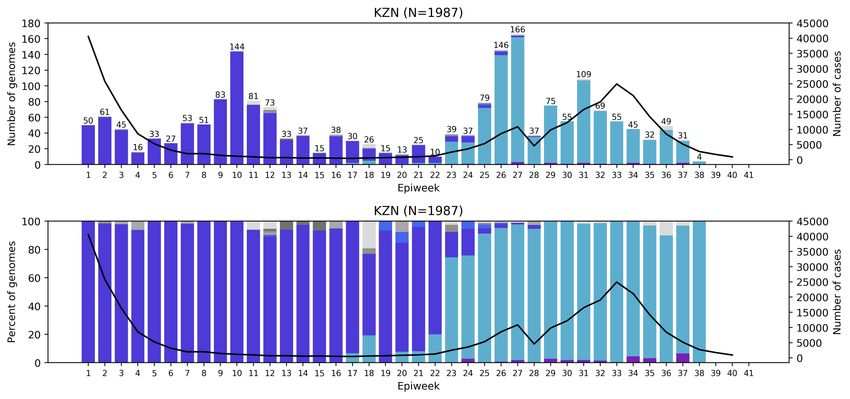
(epiweeks 18 – 41) from KwaZulu-Natal, Limpopo and Mpumalanga Provinces

Delta variant dominates the third wave in KwaZulu-Natal, Limpopo and Mpumalanga Provinces
Genomes sequenced from specimens collected in May to mid-September 2021
     (epiweeks 18 – 41) from Northern Cape, North West, and Western Cape Provinces

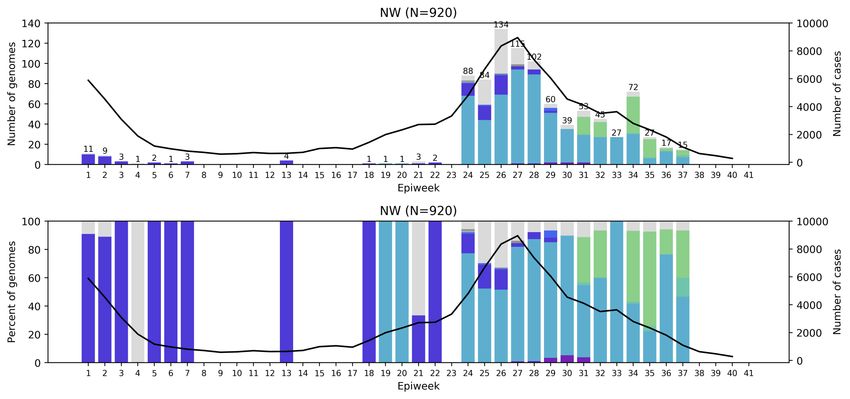
Delta dominates the third wave in Northern Cape, North West, and Western Cape provinces
Eastern Cape Province, 2021, n = 1447
Free State Province, 2021, n = 836
Gauteng Province, 2021, n = 4012
KwaZulu-Natal Province, 2021, n = 1987
Limpopo Province, 2021, n = 904
Mpumalanga Province, 2021, n = 731
Northern Cape Province, 2021, n = 885
North West Province, 2021, n = 920
Western Cape Province, 2021, n = 3095
Number of C.1.2 samples indicated above bar,
C.1.2 (n=226 in SA) in May – August 2021 by epiweek                                                 provinces ordered by number of detections

                                                                                                   11

  The majority of C.1.2 sequences have been detected in Gauteng (n=107), followed by Limpopo (n=22) and the
                                            Northern Cape (n=20).
Number of C.1.2 samples indicated above bar,
C.1.2 (n=226 in SA) in May – August 2021 by epiweek provinces ordered by number of detections
19 C.1.2 sequences have been detected in the Free State, 16 in KwaZulu-Natal, and 15 in Mpumalanga.Number of C.1.2 samples indicated above bar, C.1.2 (n=226 in SA) in May – August 2021 by epiweek provinces ordered by number of detections The Western Cape has 12 sequences, the North West has 8, and the Eastern Cape has 7 detections of C.1.2.
C.1.2 growth compared to Beta and Delta

C.1.2 continues to be detected at low levels (less than 4% of genomes per month)
Summary
• Delta has recently been split into three clades.
   • New clades have been assigned due to >20% global circulation of particular sequences for
     more than 2 months
   • We are in the process of updating the classification of all Delta samples submitted to date.

• Delta continues to dominate in all provinces from specimens collected in
  September

• Overall number of lineages detected decreased as Delta became dominant

• Mutated C.1.2 lineage has now been detected in all provinces of South Africa
   • The frequency of C.1.2 at less than 4% of genomes from May through early September.

• Lambda and Mu variants not detected in South Africa
UKZN-Inkosi Albert University of University of Stellenbosch
Luthuli Central Hospital KwaZulu-Natal &
Africa Health & NHLS Tygerberg Virology
Research Institute
KRISP at UKZN:
Dr Khanyi Msomi Tulio de Oliveira
Dr Kerusha Govender Richard Lessels
Houriiyah Tegally Susan Engelbrecht
Dr Pravi Moodley
Eduan Wilkinson Wolfgang Preiser
Dr Aabida Khan Gert van Zyl
Jennifer Giandhari
Dr Lili Gounder Sureshnee Pillay Tongai Maponga
Dr Kerri Francois Emmanuel James San Bronwyn Kleinhans
Dr Cherise Naicker Shannon Wilson
Dr Joedene Chetty Karabo Phadu
AHRI Tania Stander
Dr Neli Ngcaba
Alex Sigal Kamela Mahlakwane
Dr Tshepiso Mosito Sandile Cele Mathilda Claassen
Mr Malcolm Ellapen Willem Hanekom Diagnostic laboratory staff
Mr Kubendran Reddy
The COVID-19 Bench teamUniversity of Cape Town, NHLS University of the
& WCG Free State
NHLS-UCT WCG-UCT UFS
Carolyn Williamson Mary-Anne Davies Dominique Goedhals
Nei-yuan Hsiao Hannah Hussey Armand Bester
Diana Hardie Andrew Boulle Martin Myaga
Kruger Marais Masudah Paleker Peter Mwangi
Stephen Korsman Theuns Jacobs Emmanuel Ogunbayo
Ziyaad Valley-Omar Erna Morden Milton Mogotsi
Makgotso Maotoana
Lutfiyya Mohamed
UCT, IDM and CIDRI-Africa
NHLS Division of Virology
Deelan Doolabh Robert Wilkinson Sabeehah Vawda
Arash Iranzadeh Darren Martin Felicity Burt
Lynn Tyers Nicola Mulder Thokozani Mkhize
Innocent Mudau Wendy Burgers Diagnostic laboratory staff
Nokuzola Mbhele Ntobeko Ntusi
Fezokuhle Khumalo Rageema Joseph
Thabang Serakge Sean Wasserman
Bruna Galvão Linda Boloko
Arghavan Alisoltani
(U. California)National Institute for Communicable Diseases Zoonotic arbo and respiratory virus
program
Centre for Viral Zoonoses
Centre for Respiratory Centre for HIV and STIs Sequencing Core Facility Department Medical Virology/ NHLS
Diseases & Meningitis
Jinal Bhiman
Cathrine Scheepers Zamantungwa Khumalo Tshwane Academic division
Constantinos Kurt Wibmer Annie Chan
Anne von Gottberg Thandeka Moyo Morne du Plessis University of Pretoria
Thabo Mohale Tandile Hermanus Stanford Kwenda
Daniel Amoako Frances Ayres Phillip Senzo Mtshali ZARV research program/UP
Josie Everatt Zanele Molaudzi Mushal Allam Marietjie Venter (Head: ZARV)
Boitshoko Mahlangu Bronwen Lambson Florah Mnyameni Adriano Mendes (Postdoc)
Noxolo Ntuli Tandile Hermanus Arshad Ismail Amy Strydom (Postdoc)
Anele Mnguni Mashudu Madzivhandila Michaela Davis (MSc, intern medical scientist)
Amelia Buys Prudence Kgagudi
Cardia Fourie Brent Oosthuysen
Noluthando Duma Penny Moore
Linda de Gouveia Lynn Morris NHLS Tshwane
Jackie Kleynhans Prof Simnikiwe Mayaphi (HOD)
Nicole Wolter NICD Groups
Sibongile Walaza NICD COVID-19 response team Funders:
Mignon du Plessis NICD SARS-CoV-2 Sequencing GIZ/BMBF: African Network for Improved
Stefano Tempia Group diagnostics and epidemiology of common and
Mvuyo Makhasi emerging infectious agents (ANDEMIA)
Cheryl Cohen G7 Global Health fund, Robert Koch Institute, Dr
Fabian LeendertzAdditional support and collaborators
Lancet CAPRISA Africa CDC
NHLS
Koeleka Mlisana Allison J. Glass Salim Abdool Karim John Nkengasong
Zinhle Makatini Nigel Garret Sofonias Tessema
Eugene Elliot Ampath
Florette K. Treurnicht Terry Marshall UKZN - Big Data Netcare:
Kathleen Subramoney Cindy van Deventer Francesco Pettruccione Richard Friedland
Oluwakemi Laguda-Akingba Eddie Silberbauer Craig Murphy
Ilya Sinayskiy
Shareef Abrahams Caroline Maslo
Greta Hoyland Liza Sitharam
University of Oxford
Gloria Selabe Pathcare Vermaak
José Lourenço
Elias Bereda Andries Dreyer DSI
Jeannette Wadula Howard Newman
FioCruz, Brazil Glaudina Loots
Riaan Writes
Marianne Wolfaardt Vagner Fonseca
Hyrax Biosciences SA MRC
Warren Lowman Marta Giovanetti
Simon Travers Glenda Gray
Luiz Carlos Junior Alcantara
Cape Town HVTN Laboratory Bridge-the-Gap
Erica Anderson-Nissen Raymond Rott
Anneta Naidoo
Cytespace Africa Laboratories
Ndlovu Research Christa Viljoen
Hugo Tempelman
CJ Umunnakwe ARC-OVI
Lia RotherhamSouth African genomes submitted per sequencing lab,
2020 and 2021 (N=20 952)
* * * * * *
*NGS-SA laboratories
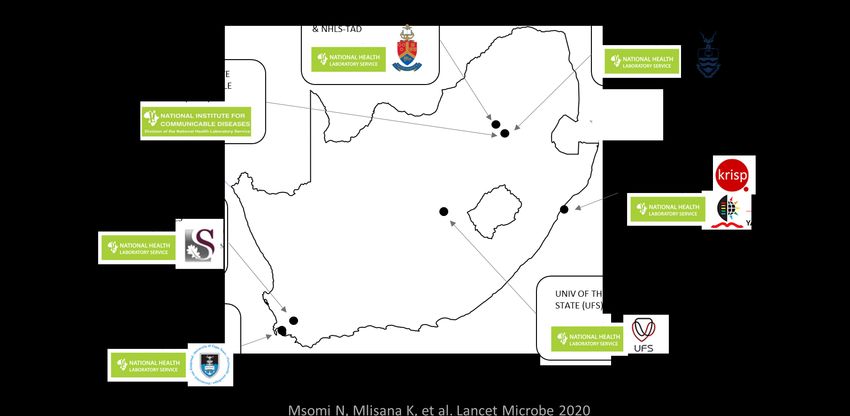
Multiple labs from NGS-SA are contributing to the sequencing effort. Sequencing efforts have
increased with the third wave.Variants of Concern (VOC)
Pango Nextstrain Additional amino acid Earliest documented
WHO label GISAID clade Date of designation
lineages+ clade changes monitored* samples
+S:484K United Kingdom,
Alpha B.1.1.7# GRY 20I (V1) 18-Dec-2020
+S:452R Sep-2020
+S:L18F South Africa,
Beta B.1.351 GH/501Y.V2 20H (V2) 18-Dec-2020
May-2020
Brazil,
Gamma P.1 GR/501Y.V3 20J (V3) +S:681H 11-Jan-2021
Nov-2020
+S:417N India, VOI: 4-Apr-2021
Delta B.1.617.2§ G/478K.V1 21A
Oct-2020 VOC: 11-May-2021
https://www.who.int/en/activities/tracking-SARS-CoV-2-variants/ accessed 17 September 2021
*Notable spike (S) amino acid changes under monitoring, which are currently reported in a minority of sequenced samples
+Includes all descendant lineages.
#Includes all Q.* lineages in the PANGO nomenclature system.
§Includes all AY.* lineages in the PANGO nomenclature system.Currently designated Variants of Interest (VOI)
Pango* Nextstrain Earliest documented Date of
WHO label GISAID clade
lineages clade samples designation
Lambda C.37 GR/452Q.V1 21G Peru, Dec-2020 14-Jun-2021
Mu B.1.631 GH 21H Colombia, Jan-2021 30-Aug-2021
https://www.who.int/en/activities/tracking-SARS-CoV-2-variants/ accessed 27 September 2021
*Includes all descendant lineages.Submission of routine specimens for sequencing
• representative of multiple geographic regions (provinces/districts/health
facilities) from individuals of
• all ages
• over as many time periods during the SARS-CoV-2 epidemic in South Africa
• requested that testing laboratories in both the private and public sectors,
submit respiratory samples to their closest NGS-SA sequencing laboratory
on a routine basis (ideally every week) as follows, depending on the
capacity of the testing laboratory:
• All positives samples should be sent every week (NGS-SA laboratory will perform
random sampling as described below) OR
• A weekly selection of approximately 10%-20% of randomly selected positive samples
should be sent every week. Number of selected samples will depend on the size of
laboratory and how many other laboratories are drained by the submitting
laboratory.Submission of special interest specimens for sequencing In addition to routine samples mentioned above, please send specimens separately to above and clearly marked if: • Suspected vaccine breakthrough (≥14 days after vaccine), especially if hospitalised and clinically severe • Suspected re-infection (≥90 days after previous episode), especially if hospitalised and clinically severe • Prolonged shedding with high SARS-CoV-2 viral loads (i.e. Ct values less than 30 for more than 1 month post-primary diagnosis) in immunocompromised individuals • Possible animal-to-human transmission • Suspected cases of importation from another country, especially countries known to harbour SARS-CoV-2 variants of concern or countries with little available information • Clusters of “unusual” cases (e.g., in terms of disease presentation, patient groups affected, etc.)
You can also read


