SARS-COV-2 VARIANTS OF CONCERN AND VARIANTS UNDER INVESTIGATION IN ENGLAND - TECHNICAL BRIEFING 13
←
→
Page content transcription
If your browser does not render page correctly, please read the page content below
SARS-CoV-2 variants of concern and
variants under investigation in
England
Technical briefing 13
27 May 2021

This briefing provides an update on previous briefings up to 22 May 2021

1

SARS-CoV-2 variants of concern and variants under investigation

Contents
Summary............................................................................................................................. 3
   Published information on variants.................................................................................... 4
Part 1: Surveillance overview .............................................................................................. 5
   Variants under surveillance ............................................................................................. 5
   Variant prevalence......................................................................................................... 13
   Variant growth rates ...................................................................................................... 20
   Use of rapid genotyping assays .................................................................................... 21
   Secondary attack rates .................................................................................................. 21
   Surveillance of reinfections ............................................................................................ 30
   SARS-CoV-2 Immunity and Reinfection Evaluation (the SIREN study) cohort
   monitoring ...................................................................................................................... 32
Part 2: VOC-21APR-02 (B.1.617.2) surveillance .............................................................. 34
   Surveillance through genomic data ............................................................................... 34
   Spatial variation in risk................................................................................................... 38
   Cluster analysis ............................................................................................................. 39
   Surveillance of cases in travellers from India ................................................................ 41
   Surveillance through S gene detection .......................................................................... 42
   Live virus and pseudovirus neutralization ...................................................................... 55
   Monitoring of vaccine effectiveness ............................................................................... 56
   Serial interval and viral load dynamics .......................................................................... 56
   VUI-21APR-01 (B.1.617.1) ............................................................................................ 57
   VUI-21APR-03 (B.1.617.3) ............................................................................................ 61
Part 3: New variant under investigation VUI-21MAY-02 (C.36.3) ...................................... 65
Sources and acknowledgments ........................................................................................ 67

                                                                  2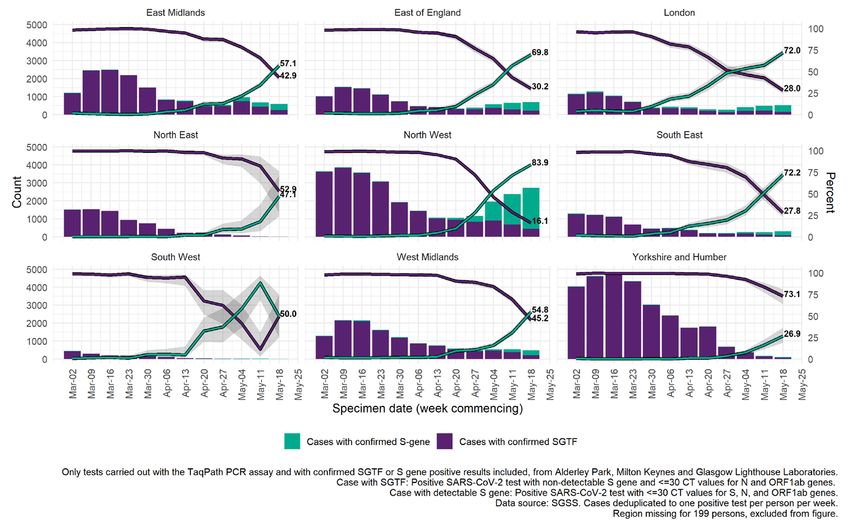
SARS-CoV-2 variants of concern and variants under investigation

Summary
There are 5 variants of concern and 9 variants under investigation (Table 1).

This report has been published to continue to share detailed surveillance of VOC-21APR-
02 (B.1.617.2) and information on a new variant under investigation VUI-21MAY-02
(C.36.3). A separate report is published covering our routine data on all other VOCs and
VUIs. These additional specialist technical briefings represent early data and analysis on
an emerging variant and findings have a high level of uncertainty.

Whilst case numbers remain very low, the proportion of cases which are VOC-21APR-02
(B.1.617.2) has continued to increase, as monitored through both genomic and S gene
target data. VOC-21APR-02 is likely to be the predominant variant in England although
there is regional heterogeneity.

Iterated vaccine effectiveness analysis combined with additional neutralisation data from
multiple samples tested at multiple laboratories continues to support the assessment of
reduced vaccine effectiveness after the first dose.

The median time to onset of symptoms in household contacts, where the index case is
B.1.617.2, is 4 days, which is the same as for B.1.1.7 (using routine contact tracing data).
Longitudinal sampling studies have commenced.

Data on hospital admissions with vaccination status is now included and will form part of
ongoing surveillance and vaccine effectiveness monitoring.

K417N, a receptor binding domain mutation associated with antigenic change and present
in B.1.351 (VOC-20DEC-02), has been noted in a small number of cases of B.1.617.2, in
addition to the standard mutations for this lineage.

The risk assessment for VOC-21APR-02 (B.1.617.2) is published separately.

                                                  3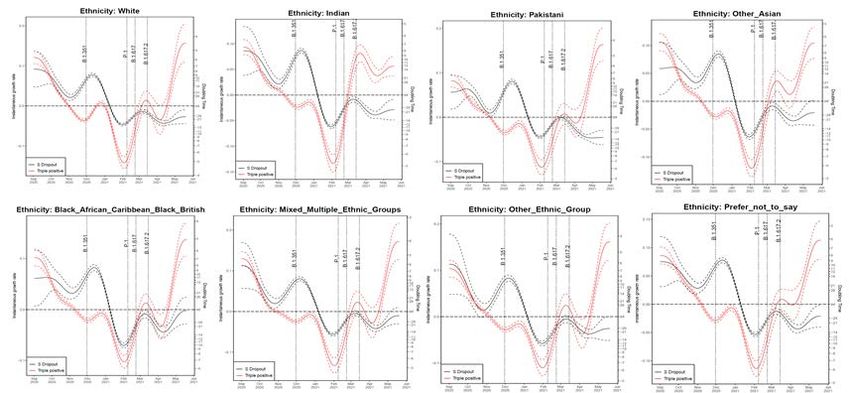
SARS-CoV-2 variants of concern and variants under investigation

Published information on variants
The collection page gives content on variants, including prior technical briefings.
Definitions for variants of concern, variants under investigation and signals in monitoring
are detailed in technical briefing 8. Data on variants not detailed here is published in the
variant data update. Variant risk assessments are available in prior technical briefings. A
repository containing the up-to-date genomic definitions for all variants of concern (VOC)
and variants under investigation (VUI) as curated by Public Health England was created
on 5 March 2021. The repository can be accessed on GitHub.

                                                  4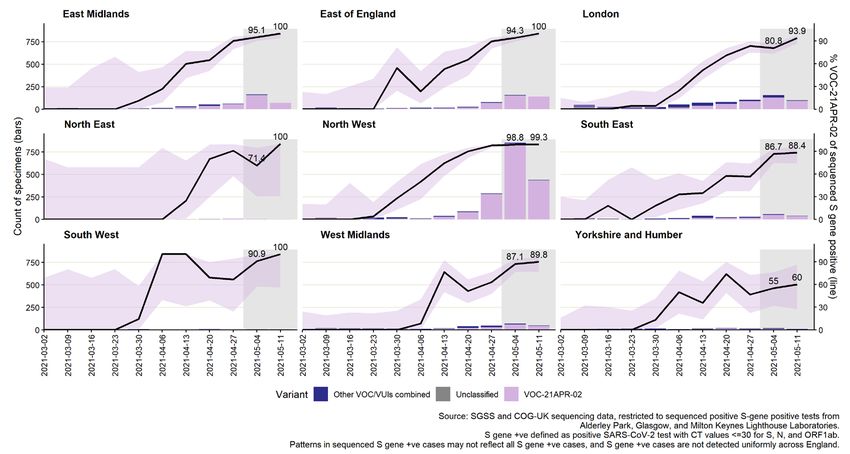
SARS-CoV-2 variants of concern and variants under investigation

Part 1: Surveillance overview

Variants under surveillance
Table 1 shows the current variants of concern (VOC) and variants under investigation
(VUI). Figure 1 shows the proportion of cases sequenced over time. Summary
epidemiology on each variant is shown in Table 2, case numbers are also updated online.
Tables 3a and 3b show hospitalisation and death data. Figure 2 shows cumulative cases
of variants over time, indexed by the day of the fifth case.

                                                  5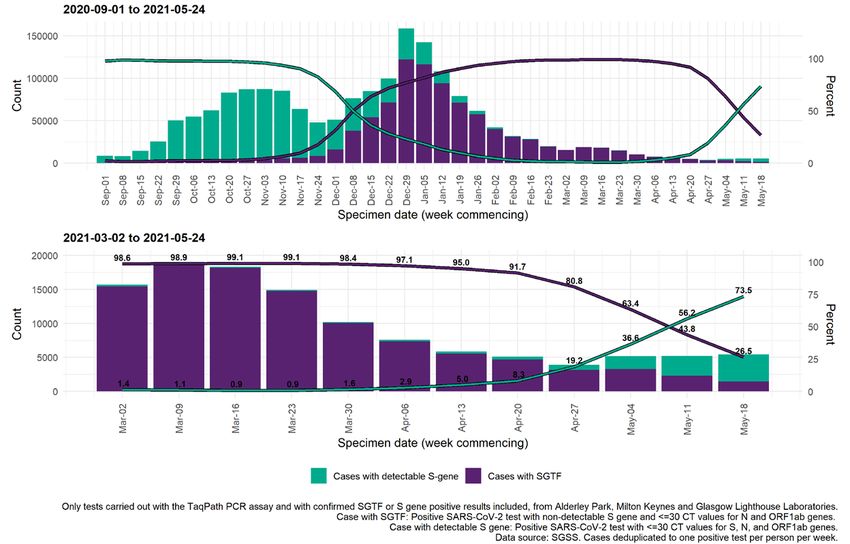
SARS-CoV-2 variants of concern and variants under investigation

Table 1. Variant lineage and designation as of 25 May 2021 (provisionally extinct
variants removed)

 Lineage                               Designation                First detected in   Status
                                                                  sequence from
 B.1.1.7                               VOC-20DEC-01               UK                  VOC
 B.1.351                               VOC-20DEC-02               South Africa        VOC
 P.1                                   VOC-21JAN-02               Japan ex Brazil     VOC
 B1.1.7 with E484K                     VOC-21FEB-02               UK                  VOC
 B.1.617.2                             VOC-21APR-02               India               VOC
 P.2                                   VUI-21JAN-01               Brazil              VUI
 A.23.1 with E484K                     VUI-21FEB-01               UK                  VUI
 B.1.525                               VUI-21FEB-03               UK                  VUI
 B.1.1.318                             VUI-21FEB-04               UK                  VUI
 P.3                                   VUI-21MAR-02               Philippines         VUI
 B.1.617.1                             VUI-21APR-01               India               VUI
 B.1.617.3                             VUI-21APR-03               India               VUI
 AV.1                                  VUI-21MAY-01               UK                  VUI
 C.36.3                                VUI-21MAY-02               Thailand ex Egypt   VUI
 B.1.429                                                                              Monitoring
 B.1.1.7 with S494P                                                                   Monitoring
 A.27                                                                                 Monitoring
 B.1.526                                                                              Monitoring
 B.1.1.7 with Q677H                                                                   Monitoring
 B.1.620                                                                              Monitoring
 B1.214.2                                                                             Monitoring
 B.1.1.1 with L452Q and F490S                                                         Monitoring
 R.1                                                                                  Monitoring
 B.1.1.28 with N501T and                                                              Monitoring
 E484Q
 B.1.621                                                                              Monitoring
 B.1 with 214insQAS                                                                   Monitoring
 AT.1                                                                                 Monitoring

                                                  6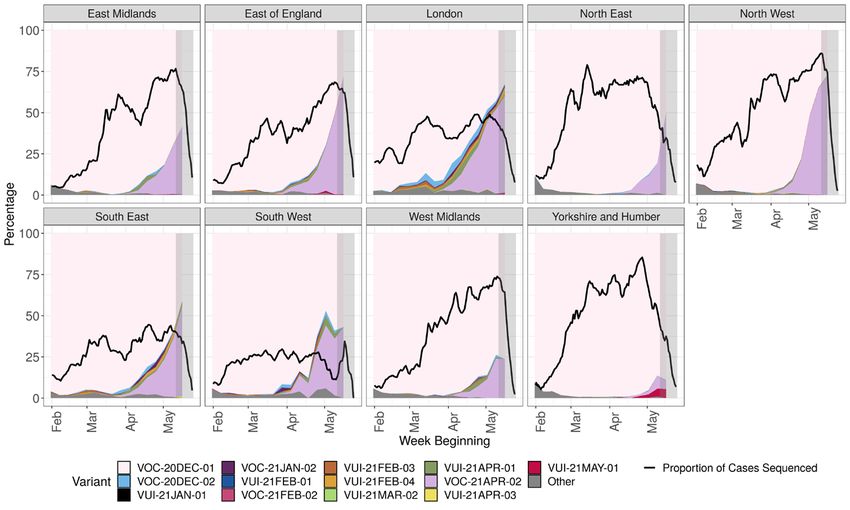
SARS-CoV-2 variants of concern and variants under investigation

Sequencing coverage
Figure 1. Coverage of sequencing: percentage of SARS-CoV-2 cases sequenced over time as of 24 May 2021

(Find accessible data used in this graph in underlying data)

                                                                  7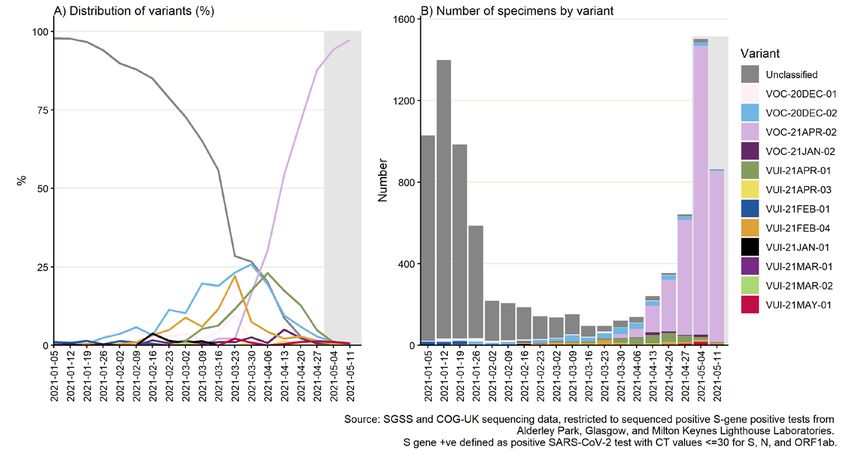
SARS-CoV-2 variants of concern and variants under investigation

VOC and VUI case numbers, proportion, deaths and case fatality
rate
Table 2 shows the number of cases and deaths associated with each variant of concern
and variant under investigation, and the proportion of total sequenced cases accounted for
by each variant. Table 3 shows the number of cases known to be infected with VOC/VUIs
who visited an NHS Emergency Department, the number who were admitted, and the
number who died in any setting (note data is shown from 1 February 2021 onwards to
enable comparison). Figure 2 shows the cumulative number of cases per variant indexed
by days since first report.

Table 2. Case number, proportion, death and case fatality rate of variants of
concern and variant under investigation from 1 October 2020 to 25 May 2021

 Variant                 Case number        Case proportion       Deaths   Case fatality

 VOC-20DEC-01                  210,662      96.374%                4,152   2.0%
                                                                           (1.9 to 2.0%)

 VOC-20DEC-02                       831     0.38%                    13    1.6%
                                                                           (0.8 to 2.7%)

 VOC-21APR-02*                    5,599     2.561%                   12    0.2%
                                                                           (0.1 to 0.4%)

 VOC-21FEB-02                        43     0.02%                      1   2.3%
                                                                           (0.1 to 12.3%)

 VOC-21JAN-02                       145     0.066%                     0   0.0%
                                                                           (0.0 to 2.5%)

 VUI-21APR-01                       406     0.186%                     0   0.0%
                                                                           (0.0 to 0.9%)

 VUI-21APR-03                        14     0.006%                     0   0.0%
                                                                           (0.0 to 23.2%)

 VUI-21FEB-01                        79     0.036%                     2   2.5%
                                                                           (0.3 to 8.8%)

 VUI-21FEB-03                       430     0.197%                   12    2.8%
                                                                           (1.5 to 4.8%)

 VUI-21FEB-04                       228     0.104%                     1   0.4%
                                                                           (0.0 to 2.4%)

                                                  8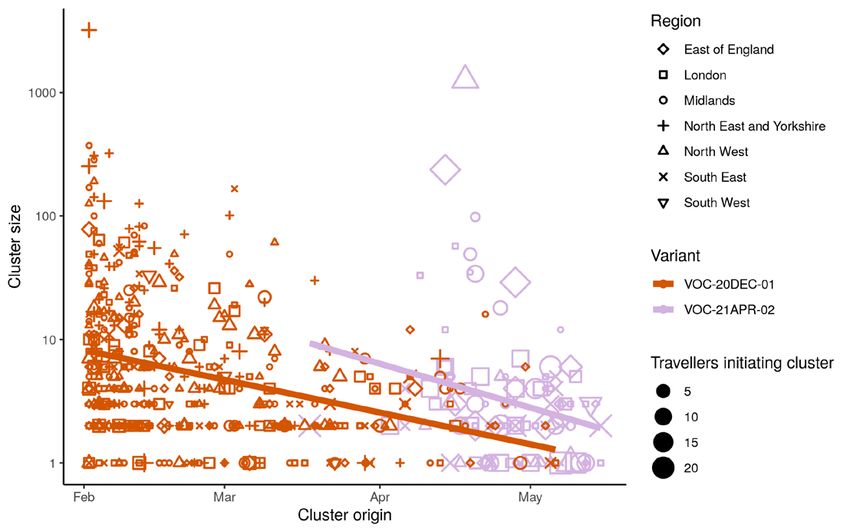
SARS-CoV-2 variants of concern and variants under investigation

  VUI-21JAN-01                        54     0.025%                            1     1.9%
                                                                                     (0.0 to 9.9%)

  VUI-21MAR-01                         2     0.001%                            0     0.0%
                                                                                     (0.0 to 84.2%)

  VUI-21MAR-02                         6     0.003%                            0     0.0%
                                                                                     (0.0 to 45.9%)

  VUI-21MAY-01                        90     0.041%                            0     0.0%
                                                                                     (0.0 to 4.0%)

Excludes variant cases not linked to a known COVID-19 case or with provisional sequencing/genotyping
results.
a
  Case number England genomic cases 25 May 2021.
b
  Deaths as of 25 May 2021 (within 28 days) with confirmed or probable VOC or total cases.
c
  95% Confidence Intervals calculated with Clopper–Pearson exact method, using R package PropCIs.
* VOC-21APR-02 includes a high proportion of recent cases who have not completed 28 days of follow up.

                                                   9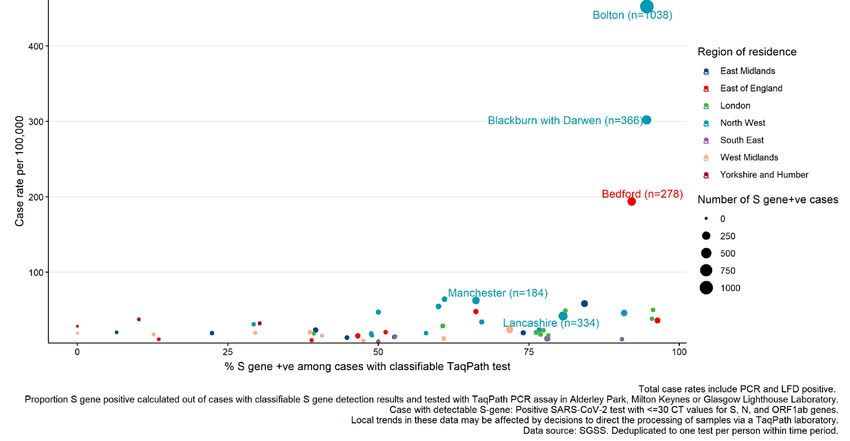
SARS-CoV-2 variants of concern and variants under investigation

Table 3a. Attendance to emergency care and deaths among all COVID-19 sequenced cases in England, 1 February 2021 to
25 May 2021

                                                                                                     Cases where
                                                                                                    presentation to
                                                      Cases with
                              Cases since                                        Cases with an     A&E resulted in
        Variant                                    specimen date in                                                           Deaths^
                              01 Feb 2021¥                                        A&E visit§           overnight
                                                     past 28 days
                                                                                                       inpatient
                                                                                                      admission§
                                                   Number              %        Number         %   Number      %      Number            %

VOC-20DEC-01                136,048               9,554           7.0       5,391        4.0       2,079    1.5       1,703       1.3
VOC-20DEC-02                628                   74              11.8      26           4.1       9        1.        8           1.3
VOC-21JAN-02                145                   36              24.8      7            4.8       1        0.7       0           NA
VOC-21FEB-02                17                    0               NA        0            NA        0        NA        1           5.9
VOC-21APR-02                5,599                 4,665           83.3      201          3.6       43       0.8       12          0.2
VUI-21JAN-01                24                    0               NA        1            4.2       1        1.2       0           NA
VUI-21FEB-01                8                     0               NA        0            NA        0        NA        0           NA
VUI-21FEB-03                376                   39              10.4      10           2.7       3        0.8       7           1.9
VUI-21FEB-04                221                   43              19.5      3            1.4       0        NA        1           0.5
VUI-21MAR-02                6                     0               NA        0            NA        0        NA        0           NA
VUI-21APR-01                406                   77              19.0      7            1.7       2        0.5       0           NA
VUI-21APR-03                14                    2               14.3      0            NA        0        NA        0           NA
VUI-21MAY-01                90                    76              84.4      0            NA        0        NA        0           NA

                                                                           10
SARS-CoV-2 variants of concern and variants under investigation
Table 3b. Attendance to emergency care and deaths by vaccination status among VOC-21APR-02 confirmed cases in
England, 1 February 2021 to 25 May 2021
Cases withSARS-CoV-2 variants of concern and variants under investigation
Figure 2. Cumulative cases in England of variants indexed by days since the fifth reported, data as of 25 May 2021
(Find accessible data used in this graph in underlying data).
Figure 2 demonstrates the rapid identification of VOC-21APR-02 (B.1.617.2) cases over a short period of time.
12SARS-CoV-2 variants of concern and variants under investigation
Variant prevalence
The prevalence of different variants amongst all sequenced cases is presented in Figure
3, split by region in Figure 4 and by travel status in Figure 5. The ‘Other’ category in Figure
3 and Figure 4 includes genomes where the quality is insufficient to determine variant
status and genomes that do not meet the current definition for any designated variant
under investigation or variant of concern. The total genomic dataset used for this
assessment includes enhanced testing and sequencing from individuals who have
travelled, and surge testing and sequencing in outbreak areas. Sequencing numbers and
coverage fall in the last week shown due partly to sequencing lag time, and new
sequences are still being produced relating to sample dates in that week. Rapid
genotyping assay results that have not been confirmed by sequencing have been
removed from this dataset. The supplementary data for figures are available.
13SARS-CoV-2 variants of concern and variants under investigation
Figure 3. Variant prevalence for all England available case data from 1 February 2021 as of 25 May 2021
(excluding cases where the specimen date was unknown)
14SARS-CoV-2 variants of concern and variants under investigation
The most recent data shows 58% of sequenced cases are VOC-21APR-02. At the latest
data point where there is complete data (outside the grey region), 43% of sequenced
cases are VOC-21APR-02. The black line indicates proportion of cases sequenced in a
7-day rolling window. The area in grey shows weeks where the sequence data is still
accumulating, therefore the proportions are less likely to accurately reflect prevalence.
Rapid genotyping assay results that have not been confirmed by sequencing have been
removed from this dataset. (Find accessible data used in this graph in
15SARS-CoV-2 variants of concern and variants under investigation
Figure 4. Variant prevalence for all England available case data from 1 February 2021 as of 25 May 2021 by region
(excluding cases where the region or specimen date were unknown)
16SARS-CoV-2 variants of concern and variants under investigation
In figure 4, the black line indicates proportion of cases sequenced in a 7-day sliding
window. The area in grey shows weeks where the sequence data is still accumulating,
therefore the proportions are less likely to accurately reflect prevalence. Rapid genotyping
assay results that have not been confirmed by sequencing have been removed from this
dataset. Data for most recent 2 weeks is incomplete. (Find accessible data used in this
graph in
17SARS-CoV-2 variants of concern and variants under investigation
Figure 5. Prevalence of variants over time: all sequenced cases in England, split by travel status as of 25 May 2021
(excluding cases where the specimen date is unknown)
18SARS-CoV-2 variants of concern and variants under investigation Travel status is assigned based an interval of
SARS-CoV-2 variants of concern and variants under investigation

Variant growth rates
Logistic growth rates (1/week from 1 January 2021 as of 25 May 2021) relative to VOC-
20DEC-01 (B.1.1.7) are calculated for each VUI or VOC with more than 20 samples and
shown in Table 4. Sample inclusion criteria are: 1) A non-traveller as determined by
matching each case against passenger locator forms and managed quarantine service
test codes 2) Collected from Pillar 2 testing. 3) If multiple sequences are collected from the
same patient which show the same variant, the first sample is retained. Additionally,
samples with missing or unknown date of sample collection or upper tier local authority
(UTLA) of residence are excluded.

A sample of VOC-20DEC-01 (B.1.1.7) is collected for measuring relative growth rates by
weighting each VOC-20DEC-01 (B.1.1.7) sample by the proportion of the VUI or VOC
which are sampled in each UTLA. Any VOC-20DEC-01 (B.1.1.7) samples collected
outside the period of time that the VUI or VOC are observed are excluded as are VOC-
20DEC-01 (B.1.1.7) samples collected in UTLAs where the VUI or VOC have not yet been
detected. The growth rate is estimated by logistic regression of the variant on time of
sample collection. A growth rate of 0 would indicate parity with VOC-20DEC-01 (B.1.1.7).
Growth rate is context dependent and cannot be interpreted as a change in biological
transmissibility.

Compared to VOC-20DEC-01 (B.1.1.7), VOC-21APR-02 (B.1.617.2) displays an
increased logistic growth rate indicating that the proportion of samples that are VOC-
21APR-02 is increasing.

Table 4. Growth rate of variants of concern and variants under investigation
1 January 2021 as of 25 May 2021

 Variant                                          Growth rate (1/week)
 VOC-20DEC-02                                     0.16 (p=9.366e-36, n=337)
 VUI-21JAN-01                                     -0.098 (p=0.15, n=21)
 VOC-21JAN-02                                     0.32 (p=1.191e-15, n=74)
 VUI-21FEB-01                                     -0.31 (p=0.0004, n=55)
 VUI-21FEB-03                                     0.11 (p=2.54e-11, n=192)
 VUI-21FEB-04                                     0.19 (p=1.682e-15, n=126)
 VUI-21APR-01                                     0.32 (p=4.27e-18, n=149)
 VOC-21APR-02                                     0.94 (p=0, n=4,699)
 VUI-21APR-03                                     0.98 (p=0.12, n=5)

Sample sizes (n) correspond to the number of VUI or VOC used in the analysis. P values correspond to the
null hypothesis that there is no difference in VUI/VOC growth rates and VOC-20DEC-01 (B.1.1.7) growth
rates.

                                                   20
SARS-CoV-2 variants of concern and variants under investigation
Use of rapid genotyping assays
Rapid genotyping assays are being rolled out across the testing laboratory network and
have been amended to incorporate VOC-21APR-02 detection. At present the genotyping
assay detects P681R, N501Y, K417N, K471T and deletion 69-70 (‘S gene target failure’).
Genotyping results are confirmed by sequencing. Data presented in the technical briefing
currently uses either genomic or S gene target data. Genotyping assay results will be
incorporated in the coming weeks.
Secondary attack rates
This section includes secondary attack rates for traveller and non-traveller cases, and
separate household contact rates. It also includes a new analysis of time to onset of
symptoms in household contacts.
Secondary attack rates are based on positive tests amongst contacts named to NHS Test
and Trace by an original case identified with a confirmed or probable variant of concern or
variant under investigation.
Secondary attack rates are shown for cases with and without travel history. In non-travel
settings, only close contacts (household members, face to face contact, people within 1
metre of the case for 1 minute or longer, or people within 2 metres for 15 minutes) named
by the original case are included. In travel settings the contacts reported are not restricted
to only close contacts named by the case (for example, they may include contacts on a
plane linked by additional contact tracing efforts), leading to likely deflation of secondary
attack rates amongst travellers compared to non-travellers. In addition, people recently
returning from overseas are subject to stricter quarantine measures and may moderate
their behaviour towards contacts. Travel history indicates, but does not confirm, where
infection of the original case occurred.
Table 5 shows the secondary attack rates for VOC-21APR-02 (B.1.617.2) compared to the
other B.1.617 variants and VOC-20DEC-01 (B.1.1.7). The time period of study for
secondary attack rates has been restricted to the period 29 March 2021 to 4 May 2021, to
capture recent social restrictions and vaccination levels. A reduction in secondary attack
rate for non-travel cases with VOC-20DEC-01 is observed in this shorter period when
compared to Table 6 covering 05 January 2021 to 4 May 2021.
Secondary attack rates for contacts of cases with VOC-21APR-02 (B.1.617.2) and no
travel history are higher than those for contacts of non-travel cases with VOC-20DEC-01
(B.1.1.7): 13.5% compared to 8.1%. Estimates of secondary attack rates for contacts of
those that have travelled with variants of concern or variants under investigation were all
considerably lower than those that have not travelled, due to the difference in contact
21SARS-CoV-2 variants of concern and variants under investigation
definition. Secondary attack rates for contacts of travel cases with VOC-21APR-02
(B.1.617.2) were higher than those for travel cases with VOC-20DEC-01 (B.1.1.7).
Table 6 shows the secondary attack rates for variants (excluding B.1.617 variants) for the
period 5 January 2021 to 4 May 2021. Secondary attack rates for contacts of non-travel
cases with VOC-21FEB-02 and VUI-21MAY-01 were lower than for contacts of non-travel
cases with VOC-20DEC-01 over this time. All other secondary attack rates for contacts of
non-travel cases with the remaining variants of concern or under investigation are not
significantly different from VOC-20DEC-01. Estimates of secondary attack rates for
contacts of those that have travelled with variants of concern or variants under
investigation were all considerably lower than those that have not travelled, due to the
difference in contact definition.
Table 7 shows the secondary attack rates amongst household and non-household
contacts of non-travel cases with VOC-21APR-02 (B.1.617.2) and VOC-20DEC-01
(B.1.1.7). The time period of study for secondary attack rates has been restricted to the
period 29 March 2021 to 4 May 2021 as in Table 5. Secondary attack rates are higher
amongst household contacts than non-household contacts of non-travel cases with both
variants and higher for contacts of non-travel cases with VOC-21APR-02 (B.1.617.2) than
VOC-20DEC-01 (B.1.1.7); this is consistent with Table 5.
Fig 6 (and Table 8) shows the time interval between index and secondary case onset for
household contacts, and between exposure date and secondary case onset for non-
household contacts. The median interval for household exposures is 4 days for both VOC-
20DEC-01 and VOC-21APR-02. For non-household exposures, the median interval from
exposure date to secondary case onset is also 4 days for VOC-20DEC-01, but 5 days for
VOC-21APR-02.
22SARS-CoV-2 variants of concern and variants under investigation
Table 5. Secondary attack rates for VUI-21APR-01 (B.1.617.1), VOC-21APR-02 (B.1.617.2) and VUI-21APR-03 (B.1.617.3),
presented with VOC-20DEC-01 (B.1.1.7), time restricted for comparison (29 March 2021 to 4 May 2021, variant data as at
18 May 2021, contact tracing data as at 25 May 2021)
Variant Cases in Cases in those Case proportion Secondary Attack Rate Secondary Attack Rate
those that that have not that among contacts of cases among contacts of cases
have travelled travelled or have travelled that have travelled (95% that have not travelled or
(% with unknown (% CI) [secondary cases/ unknown (95%
contacts) with contacts) contacts] CI) [secondary
cases/contacts]
VOC-20DEC-01 1,738 (71.2% 26,437 (81.8% 6.2% 1.7% (1.5% to 1.8%) 8.1% (7.9% to 8.3%)
with contacts) with contacts) [452/26,934] [5,587/68,713]
VUI-21APR-01 158 (78.5% with 119 (79.0% with 57.0% 2.2% (1.7% to 2.9%) 11.0% (7.9% to 15.0%)
contacts) contacts) [56/2,509] [33/301]
VOC-21APR-02 404 (70.8% with 1,446 (83.4% with 21.8% 2.9% (2.5% to 3.4%) 13.5% (12.5% to 14.6%)
contacts) contacts) [174/5,908] [537/3,977]
VUI-21APR-03 4 (25.0% with 5 (100.0% with 44.4% Unavailable [1/3] Unavailable [1/12]
contacts) contacts)
Secondary attack rates are marked as ‘Unavailable’ when count of contacts is less than 50 or count of exposing cases is less than
20. Travel-linked cases for secondary attack rates are identified positively in NHS Test and Trace data using multiple PHE sources.
A case is considered as being travel-linked if EpiCell or Health Protection Teams have found evidence of international travel, their
NHS Test and Trace record mentions an event associated with international travel, their NHS Test and Trace record was created
after notification via IHR NFP, their contacts were traced by the international contact tracing team or they have been marked for
priority contact tracing in NHS Test and Trace for reasons of travel. Some travel-linked cases may be missed by these methods
and would be marked as non-travel-linked or unknown.
23SARS-CoV-2 variants of concern and variants under investigation
Secondary attack rates from NHS Test and Trace should generally be considered lower
bounds due to the nature of contact tracing and testing. Data provided is for period 29
March 2021 to 4 May 2021 in order to allow time for contacts to become cases, hence
case counts are lower than other sources. Provisional results are excluded.
24SARS-CoV-2 variants of concern and variants under investigation
Table 6. Secondary attack rates for all variants (excluding B.1.617 variants)
(5 January 2021 to 4 May 2021, variant data as at 18 May 2021, contact tracing data as at 25 May 2021)
Variant Cases in Cases in those Case Secondary Attack Rate Secondary Attack
those that that have not proportion among contacts of cases Rate among contacts
have travelled travelled or that have that have travelled (95% CI) of cases that have
(with contacts) unknown (with travelled [secondary cases/contacts] not travelled or
contacts) unknown (95%
CI) [secondary
cases/contacts]
VOC-20DEC-01 3,906 (77.8% 165,560 (74.4% 2.3% 1.7% (1.6% to 1.8%) 9.9% (9.8% to 10.0%)
with contacts) with contacts) [1,170/69,210] [34,166/344,947]
VOC-20DEC-02 291 (72.9% with 334 (66.5% with 46.6% 2.5% (2.1% to 3.1%) 9.0% (7.1% to 11.4%)
contacts) contacts) [106/4,162] [63/698]
VUI-21JAN-01 3 (66.7% with 32 (75.0% with 8.6% Unavailable [0/137] 8.1% (3.5% to 17.5%)
contacts) contacts) [5/62]
VOC-21JAN-02 55 (60.0% with 60 (66.7% with 47.8% 0.9% (0.4% to 2.2%) [5/536] 11.0% (6.9% to
contacts) contacts) 17.1%) [16/146]
VUI-21FEB-01 0 (0 with 63 (60.3% with 0.0% Unavailable [0/0] 8.6% (4.4% to 16.1%)
contacts) contacts) [8/93]
VOC-21FEB-02 1 (100.0% with 33 (81.8% with 2.9% Unavailable [0/96] 0.0% (0.0% to 3.3%)
contacts) contacts) [0/111]
VUI-21FEB-03 190 (71.1% with 177 (73.4% with 51.8% 1.3% (1.0% to 1.7%) 9.0% (6.3% to 12.5%)
contacts) contacts) [55/4,184] [30/335]
VUI-21FEB-04 79 (68.4% with 114 (75.4% with 40.9% 0.6% (0.3% - 1.0%) 9.4% (6.3% - 13.8%)
contacts) contacts) [13/2,193] [22/235]
25SARS-CoV-2 variants of concern and variants under investigation
Variant Cases in Cases in those Case Secondary Attack Rate Secondary Attack
those that that have not proportion among contacts of cases Rate among contacts
have travelled travelled or that have that have travelled (95% CI) of cases that have
(with contacts) unknown (with travelled [secondary cases/contacts] not travelled or
contacts) unknown (95%
CI) [secondary
cases/contacts]
VUI-21MAR-01 1 (100.0% with 0 (0 with contacts) 100.0% Unavailable [0/7] Unavailable [0/0]
contacts)
VUI-21MAR-02 4 (25.0% with 1 (100.0% with 80.0% Unavailable [0/4] Unavailable [0/3]
contacts) contacts)
VUI-21MAY-01 2 (0.0% with 26 (84.6% with 7.1% Unavailable [0/0] 3.3% (1.1% to 9.2%)
contacts) contacts) [3/92]
Secondary attack rates are marked as ‘Unavailable’ when count of contacts is less than 50 or count of exposing cases is less than
20. Travel-linked cases for secondary attack rates are identified positively in NHS Test and Trace data using multiple PHE sources.
A case is considered as being travel-linked if EpiCell or Health Protection Teams have found evidence of international travel, their
NHS Test and Trace record mentions an event associated with international travel, their NHS Test and Trace record was created
after notification via IHR NFP, their contacts were traced by the international contact tracing team or they have been marked for
priority contact tracing in NHS Test and Trace for reasons of travel. Some travel-linked cases may be missed by these methods
and would be marked as non-travel-linked or unknown.
Secondary attack rates from NHS Test and Trace should generally be considered lower bounds due to the nature of contact tracing
and testing. Data provided is for period 5 January 2021 to 4 May 2021 in order to allow time for contacts to become cases, hence
case counts are lower than other sources. Provisional results are excluded.
26SARS-CoV-2 variants of concern and variants under investigation
Table 7. Secondary attack rates for household contacts of non-travel cases of VOC-20DEC-01 (B.1.1.7) and VOC-21APR-02
(B.1.617.2) (29 March 2021 to 4 May 2021, variant data as at 18 May 2021, contact tracing data as at 25 May 2021)
Variant Cases in those that have not Secondary Attack Rate Secondary Attack Rate among non-
travelled or unknown (with among household contacts of cases household contacts of cases that
household contacts, with non- that have not travelled or unknown have not travelled or unknown (95%
household contacts) (95% CI) CI) [secondary cases/contacts]
[secondary cases/contacts]
VOC-20DEC-01 2,6437 (79.7% with household, 8.9% (8.7% to 9.1%) [5,019/56,374] 4.6% (4.2% to 5.0%) [568/12,339]
17.9% with non-household
contacts)
VOC-21APR-02 1,446 (81.3% with household, 15.0% (13.8% to 16.2%) [490/3,274] 6.7% (5.1% to 8.8%) [47/703]
16.2% with non-household
contacts)
Secondary attack rates are marked as ‘Unavailable’ when count of contacts is less than 50 or count of exposing cases is less than
20. Travel-linked cases for secondary attack rates are identified positively in NHS Test and Trace data using multiple PHE sources.
A case is considered as being travel-linked if EpiCell or Health Protection Teams have found evidence of international travel, their
NHS Test and Trace record mentions an event associated with international travel, their NHS Test and Trace record was created
after notification via IHR NFP, their contacts were traced by the international contact tracing team or they have been marked for
priority contact tracing in NHS Test and Trace for reasons of travel. Some travel-linked cases may be missed by these methods
and would be marked as non-travel-linked or unknown.
Secondary attack rates from NHS Test and Trace should generally be considered lower bounds due to the nature of contact tracing
and testing. Data provided is for period 29 March 2021 to 4 May 2021 in order to allow time for contacts to become cases, hence
case counts are lower than other sources. Provisional results are excluded.
27SARS-CoV-2 variants of concern and variants under investigation
Fig. 6 Time interval to onset of symptoms in secondary case, household and non-household contacts of cases of
VOC-20DEC-01 (B.1.1.7) and VOC-21APR-02 (B.1.617.2) (29 March 2021 to 5 May 2021, variant data as at 25 May,
contact tracing data as at 26 May)
NHS Test and Trace data. Distribution of time in days from contact exposure to secondary case onset of symptoms. Periods
restricted to between 2 to 14 days. Household exposure dates are taken as date of onset or test in primary case. (Find accessible
data used in this graph in underlying data).
28SARS-CoV-2 variants of concern and variants under investigation
Table 8. Time interval to onset in secondary case, household and non-household
contacts of cases of VOC-20DEC-01 (B.1.1.7) and VOC-21APR-02 (B.1.617.2)
(29 March 2021 to 5 May 2021, variant data as at 25 May, contact tracing data as
at 26 May)
Variant Exposure type Secondary Median interval
cases (days)
VOC-20DEC-01 Household 5,376 4
VOC-21APR-02 Household 618 4
VOC-20DEC-01 Non-household 888 4
VOC-21APR-02 Non-household 160 5
NHS Test and Trace data. Distribution of time in days from contact exposure to secondary
case onset of symptoms. Periods restricted to between 2 to 14 days. Household exposure
dates are taken as date of onset or test in primary case.
29SARS-CoV-2 variants of concern and variants under investigation
Surveillance of reinfections
Individuals who have 2 positive tests (PCR and/or LFD) at least 90 days apart are classed
as possible reinfection cases. A small proportion of reinfections have been sequenced
through standard national surveillance sequencing. Table 9 shows the total number of
sequences available from second episodes of infection in possible reinfection cases,
categorized by variant. Figure 7 shows the number of different variants identified through
sequencing that are possible reinfection cases. In recent weeks there have been a
number of reinfections with VOC-21APR-02 (B.1.617.2). This is expected with any
prevalent variant; comparative analyses are underway. Sequencing numbers fall in the
last 2 weeks shown due partly to sequencing lag time, and new sequences are still being
produced relating to sample dates in those weeks.
Table 9. Number of sequenced reinfection cases and the variant assigned. (Data as
of 25 May 2021).
Variant Total
VOC-20DEC-01 540
VOC-20DEC-02 1
VUI-21JAN-01 0
VOC-21FEB-02 1
VUI-21FEB-03 2
VUI-21FEB-04 2
VUI-21APR-01 2
VOC-21APR-02 54
VUI-21APR-03 0
VUI-21MAY-01 1
Total sequenced 812
30SARS-CoV-2 variants of concern and variants under investigation
Figure 7. The number of reinfections cases from all sample sources, with the total number of reinfections cases with
sequences, and the number of variant sequences over time as of 25 May 2021
(Find accessible data used in this graph in underlying data).
31SARS-CoV-2 variants of concern and variants under investigation
SARS-CoV-2 Immunity and Reinfection
Evaluation (the SIREN study) cohort monitoring
The SIREN study is a cohort of National Health Service healthcare workers, including 135
sites and 44,549 participants across the UK, 35,720* in England, who are tested every 2
weeks for COVID-19 by PCR, and who have monthly serological testing. This cohort had a
high seropositivity on recruitment (30% before the second wave) and is now vaccinated
(95%). The incidence of new infections and potential reinfections in SIREN is monitored
and would be expected to rise if a new variant became highly prevalent and was able to
escape either natural or vaccine-derived immunity. During the period of time that VOC-
21APR-02 (B.1.617.2) became prevalent, there has been no increase in PCR-positive
participants in the SIREN cohort overall (Figure 8) and reinfections remain at very low
numbers in individuals previously either PCR positive or seropositive (Figure 9).
Figure 8. PCR positivity within the SIREN study for all regions, England (fortnightly
testing interval). Data up to 23 May 2021
Total
35 25000
Participants PCR tested within period
30
Participants with positive PCR test
20000
within period (per 1,000)
25
15000
20
15
10000
10
5000
5
0 0
14 Dec 28 Dec 11 Jan 25 Jan 08 Feb 22 Feb 08 Mar 22 Mar 05 Apr 19 Apr 03 May 17
May*
14 days beginning
Key:
Contains only participants with at least one PCR test within given period; participants are
counted as positive if at least one PCR test within given period is positive; only samples
collected during the SIREN study (that is baseline and follow-up); figures have not been
restricted by antibody status nor vaccination status, therefore will include participants
presumed no longer susceptible to a new infection; includes only participants from
England trusts.
32SARS-CoV-2 variants of concern and variants under investigation
* This is the number who enrolled and have not subsequently withdrawn and requested
their data to be deleted (Find accessible data used in this graph in underlying data).
Figure 9. Monthly frequency of potential reinfections within SIREN. Data up to
25 May 2021
Number of reinfection cases within
80
70
60
50
period
40
30
20
10
0
Month
238 total potential reinfections (green line) within SIREN identified in England up to 25
May 2021. 9813* (31%) of SIREN cohort with prior infection at enrolment.
*This number has increased during follow-up as participants move from the negative to
positive cohort after a primary infection.
(Find accessible data used in this graph in underlying data).
33SARS-CoV-2 variants of concern and variants under investigation
Part 2: VOC-21APR-02 (B.1.617.2)
surveillance
VUI-21APR-02 (B.1.617.2) was escalated to a variant of concern on 6 May 2021 (VOC-
21APR-02).
Surveillance through genomic data
Table 10. Number of confirmed and probable VOC-21APR-02 (B.1.617.2) cases, by
region of residence as of 25 May 2021
Region Case Number Case Cases that Proportion of
Proportion have travelled travellers
among cases*
East Midlands 535 9.6% 56 10.5%
East of England 713 12.7% 83 11.6%
London 991 17.7% 204 20.6%
North East 81 1.4% 10 12.3%
North West 2,486 44.4% 39 1.6%
South East 315 5.6% 87 27.6%
South West 98 1.8% 44 44.9%
West Midlands 258 4.6% 51 19.8%
Yorkshire and
108 1.9% 22 20.4%
Humber
Unknown
14 0.3% NA
region
England 5,599 - 596 10.6%
*Denominator is all cases, including those with unknown or pending travel status
34SARS-CoV-2 variants of concern and variants under investigation
Figure 10. Confirmed and probable VOC-21APR-02 (B.1.617.2) cases by specimen date as of 25 May 2021
Larger plot includes last 60 days only. (Find accessible data used in this graph in underlying data).
35SARS-CoV-2 variants of concern and variants under investigation
Figure 11. Travel data for confirmed and probable VOC-21APR-02 (B.1.617.2) cases by specimen date as of 25 May 2021
Larger plot includes last 60 days only. (Find accessible data used in this graph in underlying data).
36SARS-CoV-2 variants of concern and variants under investigation
Table 11 Additional spike mutations of interest detected in VOC-21APR-02 genomes in the UK
Amino acid Nucleotide Total number of Number of Number of Number of
change change sequences (UK) sequences sequences sequences
26 February to 25 26 March to 25 26 April to 25 May
March April
Total 7,388 4 813 6,570
P681R 23604G 7,372 4 810 6,557
L452R 22917G 7,262 4 809 6,448
G142D 21987A 4,466 3 583 3,880
K417N 22813T 29 0 1 28
G446V 22899T 9 0 4 5
Q677H 23593T 9 0 6 3
S255F 22326T 6 0 2 4
V503I 23069A 6 0 0 6
L244S 22293C 5 0 0 5
E484A 23013C 4 0 0 4
S494L 23043T 3 0 0 3
A701V 23664T 2 0 1 1
D80A 21801C 1 0 0 1
P251L 22314T 1 0 0 1
D405Y 22775T 1 0 0 1
L455F 22927T 1 0 1 0
S477I 22992T 1 0 0 1
P479S 22997T 1 0 0 1
V483F 23009T 1 0 0 1
E484Q 23012C 1 0 0 1
R682W 23606T 1 0 0 1
R683Q 23610A 1 0 0 1
R683L 23610T 1 0 0 1
This data uses the numbers of genomes in the national genomic dataset rather than case numbers. Further investigations of
K417N genomes are being undertaken.
37SARS-CoV-2 variants of concern and variants under investigation Spatial variation in risk The spatial risk surface is estimated by comparing the smoothed intensity of cases (variants of concern) and controls (PCR +ve, non-variants of concern) across a defined geographical area to produce an intensity (or risk) ratio. If the ratio is ~1, this suggests that the risk of infection is unrelated to spatial location. Evidence of spatial variation in risk occurs where the intensities differ. Ratio values >1 indicate an increased risk and values
SARS-CoV-2 variants of concern and variants under investigation

Cluster analysis
SARS-CoV-2 clusters initiated by cases linked to recent India travel tend to be larger if the
traveller carries VOC-21APR-02 (B.1.617.2) in comparison to VOC-20DEC-01 (B.1.1.7)
after adjusting for time of the first case in each cluster (Figure 13, negative binomial GLM
p = 0.0498).

Clusters were derived by a maximum parsimony reconstruction of the geographic location
in a maximum likelihood SARS-CoV-2 phylogeny provided by the UK COVID-19
Genomics Consortium. When comparing cluster sizes, only sequences sampled in
England Pillar 2 and excluding travellers were included. Persons under the age of 20 were
excluded. After identifying clusters linked to India travel, 104 VOC-21APR-02 (B.1.617.2)
clusters were retained with a mean origin date of 26 April 2021 and a mean size of 20.3. A
further 469 VOC-20DEC-01 (B.1.1.7) clusters were retained with a mean origin date of
February 21, 2021 and a median size of 22.1.

Older clusters tend to be larger than recently introduced clusters, and VOC-21APR-02
(B.1.617.2) India-linked clusters were introduced later on average than VOC-20DEC-01
(B.1.1.7) India-linked clusters. The principal findings in this iteration of the analysis are that
the regional composition (NHS region) of clusters was not a significant predictor of cluster
size (p>0.13), a larger number of traveller cases detected at the origin of each cluster was
associated with larger cluster sizes (p=0.0007), and after adjusting for the number of
travellers at the origin of each cluster, VOC-21APR-02 clusters were not significantly
larger than VOC-20DEC-01 clusters (p=0.19).

                                                  39
SARS-CoV-2 variants of concern and variants under investigation
Figure 13. Clustering of VOC-20DEC-01 (B.1.1.7) and VOC-21APR-02 (B.1.617.2) by
region as of 25 May 2021
The size of phylogenetic clusters initiated by cases linked to travel from India is shown
versus the time of origin of each cluster (time of first sample). Lines show a linear
regression for lineages VOC-20DEC-01 (B.1.1.7) and VOC-21APR-02 (B.1.617.2). (Find
accessible data used in this graph in underlying data).
40SARS-CoV-2 variants of concern and variants under investigation
Surveillance of cases in travellers from India
Figure 14. Lineages of cases with recent travel history from India
Each line shows the count of cases by test date of that lineage with known travel history from India within 14 days of testing
positive: VOC-20DEC-01 (B.1.1.7) in green, VUI-21APR-01 (B.1.617.1) in blue, VOC-21-APR-02 (B.1.617.2) in cyan, other
lineages as dashed line (22 February 2021 to 16 May 2021, final week incomplete). (Find accessible data used in this graph in
underlying data).
41SARS-CoV-2 variants of concern and variants under investigation
Surveillance through S gene detection
The S gene target in a 3-target assay (S, N and ORF1ab) used in some Lighthouse
Laboratories fails in VOC-20DEC-01 (B.1.1.7) the previously dominant variant. However,
this S gene is detected in VUI-21APR-01 (B.1.617.1), VOC-21APR-02 (B.1.617.2) and
VUI-21APR-03 (B.1.617.3) variants. It is also detected in VOC-20DEC02 (B.1.351) and
other variants. Specimens with a detectable S gene (also referred to as S gene positive)
are defined as those with cycle threshold (CT) values of ≤30 in all 3 gene targets: S, N,
and ORF1ab.
Figure 15 shows the number of sequenced S gene positive isolates over time since
January 2021 (data as of 25 May 2021), as well as the distribution of identified variants
among these specimens. Unclassified variants refer to those not currently considered a
VOC or VUI; these dominated the sequenced S gene positive specimens at the beginning
of 2021 and have decreased to less than 1% in the most recent week of data (11 May to
17 May 2021, Figure 16). Comparatively, the proportion of confirmed VOC-21APR-02
specimens among S gene positives continues to increase, to 97.3% in the week starting
11 May 2021 (note incomplete week due to reporting delays). This is largely consistent
across regions, however lower in Yorkshire and Humber where variant VUI-21MAY-01,
which is also S gene positive, is present. Additionally, this proxy is limited by variable
TaqPath laboratory coverage across England (Figure 17), and biases in sequencing, for
instance targeting of contacts of variant cases in outbreak settings.
The number and proportion of S gene positive samples in England (Figure 18) has also
steadily increased since mid-April, with more than 4,000 in the week starting 18 May;
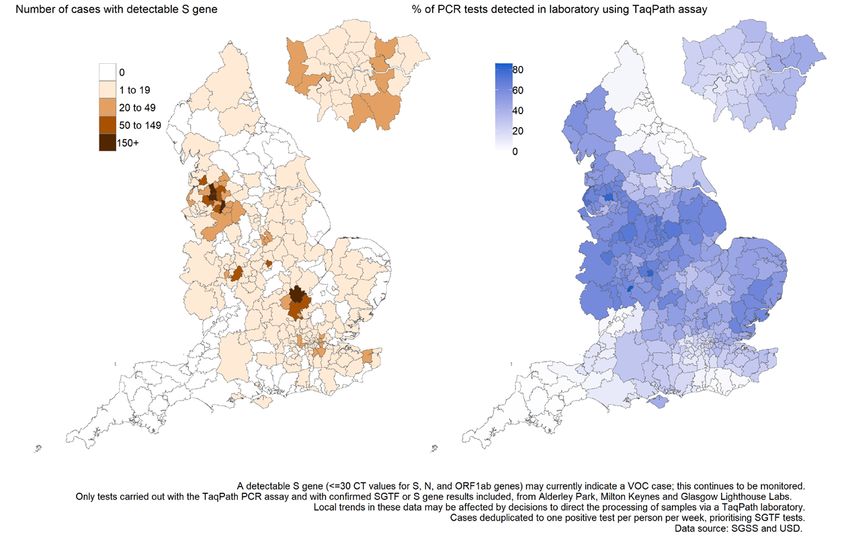
73.5% of all cases tested on the TaqPath assay and reported to PHE that week. Almost all
regions now have majority S gene positive cases in the most recent week (Figure 19),
although with highest numbers concentrated in a small number of local authorities
(Figures 17 and 20). Several of these areas, in particular Bolton, Blackburn with Darwen,
and Bedford, also have high total case rates (Figure 20), although are also located in
areas where a higher proportion of specimens are tested in laboratories which use the
TaqPath PCR assay (Figure 17).
42SARS-CoV-2 variants of concern and variants under investigation
Figure 15. Weekly distribution of variants among sequenced S gene positive SARS-CoV-2 specimens
Specimen dates between 1 January 2021 and 15 May 2021, data as of 25 May 2021. Gray shading applied to 14 most recent days
of data as these are affected by reporting delay. (Find accessible data used in this graph in underlying data).
43SARS-CoV-2 variants of concern and variants under investigation
Figure 16. Weekly distribution of variants among sequenced S gene positive SARS-CoV-2 specimens, by region of
residence
44SARS-CoV-2 variants of concern and variants under investigation
In figure 16 the black line represents weekly proportion of specimens that are VOC-
21APR-02 with most recent 2 weeks labelled and 95% confidence intervals in lilac.
Proportions for other variants not shown but are grouped for counts (bars). Specimen
dates between 1 January 2021 and 15 May 2021, data as of 25 May 2021. Gray shading
applied to 14 most recent days of data as these are affected by reporting delay. (Find
accessible data used in this graph in underlying data).
45SARS-CoV-2 variants of concern and variants under investigation
Figure 17. Number of cases with detectable S gene target and TaqPath lab test coverage by local authority of residence
46SARS-CoV-2 variants of concern and variants under investigation
Specimen dates for figure 17; 15 May 2021 to 21 May 2021, data as of 25 May 2021; most
recent 3 days excluded to reporting delay (Find accessible data used in this graph in
underlying data).
47SARS-CoV-2 variants of concern and variants under investigation
Figure 18. Weekly number and proportion of England Pillar 2 COVID-19 cases with SGTF and detectable S gene target
among those tested with the TaqPath assay
Specimen dates between 1 September 2020 to 24 May 2021, data as of 25 May 2021 (Find accessible data used in this graph in
underlying data).
48SARS-CoV-2 variants of concern and variants under investigation
Figure 19. Weekly number and proportion of England Pillar 2 COVID-19 cases with detectable S gene target or SGTF
among those tested with the TaqPath assay, by region of residence
49SARS-CoV-2 variants of concern and variants under investigation
In figure 19; specimen dates between 2 March 2021 and 24 May 2021, data as of 25 May
2021; 95% confidence intervals indicated by grey shading and percentage for most recent
week labelled (Find accessible data used in this graph in underlying data).
50SARS-CoV-2 variants of concern and variants under investigation
Figure 20. 7-day COVID-19 case rates per 100,000 population vs proportion S gene positive cases among those tested
with TaqPath assay, by upper tier local authority (UTLA) of residence
Specimen dates between 15 May 2021 and 21 May 2021, data as of 25 May 2021 (3 most recent days excluded due to reporting
delay). Restricted to UTLAs with >20 cases tested on TaqPath assay. Five UTLAs with highest number of S gene positive cases
labelled. (Find accessible data used in this graph in underlying data).
51SARS-CoV-2 variants of concern and variants under investigation
Growth rate of S gene positive and negative cases
Figures 21 and 22 show growth rate and doubling time of S gene positive and negative (S
gene target failure), for region and ethnicity, produced by fitting a generalized additive
model with a quasi-Poisson.
The left vertical axis in both figures describe the daily rates of exponential growth; and the
right vertical axis the corresponding daily doubling times, that is number of days required
for cases to double at that particular growth rate. The dashed lines represent uncertainty
(95% CI), which grows approaching the plot edges because the number of data points
used for the estimation becomes smaller. Note that, if an epidemic trend changes from
growth to decline, the growth rates change from positive to negative, while the doubling
times become longer and longer, cross infinity when the trend is temporarily flat, and turn
into halving times (that is number of days it takes for cases to halve), represented as
negative doubling times
52SARS-CoV-2 variants of concern and variants under investigation
Figure 21. Growth rate and doubling time of S gene positive and negative cases by region as of 20 May 2021
The growth rate for cases with all 3 PCR targets positive has been increasing over the course of April and May in all regions. The
East Midlands and the East of England are the only regions seeing growth in cases with the S-dropout. Confidence intervals are
wide for most regions, and data on PCR targets is low in some regions (East of England, South West, North East, Yorkshire and
Humber). (Find accessible data used in this graph in underlying data).
53SARS-CoV-2 variants of concern and variants under investigation
Figure 22. Growth rate and doubling time of S gene positive and negative cases by ethnicity as of 20 May 2021
The growth rate for cases with all 3 PCR targets positive has been increasing over the course of April and May in all ethnicities. The
growth rates for the Indian ethnicity appear to have levelled, whilst growth rate in other ethnicities continues to rise. (Find
accessible data used in this graph in underlying data). Confidence intervals are wide, and data on PCR targets is low in some
regions.
54SARS-CoV-2 variants of concern and variants under investigation
Live virus and pseudovirus neutralization
Neutralisation studies of VOC-21APR-02 (B.1.617.2) have been conducted by the
Genotype to Phenotype Consortium laboratories (Imperial College London, Centre for
Virus Research Glasgow, Pirbright Virology Institute, the Francis Crick Institute), PHE
Colindale and Oxford University. There are reductions in neutralising activity seen across
multiple sera and laboratories including:
• first wave convalescent sera tested against live virus
• vaccinee sera tested against pseudovirus with B.1.617.2. spike
• a panel of 220 vaccinee sera from the Legacy study (University College London
Hospitals/Francis Crick Institute) tested against live virus
These changes are greater than the reduction seen for VOC-20DEC-01 (B.1.1.7). Whilst
outputs from individual assays vary, the consensus view is that the magnitude of the
change is likely to lie between that seen for B.1.1.7 and B.1.351. Further assessment is in
process.
55SARS-CoV-2 variants of concern and variants under investigation
Monitoring of vaccine effectiveness
The vaccine effectiveness analyses undertaken previously were iterated including data up
to the end of week 21. This provides estimates of vaccine effectiveness against
symptomatic disease, methods are described in Effectiveness of COVID-19 vaccines
against the B.1.617.2 variant. The analysis now includes 7673 symptomatic cases
identified as B.1.1.7 and 2934 cases identified as B.1.617.2. Results remain similar to
those seen last week, though with increased precision. After a single dose there was a
17% absolute reduction in vaccine effectiveness against symptomatic disease with
B.1.617.2 compared to B.1.1.7, but only a modest reduction in vaccine effectiveness after
2 doses (Table 12).
Table 12.
Vaccination status Vaccine Effectiveness
VOC-20DEC-01 (B.1.1.7) VOC21-APR-02 (B.1.617.2)
Dose 1 50.2 (46.7 to 53.5) 33.2 (25.8 to 39.9)
Dose 2 88.4 (85.7 to 90.7) 80.8 (76.3 to 84.4)
Serial interval and viral load dynamics
The Assessment of Transmission and Contagiousness of COVID-19 in Contacts
(ATACCC) study (NIHR Health Protection Research Unit in Respiratory Infections, PHE
and Imperial College London) has been reopened to recruitment as of 24 May 2021 to
assist with characterisation of B.1.617.2.
The study analyses secondary attack rates, serial intervals and viral load dynamics, by
performing intensive, longitudinal PCR sampling of contacts of newly diagnosed COVID-
19 cases in the community, accompanied by collection of symptom diaries and
demographic data.
56SARS-CoV-2 variants of concern and variants under investigation
VUI-21APR-01 (B.1.617.1)
Table 13. Number of confirmed and probable VUI-21APR-01 (B.1.617.1) cases, by
region of residence as of 25 May 2021
Region Case Case Cases that Proportion of
Number Proportion have travellers
travelled among cases*
East Midlands 49 12.1% 25 51.0%
East of England 34 8.4% 20 58.8%
London 170 41.9% 96 56.5%
North East 4 1.0% 2 50.0%
North West 32 7.9% 21 65.6%
South East 42 10.3% 25 59.5%
South West 11 2.7% 8 72.7%
West Midlands 48 11.8% 19 39.6%
Yorkshire and 16 3.9% 12 75.0%
Humber
England 406 - 228 56.2%
*Denominator is all cases, including those with unknown or pending travel status. Travel status in this table
and all subsequent travel data in this document is based on information provided through the Contact
Tracing Advisory Service (CTAS) and passenger locator forms where available. Travel status for cases
under investigation is confirmed after follow up and is updated regularly.
57SARS-CoV-2 variants of concern and variants under investigation
Figure 23. Spatial variation in risk for VUI-21APR-01 (B.1.617.1) data from 1 October
2020, as of 25 May 2021, excluding cases that are known to have travelled
Supplementary data is not available for this figure. This figure excludes cases in managed
quarantine facilities.
58SARS-CoV-2 variants of concern and variants under investigation
Figure 24. Confirmed and probable VUI-21APR-01 (B.1.617.1) cases by specimen date as of 25 May 2021
Larger plot includes last 60 days only. (Find accessible data used in this graph in underlying data).
59SARS-CoV-2 variants of concern and variants under investigation
Figure 25. Travel data for confirmed and probable VUI-21APR-01 (B.1.617.1) cases by specimen date as of 25 May 2021
Larger plot includes last 60 days only. (Find accessible data used in this graph in underlying data). N/A indicates information is
pending or not available.
60SARS-CoV-2 variants of concern and variants under investigation
VUI-21APR-03 (B.1.617.3)
Table 14. Number of confirmed and probable VUI-21APR-03 (B.1.617.3) cases, by
region of residence as of 25 May 2021
Region Case Case Proportion Cases that have Proportion of
Number travelled travellers among
cases
East Midlands 0 0.0% 0 NA
East of England 0 0.0% 0 NA
London 5 35.7% 3 60.0%
North East 0 0.0% 0 NA
North West 7 50.0% 3 42.9%
South East 2 14.3% 1 50.0%
South West 0 0.0% 0 NA
West Midlands 0 0.0% 0 NA
Yorkshire and 0 0.0% 0 NA
Humber
England 14 - 7 50.0%
*Denominator is all cases, including those with unknown or pending travel status
Figure 26. Spatial variation in risk for VUI-21APR-03 (B.1.617.3) data from 1 October
2020, as of 25 May 2021, excluding cases that are known to have travelled
Supplementary data is not available for this figure. This figure excludes cases in managed
quarantine facilities
61SARS-CoV-2 variants of concern and variants under investigation
Figure 27. Confirmed and probable VUI-21APR-03 (B.1.617.3) cases by specimen date as of 25 May 2021
Larger plot includes last 60 days only. (Find accessible data used in this graph in underlying data).
62SARS-CoV-2 variants of concern and variants under investigation
Figure 28. Travel data for confirmed and probable VUI-21APR-03 (B.1.617.3) cases by specimen date as of 25 May 2021
Larger plot includes last 60 days only (Find accessible data used in this graph in underlying data). N/A indicates information is
pending or not available.
63SARS-CoV-2 variants of concern and variants under investigation
International surveillance
GISAID includes data on sequences available internationally. As of 26 May 2021, sequences
from the following countries (excluding UK) have been identified in GISAID:
VUI-21APR-01 (B.1.617.1) In total 2,099 sequences from: Australia, 29, Austria, 1,
Bahrain, 8, Belgium, 8, Canada, 38, Curacao, 1, Czech Republic, 3, Denmark, 27,
Finland, 1, France, 7, Germany, 84, Greece, 1, Guadeloupe, 2, Hong Kong, 9, India,
1472, Ireland, 39, Italy, 5, Japan, 19, Jordan, 4, Luxembourg, 5, Malaysia, 1, Mexico,
3, Nepal, 2, Netherlands, 9, New Zealand, 4, Portugal, 9, Saint Martin, 2, Singapore,
58, South Korea, 5, Spain, 4, Sweden, 5, Switzerland, 9, Thailand, 1, USA, 223,
Uganda, 1
VOC-21APR-02 (B.1.617.2) In total 3,744 sequences from: Argentina, 1, Aruba, 3,
Australia, 106, Austria, 3, Bahrain, 14, Bangladesh, 11, Belgium, 79, Canada, 125,
China, 2, Democratic Republic of the Congo, 6, Denmark, 62, France, 50, Germany,
264, Greece, 1, Hong Kong, 3, India, 1309, Indonesia, 27, Iran, 4, Ireland, 89, Israel,
37, Italy, 51, Japan, 138, Jordan, 1, Luxembourg, 2, Malaysia, 4, Mexico, 20,
Morocco, 1, Nepal, 12, Netherlands, 31, New Zealand, 11, Norway, 5, Poland, 24,
Portugal, 29, Reunion, 1, Romania, 4, Russia, 1, Singapore, 100, Slovenia, 1, South
Africa, 16, South Korea, 1, Spain, 43, Sweden, 11, Switzerland, 33, Thailand, 1,
Turkey, 1, USA, 1003, Uganda, 3
VUI-21APR-03 (B.1.617.3) In total 64 sequences from: India, 61, Russia, 2, USA, 1
64SARS-CoV-2 variants of concern and variants under investigation
Part 3: New variant under investigation
VUI-21MAY-02 (C.36.3)
C.36.3 was designated a Variant Under Investigation on 24 May 2021 (VUI-21MAY-02) on
the basis of the mutation profile and increased importation from a widening international area.
Genomic profile
The complete mutation profile of VUI-21MAY-02 (C.36.3) is shown in Table 15.
Table 15. C.36.3 Mutation profile
Gene Mutations
orf1ab E102K, A859V, T1246I, D1639N, P2287S, D2980N, D3222N, G3278S,
S3687L, L3691S, T4090I, P4715L, D5429Y
S S12F, del69-70, W152R, R346S, L452R, D614G, Q677H, A899S
M I82T
N R203K, G204R, G212V
Biological profile
VUI-21MAY-02 (C.36.3) contains several spike receptor binding domain (RBD) mutations
linked to antigenic change including both L452R and R346S. Furthermore, it contains N-
terminal domain (NTD) mutations potentially associated with antigenic change such as S12F
and W152R. VUI-21MAY-02 also contains deletion 69-70 and Q677H, mutations also
observed in other VOC/VUIs. Deletion 69-70 is associated with S gene target failure in the
Taqpath assay which is used in surveillance analyses.
Surveillance in England
As of 25 May 2021, 109 genomically confirmed cases of VUI-21MAY-02 (C.36.3) have been
identified in England. The regional distribution is shown in table 16.
Table 16: Cases of VUI-21MAY-02 (C.36.3) by region
Region Number of cases of C.36.3
East Midlands 6
East of England 18
London 33
North East 1
North West 11
South East 8
South West 3
West Midlands 9
Yorkshire and Humber 20
65You can also read


