SOLAR-ECLIPSE A GENETIC IMAGING RESEARCH TOOL - KOCHUNOV PETER, PHD, DABMP MARYLAND PSYCHIATRIC RESEARCH CENTER, UNIVERSITY OF MARYLAND AND TEXAS ...
←
→
Page content transcription
If your browser does not render page correctly, please read the page content below
SOLAR-Eclipse
a genetic imaging research
           tool
           Kochunov Peter, PhD, DABMP
 Maryland Psychiatric Research Center, University of
                      Maryland
                        And
        Texas Biomedical Research Institute
Overview
Historical perspective
Downloading and installing SOLAR-Eclipse
Creating a solar analysis directory
• pedigree files
• Marker files
• phenotype files
Common analyses types
• Univariate and bivarate analyses of variance, linkage and
association
Using Solar-Eclipse for Mega-and-Meta analyses
• Additive Genetic Analyses (Heritability)
• Analyses of fixed genetic factors (Association)
Executing solar in parallel environmentSOLAR-Eclipse
Extension of SOLAR for imaging genetic
research
Developed for multiplatform (pc/mac/linux)
• Genetic analysis of discreet and continuous traits
• Supports polygenic, quantitative trait and GWAS
analyses in related and unrelated samples
• Supports uni-and-multivariate analyses
• Supports discrete and continuous covariates
Implements functionality of three genetic tools
• MENDEL, FISHER and SEARCHMENDEL
Intended for
• Gene mapping calculation
• QTL analyses
• Pedigree segregation
• Multipoint/Linkage Quantitative Trait mapping
• Allele frequency estimation
• Paternity testing
• Genetic Counseling for disorders such as
• Cystic Fibrosis
• Duchenne Dystrophy and othersFISHER
Genetic analysis of quantitative traits whose
variability explained by
• polygenic inheritance
• environmental forces
Provided functions for additive genetic
analysis of continuous polygenic traits
• Heritability
• Genetic correlationMENDEL and FISHER
Use genetic likelihood calculations
• Variability in trait is considered to be
multivariate normal
• Multivariate and univariate analyses are
supported
• Proband corrections and robust outlier
detection is implemented
Use maximum-likelihood estimation
(MLE) called SEARCHSEARCH algorithm
The MLE engine for MENDEL/FISHER
An optimization routine
• Works within user-set bounds and limits
• Maximizes a cost function
• Samples a function over a grid
• Implemented the least square and use-defined
estimators
John has optimized it for discrete traits “OPTIMA”What is SOLAR-Eclipse?
4DNIFTI
image/surface
input data
All functions use TCL for
TCL interpreter
high-order processing
SOLAR-Eclipse (C++/tcl) NIFTI output
C/C++ coded SEARCH/OPTIMA and
parts of FISHER and MENDELProgress since last year?
Polyclass functionality is now standard
• Combined analysis of multiple pedigrees
• Mega-and-meta analysis metrics
• Additive genetic effect modeling
• Per class and in a combined pedigree
• Fixed genetic effect modeling
• Per class and in a combined pedigree
Improvements in file handlingDownloading and installation
Available at
http://www.nitrc.org/projects/se_linux/
Installation is simple – untar
Need to get software key/license
• Email solar@txbiomedgenetics.org
• One per user
Website (WIP)
• http://www.mdbrain.org/solareclipse/
• Instruction videos, how-to’s, example files
• Main solar manuals are at
• http://solar.txbiomedgenetics.org/doc/When you type “solar”
TCL interpreter starts
When you type a command like “polygenic”
• TCL interpreter reads solar.tcl file
• Codes all the popular functions such as polygenic
• Executes “polygenic” function
• analyzes the arguments and existing global variables
• Chooses among several analyses e.g. univariate vs.
multivariate
• Calls upon compiled work for computationally-intensive
proceduresWhat is TCL and its role in Solar
Tool Command Language
Similar to shell scripts such as bash and sh
All solar command are TCL functions
You can examine/modify any command by
• showproc command
• showproc command new_command.tcl
• It will create a copy of original TCL script in your directory
• Open it with a text editor to see what it doesSOLAR working directory
All projects are organized by “directory”
• Solar reads the default files from the directory
it is started from
• Including pedigree and default phenotype files
Directory should contain the pedigree file
• The kinship matrix
• Definition of the familial ties among the
subjectsCoding the pedigree is Simple®
Make in excel and save as a csv file
• Mac users should save it in Windows’ CSV format
Pedigree file defines
• Subject ID
• IDs for Father and Mother, including founders
• Sex: 2 and 1 or M and F.
• Family ID
• Monozygotic twin label
• Class – used for mega-genetic analysisDefining pedigree
Each “active” subject has to have
• ID
• Family id
• Gender
• Parent IDs, even if you don’t use parents
• Even if the parents aren’t known
• A label for being a twin
Additional variables
• Class- specifies that subjects belong to a different
pedigrees
• House – specifies household, to study enviromental
effectsExample pedigree for QTIM twins
Neda will go into more details
Defined twins
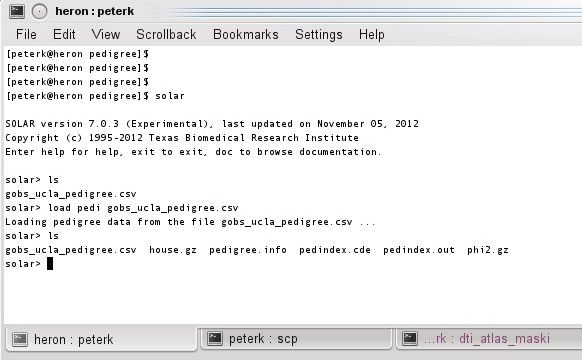
Defined parentsReading in the csv pedigree file
Starting Solar
Checking that the cvs pedigree is there
Loading pedigree
A successfully loaded pedi should have
all these files created in the directoryImport of existing pedigrees
Use Pedsys (http://
pedsys.txbiomedgenetics.org)
To import from other packages
• S.A.G.E.
• REGC
• CRI-MAP
• PAP
• IBDMAT and others
More information
• http://solar.txbiomedgenetics.org/doc/04.chapter.htmlCreating a SNP file
SOLAR uses a simple marker format.
• CSV file with a header
• ID/EGO column is used to define subject ids
It would look like
• ID, rs429358, rs839523, rs1799945
• PF0132, 1, 2, 1
• PF0133, 2,2,2
• PF0134,1,2,2Reading PLINK genotype files
Work-in-progress
Will only work with “dose” files
• Minor allele is coded as 0 (0, 1, 2) or fractional values
Have a converter – contact me
ENIGMA offers SNP extractor scripts that will
create genotype files from a list of snps.Creating phenotype files
SOLAR phenotype files are in CSV
format
Header includes either ID or EGO
• Identifiers for ID field
Typical file for a continuous trait is
• ID, Age, Sex, Gmthickness, FA, FLAIR
• PH0001, 25, M, 2.5, 0.56, 1.193
• PH0002, 39, F, 2.34, 0.49, 2.141Phenotypes to incorporate
imaging data
The CSV header should identify the
format of the trait using semicolon
• GMdensity:NIFTI
• GMthickness:GIFTI
• Do we need support for other format?
File name is provided for each subject
• Semicolon can be used for volume
identification in 4D fileAn example of a phenotype file
with binary traits
The semicolon identifies the sequential volume number in the 4D file
– starting with zeroPerforming processing on individual voxels
Specific voxel(s) need to be defined before processing
Individual voxels can be defined as
• voxel X:Y:Z
• solar> help voxel
Purpose: To set and save current voxel position
Usage: voxel []
is 3 coordinates delimited by colons as x:y:z
for example, 12:8:23
If no voxel-value is specified, the current voxel is returned.
If no current voxel has been defined, an error is raised.
If a voxel has been defined, it is written to model files.
The current voxel can also be set with the mask
command, and
that is the general way it should be done.Performing processing on set of voxels
Mask command defines the set of voxels of the same intensity
solar> help mask
Purpose: To read image mask file and set current voxel
Usage: mask [] [-intensity ] [-index
]
mask -next
mask -delete
is the name of the file containing the mask
is the integer value that defines this mask
is position within the set of mask-defined voxels
-next specifies to advance to the next mask-defined voxel
-delete deletes the mask and frees all related storageDefining output (WIP)
Imaging trait analysis can be saved into nifti multi-
volume file
outputvolume []
• Copies header information from the trait file
• Processing of each voxel is stored in the corresponding
coordinate space
• [0] – heritability
• [1] – standard error
• [2] – probability
• [3] - % variance explained by covariates
• Similar format will be used for the genetic correlationExecuting it in a parallel
environment
Masking for simplified sge-execution
Use a mask to parcelate space
Save outputs in different files
Submit them as separate jobs
Add files for the final result!Mega-and-Meta genetic analyses
SOLAR engine is flexible and powerful
• Works with pedigrees of random length and
complexity
• Families
• Twins
• Unrelated
• Separate pedigrees can be combined at raw-data
state
• Merge small populations into a synthetic pedigree
• Perform genetic analysis as if working in large
extended families.Advantages Mega vs. Meta genetic
analysis
Advantages of Mega-genetic analysis:
• More “powerful” than meta-analysis
• Test of significance is performed on higher degree of
freedoms
• Smaller samples can be combined into a single set
• Less weighted by discrepancies in subject numbers and
less affected by variance in standard deviation among
cohorts
• Can be used for testing heterogeneity of genetic effects
Advantages of Meta-genetic analysis:
• Easier to perform and is more accepted
• “Synthetic” heritability and fixed effects may not be well
defined due to population differencesHow does one proceed?
Pedigrees are merged with “class” field
• Class defines all subjects belonging to the same group
• Sporadic model is fit separately for each “class”
• Individual datasets are inverse-Gaussian normalized
• Combine data by ensuring equal distribution and
variance of the trait
• Several polygenic tests are performed
• Test of significance for each pedigree
• Cross-wise test of difference in genetic effects for each
pedigree
• Test of significance for a combined pedigreePolyclass modeling function
Polyclass function will model additive
and fixed genetic effects across pedigree
• It performed per-pedigree modeling of genetic
effect
• Useful for meta-analysis and analysis of site-
specific effects
• Performs combined modeling of genetic effect
• Statistical power of discovery is greatly improved
• Genetic effects are “generalized” across cohortsExample: mega-association
analysis
To perform association analysis across
more than one cohort (pedigree)
This example uses 4 cohorts
• GOBS (N=800)Mega-genetic analysis is simple
polyclass 0-3 –maxsnp rs6675281 –
intrait
• This will model association between the trait
and rs6675281
• separately in classes 0, 1, 2, 3
• -intrait option will use inverse Gaussian for
trait normalizationThe analysis: FA values (raw)
30
TAOS
25
QTIM
20 GOBS
NIDA
15
10
5
0
0.3 0.35 0.4 0.45 0.5 0.55 0.6Sporadic model is fit per cohort
Regression of age, gender and ethnicity effects separately per
cohort
3.5
3
2.5
2
1.5
1
0.5
0
-3 -2 -1 0 1 2 3Inverse normalization performed
per cohort.
2.5
2
1.5
1
0.5
0
-2 -1 0 1 2Per-sample association analysis
GOBS MAF=10% 0.4
QTIM MAF=17%
0.15 0.3
0.1
0.2 N=13
0.1
0.05 0
N=1 -0.1 TT CT CC
0
-0.2
TT CT CC
-0.05 -0.3
-0.4
-0.1
Variance explained=0.1% -0.5
Variance explained=0.8%
-0.15 -0.6
0.12 TAOS MAF=20% 0.2 NIDA MAF=30%
0.1
0.15
0.08
0.1
0.06
0.05
0.04 N=12
0.02 0
N=2
0
-0.05
TT CT CC
-0.02 TT CT CC
-0.1
-0.04
Variance explained=0.1% Variance explained=0.7%
-0.06 -0.15Mega-genetic analysis is simple
polyclass 0-3 –maxsnp rs6675281 –
intrait –comb
• This will model association between the trait
and rs6675281
• separately in classes 0, 1, 2, 3
• -intrait option will use inverse Gaussian for
trait normalization
• –comb will provide for mega-analysisAll three preceding steps are
performed
Populations are combined into a super
pedigree 2.5
2
1.5
1
0.5
0
-3 -2 -1 0 1 2 3DISC1 rs6675281 polymorphism
Whole-sample mega-genetic (N=2285)
analysis
N=28 N=390 N=1867
0.15
0.1
0.05
0
-0.05
TT CT CC
-0.1
-0.15
-0.2
-0.25
-0.3
-0.35
Total variance explained in average
FA values =0.2% (p=0.002)Downloading solar-eclipse
We are always in need of few brave
souls/testers
• http://www.nitrc.org/projects/se_linux/
• Stability should improve in the next six month
Best to contact me to discuss the project
• pkochunov@gmail.comNext year’s workshop
Discussion of new SE features
• Performance and memory optimization
strategies
Voxel-wise, mega-GWAS of fixed effects
in Enigma-DTI (>5,000 subjects)
Better multiple comparison corrections
• Collaboration with Tom Nichols.
Integration of SE with image analyses
pipelines
• Collaborative work with Bennett LandmanAcknowledgements
Collaborative effort of
• John Blangero
• Charles Peters
• David Glahn
• Tom Nichols
• Bennett Landman
• Neda Jahanshad
• Paul Thompson
Supported by EB015611, P01HL045522, R37MH059490,
R01MH078111, R01MH0708143 and R01MH083824You can also read


