Southend-on-Sea Borough Council Air Quality Action Plan - In fulfilment of Part IV of the Environment Act 1995 Local Air Quality Management ...
←
→
Page content transcription
If your browser does not render page correctly, please read the page content below
Southend-on-Sea Borough Council
Air Quality Action Plan
In fulfilment of Part IV of the
Environment Act 1995
Local Air Quality Management

November (2017)
Southend-on-Sea Borough Council Air Quality Action Plan 2017

Local Authority
                   William Pegram
Officer
Department         Regulatory Services

                   Civic Centre, Victoria Avenue, Southend-on-
Address
                   Sea, Essex SS2 6ER

Telephone          Telephone 01702 215000

E-mail             billpegram@southend.gov.uk
Report Reference
                   AQAP1
number
Date               November 2017
Southend-on-Sea Borough Council Air Quality Action Plan 2017
Forward by Portfolio Holder
“Everyone has the right to breathe clean air and public interest in air quality
has been at an all-time high.
The most immediate air quality challenge is tackling the problem of nitrogen
dioxide (NO2) around our roads – the only statutory air quality obligation the
UK is currently failing to meet.
Southend-On-Sea Borough Council provides a high quality environment for
residents, visitors and businesses and generally enjoys good air quality. There
are, however, traffic hot-spots giving rise to unacceptable levels of air quality,
and this has become a serious public health concern for many Cities and large
Towns throughout the UK.
Given that the primary source of the pollutants is vehicle emissions, finding
solutions is a challenge for us all to rise to. There are enterprising plans for
investment to build and regenerate but this vision needs to be matched
with improvements to air quality.
We fundamentally believe that the needs of the local community are at the
heart of what we do at the Council. It is our objective to work together with
communities to solve problems locally and participate in decisions that affect
them and as a result build stronger more resilient communities.
1Southend-on-Sea Borough Council Air Quality Action Plan 2017
An improvement to air quality requires an integrated and collaborative
approach on the part of both internal and external stakeholders including the
Community.
In developing this action plan, partnership working will be a key prerequisite.
We will need to take an innovative and creative approach. The plan has been
structured to incorporate both Borough wide actions and more specific actions
aimed at local traffic hot-spots.
Together we shall work towards making the Borough “A Better Place to Live”,
to work in and to visit.
On behalf the Council we would like to thank everyone who has been involved
in the development of this Air Quality Action Plan which will identify local
priorities, deliver improved outcomes and make a real difference to the lives of
local people.”
2Southend-on-Sea Borough Council Air Quality Action Plan 2017
Executive Summary
This Air Quality Action Plan (AQAP) has been produced as part of our statutory
duties required by the Local Air Quality Management framework. It outlines the
action we will take to improve air quality in the Borough between 2018 and
2021.
This is the Borough Council’s first air quality action plan and has been triggered
primarily to address the air quality concerns associated with the Air Quality
Management Area (AQMA) declared along a stretch of the A217, Prince
Avenue, Southend in November 2016. The AQMA is our first priority. The
secondary purpose of the action plan is to address air quality across the whole
Borough.
Air pollution is associated with a number of adverse health impacts. It is
recognised as a contributing factor in the onset of heart disease and cancer.
Additionally, air pollution particularly affects the most vulnerable in society:
children and older people, and those with heart and lung conditions. There is
also often a strong correlation with equalities issues, because areas with poor
air quality are also often the less affluent areas1,2.
The annual health cost to society of the impacts of particulate matter alone in
the UK is estimated to be around £16 billion3. The Council is committed to
reducing the exposure of people in the Borough to poor air quality in order to
improve health.
We have developed actions that can be considered under the following priority
work areas:
Southend Intelligence Hub - SMART City Journey and Digital Strategy
Strategic Planning and Transport Policy
Public Health and Raising Awareness
Land Use Planning and Development Control
1
Environmental equity, air quality, socioeconomic status and respiratory health, 2010
2
Air quality and social deprivation in the UK: an environmental inequalities analysis, 2006
3
Defra. Abatement cost guidance for valuing changes in air quality, May 2013
3Southend-on-Sea Borough Council Air Quality Action Plan 2017
Sustainable Innovation
Low Emission Air Quality Strategy (LEAQS)
Community Engagement
In this AQAP we outline how we plan to effectively tackle air quality issues
within our control. However, we recognise that there are a large number of air
quality policy areas that are outside of our influence (such as vehicle emissions
standards agreed in Europe), but for which we may have useful evidence, and
so we will continue to work with regional and central government on policies
and issues beyond the Borough Council’s direct influence.
The emphasis of the plan is to firstly, develop measures that will provide the
necessary emissions reductions to achieve the air quality objectives within
specified timescales, and, secondly, to act as a live document which can be
continually reviewed and developed to ensure current measures are
progressing and new measures are brought forward.
Responsibilities and Commitment
This AQAP was prepared by the Regulatory Services section of the Borough
Council with the support and agreement mainly of the following departments:
Public Health
Strategic Planning and Transport Policy
ICT
Energy and Sustainability
Land Use Planning and Development Control
It has been approved by the Cabinet and Full Council and will be subject to an
annual review. Progress each year will be reported in the Annual Status Reports
(ASRs) produced by the Borough Council as part of our statutory Local Air
Quality Management duties.
If you have any comments on this AQAP please send them to Bill Pegram at
Southend-on-Sea Borough Council, Civic Centre, Victoria Avenue, Southend
SS2 6ER Email: BillPegram@southend.gov.uk
4Southend-on-Sea Borough Council Air Quality Action Plan 2017
Table of Contents
Forward by Portfolio Holder .................................................................................... 1
Executive Summary ................................................................................................. 3
Responsibilities and Commitment ..................................................................................... 4
1. Introduction ...................................................................................................... 7
2. Summary of Current Air Quality in Southend-on-Sea Borough Council ...... 11
3. The Council’s Air Quality Corporate Priorities ................................................ 12
3.1 Southend Intelligence Hub – SMART CITY Journey ............................................................12
3.2 Public Health Context ....................................................................................................12
3.3 Transport Planning and Policy Context ............................................................................12
3.5 Source Apportionment of Traffic Emissions in AQMA and Agglomeration Zone ....................14
3.9 Required Reduction in Emissions ....................................................................................19
3.10 Immediate Key Priorities ..............................................................................................21
4. Development and Implementation of AQAP ..................................................... 22
4.1 Consultation and Stakeholder Engagement ......................................................................22
4.2 Steering Group .............................................................................................................24
5. Action Plan Measures ........................................................................................ 25
Appendix A: Response to Consultation ............................................................... 56
Appendix B: Reasons for Not Pursuing Action Plan Measures ......................... 85
Appendix C: Detaied Assessment 2016 and Annual Status Report 2017……………………….86
Glossary of Terms .................................................................................................. 88
References .............................................................................................................. 89
5Southend-on-Sea Borough Council Air Quality Action Plan 2017
List of Tables and Figures
Title Page
Table 1. DEFRA Mapped Background Annual Means 16
Table 4.1 Consultation Undertaken 22
Table 5.1 Actions - Southend Intelligence Hub SMART CITY 23
Journey
Table 5.2 Actions - Strategic Planning and Transport 28
Table 5.3 Actions - Public Health and Raising Awareness 33
Table 5.4 Actions - Land Use Planning and Development Control 38
Table 5.5 Actions - Sustainable Innovation 43
Table 5.6 Low Emission Air Quality Strategy 45
Table 5.7 Community Engagement 47
Figure 1. Source Apportionment NOx (Detailed Assessment 2016) 16
Figure 2. Source Apportionment (Agglomeration Zone) 18
Figure 3. Plan of AQMA The Bell Junction A127 21
Addendum: Targeted Feasibility Study A127 May 2018 55
6Southend-on-Sea Borough Council Air Quality Action Plan 2017
1. Introduction
This report outlines the actions that Southend-on-Sea Borough Council will
deliver between 2018 and 2021 in order to reduce concentrations of air
pollutants and exposure to air pollution; thereby positively impacting on the
health and quality of life of residents and visitors to the Borough.
It has been developed in recognition of the legal requirement on the local
authority to work towards Air Quality Strategy (AQS) objectives under Part IV of
the Environment Act 1995 and relevant regulations made under that part and
to meet the requirements of the Local Air Quality Management (LAQM)
statutory process.
The Plan will be reviewed periodically and progress on measures set out will be
reported on annually within the Council’s air quality Annual Status Report (ASR)
submitted to DEFRA.
Taking action to improve air quality is crucial in order to improve the health of
the population. There is growing evidence that air pollution is a significant
contributor to preventable ill health and early death. These health impacts
impose a cost on the economy estimated to run into billions.
The most immediate air quality challenge is tackling the problem of nitrogen
dioxide (NO2) concentrations around roads – the only statutory air quality
obligation the UK is currently failing to meet.
This document has been produced by Southend-on-Sea Borough Council and
constitutes our first Air Quality Action Plan (AQAP). It has been triggered
primarily to address the air quality concerns associated with the Air Quality
Management Area (AQMA) declared along a stretch of the A127, Prince
Avenue, Southend in November 2016. Its secondary purpose is to address air
quality issues by a wider, cross Borough approach with so-called “soft” indirect
actions.
It is a statutory duty for the Council to develop an AQAP following the
declaration of an AQMA in response to an identified breach of the annual mean
air quality objective for nitrogen dioxide.
The vision of the Council is to “Create a Better Southend” supported by the five
corporate aims of a “Clean, Safe, Healthy and Prosperous Southend, led by an
7Southend-on-Sea Borough Council Air Quality Action Plan 2017
excellent Council”. This vision will be reflected in and provide a clear focus for
the actions outlined in this document.
1.1 Legislative Background
Air quality limit values for the protection of human health have been set by two
EU Air Quality Directives 2008/50/EC and 2004/107/EC. These were transposed
into UK Law via the Air Quality Standards Regulations 2010.
Action is then driven by the UK’s Air Quality Strategy which sets out equivalent
Air Quality Objectives (AQOs).
Part IV of the Environment Act 1995 places a statutory duty on all local
authorities in the UK to periodically review and assess air quality within their
areas. This is to determine the likelihood of complying with prevailing health
based air quality objectives for a number of pollutants. The UK Air Quality
Strategy, Policy and Technical Guidance provide the over-arching themes for
local air quality management in the UK.
Local Authorities that identify a breach of any of the air quality objectives in
their area are required to formally declare an Air Quality Management Area.
Once declared the authority has a duty under Section 84 (2) of the Act to
produce an Air Quality Action Plan (AQAP).
Local Authorities are not legally obliged to meet the air quality objectives but
they must be able to demonstrate that they are working towards the
objectives.
In order to effectively discharge duties under the Local Air Quality
Management regime the Council is required to report on air quality throughout
the Borough. This function is undertaken by Regulatory Services.
Regulatory Services will continue to ensure that ambient air quality is
monitored after the implementation of this AQAP. The team will report
regularly on progress, both through the local air quality management reporting
schedule to DEFRA and via the Council’s Corporate Priority Actions Protocol:
Action 1718 PLACE PPC03.
8Southend-on-Sea Borough Council Air Quality Action Plan 2017
1.2 The Action Planning Process
Action planning is an essential part of the local air quality management
process, providing a practical opportunity for improving air quality in areas
where review and assessment has shown that national measures will be
insufficient to meet one or more the air quality objectives. A suitable air quality
action plan should include the following:
1. Quantification of the source contributions to the pollution burden for
example by vehicle categories. This allows action plan measures to be
targeted more effectively.
2. Evidence that available options have been considered on the grounds of
cost, feasibility and potential scale of impact.
3. Quantification of expected improvement in air quality.
4. Confirmation of how the Council will discharge its powers and also work
in partnership with other stakeholders in pursuit of the relevant air
quality objective.
5. Clear timescales within which the authority and other stakeholders
propose to implement the various measures contained in the plan.
6. Quantification of the expected impacts of the proposed measures, and
where possible, an indication as to whether these will be sufficient to
demonstrate compliance with the objective/s.
7. Identification of how the Council intends to monitor and evaluate the
effectiveness of the plan.
8. Prompt the formation of a Steering Group to enable and drive forward all
of the above.
The emphasis of AQAPs should be to firstly, develop measures that will provide
the necessary emissions reductions to achieve the air quality objectives within
specified timescales, and, secondly, to act as a live document which can be
9Southend-on-Sea Borough Council Air Quality Action Plan 2017
reviewed periodically (at least once a year) and developed to ensure current
measures are progressing and new measures are brought forward.
This AQAP has been written to incorporate the following priority work areas:
1. Southend Intelligence Hub – SMART City Journey and Digital Strategy
2. Strategic Planning and Transport Policy
3. Public Health and Raising Awareness
4. Land Use Planning and Development Control
5. Sustainable Innovation
6. Low Emission Air Quality Strategy (LEAQS)
7. Community Engagement
10Southend-on-Sea Borough Council Air Quality Action Plan 2017
2. Summary of Current Air Quality in Southend-on-
Sea Borough Council
The main source of air pollution in the Borough is road traffic emissions from
major roads, notably the A13, A127 and A1159. Other pollution sources
including commercial, industrial and domestic sources also make a
contribution to background pollutant concentrations. Exceedances of the
annual mean air quality objective for nitrogen dioxide continue to be observed
at three semi-permanent sites in or close to the existing AQMA boundary. One
temporary site (of eight) associated with a major improvement scheme at
A127 Kent Elms junction also shows an exceedance.
Neighbouring Rochford District Council is home to London Southend Airport
which is close to the administrative boundary with Southend. The Council
monitors air quality at roadside locations nearby. Airside operations are
expected to only make an imperceptible contribution to background pollutant
concentrations.
In November 2016 Southend-on-Sea Borough Council declared its first Air
Quality Management Areas (AQMA) centred at the junction between Prince
Avenue, Hobleythick Lane and Rochford Road (also known as “The Bell
Junction”). Here exceedances of the annual mean Air Quality Objectives for
nitrogen dioxide were confirmed by a Detailed Assessment completed in July
2016.
The Council has 25 semi-permanent and 8 temporary passive diffusion tube
sites at which air quality is measured to ensure that the we remain informed of
air quality especially at locations where traffic volumes are high, and that if
exceedances are recorded, then appropriate measures can be swiftly
implemented.
As a Unitary Authority, the Council is responsible for highways, transportation
and strategic planning. As a single tier authority, the relevant departments of
Environmental Health, Public Health, Strategic Transport Policy, Planning and
Sustainability are able to work effectively together to keep air quality a high
priority, supported by the same Local Plan and Local Transport Plan objectives
For more information please refer to the latest Air Quality Annual Status
Report (ASR) 2018.
11Southend-on-Sea Borough Council Air Quality Action Plan 2017
3. The Council’s Air Quality Corporate Priorities
3.1 Southend Intelligence Hub – SMART CITY Journey
The connection of the Council’s 31 Urban Traffic Control sites to the newly
deployed pan borough full fibre network presents the opportunity to monitor a
raft of traffic and environmental characteristics simultaneously in real time.
The intention is to relay data captured this way back to the Council’s
Intelligence Hub and host it for analytical purposes within the CISCO City
Connected Digital Platform. The provision of the Intelligence Hub and the
ability to cross reference data captured in this way is key to Southend’s SMART
CITY ambitions. As step one, the Intelligence Hub will see the co-location of
three core 24/7 services: public space CCTV, traffic management and tele-care.
See section 5.1 Southend Intelligence Hub on page 26.
3.2 Public Health Context
Air pollution affects mortality from cardiovascular and respiratory conditions,
including lung cancer. In its report on ‘The Mortality Effects of Long-Term
Exposure to Particulate Air Pollution in the United Kingdom’, published in
2010, the Committee on the Medical Effects of Air Pollutants (COMEAP)
estimated the mortality burden of existing levels of air pollution on the
population of the UK as being equivalent to 29,000 deaths and an associated
loss to the population of 340,000 life-years. Local authorities, working together
with the public, can implement measures to reduce exposure to air pollution
as well as reducing polluting emissions through, for instance, active travel
plans.
See section 5.3 Public Health and Raising Awareness on page 38.
3.3 Transport Planning and Policy Context
The Council is now working to LTP3 with a current implementation plan
covering 2015-2021 reflecting the Governments spending plan.
Local Transport Plans steer the implementation of national transport policies
at the local level. As a strategic document the LTP does not contain details of
12Southend-on-Sea Borough Council Air Quality Action Plan 2017
schemes, but sets out a long term transport strategy, a shorter term
implementation plan and a number of supporting strategies.
Transport needs to be linked with wider economic, social and environmental
objectives. The LTP3 has therefore been developed within the context
provided by a range of policy documents, including the Southend Core
Strategy.
The long term transport strategy vision is linked to the Council’s long term
vision of:
“Creating a better Southend” which is supported by five aims resulting in a
Clean, Safe, Healthy and Prosperous Southend Led by an Excellent Council.”
See section 5.2 Strategic Planning and Transport Policy on page 31.
3.4 Land Use Planning Context
A key priority for the Borough Council is to integrate air quality considerations
with other policy areas such as Land Use Planning and Development Control.
Many developments have the potential to increase the pollution burden and it
is appropriate that these developments are required to mitigate or offset this
in order to help to achieve an overall reduction in local air pollution. It is
therefore essential to identify how we can bring air quality considerations into
the planning process at the earliest possible stage. It is no longer satisfactory
to simply demonstrate that a development is no worse than the existing or
previous land use on a particular site.
See Land Use Planning and Development Control section on page 41.
13Southend-on-Sea Borough Council Air Quality Action Plan 2017
3.5 Source Apportionment of Traffic Emissions in AQMA and
Agglomeration Zone
Source apportionment is the process of identifying the contribution each
individual source of a pollutant such as nitrogen dioxide makes to the overall
level. These consist of background sources and locally generated sources.
The AQAP measures presented in this report are intended to be targeted
towards the predominant sources of emissions within the Borough which is
traffic.
We have assessed the contribution each category of vehicle type makes to the
overall pollution burden.
A source apportionment exercise was carried out by external consultants on
the Council’s behalf in 2016 during completion of the Detailed Assessment.
Annual Average Daily Traffic (AADT) flows and queuing data were provided by
SBC after traffic counts were carried out across the Borough. Through the use
of ADMS-Roads modelling, concentrations at relevant receptors at The Bell
junction and Cuckoo Corner were predicted. This identified that the maximum
concentration in this area was estimated at Prince Avenue on the approach to
Cuckoo Corner. Source contributions to NOx concentrations at this receptor
were calculated, including regional and local background concentrations and
concentrations as a result of traffic sources. Figure 1 shows the percentage
contributions to NO2 concentrations.
14Southend-on-Sea Borough Council Air Quality Action Plan 2017
Figure 1. Source Apportionment of NO2 Concentrations on Prince Avenue,
including petrol and diesel contribution
Figure 1 shows that the highest proportion of NO2 emissions can be attributed
to cars (21%), with buses, HGVs and LGVs contributing roughly the same
proportion each. Therefore, there is no standout source contribution so
measures will be focussed on reducing vehicle emissions as a whole.
Further refinement of the source apportionment calculation showed that
diesel vehicles were responsible for a much higher proportion of NO2
emissions than petrol vehicles.
15Southend-on-Sea Borough Council Air Quality Action Plan 2017
3.6 Estimated Background Concentrations
DEFRA has made estimates of background pollution concentrations on a 1km2
grid for the UK for seven of the main pollutants including NO2, PM10 and PM2.5.
Base year data was for 2011 and projections are made for years 2011 to 2013.
Table 1 shows the estimated background values of the pollutants for the year
2015.
Table 1. DEFRA Mapped Background Annual Mean Pollutant Concentrations (µg/m 3).
Grid Square Centre Coordinates 586500,
187500 2015
Nitrogen Dioxide, NO2 21.6
Nitrogen Oxides, NOx 32.2
Particulate Matter PM10 17.6
Particulate Matter PM2.5 2.3
The background source component comprises emissions from the following
sectors:
Domestic (including heating and cooking)
Commercial and Industrial (heating)
Other transport sources such as railways, airports and shipping
Small Industrial processes such as those regulated under the
environmental permitting regime
Minor roads.
16Southend-on-Sea Borough Council Air Quality Action Plan 2017
3.7 Southend Urban Area Agglomeration Zone - Source
Apportionment
The Southend Urban Area Agglomeration Zone is made up of Southend-on-Sea
Borough Council, Rochford District Council and Castle Point Borough Council. It
is one of 28 national zones each with its own DEFRA action plan setting out
national, regional and local actions. Locations of EU non-compliance are along
the A127.
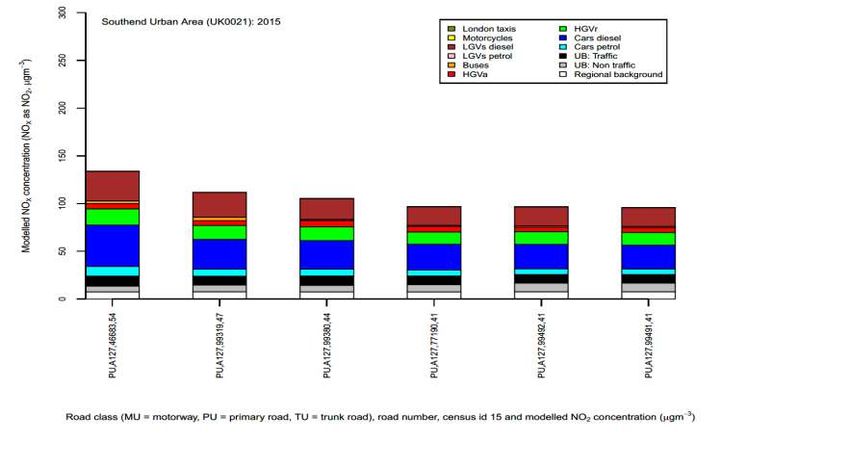
Local road traffic was the dominant source of NOx for the reference year of
2015. The largest contribution was from diesel cars and diesel LGVs
contributing approximately 32% and 23% respectively to the road link with the
highest concentrations. Cars, LGVs, rigid HGVs and articulated HGVs were
important sources on the primary roads with the highest concentrations. For all
road links concentrations of NOx from diesel cars were approximately four
times greater than NOx emissions from petrol cars. NOx concentrations from
petrol LGVs are a small component of total NOx concentrations and less than
2% of total NOx from LGVs. See Figure 2 below.
Data from both source apportionment analyses confirm that diesel vehicles are
the main contributor of NOx on our roads.
3.8 Agglomeration Zone Status
The assessment undertaken for the Southend Urban Area Agglomeration
Zone indicates that the annual limit value was exceeded in 2015 but is likely
to be achieved before 2020 through the introduction of national and local
measures included in the baseline.
17Southend-on-Sea Borough Council Air Quality Action Plan 2017
Figure 2. Annual mean roadside NOx source apportionment for all roads exceeding the annual mean NO2 limit value in 2015 in Southend
Agglomeration Zone
18Southend-on-Sea Borough Council Air Quality Action Plan 2017
3.9 Required Reduction in Emissions
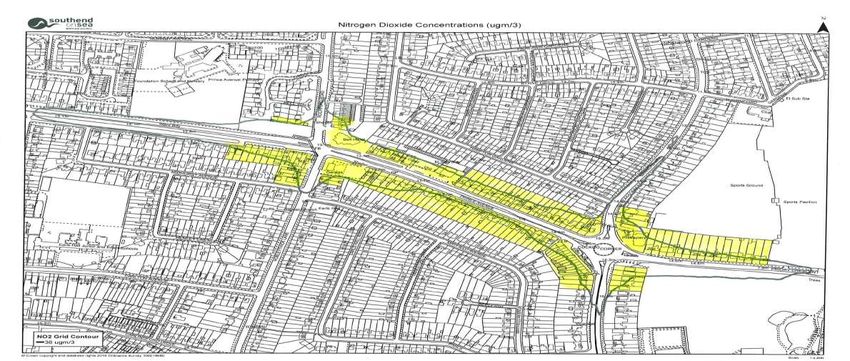
Figure 3 below shows the AQMA boundary. The air quality objective (AQO)
being exceeded at this location is the annual mean for nitrogen dioxide (N02)
which is 40µg/m3.
Real time automatic monitoring as part of the Detailed Assessment undertaken
in 2016 confirms an (annualised) annual mean of 44µg/m3. In order to calculate
the required reduction in emissions, a road NOx concentration of 67.5µg/m3
has been calculated using the NOx to NO2 calculator in line with Box 7.6 in
LAQM.TG(16). The road NOx concentration required to meet the 40 µg/m3 AQO
is 57.6 µg/m3. Therefore, a reduction of 9.9 µg/m3 of road NOx is required to
meet the AQO at this location. This equates to a 15% reduction.
However, as part of the Bell Junction AQMA Strategic Highway Improvement
impact assessment, further analysis of the required reductions in traffic
emissions from the different vehicle categories will be undertaken. Parameters
such as average speed and queue length will also be assessed in order to
provide a basis for future monitoring of the effectiveness of the preferred
option.
There are c125 residential units included in the AQMA boundary. Based on the
Office for National Statistics there were on average 2.4 people per household in
the UK in 2015. Therefore it is estimated that there are c300 people living
within the AQMA boundary.
This was calculated in line with Technical Guidance LAQM.TG16 Chapter 7.
19Southend-on-Sea Borough Council Air Quality Action Plan 2017
Figure 3. The A127 Bell Junction AQMA: Boundary in Green; Properties Affected in Yellow
20Southend-on-Sea Borough Council Air Quality Action Plan 2017
3.10 Immediate Key Priorities
Source apportionment has identified the following contributions to the overall
NO2 pollution burden in the AQMA:
Vehicle Type Percentage Contribution
Diesel Cars 18
LGVs Diesel 13
Buses and Coaches 15
Artic and Rigid HGVs Diesel 15
Emissions from these vehicle categories will be the main focus for priorities 1
and 3 below.
Priority 1 - Assess the air quality impact of the preferred option (of three)
for the Bell Junction AQMA, A127 Strategic Highway Improvement.
Priority 2 - Assess the air quality impact of the Kent Elms A127 Strategic
Highway Improvement at this location, as well as the Bell Junction AQMA
further east.
Priority 3 - Development of a Low Emission Air Quality Strategy (LEAQS)
which will attempt to target diesel cars (18%), diesel LGVs(13%) and
buses (15%), all of which contribute significantly to the overall NO2
pollution burden in the AQMA and on our roads generally.
Priority 4 – Southend Intelligence Hub – SMART CITY Journey.
21Southend-on-Sea Borough Council Air Quality Action Plan 2017
4. Development and Implementation of AQAP
4.1 Consultation and Stakeholder Engagement
Stakeholder consultation is a fundamental aspect of Local Air Quality
Management, and a legal requirement under Schedule 11 (s90) of the
Environment Act 1995.
The consultation process should be collaborative based and provide the way to
better prepare and develop the action plan. It provides participants and,
importantly, the public, with the information they need to contribute in a
meaningful and constructive way.
The public health effects of poor air quality are well documented and DEFRA
expect the highest level of support across the local authority (e.g. Chief
Executive and Council level) to ensure all parts of the local authority are
working effectively together.
Internal Stakeholders Consulted:
Strategic Transport Policy
Public Health
Planning and Development Control
Energy and Sustainability
Procurement
Economic Development
Elected Members
External Stakeholders Consulted:
Transport Companies
Key Freight Operators
Key Local Businesses
Local Environment/Transport Group
Chambers of Commerce
Local Community Representatives and Residents especially in the vicinity
of the AQMA.
22Southend-on-Sea Borough Council Air Quality Action Plan 2017
DEFRA
Essex LAs
In developing this AQAP, we have worked with other local authorities,
agencies, businesses and the local community to improve local air quality.
Schedule 11 of the Environment Act 1995 requires local authorities to consult
the bodies listed in Table 0.1. In addition, we have undertaken the following
stakeholder engagement:
Via the Council’s website
Letters distributed directly to households along the AQMA
The response to our consultation stakeholder engagement is given in Appendix
A.
Table 0.1 ‒ Consultation Undertaken
Yes/No Consultee
Yes the Secretary of State
Yes the Environment Agency
Yes the highways authority
Yes all neighbouring local authorities
other public authorities as appropriate, such as Public Health
Yes
officials
bodies representing local business interests and other
Yes
organisations as appropriate
23Southend-on-Sea Borough Council Air Quality Action Plan 2017
4.2 Steering Group
The Steering Group members will be from SBC, chaired by the Director of Public
Health and include a Transport Planning Policy Engineer, Air Quality Specialist
and a relevant Portfolio Holder. The group will attend quarterly meetings in
order to drive forward existing actions and to identify new initiatives as
appropriate. As a priority, the steering group will collate and review the
responses from internal and external stakeholders to establish suitable action
moving forward. Progress will be reported via the Council’s Annual Status
Reports submitted to DEFRA, the Council’s website and internal management
team meetings.
24Southend-on-Sea Borough Council Air Quality Action Plan 2017
5. Action Plan Measures
The following tables describe the Borough Council’s AQAP measures. Details
include:
a list of the actions that form part of the plan
the responsible organisations who will deliver this action
Indication of cost of implementing each action: Low (£100K). Indication of expected benefit in terms of
pollutant emission and/or concentration reduction – Low (imperceptible
reduction), Medium (up to 2µg/m3 reduction in concentration) or High
(greater than 2µg/m3 reduction in concentration) – based on the
LLAQM Borough Air Quality Action Matrix used by London Authorities4
and professional experience. Where possible, the percentage reduction
modelled in the LAQM Matrix has been applied to the 50.9µg/m-3 highest
modelled concentration in the Detailed Assessment
the timescale for implementation
how progress will be monitored
Note, although the actions are listed in accordance with the work area priorities
as described in the main text, the NO2 source apportionment data shown in
Section 3.5-3.7 above will be a key factor in determining specific actions
targeted towards certain vehicle categories, especially in the AQMA. More
details will be provided in our Low Emission Air Quality Strategy currently in
development
Please see future Air Quality Annual Status Reports for updates on
implementation of these measures.
5.1 Southend Intelligence Hub - SMART CITY Journey and Digital
Strategy
The connection of the Council’s 31 Urban Traffic Control sites to the newly
deployed pan borough full fibre network presents the opportunity to monitor a
raft of traffic and environmental characteristics simultaneously in real time.
The intention is to relay data captured this way back to the Council’s
4
https://www.london.gov.uk/sites/default/files/air_quality_action_matrix.pdf
25Southend-on-Sea Borough Council Air Quality Action Plan 2017
Intelligence Hub and host it for analytical purposes within the CISCO City
Connected Digital Platform. The provision of the Intelligence Hub and the
ability to cross reference data captured in this way is key to Southend’s SMART
CITY ambitions. As step one, the Intelligence Hub will see the co-location of
three core 24/7 services: public space CCTV, traffic management and telecare.
Funding for the Intelligence Hub has been approved and subject to the final
business case the Hub will be built in 2018/19.
The Hub will:
Act as “eyes and ears” of the Borough, watching and monitoring activity.
Act as the City Intelligence and Coordination Centre, responding in
anticipation of incidents escalation.
Enable the Council to generate income through the selling of services
capable of being delivered through the SIH.
The SIH will see the upgrade and integration of systems and services provided
within a modern environment on a 24/7 basis. It will also have the capability to
facilitate an ambitious undertaking and could potentially co-locate key strategic
and operational services from a range of partner organisations such as the NHS
and Essex Police. It will in essence become a centralised operations suite for
delivering borough-wide management via a wide range of partnership
responses within Southend and neighbouring boroughs. In the initial formative
period however, the focus will be on council services.
The overarching benefits could include:
1. The provision of a strategic and integrated approach to image capture,
information dissemination and operational analysis of live incidents.
2. Intelligence-led responses to incidents including major emergencies
3. Delivery of enhanced traffic management on a borough wide basis.
4. Delivery of enhanced environmental monitoring (including a pilot study
of 10 remote air quality sensors) and ultimately management solutions.
5. Activation of the community to have a healthier life style.
6. More effective and efficient use of available resources.
Whilst the Southend Intelligence Hub will not lead directly to improvements in
air quality, it may be used to give a clearer picture of air quality across
26Southend-on-Sea Borough Council Air Quality Action Plan 2017
Southend as a whole to more accurately target improvement measures. Also, it
may be used to monitor the impact of AQAP measures implemented.
27Southend-on-Sea Borough Council Air Quality Action Plan 2017
Table 5.1 Southend Intelligence Hub-SMART City Journey Action Summary
Target Pollution Estimated
EU Lead Planning Implementation Measurable Progress
No. Measure EU Category Reduction in the Completion Comments
Classification Authority Phase Phase By to Date
AQMA Date
ICT,
Intelligence Transport
Strategic Commence Jan Major IT Infrastructure
1 Hub-SMART Planning and Other Aug 2017 N/A On-going Dec 2019
Transport 2018 Up-grade for Southend
City Infrastructure
Policy(SBC)
Pilot the
CISCO City
Connected
Digital
Platform
(CDP) pulling
together data
sets in respect Cost Low
of traffic and The
environment. identification Potential AQ Impact
Understanding of predictive Medium to High
Transport ICT, through
the and
1.a Planning and Other Strategic ,, 2017 ‘’ ‘’ Dec 2107 identification of
relationship preventative
Infrastructure Transport possible strategies
and strategies
Policy(SBC for further
automating
predictive and improvement
preventative
strategies
28Southend-on-Sea Borough Council Air Quality Action Plan 2017
Target Pollution Estimated
EU Lead Planning Implementation Measurable Progress
No. Measure EU Category Reduction in the Completion Comments
Classification Authority Phase Phase By to Date
AQMA Date
Provide a
business case
for the
Creation of a Cost Low
1.b Southend ‘’ ‘’ ‘’ ,, Completion ‘’ ‘’ Potential AQ Impact
Intelligence Low
Hub - SMART
CITY
Build the Hub in place,
Cost High
Intelligence properly
Potential AQ Impact
1.c Hub in ‘’ ‘’ ‘’ ,, 2018/19 staffed and ‘’ ‘’ Dec 2019
Medium to High
Southend operational
Single 24/7 solution for
the Borough
Pilot study to test
Installation of reliability, suitability for
10 air quality UTMC
Pilot Completion
1.d sensors for Completed
‘’ ‘’ ‘’ Jan 2018 and review of ‘’ ‘’ Jan 2019
UTMC 2017 May be used to
data collected
suitability monitor progress of
(Pilot) other identified AQAP
measures
29Southend-on-Sea Borough Council Air Quality Action Plan 2017
5.2 Strategic Planning and Transport Policy
5.2.1 Local Planning Framework
The Southend Core Strategy (2007) Policy KP2: Development Principles, seeks
to ensure that all new development, including transport infrastructure,
contributes to economic, social, physical and environmental regeneration in a
sustainable way, including reducing the need to travel (KP2.3.c), facilitating the
use of travel modes other than the private car (KP2.3.e); respect, conserve and
enhance and where necessary adequately mitigate effects on the natural
environment, including the Borough’s biodiversity and green space resources
(KP2.4); promote improved and sustainable modes of travel (KP2.8); including
appropriate measure in design, layout, operation and materials to achieve,
avoidance or appropriate mitigation of actual and potential pollution impacts
of development (KP2.11.c), enhancement to the ecological and amenity value
of the environment where appropriate (KP2.11.e).
Policy KP3: Implementation and Resources, sets out that the Council will enter
into planning obligations to ensure the provision of infrastructure and
transportation measures, including improvements to cycling, walking and
passenger transport facilities and services (KP3.2.b) and open spaces and green
grid enhancements (KP3.2.f), and to require all development to have regard to,
and where appropriate contribute to the delivery of, the Southend Local
Transport Plan (KP3.4).
Policy CP3: Transport and Accessibility, makes provision for improvements to
transport infrastructure and services, in partnership, to secure a step change in
provision to achieve a modern integrated transport system, necessary to
unlock key development sites and secure sustainable regeneration and growth.
This includes, Policy CP3.6, safeguarding and enhancing the environment of
‘Environmental Rooms’, as defined in the Local Transport Plan.
Policy CP4: The Environment and Urban Renaissance, requires development
proposals to contribute to the creation of a high quality, sustainable urban
environment, including creating safe, permeable and accessible development
and spaces that encourage walking and cycling within ‘Environmental Rooms’
(CP4.6); creating and maintaining a ‘Green Grid’ of high quality, linked and
publicly accessible open spaces across the town, contributing to the wider
30Southend-on-Sea Borough Council Air Quality Action Plan 2017
green grid (CP4.10); and preventing, reducing or remedying all forms of
pollution including soil, water, noise and other forms of airborne pollution
(CP4.14).
The Development Management DPD (2015) in Policy DM15: Sustainable
Transport Management, highlights the role sustainable transport in Southend
plays in supporting economic growth, including reducing carbon emissions,
improving local air quality, improving health through better air quality and
making walking and cycling an attractive and viable alternative.
It references the Southend Local Transport Plan, and highlights the need to
locate development in areas that are sustainable, or that it can be
demonstrated can be made sustainable and accessible by non-car modes and
which reduce the overall need to travel. Developments that generate
significant amounts of movement, are required to provide a supporting
Transport Statement or Transport Assessment.
Policy DM15 also encourages the provision of facilities for charging electric
vehicles and other ultra-low emission vehicles wherever practical and feasible.
5.2.2 Local Transport Plan (LTP3)
The Council is now working to LTP3 covering the period 2011-2026 with a
current implementation plan covering 2015-2021 reflecting the Governments
spending plan.
Local Transport Plans steer the implementation of national transport policies at
the local level. As a strategic document the LTP does not contain details of
schemes, but sets out a long term transport strategy, a shorter term
implementation plan and a number of supporting strategies.
Transport needs to be linked with wider economic, social and environmental
objectives. The LTP3 has therefore been developed within the context provided
by a range of policy documents, including the Southend Core Strategy.
The long term transport strategy vision is linked to the Council’s long term
vision of:
“Creating a better Southend” which is supported by five aims resulting in a
”Clean, Safe, Healthy and Prosperous Southend Led by an Excellent Council.”
31Southend-on-Sea Borough Council Air Quality Action Plan 2017
The Southend LTP3 contains the following key themes:
1. A thriving and sustainable local economy in the Borough;
2. Minimise environmental impact and promote sustainability for a greener
Borough;
3. A safer Borough, and;
4. Reduce inequalities in health and wellbeing and a more accessible
Borough.
The document incorporates four Action Plans covering the full range of
schemes to be delivered with a clear focus on ensuring that their purpose is
understood, that they interrelate and contribute to delivering a “Better
Southend”.
5.2.3 The A127 Bell AQMA Highway Improvement
Three different potential highway improvement schemes are currently being
considered, including potential air quality impacts. The preferred option will be
chosen via a formal consultation process during 2018.
5.2.4 The A127 Kent Elms Highway Improvement
The A127 Kent Elms Junction improvements provide maximum benefit with
three lanes heading eastwards, and a right hand turn lane providing improved
capacity through the junction. An additional lane is also provided heading
westward again providing greater capacity through the junction.
Together with a new footbridge the scheme will help deliver an improved local
environment and contribute positively towards sustainable transport
objectives. See ASR 2017 for more detail.
The potential air quality impact of the Kent Elms junction as well as further east
along the A127 at the Bell Junction AQMA will be monitored and modelled, the
former as part of a Detailed Assessment commissioned in December 2018.
Note that an Air Quality Assessment of the proposed road improvement works
at the Kent Elms junction was undertaken in 2016. Dispersion modelling of all
three potential scenarios suggested a slight improvement in air quality for
nitrogen dioxide and particles at all receptor locations. See reference 19.
32Southend-on-Sea Borough Council Air Quality Action Plan 2017
Table 5.2 Summary of Strategic Planning and Transport Actions
Target Pollution Estimated
EU Lead Planning Implementation Measurable Progress
No. Measure EU Category Reduction in the Completion Comments
Classification Authority Phase Phase By to Date
AQMA Date
“A Better
2
Southend”
Cost M-H
Better
Transport Potential AQ Impact
Sustainable Completion of
Planning and not quantified but
Transport and Projects
LTPA Infrastructure, Other SBC n/a On-going n/a LTP3 On-going improvements
Mobility
Traffic expected
Management KP2
Management
Corporate Priority
Action
Cost M-H
Better Networks Potential AQ Impact
Completion of
and Traffic not quantified but
Traffic Projects
LTPB Management Other SBC n/a On-going n/a LTP3 On-going improvements
Management
Schemes expected
KP2
Corporate Priority
Action
Better
Cost M-H
Partnership,
Engagement
Potential AQ Impact
and Completion of
Transport not quantified but
Sponsorship to Projects
LTPC Planning and Other SBC n/a On-going n/a LTP3 On-going improvements
Support Greater
Infrastructure expected
Efficiencies in KP2
Funding and
Corporate Priority
Delivery
Action
33Southend-on-Sea Borough Council Air Quality Action Plan 2017
Target Pollution Estimated
EU Lead Planning Implementation Measurable Progress
No. Measure EU Category Reduction in the Completion Comments
Classification Authority Phase Phase By to Date
AQMA Date
Better Operation
of Traffic
Control,
Information and Corporate Priority
Communication Action
Systems Completion of
UTC, congestion
including Traffic Projects Cost Medium
LTPD management, SBC Completed On-going n/a LTP3 On-going
Intelligent Management
traffic reduction
Transport Internal KP2 Potential AQ Impact
Systems and expected but not
Urban Traffic quantified
Management
Control (UTMC)
Infrastructure/traffic
management
A127 AQMA Completion of
Traffic Strategic Medium– improvements in and
Strategic Project,
Management, UTC, congestion Transport concentration adjacent to AQMA
Highway Scoping
3 Transport management, and On-going tbc determined by March 2021
Improvement, Modelling and phase
Planning and traffic reduction Planning modelling study Cost High
The Bell monitoring of AQ
Infrastructure Policy commissioned
Junction and traffic
Potential AQ Impact
Medium
Potential AQ Impact
quantified by diffusion
Post project
Traffic Medium – Road works tube monitoring and
A127 Kent Elms modelling and
Management, UTC, congestion concentration will 80% traffic modelling in
Strategic monitoring of AQ
4 Transport management, SBC 2016 2018/19 be determined by complete, June 2018 tbc progress/ to be
Highway and traffic
Planning and traffic reduction post project awaiting undertaken
Improvement
Infrastructure modelling footbridge
KP2
Cost High
Promote Traffic
Cost L-M
Workplace, Management,
Promoting Travel Monitoring Promotion
5 School and Transport SBC Completed On-going Low On-going
Alternatives adoption rate On-going Potential AQ Impact
Personalised Planning and
Low
Travel Plans Infrastructure
34Southend-on-Sea Borough Council Air Quality Action Plan 2017
Target Pollution Estimated
EU Lead Planning Implementation Measurable Progress
No. Measure EU Category Reduction in the Completion Comments
Classification Authority Phase Phase By to Date
AQMA Date
Promotion of
Cycling via
“Sustainable
Motion” Project, Cost Low
“Cycle Promoting
Promotion of
6 Southend” , Travel SBC Completed On-going Uptake levels Low On-going On-going Potential AQ Impact
Cycling
“Ideas in Motion” Alternatives Low
Project and Bike
Hire Scheme
Promote and Cost Low
Promoting
Encourage Promotion of
7 Travel SBC Completed On-going Uptake levels Low On-going On-going
walking via Cycling Potential AQ Impact
Alternatives
“Ideas in Motion” Low
Cost Low
Promote Train Alternatives to
8 Travel via “Ideas Private Other SBC Completed On-going Uptake levels Low On-going
Potential AQ Impact
in Motion” Vehicle Use
Low
Cost Low
Encourage and Promote Encourage and
9 Facilitate Home Travel Facilitate Home SBC Completed On-going Uptake levels Low On-going On-going
Potential AQ Impact
Working Alternatives Working
L-M
Encourage
development of
Car Clubs via Cost Low
Alternatives to
Section 106
10 Private Car Clubs SBC Completed On-going Uptake levels Low On-going
Agreements and Potential AQ Impact
Vehicle Use
Motion Hub Low
35Southend-on-Sea Borough Council Air Quality Action Plan 2017
Target Pollution Estimated
EU Lead Planning Implementation Measurable Progress
No. Measure EU Category Reduction in the Completion Comments
Classification Authority Phase Phase By to Date
AQMA Date
Promote uptake
Procuring
of Sustainable Promotional
alternative re-
Transport such Low – LLAQM Events
fuelling
as Electric Promoting indicates a Completed, Cost Low
infrastructures to
11 Vehicles and Low Emission SBC Completed On-going Uptake levels reduction in NO2 Two
promote low
Installation of Transport concentration of +charging Potential AQ Impact
emission
Electric 0.4-0.6 µg/m3 points
vehicles and EV
Charging Points installed
charging points
Procuring
alternative re-
Low - LLAQM
Provision of fuelling
Promoting indicates a Two cars Cost
Electric cars for infrastructures to
12 Low Emission SBC Completed On-going Uptake levels reduction in NO2 currently On-going
staff business promote low
Transport concentration of available Potential AQ Impact
and private use emission
0.4-0.6 µg/m3
vehicles and EV
charging poin
Undertake a
Park and Ride
pilot for town
Phase One Cost Low
centre, in order Alternatives to
Bus based Park Pilot October 2017;
13 to assess Private SBC Completed Completed Uptake level Low
and Ride completed Future phases Potential AQ Impact
viability and up- Vehicle Use
tbc Low
take rate for
potential future
implementation
Apply for
National
Cost Low
Productivity Transport Securing funding
14 Investment Planning and Other SBC n/a n/a and completion n/a On-going On-going
Potential AQ Impact
Funding (NPIF) Infrastructure of projects
not quantified
for Infrastructure
Projects
36Southend-on-Sea Borough Council Air Quality Action Plan 2017
5.3 Public Health and Raising Awareness
5.3.1 Public Health Outcomes Framework
The Public Health Outcomes Framework originally published in 2012 sets out
the (national) desired outcomes for public health and how these will be
measured. The framework concentrates on two high level outcomes that set
the vision to be achieved across the public health system. These are:
Increased healthy life expectancy
Reduced differences in life expectancy and healthy life expectancy
between communities.
The outcomes reflect a focus not only on how long people live but also on how
well they live at all stages of life. The second outcome focuses attention on
reducing health inequalities between people, communities and areas. Using a
measure of both life expectancy and healthy life expectancy will enable the use
of the most reliable information available to understand the nature of health
inequalities both within and between areas.
A set of supporting public health indicators will help focus understanding of
progress year by year nationally and locally on those things that matter most to
public health.
The indicators, which cover the full spectrum of public health and what can be
currently realistically measured, are grouped into four domains:
1. Improving the wider determinants of health
2. Health improvement
3. Health protection
4. Healthcare public health and preventing premature mortality?
The domain of health protection includes air pollution (specifically PM2.5) as a
public health indicator. For the Southend area the mortality burden estimate
for the local population is that 6.1% of all mortality for age group 25+ years is
attributable to anthropogenic PM2.5 exposure 4.
37Southend-on-Sea Borough Council Air Quality Action Plan 2017
5.3.2 Vulnerable Groups
Ensure healthcare professionals aware of the UK Daily Air Quality Index, and
that they understand the health effects of long-term exposure to air pollution,
to raise awareness of poor outdoor air quality and advise high risk groups on
how to minimise their exposure and its impact. For example:
Avoid or reduce strenuous activity outside, especially in highly polluted
locations, busy roads, and particularly if experiencing symptoms such as
sore eyes, a cough or sore throat
Use an asthma reliever more often, as necessary
Close external doors and windows facing busy roads at times when
traffic is heavy or congested, in order to avoid highly polluted air
entering the property.
38Southend-on-Sea Borough Council Air Quality Action Plan 2017
Table 5.3 Public Health and Raising Awareness Summary of Actions
Target Pollution Estimated
EU Lead Planning Implementation Measurable Progress
No. Measure EU Category Reduction in the Completion Comments
Classification Authority Phase Phase By to Date
AQMA Date
Undertake a
Cost Low
Health Impact
Assessment in
Policy Potential AQ Impact
order to better
15 Guidance Other SBC 2018 2018 tbc Completion n/a In progress 2019 tbc n/a
understand the
(Public Health
health impacts
Local Morbidity and
of air pollution
Mortality Study
locally
Ensure that the
relevant
chapters of the
JSNA have up
to date pollution
data and
information
Cost Low
about the impact Policy
16 of air quality on Guidance Other SBC 2018 2018 tbc Completion n/a In progress 2019 tbc
Potential AQ Impact
health. This can (Public Health)
n/a
then be
considered as
we refresh the
relevant JSNA
chapters going
forward.
39Southend-on-Sea Borough Council Air Quality Action Plan 2017
Target Pollution Estimated
EU Lead Planning Implementation Measurable Progress
No. Measure EU Category Reduction in the Completion Comments
Classification Authority Phase Phase By to Date
AQMA Date
Raising
Awareness with
regard to air
pollution in
general e.g.
domestic Promoting
biomass Travel Links to Cost Low
burners, health Alternatives DEFRA
17 Other SBC 2018 On-going Up-dates Low On-going
effects, travel and Public advice in Potential AQ Impact
choices, benefits Health progress Low
of personal Information
behavioural
change via e.g.
social media,
SBC website,
and health alerts
Raising
awareness of Promoting
High Risk and Travel Cost Low
Vulnerable Alternatives
18 Other SBC 2018 On-going Up-dates Low On-going On-going
Groups via e.g. and Public Potential AQ Impact
social media, Health Low
SBC website, Information
health alerts
Promoting Cost Low
Travel
Promote
Alternatives Completed Potential AQ Impact
19 National Clean Other SBC Completed Completed Completion n/a n/a
and Public June 2017 n/a
Air Day 2017
Health
Information Learn from 2017 event
and promote event for
2018
40Southend-on-Sea Borough Council Air Quality Action Plan 2017
5.4 Land Use Planning and Development Control
A key principle for Southend-on-Sea Borough Council is to integrate air quality
considerations with other policy areas such as Land Use Planning. Many
developments have the potential to increase the pollution burden and it is
appropriate that these developments are required to mitigate or offset this in
order to help to achieve an overall reduction in local air pollution. It is
therefore essential to identify how we can bring air quality considerations into
the planning process at the earliest possible stage. It is no longer satisfactory to
simply demonstrate that a development is no worse than the existing or
previous land use on a particular site.
5.4.1 Southend Central Area Action Plan (SCAAP)
The Southend Central Area Action Plan (SCAAP), when adopted, will form part
of the Southend-on-Sea Local Planning Framework.
The SCAAP reflects the vision, strategic objectives and spatial strategy of the
Southend Core Strategy (2007). The Core Strategy is a strategic level document
that provides the framework for subsequent DPDs, including the SCAAP. It
establishes housing and job growth targets for the SCAAP area, over a plan
period of 2001- 2021.
5.4.2 Air Quality Supplementary Planning Guidance
This document will be produced in order to provide consistency in the way
potential developments are considered in relation to their potential impact on
local air quality and the need to provide an appropriate air quality assessment.
Where developments take place in or adjacent to an AQMA mitigation
measures must be considered as standard practice, particularly in cases where
the development is new and does not simply replace an existing use. This is
especially important where the development has provision for a large number
of parking spaces significantly increasing the number of vehicle trips, and/or
heating plant.
Guidance for dust management on construction sites and medium combustion
plant (MCP) will be incorporated.
41You can also read


