Weeki Wachee Basin Management Action Plan - Florida Department of Environmental ...
←
→
Page content transcription
If your browser does not render page correctly, please read the page content below
Weeki Wachee
Basin Management Action Plan

Division of Environmental Assessment and Restoration
          Water Quality Restoration Program
  Florida Department of Environmental Protection

             with participation from the
            Weeki Wachee Stakeholders

                     June 2018

                              2600 Blair Stone Rd.
                             Tallahassee, FL 32399
                                    floridadep.gov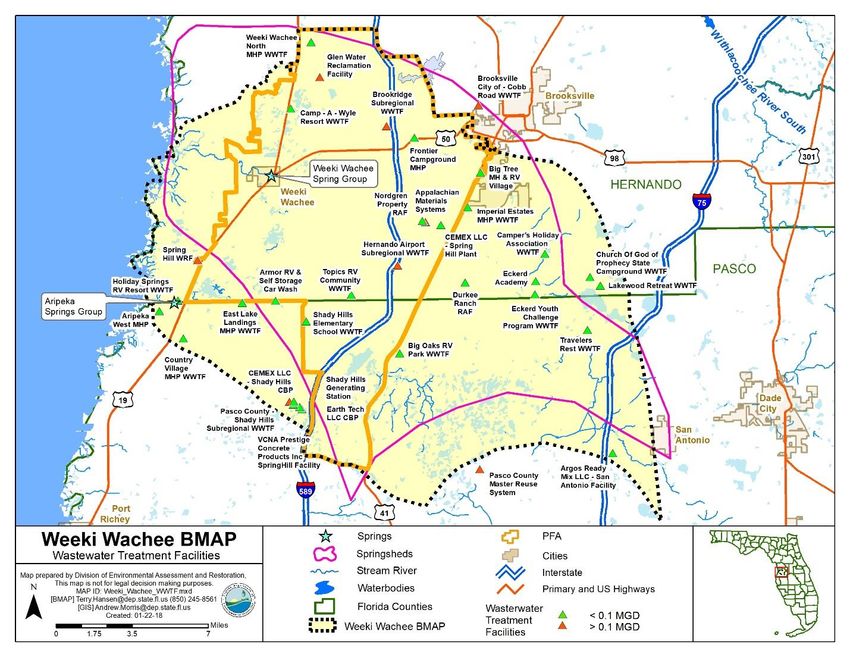
Weeki Wachee Basin Management Action Plan (BMAP), June 2018

                                      Acknowledgments
The Florida Department of Environmental Protection adopted the Weeki Wachee Basin
Management Action Plan by Secretarial Order as part of its statewide watershed management
approach to restore and protect Florida's water quality. The plan was developed in coordination
with stakeholders, identified below, with participation from affected local, regional, and state
governmental interests; elected officials and citizens; and private interests.

Florida Department of Environmental Protection
Noah Valenstein, Secretary

                           Table A-1. Weeki Wachee stakeholders
                  Type of Entity                                            Name
                                                                     City of Brooksville
                                                                      Hernando County
             Responsible Stakeholders                                   Pasco County
                                                                   Agricultural producers
                                                                        Golf courses
                                                      Florida Department of Agriculture and Consumer
                                                                          Services
               Responsible Agencies                   Florida Department of Environmental Protection
                                                                Florida Department of Health
                                                       Southwest Florida Water Management District
                                                                           Citizens
                                                                   City of Weeki Wachee
                                                                    Florida Farm Bureau
                                                           Florida Onsite Wastewater Association
           Other Interested Stakeholders                          Florida Springs Institute
                                                      Hernando Beach Government Affairs Committee
                                                                Hernando County Task Force
                                                      Hernando Environmental Land Protectors (HELP)
                                                                   Save the Manatee Club

See Appendix A for links to important sources referenced in this document. For additional
information on the watershed management approach in the Weeki Wachee Basin, contact:

Terry Hansen, P.G., Basin Coordinator
Florida Department of Environmental Protection
Water Quality Restoration Program, Watershed Planning and Coordination Section
2600 Blair Stone Road, Mail Station 3565
Tallahassee, FL 32399-2400
Email: terry.hansen@dep.state.fl.us
Phone: (850) 245–8561
Fax: (850) 245–8434

                                            Page 2 of 87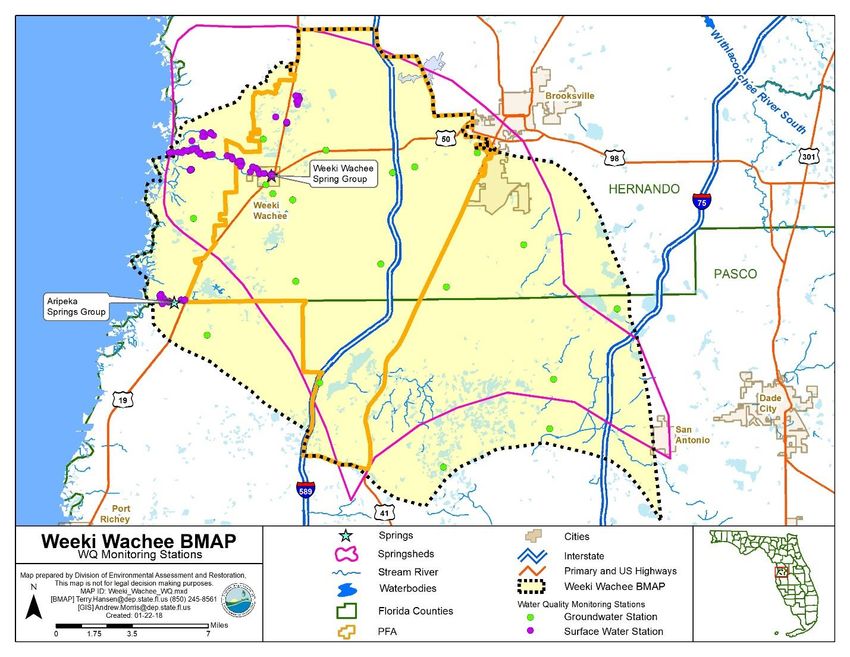
Weeki Wachee Basin Management Action Plan (BMAP), June 2018

                                                     Table of Contents
Acknowledgments ..........................................................................................................................2
List of Acronyms and Abbreviations ...........................................................................................7
Executive Summary .....................................................................................................................10
Section 1 : Background................................................................................................................15
      1.1 Legislation ......................................................................................................................15
      1.2 Water Quality Standards and Total Maximum Daily Loads (TMDLs) ..................15
      1.3 BMAP Requirements ....................................................................................................16
      1.4 BMAP Area ....................................................................................................................16
      1.5 Priority Focus Area (PFA) ...........................................................................................16
      1.6 Other Scientific and Historical Information ...............................................................19
      1.7 Stakeholder Involvement ..............................................................................................19
      1.8 Description of BMPs Adopted by Rule .......................................................................20
Section 2 : Implementation to Achieve TMDLs ........................................................................21
      2.1 Allocation of Pollutant Loads .......................................................................................21
      2.2 Prioritization of Management Strategies ....................................................................26
      2.3 Load Reduction Strategy ..............................................................................................27
      2.4 OSTDS Management Strategies ..................................................................................28
      2.5 UTF Management Strategies........................................................................................30
      2.6 STF Management Strategies ........................................................................................32
      2.7 Agricultural Sources Management Strategies and Additional Reduction Options 32
      2.8 WWTF Management Strategies ..................................................................................35
      2.9 Atmospheric Deposition Management Strategies ......................................................37
      2.10 Future Growth Management Strategies ..............................................................38
      2.11 Protection of Surface Water and Groundwater Resources through Land
      Conservation ........................................................................................................................38
      2.12 Commitment to Implementation ..........................................................................39
Section 3 : Monitoring and Reporting .......................................................................................40
      3.1 Methods for Evaluating Progress ................................................................................40
      3.2 Adaptive Management Measures ................................................................................40
      3.3 Water Quality and Biological Monitoring ..................................................................41
Appendices ....................................................................................................................................45
      Appendix A. Important Links ...........................................................................................45
      Appendix B. Projects to Reduce Nitrogen Sources ..........................................................46
      Appendix C. Weeki Wachee PFA Report .........................................................................55

                                                                Page 3 of 87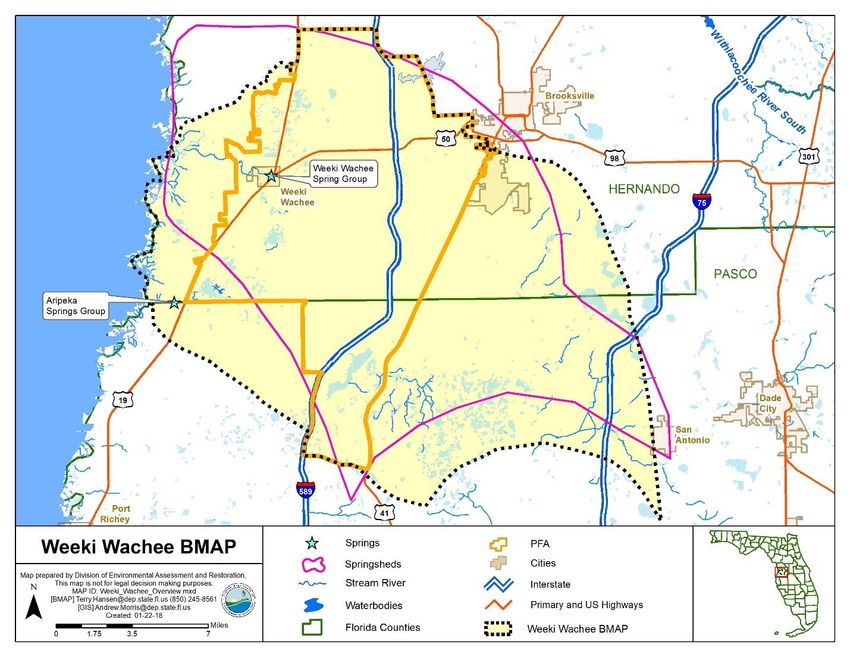
Weeki Wachee Basin Management Action Plan (BMAP), June 2018

Appendix D. OSTDS Remediation Plan ...........................................................................56
Appendix E. Technical Support Information ...................................................................65
Appendix F. Educational Activities to Implement the UTF Management Strategies ..70
Appendix G. FDACS Information on BMPs ....................................................................74
Appendix H. Future Growth Strategies of Local Jurisdictions ......................................83

                                              Page 4 of 87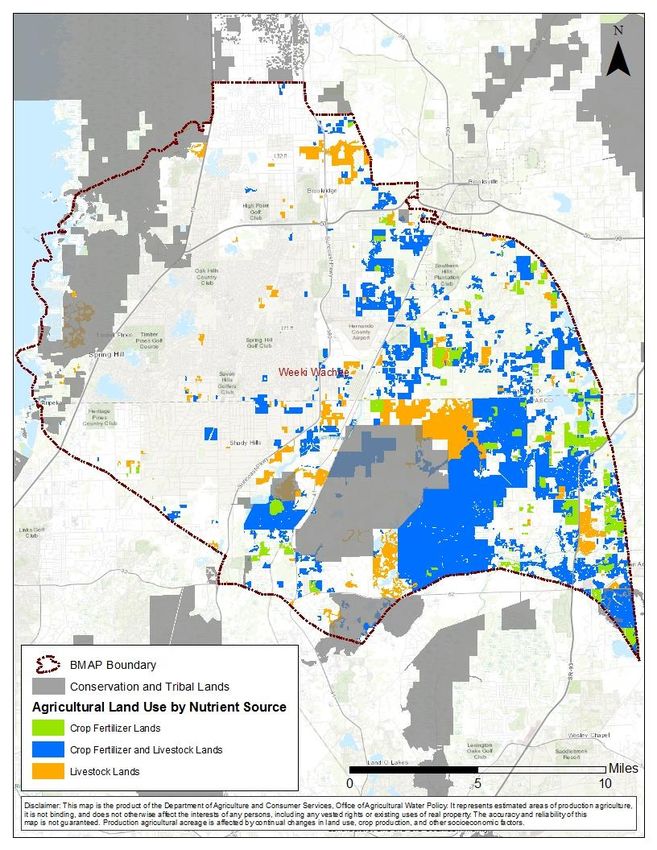
Weeki Wachee Basin Management Action Plan (BMAP), June 2018

                                                List of Figures
Figure ES-1. Weeki Wachee BMAP and PFA boundaries ............................................................11
Figure 1. Weeki Wachee BMAP, springshed, and PFA boundaries .............................................17
Figure 2. Loading to groundwater by source in the Weeki Wachee Springshed ...........................25
Figure 3. OSTDS locations in the Weeki Wachee BMAP area and PFA......................................29
Figure 4. Locations of domestic WWTFs in the Weeki Wachee BMAP area ..............................36
Figure 5. Groundwater and surface water stations sampled in the Weeki Wachee Basin .............43
Figure D-1. Locations of OSTDS in the PFA in the Weeki Wachee BMAP area ........................61
Figure G-1. Agricultural lands in the BMAP area .........................................................................77
Figure G-2. BMP enrollment in the BMAP area as of December 31, 2017 ..................................79

                                                      Page 5 of 87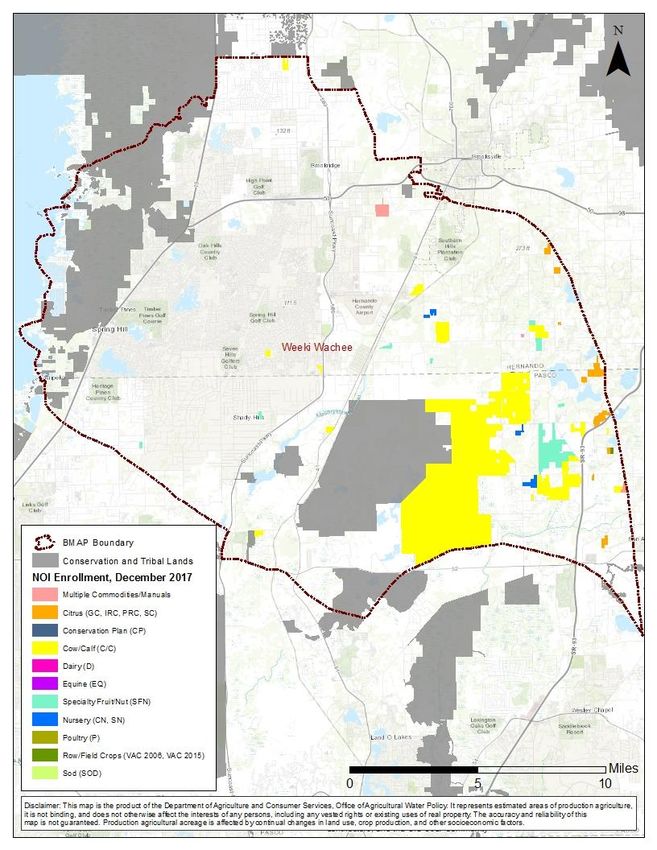
Weeki Wachee Basin Management Action Plan (BMAP), June 2018

                                                    List of Tables
Table A-1. Weeki Wachee stakeholders ..........................................................................................2
Table ES-1. WWTF effluent standards ..........................................................................................13
Table 1. Restoration targets for Weeki Wachee Spring Group, Magnolia-Aripeka Springs Group,
              Wilderness-Mud-Salt Springs Group, and Jenkins Creek Spring ...........................16
Table 2. BMPs and BMP manuals adopted by rule as of June 2017 .............................................20
Table 3. Estimated nitrogen load to groundwater by source in the BMAP area ...........................22
Table 4. Total reduction required to meet the TMDLs ..................................................................26
Table 5. Nitrogen reduction schedule (lb-N/yr) .............................................................................26
Table 6. Summary of potential credits for the Weeki Wachee BMAP to meet the TMDLs .........28
Table 7. Estimated individual OSTDS improvements to groundwater .........................................30
Table 8. Current project credits to reduce UTF loading to groundwater .......................................31
Table 9. Maximum UTF load reductions based on existing public education credit policies .......31
Table 10. Maximum load reductions from STF improvements based on existing credit policies 32
Table 11. Estimated acreages for additional agricultural projects or practices .............................34
Table 12. Calculations for additional load reductions to groundwater ..........................................34
Table 13. Wastewater effluent standards for the BMAP area .......................................................37
Table 14. Stakeholder conservation land purchases ......................................................................39
Table 15. Core water quality indicators and field parameters .......................................................42
Table 16. Supplemental water quality indicators and field parameters .........................................42
Table 17. Biological response measures for spring runs ...............................................................43
Table B-1. Stakeholder projects to reduce nitrogen sources ..........................................................47
Table D-1. Estimated reduction credits for additional OSTDS enhancement or sewer * .............60
Table D-2. Prioritized target audiences, messaging, and materials/resources ...............................62
Table D-3. Stakeholder educational activities to implement the OSTDS remediation plan .........64
Table E-1. Range of environmental attenuation of nitrogen from a detailed literature review .....68
Table F-1. Stakeholder educational activities to implement UTF management strategies............71
Table G-1. Agricultural land use in the BMAP area .....................................................................74
Table G-2. Fertilized crop lands in the BMAP area ......................................................................75
Table G-3. Livestock lands in the BMAP area ..............................................................................75
Table G-4. Agricultural acreage and BMP enrollment in the BMAP area as of
              December 31, 2017..................................................................................................80
Table G-5. Beyond BMP implementation .....................................................................................82
Table H-1. Future growth strategies of local jurisdictions ............................................................83

                                                          Page 6 of 87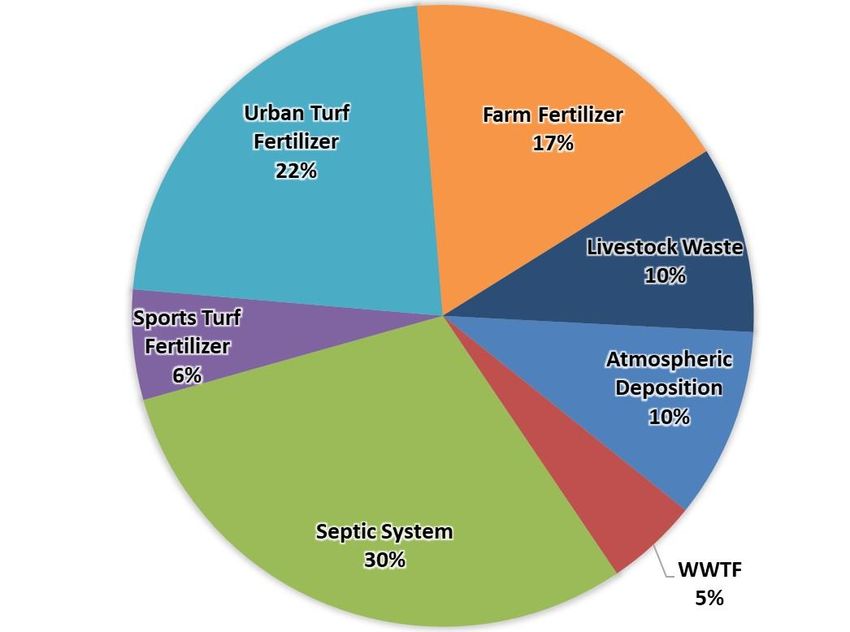
Weeki Wachee Basin Management Action Plan (BMAP), June 2018

                 List of Acronyms and Abbreviations
ac        Acre
AWT       Advanced Wastewater Treatment
ATU       Aerobic Treatment Unit
BAF       Biochemical Attenuation Factor
BMAP      Basin Management Action Plan
BMPs      Best Management Practices
CASTNET   Clean Air Status and Trends Network
cfs       Cubic Feet Per Second
CMAQ      Community Multiscale Air Quality
C.R.      County Road
CRF       Controlled Release Fertilizer
DEP       Florida Department of Environmental Protection
DMR       Discharge Monthly Report
DO        Dissolved Oxygen
F.A.C.    Florida Administrative Code
F.A.R.    Florida Administrative Register
FARMS     Facilitating Agricultural Resource Management Systems
FDACS     Florida Department of Agriculture and Consumer Services
FDOH      Florida Department of Health
FF        Farm Fertilizer
FGS       Florida Geological Survey
FLUCCS    Florida Land Use Cover and Forms Classification System
FOWA      Florida Onsite Wastewater Association
F.S.      Florida Statutes
FSAID     Florida Statewide Agricultural Irrigation Demand
FYN       Florida Yards and Neighborhoods
GIS       Geographic Information System
gpd       Gallons Per Day
HA        Habitat Assessment
IA        Implementation Assurance
IV        Implementation Verification
in/yr     Inch Per Year
lb        Pound
lb-N/yr   Pounds of Nitrogen Per Year
LF        Linear Feet
LID       Low Impact Development
LVS       Linear Vegetation Survey
LW        Livestock Waste
MFLs      Minimum Flows and Levels
mgd       Million Gallons Per Day
mg/L      Milligrams Per Liter

                                      Page 7 of 87
Weeki Wachee Basin Management Action Plan (BMAP), June 2018

MIL       Mobile Irrigation Lab
N         Nitrogen
N/A       Not Applicable
NADP      National Atmospheric Deposition Program
NELAC     National Environmental Accreditation Conference
NELAP     National Environmental Accreditation Program
NNC       Numeric Nutrient Criteria
NOI       Notice of Intent
NSF       NSF International (formerly National Sanitation Foundation)
NSILT     Nitrogen Source Inventory Loading Tool
NTN       National Trends Network
OAWP      Office of Agricultural Water Policy
OFS       Outstanding Florida Spring
OFW       Outstanding Florida Water
OSTDS     Onsite Sewage Treatment and Disposal System
PBTS      Performance-based Treatment System
PFA       Priority Focus Area
PSA       Public Service Announcement or Planned Service Area
QA/QC     Quality Assurance/Quality Control
RIB       Rapid Infiltration Basin
RPS       Rapid Periphyton Survey
SBIO      DEP Statewide Biological Database
SCI       Stream Condition Index
SOP       Standard Operating Procedure
STF       Sports Turf Fertilizer
STORET    Florida Storage and Retrieval Database
SWFWMD    Southwest Florida Water Management District
SWIM      Surface Water Improvement and Management
TDEP      Total Atmospheric Deposition Model
TMDL      Total Maximum Daily Load
TN        Total Nitrogen
TSS       Total Suspended Solids
UFA       Upper Floridan Aquifer
UF–IFAS   University of Florida Institute of Food and Agricultural Sciences
USDA      U.S. Department of Agriculture
USGS      U.S. Geological Survey
UTF       Urban Turfgrass Fertilizer
WAFR      Wastewater Facility Regulation (Database)
WBID      Waterbody Identification (Number)
WIN       Florida Watershed Information Network Database
WMD       Water Management District
WWTF      Wastewater Treatment Facility
WWTP      Wastewater Treatment Plant

                                      Page 8 of 87
Weeki Wachee Basin Management Action Plan (BMAP), June 2018
yr Year
Page 9 of 87Weeki Wachee Basin Management Action Plan (BMAP), June 2018
Executive Summary
Weeki Wachee Basin
The Florida Springs and Aquifer Protection Act (Chapter 373, Part VIII, Florida Statutes [F.S.]),
provides for the protection and restoration of Outstanding Florida Springs (OFS), which
comprise 24 first magnitude springs, 6 additional named springs, and their associated spring
runs. The Florida Department of Environmental Protection (DEP) has assessed water quality in
each OFS, and has determined that 24 of the 30 OFS are impaired for the nitrate form of
nitrogen. The Weeki Wachee Spring Group is one of the impaired first magnitude OFS.
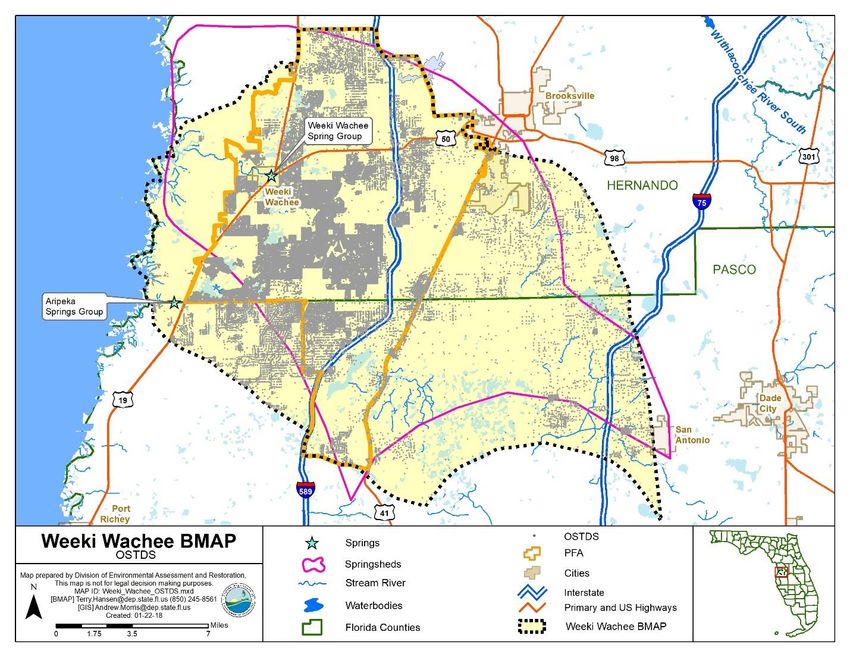
The Weeki Wachee Basin Management Action Plan (BMAP) area (Figure ES-1) consists of
200,474 acres located in southern Hernando County, including a portion of the City of
Brooksville, and northern Pasco County. The BMAP area contains the Weeki Wachee Spring
Group which is composed of a single, large main spring and numerous smaller springs spread
over an area of nearly five square miles. Weeki Wachee Spring is the primary source of the
Weeki Wachee River and the largest spring (by discharge) in the group. The BMAP area also
contains Magnolia-Aripeka Springs Group; Mud Spring, Salt Spring, Wilderness Spring
(collectively referred to as the "Wilderness-Mud-Salt Springs Group"); and Jenkins Creek Spring
which are located within the Weeki Wachee riverine system Outstanding Florida Water (OFW)
boundaries.
Weeki Wachee Priority Focus Area (PFA)
The PFA (see Appendix C) comprises 90,415 acres and includes a region in the western part of
the springshed for Weeki Wachee Spring. The PFA represents the area in the basin where the
aquifer is most vulnerable to inputs and where there are the most connections between
groundwater and the springs.
Page 10 of 87Weeki Wachee Basin Management Action Plan (BMAP), June 2018
Figure ES-1. Weeki Wachee BMAP and PFA boundaries
Nitrogen Source Identification, Required Reductions, and Options to Achieve
Reductions
DEP adopted nutrient total maximum daily loads (TMDLs) for Weeki Wachee Spring and Weeki
Wachee River in 2014. The TMDLs established monthly average nitrate targets of 0.28
milligrams per liter (mg/L) for Weeki Wachee Spring and 0.20 mg/L for Weeki Wachee River.
DEP adopted nitrate targets of 0.23 mg/L for Magnolia-Aripeka Springs Group; Wilderness-
Mud-Salt Springs Group; and Jenkins Creek Spring through adoption of TMDLs in 2016.
Onsite sewage treatment and disposal systems (OSTDS) represent 30 % of the nitrogen loading
to groundwater, agriculture (including farm fertilizer [FF] and livestock waste [LW]) 27 %, and
urban turfgrass fertilizer (UTF) 22 % of the total loading to groundwater based on the DEP
analysis conducted using the Nitrogen Source Inventory Loading Tool (NSILT).
The total load reduction required to meet the TMDLs at the vents is 195,200 pounds of nitrogen
per year (lb-N/yr). To measure progress towards achieving the necessary load reduction, DEP is
establishing the following milestones:
Page 11 of 87Weeki Wachee Basin Management Action Plan (BMAP), June 2018
Initial reduction of 58,560 lb-N/yr (30 %) within 5 years.
An additional 97,600 lb-N/yr (50 %) within 10 years.
The remaining 39,040 lb-N/yr (20 %) within 15 years.
For a total of 195,200 lb-N/yr within 20 years.
The policies and submitted projects included within this BMAP are estimated to achieve a
reduction of 396,220 to 552,102 lb-N/yr to groundwater. While reductions to groundwater will
benefit the spring, it is uncertain to know with precision how those reductions will impact the
necessary reductions at the spring. DEP will continue to monitor the spring to evaluate those
reductions as projects are implemented against the required load reductions above. The BMAP is
designed to achieve 80 % of the load reductions needed for the spring vent within 10 years of
adoption and 100 % within 15 years. Projects and strategies are designed to achieve nitrogen
reductions at Weeki Wachee, but are expected to provide benefits to all springs vents within the
springshed/contributing area. DEP will evaluate progress towards these milestones and will
report to the Governor and Florida Legislature. DEP will adjust management strategies to ensure
the target concentrations are achieved. This may include expanding the area to which the OSTDS
remediation policies apply; any such change, however, would be incorporated into an updated
BMAP through a formal adoption process.
For the list of projects to improve water quality, see Appendix B. Included are owner-
implemented best management practices (BMPs) for FF, LW, sports turfgrass fertilizer (STF);
wastewater treatment facility (WWTF) upgrades; projects to reduce UTF application; and
OSTDS conversions to sewer.
Successful BMAP implementation requires commitment, dedicated state funding, and follow-up.
Stakeholders have expressed their intention to carry out the plan, monitor its effects, and
continue to coordinate within and across jurisdictions to achieve nutrient reduction goals. As the
TMDLs must be achieved within 20 years, DEP, water management districts (WMDs), Florida
Department of Health (FDOH), and Florida Department of Agriculture and Consumer Services
(FDACS) will implement management strategies using the annual Legacy Florida appropriation
from the legislature of at least $50 million to reduce nitrogen in impaired OFS. DEP, working
with the coordinating agencies, will continue to invest existing funds and explore other
opportunities and potential funding sources for springs restoration efforts.
Restoration Approaches
Load reduction to the aquifer is needed to achieve the load reductions requirements at the spring
vent. To ensure that load reductions are achieved at the spring vent, the following restorations
actions are being established. These actions are designed to reduce the amount of nutrients to the
aquifer, which will reduce the load at the vent and ultimately achieve the necessary reductions.
Monitoring of the vent during implementation will be implemented to monitor progress.
Page 12 of 87Weeki Wachee Basin Management Action Plan (BMAP), June 2018
New OSTDS – Upon BMAP adoption, the OSTDS remediation plan prohibits
new systems on lots of less than 1 acre within the PFAs, unless the system
includes enhanced treatment of nitrogen as defined by the OSTDS remediation
plan, or unless the OSTDS permit applicant demonstrates that sewer connections
will be available within 5 years. Local governments and utilities are expected to
develop master wastewater treatment feasibility analyses within 5 years to
identify specific areas to be sewered or to have enhanced nitrogen reducing
OSTDS within 20 years of BMAP adoption. The OSTDS remediation plan is
incorporated as Appendix D.
Existing OSTDS – Upon completion of the master wastewater treatment
feasibility analyses, FDOH rulemaking, and funding program for homeowners
included in the OSTDS remediation plan, but no later than five years after BMAP
adoption, modification or repair permits issued by FDOH for all OSTDS within
the PFA on all lot sizes will require enhanced treatment of nitrogen, unless sewer
connections will be available based on a BMAP-listed project. All OSTDS subject
to the policy must include enhanced treatment of nitrogen no later than 20 years
after BMAP adoption.
WWTFs − The effluent standards listed in Table ES-1 will apply to all new and existing
WWTFs in the BMAP area (inside and outside the PFA).
Table ES-1. WWTF effluent standards
gpd = Gallons per day
Nitrogen Concentration Limits for Nitrogen Concentration Limits
95% of the Permitted Capacity Rapid Infiltration Basins (RIBs) and for All Other Land Disposal
(gpd) Absorption Fields (mg/L) Methods, Including Reuse (mg/L)
Greater than 100,000 3 3
20,000 to 100,000 3 6
Less than 20,000 6 6
UTF – UTF sources can receive up to 6 % credit for the DEP-approved suite of public
education and source control ordinances. Entities have the option to collect and provide
monitoring data to quantify reduction credits for additional measures.
STF – STF sources include golf courses and other sporting facilities. Golf
courses can receive up to 10 % credit for implementing the Golf Course BMP
Manual. Other sports fields can receive up to 6 % credit for managing their
fertilizer applications to minimize transport to groundwater.
FF – All FF sources are required to implement BMPs or perform monitoring to
demonstrate compliance with the TMDL. A 15 % reduction to groundwater is estimated
for owner-implemented BMPs. Additional credits could be achieved through better
documentation of reductions achieved through BMP implementation or implementation
Page 13 of 87Weeki Wachee Basin Management Action Plan (BMAP), June 2018
of additional agricultural projects or practices, such as precision irrigation, soil moisture
probes, controlled release fertilizer, and cover crops.
LW – All LW sources are required to implement BMPs or perform monitoring. A 10 %
reduction to groundwater is estimated for owner-implemented BMPs. Additional credits
could be achieved through additional projects and practices if data are available.
Page 14 of 87Weeki Wachee Basin Management Action Plan (BMAP), June 2018
Section 1: Background
1.1 Legislation
Chapter 373, Part VIII, Florida Statutes (F.S.), created the Florida Springs and Aquifer
Protection Act to provide for the protection and restoration of Outstanding Florida Springs
(OFS), which comprise 24 first magnitude springs, 6 additional named springs, and their
associated spring runs. The Florida Department of Environmental Protection (DEP) has assessed
water quality in each OFS, and has determined that 24 of the 30 OFS are impaired for the nitrate
form of nitrogen. The Weeki Wachee Spring Group is one of the impaired first magnitude OFS.
Development of the basin management action plan (BMAP) to meet the new requirements of the
Florida Springs and Aquifer Protection Act for the Weeki Wachee Basin was initiated in 2016.
1.2 Water Quality Standards and Total Maximum Daily Loads (TMDLs)
A TMDL represents the maximum amount of a given pollutant that a waterbody can assimilate
and still meet water quality criteria. The waters of the Weeki Wachee Spring Group, Magnolia-
Aripeka Springs Group, Wilderness-Mud-Salt Springs Group, and Jenkins Creek Spring that are
addressed in this BMAP are Class III waterbodies with a designated use of recreation,
propagation, and the maintenance of a healthy, well-balanced population of fish and wildlife.
These waters are impaired by nitrate nitrogen, which in excess has been demonstrated to
adversely affect flora or fauna through the excessive growth of algae. Excessive algal growth
results in ecological imbalances in springs and rivers and can produce human health problems,
foul beaches, inhibit navigation, and reduce the aesthetic value of the resources.
DEP adopted nutrient TMDLs for the Weeki Wachee Spring Group in 2014 (see Table 1). The
TMDLs established a target of an annual average of 0.28 milligrams per liter (mg/L) of nitrate
for Weeki Wachee Spring and 0.20 mg/L for Weeki Wachee River. The period of record for
water quality data for the TMDLs was January 2004 through December 2012. DEP adopted
nutrient TMDLs for the Magnolia-Aripeka Springs Group, Wilderness-Mud-Salt Springs Group,
and Jenkins Creek Spring in 2016 (see Table 1). The TMDLs established a target of an annual
average of 0.23 mg/L of nitrate. The period of record for the water quality data for the TMDLs
was January 2004 through December 2014.
Page 15 of 87Weeki Wachee Basin Management Action Plan (BMAP), June 2018
Table 1. Restoration targets for Weeki Wachee Spring Group, Magnolia-Aripeka Springs
Group, Wilderness-Mud-Salt Springs Group, and Jenkins Creek Spring
Waterbody
Identification
Waterbody or Spring (WBID) TMDL
Name Number Parameter (mg/L)
Weeki Wachee Spring 1382B Nitrate, annual average 0.28
Weeki Wachee River 1382F Nitrate, annual average 0.20
Magnolia-Aripeka
1391B Nitrate, annual average 0.23
Springs Group
Wilderness-Mud-Salt
1382G Nitrate, annual average 0.23
Springs Group
Jenkins Creek Spring 1389 Nitrate, annual average 0.23
1.3 BMAP Requirements
Section 403.067(7), F.S., provides DEP with the statutory authority for the BMAP Program. A
BMAP is a comprehensive set of strategies to achieve the required pollutant load reductions. In
addition to this authority, the Florida Springs and Aquifer Protection Act (Part VIII of Chapter
373, F.S.) describes additional requirements for the 30 Outstanding Florida Springs.
1.4 BMAP Area
The BMAP area (Figure 1) comprises 200,474 acres located in southern Hernando County,
including a portion of the City of Brooksville, and northern Pasco County. The BMAP area
contains the Weeki Wachee Spring Group which is composed of a single, large main spring and
numerous smaller springs spread over an area of nearly five square miles. Weeki Wachee Spring
is the primary source of the Weeki Wachee River and the largest spring (by discharge) in the
group. The BMAP area also contains Magnolia-Aripeka Springs Group; Mud Spring, Salt
Spring, Wilderness Spring (collectively referred to as the "Wilderness-Mud-Salt Springs
Group"); and Jenkins Creek Spring which are located within the Weeki Wachee riverine system
Outstanding Florida Water (OFW) boundaries.
This area includes the surface water basin as well as the groundwater contributing areas for the
springs (or springsheds). Springsheds for the OFS were delineated or reviewed by Southwest
Florida Water Management District (SWFWMD) with input from the Florida Geological Survey
(FGS). A springshed is the area of land that contributes water to a spring or group of springs,
mainly via groundwater flow.
1.5 Priority Focus Area (PFA)
In compliance with the Florida Springs and Aquifer Protection Act, this BMAP delineates a
PFA, defined as the area(s) of a basin where the Floridan aquifer is generally most vulnerable to
pollutant inputs and where there is a known connectivity between groundwater pathways and an
OFS. The PFA provides a guide for focusing restoration strategies where science suggests these
Page 16 of 87Weeki Wachee Basin Management Action Plan (BMAP), June 2018
efforts will most benefit the springs. The document describing the delineation process for the
PFA is on the DEP website. The link to the PFA document is provided in Appendix C.
1.5.1 Description
Nitrogen sources are more likely to influence groundwater quality under certain conditions. For
example, where soils are sandy and well drained, less nitrogen is converted to gas and released
into the atmosphere or taken up by plants, compared with other soil types. Therefore, local soil
types play a role in how much nitrogen travels from the land surface to groundwater in a specific
springshed. Also, the underlying geologic material influences the vulnerability of the underlying
aquifers and the rate of lateral movement within the Floridan aquifer toward the springs. These
conditions, and others, were considered in the delineation of the PFA (see Appendix C).
Following BMAP adoption, DEP will ensure that the Geographic Information System (GIS) files
associated with the PFA boundary are available to the public on the DEP Map Direct webpage.
Figure 1. Weeki Wachee BMAP, springshed, and PFA boundaries
Page 17 of 87Weeki Wachee Basin Management Action Plan (BMAP), June 2018
1.5.2 Additional Requirements
In accordance with Section 373.811, F.S., the following activities are prohibited in the PFA:
New domestic wastewater disposal facilities, including rapid infiltration basins (RIBs),
with permitted capacities of 100,000 gpd or more, except for those facilities that meet an
advanced wastewater treatment (AWT) standard of no more than 3 mg/L total nitrogen
(TN) on an annual permitted basis.
New onsite sewage treatment and disposal systems (OSTDS or septic systems; the
terms are used interchangeably throughout this document) on lots of less than one
acre inside the PFAs unless additional nitrogen treatment is provided, as specified in
the OSTDS remediation plan (see Appendix D for details).
New facilities for the disposal of hazardous waste.
The land application of Class A or Class B domestic wastewater biosolids not in
accordance with a DEP-approved nutrient management plan establishing the rate at
which all biosolids, soil amendments, and sources of nutrients at the land application site
can be applied to the land for crop production, while minimizing the amount of pollutants
and nutrients discharged to groundwater or waters of the state.
New agricultural operations that do not implement best management practices (BMPs),
measures necessary to achieve pollution reduction levels established by DEP, or
groundwater monitoring plans approved by a water management district (WMD), or
DEP.
1.5.2.1 Biosolids and Septage Application Practices
In the PFA, the aquifer contributing to the springs is highly vulnerable to contamination by
nitrogen sources and soils have a high to moderate tendency to leach applied nitrogen. DEP
previously documented elevated nitrate concentrations in groundwater beneath septage
application zones in spring areas. To assure that nitrogen losses to groundwater are minimized
from permitted application of biosolids and septage in the PFA, the following requirements apply
to newly-permitted application sites and existing application sites upon permit renewal.
All permitted biosolids application sites that are agricultural operations must be enrolled
in the Florida Department of Agriculture and Consumer Services (FDACS) BMP
Program or be within an agricultural operation enrolled in the FDACS BMP Program for
the applicable crop type. Implementation of applicable BMPs will be verified by FDACS
in accordance with Chapter 5M-1, Florida Administrative Code (F.A.C.). Permitted
biosolids application sites that are new agricultural operations must also comply with
Subsection 373.811(5), F.S. Biosolids application sites must be certified as viable
agricultural operations by an acknowledged agricultural professional such as an
agricultural consultant or agricultural extension agent. Effective nutrient management
Page 18 of 87Weeki Wachee Basin Management Action Plan (BMAP), June 2018
practices must be ongoing at the application zones in the permit. Plant uptake and
harvesting are vital components of the nutrient management plan to remove nitrogen and
prevent it from leaching to groundwater. If DEP determines that the site is not a viable
agricultural site implementing a nutrient management plan, corrective action will be
required.
Groundwater monitoring for nitrate is required for all biosolids and septage land
application sites in the PFA to assure compliance with nutrient management objectives in
this BMAP. However, groundwater monitoring is not required if the site nutrient
management plan limits biosolids application rates to TN with no adjustment for
available nitrogen normally allowed by subsections 62-640.500(5) and (6), F.A.C. (e.g.
for a recommended fertilizer rate of 160 pounds of nitrogen per acre, only 160 pounds of
TN per acre shall be applied). For septage application, groundwater monitoring is not
required if the site nutrient management plan limits application rates to 30,000 gallons
per acre for sites accepting mixtures of septage and grease (food establishment sludge) or
to 40,000 gallons per acre for sites accepting septage without grease. The permit renewal
application will include a trend analysis for nitrate in groundwater monitoring wells
during the previous permit cycle, and an evaluation of the potential for the facility to
cause or contribute to exceedance of the TMDL.
1.6 Other Scientific and Historical Information
In preparing this BMAP, DEP collected and evaluated credible scientific information on the
effect of nutrients, particularly forms of nitrogen, on springs and springs systems. Some of the
information collected is specific to the Weeki Wachee Basin, while other references provide
information on related knowledge for restoring springs, such as nitrogen-reducing technologies,
the treatment performance of OSTDS, and runoff following fertilizer applications.
1.7 Stakeholder Involvement
Stakeholder involvement is critical to develop, gain support for, and secure commitments in a
BMAP. The BMAP process engages stakeholders and promotes coordination and collaboration
to address the pollutant load reductions necessary to achieve the TMDLs. DEP invites
stakeholders to participate in the BMAP development process and encourages public
participation and consensus to the greatest practicable extent. Table A-1 identifies the
stakeholders who participated in the development of this BMAP.
During the development of the Weeki Wachee BMAP, DEP held a series of meetings involving
stakeholders and the general public. The purpose of these meetings was to consult with
stakeholders to gather information, evaluate the best available science, develop an OSTDS
remediation plan (including a public education plan), define management strategies and
milestones, and establish monitoring requirements. All of the meetings were open to the public
and noticed in the Florida Administrative Register (F.A.R.). Additionally, a public meeting on
the current draft BMAP was held on January 17, 2018, and was noticed in the F.A.R. and in local
newspapers.
Page 19 of 87Weeki Wachee Basin Management Action Plan (BMAP), June 2018
Upon BMAP adoption, DEP intends to facilitate annual meetings with stakeholders to review
progress towards achieving the TMDLs.
1.8 Description of BMPs Adopted by Rule
Table 2 identifies the adopted BMPs and BMP manuals relevant to this BMAP.
Table 2. BMPs and BMP manuals adopted by rule as of June 2017
F.A.C.
Agency Chapter Chapter Title
FDACS Office of Agricultural Water
5M-6 Florida Container Nursery BMP Guide
Policy (OAWP)
FDACS OAWP 5M-8 BMPs for Florida Vegetable and Agronomic Crops
FDACS OAWP 5M-9 BMPs for Florida Sod
FDACS OAWP 5M-11 BMPs for Florida Cow/Calf Operations
Conservation Plans for Specified Agricultural
FDACS OAWP 5M-12
Operations
BMPs for Florida Specialty Fruit and Nut Crop
FDACS OAWP 5M-13
Operations
FDACS OAWP 5M-14 BMPs for Florida Equine Operations
FDACS OAWP 5M-16 BMPs for Florida Citrus
FDACS OAWP 5M-17 BMPs for Florida Dairies
FDACS OAWP 5M-18 Florida Agriculture Wildlife BMPs
FDACS OAWP 5M-19 BMPs for Florida Poultry
FDACS Division of Agricultural
5E-1 Fertilizer
Environmental Services
FDACS Division of Aquaculture 5L-3 Aquaculture BMPs
FDACS Florida Forest Service 5I-6 BMPs for Silviculture
Florida Forestry Wildlife BMPs for State Imperiled
FDACS Florida Forest Service 5I-8
Species
Facilitating Agricultural Resource Management
SWFWMD 40D-26
Systems (FARMS) Program
DEP 62-330 Environmental Resource Permitting
Page 20 of 87Weeki Wachee Basin Management Action Plan (BMAP), June 2018
Section 2: Implementation to Achieve TMDLs
2.1 Allocation of Pollutant Loads
DEP collected and evaluated credible scientific information on the effect of nutrients,
particularly forms of nitrogen, on Weeki Wachee Spring.
2.1.1 Nutrients in the Springs and Spring Systems
DEP developed the Nitrogen Source Inventory Loading Tool (NSILT) to provide information on
the major sources of nitrogen in the groundwater contributing area and spring contributing area
for the OFS. In addition, this tool is used to estimate nitrogen loads to groundwater from these
sources in the spring contributing area. The NSILT is a GIS- and spreadsheet-based tool that
provides spatial estimates of the relative contribution of nitrogen from major nitrogen sources
and accounts for the transport pathways and processes affecting the various forms of nitrogen as
they move from the land surface through the soil and geologic strata.
The first major factor to be considered in estimating the loading to groundwater in the NSILT is
the attenuation of nitrogen as it moves from its source through the environment, before it reaches
the Upper Floridan aquifer (UFA). Biological and chemical processes that occur as part of the
nitrogen cycle, as well as hydrogeological processes, control the movement of nitrogen from the
land surface to groundwater. Many of these processes attenuate (impede or remove) the amount
of nitrogen transported to groundwater. An understanding of how water moves through the
subsurface and the processes that transform the different forms of nitrogen is essential for
estimating nitrogen loading to groundwater from various sources.
A second major factor to consider in estimating the loading to groundwater is the geological
features in the springshed and the related recharge rate to the aquifer. Water movement between
the shallow groundwater (surficial aquifer, where present) and the deeper aquifer (UFA) is
slowed by a low permeability layer of clay, silt, and fine sand that retards the vertical movement
of infiltrating water from the surface. The UFA occurs in limestone that can be prone to
dissolving and, over geologic time, the development of numerous karst features (sinkholes,
caves, and conduits). These features allow water from the land surface to move directly and
relatively rapidly into the aquifer and in some areas for groundwater in the aquifer to move
rapidly to the springs.
Potential recharge rates from the surface to the UFA are affected by variations in the geologic
materials and the presence of karst features. DEP estimated the recharge rate ranges and grouped
them into three rate categories, which were applied to the NSILT:
Low recharge (Less than 3 inches per year [in/yr]).
Medium recharge (3 to 10 in/yr).
High recharge (greater than 10 in/yr).
Page 21 of 87Weeki Wachee Basin Management Action Plan (BMAP), June 2018
In the NSILT, DEP applies different attenuation factors to different types of sources, so that
various biological, chemical, and hydrogeological effects can be estimated. The attenuation that
is applied means that the amount of nitrogen leaving a source (such as a livestock operation or a
just-fertilized yard), reduces the amount of nitrogen predicted to reach the aquifer. In the NSILT
estimates, the average attenuation rates range from 90 % (for atmospheric deposition) to 25 %
(for wastewater disposal in a RIB). This means that, for these examples, only 10 % of nitrogen
from atmospheric deposition is expected to reach the aquifer, while 75 % of nitrogen from a RIB
is expected to reach groundwater, because the remainder is attenuated by various chemical and
biological processes.
Phosphorus is naturally abundant in the geologic material underlying much of Florida and is
often present in high concentrations in surface water and groundwater. Monitoring and
evaluation of phosphorus and influences on the springs continues as the nitrate TMDLs are
implemented.
2.1.2 Estimated Nitrogen Loads
Table 3 lists the estimated nitrogen loads to groundwater by source. Note that urban stormwater
loads are included in urban turfgrass fertilizer (UTF) estimates, while agricultural stormwater
loads are included in farm fertilizer (FF) and livestock waste (LW) estimates. Nitrogen loading
to surface water will be reduced through the activities and strategies for the sources identified in
this chapter for groundwater loading.
Table 3. Estimated nitrogen load to groundwater by source in the BMAP area
Total Nitrogen
Load to
Groundwater
in Pounds of
Nitrogen Per Year %
Nitrogen Source (lb-N/yr) Contribution
OSTDS 282,875 30
UTF 209,833 22
Atmospheric Deposition 93,208 10
FF 163,935 17
Sports Turfgrass Fertilizer (STF) 53,841 6
LW 91,347 10
Wastewater Treatment Facility
45,105 5
WWTF
Total 940,144 100
2.1.3 Assumptions and Considerations
The NSILT estimates are based on the following assumptions and considerations:
Page 22 of 87Weeki Wachee Basin Management Action Plan (BMAP), June 2018
NSILT Nitrogen Inputs – The methods used to calculate nitrogen inputs for each
pollutant source were based on a detailed synthesis of information, including
direct water quality measurements, census data, surveys, WWTF permits,
published scientific studies and reports, and information obtained in meetings
with agricultural producers. For some pollutant source categories, the nitrogen
inputs were calculated using assumptions and extrapolations. As a result, these
estimated inputs could be subject to further refinement if more detailed
information becomes available.
OSTDS Load Contribution – A per capita contribution to an OSTDS of 9.012
lb-N/year was used to calculate loading from OSTDS. The average household
contribution was estimated based on 2010 U.S. Census Bureau data on average
number of people per household by county (2.41 in Hernando County and 2.45 in
Pasco County) and additional information on the time spent away from home by
the school-age population and labor force (adjusted effective persons per
household of 2.08 for Hernando County and 2.07 for Pasco County).
Nitrogen Attenuation Factors – To estimate the amount of nitrogen loading to
the aquifer, DEP applied two nitrogen attenuation factors. Biological and
chemical processes that occur as part of the nitrogen cycle, as well as
hydrogeological processes that control the movement of nitrogen from the land
surface to groundwater. Biochemical attenuation accounts for biochemical
processes that convert or transform the different forms of nitrogen, while
hydrogeological attenuation accounts for spatial variations that affect the rate of
water infiltrating through geological media to recharge the UFA. Given the
relatively large range of literature-reported values of biochemical nitrogen
attenuation for each source category, DEP used an average biochemical
attenuation factor for each source based on land use practices and hydrogeological
conditions in the contributing areas.
Other assumptions and considerations for BMAP implementation include the following:
Unquantified Project Benefits – Nitrogen reductions for some of the projects
and activities listed in this BMAP cannot currently be quantified. However,
because of their positive impact, it is assumed that these actions will help reduce
pollutant loads and estimated loading reductions may be determined at a later date
and assigned to these activities.
Atmospheric Deposition – Atmospheric sources of nitrogen are local, national,
and international. Atmospheric sources are generally of low nitrogen
concentration compared with other sources and are further diminished through
additional biological and chemical processes before they reach groundwater.
Atmospheric deposition sources and trends will be reevaluated periodically.
Page 23 of 87Weeki Wachee Basin Management Action Plan (BMAP), June 2018
OSTDS Inventory and Loading Calculations – The total number of OSTDS in
the basin is estimated based on local information and Florida Department of
Health (FDOH) data. Future BMAPs and the associated OSTDS loading
calculations may be adjusted based on improved data on the number, location, and
type (conventional and enhanced nitrogen reducing) of existing septic systems,
and may include additional OSTDS installed since BMAP adoption.
PFA – The PFA provides a guide for focusing strategies where science suggests
efforts will best benefit the springs. The PFA boundary may be adjusted in the
future if additional relevant information becomes available.
Project Collection Period – The BMAP project collection period is limited to
projects after a certain date, based on the data used to calculate the reductions
needed. Reductions from older projects are already accounted for in the baseline
loading. Projects completed in the springshed after January 1, 2013, were
considered for inclusion in this BMAP.
Legacy Sources – Land uses or management practices not currently active in the
basin may still be affecting the nitrate concentration of the springs. The
movement of water from the land surface through the soil column to the UFA and
through the UFA to the spring system varies both spatially and temporally and is
influenced by local soil and aquifer conditions. As a result, there may be a lag
between when nitrogen input to the UFA occurs and ultimately when that load
arrives at the Weeki Wachee Spring Group. The impact of this delay is not fully
known.
Implementation Schedule – BMAP implementation is intended to be a 20-year
process. This plan defines nitrogen reduction milestones for 5-year (30 %), 10-
year (50 %), and 15-year (20 %) implementation, so that the TMDLs will be met
no later than the 20-year goal (see Section 2.1.6 for further details). Further, the
total reductions and the project credits may be adjusted under the adaptive
management approach used for the BMAP. This approach requires regular
follow-up to ensure that management strategies are carried out and that their
incremental effects are assessed. The process acknowledges that there is some
uncertainty associated with the outcomes of proposed management strategies and
the estimated response in nitrogen concentration at the springs. As more
information is gathered and progress towards each 5-year milestone is reviewed,
additional management strategies to achieve the TMDLs will be developed or
existing strategies refined to better address the sources of nitrogen loading.
Changes in Spring Flows – The role of this BMAP is specifically to promote the
implementation of projects that reduce nitrogen load to groundwater while the
minimum flows and levels (MFLs) established for specific springs address water
Page 24 of 87Weeki Wachee Basin Management Action Plan (BMAP), June 2018
flows and levels. To maximize efforts between the two programs, spring
protection projects should provide both water quality and quantity benefits.
2.1.4 Loading by Source
Based on the NSILT results, the pie chart in Figure 2 depicts the estimated percentage of
nitrogen loading to groundwater by source in the springshed. Septic systems represent 30 % of
the total nitrogen loading to groundwater, agriculture 27 %, and UTF 22 % of the total loading.
Stormwater loading to groundwater is incorporated into the various source categories.
Figure 2. Loading to groundwater by source in the Weeki Wachee Springshed
2.1.5 Loading Allocation
The nitrogen source reductions are based on the measured nitrate concentrations and flows at the
vent, along with the TMDL target nitrate concentration. Table 4 lists the measured nitrate (as
nitrogen) loads at the spring vents compared with the TMDL loading based on a target nitrate
concentration of 0.28 mg/L. The difference between the spring vent loading and the TMDL
loading calculations is the required reduction to meet the TMDLs. The total load that is required
Page 25 of 87Weeki Wachee Basin Management Action Plan (BMAP), June 2018
to be reduced in the basin is being allocated to the entire basin and actions defined by the BMAP
to reduce loading to the aquifer are needed to implement this allocated load.
Table 4. Total reduction required to meet the TMDLs
Nitrogen Loads
Description (lb-N/yr) Notes Regarding Data Used
Upper 95% confidence interval - nitrate data and
Total Load at Spring
289,000 flow data from 2000 to 2017 (170 cubic feet per
Vents
second [cfs])
TMDL target is 0.28 mg/L and using the same flow
TMDL Load 93,800
data from 2000 to 2017
Required Reduction 195,200
2.1.6 Description of 5-, 10-, and 15-year Milestones/Reduction Schedule
The overall load reduction targets are 30 % of the total within 5 years; 80 % of the total within
10 years; and 100 % of the total within 15 years. DEP will evaluate progress towards these
milestones and will report to the Governor and Florida Legislature. DEP will adjust management
strategies that reduce loading to the aquifer to ensure the target concentrations are achieved. This
may include expanding the area to which the OSTDS remediation policies apply; any such
change, however, would be incorporated into an updated BMAP through a formal adoption
process.
Table 5 lists the estimated nitrogen reduction schedule by milestone. Progress will be tracked
yearly and adjustments made as needed. At the five-year milestone, progress will be assessed and
load reductions adjusted as necessary. Entities have flexibility in the types and locations of
projects as long as they achieve the overall required load reductions. The monitoring of existing
groundwater and springs sampling locations is essential. Section 2.3 describes detailed source
reduction strategies.
Table 5. Nitrogen reduction schedule (lb-N/yr)
10-Year 15-Year Total Nitrogen
5-Year Milestone Milestone Milestone Reduction
(30 % of Total) (50 % of Total) (20 % of Total) (100 %)
58,560 97,600 39,040 195,200
2.2 Prioritization of Management Strategies
The management strategies listed in Appendix B, Appendix E, and Appendix F are ranked with
a priority of high, medium, or low. In 2016, the Florida Legislature amended the Watershed
Restoration Act (Section 403.067, F.S.), creating additional requirements for all new or revised
BMAPs. BMAPs must now include planning-level details for each listed project, along with their
priority ranking.
Project status was selected as the most appropriate indicator of a project’s priority ranking.
Projects with a "completed" status were assigned a low priority. Projects classified as
Page 26 of 87Weeki Wachee Basin Management Action Plan (BMAP), June 2018
"underway" were assigned a medium priority because some resources have been allocated to
these projects, but some work still needs to be completed. High priority was assigned to projects
listed as "planned" as well as certain "completed" projects that are ongoing each year (any
project with one of these project types: "street sweeping," "catch basin inserts/inlet filter
cleanout," "public education efforts," "fertilizer cessation," "fertilizer reduction," or "aquatic
vegetation harvesting"), and select projects that are elevated because substantial, subsequent
project(s) are reliant on their completion.
2.3 Load Reduction Strategy
A precise total load reduction to groundwater needed to meet the TMDL is unknown and
dependent on a number of complex factors. Ultimately there must be a reduction at the spring
vent of at least 195,200 lb-N/yr. Based on the totals of all the credits from BMAP actions and
policies, the range of total reductions to groundwater is between 396,220 - 552,102 lb-N/yr (see
Table 6). However, due to the proximity of these reductions to the spring and the uncertainties of
fate and transport in the karst geology, additional actions may be necessary to ensure that the
loading at the vent is achieved within the timeline of the BMAP.
To achieve reductions outside the scope of the policies listed, additional project options are
available to local entities but have not been planned. Other efforts could be pursued to further
reduce the nitrogen load to groundwater in the basin.
Page 27 of 87Weeki Wachee Basin Management Action Plan (BMAP), June 2018
Table 6. Summary of potential credits for the Weeki Wachee BMAP to meet the TMDLs
Note: No reductions are estimated for atmospheric deposition sources
Credits to Load to
Groundwater
Nitrogen Source (lb-N/yr) Description
Credits are based on lots of all sizes inside the PFA being
remediated by either enhancing onsite system or connecting to
sewer. An estimated 27,538 lb-N/yr have been provided as
OSTDS 195,668 - 285,977
OSTDS remediation projects which may be on these lots or in the
larger BMAP area. Any projects outside the PFA would add
additional reductions to the estimates listed.
DEP approved credits (6%) for public education activities as well
UTF 12,590
as credits identified for stakeholder stormwater projects.
6% BMP credit for sports fields and 10% BMP credit for golf
STF 5,342 courses on STF load to groundwater, assuming 100% BMP
implementation on golf courses and sports fields.
15% BMP credit on FF load to groundwater, assuming 100%
FF 24,590
owner-implemented and verified BMPs on all fertilized lands.
10% BMP credit on LW load to groundwater, assuming 100%
LW 9,135
owner-implemented and verified BMPs at all livestock facilities.
Achieved by BMAP WWTF policy if BMAP-wide (achieving 3
WWTF 33,058
or 6 mg/L).
WWTF - Hernando County Spring Hill WRF Decommissioning Project
46,171
Decommission (Project HC-20).
WWTF – Biological
53,272 Pasco County Crews Lake Restoration Project (Project PC-02).
Application
Total Credits from
BMAP Policies and 379,826 - 470,134
Submitted Projects
Advanced
Agricultural Includes 10%-50% reduction from 100% of fertilized acres with
16,394 – 81,968
Practices and a change in practice
Procedures
Load reduction to meet TMDL at the spring vent is 195,200
Total Credits 396,220 – 552,102
lb-N/yr.
2.4 OSTDS Management Strategies
Overall there are currently around 35,000 OSTDS in the PFA, based on FDOH estimates. This
BMAP lists 5 specific projects (Appendix B) that reduce nitrogen loading from existing OSTDS
on variably sized parcels by a total of 27,538 lb-N/yr. Figure 3 shows the locations of all
OSTDS in the BMAP area.
In addition to the 5 listed projects, DEP assessed the overall OSTDS loading compared with
other nitrogen sources in the PFA, as well as the relative loading in the wider BMAP area. Based
on these assessments, DEP has determined that for the Weeki Wachee BMAP area, OSTDS
contribute more than 20 % of nonpoint source nitrogen pollution to the OFS. Per the Weeki
Wachee NSILT, septic systems contribute 30 % pollutant loading in the springshed area and
approximately 44 % of the nitrogen loading in the PFA. Cumulatively, nitrogen loading from
Page 28 of 87You can also read


